Journal of Peking University (Health Sciences) ›› 2025, Vol. 57 ›› Issue (3): 423-429. doi: 10.19723/j.issn.1671-167X.2025.03.003

Previous Articles     Next Articles

Spousal correlations of blood lipid based on a family design

Yixin LI1, Huangda GUO1, Hexiang PENG1, Tianjiao HOU1, Hanyu ZHANG1, Yinxi TAN2, Yi ZHENG2, Mengying WANG2,3, Yiqun WU1,3, Xueying QIN1,3, Jin LI1,3, Ying YE4, Tao WU1,3,*(), Dafang CHEN1,3, Yonghua HU1,3, Liming LI1,3   

  1. 1. Department of Epidemiology and Biostatistics, Peking University School of Public Health, Beijing 100191, China
    2. Department of Nutrition and Food Hygiene, Peking University School of Public Health, Beijing 100191, China
    3. Key Laboratory of Epidemiology of Major Diseases, Ministry of Education, Beijing 100191, China
    4. Department of Endemic Disease Control, Fujian Provincial Center for Disease Control and Prevention, Fuzhou 350003, China
  • Received:2025-02-08 Online:2025-06-18 Published:2025-06-13
  • Contact: Tao WU
  • Supported by:
    the National Natural Science Foundation of China(82204135); the National Natural Science Foundation of China(82473716); the Beijing Natural Science Foundation(7232237); the Natural Science Foundation of Fujian Province(2021J01352); the Fujian Provincial Health Technology Project(2024CXA030)

RICH HTML


Abstract:

Objective: To explore the spousal correlations of total cholesterol (TC), total triglyceride (TG), low-density lipoprotein cholesterol (LDL-C), and high-density lipoprotein cholesterol (HDL-C), and to investigate the reasons behind these spousal correlations. Methods: Participants and data were from the baseline survey of family-based cohort studies in Fangshan, Beijing and Tulou, Fujian. The origin of spousal correlations were explored from perspectives of convergence, assortative mating, social homogamy. Pearson ' s correlation and generalized linear models (GLM) were used to estimate the spousal correlation. Convergence was assessed by Pearson ' s correlation between the phenotypic differences between couples and the duration of marriage, with GLM used for further validation. Pearson ' s correlation of genetic risk scores (GRS) and couple-specific Mendelian randomization (MR) were calculated to assess the genetic correlation and possible causal relationships between spouses. Two-independent-sample t-tests were used to compare GRS consistency across subgroups divided by education attainment, couple-specific MR and Q statistics used to test assortative mating in subgroups and intergroup differences. Results: In the study, 342 couples (287 couples from Fangshan and 55 couples from Fujian) were included, with the average age of (64.91±8.76) years. Spousal correlations of TC, TG, HDL-C, and LDL-C showed statistically significant associations both before and after adjusting for covariates, with effect sizes of 0.229 (95%CI: 0.125-0.327), 0.257 (95%CI: 0.155-0.354), 0.179 (95%CI: 0.074-0.280), and 0.181 (95%CI: 0.076-0.282). For convergence, for each additional year of marriage, ΔTC increased by 0.016 mmol/L (95%CI: 0.001-0.033 mmol/L), and ΔLDL-C increased by 0.017 mmol/L (95%CI: 0.002-0.031 mmol/L). For assortative mating, GRS correlations and results of couple specific MR didn ' t show any statistical significance. For social homogamy, no differences in GRS or assortative mating were found between subgroups stratified by education attainment. Conclusion: The blood lipid in participants exhibit spousal phenotypic correlations, however, no effects of convergence, assortative mating or social homogamy were observed. More independent studies with larger sample sizes are warranted to further validate these findings in the future.

Key words: Family-based study, Spousal concordance, Assortative mating, Social homogamy, Convergence

CLC Number: 

  • R181.2

Figure 1

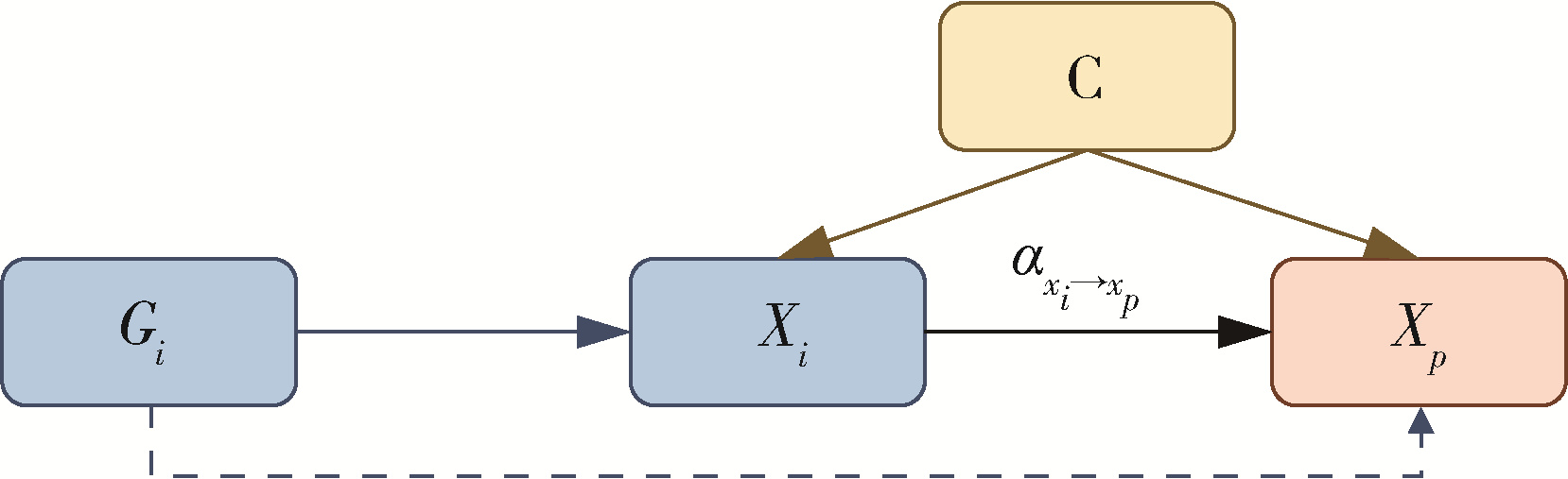
Couple-specific Mendelian randomization framework Xi, index ' s phenotype; Xp, partner ' s phenotype; Gi, index ' s genotype; C, confunders; αxi→xp, causal effect among couples with single trait X."

Table 1

Baseline characteristics of participants by sex"

Items All (n=684) Male (n=342) Female (n=342) P
Age/years, ${\bar x}$±s 64.91±8.76 65.67±9.32 64.15±8.10 0.025
BMI/(kg/m2), ${\bar x}$±s 25.145±3.632 24.512±3.345 25.778±3.799 < 0.001
TC/(mmol/L), ${\bar x}$±s 3.652±1.179 3.562±1.105 3.741±1.244 0.047
TG/(mmol/L), ${\bar x}$±s 1.663±1.131 1.527±1.017 1.799±1.221 0.002
LDL-C/(mmol/L), ${\bar x}$±s 2.696±0.836 2.599±0.821 2.794±0.841 0.002
HDL-C/(mmol/L), ${\bar x}$±s 1.211±2.970 1.089±0.370 1.333±4.183 0.282
Hypertension, n (%) 478 (74.687) 243 (75.938) 235 (73.438) 0.520
Type 2 diabetes, n (%) 158 (24.765) 76 (23.824) 82 (25.705) 0.650
Hyperlipidemia, n (%) 226 (41.016) 109 (38.380) 117 (43.820) 0.230
Smoke status, n (%) < 0.001
  Never 368 (54.357) 91 (26.844) 277 (81.953)
  Current or former 309 (45.643) 248 (73.156) 61 (18.047)
Drinking status, n (%) < 0.001
  Never 499 (73.817) 174 (51.479) 325 (96.154)
  Current or former 177 (26.183) 164 (48.521) 13 (3.846)
Education, n (%) < 0.001
  Below primary school 153 (22.600) 53 (15.680) 100 (29.499)
  Primary school 239 (35.303) 104 (30.769) 135 (39.823)
  Junior high school 228 (33.678) 141 (41.716) 87 (25.664)
  High school 53 (7.829) 37 (10.947) 16 (4.720)
  Junior college or above 4 (0.591) 3 (0.888) 1 (0.295)

Figure 2

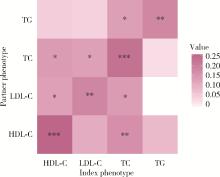
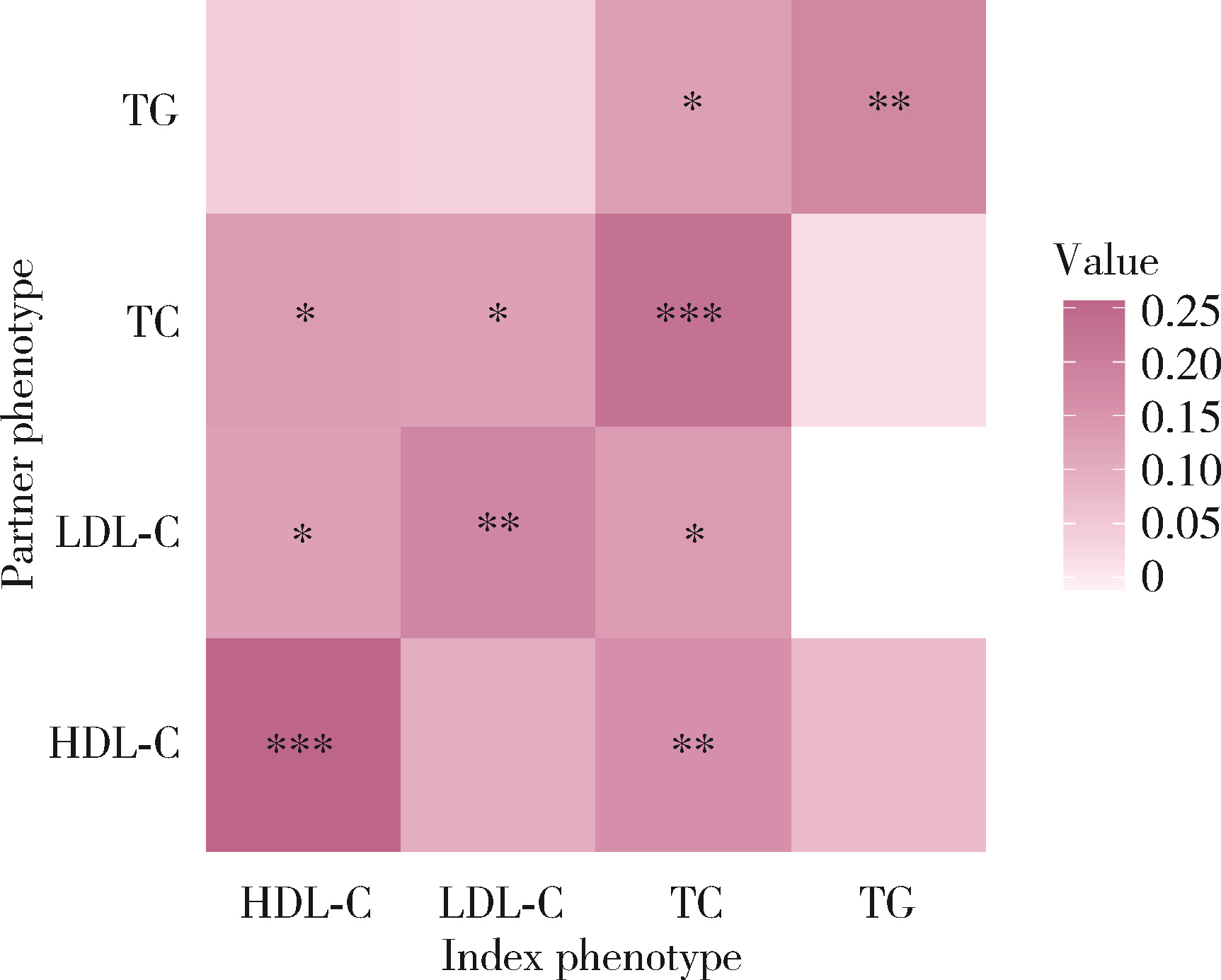
Correlation of lipid phenotypes between spouses * P < 0.05, * * P < 0.01, * * * P < 0.001. TC, total cholesterol; TG, triglycerides; LDL-C, low-density lipoprotein cholesterol; HDL-C, high-density lipoprotein cholesterol; Index phenotype, phenotype of an individual; Partner phenotype, phenotype of index ' s partner."

Table 2

Results of phenotype association analysis between spouses"

Items All (n=684) Fangshan (n=574) Fujian (n=110)
r (95%CI) P r (95%CI) P r (95%CI) P
TC 0.183 (0.101, 0.265) < 0.001 0.182 (0.090, 0.274) < 0.001 0.186 (-0.002, 0.374) 0.007
TG 0.203 (0.121, 0.285) < 0.001 0.191 (0.099, 0.283) < 0.001 0.259 (0.073, 0.445) 0.672
HDL-C 0.241 (0.159, 0.323) < 0.001 0.189 (0.095, 0.283) < 0.001 0.421 (0.247, 0.595) 0.055
LDL-C 0.168 (0.088, 0.248) < 0.001 0.209 (0.119, 0.299) < 0.001 -0.015 (-0.207, 0.177) < 0.001

Table 3

Correlation of length of relationship and phenotype difference between spouses"

Items All (n=684) Male≥Female* Female≥Male#
r (95%CI) P n r (95%CI) P n r (95%CI) P
ΔTG 0.021 (-0.088, 0.129) 0.706 170 0.016 (-0.138, 0.170) 0.836 179 0.063 (-0.089, 0.212) 0.419
ΔTC 0.086 (-0.023, 0.193) 0.121 139 0.056 (-0.114, 0.224) 0.519 209 0.134 (-0.005, 0.268) 0.058
ΔHDL-C 0.095 (-0.014, 0.202) 0.086 139 0.070 (-0.101, 0.238) 0.422 209 0.125 (-0.014, 0.260) 0.079
ΔLDL-C 0.043 (-0.066, 0.151) 0.443 171 -0.036 (-0.190, 0.120) 0.653 181 0.121 (-0.027, 0.264) 0.109

Table 4

Generalized linear model association analysis between length of relationship and phenotype difference"

Items All (n=684) Male≥Female* Female≥Male#
β (95%CI) P n β (95%CI) P n β (95%CI) P
ΔTG -0.008 (-0.030, 0.014) 0.461 170 -0.010 (-0.045, 0.025) 0.590 179 -0.012 (-0.039, 0.015) 0.393
ΔTC 0.021 (-0.001, 0.043) 0.048 139 0.021 (-0.012, 0.054) 0.232 209 0.023 (-0.004, 0.050) 0.112
ΔHDL-C 0.013 (-0.007, 0.033) 0.181 139 0.015 (-0.010, 0.040) 0.260 209 0.017 (-0.012, 0.046) 0.251
ΔLDL-C 0.025 (0.003, 0.047) 0.025 171 0.043 (0.008, 0.078) 0.022 181 0.014 (-0.013, 0.041) 0.323

Table 5

Results of couple-specific Mendelian randomization"

Items Male to female (n=123) Female to male (n=123) All (n=246)
α(95%CI) P α(95%CI) P α(95%CI) P
TG -0.684 (-1.757, 0.388) 0.211 -0.498 (-1.592, 0.596) 0.373 -0.578 (-1.297, 0.141) 0.115
TC 0.626 (-1.476, 2.728) 0.559 1.681 (-0.228, 3.589) 0.084 1.146 (-0.388, 2.681) 0.143
HDL-C -0.206 (-1.128, 0.716) 0.662 0.337 (-0.500, 1.174) 0.430 0.087 (-0.539, 0.713) 0.785
LDL-C 0.592 (-0.316, 1.500) 0.202 -0.294 (-1.460, 0.873) 0.622 0.021 (-0.760, 0.802) 0.958
1
Rotter JI , Rimoin DL . Peptic ulcer disease: A heterogeneous group of disorders?[J]. Gastroenterology, 1977, 73 (3): 604- 607.

doi: 10.1016/S0016-5085(19)32149-3
2
Kunkle BW , Grenier-Boley B , Sims R , et al. Genetic meta-analysis of diagnosed Alzheimer ' s disease identifies new risk loci and implicates Aβ, tau, immunity and lipid processing[J]. Nat Genet, 2019, 51 (3): 414- 430.

doi: 10.1038/s41588-019-0358-2
3
O'sullivan JW , Raghavan S , Marquez-Luna C , et al. Polygenic risk scores for cardiovascular disease: A scientific statement from the American Heart Association[J]. Circulation, 2022, 146 (8): e93- e118.
4
Cole JB , Florez JC . Genetics of diabetes mellitus and diabetes complications[J]. Nat Rev Nephrol, 2020, 16 (7): 377- 390.

doi: 10.1038/s41581-020-0278-5
5
Domingue BW , Fletcher J , Conley D , et al. Genetic and educational assortative mating among US adults[J]. Proc Natl Acad Sci USA, 2014, 111 (22): 7996- 8000.

doi: 10.1073/pnas.1321426111
6
Watson D , Klohnen EC , Casillas A , et al. Match makers and deal breakers: Analyses of assortative mating in newlywed couples[J]. J Pers, 2004, 72 (5): 1029- 1068.

doi: 10.1111/j.0022-3506.2004.00289.x
7
Hu A , Qian Z . Educational homogamy and earnings inequality of married couples: Urban China, 1988-2007[J]. Res Soc Strat Mobil, 2015, 40, 1- 15.
8
Willoughby EA , Giannelis A , Ludeke S , et al. Parent contributions to the development of political attitudes in adoptive and biological families[J]. Psychol Sci, 2021, 32 (12): 2023- 2034.

doi: 10.1177/09567976211021844
9
Kandler C , Bleidorn W , Riemann R . Left or right? Sources of political orientation: The roles of genetic factors, cultural transmission, assortative mating, and personality[J]. J Pers Soc Psychol, 2012, 102 (3): 633- 645.

doi: 10.1037/a0025560
10
Silventoinen K , Kaprio J , Lahelma E , et al. Assortative mating by body height and BMI: Finnish twins and their spouses[J]. Am J Hum Biol, 2003, 15 (5): 620- 627.

doi: 10.1002/ajhb.10183
11
Maes HH , Neale MC , Eaves LJ . Genetic and environmental factors in relative body weight and human adiposity[J]. Behav Genet, 1997, 27 (4): 325- 351.

doi: 10.1023/A:1025635913927
12
Agrawal A , Heath AC , Grant JD , et al. Assortative mating for cigarette smoking and for alcohol consumption in female Australian twins and their spouses[J]. Behav Genet, 2006, 36 (4): 553- 566.

doi: 10.1007/s10519-006-9081-8
13
Howe LJ , Lawson DJ , Davies NM , et al. Genetic evidence for assortative mating on alcohol consumption in the UK Biobank[J]. Nat Commun, 2019, 10 (1): 5039.

doi: 10.1038/s41467-019-12424-x
14
Reynolds CA , Barlow T , Pedersen NL . Alcohol, tobacco and caffeine use: Spouse similarity processes[J]. Behav Genet, 2006, 36 (2): 201- 215.

doi: 10.1007/s10519-005-9026-7
15
Hippisley-Cox J , Coupland C , Pringle M , et al. Married couples' risk of same disease: Cross sectional study[J]. BMJ, 2002, 325 (7365): 636.

doi: 10.1136/bmj.325.7365.636
16
Rawlik K , Canela-Xandri O , Tenesa A . Indirect assortative mating for human disease and longevity[J]. Heredity (Edinb), 2019, 123 (2): 106- 116.

doi: 10.1038/s41437-019-0185-3
17
Versluys TMM , Flintham EO , Mas-Sandoval A , et al. Why do we pick similar mates, or do we?[J]. Biol Lett, 2021, 17 (11): 20210463.

doi: 10.1098/rsbl.2021.0463
18
Sjaarda J , Kutalik Z . Partner choice, confounding and trait convergence all contribute to phenotypic partner similarity[J]. Nat Hum Behav, 2023, 7 (5): 776- 789.

doi: 10.1038/s41562-022-01500-w
19
Retnakaran R , Wen SW , Tan H , et al. Spousal concordance of cardiovascular risk factors in newly married couples in China[J]. JAMA Netw Open, 2021, 4 (12): e2140578.

doi: 10.1001/jamanetworkopen.2021.40578
20
Wang M , Wang S , Wang X , et al. Carotid intima-media thickness, genetic risk, and ischemic stroke: A family-based study in rural China[J]. Int J Environ Res Public Health, 2020, 18 (1): 119.

doi: 10.3390/ijerph18010119
21
黄辉, 叶莺, 黄春兰, 等. 福建土楼家系队列研究: 研究方法及调查对象基线和家系特征[J]. 中华流行病学杂志, 2018, 39 (10): 1402- 1407.
22
Xiao H , Ma Y , Zhou Z , et al. Disease patterns of coronary heart disease and type 2 diabetes harbored distinct and shared genetic architecture[J]. Cardiovasc Diabetol, 2022, 21 (1): 276.

doi: 10.1186/s12933-022-01715-1
23
Choi SW , Mak TSH , O'reilly PF . Tutorial: A guide to performing polygenic risk score analyses[J]. Nature Protocols, 2020, 15 (9): 2759- 2772.

doi: 10.1038/s41596-020-0353-1
24
Richmond RC , Howe LJ , Heilbron K , et al. Correlations in sleeping patterns and circadian preference between spouses[J]. Commun Biol, 2023, 6 (1): 1156.

doi: 10.1038/s42003-023-05521-7
25
Kim HC , Kang DR , Choi KS , et al. Spousal concordance of metabolic syndrome in 3141 Korean couples: A nationwide survey[J]. Ann Epidemiol, 2006, 16 (4): 292- 298.

doi: 10.1016/j.annepidem.2005.07.052
26
Shiffman D , Louie JZ , Devlin JJ , et al. Concordance of cardiovascular risk factors and behaviors in a multiethnic US nationwide cohort of married couples and domestic partners[J]. JAMA Netw Open, 2020, 3 (10): e2022119.

doi: 10.1001/jamanetworkopen.2020.22119
27
Li J , Liu M , Liu F , et al. Age and genetic risk score and rates of blood lipid changes in China[J]. JAMA Netw Open, 2023, 6 (3): e235565.

doi: 10.1001/jamanetworkopen.2023.5565
28
Yamamoto K , Sonehara K , Namba S , et al. Genetic footprints of assortative mating in the Japanese population[J]. Nat Hum Behav, 2023, 7 (1): 65- 73.
29
Yengo L , Robinson MR , Keller MC , et al. Imprint of assortative mating on the human genome[J]. Nat Hum Behav, 2018, 2 (12): 948- 954.

doi: 10.1038/s41562-018-0476-3
30
Gonggrijp BMA , Silventoinen K , Dolan CV , et al. The mechanism of assortative mating for educational attainment: A study of Finnish and Dutch twins and their spouses[J]. Front Genet, 2023, 14, 1150697.

doi: 10.3389/fgene.2023.1150697
31
Bennett-Britton I , Teyhan A , Macleod J , et al. Changes in marital quality over 6 years and its association with cardiovascular disease risk factors in men: findings from the ALSPAC prospective cohort study[J]. J Epidemiol Community Health, 2017, 71 (11): 1094- 1100.

doi: 10.1136/jech-2017-209178
[1] Huangda GUO,Hexiang PENG,Siyue WANG,Tianjiao HOU,Yixin LI,Hanyu ZHANG,Mengying WANG,Yiqun WU,Xueying QIN,Xun TANG,Jing LI,Dafang CHEN,Yonghua HU,Tao WU. A ssociations of short-term ambient particulate matter exposure and MTNR1B gene with triglyceride-glucose index: A family-based study [J]. Journal of Peking University (Health Sciences), 2024, 56(3): 375-383.
Viewed
Full text


Abstract

Cited

  Shared   
  Discussed   
No Suggested Reading articles found!