Spousal correlations of blood lipid based on a family design

  • Yixin LI 1 ,
  • Huangda GUO 1 ,
  • Hexiang PENG 1 ,
  • Tianjiao HOU 1 ,
  • Hanyu ZHANG 1 ,
  • Yinxi TAN 2 ,
  • Yi ZHENG 2 ,
  • Mengying WANG 2, 3 ,
  • Yiqun WU 1, 3 ,
  • Xueying QIN 1, 3 ,
  • Jin LI 1, 3 ,
  • Ying YE 4 ,
  • Tao WU , 1, 3, * ,
  • Dafang CHEN 1, 3 ,
  • Yonghua HU 1, 3 ,
  • Liming LI 1, 3
Expand
  • 1. Department of Epidemiology and Biostatistics, Peking University School of Public Health, Beijing 100191, China
  • 2. Department of Nutrition and Food Hygiene, Peking University School of Public Health, Beijing 100191, China
  • 3. Key Laboratory of Epidemiology of Major Diseases, Ministry of Education, Beijing 100191, China
  • 4. Department of Endemic Disease Control, Fujian Provincial Center for Disease Control and Prevention, Fuzhou 350003, China
WU Tao, e-mail,

Received date: 2025-02-08

  Online published: 2025-06-13

Supported by

the National Natural Science Foundation of China(82204135)

the National Natural Science Foundation of China(82473716)

the Beijing Natural Science Foundation(7232237)

the Natural Science Foundation of Fujian Province(2021J01352)

the Fujian Provincial Health Technology Project(2024CXA030)

Copyright

All rights reserved. Unauthorized reproduction is prohibited.

Abstract

Objective: To explore the spousal correlations of total cholesterol (TC), total triglyceride (TG), low-density lipoprotein cholesterol (LDL-C), and high-density lipoprotein cholesterol (HDL-C), and to investigate the reasons behind these spousal correlations. Methods: Participants and data were from the baseline survey of family-based cohort studies in Fangshan, Beijing and Tulou, Fujian. The origin of spousal correlations were explored from perspectives of convergence, assortative mating, social homogamy. Pearson ' s correlation and generalized linear models (GLM) were used to estimate the spousal correlation. Convergence was assessed by Pearson ' s correlation between the phenotypic differences between couples and the duration of marriage, with GLM used for further validation. Pearson ' s correlation of genetic risk scores (GRS) and couple-specific Mendelian randomization (MR) were calculated to assess the genetic correlation and possible causal relationships between spouses. Two-independent-sample t-tests were used to compare GRS consistency across subgroups divided by education attainment, couple-specific MR and Q statistics used to test assortative mating in subgroups and intergroup differences. Results: In the study, 342 couples (287 couples from Fangshan and 55 couples from Fujian) were included, with the average age of (64.91±8.76) years. Spousal correlations of TC, TG, HDL-C, and LDL-C showed statistically significant associations both before and after adjusting for covariates, with effect sizes of 0.229 (95%CI: 0.125-0.327), 0.257 (95%CI: 0.155-0.354), 0.179 (95%CI: 0.074-0.280), and 0.181 (95%CI: 0.076-0.282). For convergence, for each additional year of marriage, ΔTC increased by 0.016 mmol/L (95%CI: 0.001-0.033 mmol/L), and ΔLDL-C increased by 0.017 mmol/L (95%CI: 0.002-0.031 mmol/L). For assortative mating, GRS correlations and results of couple specific MR didn ' t show any statistical significance. For social homogamy, no differences in GRS or assortative mating were found between subgroups stratified by education attainment. Conclusion: The blood lipid in participants exhibit spousal phenotypic correlations, however, no effects of convergence, assortative mating or social homogamy were observed. More independent studies with larger sample sizes are warranted to further validate these findings in the future.

Cite this article

Yixin LI , Huangda GUO , Hexiang PENG , Tianjiao HOU , Hanyu ZHANG , Yinxi TAN , Yi ZHENG , Mengying WANG , Yiqun WU , Xueying QIN , Jin LI , Ying YE , Tao WU , Dafang CHEN , Yonghua HU , Liming LI . Spousal correlations of blood lipid based on a family design[J]. Journal of Peking University(Health Sciences), 2025 , 57(3) : 423 -429 . DOI: 10.19723/j.issn.1671-167X.2025.03.003

某种疾病或行为在家庭成员中比在普通人群中更频繁出现的现象被称为家族聚集性。很多慢性疾病存在家族聚集性,如消化道溃疡[1]、阿尔茨海默病(Alzheimer disease)[2]、心血管疾病[3]、糖尿病[4]等。遗传流行病学研究常以具有血缘关系的亲属为研究对象探索疾病病因,但是,没有血缘关系的家庭成员间(如配偶)的某些特征往往也存在相关性,例如社会人口学因素[5-9](如受教育程度、宗教信仰)、身体测量指标[10-11](如身高、体重指数、肥胖)、生活行为方式[12-14](如吸烟、饮酒、咖啡因摄入)、疾病风险[15-16](如哮喘、消化性溃疡、高血压、精神心理障碍)等。既往研究发现,配偶间相关性的产生原因包括以下3种[17-18]:伴侣趋同(convergence)、选择性婚配(assortative mating)、社会同质性(social homogamy)。伴侣趋同指配偶的表型(疾病、行为等可测量或评估的特点)相关性来源于共享的生活环境与伴侣间互相影响的生活行为习惯,即随着结婚时间的增加,配偶对于彼此的影响导致表型逐渐趋于一致;选择性婚配指个体在寻找配偶时倾向于寻找更相似的个体,如身高较高的个体通常寻找身高较高的配偶,该理论认为观察到的配偶相关性是由于配偶双方存在相似的遗传背景;另外,特定的地理位置(如不同国家或地区)、社会文化环境(如信仰、宗教)造就了定居人群的遗传和表型相关性,当配偶双方均来自该人群时产生的配偶相关性成为社会同质性。
既往研究发现,总胆固醇(total cholesterol, TC)、总甘油三酯(total triglyceride,TG)、低密度脂蛋白胆固醇(low density lipoprotein-cholesterol, LDL-C)、高密度脂蛋白胆固醇(high density lipoprotein-cholesterol, HDL-C)等血脂相关表型均可能存在配偶相关性[19],但是国内从上述角度探索配偶相关性及其产生原因的研究较少。因此,本研究利用北京房山和福建土楼家系资料探索我国居民的血脂表型配偶相关性,并从伴侣趋同、选择性婚配、社会同质性三个角度探索其产生原因,以期为人群血脂健康干预提供新的研究证据。

1 资料与方法

1.1 研究对象

本研究基于北京房山家系队列和福建土楼家系队列项目开展,两家系队列均通过问卷调查、体格检查和血生化检测收集研究对象信息[20-21]。本研究在开始前获得北京大学生物医学伦理委员会批准(北京房山家系队列:IRB00001052-14021;福建土楼家系队列:IRB00001052-14021),所有研究对象均已签署知情同意书。
本研究根据两家系队列基线问卷调查中的家庭关系、个人亲缘关系筛选配偶对,纳入符合以下标准的研究对象:(1)年龄≥18岁;(2)自愿参加本次研究并且签署知情同意书;(3)血样、问卷调查、体格检查、血生化检测、基因型检测数据(仅针对选择性婚配、社会同质性分析)等资料可获得;(4)配偶的血样、问卷调查、体格检查、血生化检测、基因型检测数据(仅针对选择性婚配、社会同质性分析)等资料可获得。使用R 4.3.2、Excel 2016软件进行配偶的匹配及筛选工作。

1.2 主要结局指标及协变量

本研究的主要结局指标为TC、TG、HDL-C、LDL-C。两家系队列均在基线时采集研究对象空腹8 h以上的血样,血生化指标检测流程参见既往研究[20-21]。本研究纳入分析的协变量包括性别(男、女)、年龄(连续变量)、降脂药的用药情况(是、否),均来自基线调查时研究对象自报。

1.3 社会同质性因素与结婚时间

本研究探讨的社会同质性因素为受教育程度,研究变量均来自基线调查时研究对象自报。根据受教育程度高低、配偶间受教育程度一致性两个层次进行分层,若夫妻二人中至少有一人完成义务教育(至少具有初中学历),则认为配偶两人为高学历人群,反之则为低学历人群;若二人均完成或均未完成义务教育,则认为该对配偶属于学历一致人群,反之则属于学历不一致人群。
为保证北京房山、福建土楼两家系队列的结婚时间可比性,在两家系队列中均使用配偶年龄平均数代替结婚时间[13]

1.4 基因分型及多态性位点检测信息

基因型数据的收集、质量控制、填补过程参见既往研究[22]。本研究采取候选基因策略,根据血脂的东亚人群全基因组关联研究(Genome-Wide Association Studies,GWAS)公开汇总数据筛选候选位点,筛选标准为:(1)关联分析的结果具有统计学意义(有统计学意义的阈值为P < 5×10⁻⁸);(2)在北京房山家系队列质量控制、填补后的全基因组中匹配该基因型数据。最终,针对TC、TG、HDL-C、LDL-C分别纳入21、14、19、15个基因多态性位点。

1.5 统计学分析

对研究对象的性别、年龄、受教育程度、血脂指标进行描述性分析。连续变量采用平均值±标准差进行描述,采用t检验进行组间比较;分类变量采用百分比(频数)表示,采用Pearson χ2检验进行组间比较。对连续变量进行正态性检验,采用基于秩的逆正态变换进行正态化处理。使用Pearson相关计算个体的表型及其配偶表型的相关性,使用广义线性模型进一步验证纳入协变量后个体与其配偶的表型间关联。
伴侣间趋同:根据公式Δx= |配偶中男性表型-配偶中女性表型|计算配偶双方的表型差异,首先使用Pearson相关评价Δx与结婚时间的相关性,然后使用广义线性模型进一步验证配偶结婚时间与配偶间表型差值的关联,纳入配偶双方年龄差值、降脂药用药情况作为协变量。
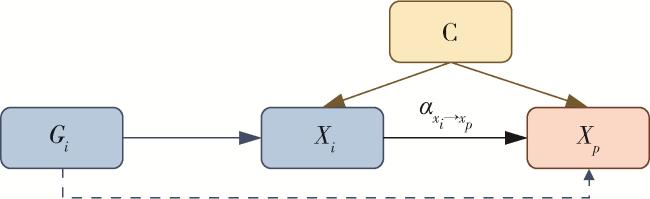
选择性婚配:从遗传背景相关性、个体间潜在因果效应两个层次分别探索个体与配偶间的选择性婚配。分别根据公开数据库构建个体、配偶的血脂相关表型多基因遗传风险评分(genetic risk score, GRS)[23],使用Pearson相关计算个体与其配偶GRS的相关性。根据配偶特异性孟德尔随机化(Mendelian randomization, MR)探索配偶表型的潜在因果关联[18](图 1)。
图1 配偶间孟德尔随机化分析框架图

Figure 1 Couple-specific Mendelian randomization framework

Xi, index ' s phenotype; Xp, partner ' s phenotype; Gi, index ' s genotype; C, confunders; αxixp, causal effect among couples with single trait X.

每位参与者分别以个体、配偶两次纳入分析,个体基因对于表型的效应值(GiXi)来自OpenGWAS网站中的GWAS汇总数据(https://gwas.mrcieu.ac.uk)。配偶间的效应值(GiXP)使用房山家系队列中个体基因型与配偶表型计算得到,调整的协变量包括年龄、性别、降脂药用药情况。使用逆方差加权法的结果作为配偶特异性MR分析结果,以P < 0.05为有统计学意义阈值。
社会同质性:首先根据GRS评价层间遗传背景异质性,使用两独立样本t检验评价各层GRS是否存在差异。使用配偶特异性MR探索层间配偶表型的潜在因果关联,使用Q统计量检验层间因果关联的差异[24]
配偶间效应值(GiXP)以及GRS的计算使用PLINK 1.90软件完成,其余所有分析使用R 4.3.2软件完成,配偶特异性MR分析使用TwoSampleMR(v0.6.8)包完成,Q统计量使用Metafor(4.6.0)包计算。

2 结果

2.1 研究对象基线特征

本研究共纳入342对异性配偶,其中287对来自北京房山家系队列,55对来自福建土楼家系队列(表 1)。研究对象的平均年龄为(64.91±8.76)岁,男性TC、TG、LDL-C高于女性,差异有统计学意义;高血压、2型糖尿病、高血脂患病率的性别差异均无统计学意义。
表1 研究对象基本特征(按性别区分)

Table 1 Baseline characteristics of participants by sex

Items All (n=684) Male (n=342) Female (n=342) P
Age/years, ${\bar x}$±s 64.91±8.76 65.67±9.32 64.15±8.10 0.025
BMI/(kg/m2), ${\bar x}$±s 25.145±3.632 24.512±3.345 25.778±3.799 < 0.001
TC/(mmol/L), ${\bar x}$±s 3.652±1.179 3.562±1.105 3.741±1.244 0.047
TG/(mmol/L), ${\bar x}$±s 1.663±1.131 1.527±1.017 1.799±1.221 0.002
LDL-C/(mmol/L), ${\bar x}$±s 2.696±0.836 2.599±0.821 2.794±0.841 0.002
HDL-C/(mmol/L), ${\bar x}$±s 1.211±2.970 1.089±0.370 1.333±4.183 0.282
Hypertension, n (%) 478 (74.687) 243 (75.938) 235 (73.438) 0.520
Type 2 diabetes, n (%) 158 (24.765) 76 (23.824) 82 (25.705) 0.650
Hyperlipidemia, n (%) 226 (41.016) 109 (38.380) 117 (43.820) 0.230
Smoke status, n (%) < 0.001
  Never 368 (54.357) 91 (26.844) 277 (81.953)
  Current or former 309 (45.643) 248 (73.156) 61 (18.047)
Drinking status, n (%) < 0.001
  Never 499 (73.817) 174 (51.479) 325 (96.154)
  Current or former 177 (26.183) 164 (48.521) 13 (3.846)
Education, n (%) < 0.001
  Below primary school 153 (22.600) 53 (15.680) 100 (29.499)
  Primary school 239 (35.303) 104 (30.769) 135 (39.823)
  Junior high school 228 (33.678) 141 (41.716) 87 (25.664)
  High school 53 (7.829) 37 (10.947) 16 (4.720)
  Junior college or above 4 (0.591) 3 (0.888) 1 (0.295)

BMI, body mass index; TC, total cholesterol; TG, triglycerides; LDL-C, low-density lipoprotein cholesterol; HDL-C, high-density lipoprotein cholesterol.

2.2 配偶间血脂指标的表型相关性

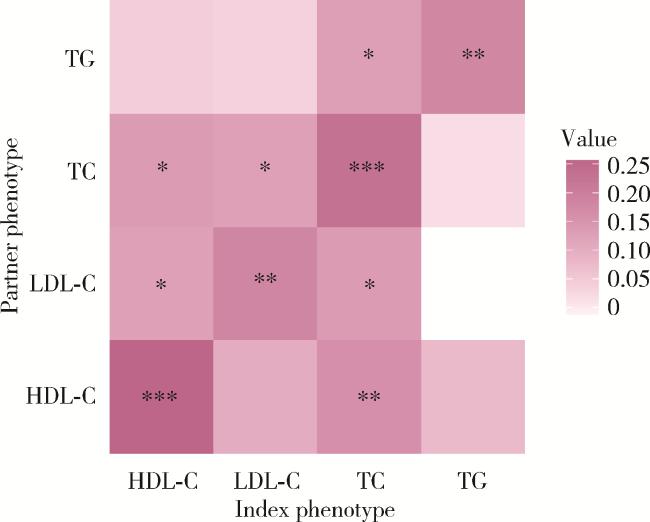
血脂指标TC、TG、HDL-C、LDL-C均有统计学意义的配偶间表型相关性(图 2),其中相关系数较高的表型为TC(r=0.229, 95%CI:0.125~0.327)和HDL-C(r=0.257, 95%CI:0.155~0.354),TG的相关系数为r=0.179(95% CI:0.074~0.280),LDL-C的相关系数为r=0.181(95% CI:0.076~0.282)。
图2 配偶间血脂指标的表型相关性

Figure 2 Correlation of lipid phenotypes between spouses

* P < 0.05, * * P < 0.01, * * * P < 0.001. TC, total cholesterol; TG, triglycerides; LDL-C, low-density lipoprotein cholesterol; HDL-C, high-density lipoprotein cholesterol; Index phenotype, phenotype of an individual; Partner phenotype, phenotype of index ' s partner.

调整年龄、疾病患病情况、用药情况后,上述血脂指标依然有统计学意义的相关性(表 2),特别是TC、LDL-C,在两地人群的相关性均有统计学意义。
表2 配偶间表型关联分析结果

Table 2 Results of phenotype association analysis between spouses

Items All (n=684) Fangshan (n=574) Fujian (n=110)
r (95%CI) P r (95%CI) P r (95%CI) P
TC 0.183 (0.101, 0.265) < 0.001 0.182 (0.090, 0.274) < 0.001 0.186 (-0.002, 0.374) 0.007
TG 0.203 (0.121, 0.285) < 0.001 0.191 (0.099, 0.283) < 0.001 0.259 (0.073, 0.445) 0.672
HDL-C 0.241 (0.159, 0.323) < 0.001 0.189 (0.095, 0.283) < 0.001 0.421 (0.247, 0.595) 0.055
LDL-C 0.168 (0.088, 0.248) < 0.001 0.209 (0.119, 0.299) < 0.001 -0.015 (-0.207, 0.177) < 0.001

Abbreviations as in Table 1.

2.3 伴侣间趋同

通过表型差异与结婚时间的相关评价伴侣间趋同,本研究未观察到有统计学意义(P < 0.05)的伴侣间趋同(表 3),其中,HDL-C配偶间的表型差异呈现出随结婚时间增加的趋势,但并无统计学意义。
表3 结婚时间与表型差值的相关性

Table 3 Correlation of length of relationship and phenotype difference between spouses

Items All (n=684) Male≥Female* Female≥Male#
r (95%CI) P n r (95%CI) P n r (95%CI) P
ΔTG 0.021 (-0.088, 0.129) 0.706 170 0.016 (-0.138, 0.170) 0.836 179 0.063 (-0.089, 0.212) 0.419
ΔTC 0.086 (-0.023, 0.193) 0.121 139 0.056 (-0.114, 0.224) 0.519 209 0.134 (-0.005, 0.268) 0.058
ΔHDL-C 0.095 (-0.014, 0.202) 0.086 139 0.070 (-0.101, 0.238) 0.422 209 0.125 (-0.014, 0.260) 0.079
ΔLDL-C 0.043 (-0.066, 0.151) 0.443 171 -0.036 (-0.190, 0.120) 0.653 181 0.121 (-0.027, 0.264) 0.109

* Male phenotype is greater than female phenotype in spouses; # Female phenotype is greater than male phenotype in spouses. Abbreviations as in Table 1.

调整配偶年龄差、服用降脂药等协变量后进行关联分析,结果如表 4所示,ΔTC、ΔLDL-C与结婚时间呈现有统计学意义的关联,结婚时间每增加1年,ΔTC增加0.021(95%CI:-0.001~0.043)个标准差(1标准差=0.764 mmol/L),ΔLDL-C增加0.025(95%CI:0.003~0.047)个标准差(1标准差=0.665 mmol/L)。在男性表型≥女性表型时,ΔLDL-C仍然与结婚时间存在有统计学意义的关联,也就是说,若男性LDL-C水平高于或等于女性,配偶间LDL-C的差异随结婚时间增加而增加。
表4 结婚时间与表型差值的广义线性模型关联分析

Table 4 Generalized linear model association analysis between length of relationship and phenotype difference

Items All (n=684) Male≥Female* Female≥Male#
β (95%CI) P n β (95%CI) P n β (95%CI) P
ΔTG -0.008 (-0.030, 0.014) 0.461 170 -0.010 (-0.045, 0.025) 0.590 179 -0.012 (-0.039, 0.015) 0.393
ΔTC 0.021 (-0.001, 0.043) 0.048 139 0.021 (-0.012, 0.054) 0.232 209 0.023 (-0.004, 0.050) 0.112
ΔHDL-C 0.013 (-0.007, 0.033) 0.181 139 0.015 (-0.010, 0.040) 0.260 209 0.017 (-0.012, 0.046) 0.251
ΔLDL-C 0.025 (0.003, 0.047) 0.025 171 0.043 (0.008, 0.078) 0.022 181 0.014 (-0.013, 0.041) 0.323

* Male phenotype is greater than female phenotype in spouses; # Female phenotype is greater than male phenotype in spouses. Abbreviations as in Table 1.

2.4 选择性婚配

以来自房山家系的基因型信息齐全的123对配偶为研究对象,在血脂指标中均未观察到有统计学意义的配偶遗传背景相关性。使用配偶特异性MR探索个体表型与配偶表型间的潜在因果关联,未观察到配偶的表型间存在有统计学意义的因果关联(表 5)。
表5 配偶间特异性孟德尔随机化分析结果

Table 5 Results of couple-specific Mendelian randomization

Items Male to female (n=123) Female to male (n=123) All (n=246)
α(95%CI) P α(95%CI) P α(95%CI) P
TG -0.684 (-1.757, 0.388) 0.211 -0.498 (-1.592, 0.596) 0.373 -0.578 (-1.297, 0.141) 0.115
TC 0.626 (-1.476, 2.728) 0.559 1.681 (-0.228, 3.589) 0.084 1.146 (-0.388, 2.681) 0.143
HDL-C -0.206 (-1.128, 0.716) 0.662 0.337 (-0.500, 1.174) 0.430 0.087 (-0.539, 0.713) 0.785
LDL-C 0.592 (-0.316, 1.500) 0.202 -0.294 (-1.460, 0.873) 0.622 0.021 (-0.760, 0.802) 0.958

Abbreviations as in Table 1.

2.5 社会同质性

根据学历高低和学历一致性对人群进行分层,分为高学历组(78人)、低学历组(168人)、学历一致组(128人)、学历不一致组(118人)。不同亚组间未观察到有统计学意义的血脂相关遗传背景差异,各组内配偶特异性MR与组间异质性结果均无统计学意义。

3 讨论

本研究基于北京房山和福建土楼家系队列,研究调查对象中的配偶血脂指标相关性,发现TC、TG、HDL-C、LDL-C存在配偶间相关性,未观察到伴侣趋同、选择性婚配、社会同质性影响上述血脂指标相关性。了解配偶相关性及其产生原因能够为疾病的病因探索与防控提供更多理论依据,伴侣趋同的存在提示针对配偶的共同干预措施可能更有效。选择性婚配为遗传流行病学中的偏倚和人群分层提供了可能的解释,社会同质性则从社会因素的角度对配偶相关性进行了解释。
既往血脂指标的配偶间相关性研究得到的结果并不一致,Kim等[25]对3 141对韩国夫妻的研究发现,TC、TG、HDL-C、LDL-C均存在配偶间表型相关性;Retnakaran等[19]对中国的831对新婚夫妻的研究得到了同样的结果;而Shiffman等[26]对5 364对美国夫妻的研究并未发现配偶间TC存在有统计学意义的相关。上述研究结果的差异可能与不同人群间遗传与文化背景差异以及美国人群研究的多种族特质有关。本研究得到的结果与东亚人群研究得到的结果一致,进一步验证了该人群配偶间血脂指标的相关性。
本研究发现,夫妻间TC、LDL-C水平的差异均受结婚时间影响,且随着结婚时间增加差异增加,TG、HDL-C则未观察到配偶间表型差异受结婚时间的影响,此结果可能受男女血脂指标随年龄变化差异的影响。既往针对中国人群的纵向队列研究结果显示,不同性别间TC、LDL-C变化的速率有所差异,男性TC、LDL-C的增加速率随年龄有所下降,女性TC、LDL-C的增加速率则随年龄增加呈现先增加、后降低的反V型趋势,拐点出现在40~49岁期间,且50岁后女性的下降速率始终高于男性,故整体血脂水平的变化趋势为,50岁前女性的TC、LDL-C水平均低于男性,50岁后则相反[27]。本研究人群的年龄多数落在50岁以上区间内,观察到的结果符合该年龄段男性、女性TC、LDL-C变化的趋势,一方面这可能是由于研究人群确实不存在配偶间趋同的现象,另一方面则可能是由于配偶间趋同对于配偶双方表型的影响难以弥补性别差异带来的表型差异。未来仍需更多相关研究探索血脂表型的配偶间趋同,并将其与配偶的性别差异进行定量比较。
本研究并未发现TC、TG、HDL-C、LDL-C存在选择性婚配,这一结果与既往的研究结果一致。Yamamoto等[28]利用日本生物银行(Biobank Japan,BBJ)数据,基于配子相不平衡[29]的思想探索选择性婚配,并未发现上述指标的选择性婚配;Sjaarda等[18]基于英国生物银行(UK Biobank)数据,使用配偶特异性MR方法同样未发现血脂相关指标存在配偶间因果效应。一方面,这可能是由于单核苷酸多态性(single nucleotide polymorphism,SNP)对于血脂相关表型的遗传度的解释有限,难以估计配偶间真正的遗传背景相关性;另一方面,血脂指标受生活方式影响较大,观察到的配偶间相关性可能受其他表型的间接选择性婚配影响(如个体在是否吸烟层次发生了选择性婚配,吸烟与血脂相关,便可观察到血脂的配偶间相关性),因此难以观察到血脂表型的遗传背景相关性,未来仍需更多开展对于该表型的间接选择性婚配的探索。
对于社会同质性因素,本研究对学历进行了探索,并未得到阳性结果,这与既往研究结果并不一致[18, 30],这可能是由于本研究进行该阶段分析的研究对象为中国北方农村人群,已经是社会同质性分层进行初步分层的结果,尽管选择的指标能够对人群进行一定区分,但区分度较低,这也是本研究的局限性之一。
家系资料是宝贵的流行病学研究资源,独特的家系设计为基于配偶进行选择性婚配、社会同质性的探索提供了可能。本研究仍有如下局限性:(1)本研究为横断面研究设计,且主要研究对象为中老年人,难以排除回忆偏倚;(2)尽管本研究调整了部分混杂因素,但还可能存在未知和未测量的残余混杂,如婚姻美满程度已被证实与个体的血脂相关表型存在关联[31],但本研究并未收集相关指标;(3)本研究的样本量相对较小,限制了发现更多阳性结果的统计学效能,有待未来进一步扩大家系队列的建设规模,为后续研究提高把握度。
综上所述,本研究发现中国人群的血脂相关表型存在配偶间表型相关性,但未观察到伴侣趋同、选择性婚配、社会同质性对于血脂相关表型的影响,此结果有待在将来更大的前瞻性人群样本中进一步验证。

利益冲突  所有作者均声明不存在利益冲突。

作者贡献声明  李奕昕:提出研究思路,整理和分析数据,撰写论文;李奕昕、郭煌达、彭和香、王梦莹、吴涛:参与研究设计及数据的收集与整理;李奕昕、郭煌达、彭和香、侯天姣、章涵宇、谭音希、郑一、王梦莹、武轶群、秦雪英、李劲、叶莺、吴涛、陈大方、胡永华、李立明:稿件修改;吴涛:总体把关和审定论文。

1
Rotter JI , Rimoin DL . Peptic ulcer disease: A heterogeneous group of disorders?[J]. Gastroenterology, 1977, 73 (3): 604- 607.

DOI

2
Kunkle BW , Grenier-Boley B , Sims R , et al. Genetic meta-analysis of diagnosed Alzheimer ' s disease identifies new risk loci and implicates Aβ, tau, immunity and lipid processing[J]. Nat Genet, 2019, 51 (3): 414- 430.

DOI

3
O'sullivan JW , Raghavan S , Marquez-Luna C , et al. Polygenic risk scores for cardiovascular disease: A scientific statement from the American Heart Association[J]. Circulation, 2022, 146 (8): e93- e118.

4
Cole JB , Florez JC . Genetics of diabetes mellitus and diabetes complications[J]. Nat Rev Nephrol, 2020, 16 (7): 377- 390.

DOI

5
Domingue BW , Fletcher J , Conley D , et al. Genetic and educational assortative mating among US adults[J]. Proc Natl Acad Sci USA, 2014, 111 (22): 7996- 8000.

DOI

6
Watson D , Klohnen EC , Casillas A , et al. Match makers and deal breakers: Analyses of assortative mating in newlywed couples[J]. J Pers, 2004, 72 (5): 1029- 1068.

DOI

7
Hu A , Qian Z . Educational homogamy and earnings inequality of married couples: Urban China, 1988-2007[J]. Res Soc Strat Mobil, 2015, 40, 1- 15.

8
Willoughby EA , Giannelis A , Ludeke S , et al. Parent contributions to the development of political attitudes in adoptive and biological families[J]. Psychol Sci, 2021, 32 (12): 2023- 2034.

DOI

9
Kandler C , Bleidorn W , Riemann R . Left or right? Sources of political orientation: The roles of genetic factors, cultural transmission, assortative mating, and personality[J]. J Pers Soc Psychol, 2012, 102 (3): 633- 645.

DOI

10
Silventoinen K , Kaprio J , Lahelma E , et al. Assortative mating by body height and BMI: Finnish twins and their spouses[J]. Am J Hum Biol, 2003, 15 (5): 620- 627.

DOI

11
Maes HH , Neale MC , Eaves LJ . Genetic and environmental factors in relative body weight and human adiposity[J]. Behav Genet, 1997, 27 (4): 325- 351.

DOI

12
Agrawal A , Heath AC , Grant JD , et al. Assortative mating for cigarette smoking and for alcohol consumption in female Australian twins and their spouses[J]. Behav Genet, 2006, 36 (4): 553- 566.

DOI

13
Howe LJ , Lawson DJ , Davies NM , et al. Genetic evidence for assortative mating on alcohol consumption in the UK Biobank[J]. Nat Commun, 2019, 10 (1): 5039.

DOI

14
Reynolds CA , Barlow T , Pedersen NL . Alcohol, tobacco and caffeine use: Spouse similarity processes[J]. Behav Genet, 2006, 36 (2): 201- 215.

DOI

15
Hippisley-Cox J , Coupland C , Pringle M , et al. Married couples' risk of same disease: Cross sectional study[J]. BMJ, 2002, 325 (7365): 636.

DOI

16
Rawlik K , Canela-Xandri O , Tenesa A . Indirect assortative mating for human disease and longevity[J]. Heredity (Edinb), 2019, 123 (2): 106- 116.

DOI

17
Versluys TMM , Flintham EO , Mas-Sandoval A , et al. Why do we pick similar mates, or do we?[J]. Biol Lett, 2021, 17 (11): 20210463.

DOI

18
Sjaarda J , Kutalik Z . Partner choice, confounding and trait convergence all contribute to phenotypic partner similarity[J]. Nat Hum Behav, 2023, 7 (5): 776- 789.

DOI

19
Retnakaran R , Wen SW , Tan H , et al. Spousal concordance of cardiovascular risk factors in newly married couples in China[J]. JAMA Netw Open, 2021, 4 (12): e2140578.

DOI

20
Wang M , Wang S , Wang X , et al. Carotid intima-media thickness, genetic risk, and ischemic stroke: A family-based study in rural China[J]. Int J Environ Res Public Health, 2020, 18 (1): 119.

DOI

21
黄辉, 叶莺, 黄春兰, 等. 福建土楼家系队列研究: 研究方法及调查对象基线和家系特征[J]. 中华流行病学杂志, 2018, 39 (10): 1402- 1407.

22
Xiao H , Ma Y , Zhou Z , et al. Disease patterns of coronary heart disease and type 2 diabetes harbored distinct and shared genetic architecture[J]. Cardiovasc Diabetol, 2022, 21 (1): 276.

DOI

23
Choi SW , Mak TSH , O'reilly PF . Tutorial: A guide to performing polygenic risk score analyses[J]. Nature Protocols, 2020, 15 (9): 2759- 2772.

DOI

24
Richmond RC , Howe LJ , Heilbron K , et al. Correlations in sleeping patterns and circadian preference between spouses[J]. Commun Biol, 2023, 6 (1): 1156.

DOI

25
Kim HC , Kang DR , Choi KS , et al. Spousal concordance of metabolic syndrome in 3141 Korean couples: A nationwide survey[J]. Ann Epidemiol, 2006, 16 (4): 292- 298.

DOI

26
Shiffman D , Louie JZ , Devlin JJ , et al. Concordance of cardiovascular risk factors and behaviors in a multiethnic US nationwide cohort of married couples and domestic partners[J]. JAMA Netw Open, 2020, 3 (10): e2022119.

DOI

27
Li J , Liu M , Liu F , et al. Age and genetic risk score and rates of blood lipid changes in China[J]. JAMA Netw Open, 2023, 6 (3): e235565.

DOI

28
Yamamoto K , Sonehara K , Namba S , et al. Genetic footprints of assortative mating in the Japanese population[J]. Nat Hum Behav, 2023, 7 (1): 65- 73.

29
Yengo L , Robinson MR , Keller MC , et al. Imprint of assortative mating on the human genome[J]. Nat Hum Behav, 2018, 2 (12): 948- 954.

DOI

30
Gonggrijp BMA , Silventoinen K , Dolan CV , et al. The mechanism of assortative mating for educational attainment: A study of Finnish and Dutch twins and their spouses[J]. Front Genet, 2023, 14, 1150697.

DOI

31
Bennett-Britton I , Teyhan A , Macleod J , et al. Changes in marital quality over 6 years and its association with cardiovascular disease risk factors in men: findings from the ALSPAC prospective cohort study[J]. J Epidemiol Community Health, 2017, 71 (11): 1094- 1100.

DOI

Outlines

/