Association of triglyceride-glucose index and cardiovascular disease in a community-based Chinese cohort

  • Mengxi LU 1 ,
  • Qiuping LIU 1 ,
  • Tianjing ZHOU 1 ,
  • Xiaofei LIU 1 ,
  • Yexiang SUN 2 ,
  • Peng SHEN 2 ,
  • Hongbo LIN 2 ,
  • Xun TANG , 1, 3, * ,
  • Pei GAO , 1, 3, 4, *
Expand
  • 1. Department of Epidemiology and Biostatistics, Peking University School of Public Health, Beijing 100191, China
  • 2. Yinzhou District Center for Disease Control and Prevention, Ningbo 315101, Zhejiang, China
  • 3. Key Laboratory of Epidemiology of Major Disease (Peking University), Ministry of Education, Beijing 100191, China
  • 4. Center for Real-World Evidence Evaluation, Peking University Clinical Research Institute, Beijing 100191, China
TANG Xun, e-mail,
GAO Pei, e-mail,

Received date: 2025-02-07

  Online published: 2025-06-13

Supported by

the Noncommunicable Chronic Diseases-National Science and Technology Major Project(2024ZD0527406)

the National Natural Sciences Foundation of China(82373662)

the Beijing Natural Science Foundation(IS24047)

Copyright

All rights reserved. Unauthorized reproduction is prohibited.

Abstract

Objective: To investigate the association between the triglyceride-glucose (TyG) index and the incidence and mortality of cardiovascular disease (CVD) in a large population-based cohort. Methods: Participants aged 40-79 years without a history of CVD at baseline were drawn from the CHinese Electronic health Records Research in Yinzhou (CHERRY) study between January 1, 2010, and May 31, 2020. The TyG index was calculated using baseline triglyceride and fasting blood glucose. Cox proportional hazards models were used to assess the association between the TyG index and the composite outcome of CVD (incidence and mortality), adjusting for age, gender, education, region, smoking status, body mass index, systolic blood pressure, and total cholesterol. Hazard ratios (HR) and 95% confidence intervals (CI) were calculated. Nonlinear associations between the TyG index and CVD were further evaluated using restricted cubic splines, and subgroup analyses by gender and age were conducted to explore potential differences. Results: A total of 226 406 individuals were included, with a mean age of (55.0±9.7) years at baseline, 46.8% of whom were men, and a median TyG index of 8.68. Over a median follow-up of 7.99 years, 9 815 (4.34%) participants experienced CVD incidence or mortality. After adjusting for age, gender, education, region, smoking status, body mass index, systolic blood pressure and total cholesterol, the risk of CVD increased with higher TyG index levels (P < 0.001). The risk in the highest TyG quartile (TyG>9.10) was 42% higher than in the lowest quartile (TyG≤8.32) (HR=1.42, 95%CI: 1.34-1.51). Individuals under 60 years had a higher HR for CVD compared with those aged 60 years and above (HR: 1.71 vs. 1.27, P < 0.05). Restricted cubic spline analysis revealed a reverse L-shaped association between the TyG index and CVD risk in the overall population (P < 0.001 for nonlinear trend), with risk increasing after the TyG index exceeded 8.67. However, the threshold varied by gender, with a lower threshold in women (8.51) than in men (8.67). Conclusion: A significant nonlinear relationship was revealed between the TyG index and CVD risk, with a threshold effect. The risk of CVD increased once the TyG index surpassed a certain threshold, with a lower threshold in women than in men. These findings suggest that cardiovascular risk prediction and interventions based on the TyG index should be gender-stratified, and early intervention for individuals under 60 years old might have important public health implications.

Cite this article

Mengxi LU , Qiuping LIU , Tianjing ZHOU , Xiaofei LIU , Yexiang SUN , Peng SHEN , Hongbo LIN , Xun TANG , Pei GAO . Association of triglyceride-glucose index and cardiovascular disease in a community-based Chinese cohort[J]. Journal of Peking University(Health Sciences), 2025 , 57(3) : 430 -435 . DOI: 10.19723/j.issn.1671-167X.2025.03.004

探索心血管病危险因素的复合指标与结局事件在不同人群中的关联及其差异,作为后续开展综合风险预测与危险因素干预的基础,也是重要的公共卫生研究问题之一。在心血管代谢性疾病的发病机制中,尽管血糖和血脂异常与心血管病风险之间的关联已得到广泛证实[1-2],但单一危险因素如血糖或血脂指标通常难以全面反映个体风险的整体情况[3]。近年来,甘油三酯-葡萄糖(triglyceride-glucose, TyG)指数作为综合血糖与血脂信息的一种简易复合指标,能够更好地反映个体的心血管病风险,例如已有研究发现TyG指数升高与心血管病的发生及死亡风险增加有关[4],但TyG指数与心血管病之间是否存在复杂的非线性关系及其具体模式,既往研究的结论尚不一致[5]。此外,考虑到TyG指数作为糖、脂代谢多维度危险因素谱的复杂综合指标,其效应异质性强,在不同人群中的分布差异明显[6],由于既往研究多为传统队列研究且样本量有限[5, 7],仍需要能够反映现实诊疗环境的大样本真实世界证据。因此,本研究旨在基于大样本的社区人群队列,探索TyG指数与心血管病发病和死亡的关联及其人群差异,为后续进一步开展心血管病综合风险预测及危险因素干预提供依据。

1 资料与方法

1.1 研究对象

研究对象来自中国鄞州电子健康档案(CHinese Electronic health Records Research in Yinzhou, CHERRY),这是一项在浙江省宁波市鄞州区开展的双向性队列研究,详细的队列概况和数据来源见本课题组既往研究[8],本研究开始前已经北京大学生物医学伦理委员会的审查批准(IRB00001052-16011)。
纳入标准:(1)2010年1月1日至2020年5月31日在区域卫生信息平台有医疗记录,且为有效身份识别的健康档案号唯一的居民;(2)基线年龄40~79岁。
排除标准:(1)基线时已有心血管病史;(2)随访期间无任何血脂测量信息。
研究对象的基线时间定义为40岁生日、血脂测量日期或本研究开始日期(2010年1月1日)中最晚的时间。个体的随访截止时间定义为发生结局事件(心血管病发病和死亡)、因其他原因死亡或研究周期结束这三个时间点中最早的时间。

1.2 暴露因素

本研究的暴露因素为TyG指数,该指数根据空腹血糖(fasting blood glucose, FBG, 单位mg/dL)和甘油三酯(triglyceride, TG, 单位mg/dL)计算,具体计算公式为[9]
$\mathrm{TyG}=\ln \frac{\mathrm{FBG} \times \mathrm{TG}}{2} 。$
本研究涉及的社会人口学变量包括年龄、性别、居住地(城市/农村)、教育水平(初中及以下/高中及以上);心血管病危险因素变量包括收缩压、舒张压、血糖、血脂水平、体重指数(body mass index, BMI)、吸烟史、糖尿病史等。体格检查和生化检测数据来源于区域卫生信息平台的电子病历和体检数据库。若存在多条检测记录,则选择与研究对象的基线时间最接近且为结局事件发生前的检测记录作为基线数据。

1.3 结局事件

本研究的结局事件定义为首次发生的心血管病事件和心血管病死亡的复合终点[10],根据国际疾病分类第十版(International Classification of Disease 10th, ICD-10)编码,包括非致死性或致死性脑卒中(I60-I69)、非致死性心肌梗死(I21-I23)、冠心病死亡(I21-I25)。心血管病结局事件诊断由专业医生在浙江省疾病监测及死因登记平台核查确认。

1.4 统计学分析

使用R4.1.3统计软件,分性别对人群进行基线特征描述,符合正态分布的连续变量使用均数±标准差表示,不符合正态分布则使用M(P25, P75)表示;n(%)描述分类变量。采用t检验比较连续变量的组间差异,如变量不满足正态分布则采用Wilcoxon秩和检验;采用卡方检验比较分类变量的组间差异。根据TyG指数的四分位数分为下四分位数(8.32)、中位数(8.68)、上四分位数(9.10)共3组;采用Kaplan-Meier曲线描述随访期间结局事件的发生情况。
采用Cox比例风险模型分析TyG指数的四分位数分组与心血管病发病和死亡的关联,计算风险比(hazard ratio, HR)及其95%置信区间(confidence interval, CI)。为控制混杂因素,Cox模型中调整的变量包括年龄、性别、教育水平、居住地、吸烟状态、体重指数、收缩压及总胆固醇。使用Schoenfeld残差图检验模型调整变量的等比例风险假设。在Cox模型中进一步检验TyG指数与心血管病发病和死亡的关联在不同性别、年龄(< 60岁,≥60岁)亚组中的差异。
使用基于Cox模型的限制性立方样条(restricted cubic spline, RCS)回归方法分析TyG指数与心血管病发病和死亡在总人群和不同性别中的非线性关系,考虑到样本量较大,选取5个节点(0.050、0.275、0.500、0.725、0.950)进行分析[11]。本研究以发生心血管病发病和死亡风险随TyG指数增加而增大的起始值作为风险阈值。双侧检验,显著性水平α=0.05。在亚组分析中通过Bonferroni法对多重假设检验进行调整,显著性水平调整为0.05/6≈0.008。

2 结果

2.1 队列人群的基线特征和结局事件

本研究共纳入226 406名研究对象(表 1),平均年龄为(55.0±9.7)岁,其中53.2%为女性。研究对象的TyG指数为8.7±0.6,TyG的下四分位数、中位数和上四分位数分别为8.32、8.68、9.10。在空腹血糖、总胆固醇水平及TyG水平方面,男性均高于女性(P < 0.001)。
表1 研究对象的基线特征

Table 1 Baseline characteristics of study participants

Characteristic Total (n=226 406) Women (n=120 558) Men (n=105 848) P value*
Age/years 55.0±9.7 54.5±9.6 55.5±9.9 < 0.001
Education (senior high school or higher) 34 173 (15.1) 14 806 (12.3) 40 238 (38.0) < 0.001
Region (Urban) 154 444 (68.2) 81 099 (67.3) 73 345 (69.3) < 0.001
Current smoker 41 861 (18.5) 1 623 (1.3) 40 238 (38.0) < 0.001
Diabetes 19 701 (8.7) 10 475 (8.7) 9 226 (8.7) 0.823
Hypertension 74 319 (32.8) 39 305 (32.6) 35 014 (33.1) 0.016
Treated hypertension 69 047 (30.5) 34 237 (28.4) 348 100 (32.9) < 0.001
Family history of CVD 1 486 (0.7) 691 (0.6) 795 (0.8) < 0.001
SBP/mmHg 131.2±16.3 130.6±16.7 131.9±15.9 < 0.001
DBP/mmHg 81.6±9.6 80.8±9.6 82.5±9.5 < 0.001
BMI/(kg/m2) 23.3±2.8 23.2±2.9 23.3±2.7 < 0.001
FBG/(mg/dL) 103.6±30.8 101.8±27.2 105.7±34.3 < 0.001
TG/(mg/dL) 145.5 (111.5, 179.1) 141.6 (106.4, 172.8) 151.2 (116.4, 185.7) < 0.001
TC/(mg/dL) 190.2±37.8 194.3±37.7 185.6±37.3 0.030
HDL-C/(mg/dL) 50.3±12.9 52.0±12.4 48.5±13.1 < 0.001
LDL-C/(mg/dL) 109.7±31.0 111.5±31.3 107.2±30.6 < 0.001
TyG index 8.7 (8.3, 9.1) 8.7 (8.2, 9.0) 8.8 (8.3, 9.1) < 0.001

Data were ${\bar x}$±sn(%) or M(P25, P75). *Compared between men and women. CVD, cardiovascular disease; SBP, systolic blood pressure; DBP, diastolic blood pressure; BMI, body mass index; FBG, fasting plasma glucose; TG, triglycerides; TC, total cholesterol; HDL-C, high-density lipoprotein cholesterol; LDL-C, low-density lipoprotein cholesterol; TyG index, triglyceride-glucose index.

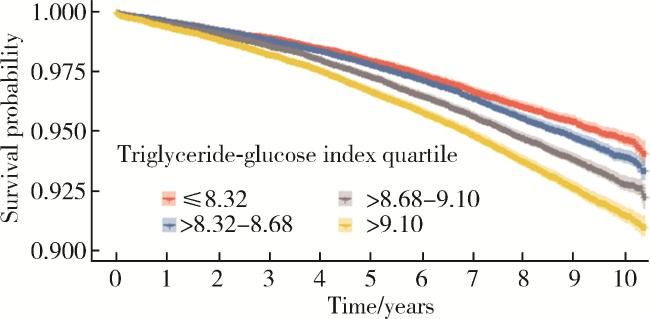
在中位随访时间7.99年,累计1 558 768人年的随访期间,共有9 815人心血管病发病和死亡(6.30/1 000人年)。Kaplan-Meier曲线(图 1)展示了按照TyG四分位数分组的心血管病发病和死亡发生率的差异,提示随着TyG指数的增大,人群心血管病发病和死亡的风险将增加。
图1 甘油三酯-葡萄糖指数不同分组的心血管病发病和死亡的Kaplan-Meier曲线

Figure 1 Kaplan-Meier curve of cardiovascular disease events by quartiles of triglyceride-glucose index

2.2 TyG指数与心血管病复合结局事件的关联

Cox比例风险模型分析结果显示(表 2),以TyG指数的下四分位数组为参照,调整混杂因素后,TyG指数的上四分位数组心血管病发病和死亡的风险增加了42%(HR=1.42, 95%CI: 1.34~1.51),提示TyG指数是发生心血管病发病和死亡的独立危险因素,随着TyG指数的增大,心血管病发病和死亡的风险增高(P < 0.001),与前述Kaplan-Meier曲线的结果一致。
表2 甘油三酯-葡萄糖指数与心血管病发病和死亡的关联

Table 2 Association of triglyceride-glucose index and cardiovascular disease events

Quartile Number of cases Case per 1 000 person-years Model 1 Model 2 Model 3 Model 4
HR (95%CI) P HR (95%CI) P HR (95%CI) P HR (95%CI) P
Quartile 1
(≤8.32)
1 890 4.93 Reference Reference Reference Reference
Quartile 2
(>8.32-8.68)
2 169 5.56 1.12
(1.05-1.19)
< 0.001 1.04
(0.98-1.10)
0.244 1.02
(0.96-1.08)
0.611 1.02
(0.96-1.08)
0.611
Quartile 3
(>8.68-9.10)
2 621 6.67 1.34
(1.26-1.42)
< 0.001 1.19
(1.12-1.26)
< 0.001 1.15
(1.08-1.22)
< 0.001 1.15
(1.08-1.22)
< 0.001
Quartile 4
(>9.10)
3 135 8.00 1.61
(1.52-1.70)
< 0.001 1.50
(1.41-1.58)
< 0.001 1.42
(1.34-1.51)
< 0.001 1.42
(1.34-1.51)
< 0.001

HR, hazard ratio; CI, confidence interval. Model 1, unadjusted; Model 2, adjusted for age, gender; Model 3, adjusted for age, gender, education, region, smoking status, body mass index, systolic blood pressure; Model 4, adjusted for age, gender, education, region, smoking status, body mass index, systolic blood pressure, and total cholesterol.

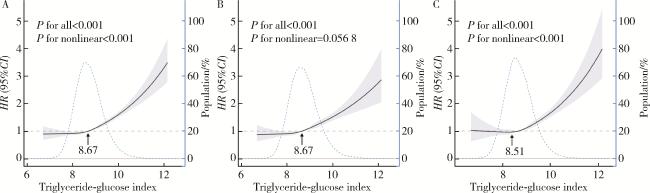
限制性立方样条分析结果进一步发现TyG指数与心血管病发病和死亡存在非线性关联(P < 0.001),提示TyG指数与心血管病发病和死亡的风险存在阈值。如图 2所示,总人群中TyG指数与心血管病发病和死亡呈现“反L型”的关系,提示当TyG指数大于阈值8.67时,心血管病发病和死亡的风险随着TyG指数增加而增大(P < 0.05),小于8.67时无显著关联。
图2 按性别分组的甘油三酯-葡萄糖指数与心血管病发病和死亡的非线性关联

Figure 2 Nonlinear association of triglyceride-glucose index and cardiovascular disease events, by gender

A, overall; B, men; C, women. P for all tested whether using splines improves the model compared to a simple linear term; P for nonlinear tested whether the nonlinear part of the spline model is statistically significant; Graphs show multivariate adjusted hazard ratios (HR; solid lines) and 95%CI (shaded areas). Dashed lines represent the proportion of the population with different levels of triglyceride-glucose index. Arrows indicate the triglyceride-glucose index at the point where risk crosses the reference line (HR=1).

2.3 亚组分析

分性别比较上述非线性关联,发现男性与女性人群中非线性关联的“反L型”曲线类似,但男性TyG指数与心血管病发病和死亡的风险阈值为8.67(图 2B),而女性中的风险阈值为8.51(图 2C),提示不同性别人群中TyG指数的风险阈值存在差异,女性低于男性。
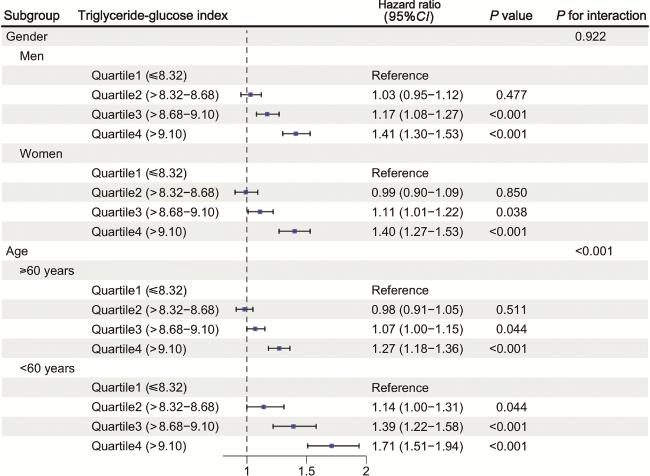
Cox比例风险模型的亚组分析结果显示(图 3),在TyG指数与心血管病发病和死亡的关联中,年龄存在交互作用(P < 0.001)。对于年龄在60岁及以上的人群,TyG指数的上四分位数组与下四分位数组相比,心血管病发病和死亡风险增加27%(HR=1.27, 95%CI: 1.18~1.36),而对于年龄在60岁以下的人群,相应的风险增加71%(HR=1.71, 95%CI: 1.51~1.94),提示TyG指数与心血管病发病和死亡风险的效应强度在60岁以下低年龄组人群中更高。
图3 不同性别、年龄亚组中甘油三酯-葡萄糖指数与心血管病发病和死亡的关联

Figure 3 Association of triglyceride-glucose index and cardiovascular disease events, by gender and age groups

3 讨论

本研究在大样本的真实世界队列人群中发现,TyG指数升高将增加心血管病发病和死亡的风险,这与既往多数研究的结论一致。例如,本研究中TyG指数上四分位数组与下四分位数组相比的心血管病发病和死亡发生风险增加了42%,这与包含五项队列研究共覆盖259 757人的一项meta分析结果接近(风险增加46%)[12];但仍有一些小样本研究未发现统计学关联[5],充分说明了大样本量对于保证统计学效能的重要性。此外,考虑到肥胖可能直接或间接促进心血管病发展[13],既往研究通过中介效应分析发现,基线TyG指数在BMI与心血管病发病和死亡之间发挥了部分中介作用[14],本研究在调整了BMI等影响因素后发现,TyG指数与心血管病发病和死亡的关联仍然显著,进一步验证了TyG指数作为心血管病独立危险因素的潜在应用价值。
本研究发现非线性关联呈现“反L型”曲线,与既往大部分研究一致,但不同人群中TyG指数非线性关联的阈值存在差异。一项在美国人群中的研究结果显示,TyG指数与心血管病发病和死亡的“反L型”非线性关联的阈值为8.53[15],略低于本研究中的阈值(8.67),这可能与TyG指数分布的人群差异有关,该研究人群的TyG指数四分位数均小于本研究人群。因此,未来需要大样本的队列研究进一步比较不同地区人群中TyG阈值的差异,为确定干预的目标人群提供依据。此外,在一项多国高血压人群研究中[5],TyG指数与心血管病发病和死亡的非线性关联的阈值(中国为8.95,美国为8.83)均高于本研究,这可能与高血压人群的基线血糖、血脂水平较高有关,提示需要针对不同危险因素水平的人群确定TyG指数的阈值差异,用于细化人群心血管病预防的分层管理,这也符合目前《国际心血管病预防指南》中细化人群(如老年人群、糖尿病人群等)开展心血管病风险评估的推荐理念[16]
本研究还发现与心血管病发病和死亡增加有关的TyG指数的阈值女性低于男性。心血管病超额风险的性别差异机制目前尚不明确,但已有研究陆续发现男性和女性在心血管病危险因素和预后方面有差异[17]。因此,有必要分性别确定TyG指数不同的阈值,为心血管病风险管理提供更准确的人群分层依据,这也与目前国际相关指南普遍推荐的大多数心血管病风险预测工具中分性别构建预测模型的思路一致[18]
既往研究尚未见TyG指数与心血管病发病和死亡的关联存在年龄的交互作用的报道,本研究发现与60岁及以上人群相比,在60岁以下低年龄组人群中TyG指数增加心血管病发病和死亡风险的效应强度更大。既往研究已发现,一些胰岛素抵抗相关的替代指标(如胰岛素抵抗代谢评分)与心血管病死亡结局的关联在65岁以下群体中更明显[19],结合前期开滦队列研究在中国人群中TyG指数的累积水平与更高的心血管病发病风险存在关联的发现[20],本研究的结果进一步提示了在低年龄组考虑早期干预TyG指数的必要性。
本研究是目前样本量很大的探讨TyG指数与心血管病发病和死亡关联的中国人群队列研究,但研究仍存在一定的局限性,首先需要特别强调的是本研究仅发现了关联,不能反映TyG指数与心血管病的因果关系;其次,本研究分析关联时涉及多重假设检验,将导致假阳性率增加,但经过Bonferroni校正后本研究结论仍然稳健;第三,考虑到不同类型的心血管病亚型可能存在异质性,未来还需要进一步探索TyG指数对心血管病不同亚型影响的差异;最后,由于本研究数据来源于区域人群,可能会影响结论的外推性,后续还需要在其他人群中开展研究,以提供更多的真实世界证据。
综上所述,本研究提示TyG指数与心血管病发病和死亡之间存在明显阈值效应的非线性关系,当TyG指数超过一定阈值时,心血管病发病和死亡风险增加,且女性的阈值低于男性,提示后续利用TyG指数开展综合风险预测及危险因素干预时,需要按性别分层管理,特别是在60岁以下人群中开展早期干预具有重要的公共卫生学意义。

利益冲突  所有作者均声明不存在利益冲突。

作者贡献声明  陆梦溪、唐迅、高培:提出研究思路,设计研究方案;陆梦溪、刘秋萍、周恬静、刘晓非、孙烨祥、沈鹏、林鸿波:收集、整理、分析数据;陆梦溪:撰写论文;唐迅、高培:总体把关和审定论文。全体作者均审阅修改论文。

1
Khan SS , Coresh J , Pencina MJ , et al. Novel prediction equations for absolute risk assessment of total cardiovascular disease incorporating cardiovascular-kidney-metabolic health: A scientific statement from the American Heart Association[J]. Circulation, 2023, 148 (24): 1982- 2004.

DOI

2
Arnett DK , Blumenthal RS , Albert MA , et al. 2019 ACC/AHA guideline on the primary prevention of cardiovascular disease: Executive summary: A report of the American College of Cardiology/American Heart Association task force on clinical practice guidelines[J]. J Am Coll Cardiol, 2019, 74 (10): 1376- 1414.

DOI

3
Silveira Rossi JL , Barbalho SM , Reverete de Araujo R , et al. Metabolic syndrome and cardiovascular diseases: Going beyond traditional risk factors[J]. Diabetes Metab Res Rev, 2022, 38 (3): e3502.

DOI

4
Ding X , Wang X , Wu J , et al. Triglyceride-glucose index and the incidence of atherosclerotic cardiovascular diseases: A meta-analysis of cohort studies[J]. Cardiovasc Diabetol, 2021, 20 (1): 76.

DOI

5
Huang Y , Zhou Y , Xu Y , et al. Inflammatory markers link triglyceride-glucose index and obesity indicators with adverse cardiovascular events in patients with hypertension: Nsights from Three cohorts[J]. Cardiovasc Diabetol, 2025, 24 (1): 11.

DOI

6
Tao L C , Xu J N , Wang TT , et al. Triglyceride-glucose index as a marker in cardiovascular diseases: Landscape and limitations[J]. Cardiovasc Diabetol, 2022, 21 (1): 68.

DOI

7
Cui C , Liu L , Qi Y , et al. Joint association of TyG index and high sensitivity C-reactive protein with cardiovascular disease: A national cohort study[J]. Cardiovasc Diabetol, 2024, 23 (1): 156.

DOI

8
Lin H , Tang X , Shen P , et al. Using big data to improve cardiovascular care and outcomes in China: A protocol for the CHinese Electronic health Records Research in Yinzhou (CHERRY) Study[J]. BMJ Open, 2018, 8 (2): e019698.

DOI

9
Hong S , Han K , Park CY . The triglyceride glucose index is a simple and low-cost marker associated with atherosclerotic cardiovascular disease: A population-based study[J]. BMC Med, 2020, 18 (1): 361.

DOI

10
WHO CVD risk chart working group . World Health Organization cardiovascular disease risk charts: Revised models to estimate risk in 21 global regions[J]. Lancet Glob Health, 2019, 7 (10): e1332- e1345.

DOI

11
Harrell FE . Regression modeling strategies: With applications to linear models, logistic and ordinal regression, and survival analysis[M]. Cham: Springer International Publishing, 2015: 26- 28.

12
Liu X , Tan Z , Huang Y , et al. Relationship between the triglyceride-glucose index and risk of cardiovascular diseases and mortality in the general population: A systematic review and meta-analysis[J]. Cardiovasc Diabetol, 2022, 21 (1): 124.

DOI

13
Welsh A , Hammad M , Piña IL , et al. Obesity and cardiovascular health[J]. Eur J Prev Cardiol, 2024, 31 (8): 1026- 1035.

DOI

14
Li S , Guo B , Chen H , et al. The role of the triglyceride (triacylglycerol) glucose index in the development of cardiovascular events: A retrospective cohort analysis[J]. Sci Rep, 2019, 9 (1): 7320.

DOI

15
Dang K , Wang X , Hu J , et al. The association between triglyceride-glucose index and its combination with obesity indicators and cardiovascular disease: NHANES 2003-2018[J]. Cardiovasc Diabetol, 2024, 23 (1): 8.

DOI

16
Visseren F L J , Mach F , Smulders Y M , et al. 2021 ESC guidelines on cardiovascular disease prevention in clinical practice[J]. Eur Heart J, 2021, 42 (34): 3227- 3337.

DOI

17
Meng R , Wang W , Huang T , et al. Tackling social and behavioural risk factors for cardiovascular diseases in Chinese women[J]. BMJ, 2024, 386, e078638.

18
Van Daalen KR , Zhang D , Kaptoge S , et al. Risk estimation for the primary prevention of cardiovascular disease: considerations for appropriate risk prediction model selection[J]. Lancet Glob Health, 2024, 12 (8): e1343- e1358.

DOI

19
Duan M , Zhao X , Li S , et al. Metabolic score for insulin resistance (METS-IR) predicts all-cause and cardiovascular mortality in the general population: Evidence from NHANES 2001-2018[J]. Cardiovasc Diabetol, 2024, 23 (1): 243.

DOI

20
Cui H , Liu Q , Wu Y , et al. Cumulative triglyceride-glucose index is a risk for CVD: A prospective cohort study[J]. Cardiovasc Diabetol, 2022, 21 (1): 22.

DOI

Outlines

/