Association between DNA methylation clock and obesity-related indicators: A longitudinal twin study

  • Shunkai LIU 1, 2 ,
  • Weihua CAO 1, 2 ,
  • Jun LV 1, 2 ,
  • Canqing YU 1, 2 ,
  • Tao HUANG 1, 2 ,
  • Dianjianyi SUN 1, 2 ,
  • Chunxiao LIAO 1, 2 ,
  • Yuanjie PANG 1, 2 ,
  • Runhua HU 1, 2 ,
  • Ruqin GAO 3 ,
  • Min YU 4 ,
  • Jinyi ZHOU 5 ,
  • Xianping WU 6 ,
  • Yu LIU 7 ,
  • Wenjing GAO , 1, 2, * ,
  • Liming LI 1, 2
Expand
  • 1. Department of Epidemiology and Biostatistics, Peking University School of Public Health, Beijing 100191, China
  • 2. Key Laboratory of Epidemiology of Major Diseases (Peking University), Ministry of Education, Beijing 100191, China
  • 3. Qingdao Center for Disease Control and Prevention, Qingdao 266033, Shandong, China
  • 4. Zhejiang Center for Disease Control and Prevention, Hangzhou 310051, China
  • 5. Jiangsu Center for Disease Control and Prevention, Nanjing 210008, China
  • 6. Sichuan Center for Disease Control and Prevention, Chengdu 610041, China
  • 7. Heilongjiang Center for Disease Control and Prevention, Harbin 150090, China
GAO Wenjing, e-mail,

Received date: 2025-02-08

  Online published: 2025-06-13

Supported by

National Natural Science Foundation of China(82373659)

National Natural Science Foundation of China(82073633)

National Natural Science Foundation of China(81573223)

Special Fund for Health Science Research in the Public Welfare(201502006)

Special Fund for Health Science Research in the Public Welfare(201002007)

Copyright

All rights reserved. Unauthorized reproduction is prohibited.

Abstract

Objective: To explore the relationship between obesity indicators and DNA methylation clocks acceleration, and to analyze their temporal sequence. Methods: Data were obtained from two surveys conducted in 2013 and 2017-2018 by the Chinese National Twin Registry. Peripheral blood DNA methylation data were measured using the Illumina Infinium Human Methylation 450K BeadChip and EPIC BeadChip. DNA methylation clocks/acceleration metrics (GrimAA, PCGrimAA and DunedinPACE) were calculated using the DNA methylation online tool (https://dnamage.genetics.ucla.edu/) or R code provided by researchers. Obesity indicators included weight, body mass index (BMI), waist circumference, waist-hip ratio, and waist-height ratio. A total of 1 070 twin individuals were included in the cross-sectional analysis, comprising 378 monozygotic (MZ) twin pairs and 155 dizygotic (DZ) twin pairs for within-pair analysis. Mixed-effects models were used to examine the associations between obesity indicators and DNA methylation clocks, as well as their acceleration measures. The longitudinal analysis included 314 twin individuals, comprising 95 MZ twin pairs and 62 DZ twin pairs for within-pair analysis. Cross-lagged panel models were applied to further explore the temporal relationships between obesity and DNA methylation clock indicators. All analyses were conducted both in the full twin sample and separately within MZ and DZ twin pairs. Results: In the cross-sectional analysis population, monozygotic twins accounted for 71.0%, males for 68.0%, and the mean chronological age was (49.9±12.1) years. In the longitudinal analysis population, monozygotic twins accounted for 60.5%, males for 60.8%, with a mean baseline chronological age of (50.4±10.2) years and a mean follow-up duration of (4.6±0.6) years. Except for the waist-to-hip ratio, which was significantly higher at follow-up compared with baseline, no statistically significant differences were observed in the means of other obesity indicators between baseline and follow-up. Correlation analysis revealed that weight, BMI, waist circumfe-rence, waist-hip ratio (WHR), and waist-height ratio (WHtR) were positively correlated with DunedinPACE in all the twins, with WHtR showing the strongest association (β=0.21, 95%CI: 0.11 to 0.31). Weight and BMI were negatively associated with GrimAA (β=-0.03, 95%CI: -0.05 to -0.01; β=-0.07, 95%CI: -0.12 to -0.02), while weight was negatively associated with PCGrim- AA (β=-0.02, 95%CI: -0.03 to 0.00). However, within-twin-pair analyses showed no statistically significant correlations. Cross-lagged panel model analysis indicated that higher baseline weight might lead to increased GrimAA at follow-up, while elevated baseline weight, BMI, and waist circumference might increase PCGrimAA. Higher baseline WHR was associated with increased DunedinPACE at follow-up. Conclusion: Obesity indicators correlate with DNA methylation clock acceleration metrics. Baseline obesity may influence changes in certain DNA methylation clock indicators over time, suggesting that obesity could exert long-term health effects by accelerating DNA methylation aging. However, these associations may be confounded by shared genetic or environmental factors among the twins.

Cite this article

Shunkai LIU , Weihua CAO , Jun LV , Canqing YU , Tao HUANG , Dianjianyi SUN , Chunxiao LIAO , Yuanjie PANG , Runhua HU , Ruqin GAO , Min YU , Jinyi ZHOU , Xianping WU , Yu LIU , Wenjing GAO , Liming LI . Association between DNA methylation clock and obesity-related indicators: A longitudinal twin study[J]. Journal of Peking University(Health Sciences), 2025 , 57(3) : 456 -464 . DOI: 10.19723/j.issn.1671-167X.2025.03.008

衰老是一个不可逆的生理过程,伴随着细胞和组织功能的逐渐衰退,增加了多种与年龄相关疾病的风险。近年来,DNA甲基化时钟作为一种表观遗传学标志物,因其能较准确反映个体的生物学年龄,成为评估衰老程度的重要工具。DNA甲基化通过调控基因表达在衰老过程中发挥关键作用,其变化可作为衡量衰老速度的指标[1]。随着高通量检测技术和机器学习方法的发展,研究者构建了多种DNA甲基化时钟,用于估计个体的生物学年龄。后续发展出的第二代时钟,如DNA甲基化PhenoAge[2]和GrimAge[3],第三代时钟DunedinPACE[4],以及基于主成分的时钟[5-7],进一步提高了其在反映衰老相关表型方面的准确性和稳定性。
在分子和细胞层面,肥胖与衰老具有诸多相似机制,例如氧化应激、自噬功能障碍、线粒体功能紊乱及端粒缩短等[8-12]。在疾病层面,与衰老类似,肥胖也与高血压、2型糖尿病、肌少症、免疫系统减弱、认知能力下降、行动不便和癌症等年龄相关疾病的风险增加有关[13]。已有研究表明,肥胖指标如体重指数(body mass index, BMI)、腰围等均与DNA甲基化时钟加速呈正相关,但不同研究的结果并不一致[14-15],且多为横断面设计,难以明确其因果和时序关系。
双生子研究为探索DNA甲基化时钟与肥胖的关系提供了独特优势。同卵双生子共享几乎相同的遗传背景,而异卵双生子共享部分遗传信息,这种设计能够有效控制遗传和环境因素的混杂效应。然而,目前基于双生子人群的DNA甲基化时钟与肥胖关系的研究很少。基于此,本研究旨在利用中国双生子登记系统(Chinese National Twin Registry,CNTR)的两期专题调查数据,通过双生子设计,探索肥胖相关指标与第二代、第三代DNA甲基化时钟及主成分时钟之间的横断面相关性和纵向时间顺序关联,为肥胖与衰老的干预策略提供科学依据。

1 资料与方法

1.1 研究对象

CNTR是我国最大的双生子登记系统[16],在2013年于山东、江苏、浙江、四川4个项目地区与2017—2018年于山东、江苏、浙江、四川、黑龙江5个项目地区开展了两期专题调查,探讨遗传因素、环境暴露和生活方式在疾病发生发展中的作用。专题调查所有流程均获得北京大学生物医学伦理委员会批准(IRB00001052-13022、IRB00001052-14021),所有研究对象均已签署知情同意书。本研究基于两次专题调查中通过问卷调查、体格检查和外周血DNA甲基化检测收集的研究对象信息。
本研究分为横断面相关性分析(研究人群1)和纵向交叉滞后分析(研究人群2)。研究人群1从两次专题调查招募的全部研究对象中选择,有两次调查数据者使用二期调查数据。研究人群1纳入标准:(1)年龄≥18周岁,(2)完成问卷调查、体格检查和DNA甲基化检测;排除标准:(1)妊娠期妇女,(2)肥胖指标缺失者,(3)双生子对内分析时,双生子对中任何一个被排除,则该对双生子被排除。研究人群2在人群1的基础上还需满足同时参与两次专题调查。最终研究人群1纳入1 070人,研究人群2纳入314人。

1.2 肥胖相关指标定义

体格检查收集身高、腰围、臀围和体重信息。采用统一的身高仪两次测量身高信息,统一的软皮尺测量腰围和臀围;若两次结果差异大于1 cm,则额外增加第三次测量,分析时取其均值。采用人体成分分析仪(百利达MC-780型号仪器)测量体重。根据测量的身高、体重、腰围和臀围分别计算:(1)体重指数(body mass index,BMI):BMI=体重/身高2 (kg/m2);(2)腰臀比(waist-hip ratio,WHR):WHR=腰围/臀围;(3)腰高比(waist-height ratio,WHtR):WHtR=腰围/身高。全身性肥胖的诊断标准为BMI>28.0 kg/m2,中心性肥胖(即腹型肥胖)的诊断标准为腰围男性≥90 cm,女性≥85 cm[17]。本研究的协变量包括吸烟、饮酒、体力活动水平,信息从问卷调查中获得,采用面对面询问、研究对象自报的调查方式获得。

1.3 DNA甲基化时钟指标计算

DNA甲基化时钟指标基于外周血样本,采用Illumina 450K和850K DNA甲基化芯片平台进行检测。首先,利用BioTeke试剂盒提取全血DNA,并通过Zymo EZ DNA甲基化试剂盒进行亚硫酸氢盐转化,以区分甲基化和未甲基化的胞嘧啶位点。转化后的样本经稀释后,使用Illumina Infinium人类甲基化450K芯片和EPIC芯片进行全基因组甲基化检测。为确保数据一致性,使用R软件minfi程序包的combineArrays函数获取450K和EPIC芯片的共有探针位点,用于跨平台比较。通过getBeta函数计算每个位点的甲基化水平β值。由于芯片包含Infinium Ⅰ和Ⅱ两种探针,使用preprocessQuantile函数对数据进行归一化处理。
本研究主要关注第二代、第三代时钟和主成分时钟,计算GrimAge、DunedinPACE和PCGrimAge三种DNA甲基化时钟指标。GrimAge时钟基于1 030个CpG位点的甲基化水平计算得到。通过将甲基化年龄与实足年龄进行回归分析,得到的DNA甲基化时钟加速(GrimAge acceleration,GrimAA),用于表征衰老程度。DunedinPACE时钟基于173个CpG位点,用于评估单个时间点的衰老速度。PCGrimAge是基于GrimAge构建的主成分(principle component,PC)时钟,使用CpG位点的主成分代替原始CpG位点,提高了时钟的可靠性,并在预测衰老表型和死亡率方面表现出更好的性能[5]。甲基化时钟指标计算均通过加利福尼亚大学洛杉矶分校提供的在线工具(https://dnamage.genetics.ucla.edu/)或研究者提供的R代码完成。

1.4 卵型鉴定

采用基因比对法判定卵型。利用甲基化芯片上的59个单核苷酸多态性(single nucleotide polymorphism, SNP)位点信息,计算同一对双生子对内59个SNP位点的相关系数进而判定卵型。根据既往研究经验,对内相关系数小于0.9判定为异卵双生子,否则判定为同卵双生子[18]

1.5 统计学分析

连续型变量采用均值±标准差(${\bar x}$±s)的方式描述,采用t检验或方差分析进行组间比较;呈非正态分布的连续型变量采用中位数及四分位数描述;分类变量采用频数及构成比进行描述,采用Pearson χ2检验进行组间比较。
采用混合效应模型(linear mixed effect model,LME)进行表观遗传时钟与肥胖的横断面相关性分析。首先,在全部双生子中,以DNA甲基化时钟加速(包括GrimAA、DunedinPACE、PCGrimAA)为因变量,肥胖指标为自变量进行回归分析。模型1纳入性别和年龄作为固定效应项,双生子对编号与卵型作为随机效应项;模型2在模型1的基础上,进一步调整吸烟、饮酒和体力活动水平为固定效应项。其次,为控制双生子对内共享的遗传和环境因素,本研究分别在同卵双生子和异卵双生子对内进一步分析。基于R软件nlme程序包的lme函数,以DNA甲基化时钟指标为因变量,肥胖指标与对内均值的差值为自变量构建线性混合效应模型。在同卵双生子样本中,模型设定如下:$ \text {DNAmAA}_{ij} = \beta_0 + \beta_1\left(\text { Obesity }_{i j}-\overline{\text { Obesity }}_j\right)+\beta_2{\overline{\text { Obesity }_j}}^{+}+\beta_3 \text { Smoking }_{i j}^{+}\; \beta_4 \text { Alcohol }_{i j}+\beta_5 \text { PhysicalActivity }_{i j}+u_j+\varepsilon_{i j} $。其中,DNAmAAij表示第j对双生子中第i个个体的DNA甲基化时钟加速;Obesityij表示个体的肥胖指标(如BMI或WHR);$ \overline{\text { Obesity }}_j$表示该双生子对的肥胖指标均值,用于捕捉家庭或共同环境层面的影响;Smokingij、Alcoholij、PhysicalActivityij分别为吸烟、饮酒与体力活动等个体层面的协变量;uj为双生子对编号对应的随机效应项,用以控制对内相关性;εij为个体层面的误差项。该模型通过引入对内差值(Obesityij-$ \overline{\text { Obesity }}_j$)与对内均值,有效区分个体水平β1与双生子对水平β2的影响。在异卵双生子样本中,考虑到异卵双生子可能存在性别差异,在上述模型基础上进一步纳入性别变量作为协变量。
采用交叉滞后模型探索表观遗传时钟与肥胖指标之间的时序关系。交叉滞后模型同时估计了基线和随访时肥胖指标测量和甲基化时钟指标的自回归和交叉滞后回归效应的参数,包括:肥胖指标的自回归系数、DNA甲基化时钟加速的自回归系数、基线肥胖指标对于随访时时钟加速的交叉滞后回归(ρ1)、基线时钟加速对于随访时肥胖指标的交叉滞后回归(ρ2)。针对全部双生子个体,拟合结构方程模型估计各参数值,模型调整基线实足年龄、性别、吸烟、饮酒和体力活动水平。通过标准化均方根残差值(root mean square error of approximation,RMSEA) 和比较拟合指数(comparative fit index,CFI)评估模型拟合优度,以RMSEA < 0.05和CFI>0.95为模型拟合良好的标准。采用R软件lavaan程序包进行分析,并设置cluster参数调整双生子对内的相关性。为控制遗传因素的影响,进一步分别在同卵和异卵双生子对内进行分析。模型拟合方法、协变量调整与拟合优度判断标准与前述类似。
以上分析均使用R 4.2.3软件进行,本研究中所有假设检验的统计学显著性水平均为双侧0.05,使用Benjamin-Hochberg法进行多重检验校正。

2 结果

2.1 基本特征

研究人群1共包含1 070名研究对象,其中同卵双生子占71.0%,男性占68.0%,平均实足年龄为(49.9±12.1)岁。全人群中,从不吸烟、从不饮酒者占比均超过50%,肥胖占比7.6%,超重占比38.2%,BMI均值(24.8±3.7) kg/m2,腰臀比均值0.90±0.07,腰高比均值0.54±0.06;GrimAge时钟平均为(49.88±10.64)年,其对应的时钟加速指标GrimAA的均值为(0.00±3.86)年,而DunedinPACE时钟均值为1.13±0.11。
研究人群2共包含314名双生子,其中同卵双生子占60.5%,男性占60.8%;基线平均实足年龄为(50.4±10.2)岁,随访平均实足年龄为(55.0±10.1)岁,平均随访时间(4.6±0.6)年。除腰臀比随访时显著高于基线时,其他肥胖相关指标在基线和随访的差异均无统计学意义,基线和随访DNA甲基化时钟加速指标差异也不具有统计学意义(表 1)。
表1 研究人群基本特征

Table 1 The characteristics of study participants

Characteristics Overall samples (n=1 070) Baseline (n=314) Follow-up (n=314) P value
Demographic characteristics
  Chronological age/years, ${\bar x}$±s 49.9±12.2 50.4±10.2 55.0±10.1 < 0.001
  Gender, n(%)
    Male 728 (68.0) 191 (60.8)
    Female 342 (32.0) 123 (39.2)
  Zygosity, n(%)
    MZ 760 (71.0) 190 (60.5)
    DZ 310 (29.0) 124 (39.5)
  Smoking status, n(%) 0.450
    Never smoked 585 (54.7) 190 (60.5) 188 (59.9)
    Former smoker 138 (12.9) 26 (8.3) 35 (11.1)
    Current smoker 347 (32.4) 98 (31.2) 91 (29.0)
  Alcohol consumption, n(%) < 0.001
    Never drank 549 (51.3) 148 (47.1) 89 (28.3)
    Former drinker 71 (6.6) 10 (3.2) 139 (44.3)
    Current drinker 450 (42.1) 156 (49.7) 86 (27.4)
  Physical activity level, n(%) < 0.001
    High 519 (48.5) 43 (13.7) 117 (37.3)
    Moderate 186 (17.4) 79 (25.2) 69 (22.0)
    Low 365 (34.1) 192 (61.1) 128 (40.8)
Obesity indicators
  Weight/kg, ${\bar x}$±s 65.0±12.1 62.3±11.6 62.4±11.4 0.899
  BMI/(kg/m2), ${\bar x}$±s 24.8±3.7 24.3±3.5 24.3±3.5 0.782
  Waist circumference/cm, ${\bar x}$±s 87.0±10.1 85.4±9.7 86.2±9.4 0.292
  Waist-hip ratio, ${\bar x}$±s 0.9 ±0.1 0.9±0.1 0.9±0.1 0.001
  Waist-height ratio, ${\bar x}$±s 0.5±0.1 0.5±0.1 0.5±0.1 0.260
  BMI classification, n(%) 0.962
    Underweight 35 (3.3) 14 (4.5) 16 (5.1)
    Normal 539 (50.9) 168 (54.4) 165 (52.9)
    Overweight 404 (38.2) 112 (36.2) 117 (37.5)
    Obese 80 (7.6) 15 (4.9) 14 (4.5)
  Central obesity, n(%) 1.000
    Yes 485 (45.5) 124 (39.5) 123 (39.2)
    No 582 (54.5) 190 (60.5) 191 (60.8)
DNAm clock
  GrimAA/years, ${\bar x}$±s 0.00±3.86 0.02±4.10 0.04±3.73 0.941
  DunedinPACE, ${\bar x}$±s 1.13±0.11 1.13±0.10 1.14±0.11 0.232
  PCGrimAA/years, ${\bar x}$±s 0.00±2.62 -0.15±2.71 0.15±2.71 0.175

Physical activity level was derived from self-reported frequency and duration of work, transport, domestic, and leisure-time activities, and categorized into low, moderate, and high according to the International Physical Activity Questionnaire (IPAQ) scoring protocol. BMI classification: Underweight is defined as BMI < 18.5 kg/m2, normal weight as 18.5 kg/m2 ≤BMI < 24.0 kg/m2, overweight as 24.0 kg/m2≤BMI < 28.0 kg/m2, and obesity as BMI≥28.0 kg/m2. MZ, monozygotic twins; DZ, dizygotic twins; BMI, body mass index; DNAm, DNA methylation;GrimAA, GrimAge acceleration; PCGrimAA, principle component GrimAA.

2.2 肥胖与DNA甲基化时钟指标的横断面相关性

使用线性混合效应模型探索肥胖相关指标与DNA甲基化时钟加速的相关性,模型1发现GrimAA与体重、BMI呈负相关,在模型2中进一步调整吸烟、饮酒、体力活动协变量后,效应值的绝对值减小,但相关性仍具有统计学显著性。模型3中主成分时钟PCGrimAA也与体重呈负相关,但其与BMI的相关性不再具有统计学显著性(表 2)。DunedinPACE与体重、BMI、腰围、腰臀比、腰高比、中心性肥胖均呈正相关,且在模型2调整协变量后相关仍具有统计学显著性(表 3)。
表2 肥胖相关指标与GrimAA及PCGrimAA的横断面相关性

Table 2 Cross-sectional associations between obesity indicators and GrimAA or PCGrimAA

Characteristics GrimAA (Model 1) GrimAA (Model 2) PCGrimAA (Model 3)
β(95%CI) PFDR β(95%CI) PFDR β(95%CI) PFDR
Weight -0.03 (-0.05, -0.01) 0.005 -0.03 (-0.05, -0.01) 0.006 -0.02 (-0.03, -0.00) 0.043
BMI -0.09 (-0.14, -0.03) 0.007 -0.07 (-0.12, -0.02) 0.024 -0.03 (-0.06, 0.01) 0.273
Waist circumference -0.02 (-0.04, 0.00) 0.071 -0.02 (-0.04, 0.00) 0.077 -0.01 (-0.02, 0.01) 0.512
Waist-hip ratio -0.87 (-3.93, 2.19) 0.577 -0.79 (-3.69, 2.11) 0.595 0.28 (-1.66, 2.22) 0.820
Waist-height ratio -2.69 (-5.91, 0.53) 0.119 -2.20 (-5.26, 0.85) 0.183 -0.24 (-2.28, 1.81) 0.820
Obesity -0.75 (-1.27, -0.24) 0.009 -0.58 (-1.07, -0.10) 0.044 -0.23 (-0.55, 0.09) 0.273
Central obesity -0.60 (-1.18, -0.03) 0.068 -0.56 (-1.11, -0.01) 0.077 -0.28 (-0.64, 0.08) 0.273

Model 1, adjusted for age and sex; Model 2, further adjusted for smo-king, alcohol consumption, and physical activity; Model 3, based on Model 2, with GrimAA replaced by PCGrimAA. BMI, body mass index; GrimAA, GrimAge acceleration; PCGrimAA, principle component GrimAA; β, regression coefficient; CI, confidence interval; FDR, false discovery rate.

表3 肥胖相关指标与DunedinPACE的横断面相关性

Table 3 Cross-sectional associations between obesity indicators and DunedinPACE

Characteristic Model 1 Model 2
β(95%CI) PFDR β(95%CI) PFDR
Weight 0.000 7 (0.000 1, 0.001 3) 0.028 0.000 7 (0.000 1, 0.001 3) 0.026
BMI 0.003 0 (0.001 4, 0.004 7) < 0.001 0.003 2 (0.001 5, 0.004 8) < 0.001
Waist circumference 0.001 1 (0.000 5, 0.001 7) < 0.001 0.001 1 (0.000 5, 0.001 7) 0.001
Waist-hip ratio 0.168 8 (0.073 9, 0.263 7) < 0.001 0.162 4 (0.068 0, 0.256 9) 0.001
Waist-height ratio 0.208 2 (0.108 4, 0.307 9) < 0.001 0.208 7 (0.109 5, 0.307 9) < 0.001
Obesity 0.033 4 (0.017 9, 0.048 9) < 0.001 0.035 8 (0.020 5, 0.051 0) < 0.001
Central obesity 0.024 8 (0.006 9, 0.042 7) 0.008 0.026 4 (0.008 8, 0.044 0) 0.004

Model 1, adjusted for age and sex; Model 2, further adjusted for smoking, alcohol consumption, and physical activity. BMI, body mass index; β, regression coefficient; CI, confidence interval; FDR, false discovery rate.

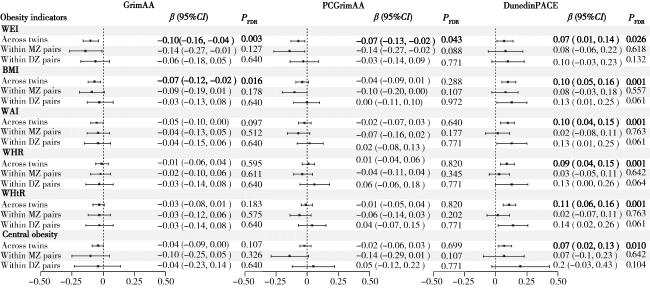
在双生子对内相关性分析中,本研究共纳入同卵双生子380对,异卵双生子155对。由于同卵双生子对内性别、实足年龄、全部遗传因素和早期家庭环境因素匹配,异卵双生子对内实足年龄、部分遗传因素匹配,本研究进一步探索在控制双生子对内共享的混杂因素后,肥胖相关指标与DNA甲基化时钟指标的相关性。同卵与异卵双生子对内分析中,全部DNA甲基化时钟指标与肥胖指标相关性均未见统计学显著性,提示这些相关性可能受到双生子共享的遗传或环境因素影响(图 1)。
图1 全部双生子与对内分析中GrimAA、PCGrimAA和DunedinPACE与肥胖相关指标的横断面相关性

Figure 1 Cross-sectional correlation between GrimAA, PCGrimAA, DunedinPACE and obesity indicators in all twins and within-pair analysis

WEI, weight; BMI, body mass index; WAI, waist circumference; WHR, waist-hip ratio; WHtR, waist-height ratio; MZ, monozygotic twins; DZ, dizygotic twins; GrimAA, GrimAge acceleration; PCGrimAA, principle component GrimAA; β, regression coefficient; CI, confidence interval; FDR, false discovery rate.

2.3 肥胖与DNA甲基化时钟指标的纵向时序关系

本研究利用研究人群2的纵向数据,分别在全部双生子、同卵和异卵双生子对中进行交叉滞后分析,探究肥胖相关指标与DNA甲基化时钟的时间顺序关系。全部双生子分析发现,基线时的体重与随访时的GrimAA之间,基线时的体重、BMI、腰围与随访时的PCGrimAA之间,以及基线时的腰臀比与随访时的DunedinPACE之间的关联均具有统计学显著性(表 4)。异卵双生子对内分析发现,基线时腰臀比可能影响随访时的DunedinPACE。同卵双生子对内分析中未发现统计学显著交叉滞后关系,提示共享的遗传或环境因素可能会对肥胖相关指标与DNA甲基化时钟指标的交叉滞后效应产生影响。
表4 双生子肥胖相关指标与DNA甲基化时钟指标交叉滞后关联

Table 4 Cross-lagged relationships between obesity indicators and DNAm clock metrics

Characteristics Obesity indicators at baseline → DNAm clock metrics at follow-up DNAm clock metrics at baseline → Obesity indicators at follow-up Fit statistics
ρ1 PFDR ρ2 PFDR SRMR CFI
GrimAA
Weight 0.04 0.035 0.02 0.996 0.04 0.96
BMI 0.05 0.414 0.01 0.996 0.05 0.94
Waist circumference 0.03 0.250 0.01 0.996 0.05 0.92
Waist-hip ratio 2.46 0.414 0.00 0.996 0.05 0.88
Waist-height ratio 0.08 0.974 0.00 0.996 0.05 0.92
PCGrimAA
Weight 0.03 < 0.001 0.00 0.966 0.01 1.00
BMI 0.07 0.022 0.01 0.966 0.02 0.99
Waist circumference 0.02 0.040 0.02 0.966 0.02 0.98
Waist-hip ratio 0.95 0.542 0.00 0.966 0.03 0.97
Waist-height ratio 1.99 0.226 0.00 0.966 0.02 0.99
DunedinPACE
Weight 0.00 0.310 -1.06 0.999 0.02 1.00
BMI 0.00 0.310 0.14 0.999 0.02 1.00
Waist circumference 0.00 0.088 0.01 0.999 0.02 0.99
Waist-hip ratio 0.17 0.030 0.02 0.999 0.03 0.98
Waist-height ratio 0.12 0.088 0.01 0.999 0.02 1.00

DNAm, DNA methylation; GrimAA, GrimAge acceleration; PCGrimAA, principle component GrimAA; BMI, body mass index;FDR, false disco-very rate; SRMR, standard root mean square residual; CFI, compare fitting indices.

3 讨论

本研究基于中国双生子登记系统专题调查招募的成年双生子,探究中国成年双生子人群中肥胖与DNA甲基化时钟的关系。本研究使用混合效应模型探究肥胖指标与DNA甲基化时钟间的横断面相关关系,使用交叉滞后模型探究二者间的纵向时序关系;利用双生子人群遗传信息匹配的特点,在全部双生子、同卵和异卵双生子中分别进行上述分析,并比较其结果,探究肥胖相关指标与DNA甲基化时钟指标间的关联是否受到共享的遗传或环境因素影响。
横断面分析结果显示,肥胖相关指标(体重、BMI、腰围等)与DNA甲基化时钟(GrimAA、PCGrimAA和DunedinPACE)之间存在一定的相关性:GrimAA、PCGrimAA与体重和BMI呈负相关,这或许解释了在外貌上肥胖个体往往看起来更显年轻的假象,但是如果关注衰老速度或者利用纵向数据,研究结果不再呈现横断面分析的结果。这可能是由于横断面研究存在局限性:横断面研究只能提供某一时点的数据,无法揭示时序关系和因果关系;此外,横断面数据无法充分控制混杂因素,可能导致虚假关联;更重要的是,横断面研究忽略了肥胖对衰老的长期影响,可能未能捕捉到肥胖对衰老速度的实际影响。
DunedinPACE时钟基于衰老相关表型的纵向变化率训练,用于表征某一时间点的衰老速度,在横断面分析中与多个肥胖指标(体重、BMI、腰围、腰臀比、腰高比、中心性肥胖)均呈正相关。本研究结果支持了肥胖通过改变基因甲基化模式进而加速衰老进程的假设。多项基于成年人群开展的既往研究指出,肥胖与DNA甲基化时钟加速相关。一项基于中国台湾人群的研究发现,肥胖指标(如BMI、腰围、臀围等)与表观遗传时钟加速显著相关。男性的腰臀比与PhenoAA和GrimAA显著相关,而女性的BMI与PhenoAA和GrimAA显著相关[14]。一项系统综述和meta分析发现,BMI与DNA甲基化时钟显著正相关,表明肥胖可能加速生物学年龄[19]。在一项研究中,非洲裔美国女性的高BMI与唾液样本中的DNA甲基化时钟加速显著相关[20]
纵向分析结果显示,基线时的肥胖指标(体重、BMI、腰围等)可能对随访时的DNA甲基化时钟产生一定的影响,具体而言,基线时的体重与随访时的GrimAA之间,基线时的体重、BMI、腰围与随访时的PCGrimAA之间,以及基线时的腰臀比与随访时的DunedinPACE之间均有正向关联。这一发现进一步支持了肥胖作为衰老加速因素的假设,即肥胖可能通过表观遗传改变加速衰老过程。多数既往研究结果也支持肥胖是DNA甲基化时钟改变的原因这一结论。Sun等[21]的研究表明,肥胖是位点DNA甲基化水平变化的原因,而不是结果;通过对不同种族的纵向队列研究,他们发现基线BMI与随访时的DNA甲基化水平之间存在显著的单向交叉滞后关系,而基线DNA甲基化水平对随访时的BMI没有显著影响。Etzel等[22]的研究显示,肥胖与加速的表观遗传时钟之间存在关联,在儿童虐待高风险队列中,较高的BMI与多种表观遗传时钟加速指标(如GrimAge和DunedinPoAm)呈正向相关,这表明肥胖可能在早期生活中就开始影响表观遗传时钟。此外,Li等[23]的双向孟德尔随机化研究进一步支持了肥胖与表观遗传时钟加速之间的因果关系,他们发现肥胖与HannumAge、GrimAge和PhenoAge的加速以及端粒长度缩短之间存在强烈的因果关联。
基于双生子人群,通过比较同卵和异卵双生子之间的差异,能够揭示遗传和环境因素在肥胖与衰老关系中的作用。结果显示,尽管在全部双生子的横断面相关性分析和纵向交叉滞后分析中观察到部分肥胖指标与DNA甲基化时钟加速间存在关联,但在双生子对内分析中,除异卵双生子对内交叉滞后分析中基线腰臀比与随访DunedinPACE正向相关外,其余关联均不再具有统计学差异。这说明,共享的遗传和环境因素在肥胖与DNA甲基化时钟加速之间的关联中起到了重要作用。尽管遗传因素在肥胖与DNA甲基化时钟加速之间的关联中起着重要作用,但有研究表明,肥胖与DNA甲基化时钟加速之间的显著关联在控制遗传因素后仍然存在。例如,Lundgren等[24]的研究发现,在BMI不一致的同卵双生子中,体重较大者的DNA甲基化时钟比体重较小者增加约5.2个月,表明这种关联并非完全由遗传因素驱动。Föhr等[25]基于芬兰双生子登记系统的研究发现,代谢综合征与DNA甲基化时钟加速的关联在调整生活方式因素后仍然显著,且遗传因素在这种关联中起到了部分解释作用。本研究并未验证上述研究的结果,一方面可能由于样本量的损失使得关联的显著性减弱,另一方面可能遗传和环境在其中确实起着至关重要的作用。未来还需要更多的双生子研究来进一步探索该领域。
现有研究普遍认为肥胖与衰老密切相关,二者共享许多生物学机制,包括基因组完整性受损、线粒体功能障碍、细胞内大分子积累、免疫力减弱、组织和身体成分的变化以及系统性炎症增加。肥胖可能通过多种上述机制加速衰老过程,例如DNA甲基化模式的改变、端粒缩短和系统性炎症[26-27]。肥胖和衰老都与慢性低度炎症有关,这种炎症状态与多种衰老表型相关,不仅会导致肌肉质量下降、蛋白质控制机制受损以及肌肉合成反应减弱,还会加速端粒缩短、增加氧化应激、促进细胞衰老。此外,肥胖和衰老都与白色脂肪组织功能障碍有关,这种功能障碍会导致代谢异常、多器官损伤和系统性炎症状态。肥胖还会加剧与年龄相关的身体功能下降,导致虚弱和残疾[28-29]
本研究具有一定的公共卫生学意义。DNA甲基化时钟作为一种重要的衰老生物标志物,已被广泛关注,并与多种年龄相关疾病,包括心血管疾病、癌症和阿尔茨海默病(Alzheimer disease, AD)等密切相关。肥胖作为一种全球流行的健康问题,与衰老进程和多种慢性病的发生密切联系,然而肥胖与DNA甲基化时钟之间的因果关系及时序性尚不清晰。探讨肥胖与DNA甲基化时钟之间的关系,有助于评估是否可以通过控制肥胖来延缓衰老过程,或是否通过干预衰老能有效预防肥胖相关疾病,并为理解衰老与肥胖之间共同的生物学机制提供新的线索。
然而,本研究也存在一些局限性:(1)DNA甲基化存在组织特异性,脂肪、肌肉组织的DNA甲基化信息与肥胖表型直接相关,而本研究基于外周血样本开展,存在一定的局限性;(2)本研究发现的肥胖指标与DNA甲基化时钟间的纵向时序关系结果仅基于中国成年双生子人群,尚未在其他人群进行验证,可能无法推广至其他人群。未来的研究应基于不同的人群和组织类型开展,以探索肥胖与衰老加速之间的关系是否存在差异;并整合多组学数据(如代谢组学、蛋白质组学等),探究不同的衰老生物标志物与肥胖间的关系,帮助揭示肥胖与衰老之间相互作用的多途径的生物学机制。
总体而言,本研究为肥胖与DNA甲基化时钟之间的关系提供了新的证据,并为将来进一步探索肥胖与衰老机制的研究奠定了基础。未来的研究可以继续深化这一领域,以便为公共卫生干预策略、衰老管理和疾病预防提供更加科学的实证支持。

利益冲突  所有作者均声明不存在利益冲突。

作者贡献声明  高文静:提出研究思路,审定论文;高汝钦、俞敏、周金意、吴先萍、刘彧:调查和收集数据;曹卫华、吕筠、余灿清、黄涛、孙点剑一、廖春晓、庞元捷、胡润华:审定论文;李立明:论文总体把关,项目管理,资金筹措;刘顺恺:分析、整理数据,撰写论文。

1
Rutledge J , Oh H , Wyss-Coray T . Measuring biological age using omics data[J]. Nat Rev Genet, 2022, 23 (12): 715- 727.

DOI

2
Levine ME . Modeling the rate of senescence: Can estimated biological age predict mortality more accurately than chronological age?[J]. J Gerontol A Biol Sci Med Sci, 2013, 68 (6): 667- 674.

DOI

3
Lu AT , Quach A , Wilson JG , et al. DNA methylation GrimAge strongly predicts lifespan and healthspan[J]. Aging, 2019, 11 (2): 303- 327.

DOI

4
Belsky DW , Caspi A , Corcoran DL , et al. DunedinPACE, a DNA methylation biomarker of the pace of aging[J]. ELife, 2022, 11, e73420.

DOI

5
Higgins-Chen AT , Thrush KL , Wang Y , et al. A computational solution for bolstering reliability of epigenetic clocks: Implications for clinical trials and longitudinal tracking[J]. Nat Aging, 2022, 2 (7): 644- 661.

DOI

6
Pang APS , Higgins-Chen AT , Comite F , et al. Longitudinal study of DNA methylation and epigenetic clocks prior to and following test-confirmed COVID-19 and mRNA vaccination[J]. Front Genet, 2022, 13, 819749.

DOI

7
Faul JD , Kim JK , Levine ME , et al. Epigenetic-based age acce-leration in a representative sample of older Americans: Associations with aging-related morbidity and mortality[J]. Proc Natl Acad Sci USA, 2023, 120 (9): e2215840120.

DOI

8
Xu S , Lu F , Gao J , et al. Inflammation-mediated metabolic regulation in adipose tissue[J]. Obes Rev, 2024, 25 (6): e13724.

DOI

9
Xu L , Yan X , Zhao Y , et al. Macrophage polarization mediated by mitochondrial dysfunction induces adipose tissue inflammation in obesity[J]. Int J Mol Sci, 2022, 23 (16): 9252.

DOI

10
Kitada M , Koya D . Autophagy in metabolic disease and ageing[J]. Nat Rev Endocrinol, 2021, 17 (11): 647- 661.

DOI

11
Grun LK , Teixeira NDR Jr , Mengden LV , et al. TRF1 as a major contributor for telomeres' shortening in the context of obesity[J]. Free Radic Biol Med, 2018, 129, 286- 295.

DOI

12
Gielen M , Hageman GJ , Antoniou EE , et al. Body mass index is negatively associated with telomere length: A collaborative cross-sectional meta-analysis of 87 observational studies[J]. Am J Clin Nutr, 2018, 108 (3): 453- 475.

DOI

13
Blüher M . An overview of obesity-related complications: The epidemiological evidence linking body weight and other markers of obesity to adverse health outcomes[J]. Diabetes Obes Metab, 2025, 27 (Suppl 2): 3- 19.

14
Lin WY , Wang YC , Teng IH , et al. Associations of five obesity metrics with epigenetic age acceleration: Evidence from 2, 474 Taiwan Biobank participants[J]. Obesity (Silver Spring), 2021, 29 (10): 1731- 1738.

DOI

15
Kresovich JK , Garval EL , Martinez Lopez AM , et al. Associations of body composition and physical activity level with multiple mea-sures of epigenetic age acceleration[J]. Am J Epidemiol, 2021, 190 (6): 984- 993.

DOI

16
Gao W , Cao W , Lv J , et al. The Chinese National Twin Registry: A 'gold mine' for scientific research[J]. J Intern Med, 2019, 286 (3): 299- 308.

DOI

17
中华人民共和国卫生和计划生育委员会. WS/T428-2013成人体重判定[S]. 北京: 中国标准出版社, 2013.

18
Wang B , Gao W , Yu C , et al. Determination of zygosity in adult Chinese twins using the 450K methylation array versus questionnaire data[J]. PLoS One, 2015, 10 (4): e0123992.

DOI

19
Ryan J , Wrigglesworth J , Loong J , et al. A systematic review and meta-analysis of environmental, lifestyle, and health factors asso-ciated with DNA methylation age[J]. J Gerontol A Biol Sci Med Sci, 2020, 75 (3): 481- 494.

DOI

20
Li C , Wang Z , Hardy T , et al. Association of obesity with DNA methylation age acceleration in African American mothers from the InterGEN Study[J]. Int J Mol Sci, 2019, 20 (17): 4273.

DOI

21
Sun D , Zhang T , Su S , et al. Body mass index drives changes in DNA methylation: A longitudinal study[J]. Circ Res, 2019, 125 (9): 824- 833.

DOI

22
Etzel L , Hastings WJ , Hall MA , et al. Obesity and accelerated epigenetic aging in a high-risk cohort of children[J]. Sci Rep, 2022, 12 (1): 8328.

DOI

23
Li J , Wang W , Yang Z , et al. Causal association of obesity with epigenetic aging and telomere length: A bidirectional mendelian randomization study[J]. Lipids Health Dis, 2024, 23 (1): 78.

DOI

24
Lundgren S , Kuitunen S , Pietiläinen KH , et al. BMI is positively associated with accelerated epigenetic aging in twin pairs discor-dant for body mass index[J]. J Intern Med, 2022, 292 (4): 627- 640.

DOI

25
Föhr T , Hendrix A , Kankaanpää A , et al. Metabolic syndrome and epigenetic aging: A twin study[J]. Int J Obes (Lond), 2024, 48 (6): 778- 787.

DOI

26
Tzanetakou IP , Katsilambros NL , Benetos A , et al. 'Is obesity linked to aging?': Adipose tissue and the role of telomeres[J]. Ageing Res Rev, 2012, 11 (2): 220- 229.

DOI

27
Tam BT , Morais JA , Santosa S . Obesity and ageing: Two sides of the same coin[J]. Obes Rev, 2020, 21 (4): e12991.

DOI

28
Pérez LM , Pareja-Galeano H , Sanchis-Gomar F , et al. 'Adipa-ging': Ageing and obesity share biological hallmarks related to a dysfunctional adipose tissue[J]. J Physiol, 2016, 594 (12): 3187- 3207.

DOI

29
Reyes-Farias M , Fos-Domenech J , Serra D , et al. White adipose tissue dysfunction in obesity and aging[J]. Biochem Pharmacol, 2021, 192, 114723.

DOI

Outlines

/