
腹腔镜下经胆囊管胆管引流术(简称C管技术)主要用于减压胆道以减少胆漏,具有创伤小和早期拔管的优点[1]。然而,部分研究认为C管技术易脱落及存在相关风险,不建议普遍采用[2]。本课题组认为C管技术的不足可能与C管的固定方式等因素有关,课题组在使用C管技术的过程中进行了改良,使C管固定更加可靠不易脱落,初步表明了其安全性[3],同时拓展了C管技术的应用领域,不单纯应用于胆道引流,还增加了辅助局部药物排石及十二指肠镜取石过程中内镜下逆行胰胆管造影(endoscopic retrograde cholangiopancreatography,ERCP)辅助插管取石的功能[4]。现对北京大学第三医院2021年8月至2023年12月采用改良C管技术的全部68例患者病例资料进行回顾性分析,进一步证明其安全性,同时探讨其应用领域及使用过程中的注意事项。
1 资料与方法
1.1 一般资料
选择2021年8月至2023年12月于北京大学第三医院,行腹腔镜下改良C管技术治疗胆总管结石及可疑胆总管结石的全部患者的病例资料,进行回顾性分析,共68例患者纳入本研究,患者年龄18~88岁,男性40例,女性28例,其中46例患者为急性胆管炎就诊患者。所有患者术前行磁共振胰胆管成像(magnetic resonance cholangiopancreatography,MRCP)检查评估胆道解剖变异及结石特点。本研究开始前已经北京大学第三医院医学伦理委员会审查批准(M2022669)。
1.2 手术方法
患者全身麻醉,采用四孔法行腹腔镜胆囊切除,经胆囊管行胆总管取石或胆总管切开取石,条件允许的情况下进一步行胆道镜检查评估有无结石残余及胆总管远端开口通畅性,上述过程完成后经胆囊管置入胆道引流管,即C管,胆总管切开处可吸收线连续缝合关闭。
改良C管置入途径及方法[3]:(1)采用7F(3F=1 mm)三腔中心静脉导管或5F单腔输尿管导管支架管作为C管(根据胆囊管直径及术者偏好选择,胆囊管直径2 mm以下首选5F单腔输尿管导管);(2)改良C管置入点优选腋中线肋弓与髂嵴之间,结合腹腔镜下升结肠位置适度调整置入点腹背位置,以不伤及升结肠为第一原则,置入后沿右结肠旁沟及肝下经胆囊管置入胆总管,固定于胆囊管保留侧;(3)胆囊管置入C管后,除根部结扎外,采用倒刺线连续重叠缝合切开胆囊管壁,形成3~5 mm左右组织窦道,根据固定程度环绕胆囊管缝合(固定程度以拉动C管时C管无移位同时带动胆囊管移位,在此基础上稍加力量可以引起C管移位);对于胆囊三角炎症反应重无法环周游离胆囊管的患者,仅采用倒刺线连续重叠缝合切开的胆囊管壁。常规于Winslow孔处放置腹腔引流管。
1.3 改良C管固定方法原理及离体胆囊验证试验
考虑改良C管技术的拔管时间为7 d左右,其固定技术的原理为缝合形成的组织窦道拔管后自行闭合,不同于T管的窦道形成,采用离体胆囊进行了验证。改良C管固定方法原理为两处固定区域在C管拔出后支撑消失,导致位于同一直线上的两个窦道错位挤压使缝合形成的组织窦道闭合,同时固定区域的胆囊管壁也会回弹封闭窦道。
1.4 术后处理及并发症定义
观察C管及腹腔引流管情况,有无导管外脱、堵塞及引流量的变化。观察患者腹部症状和体征,注意有无腹膜刺激征。改良C管技术早期阶段术后第3~6天行经C管胆道造影,造影显像正常患者,术后7 d左右拔除C管,C管拔除后当天或次日拔除腹腔引流管。C管技术后期阶段,部分患者术后第1~2天行经C管胆道造影,造影显像正常患者,夹闭C管无不适,C管造影当天或次日拔除腹腔引流管,患者带夹闭C管出院,门诊复诊时拔除C管。依术者偏好,部分患者进行了经C管胆汁淀粉酶测定及胆道测压。
1.5 随访方法
采用电话和门诊随访的方法,询问有无腹痛、发热及黄疸,门诊就诊时化验检查评估肝功能,彩色多普勒超声检查或MRCP评估胆道情况,末次随访时间为2024年2月。
2 结果
2.1 临床资料
68例患者中,42例患者为复杂胆管结石,6例为可疑胆总管结石,5例为肝外胆管结石合并肝内胆管结石(多发胆总管结石延续至肝内胆管或原发肝内胆管结石);46例急性胆管炎就诊患者中26例合并梗阻性黄疸,其中1例术中证实为胆道铸型。
2.2 改良C管固定方法原理的离体胆囊验证
改良C管的固定程度以拉动C管时C管无移位同时带动胆囊管移位,在此基础上稍加力量可以引起C管移位,采用离体胆囊证实该固定强度可以抵抗胆囊自身质量(图 1)。
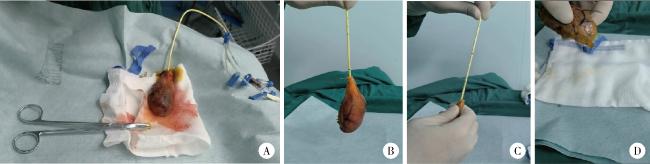


图1 改良C管固定方法缝合强度及组织窦道闭合离体胆囊验证Figure 1 In vitro gallbladder validation of modified C-tube fixation method for suturing strength and tissue sinus closure A, 7F triple lumen central venous catheter placement and suturing status in vitro gallbladder; B, the gallbladder has no slip at the fixed position of the catheter under the action of gravity; C, the C-tube was lifted, slightly more force was added, and the catheter could be pulled out slightly; D, after removing the catheter, there is no bile leakage. |
采用3例离体胆囊进行验证,在即刻拔除C管后均无胆汁流出(胆囊底位于上端,胆囊管位于下端的情况下,闭合的组织窦道可以对抗重力所致的胆汁流出),采用挤压胆囊才可见胆汁流出(图 1),这也提示对于胆总管下端梗阻未解除的患者须密切管理C管通畅性及注意拔管时机。
2.3 手术及术后情况
68例患者均顺利完成腹腔镜下胆道探查或引流术及胆囊切除术,其中11例C管采用5F单腔输尿管导管,57例C管采用7F三腔中心静脉导管;48例行胆道镜辅助下胆总管切开取石,10例行胆道镜辅助下经胆囊管取石,6例行经胆囊管网篮探查取石[其中3例取出结石数目与术前MRCP一致,其余3例未取出明确结石,这6例患者术后造影发现5例患者术后无结石残余,1例可疑结石残余(患者无症状拒绝进一步检查和治疗)],4例仅行经胆囊管胆道引流(急诊手术无胆道探查取石条件,仅行腹腔镜下改良C管引流减压及胆囊切除术);本组行网篮探查取石及单纯胆道引流的10例患者中,8例胆总管直径小于7 mm。
67例患者(1例患者数据缺失)手术时间(131±44) min(76~279 min),C管单日最大引流量(401±235) mL(10~1 150 mL),住院时间(8.6± 3.6) d (2~19 d),C管拔管时间(11±7) d (5~46 d),其中33例患者门诊拔C管,此部分患者住院时间(6.7±3.0) d (2~19 d),拔管时间(12.6±8.0) d (6~46 d)。
63例患者采用倒刺线环绕缝合固定的方法固定,5例胆囊管无法完全游离仅采用连续缝合固定;4例患者C管早期脱落(其中3例因胆囊管无法完全游离仅采用连续缝合固定,1例患者身高187 cm,C管固定处与体壁固定处张力偏大),这4例C管早期脱落患者中,除1例残余结石患者胆漏行ERCP治疗,其余3例患者无并发症。
本组68例患者中,除1例术后早期脱落患者无法造影评估胆道有无结石残余及通畅性,67例患者均行造影评估。5例存在造影过程中造影剂流出缓慢的现象(注入造影剂1 min以上未流入十二指肠);2例患者C管移位,造影时仅1~2个引流孔道在胆道内,4例患者C管置入过深,造影时最远端孔道在十二指肠腔内,均无并发症且不影响引流效果。
2.4 拓展应用
2例术后残余结石患者行C管辅助下硝酸甘油辅助排石成功,7例残余结石患者行C管辅助下ERCP取石(包括4例无术中探查取石条件的患者、1例嵌顿结石取石失败和2例残余结石的患者)。
8例患者经胆囊管行胆总管测压(11~28 cmH2O,1 cmH2O=98 Pa),其中2例原发性胆总管结石测压患者胆道压力明显升高(分别为24和26 cmH2O)。55例患者行C管淀粉酶测定,意外发现9例胆汁淀粉酶明显升高(349~44 936 U/L),考虑存在胰胆反流。通过术后C管造影发现4例胆胰合流异常患者,包括1例造影符合胆胰合流异常但C管淀粉酶不高的患者(该患者复测2次均不高,因此不考虑测量误差)。
2.5 围术期并发症及C管相关不良事件
围术期总体并发症14例,2例残余结石(择期行ERCP取石),其余C管相关并发症12例,包括Ⅲa级1例(残余结石致胆漏行ERCP治疗),Ⅱ级2例(1例胆管内大量沥青样胆泥及絮状物致胆漏行硝酸甘油经C管注入局部辅助排石治疗,1例胆管铸型结石致胆漏发热行药物治疗);Ⅰ级9例(拔管后一过性发热1例,行CT检查未见胆漏,观察1 d,次日出院;C管体壁固定处皮肤红肿1例;拔管后一过性疼痛7例,持续5~10 min,其中2例行CT检查未见异常,均自行缓解未进一步治疗)。
通过术后造影发现未造成并发症的C管相关不良事件9例,包括早期脱落3例,移位2例,置入过深4例。
2.6 68例患者的随访情况
术后中位随访时间21(2~30)个月,所有患者术后1个月肝功能均恢复正常,彩色多普勒超声检查或MRCP检查5例患者再发结石,该5例患者造影时确认无残余结石,考虑为原发性胆总管结石,其余患者术后门诊随访无结石复发征象。
3 讨论
肝外胆管结石的微创治疗方法多样,主要包括腹腔镜手术取石、内镜取石和药物排石3种,各种方式都有不足。T管引流和经内镜鼻胆管引流是弥补手术和内镜治疗的重要手段,但患者不适明显,尚缺乏一种普遍有效且舒适度更好的治疗手段弥补现有3种主要治疗方式的不足。微创手术治疗胆总管结石如何保障其安全及发挥其作用亦存在诸多探索,本课题组在腹腔镜胆道手术的基础上引入改良C管技术。C管技术即经胆囊管胆管引流术,主要用于替代T管的引流功能。传统C管技术采用单腔硅胶细软管或5F输尿管支架管,大多数采用钛夹或结扎固定,经锁骨中线与肋缘下交界处引出体外,易脱落,且5F单腔C管较7F三腔C管功能更单一。本课题组对传统C管的固定方法和走向进行改良,并采用功能较多的引流管(三腔中心静脉导管)治疗复杂胆总管结石,初步表明其安全有效[3]。课题组进一步通过离体胆囊验证了该改良固定方法的原理及有效性,更重要的是改良C管技术可以协助应用于上述三种治疗方式,弥补其不足。在手术治疗过程中替代T管,可以早期拔管;在内镜治疗过程中通过引入导丝辅助十二指肠镜下插管,增加插管成功率;在药物排石过程中,通过C管局部用药辅助排石,还能减少排石过程中胰腺炎或胆管炎的发生。该组数据表明腹腔镜改良C管技术可以有效实现上述功能,且相对安全,仅1例患者发生需内镜干预的并发症,较胆总管一期缝合或T管引流的严重并发症发生率相对较低[5]。
在充分发挥传统C管主要用于引流减压胆道以减少胆漏的基础上,本组数据表明腹腔镜下改良C管技术可以广泛应用于胆石症的微创治疗。本组68例患者中,46例因急性胆管炎就诊,其中26例合并梗阻性黄疸,该类患者常需胆道引流,包括T管或鼻胆管引流,患者不适明显,本组采用改良C管技术引流效果良好,单日最大引流量(401±235) mL(10~1 150 mL),但本组患者中2例出现胆漏,包括1例胆道铸型所致急性胆管炎患者和1例胆道大量沥青样结石患者,发现胆漏及C管引流效果不良后经C管行硝酸甘油胆道冲洗可有效补救,提示此类患者在采用C管引流时需慎重,此2例患者采用三腔中心静脉导管引流,体现了多腔道引流的必要性(既可以减少引流孔堵塞,又可以在引流的同时增加冲洗功能)。42例患者为复杂胆管结石,复杂胆管结石手术困难、风险高,常常需要T管引流[6],本课题组在前期研究表明,改良C管技术可以安全有效地应用于复杂胆管结石的微创治疗,避免了T管引流的不适及风险,本组数据进一步验证了C管技术对于复杂胆管结石微创治疗的有效性。6例为可疑胆总管结石,均为急诊患者,其中3例胆管纤细,可疑胆总管结石患者常先采用ERCP治疗,增加了患者风险和费用,本课题组尝试采用经胆囊管网篮盲法取石或单纯胆道引流术,术后造影仅1例残存结石,行二期ERCP取石,减少了术前ERCP取石的风险,值得进一步探索研究。5例肝外胆管结石合并肝内胆管结石患者在胆道镜探查过程中发现无胆管狭窄,且2例为胆固醇结石(考虑低磷脂相关胆石症),仅行胆道镜取石治疗,未行肝切除,对于胆固醇结石患者术后辅以熊去氧胆酸治疗预防结石复发,短期效果良好,避免了肝切除。
另外,腹腔镜下改良C管技术对胆道疾病的诊断可提供帮助。本组68例患者中,5例术后半年左右发生结石复发,考虑为原发胆总管结石。原发胆总管结石的诊断主要依据胆总管直径和胆总管结石的特点,缺乏特异性[7]。此5例患者中4例存在造影过程中造影剂流出缓慢的现象(注入造影剂1 min以上未流入十二指肠),2例测压患者胆道压力明显升高(分别为24和26 cmH2O),提示胆道测压和动态监测评估括约肌功能可能为原发性胆总管结石的诊断提供新的线索。另外通过术后C管造影及胆汁淀粉酶检测,意外发现9例胰胆反流患者,大多术前影像未提示胆胰合流异常,说明C管可用于协助诊断胰胆反流,进一步证实关注隐匿性胰胆反流的重要性,考虑胰胆反流患者肝外胆管肿瘤的潜在风险,应加强随访[8]。本研究还发现1例影像征象符合胆胰合流异常但两次淀粉酶测定都不高的患者,考虑与本例患者Oddi括约肌松弛,造影剂流出通畅有关,这提示在胆胰合流异常的治疗决策过程中要重视淀粉酶浓度的测定,慎重仅依据影像标准制定治疗决策。上述现象为进一步拓展改良C管技术的诊断功能提供了线索。
尽管腹腔镜改良C管技术在一定程度上减少了C管意外脱落的风险,但本组仍有3例患者发生早期脱落,值得关注。C管可能脱落的原因及改进措施如下:(1)3例患者中2例胆囊三角区炎症重,无法进行环绕缝合固定,固定欠稳妥,考虑此为原因之一,此情况下需慎重采用改良C管技术,尤其对于有胆道梗阻隐患的患者,我们已设计了应用于此场景的C管,可以减少脱落风险;(2)C管引出路径改为后腹膜路径后虽然没有了前腹壁肋弓的挤压,但仍存在肝右缘或侧腹壁肋弓挤压的可能,本组1例患者,术后脱落CT复查考虑与此有关,目前采用气腹前定位穿刺孔及术中评估肝右下缘与引流管路径的方法减少挤压脱落的风险;(3)1例环绕缝合固定的患者身高187 cm,30 cm长的C管相对长度不够,导致C管胆囊管固定处与体壁引出处张力大,且患者为嵌顿结石,术中采用了活检钳夹碎结石的操作,导致残余小结石堵塞胆总管远端,C管脱落后胆漏,此情况下需慎重采用改良C管技术。除此之外,本组数据有7例患者出现拔管后一过性疼痛,虽然基本都自行缓解,但值得重视,4例患者存在造影剂流出不畅或胰胆反流,另有3例患者虽不存在上述原因,考虑为经胆囊管取石,胆囊管残端保留过短不能形成有效的组织窦道长度。鉴于此,对于造影剂流出不畅、胰胆反流或胆囊管残端保留过短不能形成有效的组织窦道长度的患者可适当延长拔管时间,以加强周围网膜组织的包裹。
本研究存在一定局限性,研究为回顾性,且病例数较少,手术安全性及效果仍有待证实,增加患者数量以进一步验证改良C管技术联合腹腔镜胆总管探查取石术可行性的前瞻性队列研究正在进行中。
综上所述,本组数据表明腹腔镜下改良C管技术可以有效应用于肝外胆石症的治疗,并可尝试在部分胆道疾病的诊断中进行应用,近期效果良好。