Application of combined detection of inflammatory indexes and cytokines in chronic periodontitis

  • Zhenying BAO 1 ,
  • Yajie WANG , 2, *
Expand
  • 1. Department of Clinical Laboratory, Peking University School and Hospital of Stomatology & National Center for Stomatology & National Clinical Research Center for Oral Diseases & National Engineering Research Center of Oral Biomaterials and Digital Medical Devices, Beijing 100081, China
  • 2. Department of Clinical Laboratory, Beijing Ditan Hospital, Capital Medical University, Beijing 100015, China
WANG Yajie, e-mail,

Received date: 2022-10-25

  Online published: 2025-08-02

Copyright

All rights reserved. Unauthorized reproduction is prohibited.

Abstract

Objective: To analyze the inflammatory indexes and cytokines levels in serum and saliva of patients with chronic periodontitis (CP), and to explore the value of single index or multiple indexes combined detection in the clinical diagnosis and treatment of CP. Methods: The serum and saliva specimens of 42 CP patients and 38 periodontal healthy people admitted to the Department of Periodontology in Peking University Hospital of Stomatology were detected by inflammatory indexes and cytokines. According to clinical periodontal parameters, CP patients were performed by clinical staging, and the correlation between inflammatory indexes and cytokines levels and the severity of CP was analyzed. To evaluate the levels of inflammatory indexes and cytokines in serum and saliva samples in the periodontal health group and CP group. Three inflammatory indexes were involved in this study: C-reactive protein (CRP), serum amyloid A (SAA), procalcitonin (PCT); and 12 cytokines: Interleukin (IL)-1β, IL-2, IL-4, IL-5, IL-6, IL-8, IL-10, IL-12P70, IL-17, interferon (IFN)-α, IFN-γ, and tumor necrosis factor α (TNF-α). The Spearman correlation statistical method was used to analyze the correlation between the levels of inflammatory indexes and cytokines and the severity of chronic periodontitis. Mann-Whitney U test was used to identify the indicators with differences between the groups, the optimal indicators were identified through binary Logistic regression analysis with stepwise selection, and the area under the curve (AUC) of receiver operating characteristic (ROC) was used to evaluate the diagnostic efficiency. Results: By testing the levels of inflammatory markers and cytokines in patients with chronic periodontitis with dif-ferent clinical stages, it was found that CRP, SAA, IL-8 in serum and IL-1β, IL-6, IL-8, IL-12P70, IL-17, TNF-α in saliva were significantly positively correlated with the severity of chronic periodontitis. Compared with the periodontal healthy group, the serum levels of CRP, SAA, IL-2, IL-5, IL-8, IL-12P70, IL-17 and IFN-α in the CP group were significantly increased (All P < 0.05). The AUC of SAA, IL-2, IL-8, IL-12P70, IL-17, IFN-α, combination 1 (IL-2+IL-8) and combination 2 (CRP+SAA+IL-12P70) were >0.7, and the AUC of combination 2 (0.998) was the highest, with high sensitivity (97.6%) and specificity (97.4%). The levels of IL-1β, IL-6, IL-8 and IL-12P70 in the saliva of the CP group were significantly higher than those in the periodontal healthy group, while the levels of IL-4 in the saliva were significantly lower than those in the periodontal healthy group (All P < 0.05). The AUC of IL-6, IL-8 and combination 3 (IL-4+IL-6+IL-8) were >0.7, and the AUC of combination 3 (0.852) was the highest. In the comparative analysis of diagnostic efficacy between single index and multi-index combined, combination 2, combination 1, and serum IL-8 demonstrated the highest AUC values (ranked top 3), with multi-index combinations exhibiting superior discriminative power over single index. Conclusion: Serum levels of IL-8, CRP, SAA, and salivary levels of IL-1β, IL-6, IL-8, and other indicators may be helpful for the clinical diagnosis and treatment of CP. Serum IL-8 and multiple indicators may be used as an auxiliary diagnostic indice to identify CP.

Cite this article

Zhenying BAO , Yajie WANG . Application of combined detection of inflammatory indexes and cytokines in chronic periodontitis[J]. Journal of Peking University(Health Sciences), 2025 , 57(4) : 772 -778 . DOI: 10.19723/j.issn.1671-167X.2025.04.023

慢性牙周炎是由细菌侵犯牙周组织而引起的慢性炎症性疾病,其发病、进展及严重程度受微生物、遗传和环境因素共同影响,并与牙周微生物与宿主免疫反应的相互作用密切相关[1-3]。慢性牙周炎可导致牙周支持组织,包括牙龈、牙周膜、牙槽骨和牙骨质的破坏,以及牙周袋形成、附着丧失和牙槽骨的吸收[4],最终可导致牙齿丧失,严重影响患者的进食和生活质量。目前临床上对于慢性牙周炎的诊断方法主要是医生使用牙周探针对牙周组织进行检查和评估,这种侵入性检查方法会给患者带来不适感,因此,开发一种慢性牙周炎临床诊疗的无创检测方法已成为临床的迫切需求。
目前已有研究分析了慢性牙周炎与某些炎症指标或细胞因子的相关性,但研究结果各不相同。近年来,检测技术的发展为慢性牙周炎的辅助诊断提供了帮助。外周血因其样本稳定性好且检测结果准确率高而成为临床常规采用的标本;唾液也具有标本易获取、无损伤、低成本等优势,而且其与口腔病变直接接触,其中的促炎细胞因子可以直接反映口腔卫生和牙周健康状况,对口腔病变的诊断更具特异性和敏感性。本研究对慢性牙周炎患者血液和唾液中炎症指标和细胞因子的水平进行检测,并分析多指标联合检测在慢性牙周炎诊断中的应用价值。

1 资料与方法

1.1 研究对象

收集2020年12月至2022年3月在北京大学口腔医院牙周科就诊的42例慢性牙周炎患者,包括男性20例、女性22例,年龄22~81岁,中位年龄40.5岁;另选取同期38例牙周探诊深度 < 3 mm的健康个体作为对照组,包括男性17例、女性21例,年龄19~70岁,中位年龄39岁。对所有研究对象的血清和唾液标本进行炎症指标和细胞因子的检测,并记录慢性牙周炎患者的临床牙周参数,包括临床附着水平、骨吸收量、探诊深度以及因牙周炎失牙数目等多个变量。按照2018年牙周病国际新分类中的牙周炎分期标准[5]将慢性牙周炎患者分为Ⅰ、Ⅱ、Ⅲ、Ⅳ期,对炎症指标和细胞因子水平与慢性牙周炎的严重程度进行相关性分析。本研究符合《赫尔辛基宣言》,并获得北京大学口腔医院生物医学伦理委员会审查批准(审批号:PKUSSIRB-202060212)。

1.2 仪器与试剂

炎症指标:C反应蛋白(C-reactive protein,CRP)、血清淀粉样蛋白A(serum amyloid A,SAA)采用Beckman Coulter生化分析仪及柏定生物试剂检测,降钙素原(procalcitonin,PCT)采用Beckman Coulter化学发光分析仪及配套试剂检测。
细胞因子:本研究涉及到的细胞因子包括白细胞介素(interleukin,IL)-1β、IL-2、IL-4、IL-5、IL-6、IL-8、IL-10、IL-12P70、IL-17、干扰素(interferon,IFN)-α、IFN-γ和肿瘤坏死因子α(tumor necrosis factor α,TNF-α),采用BD Cantoll流式分析仪及瑞斯凯尔(Raisecare)细胞因子试剂盒检测。上述所有试剂均根据制造商的说明制备,所有操作均遵照产品说明书执行。

1.3 标本采集方法

血清标本:肘前静脉采集受试者血样,室温静置20~30 min,4 000 r/min离心10 min,使用无菌移液管提取1.5 mL血清,储存在-80 ℃,用于后续测定。
唾液标本:受试者在采集唾液样本前1 h停止进食。收集2~3 mL未刺激的全唾液至无菌样本盒中,3 000 r/min离心10 min获得上清液,转移至Eppendorf管,储存在-80 ℃,用于后续测定。

1.4 统计学方法

本研究使用SPSS 27.0软件进行统计分析。采用Shapiro-Wilk方法进行正态性检验,不满足正态分布的数据采用中位数(四分位数间距)表示,用Mann-Whitney U检验进行组间比较。通过二元Logistic回归筛选最优指标,构建受试者工作特征(receiver operating characteristic,ROC)曲线并计算曲线下面积(area under curve,AUC),以判断检测指标的诊断效能;采用DeLong检验比较不同指标AUC差异,通过Youden指数确定最佳诊断截断值。采用Spearman相关分析方法对数据进行相关性分析。P < 0.05为差异有统计学意义。

2 结果

2.1 血清炎症指标和细胞因子水平

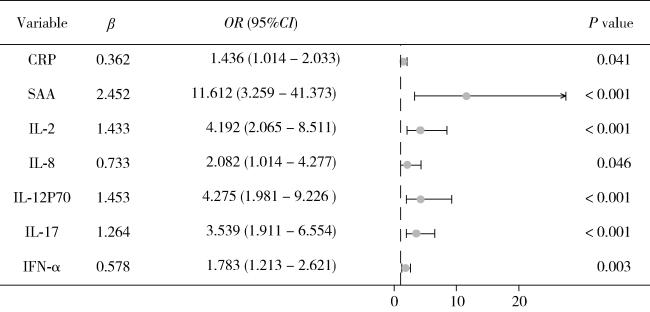
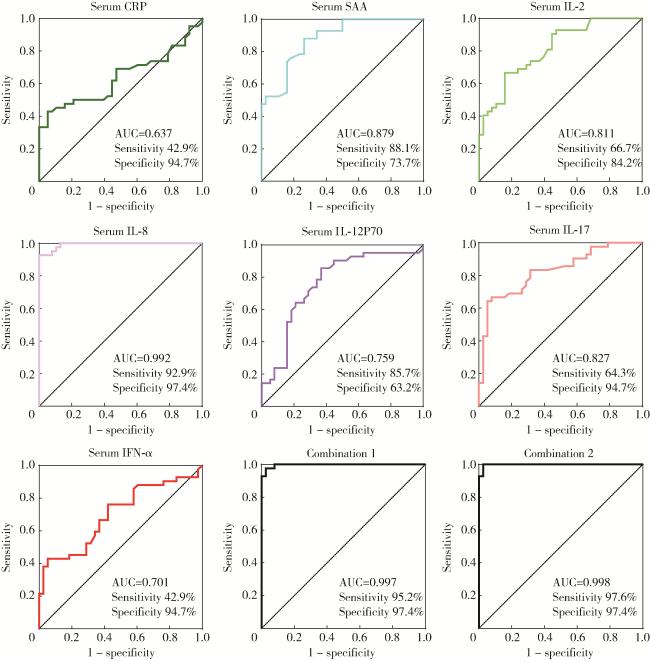
与牙周健康组相比,慢性牙周炎组血清CRP、SAA、IL-2、IL-5、IL-8、IL-12P70、IL-17和IFN-α显著升高(均P < 0.05,表 1)。采用二元Logistic回归分析筛选指标,单变量分析结果显示,血清CRP、SAA、IL-2、IL-8、IL-12P70、IL-17及IFN-α与慢性牙周炎严重程度存在统计学上的显著相关性(均P < 0.05,图 1);采用多变量逐步回归分析(入选标准P < 0.05)进一步筛选,得到两组最优组合:组合1,由IL-2和IL-8构成;组合2,由CRP、SAA和IL-12P70构成。通过ROC曲线评估单一和多指标组合对于慢性牙周炎的诊断效能,计算AUC值、最大Youden指数,并验证其对应的敏感度与特异性。结果显示,血清中组合2的AUC值(0.998)最高,具有高敏感度(97.6%)和高特异性(97.4%),组合1(AUC=0.997)与单一指标IL-8(AUC=0.992)次之(图 2)。
表1 两组血清炎症指标和细胞因子水平

Table 1 Serum inflammatory indexes and cytokines levels in both groups

Items Healthy controls (n=38) Chronic periodontitis (n=42) P
CRP/(mg/L) 0.60 (0.36, 1.62) 1.49 (0.34, 4.78) 0.035
SAA/(mg/L) 1.16 (0.92, 1.69) 2.18 (1.73, 7.18) < 0.001
PCT/(ng/L) 6.50 (2.75, 13.30) 12.00 (3.00, 21.00) 0.128
IL-1β/(ng/L) 1.04 (0.51, 1.65) 0.50 (0.00, 2.52) 0.285
IL-2/(ng/L) 1.42 (1.05, 2.16) 2.46 (1.71, 3.75) < 0.001
IL-4/(ng/L) 1.40 (0.75, 2.11) 1.26 (0.67, 1.95) 0.491
IL-5/(ng/L) 1.24 (0.73, 1.74) 1.84 (0.91, 3.93) 0.031
IL-6/(ng/L) 0.72 (0.45, 1.02) 0.24 (0.00, 1.61) 0.095
IL-8/(ng/L) 4.27 (3.31, 5.77) 47.25 (28.59, 76.37) < 0.001
IL-10/(ng/L) 1.44 (0.72, 1.98) 1.51 (1.33, 1.98) 0.116
IL-12P70/(ng/L) 0.99 (0.78, 1.73) 1.99 (1.45, 2.35) < 0.001
IL-17/(ng/L) 2.01 (1.36, 2.47) 3.33(2.39, 4.44) < 0.001
IFN-α/(ng/L) 1.53 (0.92, 2.61) 2.42(1.53, 4.30) 0.002
IFN-γ/(ng/L) 3.69 (2.56, 5.23) 4.16 (2.80, 5.54) 0.784
TNF-α/(ng/L) 2.15 (1.63, 2.59) 1.49 (0.51, 3.17) 0.158

Data are expressed as median (P25, P75). CRP, C-reactive protein; SAA, serum amyloid A; PCT, procalcitonin; IL, interleukin; IFN, inter-feron; TNF, tumor necrosis factor.

图1 二元Logistic回归筛选血清炎症指标和细胞因子的森林图

Figure 1 Forest plot of serum inflammatory indexes and cytokines screened by binary Logistic regression

CRP, C-reactive protein; SAA, serum amyloid A; IL, interleukin; IFN, interferon.

图2 受试者工作特征曲线评估血清炎症指标和细胞因子的诊断效能

Figure 2 Receiver operating characteristic curve evaluated the diagnostic efficacy of serum inflammatory indexes and cytokines

CRP, C-reactive protein; SAA, serum amyloid A; IL, interleukin; IFN, interferon; AUC, area under curve. Combination 1, IL-2+IL-8; Combination 2, CRP+SAA+IL-12P70.

2.2 唾液细胞因子水平

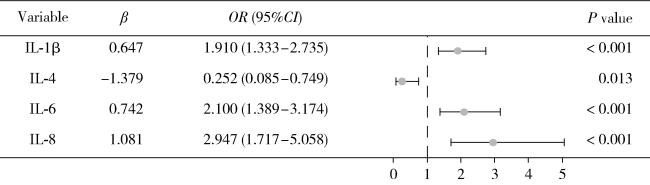
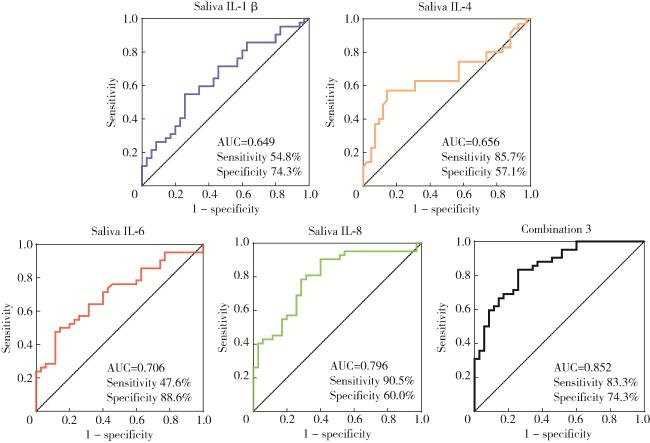
与牙周健康组相比,慢性牙周炎组唾液IL-1β、IL-6、IL-8和IL-12P70水平显著升高,IL-4水平显著降低(均P < 0.05,表 2)。采用二元Logistic回归分析筛选指标,单变量分析结果显示,唾液IL-1β、IL-4、IL-6及IL-8与慢性牙周炎的严重程度存在统计学上的显著相关性(均P < 0.05,图 3);采用多变量逐步回归分析(入选标准P < 0.05) 进一步筛选,得到最优组合3:由IL-4、IL-6及IL-8构成。通过ROC曲线分析单一和多指标组合对于慢性牙周炎的诊断效能,结果显示,唾液中组合3的AUC值(0.852)最高,单一指标IL-8(AUC=0.796)与IL-6(AUC=0.706)位列其次(图 4)。
表2 两组唾液细胞因子水平

Table 2 Saliva cytokines levels in both groups

Items Healthy controls (n=38) Chronic periodontitis (n=42) P
IL-1β/(ng/L) 231.53 (124.49, 587.13) 427.51 (171.01, 805.16) 0.025
IL-2/(ng/L) 2.42 (1.65, 3.49) 2.71 (2.19, 3.49) 0.075
IL-4/(ng/L) 1.35 (0.74, 1.86) 0.98 (0.70, 1.22) 0.019
IL-5/(ng/L) 2.42 (0.97, 7.15) 1.87 (1.26, 2.41) 0.336
IL-6/(ng/L) 16.46 (7.85, 31.68) 41.55 (20.84, 55.25) 0.002
IL-8/(ng/L) 343.02 (253.26, 798.46) 932.71 (671.42, 1 467.16) < 0.001
IL-10/(ng/L) 2.54 (1.65, 4.25) 1.92 (1.51, 3.29) 0.401
IL-12P70/(ng/L) 1.77 (1.38, 2.84) 2.18 (1.87, 2.72) 0.032
IL-17/(ng/L) 2.92 (1.92, 4.73) 2.57 (1.68, 4.75) 0.919
IFN-α/(ng/L) 2.04 (1.53, 2.81) 2.36 (1.25, 3.03) 0.612
IFN-γ/(ng/L) 2.69 (1.62, 5.47) 2.42 (1.44, 5.02) 0.771
TNF-α/(ng/L) 6.95 (4.37, 9.18) 4.74 (1.38, 7.93) 0.066

Data are expressed as median (P25, P75). IL, interleukin; IFN, interferon; TNF, tumor necrosis factor.

图3 二元Logistic回归筛选唾液细胞因子的森林图

Figure 3 Forest plot of saliva cytokines screened by binary Logistic regression

IL, interleukin.

图4 受试者工作特征曲线评估唾液细胞因子的诊断效能

Figure 4 Receiver operating characteristic curve evaluated the diagnostic efficacy of saliva cytokines

IL, interleukin; AUC, area under curve; Combination 3, IL-4+IL-6+IL-8.

2.3 炎症指标和细胞因子水平与慢性牙周炎分期的相关性分析

本研究共纳入42例慢性牙周炎患者并分为两组,其中Ⅰ~Ⅱ期组22例,Ⅲ~Ⅳ期组20例。通过Spearman相关分析发现,血清与唾液中特定炎症标志物与疾病严重程度呈显著正相关(表 3)。血清CRP、SAA、IL-8及唾液IL-1β、IL-6、IL-8、IL-12P70、IL-17、TNF-α均与慢性牙周炎临床分期呈显著正相关(均P < 0.05),其中IL-8相关性最强,提示其水平升高与疾病进展阶段密切关联。
表3 炎症指标和细胞因子水平与慢性牙周炎严重程度的相关性

Table 3 Correlation of inflammatory indexes and cytokines with severity of chronic periodontitis

Index ρ P
Serum
  CRP 0.450 0.003
  SAA 0.368 0.017
  IL-8 0.460 0.002
Saliva
  IL-1β 0.523 < 0.001
  IL-6 0.470 0.002
  IL-8 0.732 < 0.001
  IL-12P70 0.484 0.001
  IL-17 0.439 0.004
  TNF-α 0.334 0.030

CRP, C-reactive protein; SAA, serum amyloid A; IL, interleukin; TNF, tumor necrosis factor.

3 讨论

慢性牙周炎是一种以牙龈和牙周组织的慢性炎症为特征的疾病,全球范围内的发病率高达35%[6]。该病的病因复杂,主要与口腔内微生物群的失衡及宿主的免疫反应相关,导致牙周组织的逐渐破坏,最终可能导致牙齿脱落[7]。慢性牙周炎不仅对口腔健康产生显著影响,其病理过程还与多种系统性炎症反应密切相关,可能成为多系统疾病的潜在驱动因素。已有文献证实,慢性牙周炎与心血管疾病、糖尿病等全身性疾病存在关联[7-8],这些炎症指标的显著升高表明患者可能面临更高的系统性炎症风险。
炎症相关标志物在牙周炎的病理生理机制中呈现复杂调控网络,其动态平衡的打破与重建贯穿疾病发生和发展的全过程。CRP和SAA均属肝脏合成的急性时相反应蛋白,是临床监测炎症的核心指标。CRP的合成受IL-6、TNF等促炎因子调控,在炎症性疾病及恶性肿瘤中显著升高[9-10]。SAA则通过募集单核细胞、中性粒细胞等免疫细胞参与抗感染防御[11-12],是牙周炎症的早期预测因子。牙周致病菌可能通过溃疡上皮侵入循环系统,引发全身性促炎细胞因子及急性期蛋白(含SAA)的异常释放,从而加剧系统性炎症反应[13-14]。细胞因子作为介导细胞间通讯的核心信号分子,在免疫调控、炎症反应及组织修复等生理过程中发挥枢纽作用[2-3, 15]。其中IL-6作为多功能促炎因子,既是急性期反应蛋白合成的关键调节剂(感染后6~8 h达峰),也是牙周病理进程的重要驱动因子,其水平升高加剧了牙槽骨吸收,还通过抑制成纤维细胞增殖使牙周组织再生能力降低[16]。已有研究证实,IL-6正在成为慢性炎症性疾病的重要介质和新的治疗靶点[2]。IL-8作为慢性炎症性的关键介质,在牙周炎牙龈上皮细胞和巨噬细胞中高表达[17]。IL-17在慢性牙周炎中作为促炎因子,其表达增加通过趋化中性粒细胞募集,增加微生物负荷及引发组织破坏,加剧牙周炎症反应[18-19]。由辅助型T细胞2分泌的IL-4作为抑炎因子,通过与IL-5的协同作用促进体液免疫应答,可能在牙周组织炎症调控中发挥保护性作用[20]
本研究旨在分析慢性牙周炎患者血清和唾液中的炎症指标及细胞因子水平,并探讨这些指标在慢性牙周炎临床诊断中的价值。通过对42例慢性牙周炎患者和38例牙周健康者的标本进行检测,发现血清CRP、SAA、IL-8以及唾液IL-1β、IL-6、IL-8等炎症指标与慢性牙周炎的严重程度存在统计学上的显著相关性,这为该病的早期诊断和分期提供了重要依据。本研究结果还显示,血清CRP、SAA、IL-2、IL-8、IL-12P70、IL-17、IFN-α及唾液IL-1β、IL-6、IL-8等指标在慢性牙周炎患者中显著升高,IL-4显著降低,且多指标联合检测的诊断效能优于单一指标。上述发现为临床诊疗策略的制定提供了依据,可以将多指标联合检测纳入高危人群筛查体系,通过定期监测实现早期干预,从而降低牙周组织破坏风险及全身炎症相关并发症的发生率[21]
本研究中,慢性牙周炎患者血清CRP、SAA水平以及唾液IL-6、IL-1β水平均显著高于牙周健康组,唾液IL-4水平显著低于牙周健康组,与既往研究结论一致[1, 3, 13, 16, 22-23]。但本研究得出的慢性牙周炎患者血清和唾液中IL-8水平均较健康对照组显著升高的结论与既往研究不同,比如Huang等[17]报道慢性牙周炎患者唾液IL-8水平较健康对照组显著升高,而两组血浆IL-8水平无明显差异。此外,本研究中慢性牙周炎组血清IL-17水平显著高于牙周健康组,而唾液IL-17水平在两组间无明显差异,这一结论也与既往研究不一致[3, 18-19]。我们认为可能由以下原因导致:标本类型不同,不同生物样本中细胞因子的表达可能存在差异;研究人群不同,细胞因子水平因种族、地域不同可能存在差异;采样时机不同,在疾病进展的不同阶段采样,结果可能出现差异。将来应建立标准化采样流程,结合多组学技术解析炎症因子时空动态变化,以建立牙周炎分期诊断模型,并通过开展多中心、多领域的合作,进一步阐明炎症指标及细胞因子对于慢性牙周炎的临床诊疗价值。
综上,本研究为慢性牙周炎患者血清和唾液中炎症指标及细胞因子水平的变化提供了进一步的证据支持,研究结果表明,血清IL-8、CRP、SAA及唾液IL-1β、IL-6、IL-8等指标水平与慢性牙周炎的严重程度呈显著正相关,其中,血清IL-8在单一指标中展现出最高的诊断效能,而多指标联合检测的诊断效能显著优于单一指标,可能作为慢性牙周炎的辅助诊断指标。

利益冲突  所有作者均声明不存在利益冲突。

作者贡献声明  王雅杰:提出研究思路,总体把关和审定论文;包振英:设计研究方案,收集、分析、整理数据,撰写论文。

1
Keles ZP , Keles GC , Avci B , et al. Analysis of YKL-40 acute-phase protein and interleukin-6 levels in periodontal disease[J]. J Periodontol, 2014, 85 (9): 1240- 1246.

2
Nibali L , Fedele S , D' Aiuto F , et al. Interleukin-6 in oral diseases: A review[J]. Oral Dis, 2012, 18 (3): 236- 243.

3
Medara N , Lenzo JC , Walsh KA , et al. T helper 17 cell-related cytokines in serum and saliva during management of periodontitis[J]. Cytokine, 2020, 134, 155186.

4
孟焕新. 牙周病学[M]. 4版 北京: 人民卫生出版社, 2016: 168- 173.

5
Caton JG , Armitage G , Berglundh T , et al. A new classification scheme for periodontal and peri-implant diseases and conditions: Introduction and key changes from the 1999 classification[J]. J Clin Periodontol, 2018, 45 (Suppl 20): S1- S8.

6
van Winkelhoff AJ , Winkel EG , Vandenbroucke-Grauls CM . Periodontitis: A hidden chronic infection[J]. Ned Tijdschr Geneeskd, 2001, 145 (12): 557- 563.

7
Thornton-Evans G , Eke P , Wei L , et al. Periodontitis among adults aged ≥30 years: United States, 2009-2010[J]. MMWR Suppl, 2013, 62 (3): 129- 135.

8
Stringer G . Chronic periodontitis, dantamoolaroga, indicates chronic systemic inflammation and reduces longevity[J]. J Ayurveda Integr Med, 2024, 15 (6): 101048.

9
Covington EW , Roberts MZ , Dong J . Procalcitonin monitoring as a guide for antimicrobial therapy: A review of current literature[J]. Pharmacotherapy, 2018, 38 (5): 569- 581.

10
Chan T , Gu F . Early diagnosis of sepsis using serum biomarkers[J]. Expert Rev Mol Diagn, 2011, 11 (5): 487- 496.

11
冼美兰, 黄奕荣, 邱潮锋. 血清淀粉样蛋白A、降钙素原、超敏C反应蛋白检测对社区获得性肺炎评估价值分析[J]. 数理医药学杂志, 2022, 35 (1): 43- 45.

12
De Buck M , Gouwy M , Wang JM , et al. The cytokine-serum amyloid A-chemokine network[J]. Cytokine Growth Factor Rev, 2016, 30, 55- 69.

13
Türer ÇC , Ballı U , Güven B . Fetuin-A, serum amyloid A and tumor necrosis factor alpha levels in periodontal health and disease[J]. Oral Dis, 2017, 23 (3): 379- 386.

14
Machado V , Botelho J , Escalda C , et al. Serum C-reactive protein and periodontitis: A systematic review and meta-analysis[J]. Front Immunol, 2021, 12, 706432.

15
Lee LT , Wong YK , Hsiao HY , et al. Evaluation of saliva and plasma cytokine biomarkers in patients with oral squamous cell carcinoma[J]. Int J Oral Maxillofac Surg, 2018, 47 (6): 699- 707.

16
于钦, 陈贤. 牙周炎患者基础治疗前后唾液和龈沟液中IL-6、TNF-α、MMP-8水平的变化[J]. 北京口腔医学, 2018, 26 (6): 336- 339.

17
Huang YK , Tseng KF , Tsai PH , et al. IL-8 as a potential therapeutic target for periodontitis and its inhibition by caffeic acid phenethyl ester in vitro[J]. Int J Mol Sci, 2021, 22 (7): 3641.

18
Inönü E , Kayis SA , Eskan MA , et al. Salivary Del-1, IL-17, and LFA-1 levels in periodontal health and disease[J]. J Periodontal Res, 2020, 55 (4): 511- 518.

19
Saxena S , Venugopal R , Chandrayan Rao R , et al. Association of chronic periodontitis and type 2 diabetes mellitus with salivary Del-1 and IL-17 levels[J]. J Oral Biol Craniofac Res, 2020, 10 (4): 529- 534.

20
Kawamoto D , Amado PPL , Albuquerque-Souza E , et al. Chemokines and cytokines profile in whole saliva of patients with periodontitis[J]. Cytokine, 2020, 135, 155197.

21
Wang D , Dai L , Cui Z , et al. Association between periodontal diseases and chronic obstructive pulmonary disease: Evidence from sequential cross-sectional and prospective cohort studies based on UK Biobank[J]. J Clin Periodontol, 2024, 51 (1): 97- 107.

22
Lira-Junior R , Bissett SM , Preshaw PM , et al. Levels of myeloid-related proteins in saliva for screening and monitoring of periodontal disease[J]. J Clin Periodontol, 2021, 48 (11): 1430- 1440.

23
Gümüş P , Nizam N , Nalbantsoy A , et al. Saliva and serum levels of pentraxin-3 and interleukin-1β in generalized aggressive or chronic periodontitis[J]. J Periodontol, 2014, 85 (3): e40- e46.

Outlines

/