Journal of Peking University (Health Sciences) ›› 2026, Vol. 58 ›› Issue (3): 455-463. doi: 10.19723/j.issn.1671-167X.2026.03.003

Previous Articles     Next Articles

Associations of subjective perceptions and income change with transitions in usual source of care among Chinese residents: A study based on China Family Panel Studies

Chunchun XU1, Weiyan JIAN1,2,*()   

  1. 1. Department of Health Policy and Management, Peking University School of Public Health, Beijing 100191, China
    2. Key Laboratory of Health System Reform and Governance, National Health Commission, Beijing 100191, China
  • Received:2026-02-26 Online:2026-06-18 Published:2026-05-15
  • Contact: Weiyan JIAN
  • Supported by:
    Major Program of National Fund of Philosophy and Social Science of China(22&ZD143)

RICH HTML


Abstract:

Objective: Using the China Family Panel Studies (CFPS, 2012-2022), this study aimed to characterize changes in the distribution of usual sources of care and in subjective perceptions among Chinese adults, and to examine the associations of subjective perceptions and income change with next-wave transitions in usual source of care. Methods: This was a retrospective longitudinal observational study based on adult CFPS data from 2012, 2014, 2016, 2018, 2020, and 2022. We first described temporal trends in three types of usual source of care (primary care, hospitals, and clinics), as well as trends in residents' subjective perceptions of healthcare providers, and in relative income change. We then constructed person-period samples from adjacent survey waves and analyzed two transition processes separately: outflow from primary care among baseline primary care users and inflow to primary care among baseline non-primary care users. Key predictors were prior-wave satisfaction, perceived medical competence, and relative income change; the income-change variable was defined based on changes in relative income group within the same wave and same province sample. Descriptive analyses applied cross-sectional weights; the main regressions were unweighted binary Logistic models with individual-level cluster-robust standard errors, reporting odds ratios (OR), 95% confidence intervals (95% CI), and P va-lues. Results: The pooled sample comprised 135 986 observations from 34 010 individuals. From 2012 to 2022, the proportion using primary care as the usual source of care declined from 43.49% to 30.34%, whereas the hospital share rose from 34.06% to 46.81%. The decline in primary care was steeper during 2012-2018 (43.49% to 33.72%) and persisted at a slower pace thereafter (33.72% to 30.34%). Across adjacent survey waves, primary care outflow increased from 35.47% to 45.22%, while primary care inflow decreased from 30.09% to 19.60%, indicating simultaneous increases in exits and decreases in entries. Subjective perceptions improved for all three provider types over time; however, the relative gap between primary care and hospitals widened on perceived medical competence, and primary care shifted from a slight advantage over clinics to a clear disadvantage in composite subjective perceptions. The proportion of residents with unchanged relative income group rose from 50.64% to 60.33%. In multivariable models, each one-unit increase in satisfaction with primary care was associated with 7.5% lower odds of leaving primary care (OR=0.925, P < 0.001). In contrast, each one-unit increase in perceived medical competence of non-primary care providers was associated with 5.3% lower odds of moving into primary care (OR=0.947, P < 0.001). Compared with stable relative income group, upward relative income-group mobility, particularly low-to-high movement, was associated with higher odds of outflow from primary care and lower odds of inflow to primary care (outflow OR=1.166; inflow OR=0.840), whereas downward relative income-group mobility, especially high-to-low movement, showed the opposite pattern (outflow OR=0.785; inflow OR=1.371). Conclusion: Primary care utilization in China continued to decline, with increased outflow from primary care and reduced inflow to primary care occurring simultaneously. Residents ' subjective perceptions were associated with different considerations in retention in versus movement into primary care: the former was more closely related to satisfaction, whereas the latter was more closely related to perceived medical competence. People with upward relative income-group mobility showed a lower inclination to use primary care. Hierarchical care policy should address both entry into and retention in primary care by strengthening continuity of care, reinforcing service capability and institutional design, and aligning payment incentives.

Key words: Primary health care, Usual source of care, Patient acceptance of health care, Patient satisfaction, Income, Longitudinal studies

CLC Number: 

  • R197.1

Table 1

Characteristics of the main analytic sample (unweighted)"

Variable 2012 2022 Pooled sample (6 survey waves) P value
Records 23 716 13 707 135 986
Unique individuals 23 716 13 707 34 010
Female, n(%) 12 265 (51.72) 6 740 (49.17) 68 094 (50.07) < 0.001
Age, ${\bar x}$±s 46.61±15.64 47.31±16.08 47.17±16.23 < 0.001
Education levela, ${\bar x}$±s 0.74±0.92 1.22±1.10 0.92±1.01 < 0.001
Married/cohabiting, n(%) 19 686 (83.01) 10 484 (76.49) 108 156 (79.54) < 0.001
Urban residence, n(%) 10 557 (44.72) 7 311 (53.39) 65 472 (48.79) < 0.001
Eastern region, n(%) 8 789 (37.06) 5 009 (36.54) 49 833 (36.65) 0.321
Central region, n(%) 5 123 (21.60) 2 914 (21.26) 28 390 (20.88) 0.443
Western region, n(%) 6 259 (26.39) 3 836 (27.99) 38 544 (28.34) < 0.001
Northeastern region, n(%) 3 543 (14.94) 1 948 (14.21) 19 215 (14.13) 0.057
Household income per capita (median, CNY) 8 228.00 23 000.00 13 460.00 < 0.001
Low-income group, n(%) 8 092 (37.26) 4 400 (33.12) 47 316 (36.01) < 0.001
Middle-income group, n(%) 7 131 (32.83) 4 501 (33.88) 44 178 (33.63) 0.045
High-income group, n(%) 6 497 (29.91) 4 386 (33.01) 39 889 (30.36) < 0.001
Insured, n(%) 20 870 (88.22) 12 557 (92.97) 122 932 (90.99) < 0.001
Agricultural hukou, n(%) 17 025 (71.91) 9 728 (71.14) 98 477 (72.55) 0.118
Self-rated healthb, ${\bar x}$±s 3.21±1.20 2.91±1.18 3.05±1.22 < 0.001
Any chronic disease, n(%) 3 160 (13.33) 2 317 (16.91) 22 435 (16.50) < 0.001
Number of chronic diseases, ${\bar x}$±s 0.16±0.45 0.34±0.75 0.25 ± 0.60 < 0.001
Hospitalization in past 12 months, n(%) 2 121 (8.94) 1 501 (10.95) 15 361 (11.30) < 0.001

Table 2

Weighted composition of usual source of care, 2012-2022"

Survey wave Hospital, % (95%CI) Primary care, % (95%CI) Clinic, % (95%CI)
2012 34.06 (33.34-34.78) 43.49 (42.74-44.25) 22.45 (21.81-23.08)
2014 39.24 (38.49-39.99) 43.32 (42.57-44.08) 17.44 (16.86-18.02)
2016 42.33 (41.55-43.11) 39.27 (38.49-40.04) 18.40 (17.79-19.02)
2018 44.28 (43.43-45.13) 33.72 (32.91-34.53) 22.00 (21.29-22.71)
2020 44.29 (43.29-45.29) 32.61 (31.67-33.55) 23.10 (22.25-23.95)
2022 46.81 (45.82-47.79) 30.34 (29.43-31.25) 22.86 (22.03-23.69)

Table 3

Primary care outflow and inflow in each survey wave compared with the previous wave"

Survey wave Primary care outflow Stayed in primary care Primary care inflow Stayed in non-primary care
2014 3 718 (35.47) 7 017 (64.53) 4 304 (30.09) 8 677 (69.91)
2016 4 695 (40.74) 6 520 (59.26) 3 314 (25.56) 9 057 (74.44)
2018 4 245 (44.54) 5 137 (55.46) 3 162 (21.76) 10 264 (78.24)
2020 2 689 (45.22) 3 338 (54.78) 2 358 (21.46) 8 157 (78.54)
2022 2 041 (45.22) 2 460 (54.78) 1 944 (19.60) 7 262 (80.40)

Table 4

Weighted perceived quality indicators by provider type"

Survey wave Hospital Primary care Clinic
Sat Pmc Composite Sat Pmc Composite Sat Pmc Composite
2012 3.549 3.503 3.526 3.456 3.259 3.357 3.405 3.295 3.350
2014 3.559 3.528 3.543 3.434 3.254 3.344 3.379 3.263 3.320
2016 3.607 3.544 3.576 3.482 3.284 3.384 3.458 3.340 3.399
2018 3.647 3.606 3.626 3.583 3.376 3.480 3.601 3.443 3.522
2020 3.822 3.792 3.806 3.760 3.509 3.635 3.730 3.581 3.655
2022 3.839 3.827 3.832 3.778 3.532 3.656 3.810 3.673 3.742

Table 5

Distribution of income-change types across adjacent waves (end-wave weights)"

Interval Weighted valid n Downward 2 levels/% Downward 1 level/% No change/% Upward 1 level/% Upward 2 levels/%
2012→2014 20 739 5.08 19.38 50.64 19.72 5.19
2014→2016 22 203 4.21 18.35 53.75 18.87 4.82
2016→2018 22 483 3.14 19.18 56.42 17.94 3.31
2018→2020 16 164 2.79 17.04 58.94 18.37 2.87
2020→2022 13 093 2.96 17.51 60.33 16.61 2.60

Figure 1

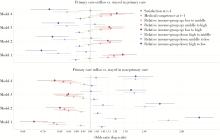
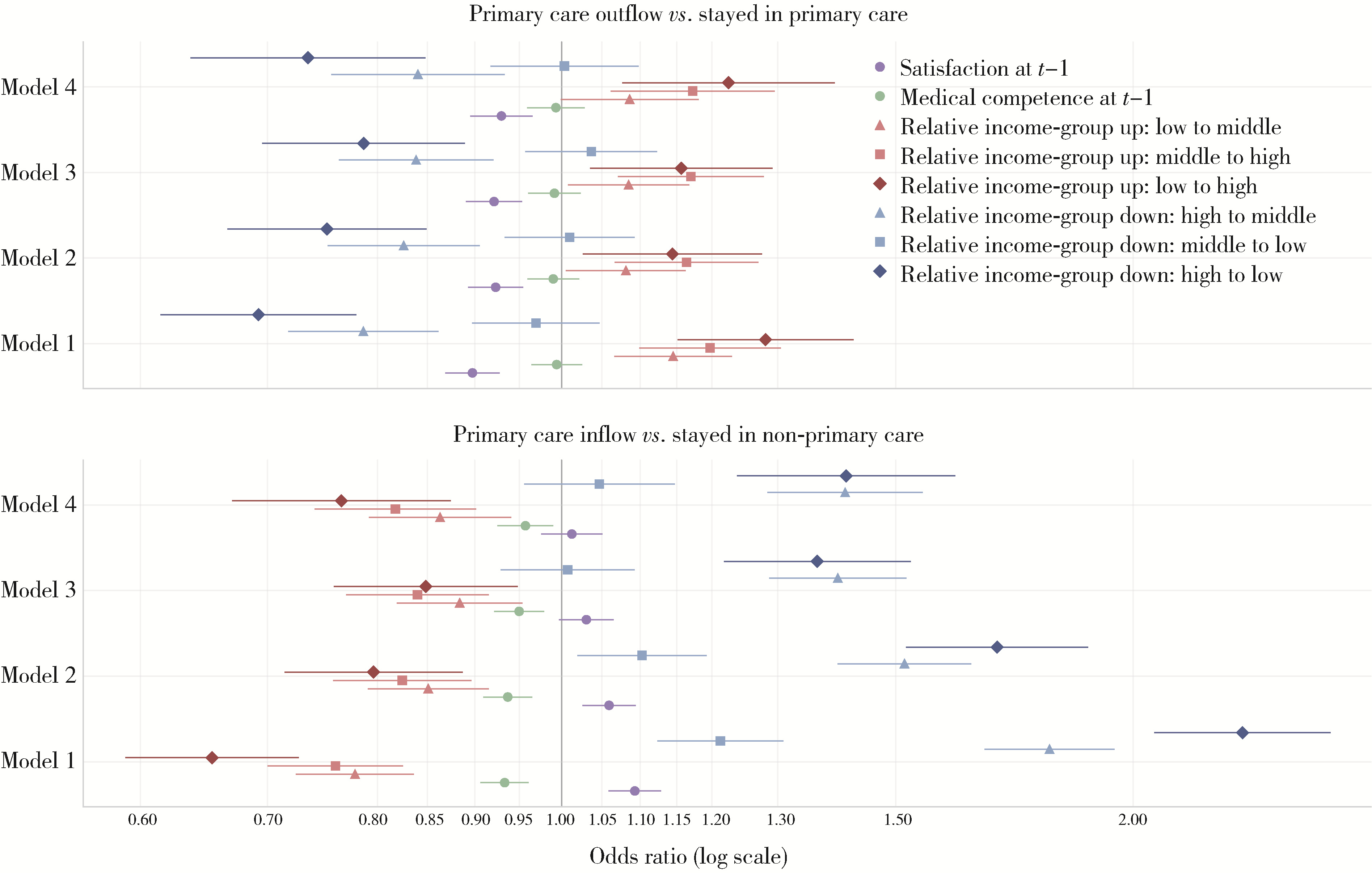
Core predictor effects in two transition outcomes Points indicate odd ratios(OR) and horizontal lines indicate 95% confidence intervals (CI); standard errors are clustered at the individual level. t-1 denotes the previous survey wave. Model 1 includes core predictors (satisfaction score, perceived medical competence score, and six income-change pathways based on relative income-group shifts; see Table 4 and Table 5 for detailed definitions of these terms) plus year fixed effects and baseline income group; Model 2 further adds predisposing factors (sex, age, education, marital status); Model 3 further adds enabling factors (urban residence, insurance, agricultural hukou, region); Model 4 further adds need factors (self-rated health, chronic disease, hospitalization). Medical expenditure is included only in sensitivity analyses."

Table 6

Full variable estimates from binary Logistic Model 4"

Variable Primary care inflow vs. stayed in non-primary care (n=56 750) Primary care outflow vs. stayed in primary care (n=39 831)
OR 95%CI P value OR 95%CI P value
Agricultural hukou 2.051 1.931-2.179 < 0.001 0.655 0.610-0.702 < 0.001
Perceived medical competence 0.947 0.919-0.977 < 0.001 0.996 0.965-1.028 0.797
Insurance coverage 1.109 1.034-1.190 0.004 0.859 0.791-0.933 < 0.001
Region: eastern 1.987 1.859-2.125 < 0.001 0.509 0.469-0.552 < 0.001
Region: central 1.888 1.756-2.031 < 0.001 0.563 0.516-0.614 < 0.001
Region: western 1.684 1.569-1.807 < 0.001 0.571 0.525-0.621 < 0.001
Urban residence 0.684 0.651-0.718 < 0.001 1.121 1.066-1.178 < 0.001
Female 0.929 0.889-0.970 < 0.001 1.065 1.018-1.115 0.006
Married/cohabiting 1.179 1.111-1.250 < 0.001 0.800 0.752-0.851 < 0.001
Year: 2016 0.737 0.695-0.782 < 0.001 1.385 1.308-1.467 < 0.001
Year: 2018 0.590 0.557-0.625 < 0.001 1.623 1.531-1.721 < 0.001
Year: 2020 0.571 0.537-0.608 < 0.001 1.611 1.508-1.722 < 0.001
Year: 2022 0.556 0.520-0.595 < 0.001 1.571 1.458-1.692 < 0.001
Age 1.010 1.008-1.012 < 0.001 0.987 0.986-0.989 < 0.001
Any chronic disease 0.897 0.845-0.952 < 0.001 1.057 0.991-1.128 0.092
Relative income-group up: middle to high 0.840 0.770-0.916 < 0.001 1.172 1.072-1.280 < 0.001
Relative income-group up: low to middle 0.878 0.814-0.948 < 0.001 1.089 1.012-1.172 0.023
Relative income-group up: low to high 0.840 0.752-0.939 0.002 1.166 1.044-1.302 0.007
Relative income-group down: middle to low 1.014 0.935-1.100 0.730 1.035 0.955-1.121 0.402
Relative income-group down: high to middle 1.397 1.286-1.519 < 0.001 0.839 0.764-0.922 < 0.001
Relative income-group down: high to low 1.371 1.224-1.536 < 0.001 0.785 0.694-0.888 < 0.001
Income group: middle 0.892 0.833-0.956 0.001 1.015 0.948-1.087 0.671
Income group: high 0.636 0.591-0.684 < 0.001 1.233 1.141-1.333 < 0.001
Education levela 0.821 0.800-0.844 < 0.001 1.042 1.011-1.075 0.008
Satisfaction 1.027 0.994-1.062 0.112 0.925 0.894-0.957 < 0.001
Self-rated healthb 0.958 0.940-0.976 < 0.001 1.031 1.011-1.051 0.002
Hospitalization in past 12 months 0.889 0.832-0.949 < 0.001 1.140 1.057-1.229 < 0.001
1
中华人民共和国国务院办公厅. 国务院办公厅关于推进分级诊疗制度建设的指导意见[EB/OL]. (2015-09-11)[2026-02-23]. https://www.gov.cn/zhengce/content/2015-09/11/content_10158.htm.
2
Li X , Lu J , Hu S , et al. The primary health-care system in China[J]. Lancet, 2017, 390 (10112): 2584- 2594.

doi: 10.1016/S0140-6736(17)33109-4
3
Wu Y , Zhang Z , Zhao N , et al. Primary health care in China: A decade of development after the 2009 health care reform[J]. Health Care Sci, 2022, 1 (3): 146- 159.

doi: 10.1002/hcs2.14
4
Wan G , Wei X , Yin H , et al. The trend in primary health care preference in China: A cohort study of 12, 508 residents from 2012 to 2018[J]. BMC Health Serv Res, 2021, 21 (1): 768.

doi: 10.1186/s12913-021-06790-w
5
Cai C , Millett C , Xiong S , et al. Impact of China ' s primary healthcare reforms on utilisation, payments and self-reported health: A quasi-experimental analysis of a middle-aged and older cohort 2011-2018[J]. BMJ Public Health, 2025, 3 (1): e001595.

doi: 10.1136/bmjph-2024-001595
6
Li C , Chen Z , Khan MM . Bypassing primary care facilities: Health-seeking behavior of middle age and older adults in China[J]. BMC Health Serv Res, 2021, 21 (1): 895.

doi: 10.1186/s12913-021-06908-0
7
陈纯, 张勇, 黄绍中, 等. 2005-2014年福建省直单位参保人群中心脑血管疾病患者门诊就诊机构及费用分布的概况及分析[J]. 中国全科医学, 2017, 20 (24): 3008- 3014.
8
Zhong C , Huang J , Li L , et al. Relationship between patient-perceived quality of primary care and self-reported hospital utilisation in China: A cross-sectional study[J]. Eur J Gen Pract, 2024, 30 (1): 2308740.

doi: 10.1080/13814788.2024.2308740
9
Liu Y , Zhong L , Yuan S , et al. Why patients prefer high-level healthcare facilities: A qualitative study using focus groups in rural and urban China[J]. BMJ Glob Health, 2018, 3 (5): e000854.
10
Fu L , Han J , Xu K , et al. Incentivizing primary care utilization in China: The impact of health insurance coverage on health-seeking behaviour[J]. Health Promot Int, 2024, 39 (5): daae115.

doi: 10.1093/heapro/daae115
11
汪晓露, 黄哲, 钱艳娟, 等. 分级诊疗背景下社区居民全科医疗服务需求与就诊意向机构研究[J]. 中国全科医学, 2021, 24 (7): 805- 811.
12
孙华君, 田慧, 杜汋. 家庭医生签约服务对居民就诊行为的影响: 基于倾向得分匹配的实证研究[J]. 中国全科医学, 2020, 23 (19): 2396- 2400.
13
朱玉琴, 金花, 于德华. 分级诊疗背景下多病共存患者就医机构选择行为及其影响因素研究[J]. 中国全科医学, 2023, 26 (13): 1598- 1604.
14
王沛, 刘军军. 基于安德森模型的多重慢病患者就医机构选择及影响因素研究[J]. 中国全科医学, 2020, 23 (25): 3154- 3159.
15
Yip W , Fu H , Chen AT , et al. 10 years of health-care reform in China: Progress and gaps in Universal Health Coverage[J]. Lancet, 2019, 394 (10204): 1192- 1204.

doi: 10.1016/S0140-6736(19)32136-1
16
Li X , Krumholz HM , Yip W , et al. Quality of primary health care in China: Challenges and recommendations[J]. Lancet, 2020, 395 (10239): 1802- 1812.

doi: 10.1016/S0140-6736(20)30122-7
17
Yip W , Fu H , Jian W , et al. Universal health coverage in China part 1:Progress and gaps[J]. Lancet Public Health, 2023, 8 (12): e1025- e1034.

doi: 10.1016/S2468-2667(23)00254-2
18
Chen M , Zhou G , Si L . Ten years of progress towards universal health coverage: Has China achieved equitable healthcare financing?[J]. BMJ Glob Health, 2020, 5 (11): e003570.

doi: 10.1136/bmjgh-2020-003570
19
雷祎, 赵焱, 孙静. 医联体模式下北京市海淀区社区居民双向转诊现状及影响因素分析[J]. 中国全科医学, 2019, 22 (25): 3049- 3054.
20
陈聪, 朱海虹. 基于安德森模型的家庭医生签约2型糖尿病患者基层就诊行为影响因素研究[J]. 中国全科医学, 2025, 28 (7): 888- 892.
21
Gu L , Wang X , Tian D . The association of family doctor contract service and patient trust in doctor: Evidence from twenty-five village clinics of three counties in rural China[J]. BMC Prim Care, 2024, 25 (1): 58.

doi: 10.1186/s12875-024-02298-4
22
Zhang J , Xu L , Qin W , et al. Do residents and healthcare providers differ in preference for family doctor contract service? Evidence from a discrete choice experiment[J]. Front Public Health, 2022, 10, 800042.

doi: 10.3389/fpubh.2022.800042
23
Lai S , Huang Y , Zhang X , et al. Promoting equality in utilization of basic public health services in China: The role of the family doctor contract service[J]. J Med Econ, 2024, 27 (1): 1444- 1455.

doi: 10.1080/13696998.2024.2421115
24
Chen Y , Huang F , Zhou Q . Equality of public health service and family doctor contract service utilisation among migrants in China[J]. Soc Sci Med, 2023, 333, 116148.

doi: 10.1016/j.socscimed.2023.116148
25
Zhang Z , Zhang R , Peng Y , et al. Barriers and facilitators of family doctor contract services in caring for disabled older adults in Beijing, China: A mixed methods study[J]. BMJ Open, 2023, 13 (6): e070130.
26
Jin H , Zhou H , Shi L , et al. Patient-centered medical home and the quality of primary care: Survey study with patients and administrators of community healthcare centers in Shanghai, China[J]. BMC Prim Care, 2025, 26 (1): 258.

doi: 10.1186/s12875-025-02856-4
27
Andersen RM . Revisiting the behavioral model and access to medical care: Does it matter?[J]. J Health Soc Behav, 1995, 36 (1): 1- 10.
28
卢珊, 李月娥. Anderson医疗卫生服务利用行为模型: 指标体系的解读与操作化[J]. 中国卫生经济, 2018, 37 (9): 5- 10.
29
孔春燕, 赵芳. 分级诊疗视域下基层首诊意愿影响因素的联合实验研究[J]. 中国全科医学, 2026, 29 (7): 851- 857.
30
中共中央办公厅, 国务院办公厅. 中共中央办公厅国务院办公厅印发《关于进一步完善医疗卫生服务体系的意见》[EB/OL]. (2023-03-23)[2026-02-01]. https://www.gov.cn/gongbao/content/2023/content_5750620.htm.
[1] Xiaolin WANG, Shaoyi GUO, Dazhao CHEN, Xijie WEN, Yong HUA, Liang ZHANG, Qin ZHANG. A follow-up study on total hip arthroplasty in patients with systemic lupus erythematosus combined with osteonecrosis of femoral head [J]. Journal of Peking University (Health Sciences), 2025, 57(6): 1081-1088.
[2] LI Zhi-chang,HOU Yun-fei,ZHOU Zhi-wei,JIANG Long,ZHANG Shu,LIN Jian-hao. Patient factors influencing preoperative expectations of patients undergoing total knee arthroplasty [J]. Journal of Peking University (Health Sciences), 2022, 54(1): 170-176.
Viewed
Full text


Abstract

Cited

  Shared   
  Discussed   
No Suggested Reading articles found!