Journal of Peking University (Health Sciences) ›› 2026, Vol. 58 ›› Issue (4): 848-854. doi: 10.19723/j.issn.1671-167X.2026.04.023

Previous Articles     Next Articles

Report on oral health literacy of children and adolescents in Nagqu, Xizang

Zitong SHAN1, Shuhao WEI1, Jiahao HAN1, Yan SI1, Wensheng RONG1, Shuguo ZHENG1, Xiaomo LIU2,*(), Shanshan ZHANG1,*()   

  1. 1. Department of Preventive Health Care, Peking University School and Hospital of Stomatology & National Center of Stomatology & National Clinical Research Center for Oral Diseases & National Engineering Research Center of Oral Biomaterials and Digital Medical Devices & Beijing Key Laboratory of Digital Stomatology & NHC Key Laboratory of Digital Stomatology & NMPA Key Laboratory for Dental Materials, Beijing 100081, China
    2. Department of Orthodontics, Peking University School and Hospital of Stomatology & National Center of Stomatology & National Clinical Research Center for Oral Diseases & National Engineering Research Center of Oral Biomaterials and Digital Medical Devices & Beijing Key Laboratory of Digital Stomatology & NHC Key Laboratory of Digital Stomatology & NMPA Key Laboratory for Dental Materials, Beijing 100081, China
  • Received:2025-10-02 Online:2026-08-18 Published:2026-04-23
  • Contact: Xiaomo LIU, Shanshan ZHANG
  • Supported by:
    the Capital's Funds for Health Improvement and Research(2024-2G-4106); the Project Sponsored by the Innovative Development Research of People's Medical Publishing House(RWCY23DⅡ007007); the Education Research Project of Peking University School and Hospital of Stomatology in 2024(2024-ZC-07); the Beijing Research Ward Excellence Program, BRWEP(BRWEP2024W194100100); the Program for New Clinical Techniques and Therapies of Peking University School and Hospital of Stomatology(PKUSSNCT-25B05); the Beijing Municipal Natural Science Foundation-Haidian Original Innovation Joint Fund(L222001)

RICH HTML


Abstract:

Objective: To understand the oral health literacy of children and adolescents in Nagqu City, and to evaluate the effect of a single online digital integrated media science popularization course on improving oral health literacy. Methods: A cluster sampling method was employed in which all students aged 9-15 years in the Seni District of Naqu City, Xizang Autonomous Region, 406 students were surveyed class-by-class using a paper questionnaire. After baseline data collection, the students received a single remote digital-multimedia oral-health education lesson; a follow-up questionnaire was administered one week later to evaluate whether the online course improved oral-health literacy. The instrument collected demographic information, basic oral-health knowledge, beliefs, self-care practices, and dental-service utilization. Data were analyzed with R 4.4.1 and SPSS 27.0. Results: The awareness rate of oral health knowledge among the children and adolescents in Xizang was less than 50%. More than half of the adolescents consumed high-sugar foods, such as desserts and sugary beverages daily. Only 15.98% of the adolescents brushed their teeth twice or more daily, 7.71% used dental floss daily before the course, and the usage rate of fluoride toothpaste was 45.45%. Oral health issues among the children and adolescents in Xizang severely impacted their daily lives, particularly in eating, pronunciation, and brushing. A single oral health education session showed no significant impact on the awareness rate or the conversion of knowledge into behavior. Conclusion: The awareness rate of oral health knowledge among the children and adolescents in Xizang is lower than the national average a decade ago, and a significant portion has yet to develop good personal oral hygiene habits. Targeted measures are needed to improve oral health awareness among the children and adolescents in Xizang. These may include utilizing interactive digital education tools and emphasizing oral disease prevention to enhance both the awareness rate of oral health knowledge and the conversion of knowledge into behavior.

Key words: Oral health literacy, Children and adolescents, Oral health education, Cross-sectional study, Xizang Autonomous Region

CLC Number: 

  • R780.1

Table 1

Questionnaire collection basic information"

Demographics Pre-education lesson,n(%) Post- education lesson, n(%) P
Age/years 9 3 (0.83) 3 (0.95) >0.999
10 20 (5.51) 18 (5.70) >0.999
11 22 (6.06) 21 (6.65) 0.877
12 104 (28.65) 91 (28.80) >0.999
13 165 (45.45) 147 (46.52) 0.841
14 47 (12.95) 35 (11.08) 0.804
15 2 (0.55) 1 (0.32) >0.999
Gender Boy 182 (50.14)
Girl 181 (49.86)
Only child Yes 17 (4.68)
No 346 (95.6)
Parent’s educational background Primary school or below 311 (85.67)
Middle school or high school 39 (10.74)
Secondary specialized school or associate degree 7 (1.93)
Bachelor’s degree or higher 6 (1.65)

Table 2

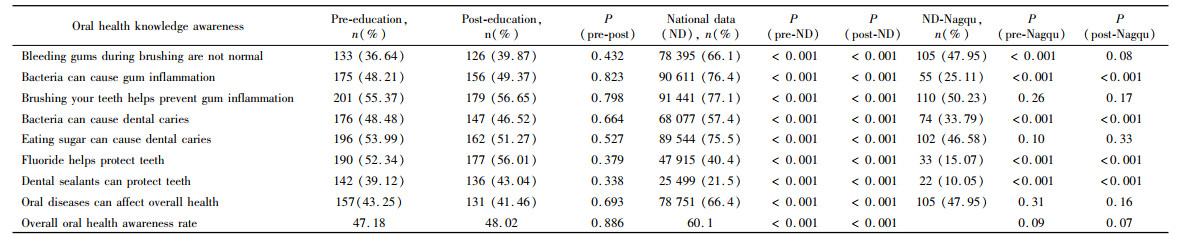
Awareness rate of oral health knowledge among children and adolescents in Xizang and the fourth oral health survey"

Table 3

Oral health attitudes among children and adolescents in Xizang and the fourth oral health survey"

Table 4

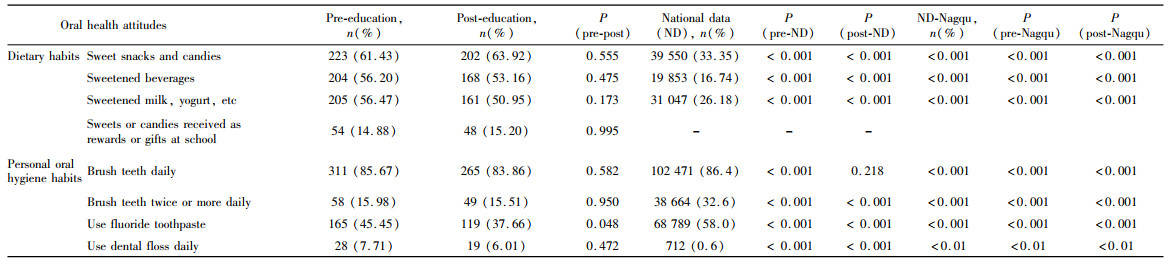
Dietary habits and personal oral hygiene practices among children and adolescents in Xizang and the fourth oral health survey"

Table 5

Self-reported incidence of various oral health issues among children and adolescents in Xizang"

Oral health status Pre-education,n(%) Post-education,n(%) P(pre-post)
Dental caries 115 (31.68) 88 (27.85) 0.32
Gingivitis 94 (25.90) 97 (30.70) 0.19
Periodontitis 82 (22.59) 73 (23.10) 0.95
Gum bleeding 147 (40.50) 120 (37.97) 0.55
Malocclusion 42 (11.57) 33 (10.44) 0.73
Mouth ulcer 98 (27.00) 86 (27.22) >0.99
Dental injure(off-campus) 106 (29.20) 74 (23.42) 0.11
Dental injure(on-campus) 34 (9.37) 39 (12.34) 0.26

Table 6

Impact of oral health related quality of lives of children and adolescents in Xizang and the fourth oral health survey"

The impact of oral health issues on daily life Pre-education lesson,n(%) Post-education lesson,n(%) P National data (ND),n(%) P(pre-ND) P(post-ND)
Eating 193 (53.17) 166 (52.53) 0.929 4 33 683 (28.4) <0.001 <0.001
pronouncing 127 (34.99) 106 (33.54) 0.753 7 11 860 (10.0) <0.001 <0.001
Brushing 119 (32.78) 120 (37.97) 0.182 7 22 534 (19.0) <0.001 <0.001
Doing housework 86 (23.69) 83 (26.27) 0.493 4 4 270 (3.6) <0.001 <0.001
Going to school 106 (29.20) 91 (28.80) 0.975 4 10 081 (8.5) <0.001 <0.001
Sleeping 103 (28.37) 92 (29.11) 0.898 7 13 521 (11.4) <0.001 <0.001
Smiling 107 (29.48) 87 (27.53) 0.398 7 19 569 (16.5) <0.001 <0.001
Mood 118 (32.51) 85 (26.90) 0.131 5 - - -
Making friends 88 (24.24) 75 (23.73) 0.948 5 14 588 (12.3) <0.001 <0.001
1
Ceylan D , Akan-Çelen FN , Özkan S , et al. Promoting adolescent health: Health literacy, self-efficacy and internet use[J]. Turk J Pediatr, 2022, 64 (1): 110- 121.

doi: 10.24953/turkjped.2021.1264
2
李丹琳, 杨蓉, 王锦, 等. 健康素养与中国青少年健康危险行为关系的Meta分析[J]. 中国健康教育, 2019, 35 (7): 596- 600.
3
Prihanto JB , Nurhayati F , Wahjuni ES , et al. Health literacy and health behavior: Associated factors in surabaya high school students, Indonesia[J]. Int J Environ Res Public Health, 2021, 18 (15): 8111.

doi: 10.3390/ijerph18158111
4
Jamieson LM , Divaris K , Parker EJ , et al. Oral health literacy comparisons between Indigenous Australians and American Indians[J]. Comm Dent Health, 2013, 30 (1): 52- 57.
5
Dickson-Swift V , Kenny A , Farmer J , et al. Measuring oral health literacy: A scoping review of existing tools[J]. BMC Oral Health, 2014, 14 (1): 148.

doi: 10.1186/1472-6831-14-148
6
Sabbahi DA , Lawrence HP , Limeback H , et al. Development and evaluation of an oral health literacy instrument for adults[J]. Comm Dent Oral Epid, 2009, 37 (5): 451- 462.

doi: 10.1111/j.1600-0528.2009.00490.x
7
Quan J K , Wang XZ , Sun XY , et al. Permanent teeth caries status of 12- to 15-year-olds in China: Findings from the 4th national oral health survey[J]. Chin J Dent Res, 2018, 21 (3): 181- 193.
8
黄克强, 高秀秋, 席焕久, 等. 西藏那曲镇藏族学生口腔健康知识与行为调查[J]. 中国学校卫生, 2006, 27 (3): 187- 188.
9
杨乐, 林天卫, 卢业明. 林芝市区藏族中学生口腔健康知识态度行为现状[J]. 中国学校卫生, 2017, 38 (6): 923- 926.
10
Duan S , Tang R , Zhang C , et al. The correlation of region-specific lifestyle and subjective perception of oral health with oral health-related quality of life among Tibetan early adolescents in Ganzi: A cross-sectional study[J]. PeerJ, 2025, 13, e18842.

doi: 10.7717/peerj.18842
11
Hou R , Mi Y , Xu Q , et al. Oral health survey and oral health questionnaire for high school students in Tibet, China[J]. Head Face Med, 2014, 10 (1): 17.

doi: 10.1186/1746-160X-10-17
12
张睿, 程立, 张桃, 等. 甘孜藏族自治州12岁藏族儿童口腔健康状况及分析[C]//2018年中华口腔医学会第十八次口腔预防医学学术年会论文汇编. 2018.
13
Apel Z , Fagundes NCF , Sharmin N , et al. Social media in oral health education: A scoping review[J]. Eur J Dent Educ, 2025, 29 (1): 50- 63.

doi: 10.1111/eje.13053
14
Luai AF , Malek AA , Hassan EH , et al. Effectiveness of immersive technologies in oral health promotion and education: A systematic review[J]. J Dent, 2024, 150, 105324.

doi: 10.1016/j.jdent.2024.105324
15
Geetha Priya PR , Asokan S , Janani RG , et al. Effectiveness of school dental health education on the oral health status and knowledge of children: A systematic review[J]. Indian J Dent Res, 2019, 30 (3): 437.

doi: 10.4103/ijdr.IJDR_805_18
16
Kim S , Kim SY . Effectiveness of school-based oral health education for children and adolescents in low- and middle-income countries: A systematic review and meta-analysis[J]. Asia Pac J Public Health, 2024, 36 (4): 312- 321.

doi: 10.1177/10105395241240959
17
Sun HB , Zhang W , Zhou XB . Risk factors associated with early childhood caries[J]. Chin J Dent Res, 2017, 20 (2): 97- 104.
18
Honkala E . Primary oral health care[J]. Med Princ Pract, 2014, 23 (Suppl 1): 17- 23.
[1] Huili LIU, Bei WEN, Xue BAI, Ming'an CHEN, Min LI. Association between weight-adjusted waist index and pain: A cross-sectional study [J]. Journal of Peking University (Health Sciences), 2025, 57(1): 178-184.
[2] Qingxin ZHOU,Qingqing YANG,Shuyuan SHI,Pei LI,Feng SUN. Association between serum uric acid and airflow obstruction based on the health-checkup population [J]. Journal of Peking University (Health Sciences), 2024, 56(4): 693-699.
[3] Chun-su ZHU,Zhi-wei LIAN,Yi-min CUI. Association between depression and chronic diseases among middle-aged and older Chinese adults [J]. Journal of Peking University (Health Sciences), 2023, 55(4): 606-611.
[4] CHEN Man-man,YANG Zhao-geng,SU Bin-bin,LI Yan-hui,GAO Di,MA Ying,MA Tao,DONG Yan-hui,MA Jun. Analysis on the law of height growth spurt in adolescence of children and adolescents in Zhongshan City [J]. Journal of Peking University (Health Sciences), 2021, 53(3): 506-510.
[5] Yu-hui LI,Bo SU,Fu-an LIN,Ya-nan FEI,Xiao-xia YU,Wen-qiang FAN,Hai-ying CHEN,Xue-wu ZHANG,Yuan JIA. Cross-sectional study on clinic behavior and therapeutic status of patients with psoriatic arthritis in multi-center [J]. Journal of Peking University(Health Sciences), 2019, 51(6): 1014-1018.
[6] Xiao-ying ZHANG,Jia-jing PENG,Chuan-hui LIU,Xiao-yan CAI,Jiang-lin ZHANG,Yi-fang MEI,Hong-tao JIN,Xiao-fei WANG,Hong MO,Zhan-guo LI. A multi-center cross-sectional survey of medicine application in patients with osteoarthritis in China [J]. Journal of Peking University(Health Sciences), 2018, 50(6): 1044-1048.
[7] DONG Yan-hui, SONG Yi, DONG Bin, ZOU Zhi-yong, WANG Zheng-he, YANG Zhao-geng, WANG Xi-jie, LI Yan-hui, MA Jun. Association between the blood pressure status and nutritional status among Chinese students aged 7-18 years in 2014: based on the national blood pressure reference for Chinese children and adolescents [J]. Journal of Peking University(Health Sciences), 2018, 50(3): 422-428.
[8] WANG Nan, ZHAO Yu-ming. Retrospective study of dental treatment under general anesthesia of 62 disabled children and adolescents [J]. Journal of Peking University(Health Sciences), 2018, 50(2): 293-299.
[9] CHENG Yin-chu, PAN Yong-ping, ZHANG Yang,PAN Yu-ting, DING Cheng-yi, CAO Yu, ZHUO Lin, FANG Ren-fei, GAO Ai-yu, GUO Jing, LI Ai-jun, FU Qiang, MA Jun, ZHAN Si-yan. Investigation of the cognition and behavior on drug safety in Beijing middle school students [J]. Journal of Peking University(Health Sciences), 2017, 49(6): 1038-1043.
[10] DONG Yan-hui, WANG Zheng-he, YANG Zhao-geng, WANG Xi-jie, CHEN Yan-jun, ZOU Zhi-yong, MA Jun. Epidemic status and secular trends of malnutrition among children and adolescents aged 7-18 years from 2005 to 2014 in China [J]. Journal of Peking University(Health Sciences), 2017, 49(3): 424-432.
[11] LIU Miao, HE Yao, JIANG Bin, WU Lei, WANG Jian-Hua, YANG Shan-Shan, WANG Yi-Yan, LI Xiao-Ying. Relationship between brachial-ankle pulse wave velocity and metabolic syndrome among the elderly in a Beijing community and the gender difference [J]. Journal of Peking University(Health Sciences), 2014, 46(3): 429-434.
Viewed
Full text


Abstract

Cited

  Shared   
  Discussed   
No Suggested Reading articles found!