Journal of Peking University (Health Sciences) ›› 2025, Vol. 57 ›› Issue (1): 192-201. doi: 10.19723/j.issn.1671-167X.2025.01.029

Previous Articles     Next Articles

Development and validation of a clinical automatic diagnosis system based on diagnostic criteria for temporomandibular disorders

Yuanyuan FANG1, Fan XU2, Jie LEI1, Hao ZHANG2, Wenyu ZHANG2, Yu SUN2, Hongxin WU2, Kaiyuan FU1,*(), Weiyu MAO1,*()   

  1. 1. Department of Oral and Maxillofacial Radiology, Center for TMD & Orofacial Pain, Peking University School and Hospital of Stomatology & National Center for Stomatology & National Clinical Research Center for Oral Diseases & National Engineering Research Center of Oral Biomaterials and Digital Medical Devices & Beijing Key Laboratory of Digital Stomato-logy, Beijing 100081, China
    2. LargeV Instrument Corp. Ltd., Beijing 100084, China
  • Received:2024-09-23 Online:2025-02-18 Published:2025-01-25
  • Contact: Kaiyuan FU, Weiyu MAO E-mail:kqkyfu@bjmu.edu.cn;maoweiyupumch@163.com
  • Supported by:
    the National Key Research and Development Program of China(2023YFC2509200);the Program for New Clinical Techniques and Therapies of Peking University School and Hospital of Stomatology(PKUSSNCT-22B13);Beijing Natural Science Foundation(L232112);the Clinical Research Foundation of Peking University School and Hospital of Stomatology(PKUSS-2023CRF206)

RICH HTML


Abstract:

Objective: To develop a clinical automated diagnostic system for temporomandibular disorders (TMD) based on the diagnostic criteria for TMD (DC/TMD) to assist dentists in making rapid and accurate clinical diagnosis of TMD. Methods: Clinical and imaging data of 354 patients, who visited the Center for TMD & Orofacial Pain at Peking University Hospital of Stomatology from September 2023 to January 2024, were retrospectively collected. The study developed a clinical automated diagnostic system for TMD using the DC/TMD, built on the. NET Framework platform with branching statements as its internal structure. Further validation of the system on consistency and diagnostic efficacy compared with DC/TMD were also explored. Diagnostic efficacy of the TMD clinical automated diagnostic system for degenerative joint diseases, disc displacement with reduction, disc displacements without reduction with limited mouth opening and disc displacement without reduction without limited mouth opening was evaluated and compared with a specialist in the field of TMD. Accuracy, precision, specificity and the Kappa value were assessed between the TMD clinical automated diagnostic system and the specialist. Results: Diagnoses for various TMD subtypes, including pain-related TMD (arthralgia, myalgia, headache attributed to TMD) and intra-articular TMD (disc displacement with reduction, disc displacement with reduction with intermittent locking, disc displacement without reduction with limited opening, disc displacement without reduction without limited opening, degenerative joint disease and subluxation), using the TMD clinical automated diagnostic system were completely identical to those obtained by the TMD specialist based on DC/TMD. Both the system and the expert showed low sensitivity for diagnosing degenerative joint disease (0.24 and 0.37, respectively), but high specificity (0.96). Both methods achieved high accuracy (> 0.9) for diagnosing disc displacements with reduction and disc displacements without reduction with limited mouth opening. The sensitivity for diagnosing disc displacement without reduction without limited mouth opening was only 0.59 using the automated system, lower than the expert (0.87), while both had high specificity (0.92). The Kappa values for most TMD subtypes were close to 1, except the disc displacement without reduction without limited mouth opening, which had a Kappa value of 0.68. Conclusion: This study developed and validated a reliable clinical automated diagnostic system for TMD based on DC/TMD. The system is designed to facilitate the rapid and accurate diagnosis and classification of TMD, and is expected to be an important tool in clinical scenarios.

Key words: Temporomandibular joint disorders, Computer-assisted diagnosis, Automation, Sensitivity and specificity

CLC Number: 

  • R782.6

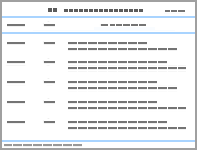
Table 1

DC/TMD history and clinical examination form"

Chief complaint
Left side (1) Right side (2)        
 
History
1. Have you ever had pain in your jaw, temple, in the ear, or in front of the ear on either side? Yes (3) No
2. In the last 30 days, have you had any headaches that included the temple areas of your head? Yes (4) No
3. In the last 30 days, have you had any jaw joint noise(s) when you moved or used your jaw? Yes (5) No
4. Have you ever had your jaw catch, even for a moment, so that it would not open all the way? Yes (6) No
5. Have you ever had your jaw lock, which affects eating? Yes (7) No
6. In the last 30 days, when you opened your mouth wide, did your jaw lock or catch even for a moment such that you could not close it from the wide-open position? Yes (8) No
 
Clinical examination
1. Palpation
Right side: Left side:
Temporalis No Pain Familiar pain (9) Headache (10) Temporalis No Pain Familiar pain (11) Headache (10)
Masseter No Pain Familiar pain (12) Headache (10) Masseter No Pain Familiar Pain (13) Headache (10)
Joint No Pain Familiar pain (14) Headache (10) Joint No Pain Familiar pain (15) Headache (10)
2. Joint noises
Left side No Open & close movement (16) Open or close movement (17) Lateral movement (18) Protrusive movement (19)
Right side No Open & close movement (20) Open or close movement (21) Lateral movement (22) Protrusive movement (23)
Left side No Crepitus (24) Joint locking (25)    
Right side No Crepitus (26) Joint locking (27)    
3. Mouth opening
>Maximum unassisted opening __ <35 mm (28) ≥35 mm (29) Pain on right joint (30) Pain on right muscles (31) Headache on right side (32)  
Pain on left joint (33) Pain on left muscles (34) Headache on left side (35)  
Maximum assisted opening __ Pain on right joint (30) Pain on right muscles (31) Headache on right side (32) Pain on left joint (33) Pain on left muscles (34) Headache on left side (35)
Protrusive movement __ Pain on right joint (30) Pain on right muscles (31) Headache on right side (32) Pain on left joint (33) Pain on left muscles (34) Headache on left side (35)
Left Lateral movement __ Pain on right joint (30) Pain on right muscles (31) Headache on right side (32) Pain on left joint (33) Pain on left muscles (34) Headache on left side (35)
Right Lateral movement __ Pain on right joint (30) Pain on right muscles (31) Headache on right side (32) Pain on left joint (33) Pain on left muscles (34) Headache on left side (35)
4. Opening pattern
Straight Intermittent locking while opening Deviation to left (36) Deviation to right (37) Corrected deviation

Figure 1

Clinical diagnosis process of pain-related temporomandibular disorders"

Table 2

Clinical diagnosis methods of pain-related temporomandibular disorders"

Disease Side Number of diagnosis*
Arthralgia Left 3+15 or/and 33
Right 3+14 or/and 30
Myalgia   3+9 or/and 11 or/and 12 or/and 13 or/and 31 or/and 34
Headache attributed to temporomandibular disorders   4+10 or/and 32 or/and 35

Figure 2

Clinical diagnosis process of intra-articular temporomandibular disorders"

Table 3

Clinical diagnosis methods of intra-articular temporomandibular disorders"

Disease Side Number of diagnosis*
Disc displacement with reductionLeft 5+16 or 5+17+18 or 5+17+19
Right 5+20 or 5+21+22 or 5+21+23
Disc displacement with reduction with intermittent lockingLeft 6+16 or 6+16+25 or 6+17+18 or 6+17+18+25 or 6+17+19 or 6+17+19+25
Right 6+20 or 6+20+27 or 6+21+22 or 6+21+22+27 or 6+21+23 or 6+21+23+27
Disc displacement without reduction with limited openingLeft 7+28+1 or/and 36
Right 7+28+2 or/and 37
Disc displacement without reduction without limited openingLeft 7+29+1 or/and 36
Right 7+29+2 or/and 37
Degenerative joint diseaseLeft 5+24
Right 5+26
SubluxationLeft 1+8
Right 2+8

Figure 3

Operation flow chart of clinical automatic diagnosis system for temporomandibular disorders"

Figure 4

Framework design of clinical automatic diagnosis system for temporomandibular disorders USL, user show layer; BLL, business logic layer; DC/TMD, diagnostic criteria for temporomandibular disorders; DAL, data access layer; MSSQL, Microsoft SQL server; OpenGL, open graphics; GLSL, OpenGL shading language."

Table 4

Diagnostic consistency of the clinical automatic diagnosis system for TMD based on DC/TMD"

Disease DC/TMD, n Clinical automatic diagnosis system for TMD, n Consistency
Arthralgia 44 44 100%
Myalgia 196 196 100%
Headache attributed to TMD 4 4 100%
Disc displacement with reduction 43 43 100%
Disc displacement with reduction with intermittent 35 35 100%
Disc displacement without reduction with limited opening 76 76 100%
Disc displacement without reduction without limited opening 61 61 100%
Degenerative joint disease 50 50 100%
Subluxation 3 3 100%
Total 512 512 100%

Table 5

The diagnostic efficacy of clinical automatic diagnosis system for TMD and expert for degenerative joint diseases"

Items DC/TMD* Clinical automatic diagnosis system for TMD Expert
TP/P, n/n 31/128 47/128
TN/N, n/n   123/128 123/128
Sensitivity (95%CI) 0.55 0.24 (0.17, 0.32) 0.37 (0.28, 0.45)
Specificity (95%CI) 0.61 0.96 (0.93, 0.99) 0.96 (0.93, 0.99)
Accuracy (95%CI)   0.60 (0.54, 0.66) 0.66 (0.61, 0.72)
Kappa value   0.79  

Table 6

The diagnostic efficacy of clinical automatic diagnosis system for TMD and expert for disc displacement with reduction"

Items DC/TMD* Clinical automatic diagnosis system for TMD Expert
TP/P, n/n 18/27 19/27
TN/N, n/n   122/127 119/127
Sensitivity (95%CI) 0.34 0.67 (0.49, 0.84) 0.70 (0.53, 0.88)
Specificity (95%CI) 0.92 0.96 (0.93, 1.00) 0.94 (0.89, 0.93)
Accuracy (95%CI)   0.91 (0.87, 0.95) 0.90 (0.85, 0.94)
Kappa value   0.92  

Table 7

The diagnostic efficacy of clinical automatic diagnosis system for TMD and expert for disc displacement without reduction with limited opening"

Items DC/TMD* Clinical automatic diagnosis system for TMD Expert
TP/P, n/n   48/53 52/53
TN/N, n/n   93/101 93/101
Sensitivity (95%CI) 0.80 0.90 (0.83, 0.98) 0.98 (0.97, 1.00)
Specificity (95%CI) 0.97 0.92 (0.87, 0.97) 0.92 (0.87, 0.97)
Accuracy (95%CI)   0.92 (0.87, 0.96) 0.95 (0.90, 0.98)
Kappa value   0.93  

Table 8

The diagnostic efficacy of clinical automatic diagnosis system for TMD and expert for disc displacement without reduction without limited opening"

Items DC/TMD* Clinical automatic diagnosis system for TMD Expert
TP/P, n/n   31/53 46/53
TN/N, n/n   93/101 93/101
Sensitivity (95%CI) 0.54 0.59 (0.45, 0.72) 0.87 (0.78, 0.96)
Specificity (95%CI) 0.79 0.92 (0.87, 0.97) 0.92 (0.87, 0.97)
Accuracy (95%CI)   0.81 (0.74, 0.87) 0.90 (0.86, 0.95)
Kappa value   0.68  
1 Iturriaga V , Bornhardt T , Velasquez N . Temporomandibular joint: Review of anatomy and clinical implications[J]. Dent Clin North Am, 2023, 67 (2): 199- 209.
doi: 10.1016/j.cden.2022.11.003
2 Valesan LF , Da-Cas CD , Réus JC , et al. Prevalence of temporomandibular joint disorders: A systematic review and meta-analysis[J]. Clin Oral Investig, 2021, 25 (2): 441- 453.
doi: 10.1007/s00784-020-03710-w
3 Cao Y , Yap AU , Lei J , et al. Oral health-related quality of life of patients with acute and chronic temporomandibular disorder diagnostic subtypes[J]. J Am Dent Assoc, 2022, 153 (1): 50- 58.
doi: 10.1016/j.adaj.2021.07.011
4 Jung HD , Kim SY , Park HS , et al. Orthognathic surgery and temporomandibular joint symptoms[J]. Maxillofac Plast Reconstr Surg, 2015, 37 (1): 14.
doi: 10.1186/s40902-015-0014-4
5 Michelotti A , Rongo R , D'antò V , et al. Occlusion, orthodontics, and temporomandibular disorders: Cutting edge of the current evidence[J]. J World Fed Orthod, 2020, 9 (Suppl 3): S15- S18.
6 Din NMU , Dar RA , Rasool M , et al. Breast cancer detection using deep learning: Datasets, methods, and challenges ahead[J]. Comput Biol Med, 2022, 149, 106073.
doi: 10.1016/j.compbiomed.2022.106073
7 Chan HP , Hadjiiski LM , Samala RK . Computer-aided diagnosis in the era of deep learning[J]. Med Phys, 2020, 47 (5): e218- e227.
8 Wu S , Roberts K , Datta S , et al. Deep learning in clinical natural language processing: A methodical review[J]. J Am Med Inform Assoc, 2020, 27 (3): 457- 470.
doi: 10.1093/jamia/ocz200
9 邵毅, 张铭志, 许言午, 等. 人工智能在视网膜图像自动分割和疾病诊断中的应用指南(2024)[J]. 眼科新进展, 2024, 44 (8): 592- 601.
10 魏世成, 王翰章. 颞颌关节紊乱综合征专家系统的设计与实现[J]. 华西口腔医学杂志, 1990, (3): 216- 220.
11 Schiffman E , Ohrbach R , Truelove E , et al. Diagnostic criteria for temporomandibular disorders (DC/TMD) for clinical and research applications: Recommendations of the International RDC/TMD Consortium Network* and Orofacial Pain Special Interest Group[J]. J Oral Facial Pain Headache, 2014, 28 (1): 6- 27.
doi: 10.11607/jop.1151
12 傅开元. 2014年新版国际颞下颌关节紊乱病分类及诊断标准解读[J]. 中华口腔医学杂志, 2017, 52 (6): 374- 376.
doi: 10.3760/cma.j.issn.1002-0098.2017.06.010
13 Minervini G , Marrapodi MM , Siurkel Y , et al. Accuracy of temporomandibular disorders diagnosis evaluated through the diagnostic criteria for temporomandibular disorder (DC/TDM) axis Ⅱ compared to the axis Ⅰ evaluations: A systematic review and meta-analysis[J]. BMC Oral Health, 2024, 24 (1): 299.
doi: 10.1186/s12903-024-03983-7
14 傅开元, 雷杰. 颞下颌关节紊乱病的分类、诊断及治疗进展[J]. 口腔医学, 2024, 44 (1): 6- 10.
15 Zhang XL , Sun JL , He DM . Review of the studies on the relationship and treatment of anterior disk displacement and dentofacial deformity in adolescents[J]. Oral Surg Oral Med Oral Pathol Oral Radiol, 2023, 135 (4): 470- 474.
doi: 10.1016/j.oooo.2022.07.018
16 Bas B , Ozgonenel O , Ozden B , et al. Use of artificial neural network in differentiation of subgroups of temporomandibular internal derangements: A preliminary study[J]. J Oral Maxillofac Surg, 2012, 70 (1): 51- 59.
doi: 10.1016/j.joms.2011.03.069
17 Tașkıran U , Çunkaș M . A deep learning based decision support system for diagnosis of temporomandibular joint disorder[J]. Applied Acoustics, 2021, 182, 108292.
doi: 10.1016/j.apacoust.2021.108292
18 Sharma N, Dar IG, Kumar J, et al. Temporomandibular joint syndrome prediction using neural network[C]/ /Ray K, Sharan SN, Rawat S, et al. Proceedings of the Engineering Vibration, Communication and Information Processing: ICoEVCI 2018, India. Singapore: Springer, 2019: 1-8.
19 Yap AU , Lei J , Zhang XH , et al. TMJ degenerative joint disease: Relationships between CBCT findings, clinical symptoms, and signs[J]. Acta Odontol Scand, 2023, 81 (7): 562- 568.
doi: 10.1080/00016357.2023.2215317
20 Patel A , Tee BC , Fields H , et al. Evaluation of cone-beam computed tomography in the diagnosis of simulated small osseous defects in the mandibular condyle[J]. Am J Orthod Dentofacial Orthop, 2014, 145 (2): 143- 156.
doi: 10.1016/j.ajodo.2013.10.014
21 Yadav S , Palo L , Mahdian M , et al. Diagnostic accuracy of 2 cone-beam computed tomography protocols for detecting arthritic changes in temporomandibular joints[J]. Am J Orthod Dentofacial Orthop, 2015, 147 (3): 339- 344.
doi: 10.1016/j.ajodo.2014.11.017
22 Lee KS , Kwak HJ , Oh JM , et al. Automated detection of TMJ osteoarthritis based on artificial intelligence[J]. J Dent Res, 2020, 99 (12): 1363- 1367.
doi: 10.1177/0022034520936950
23 Choi E , Kim D , Lee JY , et al. Artificial intelligence in detecting temporomandibular joint osteoarthritis on orthopantomogram[J]. Sci Rep, 2021, 11 (1): 10246.
[1] Rui-jie CAO,Zhong-qiang YAO,Peng-qing JIAO,Li-gang CUI. Comparison of diagnostic efficacy of different classification criteria for Takayasu arteritis in Chinese patients [J]. Journal of Peking University (Health Sciences), 2022, 54(6): 1128-1133.
[2] Peng WANG,Hua WU,Ying CHE,Dong-wei FAN,Jue LIU,Li-yuan TAO. Evaluation of screening accuracy on osteoporosis self-assessment tool for Asians and its cut-off value in healthy physical examination population [J]. Journal of Peking University(Health Sciences), 2019, 51(6): 1085-1090.
[3] XU Xiao, XU Li, JIANG Jiu-hui, WU Jia-qi, LI Xiao-tong, JING Wu-di. Accuracy analysis of alveolar dehiscence and fenestration of maxillary anterior teeth of Angle class Ⅲ by cone-beam CT [J]. Journal of Peking University(Health Sciences), 2018, 50(1): 104-109.
[4] LEI Jie,LIU Mu-qing,FU Kai-yuan. Disturbedsleep, anxiety and stress are possible risk indicators for temporomandibular disorders with myofascialpain [J]. Journal of Peking University(Health Sciences), 2016, 48(4): 692-696.
[5] WEI Pan, LU Song-He, FU Jing-Ya, YAN Zhi-Min, HUA Hong. Validation of the American College of Rheumatology Classification Criteria for primary Sjögren’s syndrome in Chinese patients [J]. Journal of Peking University(Health Sciences), 2014, 46(2): 306-310.
[6] YU Yang, SHENG Qin-Hui, ZHANG Bao-Wei, DING Wen-Hui. Left atrial size predicts adverse cardiac events in patients with non-obstruction hypertrophic cardiomyopathy [J]. Journal of Peking University(Health Sciences), 2014, 46(2): 207-210.
Viewed
Full text


Abstract

Cited

  Shared   
  Discussed   
No Suggested Reading articles found!