Journal of Peking University (Health Sciences) ›› 2025, Vol. 57 ›› Issue (5): 926-933. doi: 10.19723/j.issn.1671-167X.2025.05.017

Previous Articles     Next Articles

Effect of the combination of alkaloids from Euodiae Fructus and berberine in Zuojin Pill on cytotoxicity in HepG2 cells

Yadong GAO1,2, An ZHU1,3, Ludi LI1, Yingzi LI1, Qi WANG1,4,5,*()   

  1. 1. Department of Toxicology, Peking University School of Public Health, Beijing 100191, China
    2. Fujian Provincial Key Laboratory of Zoonosis Research, Fujian Provincial Center for Disease Control and Prevention, Fuzhou 350012, China
    3. Key Laboratory of Ministry of Education for Gastrointestinal Cancer, School of Basic Medical Sciences, Fujian Medical University, Fuzhou 350108, China
    4. Key Laboratory of State Administration of Traditional Chinese Medicine for Compatibility Toxicology, Beijing 100191, China
    5. Beijing Key Laboratory of Toxicological Research and Risk Assessment for Food Safety, Beijing 100191, China
  • Received:2024-02-07 Online:2025-10-18 Published:2025-05-07
  • Contact: Qi WANG
  • Supported by:
    the National Key Research and Development Program of China(2018YFC1704500); the National Key Research and Development Program of China(2018YFC1704506)

RICH HTML


Abstract: Objective: To investigate the hepatotoxicity of alkaloids from Euodiae Fructus combined with berberine (BBR) in Zuojin Pill, and to preliminarily explore the possible detoxification mechanism of the combination components. Methods: The combination ratio of components was determined by the maximum concentration (Cmax) of the chemical components in Zuojin Pill. HepG2 cell model was used to investigate the combined toxicity of the hepatotoxic components from Euodiae Fructus, such as evodiamine (EVO) or dehydroevodiamine (DHED), with BBR for 48 h. The experimental groups were set as follows: the vehicle control group, the EVO group, the DHED group, the BBR group, and the combination group of EVO or DHED with BBR. The cell counting kit-8 (CCK-8) method was used to determine the cell viability, and the combination index (CI) was used to determine the combined toxicity of the components. The alanine transaminase (ALT), aspartate aminotransferase (AST), lactate dehydroge-nase (LDH), and alkaline phosphatase (ALP) activities as well as total bilirubin (TBIL) content in the cell culture supernatant were detected. The protein expression levels of bile acid transporters, such as bile salt export pump (BSEP) and multidrug resistance-associated protein 2 (MRP2), were detected by Western blot. The intracellular malondialdehyde (MDA) content and superoxide dismutase (SOD) activity in HepG2 cells were detected. Results: Compared with EVO or DHED group, the combination of EVO 1 μmol/L with BBR 10 μmol/L or DHED 50 μmol/L with BBR 35 μmol/L significantly increased cell viability of HepG2 cells (P < 0.01), with CI values of 77.89 or 4.49, respectively, much greater than 1. Significant decreases in the activities of ALT, AST, LDH, ALP, and TBIL content in the cell culture supernatant were found in both combination groups (P < 0.05, P < 0.01). Compared with the EVO group, the combination of EVO with BBR upregulated the protein expression levels of BSEP and MRP2. Compared with the DHED group, the combination of DHED with BBR significantly downregulated the protein expression levels of BSEP and MRP2 (P < 0.01). Compared with EVO or DHED group, the combination of EVO or DHED with BBR significantly reduced the MDA content in HepG2 cells (P < 0.05, P < 0.01). Conclusion: A certain ratio of BBR combined with EVO or DHED had an antagonistic effect on HepG2 cytotoxicity, which might be related to regulating the expression of bile acid transpor-ters, and reducing lipid peroxidation damage.

Key words: Evodiamine, Dehydroevodiamine, Berberine, Toxicity of Chinese medicine, Chemical and drug induced liver injury

CLC Number: 

  • R114

Figure 1

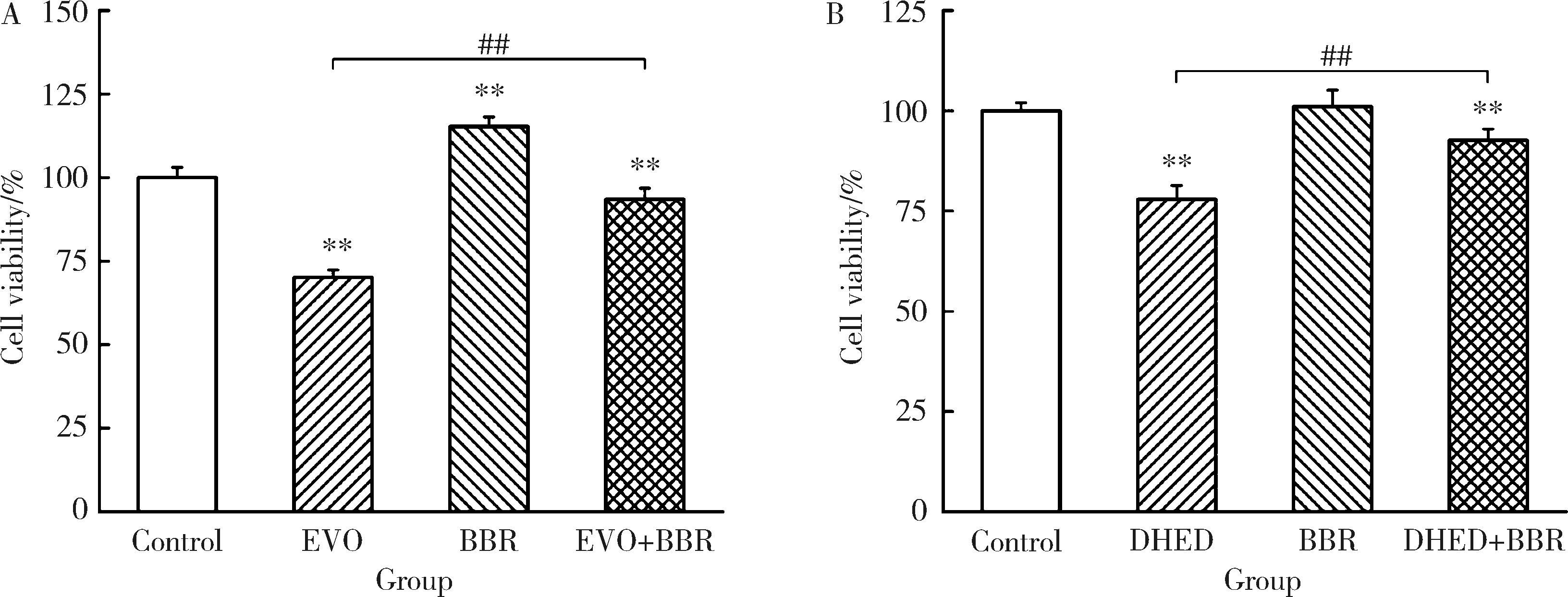
Effects of EVO, DHED and BBR treatment for 48 h on the cell viability of HepG2 cells ($\bar x \pm s$, n=3) A, the cells were treated with EVO 1 μmol/L, BBR 10 μmol/L, or EVO 1 μmol/L+BBR 10 μmol/L; B, the cells were treated with DHED 50 μmol/L, BBR 35 μmol/L, or DHED 50 μmol/L+BBR 35 μmol/L for 48 h, respectively. **P < 0.01, compared with the control group; ##P < 0.01, compared with the EVO or DHED group. EVO, evodiamine; BBR, berberine; DHED, dehydroevodiamine."

Figure 2

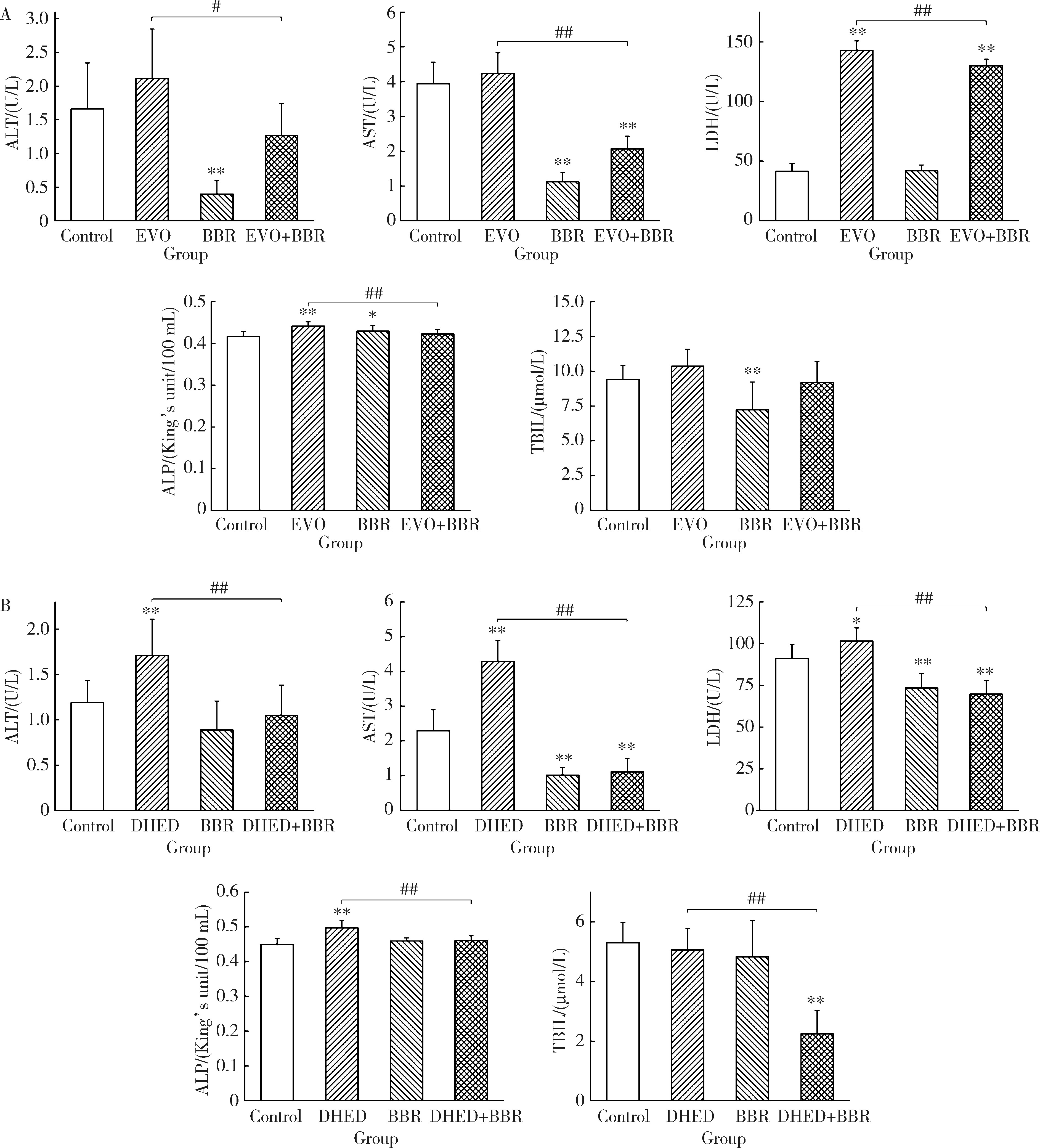
Effects of EVO, DHED and BBR treatment for 48 h on the liver function indicators of HepG2 cells ($\bar x \pm s$, n=3) Group A and group B are the same as Figure 1. * P < 0.05, ** P < 0.01, compared with the control group; # P < 0.05, ## P < 0.01, compared with the EVO or DHED group. EVO, evodiamine; BBR, berberine; DHED, dehydroevodiamine; ALT, alanine transaminase; AST, aspartate amino-transferase; LDH, lactate dehydrogenase; ALP, alkaline phosphatase; TBIL, total bilirubin."

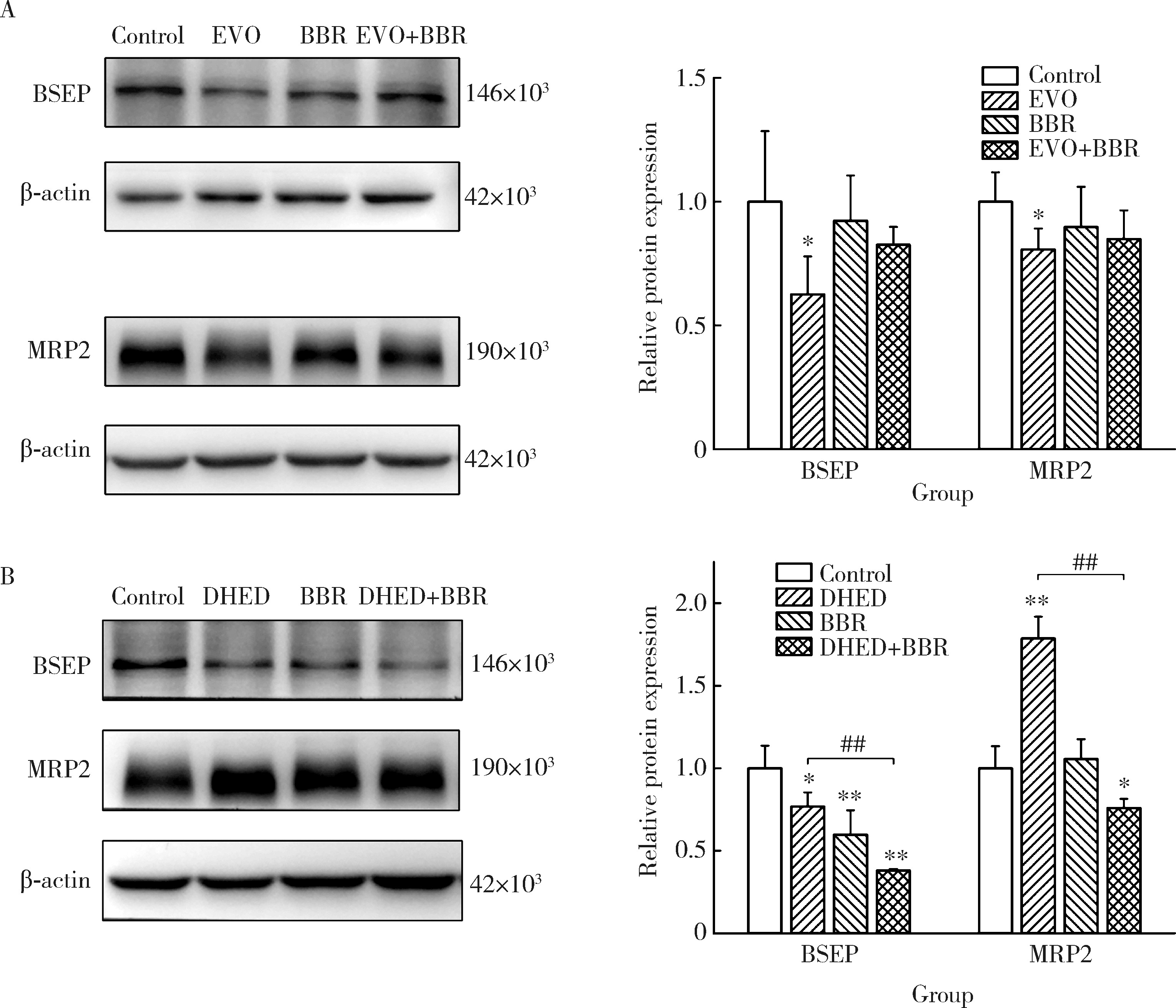
Figure 3

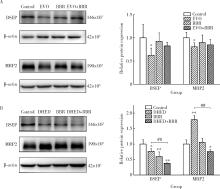
Effects of EVO, DHED and BBR treatment for 48 h on the expression levels of BSEP and MRP2 of HepG2 cells ($\bar x \pm s$, n=3) The protein expression levels were detected by Western blot, and the semi-quantitative analysis was performed. Group A and group B are the same as Figure 1. * P < 0.05, ** P < 0.01, compared with the control group; ## P < 0.01, compared with the EVO or DHED group. EVO, evodiamine; BBR, berberine; DHED, dehydroevodiamine; BSEP, bile salt export pump; MRP2, multidrug resistance-associated protein 2."

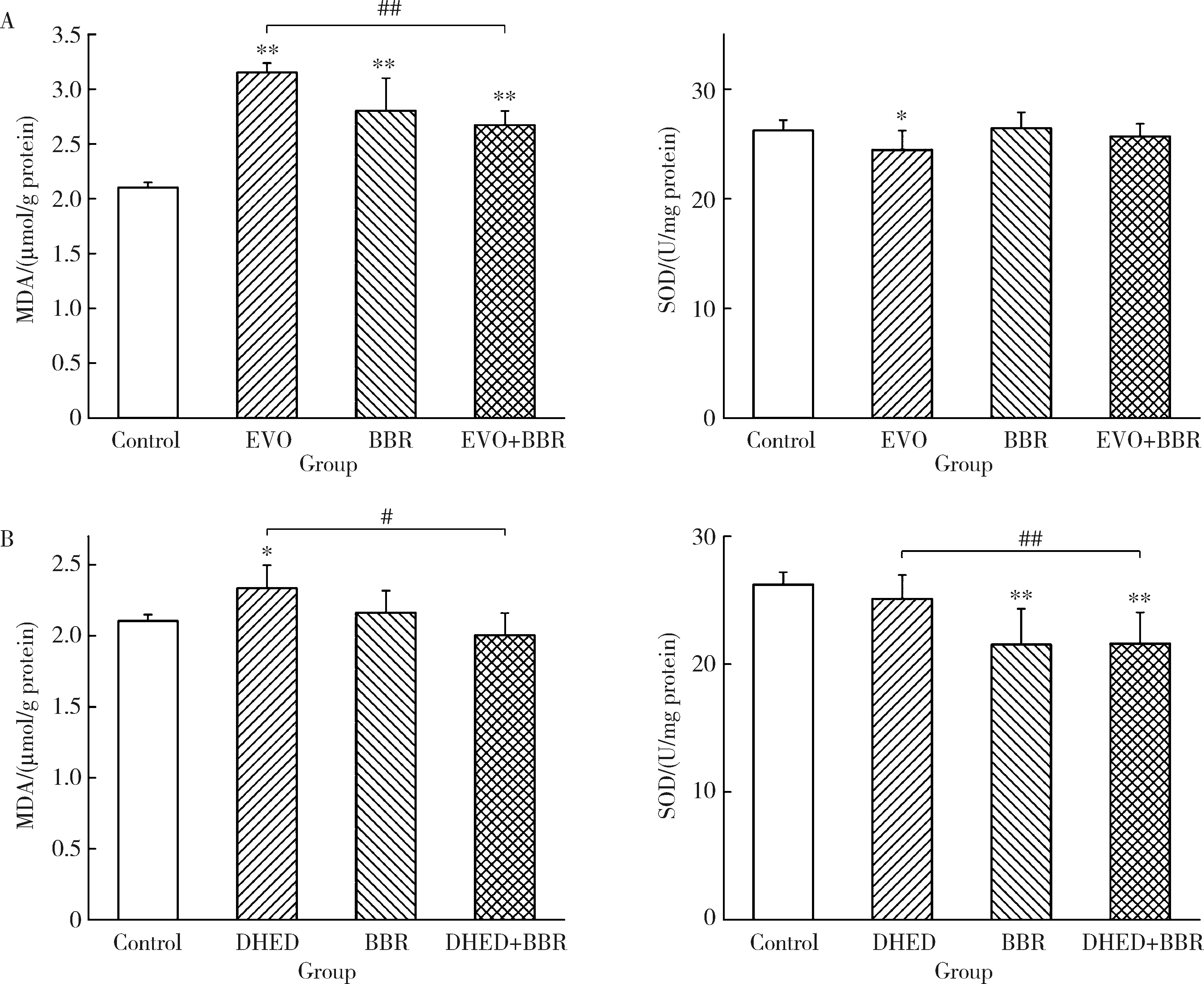
Figure 4

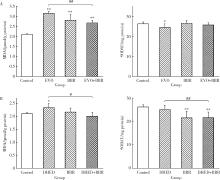
Effects of EVO, DHED and BBR treatment for 48 h on MDA content and SOD activity of HepG2 cells ($\bar x \pm s$, n=3) Group A and group B are the same as Figure 1. * P < 0.05, ** P < 0.01, compared with the control group; # P < 0.05, ## P < 0.01, compared with the EVO or DHED group. EVO, evodiamine; BBR, berberine; DHED, dehydroevodiamine; MDA, malondialdehyde; SOD, superoxide dismutase."

1
国家药典委员会. 中华人民共和国药典(一部2020年版)[M]. 北京: 中国医药科技出版社, 2020: 178.
2
黄伟, 李晓骄阳, 孙蓉. 吴茱萸水提组分多次给药对小鼠肝毒性的"量-时-毒"关系研究[J]. 中国中药杂志, 2012, 37(15): 2223- 2227.
3
刘颖, 杨润芳, 夏祺悦, 等. 吴茱萸醇提物重复给药的靶器官毒性研究[J]. 现代预防医学, 2015, 42(14): 2600- 2603.
4
彭成. 试论中药配伍研究的方法与实践[J]. 中药与临床, 2012, 3(1): 1- 4.
5
Zhou M, Deng Y, Liu M, et al. The pharmacological activity of berberine, a review for liver protection[J]. Eur J Pharmacol, 2021, 890, 173655.

doi: 10.1016/j.ejphar.2020.173655
6
Qian P, Zhang YB, Yang YF, et al. Pharmacokinetics studies of 12 alkaloids in rat plasma after oral administration of Zuojin and Fan-Zuojin formulas[J]. Molecules, 2017, 22(2): 214.

doi: 10.3390/molecules22020214
7
Chou TC. Theoretical basis, experimental design, and computerized simulation of synergism and antagonism in drug combination studies[J]. Pharmacol Rev, 2006, 58(3): 621- 681.

doi: 10.1124/pr.58.3.10
8
彭求贤, 蔡红兵, 史珏, 等. 黄连配伍吴茱萸后生物碱类成分的含量变化[J]. 中药材, 2012, 35(5): 742- 744.
9
倪建新, 林跃虹, 陈妙珠. 左金丸配伍意义的药物代谢动力学分析[J]. 中国当代医药, 2012, 19(5): 19- 20.
10
梁瑞峰, 张峰, 刘方洲, 等. 吴茱萸对黄连中小檗碱组织分布及肝脏摄取的影响[J]. 中医研究, 2014, 27(1): 64- 66.
11
黄果, 李凯鹏, 杨洁, 等. 黄连与吴茱萸合用大鼠体外肝代谢研究[J]. 中国中药杂志, 2010, 35(5): 651- 653.
12
Wang XN, Han X, Xu LN, et al. Enhancement of apoptosis of human hepatocellular carcinoma SMMC-7721 cells through synergy of berberine and evodiamine[J]. Phytomedicine, 2008, 15(12): 1062- 1068.

doi: 10.1016/j.phymed.2008.05.002
13
Zhou X, Ren F, Wei H, et al. Combination of berberine and evodiamine inhibits intestinal cholesterol absorption in high fat diet induced hyperlipidemic rats[J]. Lipids Health Dis, 2017, 16(1): 239.

doi: 10.1186/s12944-017-0628-x
14
高亚东, 朱安, 李璐迪, 等. 吴茱萸碱对HepG2细胞毒性及其机制[J]. 北京大学学报(医学版), 2021, 53(6): 1107- 1114.

doi: 10.19723/j.issn.1671-167X.2021.06.017
15
McGill MR. The past and present of serum aminotransferases and the future of liver injury biomarkers[J]. EXCLI J, 2016, 15, 817- 828.
16
Jurisic V, Radenkovic S, Konjevic G. The actual role of LDH as tumor marker, biochemical and clinical aspects[J]. Adv Exp Med Biol, 2015, 867, 115- 124.
17
Suzuki N, Irie M, Iwata K, et al. Altered expression of alkaline phosphatase (ALP) in the liver of primary biliary cirrhosis (PBC) patients[J]. Hepatol Res, 2006, 35(1): 37- 44.

doi: 10.1016/j.hepres.2006.01.009
18
Perez MJ, Briz O. Bile-acid-induced cell injury and protection[J]. World J Gastroenterol, 2009, 15(14): 1677- 1689.

doi: 10.3748/wjg.15.1677
19
Pauli-Magnus C, Stieger B, Meier Y, et al. Enterohepatic transport of bile salts and genetics of cholestasis[J]. J Hepatol, 2005, 43(2): 342- 357.

doi: 10.1016/j.jhep.2005.03.017
20
Yang K, Woodhead JL, Watkins PB, et al. Systems pharmacology modeling predicts delayed presentation and species differences in bile acid-mediated troglitazone hepatotoxicity[J]. Clin Pharmacol Ther, 2014, 96(5): 589- 598.

doi: 10.1038/clpt.2014.158
21
Fattinger K, Funk C, Pantze M, et al. The endothelin antagonist bosentan inhibits the canalicular bile salt export pump: A potential mechanism for hepatic adverse reactions[J]. Clin Pharmacol Ther, 2001, 69(4): 223- 231.

doi: 10.1067/mcp.2001.114667
22
Kenna JG. Current concepts in drug-induced bile salt export pump (BSEP) interference[J]. Curr Protoc Toxicol, 2014, 61(1): 23.7.1- 23.7.15.
23
Guo Y, Zhang Y, Huang W, et al. Dose-response effect of berberine on bile acid profile and gut microbiota in mice[J]. BMC Complement Altern Med, 2016, 16(1): 394.

doi: 10.1186/s12906-016-1367-7
24
Bu P, Le Y, Zhang Y, et al. Berberine-induced inactivation of signal transducer and activator of transcription 5 signaling promotes male-specific expression of a bile acid uptake transporter[J]. J Biol Chem, 2017, 292(11): 4602- 4613.

doi: 10.1074/jbc.M116.757567
25
Tian Y, Cai J, Gui W, et al. Berberine directly affects the gut microbiota to promote intestinal farnesoid X receptor activation[J]. Drug Metab Dispos, 2019, 47(2): 86- 93.

doi: 10.1124/dmd.118.083691
26
Ho E, Karimi Galougahi K, Liu CC, et al. Biological markers of oxidative stress: Applications to cardiovascular research and practice[J]. Redox Biol, 2013, 1(1): 483- 491.

doi: 10.1016/j.redox.2013.07.006
27
Huang P, Feng L, Oldham EA, et al. Superoxide dismutase as a target for the selective killing of cancer cells[J]. Nature, 2000, 407(6802): 390- 395.

doi: 10.1038/35030140
28
Hasanein P, Ghafari-Vahed M, Khodadadi I. Effects of isoquinoline alkaloid berberine on lipid peroxidation, antioxidant defense system, and liver damage induced by lead acetate in rats[J]. Redox Rep, 2017, 22(1): 42- 50.

doi: 10.1080/13510002.2016.1140406
29
Eftekhari A, Hasanzadeh A, Khalilov R, et al. Hepatoprotective role of berberine against paraquat-induced liver toxicity in rat[J]. Environ Sci Pollut Res Int, 2020, 27(5): 4969- 4975.

doi: 10.1007/s11356-019-07232-1
[1] GAO Ya-dong,ZHU An,LI Lu-di,ZHANG Tao,WANG Shuo,SHAN Dan-ping,LI Ying-zi,WANG Qi. Cytotoxicity and underlying mechanism of evodiamine in HepG2 cells [J]. Journal of Peking University (Health Sciences), 2021, 53(6): 1107-1114.
Viewed
Full text


Abstract

Cited

  Shared   
  Discussed   
No Suggested Reading articles found!