Journal of Peking University (Health Sciences) ›› 2025, Vol. 57 ›› Issue (5): 989-995. doi: 10.19723/j.issn.1671-167X.2025.05.026

Previous Articles     Next Articles

Three-dimensional morphological analysis of posed smile

Yujia XIAO, Bochun MAO, Yanheng ZHOU*()   

  1. Department of Orthodontics, Peking University School and Hospital of Stomatology & National Center of Stomatology & National Clinical Research Center for Oral Diseases & National Engineering Research Center of Oral Biomaterials and Digital Medical Devices & Beijing Key Laboratory of Digital Stomatology & NHC Research Center of Engineering and Technology for Computerized Dentistry & NMPA Key Laboratory for Dental Materials, Beijing 100081, China
  • Received:2022-10-08 Online:2025-10-18 Published:2024-04-03
  • Contact: Yanheng ZHOU
  • Supported by:
    the National Natural Science Foundations of China(62076011); the Research Foundation of Peking University School and Hospital of Stomatology(PKUSS20200114)

RICH HTML


Abstract: Objective: To investigate the changes and symmetry of facial soft tissue during posed smile, to analyze the feature of posed smile in different gender, and verify the reproducibility of posed smile. Methods: Three-dimensional (3D) facial images of 41 adults (16 males and 25 females with an average age of 26.76±2.70 years) which were taken by FaceScan three-dimensional sensor, including one rest position and two posed smile images. Then these images were imported into 3D soft tissue analysis software for model repositioning. 3D morphable model method (3DMM) was carried out to automatic landmarks setting. After that, the measurement of the eyes, cheeks, nose and perioral area were carried out for 3D soft tissue analysis. Finally, the changes and symmetry of the soft tissues between the two expression states and the gender differences during the posed smiles were compared. Meanwhile, the reproducibility of posed smile was statistically tested. Results: Compared with the rest position, except for nasolabial angle (1.45°±7.65°), the measurements of 3D soft tissue in other region were changed in posed smile (P < 0.001). It should be noted that the eye region was also significantly changed (P < 0.001). Furthermore, the prominent feature of posed smile was that the alar base length became longer, the upper and lower vermilions were narrow and thin, and the mentolabial furrows became shallow. Meanwhile the chin extended anteriorly while the mouth retracted; During posed smile, the labial fissure asymmetry [2.78 (1.73, 3.49) mm], mid-infraorbital asymmetry [2.36 (1.22, 3.27) mm] and outercanthal asymmetry [2.31(1.29, 2.80) mm] were most apparent. Compared with the rest position, the asymmetry was not significantly increased except for cheilion and alar curvature points during the posed smile (P>0.05). In the posed smile, the changes of the right palpebral fissure height and the thickness of lower vermilion (|Li-Stoi| z) of males were greater than those of females (P < 0.05), and asymmetry of exocanthion and cheekbone increased more than that of females (P < 0.05). There was no obvious difference between the two posed smiles. Conclusion: In this study, during the posed smile the soft tissues of the eyes, cheeks, nose, lips and chin changed in different degrees, and the asymmetry of cheilion and alar curvature point was greater than that of the rest position; In addition, the reproducibility of posed smile was excellent, which can be a reference for clinical aesthetics and functional research of smile.

Key words: Posed smile, Three-dimensional(3D)facial analysis, 3D morphable model, Symmetry, Reproducibility

CLC Number: 

  • R782

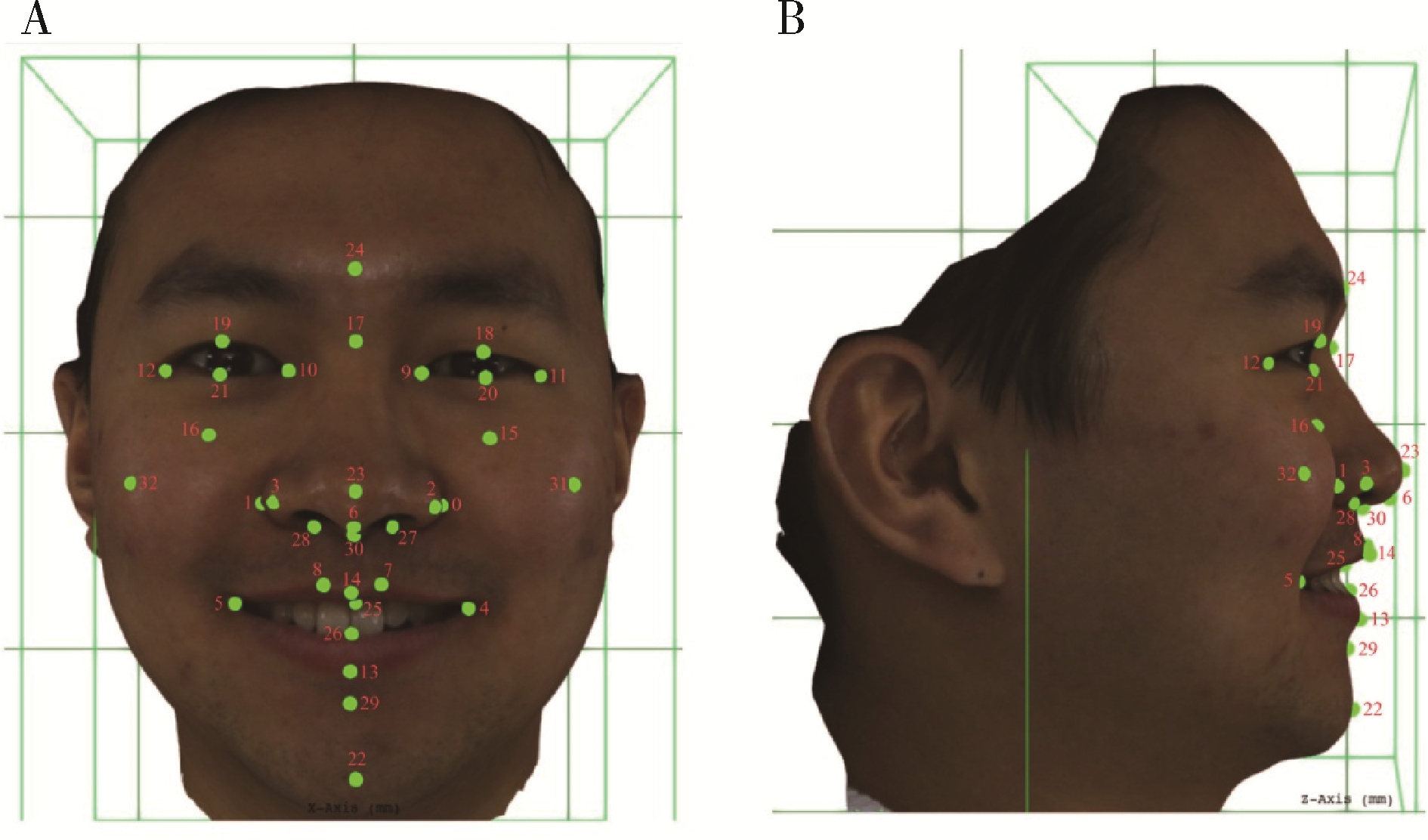
Figure 1

Landmarks of 3D facial soft tissue A, front view of 3D facial landmarks; B, lateral profile of 3D facial landmarks. 0, alar curvature point (L); 1, alar curvature point (R); 2, alare (L); 3, alare (R); 4, cheilion (L); 5, cheilion (R); 6, columella; 7, crista philtri (L); 8, crista philtri (R); 9, endocanthion (L); 10, endocanthion (R); 11, exocanthion (L); 12, exocanthion (R); 13, labrale inferius (Li); 14, labrale superius (Ls); 15, mid-infraorbital (L); 16, mid-infraorbital (R); 17, nasion; 18, palpebrale superius (L); 19, palpebrale superius (R); 20, palpebrale inferius (L); 21, palpebrale inferius (R); 22, pogonion (Pg); 23, pronasale (Prn); 24, glabella (Gl); 25, stomion superius (Stos); 26, stomion inferius (Stoi); 27, subalare (L); 28, subalare (R); 29, sublabial (Sl); 30, subnasale (Sn); 31, cheekbone (L); 32, cheekbone (R)."

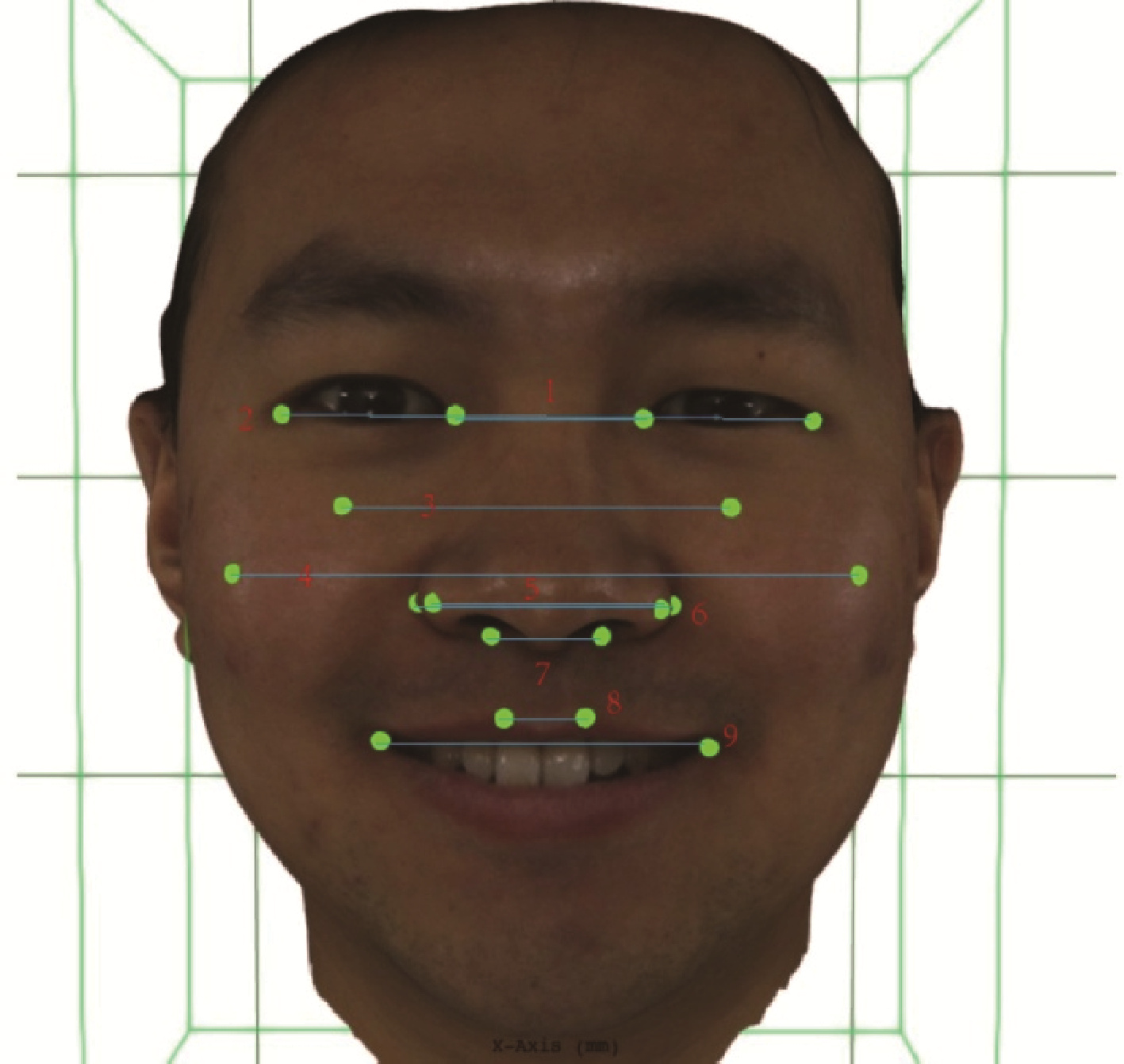
Figure 2

Schematic of facial symmetry measurement Measurement items of symmetry in posed smile: 1, endocanthion; 2, exocanthion; 3, mid-infraorbital; 4, cheekbone; 5, alar curvature point; 6, alare; 7, subalare; 8, crista philtri; 9, cheilion."

Table 1

Definitions of 3D soft tissue measurements of rest position and posed smile"

Measurement items Definition
Palpebral fissure length (L/R)/mm Horizontal distance between the exocanthion and endocanthion
Palpebral fissure height (L/R)/mm Vertical distance between the upper and lower eyelids
Facial convexity/(°) Angle at Sn subtended by side Gl-Pg
Cheekbone width/mm Distance between the L/R cheekbone
Outer canthal nasal angel/(°) Angle at Sn subtended by the outer canthi of the eyes
Nasal width/mm Horizontal width of the nose at the base of the nasal alare
Nasolabial angle /(°) Angle at Sn subtended by side Prn-Ls
Philtral length/mm Distance between the Sn and Ls
Philtral width/mm Distance between the philtral ridges,measured just above the vermilion border
Labial width/mm Distance between L/R cheilion
Upper vermilion height/mm Vertical distance between Sn and Stos
Upper lip height/mm Vertical distance between Sn and Ls
Lower vermilion height/mm Vertical distance between Sl and Li
Lower lip height/mm Vertical distance between Sl and Li
Upper lip protrusion(|Prn-Ls|z)/mm Sagittal distance between Prn and Ls
Lower lip protrusion(|Prn-Li|z)/mm Sagittal distance between Prn and Li
Mentolabial furrows depth(|Ls-Sl|z)/mm Sagittal distance between Li and Sl
Thickness of upper vermilion (|Ls-Stos|z)/mm Sagittal distance between Ls and Stos
Thickness of lower vermilion (|Li-Stoi|z)/mm Sagittal distance between Li and Stoi

Table 2

Results of 3D soft tissue measurements in posed smile and rest position"

Measurement items Rest (n=41) Posed smile (n=41) Deviation t P
Palpebral fissure length (L)/mm 31.28±1.66 31.97±1.90 0.69±1.16 3.79 < 0.001
Palpebral fissure height (R)/mm 31.86±1.58 32.80±2.06 0.94±1.39 4.33 < 0.001
Palpebral fissure height (L)/mm 10.29±1.46 8.47±1.39 -1.81±1.45 -8.00 < 0.001
Palpebral fissure height (R)/mm 10.48±1.42 8.52±1.35 -1.96±1.37 -9.11 < 0.001
Facial convexity /(°) 169.64±5.27 171.19±4.93 1.54±1.68 5.88 < 0.001
Cheekbone width/mm 107.46±3.73 112.75±4.11 5.30±1.95 17.37 < 0.001
Outer canthal nasal angel/(°) 93.76±3.64 96.42±3.93 2.66±1.77 9.62 < 0.001
Nasal width/mm 34.58±2.32 36.72±2.33 2.14±0.89 15.43 < 0.001
Nasolabial angle/(°) 98.30±8.46 99.75±7.95 1.45±7.65 1.22 0.231
Philtral length/mm 15.17±1.74 12.82±1.77 -2.35±1.34 -11.27 < 0.001
Philtral width/mm 13.52±1.39 14.71±1.37 1.19±1.33 5.74 < 0.001
Labial width/mm 49.26±4.36 59.65±5.24 10.39±3.51 18.98 < 0.001
Upper vermilion height/mm 7.50±1.11 5.51±1.19 -1.99±1.12 -11.32 < 0.001
Upper lip height/mm 14.52±1.70 12.57±1.66 -1.96±1.40 -8.93 < 0.001
Lower vermilion height/mm 8.90±1.54 8.42±1.67 -0.48±1.51 -2.05 0.047
Lower lip height/mm 7.00±1.84 7.92±1.92 0.92±1.40 4.21 < 0.001
Upper lip protrusion(|Prn-Ls|z)/mm 8.70±2.24 11.33±2.34 2.63±1.16 14.51 < 0.001
Lower lip protrusion(|Prn-Li|z)/mm 12.17±3.56 14.13±3.39 1.96±1.28 9.82 < 0.001
Mentolabial furrows depth(|Ls-Sl|z)/mm 5.45±1.45 4.18±1.75 -1.27±1.07 -7.64 < 0.001
Thickness of upper vermilion (|Ls-Stos|z)/mm 4.43±1.30 5.59±1.85 1.16±1.81 4.11 < 0.001
Thickness of lower vermilion (|Li-Stoi|z)/mm 1.26±1.29 3.62±1.81 2.36±1.91 7.89 < 0.001

Table 3

Comparison of 3D soft tissue changes in posed smile of different gender"

Deviation (posed smile-rest) Female (n=25) Male (n=16) t P
Palpebral fissure length (L)/mm 0.77±1.04 0.56±1.35 -0.52 0.610
Palpebral fissure height (R)/mm 0.80±1.38 1.16±1.42 0.80 0.431
Palpebral fissure height (L)/mm -1.33±1.20 -2.57±1.53 -2.76 0.100
Palpebral fissure height (R)/mm -1.38±1.03 -2.86±1.38 -3.69 0.010#
Facial convexity /(°) 1.53±1.59 1.57±1.87 0.09 0.932
Cheekbone width /mm 5.22±1.76 5.43±2.28 0.32 0.750
Outer canthal nasal angel/(°) 2.54±1.85 2.84±1.68 0.54 0.593
Nasal width/mm 2.23±1.00 2.00±0.69 -0.85 0.399
Nasolabial angle /(°) 0.96±6.60 2.23±9.24 0.48 0.638
Philtral length/mm -2.19±1.13 -2.61±1.62 -0.90 0.377
Philtral width/mm 1.33±1.39 0.97±1.25 -0.87 0.392
Labial Width/mm 11.09±3.66 9.29±3.04 -1.70 0.097
Upper vermilion height/mm -1.83±0.87 -2.23±1.43 -1.02 0.321
Upper lip height/mm -1.77±1.10 -2.26±1.78 -0.99 0.332
Lower vermilion height/mm -0.81±1.39 0.04±1.57 1.78 0.086
Lower lip height /mm 0.75±1.36 1.18±1.46 0.94 0.356
Upper lip protrusion(|Prn-Ls|z)/mm 2.53±0.86 2.78±1.53 0.60 0.556
Lower lip protrusion(|Prn-Li|z)/mm 2.06±1.29 1.81±1.29 0.60 0.552
Mentolabial furrows depth(|Ls-Sl|z)/mm -1.44±1.08 -1.01±1.01 1.30 0.205
Thickness of upper vermilion (|Ls-Stos|z)/mm 1.02±1.33 1.39±2.42 0.59 0.583
Thickness of lower vermilion (|Li-Stoi|z)/mm 1.67±1.82 3.45±1.56 3.33 0.002#

Table 4

Symmetry in posed smile and rest position /mm"

Symmetry Rest(n=41) Posed smile (n=41) Deviation Z P
Endocanthion 1.35 (0.95,1.70) 1.51 (0.95,1.77) 0.01 (-0.53,0.61) 0.60 0.551
Exocanthion 2.25 (1.42,2.93) 2.31 (1.29,2.80) -0.05 (-0.80,0.52) 0.51 0.613
Mid-infraorbital 2.25 (1.18,2.91) 2.36 (1.22,3.27) 0.26 (-0.74,0.89) 0.98 0.330
Cheekbone 1.16 (0.74,1.30) 1.25 (0.81,1.60) 0.23 (-0.29,0.71) 1.72 0.085
Alar curvature point 1.08 (0.74,1.45) 1.27 (0.60,1.77) 0.15 (-0.17,0.56) 2.04 0.042
Alare 1.12 (0.68,1.32) 1.19 (0.78,1.64) 0.07 (-0.22,0.35) 1.08 0.282
Subalare 1.21 (0.78,1.58) 1.14 (0.71,1.54) -0.21 (-0.41,0.30) 0.87 0.385
Crista philtri 1.12 (0.72,1.26) 1.18 (0.66,1.41) 0.00 (-0.43,0.55) 0.28 0.778
Cheilion 1.93 (1.13,2.42) 2.78 (1.73,3.49) 1.07 (-0.10,2.03) 3.23 0.001

Table 5

The change of symmetry in posed smile of different gender /mm"

Symmetry (posed smile-rest) Female(n=25) Male(n=16) Z P
Endocanthion 0.01 (-0.37,0.87) -0.45 (-0.73,0.53) -1.22 0.227
Exocanthion -0.48 (-1.08,0.15) 0.20 (-0.13,0.85) -2.38 0.017
Mid-infraorbital 0.28 (-0.67,0.83) 0.03 (-0.76,1.06) -0.04 0.968
Cheekbone 0.05 (-0.47,0.35) 0.49 (-0.15,1.11) -2.13 0.032
Alar curvature point 0.14 (-0.14,0.45) 0.35 (-0.38,0.76) -0.83 0.419
Alare 0.07 (0.07,0.29) 0.20 (-0.30,0.54) -0.98 0.333
Subalare -0.27 (-0.49,0.16) -0.12 (-0.30,0.43) -1.67 0.095
Crista philtri 0.10 (-0.33,0.61) -0.41 (-0.66,0.47) -1.74 0.085
Cheilion 1.30 (0.04,2.03) 0.62 (-0.53,2.02) -0.54 0.606

Table 6

Reproducibility of posed smile"

Measurement items Posed smile 1 (n=41) Posed smile 2 (n=41) Deviation t P
Palpebral fissure length (L)/mm 31.97±1.90 31.75±1.79 -0.22±1.06 -1.31 0.197
Palpebral fissure height (R)/mm 32.80±2.06 32.59±1.67 -0.21±1.01 -1.31 0.197
Palpebral fissure height (L)/mm 8.47±1.39 8.54±1.29 0.07±0.75 0.56 0.581
Palpebral fissure height (R)/mm 8.52±1.35 8.65±1.41 0.12±0.74 1.00 0.325
Facial convexity/(°) 171.19±4.93 171.16±5.00 -0.03±0.82 -0.26 0.799
Cheekbone width/mm 112.75±4.11 112.77±4.15 -0.02±1.35 0.10 0.932
Outer canthal nasal angel/(°) -96.42±3.93 -96.04±3.67 0.38±1.55 1.56 0.126
Nasal width/mm 36.72±2.33 36.77±2.30 0.05±0.56 0.59 0.560
Nasolabial angle /(°) 99.75±7.95 99.93±7.05 0.18±4.65 0.24 0.809
Philtral length/mm 12.82±1.77 12.75±1.96 -0.07±1.10 -0.43 0.668
Philtral width/mm 14.71±1.37 14.47±1.23 -0.23±0.95 -1.56 0.127
Labial width/mm 59.65±5.24 59.45±5.46 -0.20±2.41 -0.96 0.600
Upper vermilion height/mm 5.51±1.19 5.45±1.10 -0.06±0.67 -0.59 0.556
Upper lip height/mm 12.57±1.66 12.53±1.89 -0.03±1.12 -0.20 0.847
Lower vermilion height/mm 8.42±1.67 8.37±1.74 -0.05±0.68 -0.48 0.635
Lower lip height/mm 7.92±1.92 8.23±1.83 0.27±1.05 1.67 0.104
Upper lip protrusion (|Prn-Ls|z)/mm 11.33±2.34 11.31±1.92 -0.02±0.83 -0.13 0.896
Lower lip protrusion (|Prn-Li|z)/mm 14.13±3.39 14.26±3.45 0.13±0.97 0.83 0.412
Mentolabial furrows depth (|Ls-Sl|z)/mm 4.18±1.75 4.10±1.61 -0.08±0.79 -0.66 0.512
Thickness of upper vermilion (|Ls-Stos|z)/mm 5.59±1.85 5.72±1.93 0.13±1.86 0.45 0.658
Thickness of lower vermilion (|Li-Stoi|z)/mm 3.62±1.81 3.59±1.17 -0.04±1.61 -0.14 0.888
1
Ackerman JL , Ackerman MB , Brensinger CM , et al. A morphometric analysis of the posed smile[J]. Clin Orthod Res, 1998, 1 (1): 2- 11.

doi: 10.1111/ocr.1998.1.1.2
2
Dobreva D , Gkantidis N , Halazonetis D , et al. Smile reproducibility and its relationship to self-perceived smile attractiveness[J]. Biology (Basel), 2022, 11 (5): 719.
3
Koidou VP , Chatzopoulos GS , Rosenstiel SF . Quantification of facial and smile esthetics[J]. J Prosthet Dent, 2018, 119 (2): 270- 277.

doi: 10.1016/j.prosdent.2017.04.002
4
Armalaite J , Jarutiene M , Vasiliauskas A , et al. Smile aesthetics as perceived by dental students: A cross-sectional study[J]. BMC Oral Health, 2018, 18 (1): 225.

doi: 10.1186/s12903-018-0673-5
5
Dym H , Pierre R 2nd . Diagnosis and treatment approaches to a "gummy smile"[J]. Dent Clin North Am, 2020, 64 (2): 341- 349.

doi: 10.1016/j.cden.2019.12.003
6
Alagha MA , Ju X , Morley S , et al. Reproducibility of the dynamics of facial expressions in unilateral facial palsy[J]. Int J Oral Maxillofac Surg, 2018, 47 (2): 268- 275.

doi: 10.1016/j.ijom.2017.08.005
7
Pucciarelli V , Gibelli D , Barni L , et al. Assessing normal smiling function through 3D-3D surfaces registration: An innovative method for the assessment of facial mimicry[J]. Aesthetic Plast Surg, 2018, 42 (2): 456- 463.

doi: 10.1007/s00266-017-1028-3
8
Rao A , Badavannavar A , Acharya A . An orthodontic analysis of the smile dynamics with videography[J]. J Oral Biol Craniofac Res, 2021, 11 (2): 174- 179.

doi: 10.1016/j.jobcr.2021.01.001
9
Claes P , Walters M , Shriver MD , et al. Sexual dimorphism in multiple aspects of 3D facial symmetry and asymmetry defined by spatially dense geometric morphometrics[J]. J Anat, 2012, 221 (2): 97- 114.

doi: 10.1111/j.1469-7580.2012.01528.x
10
邱淑婷, 朱玉佳, 王时敏, 等. 姿势微笑位口唇对称参考平面的数字化构建及初步应用验证[J]. 北京大学学报(医学版), 2022, 54 (1): 193- 199.

doi: 10.19723/j.issn.1671-167X.2022.01.031
11
White JD , Ortega-Castrillón A , Matthews H , et al. MeshMonk: Open-source large-scale intensive 3D phenotyping[J]. Sci Rep, 2019, 9 (1): 6085.

doi: 10.1038/s41598-019-42533-y
12
Ekman P . Darwin, deception, and facial expression[J]. Ann N Y Acad Sci, 2003, 1000, 205- 221.

doi: 10.1196/annals.1280.010
13
Rigsbee OH 3rd , Sperry TP , BeGole EA . The influence of facial animation on smile characteristics[J]. Int J Adult Orthodon Orthognath Surg, 1988, 3 (4): 233- 239.
14
Maharjan S , Rajbhandari A , Pradhan R , et al. Average type smile in posed smile of individuals visiting department of orthodontics of a tertiary care hospital: A descriptive cross-sectional study[J]. JNMA J Nepal Med Assoc, 2022, 60 (247): 286- 289.

doi: 10.31729/jnma.7072
15
Lee K , Lee EC . Siamese architecture-based 3D densenet with person-specific normalization using neutral expression for spontaneous and posed smile classification[J]. Sensors (Basel), 2020, 20 (24): 7184.

doi: 10.3390/s20247184
16
Schmidt KL , Ambadar Z , Cohn JF , et al. Movement differences between deliberate and spontaneous facial expressions: Zygoma-ticus major action in smiling[J]. J Nonverbal Behav, 2006, 30 (1): 37- 52.

doi: 10.1007/s10919-005-0003-x
17
Park S , Lee K , Lim JA , et al. Differences in facial expressions between spontaneous and posed smiles: Automated method by action units and three-dimensional facial landmarks[J]. Sensors (Basel), 2020, 20 (4): 1199.

doi: 10.3390/s20041199
18
Kawulok M , Nalepa J , Kawulok J , et al. Dynamics of facial actions for assessing smile genuineness[J]. PLoS One, 2021, 16 (1): e0244647.

doi: 10.1371/journal.pone.0244647
19
Guo H , Zhang XH , Liang J , et al. The dynamic features of lip corners in genuine and posed smiles[J]. Front Psychol, 2018, 9, 202.

doi: 10.3389/fpsyg.2018.00202
20
Yasuda K , Nakano H , Yamada T , et al. Identifying differences between a straight face and a posed smile using the homologous modeling technique and the principal component analysis[J]. J Craniofac Surg, 2019, 30 (8): 2378- 2380.

doi: 10.1097/SCS.0000000000005969
21
Burstone CJ . Part 1 facial esthetics. Interview by ravindra Nanda[J]. J Clin Orthod, 2007, 41 (2): 79- 87.
22
Gunnery SD , Hall JA , Ruben MA . The deliberate Duchenne smile: Individual differences in expressive control[J]. J Nonverbal Behav, 2013, 37 (1): 29- 41.

doi: 10.1007/s10919-012-0139-4
23
Parra M , Pardo R , Haidar ZS , et al. Three-dimensional analysis of nasolabial soft tissues while smiling using stereophotogrammetry (3dMDTM)[J]. Int J Morphol, 2019, 37 (1): 232- 236.

doi: 10.4067/S0717-95022019000100232
24
Rubin LR , Mishriki Y , Lee G . Anatomy of the nasolabial fold: The keystone of the smiling mechanism[J]. Plast Reconstr Surg, 1989, 83 (1): 1- 10.

doi: 10.1097/00006534-198901000-00001
25
Freytag DL , Alfertshofer MG , Frank K , et al. The difference in facial movement between the medial and the lateral midface: A 3-dimensional skin surface vector analysis[J]. Aesthet Surg J, 2022, 42 (1): 1- 9.

doi: 10.1093/asj/sjab152
26
Lindell A . Lateralization of the expression of facial emotion in humans[J]. Prog Brain Res, 2018, 238, 249- 270.
27
Tanikawa C , Takada K . Test-retest reliability of smile tasks using three-dimensional facial topography[J]. Angle Orthod, 2018, 88 (3): 319- 328.

doi: 10.2319/062617-425.1
[1] Yujia ZHU, Hua SHEN, Aonan WEN, Zixiang GAO, Qingzhao QIN, Shenyao SHAN, Wenbo LI, Xiangling FU, Yijiao ZHAO, Yong WANG. Deep learning algorithms for intelligent construction of a three-dimensional maxillofacial symmetry reference plane [J]. Journal of Peking University (Health Sciences), 2025, 57(1): 113-120.
[2] Shuangyun ZHAO, Siyu ZOU, Xueying LI, Lijuan SHEN, Hong ZHOU. Evaluation of reliability and validity of Chinese version of a short-form of Health Literacy Dental scale (HeLD-14) in the application among parents of preschool children [J]. Journal of Peking University (Health Sciences), 2024, 56(5): 828-832.
[3] QIU Shu-ting,ZHU Yu-jia,WANG Shi-min,WANG Fei-long,YE Hong-qiang,ZHAO Yi-jiao,LIU Yun-song,WANG Yong,ZHOU Yong-sheng. Preliminary clinical application verification of complete digital workflow of design lips symmetry reference plane based on posed smile [J]. Journal of Peking University (Health Sciences), 2022, 54(1): 193-199.
[4] ZHU Yu-jia,ZHAO Yi-jiao,ZHENG Sheng-wen,WEN Ao-nan,FU Xiang-ling,WANG Yong. A method for constructing three-dimensional face symmetry reference plane based on weighted shape analysis algorithm [J]. Journal of Peking University (Health Sciences), 2021, 53(1): 220-226.
[5] Tian-cheng QIU,Xiao-jing LIU,Zhu-lin XUE,Zi-li LI. Evaluation of the reproducibility of non-verbal facial expressions in normal persons using dynamic stereophotogrammetric system [J]. Journal of Peking University (Health Sciences), 2020, 52(6): 1107-1111.
[6] Ning XIAO,Yu-chun SUN,Yi-jiao ZHAO,Yong WANG. A method to evaluate the trueness of reconstructed dental models made with photo-curing 3D printing technologies [J]. Journal of Peking University(Health Sciences), 2019, 51(1): 120-130.
[7] ZHENG Bang, LI Man, WANG Kai-lu, LV Jun. Analysis of the reliability and validity of the Chinese version of Pittsburgh sleep qua-lity index among medical college students [J]. Journal of Peking University(Health Sciences), 2016, 48(3): 424-428.
[8] HE Ying, GUO Chuan-Bin, DENG Xu-Liang, WANG Xing, WANG Xiao-Xia. Three-dimensional measurement and facial symmetry analysis for the craniofacial structure of people in North China with normal occlusion [J]. Journal of Peking University(Health Sciences), 2015, 47(4): 708-713.
[9] XIONG Yu-Xue, Yang-Hui-Fang, Zhao-Yi-Jiao, WANG Yong. Comparison of two kinds of methods evaluating the degree of facial asymmetry by three-dimensional data [J]. Journal of Peking University(Health Sciences), 2015, 47(2): 340-343.
Viewed
Full text


Abstract

Cited

  Shared   
  Discussed   
No Suggested Reading articles found!