A retrospective matching study of partial nephrectomy and radical nephrectomy for pathological T3a stage renal cell carcinoma

  • Zezhen ZHOU ,
  • Liyuan GE ,
  • Fan ZHANG ,
  • Shaohui DENG ,
  • Ye YAN ,
  • Hongxian ZHANG ,
  • Guoliang WANG ,
  • Lei LIU ,
  • Yi HUANG ,
  • Shudong ZHANG , *
Expand
  • Department of Urology, Peking University Third Hospital, Beijing 100191, China

Received date: 2025-02-28

  Online published: 2025-08-02

Supported by

the Beijing Health Technology Achievements and Appropriate Technology Promotion Project(BHTPP2024003)

Copyright

All rights reserved. Unauthorized reproduction is prohibited.

Abstract

Objective: To evaluate the long-term oncological outcomes of partial nephrectomy (PN) in patients with renal cell carcinoma (RCC) who were clinically staged as clinical T1 (cT1) preoperatively but upstaged to pathological T3a (pT3a) after surgery. Methods: A total of 427 RCC patients postoperatively diagnosed as pT3aN0M0 at Peking University Third Hospital from February 2013 to December 2022 were retrospectively reviewed. Among them, 33 cT1 patients upstaged to pT3a RCC received PN (PN group), while 394 non-upstaged pT3a RCC patients underwent radical nephrectomy (RN, RN group). Propensity score matching was performed at a 1 ∶ 1 ratio based on baseline characteristics. The Kaplan-Meier method was used to assess overall survival (OS), cancer-specific survival (CSS), and disease-free survival (DFS), with Log-rank tests and Cox regression models for multivariate analysis. Results: Before matching, the PN group (n = 33) had significantly higher rates of perirenal fat invasion (PFI, 45.5% vs. 15.2%) and segmental renal vein involvement (42.4% vs. 20.8%), but lower rates of renal sinus invasion (RSI, 21.2% vs. 73.6%) and renal vein tumor thrombus (0% vs. 15.2%) compared with the RN group (n = 394, all P < 0.05). After matching, baseline characteristics were comparable between the PN group (n = 33) and RN group (n = 33). No significant differences were observed in operative time, blood loss, mean hospital stay, complication rate, positive margin rate, or conversion to open surgery between the two groups (P > 0.05). However, the PN group showed significantly higher estimated glomerular filtration rate (eGFR) postoperatively [76.9 (55.4, 87.3) mL/(min·1.73 m2) vs. 61.7 (56.8, 73.5) mL/(min·1.73 m2), P < 0.05], indicating better renal function preservation. No significant differences were found in OS, CSS, or DFS between the groups (P > 0.05). Multivariate ana-lysis identified renal vein invasion (RVI), higher Fuhrman grades (Ⅲ-Ⅳ), and sarcomatoid differentiation as independent risk factors for DFS and CSS in the pT3a RCC patients (P < 0.05). Conclusion: For cT1 RCC patients upstaged to pT3a, PN preserves renal function more effectively while achieving com-parable oncological outcomes to RN. RVI, higher Fuhrmann grade, and sarcomatoid differentiation are independent risk factors for pT3N0M0 RCC patients.

Cite this article

Zezhen ZHOU , Liyuan GE , Fan ZHANG , Shaohui DENG , Ye YAN , Hongxian ZHANG , Guoliang WANG , Lei LIU , Yi HUANG , Shudong ZHANG . A retrospective matching study of partial nephrectomy and radical nephrectomy for pathological T3a stage renal cell carcinoma[J]. Journal of Peking University(Health Sciences), 2025 , 57(4) : 704 -710 . DOI: 10.19723/j.issn.1671-167X.2025.04.012

根据2020年全球癌症统计数据显示,肾细胞癌(renal cell carcinoma,RCC)新发431 288例,死亡179 368例,是全球最常见的恶性肿瘤之一[1]。现代影像学设备的普及使多数RCC可在早期偶然发现。欧洲泌尿外科学会(European Association of Urology,EAU)和美国泌尿外科学会(American Urological Association,AUA)均推荐肾部分切除术(partial nephrectomy,PN)作为临床T1期(clinical T1, cT1) 期RCC的标准术式,因其可显著保留肾功能并获得等效肿瘤学结局,T3a期RCC则通常采用根治性肾切除术(radical nephrectomy,RN)[2-3]。然而,受限于现有的影像学技术,部分T3a期病例在术前难以精确诊断,因表现为cT1期RCC而采用了PN。初诊为cT1期的患者中,大约有4.8%~6.3%的病例术后升级为病理T3a期(pathological T3a stage, pT3a),其预后显著差于未升级病例[4-7]。国内一项大型回顾性研究表明,2.2%(22/1 168)的cT1期RCC患者术后升级为pT3a期,但pT1期和pT3a期两组的预后差异无统计学意义(P>0.05)[8],这些结果表明,cT1术后升级为pT3a RCC的肿瘤学结局尚不明确。此外,PN对pT3a期RCC的适用性仍存争议,尤其是对于术后升级为pT3a期的RCC。本研究旨在分析cT1升级为pT3a期RCC患者行PN治疗的远期肿瘤学结局,比较PN与RN在pT3a期RCC人群中的疗效差异。

1 资料与方法

1.1 数据来源与研究队列

回顾研究2013年2月至2022年12月术后诊断为pT3aN0M0期RCC患者的临床病理数据,排除了双肾肿瘤、孤立肾或肾功能不全的患者,最终纳入了427例,其中33例为接受了PN治疗的cT1升级为pT3a RCC,394例为接受了RN的未升级pT3a RCC,所有手术均由同一手术团队实施。本研究经北京大学第三医院医学科学研究伦理委员会审查批准(批准号:M2022813)。

1.2 研究结局与定义

使用总生存期(overall survival, OS)、癌症特异性生存期(cancer-specific survival, CSS)和无病生存期(disease-free survival, DFS)来评估患者的肿瘤学结局。采用美国麻醉医师协会(American society of Aneshesiologists,ASA)体格情况分级来评估手术风险[9],术后并发症根据Clavien-Dindo分级系统进行评估[10],围术期结局采用手术时间、出血量、平均住院日、术后估算的肾小球滤过率(estimated glomerular filtration rate,eGFR)、阳性切缘率、并发症发生率、中转开放手术的比例进行评估,临床分期和病理分期采用2017版的TNM分期系统[11],肾肿瘤的组织学诊断和分级依据2016年世界卫生组织泌尿系统及男性生殖器官肿瘤分类[12]

1.3 随访

随访数据由两名专职临床数据管理员定期收集。术后第一年每3个月进行一次随访,第二年至第三年每6个月随访一次,三年后则每年随访一次。如果患者在随访期间死亡,其死因将根据当地医疗机构出具的死亡证明来确定,或者由主治医生判定。

1.4 统计学分析

所有统计学分析均使用SPSS 25.0版本和R统计软件包4.2.3版本(www.r-project.org)进行。正态分布计量资料用均数±标准差表示,组间比较采用t检验,非正态分布计量资料用中位数(四分位数)表示,组间比较采用非参数检验。计数资料以例(%)表示,组间比较采用卡方检验或Fisher’s精确检验。由1名不了解研究结局的独立研究人员基于基线特征对PN组和RN组两个队列进行1 ∶ 1匹配,采用最优匹配方法,卡钳值设置为0.2,多变量逻辑回归模型用于计算倾向性评分。采用Kaplan-Meier法评估OS、CSS和DFS。使用对数秩检验和Cox回归模型进行多因素分析。所有检验均为双侧检验,以P<0.05为差异有统计学意义的判定标准。

2 结果

2.1 研究队列的基线特征

表 1总结了427例患者的基线特征。匹配前,PN组(n=33)和RN组(n=394)在年龄、性别、肿瘤侧别、ASA分级、合并症、术前eGFR、组织学类型、肿瘤Fuhrman分级的差异无统计学意义(P>0.05)。然而,PN组与RN组相比肿瘤直径较小,此差异有统计学意义(P<0.05)。此外,在pT3a病理特征方面,PN组的患者中肾周脂肪浸润(perirenal fat invasion,PFI)和肾段静脉受累的比例更高,而RN组的患者肾盂肾窦侵犯(renal sinus invasion,RSI)及肾静脉癌栓的比例更高,此差异有统计学意义(P<0.05)。匹配了33例接受PN的RCC患者和33例接受RN的RCC患者,大多数特征完全匹配,匹配后PN组和RN组在基线方面差异无统计学意义(P>0.05)。
表1 倾向性评分匹配前后PN组和RN组患者的基线资料

Table 1 Baseline of patients undergoing PN and RN before and after propensity score matching

Items Before propensity score matching P value After propensity score matching Pvalue
PN (n = 33) RN (n = 394) PN (n = 33) RN (n = 33)
Age/years, n(%) 0.879 >0.999
    <65 18 (54.5) 203 (51.5) 18 (54.5) 18 (54.5)
    ≥ 65 15 (45.5) 191 (48.5) 15 (45.5) 15 (45.5)
Gender, n(%) 0.164 >0.999
    Male 26 (78.8) 257 (65.2) 26 (78.8) 27 (81.8)
    Female 7 (21.2) 137 (34.8) 7 (21.2) 6 (18.2)
Laterality, n(%) >0.999 0.460
    Left 18 (54.5) 215 (54.6) 18 (54.5) 14 (42.4)
    Right 15 (45.5) 179 (45.4) 15 (45.5) 19 (57.6)
ASA level, n(%) 0.146 0.920
    1 6 (18.2) 82 (20.8) 6 (18.2) 7 (21.2)
    2 25 (75.8) 291 (73.9) 25 (75.8) 23 (69.7)
    3 1 (3.0) 20 (5.1) 1 (3.0) 2 (6.1)
    4 1 (3.0) 1 (0.3) 1 (3.0) 1 (3.0)
Comorbidity, n(%) 14 (42.4) 166 (42.1) >0.999 14 (42.4) 17 (51.5) 0.622
Hypertension 14 (42.4) 141 (35.8) 14 (42.4) 14 (42.4)
Diabetes 6 (18.2) 52 (13.2) 6 (18.2) 9 (27.3)
CHD 1 (3.0) 21 (5.3) 1 (3.0) 2 (6.1)
CVD 2 (6.1) 21 (5.3) 2 (6.1) 1 (3.0)
Surgery history 12 (36.4) 104 (26.4) 12 (36.4) 11 (33.3)
Tumor diameter /cm, n(%) <0.001 >0.999
    ≤4 26 (78.8) 61 (15.5) 26 (78.8) 26 (78.8)
    >4, ≤7 7 (21.2) 202 (51.3) 7 (21.2) 7 (21.2)
    >7 0 (0) 131 (33.2) 0 (0) 0 (0)
eGFR/ [mL/(min·1.73 m2)], M (P25, P75) 88.9
(64.0, 99.3)
86.7
(72.6, 97.6)
0.956 88.9
(64.0, 99.3)
89.3
(79.6, 97.7)
0.830
Renal vein thrombosis, n(%) 0 (0) 60 (15.2) 0.031 0 (0) 0 (0) >0.999
PFI, n(%) 15 (45.5) 60 (15.2) <0.001 15 (45.5) 16 (48.5) >0.999
RSI, n(%) 7 (21.2) 290 (73.6) <0.001 10 (30.3) 12 (36.4) 0.794
Segmental renal vein extension, n(%) 14 (42.4) 82 (20.8) 0.008 14 (42.4) 15 (45.5) >0.999
Histology, n(%) >0.999 >0.999
    ccRCC 29 (87.9) 346 (87.8) 29 (87.9) 29 (87.9)
    nccRCC 4 (12.1) 48 (12.2) 4 (12.1) 4 (12.1)
Fuhrman grading, n(%) 0.072 0.782
    Ⅰ-Ⅱ 25 (75.8) 229 (58.1) 25 (75.8) 23 (69.7)
    Ⅲ-Ⅳ 8 (24.2) 165 (41.9) 8 (24.2) 10 (30.3)
Sarcomatoid differentiation, n(%) 0 (0) 9 (2.3) >0.999 0 (0) 0 (0) >0.999

PN, partial nephrectomy; RN, radical nephrectomy; ASA, American Society of Anesthesiologists; eGFR, estimated glomerular filtration rate; PFI, perirenal fat invasion; RSI, renal sinus invasion; ccRCC, clear cell renal cell carcinoma; nccRCC, non-clear cell renal cell carcinoma.

2.2 围术期结局

表 2总结了围术期结局。在匹配队列中,术式包括腹腔镜肾切除术和机器人辅助腹腔镜肾切除术,手术入路为经腹腔或经腹膜后。在中转开放手术的比例、手术时间、失血量、并发症发生率、阳性切缘率以及平均住院日方面,两组之间的差异无统计学意义(P>0.05)。然而,PN组术后eGFR平均为76.9(55.4,87.3) mL/(min·1.73m2),高于RN组的术后eGFR [平均为61.7(56.8,73.5) mL/(min· 1.73 m2)],此差异有统计学意义(P<0.05)。
表2 匹配后队列中PN组和RN组的围术期结局比较

Table 2 Comparison of perioperative outcomes of PN group and RN group in the matched cohort

Items PN (n=33) RN (n=33) P value
Nephrectomy techniques, n(%) 0.672
    Laparoscopic nephrectomy 29 (87.9) 31 (93.9)
    Robot-assisted laparoscopic nephrectomy 4 (12.1) 2 (6.1)
Surgical approach, n(%) 0.622
    Retroperitoneal 15 (45.5) 18 (54.5)
    Transperitoneal 18 (54.5) 15 (45.5)
Open conversion, n(%) 1 (3.0) 3 (9.1) 0.613
Operative time/min, ${\bar x}$±s 159.0±57.8 148.0±70.8 0.281
Blood loss/mL, M (P25, P75) 50.0 (20, 100) 20.0 (20, 50) 0.372
Postoperative eGFR [mL/(min·1.73m2], M (P25, P75) 76.9 (55.4, 87.3) 61.7 (56.8, 73.5) 0.016
Complications, n(%) 6 (18.2) 8 (24.2) 0.763
PSM, n(%) 1 (3.3) 0 (0) >0.999
Postoperative hospital stays/d,${\bar x}$±s 6.1±2.4 5.9±2.1 0.818

PN, partial nephrectomy; RN, radical nephrectomy; eGFR, estimated glomerular filtration rate; PSM, positive surgical margins.

2.3 肿瘤学结局

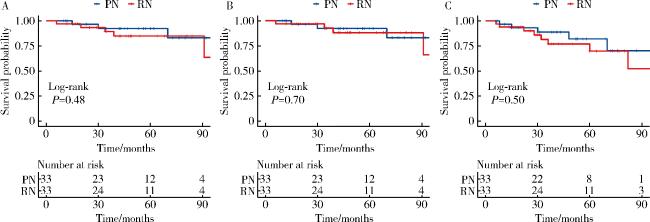
在匹配后队列中,PN组(n = 33)的中位随访时间为47(23, 73)个月,RN组(n = 33)的中位随访时间为40(22, 66)个月。随访结束时,PN组共有3例患者死亡,RN组共有5例患者死亡,差异无统计学意义(P>0.05)。PN组3例患者均死于肿瘤相关原因,RN组有4例患者死于肿瘤相关原因,差异无统计学意义(P>0.05)。两组各有2例局部复发病例。此外,PN组有3例患者发生远处转移,RN组有8例患者发生远处转移(其中1例同时出现局部复发和远处转移)。总之,PN组有5例患者在术后出现疾病进展,RN组有9例患者在术后出现疾病进展,差异无统计学意义(P>0.05)。值得注意的是,PN组存在1例切缘阳性的患者,其在随访18个月后并未出现局部复发或远处转移。两组在OS、CSS和DFS差异均无统计学意义(P>0.05,图 1)。
图1 匹配后队列中PN组和RN组的肿瘤学结局

Figure 1 Oncological outcomes of PN group and RN group in the matched cohort

A, overall survival; B, cancer-specific survival; C, disease-free survival of patients with pT3a stage renal cell carcinoma in the matched cohort. PN, partial nephrectomy; RN, radical nephrectomy; pT3a, pathological T3a.

2.4 pT3a RCC的预后因素分析

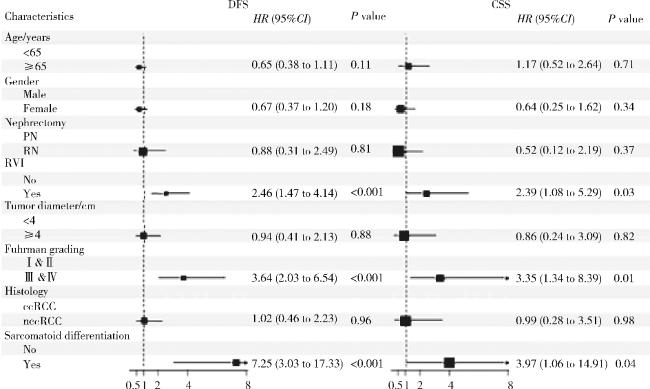
本研究中肾静脉侵犯(renal vein invasion,RVI)被定义为伴有肾静脉癌栓形成或肾段静脉受累,伴或不伴有脂肪侵犯,与仅存在脂肪侵犯的情况进行预后比较。将所有的pT3a RCC患者(n = 427)纳入多因素回归分析,发现RVI、较高的肿瘤Fuhrman分级(Ⅲ~Ⅳ)、伴有肉瘤样分化特征与pT3a RCC患者更短的DFS和CSS相关(P<0.05,图 2),表明这些指标是pT3a RCC患者预后的独立危险因素。
图2 pT3a RCC患者DFS和CSS的多因素Cox回归分析

Figure 2 Multivariate Cox regression analysis of DFS and CSS in patients with pT3a RCC

DFS, disease-free survival; CSS, cancer-specific survival; PN, partial nephrectomy; RN, radical nephrectomy; RVI, renal vein invasion; ccRCC, clear cell renal cell carcinoma; nccRCC, non-clear cell renal cell carcinoma; pT3a, pathological T3a; RCC, renal cell carcinoma.

3 讨论

本研究分析了cT1升级为T3a的RCC患者接受PN后的围术期及肿瘤学结果。在倾向性评分匹配后队列中,与RN组相比,PN组术后eGFR更高(P<0.05),表明PN在pT3a RCC患者中具有保留肾功能方面的优势。此外,PN组和RN组相比,在OS、CSS、DFS方面具有相似的肿瘤控制效果。这些结果表明,PN在部分pT3a期RCC患者具有安全性和有效性。
对于非转移性RCC,PN或RN是首选治疗方法[13]。由于PN在保留肾功能和提高生活质量方面具有优势,且肿瘤学效果相似,对于T1期RCC患者最好采用PN而非RN进行治疗[2]。对于肿瘤直径<4 cm的RCC,与PN相比,RN的心血管事件发生率和全因死亡率更高[14]。在匹配了与肾功能相关的主要因素(包括年龄、性别、合并症、肿瘤直径、术前eGFR)后,我们发现PN组与RN组相比,术后的eGFR更高(P<0.05),但OS差异无统计学意义,可能与随访时间较短有关。鉴于肾功能与全因死亡率存在关联,未来需要更长时间的随访观察PN组是否有OS方面的优势。
既往研究表明,接受PN的患者中发现存在PFI的比例更高[15],与本研究的结果相似。匹配前在pT3a病理特征方面,PN组的患者中PFI和肾段静脉受累的比例更高,而RN组的患者RSI及肾静脉癌栓的比例更高,此差异有统计学意义(P<0.05),这表明PN组和RN组患者pT3a病理特征比例存在偏倚,在比较两组的预后时应注意调整。我们使用了倾向性评分匹配的方法对上述偏倚进行了调整,排除了伴有肾静脉癌栓形成的患者,避免了这部分患者(需要行静脉癌栓取出或切除)对围术期结局和肿瘤学结局的影响。
T3aN0M0期的RCC总体预后较好,特别是cT1升级为T3a期。一项研究表明,T3N0M0期的5年OS远高于T1~3N1M0期(72.7% vs. 38.1%)[16]。鉴于这一证据,Swami等[17]提议将T3N0M0期从美国癌症联合委员会(American Joint Committee on Cancer,AJCC)Ⅲ期降至AJCC Ⅱ期。此外,在pT3a期RCC中,肿瘤大小对预后的重要性也不容忽视。一项多中心回顾性研究显示,T2期和T3a期(≤ 7 cm)的生存率相似 [18]。一项倾向性评分匹配研究表明,对于肿瘤在0~4 cm大小的pT3aN0M0期RCC患者,PN与RN相比与更高的生存率相关(P<0.05)[15]。这些结果进一步证实PN在低危pT3aN0M0期RCC患者中具有可行性。
pT3a期是一个具有强烈异质性的RCC分期类别,其包括PFI、RSI以及肾静脉(或其节段分支)的侵犯[11],这些特征对预后的影响差异有统计学意义。先前的一项研究表明,与肾段静脉侵犯相比,肾静脉侵犯与更差的DFS和CSS独立相关[19]。一项荟萃分析表明,在pT3a期RCC患者中,合并RSI的患者与合并PFI的患者相比具有更差的CSS(HR: 1.94, 95%CI: 1.21~3.12; P = 0.006)[20]。在非转移性pT3a期RCC(仅接受RN)患者中,同时具有多种pT3a侵犯特征与仅存在单种pT3a侵犯特征相比,具有更差的OS、CSS和DFS(P<0.05)[21]。此外,本研究显示,在pT3a期RCC患者中,接受PN的患者与接受RN的患者具有不同的pT3a病理特征,包括肾静脉癌栓形成(0% vs. 15.2%,P<0.05)、PFI(45.5% vs. 15.2%,P<0.01)、RSI(21.2% vs. 73.6%,P<0.001)以及肾段静脉受累(42.4% vs. 20.8%,P<0.01)。多因素分析进一步表明,RVI与更短的DFS和CSS显著相关(P<0.01和P<0.05)。上述结果表明,现有TNM分期系统可能需要进一步细分,以区分出部分预后良好的pT3aN0M0期RCC患者,这些患者可能具有PN的适应证。使用列线图进行危险分层可能有利于对pT3aN0M0期RCC患者的预后进行精准评估,可用于指导后续治疗[22]
对于T3a期RCC患者行PN的争议主要集中在更高的并发症风险和局部复发风险上。既往研究表明,RCC导致的疾病进展或死亡与阳性切缘之间的关联较弱[23]。然而,最新的荟萃分析显示,与阴性手术切缘相比,阳性切缘与较高的局部复发风险(HR=2.13,95%CI:1.67~2.72)和较低的无进展生存期(HR=1.70,95%CI:1.40~2.07)显著相关[24]。我们的研究结果显示,在中转开放手术比例、手术时间、失血量、并发症发生率以及阳性切缘率方面,PN与RN差异无统计学意义。先前的一项研究报告称,在cT1升级为pT3a期的RCC患者中,PN术后的阳性切缘比例为7/49,且阳性切缘患者中4/7出现了复发[25]。然而,在我们的研究中,PN组只有1/33例患者观察到阳性切缘,但该患者在随访18个月后并未观察到局部复发或转移的迹象,未来需要进一步随访密切观察。最新的meta分析表明,对于pT3a期RCC患者,PN在肿瘤控制方面具有相似或更好的效果[26-28]。因此,未来需要大样本、多中心、前瞻性的队列研究来评估pT3a期RCC患者应用PN的阳性切缘率和远期肿瘤学结局。
本研究存在一些局限性:(1)这是一项回顾性研究,不可避免地存在选择偏倚;(2)由于患者整体预后较好,随访时间有限,未能观察到中位生存期,研究结论尚不成熟。因此,为了支持这些研究结果,未来需要多中心、前瞻性且长期随访研究来获得更多证据。
倾向性评分匹配的结果表明,对于cT1升级为pT3a的RCC患者,PN在保留肾功能方面具有优势,并且肿瘤学结果与RN相当,基于这些结果,可考虑对部分预后良好、技术学可行的pT3a期RCC患者使用PN。

利益冲突  所有作者声明不存在利益冲突。

作者贡献声明  周泽臻:整理数据,统计分析,撰写文章;葛力源:整理数据,修改文章;张帆、邓绍晖、颜野、张洪宪、王国良、刘磊、黄毅:收集数据,指导文章撰写;张树栋:设计课题,基金支持,指导文章撰写。

1
Sung H , Ferlay J , Siegel RL , et al. Global cancer statistics 2020:GLOBOCAN estimates of incidence and mortality worldwide for 36 cancers in 185 countries[J]. CA Cancer J Clin, 2021, 71 (3): 209- 249.

2
Ljungberg B , Albiges L , Abu-GhanemY , et al. European Association of Urology guidelines on renal cell carcinoma: The 2022 update[J]. Eur Urol, 2022, 82 (4): 399- 410.

3
Campbell SC , Clark PE , Chang SS , et al. Renal mass and loca-lized renal cancer: Evaluation, management, and follow-up: AUA guideline. Part[J]. J Urol, 2021, 206 (2): 199- 208.

4
Lee H , Lee M , Lee SE , et al. Outcomes of pathologic stage T3a renal cell carcinoma up-staged from small renal tumor: Emphasis on partial nephrectomy[J]. BMC Cancer, 2018, 18 (1): 427.

5
Gorin MA , Ball MW , Pierorazio PM , et al. Outcomes and predictors of clinical T1 to pathological T3a tumor up-staging after robotic partial nephrectomy: A multi-institutional analysis[J]. J Urol, 2013, 190 (5): 1907- 1911.

6
Russell CM , Lebastchi AH , Chipollini J , et al. Multi-institutional survival analysis of incidental pathologic T3a upstaging in clinical T1 renal cell carcinoma following partial nephrectomy[J]. Urology, 2018, 117, 95- 100.

7
Choueiri TK , Chen MH , D'Amico AV , et al. Impact of postoperative prostate-specific antigen disease recurrence and the use of salvage therapy on the risk of death[J]. Cancer, 2010, 116 (8): 1887- 1892.

8
白红松, 王栋, 寿建忠, 等. cT1期肾癌行肾部分切除术后升期为pT3a期的临床分析[J]. 临床泌尿外科杂志, 2020, 35 (9): 716- 720.

9
Hackett NJ , De Oliveira GS , Jain UK , et al. ASA class is a reliable independent predictor of medical complications and morta-lity following surgery[J]. Int J Surg, 2015, 18, 184- 190.

10
Mitropoulos D , Artibani W , Graefen M , et al. Reporting and grading of complications after urologic surgical procedures: An ad hoc EAU guidelines panel assessment and recommendations[J]. Eur Urol, 2012, 61 (2): 341- 349.

11
Amin MB , Edge SB , Greene FL , et al. AJCC cancer staging manual[M]. 8th ed. New York: Springer, 2017: 196- 198.

12
Moch H , Cubilla AL , Humphrey PA , et al. The 2016 WHO classification of tumours of the urinary system and male genital organs. Part A. Renal, penile, and testicular tumours[J]. Eur Urol, 2016, 70 (1): 93- 105.

13
Rose TL , Kim WY . Renal cell carcinoma: A review[J]. JAMA, 2024, 332 (12): 1001- 1010.

14
Alam R , Patel HD , Osumah T , et al. Comparative effectiveness of management options for patients with small renal masses: A prospective cohort study[J]. BJU Int, 2019, 123 (1): 42- 50.

15
Yang Z, Li J, Liu Z, et al. The effectiveness of partial versus radical nephrectomy for pT3aN0M0 renal cell carcinoma: A propensity score analysis[J]. 2020, 46(10): 1234-1256.

16
Shao N , Wang HK , Zhu Y , et al. Modification of American Joint Committee on cancer prognostic groups for renal cell carcinoma[J]. Cancer Med, 2018, 7 (11): 5431- 5438.

17
Swami U , Nussenzveig RH , Haaland B , et al. Revisiting AJCC TNM staging for renal cell carcinoma: Quest for improvement[J]. Ann Transl Med, 2019, 7 (Suppl 1): S18.

18
Lam JS , Klatte T , Patard JJ , et al. Prognostic relevance of tumour size in T3a renal cell carcinoma: A multicentre experience[J]. Eur Urol, 2007, 52 (1): 155- 162.

19
Ball MW , Gorin MA , Harris KT , et al. Extent of renal vein invasion influences prognosis in patients with renal cell carcinoma[J]. BJU Int, 2016, 118 (1): 112- 117.

20
Zhang Z , Yu C , Velet L , et al. The difference in prognosis between renal sinus fat and perinephric fat invasion for pT3a renal cell carcinoma: A meta-analysis[J]. PLoS One, 2016, 11 (2): e0149420.

21
Shah PH , Lyon TD , Lohse CM , et al. Prognostic evaluation of perinephric fat, renal sinus fat, and renal vein invasion for patients with pathological stage T3a clear-cell renal cell carcinoma[J]. BJU Int, 2019, 123 (2): 270- 276.

22
周泽臻, 邓绍晖, 颜野, 等. 非转移性T3a肾细胞癌患者3年肿瘤特异性生存期预测[J]. 北京大学学报(医学版), 2024, 56 (4): 673- 679.

DOI

23
Raz O , Mendlovic S , Shilo Y , et al. Positive surgical margins with renal cell carcinoma have a limited influence on long-term oncological outcomes of nephron sparing surgery[J]. Urology, 2010, 75 (2): 277- 280.

24
Omrani M , Basiri A , Rahimlou M . Impact of positive surgical margins on recurrence and overall survival following partial nephrectomy: A systematic review and meta-analysis[J]. Urol J, 2025, 22 (1): 14- 24.

25
Shah PH , Moreira DM , Patel VR , et al. Partial nephrectomy is associated with higher risk of relapse compared with radical nephrectomy for clinical stage T1 renal cell carcinoma pathologically up staged to T3a[J]. J Urol, 2017, 198 (2): 289- 296.

26
Chung DY , Kang DH , Kim JW , et al. Comparison of oncologic outcomes between partial nephrectomy and radical nephrectomy in patients who were upstaged from cT1 renal tumor to pT3a renal cell carcinoma: an updated systematic review and meta-analysis[J]. Ther Adv Urol, 2020, 12, 1756287220981508.

27
Deng H , Fan Y , Yuan F , et al. Partial nephrectomy provides equivalent oncologic outcomes and better renal function preservation than radical nephrectomy for pathological T3a renal cell carcinoma: A meta-analysis[J]. Int Braz J Urol, 2021, 47 (1): 46- 60.

28
Liu H , Kong QF , Li J , et al. A meta-analysis for comparison of partial nephrectomy vs. radical nephrectomy in patients with pT3a renal cell carcinoma[J]. Transl Androl Urol, 2021, 10 (3): 1170- 1178.

Outlines

/