Journal of Peking University (Health Sciences) ›› 2025, Vol. 57 ›› Issue (4): 704-710. doi: 10.19723/j.issn.1671-167X.2025.04.012

Previous Articles     Next Articles

A retrospective matching study of partial nephrectomy and radical nephrectomy for pathological T3a stage renal cell carcinoma

Zezhen ZHOU, Liyuan GE, Fan ZHANG, Shaohui DENG, Ye YAN, Hongxian ZHANG, Guoliang WANG, Lei LIU, Yi HUANG, Shudong ZHANG*()   

  1. Department of Urology, Peking University Third Hospital, Beijing 100191, China
  • Received:2025-02-28 Online:2025-08-18 Published:2025-08-02
  • Contact: Shudong ZHANG
  • Supported by:
    the Beijing Health Technology Achievements and Appropriate Technology Promotion Project(BHTPP2024003)

RICH HTML


Abstract:

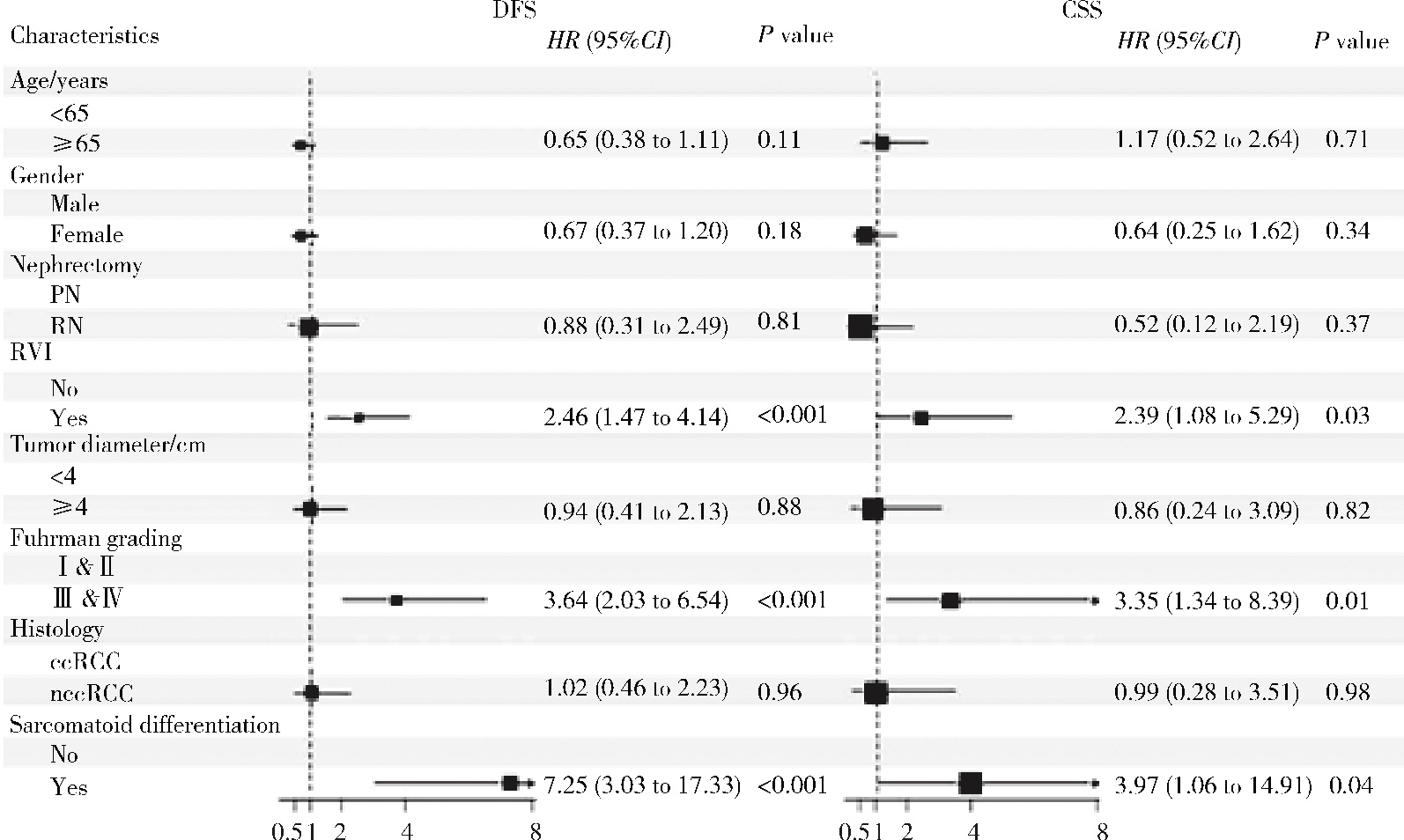
Objective: To evaluate the long-term oncological outcomes of partial nephrectomy (PN) in patients with renal cell carcinoma (RCC) who were clinically staged as clinical T1 (cT1) preoperatively but upstaged to pathological T3a (pT3a) after surgery. Methods: A total of 427 RCC patients postoperatively diagnosed as pT3aN0M0 at Peking University Third Hospital from February 2013 to December 2022 were retrospectively reviewed. Among them, 33 cT1 patients upstaged to pT3a RCC received PN (PN group), while 394 non-upstaged pT3a RCC patients underwent radical nephrectomy (RN, RN group). Propensity score matching was performed at a 1 ∶ 1 ratio based on baseline characteristics. The Kaplan-Meier method was used to assess overall survival (OS), cancer-specific survival (CSS), and disease-free survival (DFS), with Log-rank tests and Cox regression models for multivariate analysis. Results: Before matching, the PN group (n = 33) had significantly higher rates of perirenal fat invasion (PFI, 45.5% vs. 15.2%) and segmental renal vein involvement (42.4% vs. 20.8%), but lower rates of renal sinus invasion (RSI, 21.2% vs. 73.6%) and renal vein tumor thrombus (0% vs. 15.2%) compared with the RN group (n = 394, all P < 0.05). After matching, baseline characteristics were comparable between the PN group (n = 33) and RN group (n = 33). No significant differences were observed in operative time, blood loss, mean hospital stay, complication rate, positive margin rate, or conversion to open surgery between the two groups (P > 0.05). However, the PN group showed significantly higher estimated glomerular filtration rate (eGFR) postoperatively [76.9 (55.4, 87.3) mL/(min·1.73 m2) vs. 61.7 (56.8, 73.5) mL/(min·1.73 m2), P < 0.05], indicating better renal function preservation. No significant differences were found in OS, CSS, or DFS between the groups (P > 0.05). Multivariate ana-lysis identified renal vein invasion (RVI), higher Fuhrman grades (Ⅲ-Ⅳ), and sarcomatoid differentiation as independent risk factors for DFS and CSS in the pT3a RCC patients (P < 0.05). Conclusion: For cT1 RCC patients upstaged to pT3a, PN preserves renal function more effectively while achieving com-parable oncological outcomes to RN. RVI, higher Fuhrmann grade, and sarcomatoid differentiation are independent risk factors for pT3N0M0 RCC patients.

Key words: Renal cell carcinoma, Partial nephrectomy, Radical nephrectomy, Pathological T3a

CLC Number: 

  • R737.11

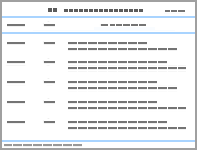
Table 1

Baseline of patients undergoing PN and RN before and after propensity score matching"

Items Before propensity score matching P value After propensity score matching Pvalue
PN (n = 33) RN (n = 394) PN (n = 33) RN (n = 33)
Age/years, n(%) 0.879 >0.999
    <65 18 (54.5) 203 (51.5) 18 (54.5) 18 (54.5)
    ≥ 65 15 (45.5) 191 (48.5) 15 (45.5) 15 (45.5)
Gender, n(%) 0.164 >0.999
    Male 26 (78.8) 257 (65.2) 26 (78.8) 27 (81.8)
    Female 7 (21.2) 137 (34.8) 7 (21.2) 6 (18.2)
Laterality, n(%) >0.999 0.460
    Left 18 (54.5) 215 (54.6) 18 (54.5) 14 (42.4)
    Right 15 (45.5) 179 (45.4) 15 (45.5) 19 (57.6)
ASA level, n(%) 0.146 0.920
    1 6 (18.2) 82 (20.8) 6 (18.2) 7 (21.2)
    2 25 (75.8) 291 (73.9) 25 (75.8) 23 (69.7)
    3 1 (3.0) 20 (5.1) 1 (3.0) 2 (6.1)
    4 1 (3.0) 1 (0.3) 1 (3.0) 1 (3.0)
Comorbidity, n(%) 14 (42.4) 166 (42.1) >0.999 14 (42.4) 17 (51.5) 0.622
Hypertension 14 (42.4) 141 (35.8) 14 (42.4) 14 (42.4)
Diabetes 6 (18.2) 52 (13.2) 6 (18.2) 9 (27.3)
CHD 1 (3.0) 21 (5.3) 1 (3.0) 2 (6.1)
CVD 2 (6.1) 21 (5.3) 2 (6.1) 1 (3.0)
Surgery history 12 (36.4) 104 (26.4) 12 (36.4) 11 (33.3)
Tumor diameter /cm, n(%) <0.001 >0.999
    ≤4 26 (78.8) 61 (15.5) 26 (78.8) 26 (78.8)
    >4, ≤7 7 (21.2) 202 (51.3) 7 (21.2) 7 (21.2)
    >7 0 (0) 131 (33.2) 0 (0) 0 (0)
eGFR/ [mL/(min·1.73 m2)], M (P25, P75) 88.9
(64.0, 99.3)
86.7
(72.6, 97.6)
0.956 88.9
(64.0, 99.3)
89.3
(79.6, 97.7)
0.830
Renal vein thrombosis, n(%) 0 (0) 60 (15.2) 0.031 0 (0) 0 (0) >0.999
PFI, n(%) 15 (45.5) 60 (15.2) <0.001 15 (45.5) 16 (48.5) >0.999
RSI, n(%) 7 (21.2) 290 (73.6) <0.001 10 (30.3) 12 (36.4) 0.794
Segmental renal vein extension, n(%) 14 (42.4) 82 (20.8) 0.008 14 (42.4) 15 (45.5) >0.999
Histology, n(%) >0.999 >0.999
    ccRCC 29 (87.9) 346 (87.8) 29 (87.9) 29 (87.9)
    nccRCC 4 (12.1) 48 (12.2) 4 (12.1) 4 (12.1)
Fuhrman grading, n(%) 0.072 0.782
    Ⅰ-Ⅱ 25 (75.8) 229 (58.1) 25 (75.8) 23 (69.7)
    Ⅲ-Ⅳ 8 (24.2) 165 (41.9) 8 (24.2) 10 (30.3)
Sarcomatoid differentiation, n(%) 0 (0) 9 (2.3) >0.999 0 (0) 0 (0) >0.999

Table 2

Comparison of perioperative outcomes of PN group and RN group in the matched cohort"

Items PN (n=33) RN (n=33) P value
Nephrectomy techniques, n(%) 0.672
    Laparoscopic nephrectomy 29 (87.9) 31 (93.9)
    Robot-assisted laparoscopic nephrectomy 4 (12.1) 2 (6.1)
Surgical approach, n(%) 0.622
    Retroperitoneal 15 (45.5) 18 (54.5)
    Transperitoneal 18 (54.5) 15 (45.5)
Open conversion, n(%) 1 (3.0) 3 (9.1) 0.613
Operative time/min, ${\bar x}$±s 159.0±57.8 148.0±70.8 0.281
Blood loss/mL, M (P25, P75) 50.0 (20, 100) 20.0 (20, 50) 0.372
Postoperative eGFR [mL/(min·1.73m2], M (P25, P75) 76.9 (55.4, 87.3) 61.7 (56.8, 73.5) 0.016
Complications, n(%) 6 (18.2) 8 (24.2) 0.763
PSM, n(%) 1 (3.3) 0 (0) >0.999
Postoperative hospital stays/d,${\bar x}$±s 6.1±2.4 5.9±2.1 0.818

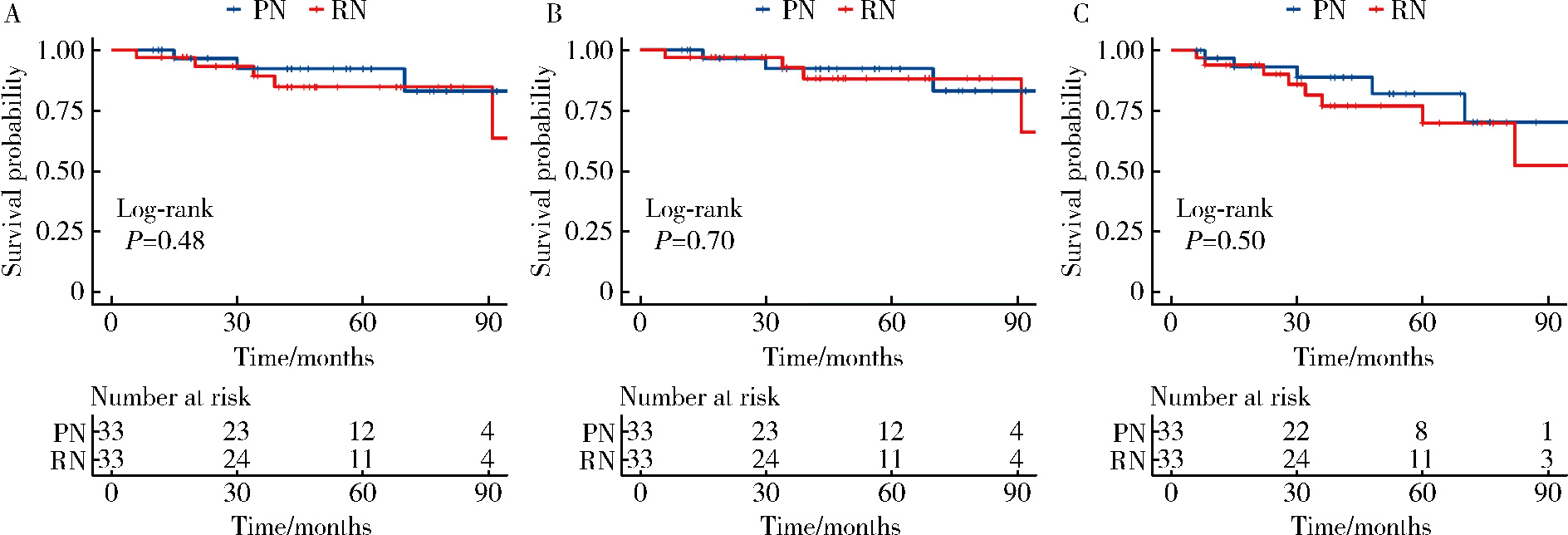
Figure 1

Oncological outcomes of PN group and RN group in the matched cohort A, overall survival; B, cancer-specific survival; C, disease-free survival of patients with pT3a stage renal cell carcinoma in the matched cohort. PN, partial nephrectomy; RN, radical nephrectomy; pT3a, pathological T3a."

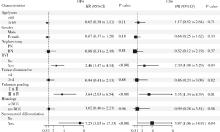
Figure 2

Multivariate Cox regression analysis of DFS and CSS in patients with pT3a RCC DFS, disease-free survival; CSS, cancer-specific survival; PN, partial nephrectomy; RN, radical nephrectomy; RVI, renal vein invasion; ccRCC, clear cell renal cell carcinoma; nccRCC, non-clear cell renal cell carcinoma; pT3a, pathological T3a; RCC, renal cell carcinoma."

1
Sung H , Ferlay J , Siegel RL , et al. Global cancer statistics 2020:GLOBOCAN estimates of incidence and mortality worldwide for 36 cancers in 185 countries[J]. CA Cancer J Clin, 2021, 71 (3): 209- 249.
2
Ljungberg B , Albiges L , Abu-GhanemY , et al. European Association of Urology guidelines on renal cell carcinoma: The 2022 update[J]. Eur Urol, 2022, 82 (4): 399- 410.
3
Campbell SC , Clark PE , Chang SS , et al. Renal mass and loca-lized renal cancer: Evaluation, management, and follow-up: AUA guideline. Part[J]. J Urol, 2021, 206 (2): 199- 208.
4
Lee H , Lee M , Lee SE , et al. Outcomes of pathologic stage T3a renal cell carcinoma up-staged from small renal tumor: Emphasis on partial nephrectomy[J]. BMC Cancer, 2018, 18 (1): 427.
5
Gorin MA , Ball MW , Pierorazio PM , et al. Outcomes and predictors of clinical T1 to pathological T3a tumor up-staging after robotic partial nephrectomy: A multi-institutional analysis[J]. J Urol, 2013, 190 (5): 1907- 1911.
6
Russell CM , Lebastchi AH , Chipollini J , et al. Multi-institutional survival analysis of incidental pathologic T3a upstaging in clinical T1 renal cell carcinoma following partial nephrectomy[J]. Urology, 2018, 117, 95- 100.
7
Choueiri TK , Chen MH , D'Amico AV , et al. Impact of postoperative prostate-specific antigen disease recurrence and the use of salvage therapy on the risk of death[J]. Cancer, 2010, 116 (8): 1887- 1892.
8
白红松, 王栋, 寿建忠, 等. cT1期肾癌行肾部分切除术后升期为pT3a期的临床分析[J]. 临床泌尿外科杂志, 2020, 35 (9): 716- 720.
9
Hackett NJ , De Oliveira GS , Jain UK , et al. ASA class is a reliable independent predictor of medical complications and morta-lity following surgery[J]. Int J Surg, 2015, 18, 184- 190.
10
Mitropoulos D , Artibani W , Graefen M , et al. Reporting and grading of complications after urologic surgical procedures: An ad hoc EAU guidelines panel assessment and recommendations[J]. Eur Urol, 2012, 61 (2): 341- 349.
11
Amin MB , Edge SB , Greene FL , et al. AJCC cancer staging manual[M]. 8th ed. New York: Springer, 2017: 196- 198.
12
Moch H , Cubilla AL , Humphrey PA , et al. The 2016 WHO classification of tumours of the urinary system and male genital organs. Part A. Renal, penile, and testicular tumours[J]. Eur Urol, 2016, 70 (1): 93- 105.
13
Rose TL , Kim WY . Renal cell carcinoma: A review[J]. JAMA, 2024, 332 (12): 1001- 1010.
14
Alam R , Patel HD , Osumah T , et al. Comparative effectiveness of management options for patients with small renal masses: A prospective cohort study[J]. BJU Int, 2019, 123 (1): 42- 50.
15
Yang Z, Li J, Liu Z, et al. The effectiveness of partial versus radical nephrectomy for pT3aN0M0 renal cell carcinoma: A propensity score analysis[J]. 2020, 46(10): 1234-1256.
16
Shao N , Wang HK , Zhu Y , et al. Modification of American Joint Committee on cancer prognostic groups for renal cell carcinoma[J]. Cancer Med, 2018, 7 (11): 5431- 5438.
17
Swami U , Nussenzveig RH , Haaland B , et al. Revisiting AJCC TNM staging for renal cell carcinoma: Quest for improvement[J]. Ann Transl Med, 2019, 7 (Suppl 1): S18.
18
Lam JS , Klatte T , Patard JJ , et al. Prognostic relevance of tumour size in T3a renal cell carcinoma: A multicentre experience[J]. Eur Urol, 2007, 52 (1): 155- 162.
19
Ball MW , Gorin MA , Harris KT , et al. Extent of renal vein invasion influences prognosis in patients with renal cell carcinoma[J]. BJU Int, 2016, 118 (1): 112- 117.
20
Zhang Z , Yu C , Velet L , et al. The difference in prognosis between renal sinus fat and perinephric fat invasion for pT3a renal cell carcinoma: A meta-analysis[J]. PLoS One, 2016, 11 (2): e0149420.
21
Shah PH , Lyon TD , Lohse CM , et al. Prognostic evaluation of perinephric fat, renal sinus fat, and renal vein invasion for patients with pathological stage T3a clear-cell renal cell carcinoma[J]. BJU Int, 2019, 123 (2): 270- 276.
22
周泽臻, 邓绍晖, 颜野, 等. 非转移性T3a肾细胞癌患者3年肿瘤特异性生存期预测[J]. 北京大学学报(医学版), 2024, 56 (4): 673- 679.

doi: 10.19723/j.issn.1671-167X.2024.04.021
23
Raz O , Mendlovic S , Shilo Y , et al. Positive surgical margins with renal cell carcinoma have a limited influence on long-term oncological outcomes of nephron sparing surgery[J]. Urology, 2010, 75 (2): 277- 280.
24
Omrani M , Basiri A , Rahimlou M . Impact of positive surgical margins on recurrence and overall survival following partial nephrectomy: A systematic review and meta-analysis[J]. Urol J, 2025, 22 (1): 14- 24.
25
Shah PH , Moreira DM , Patel VR , et al. Partial nephrectomy is associated with higher risk of relapse compared with radical nephrectomy for clinical stage T1 renal cell carcinoma pathologically up staged to T3a[J]. J Urol, 2017, 198 (2): 289- 296.
26
Chung DY , Kang DH , Kim JW , et al. Comparison of oncologic outcomes between partial nephrectomy and radical nephrectomy in patients who were upstaged from cT1 renal tumor to pT3a renal cell carcinoma: an updated systematic review and meta-analysis[J]. Ther Adv Urol, 2020, 12, 1756287220981508.
27
Deng H , Fan Y , Yuan F , et al. Partial nephrectomy provides equivalent oncologic outcomes and better renal function preservation than radical nephrectomy for pathological T3a renal cell carcinoma: A meta-analysis[J]. Int Braz J Urol, 2021, 47 (1): 46- 60.
28
Liu H , Kong QF , Li J , et al. A meta-analysis for comparison of partial nephrectomy vs. radical nephrectomy in patients with pT3a renal cell carcinoma[J]. Transl Androl Urol, 2021, 10 (3): 1170- 1178.
[1] Boda GUO, Min LU, Guoliang WANG, Hongxian ZHANG, Lei LIU, Xiaofei HOU, Lei ZHAO, Xiaojun TIAN, Shudong ZHANG. Clinicopathological and prognostic differences between clear cell and non-clear cell renal cell carcinoma with venous tumor thrombus [J]. Journal of Peking University (Health Sciences), 2025, 57(4): 644-649.
[2] Zhanyi ZHANG, Min LU, Yuehao SUN, Jinghan DONG, Xiaofei HOU, Chunlei XIAO, Guoliang WANG, Xiaojun TIAN, Lulin MA, Hongxian ZHANG, Shudong ZHANG. Clinicopathological features and survival analysis of TFE3-rearranged renal cell carcinoma with venous tumor thrombus [J]. Journal of Peking University (Health Sciences), 2025, 57(4): 650-661.
[3] Kewei CHEN,Zhuo LIU,Shaohui DENG,Fan ZHANG,Jianfei YE,Guoliang WANG,Shudong ZHANG. Clinical diagnosis and treatment of renal angiomyolipoma with inferior vena cava tumor thrombus [J]. Journal of Peking University (Health Sciences), 2024, 56(4): 617-623.
[4] Fan SHU,Yichang HAO,Zhanyi ZHANG,Shaohui DENG,Hongxian ZHANG,Lei LIU,Guoliang WANG,Xiaojun TIAN,Lei ZHAO,Lulin MA,Shudong ZHANG. Functional and oncologic outcomes of partial nephrectomy for cystic renal cell carcinoma: A single-center retrospective study [J]. Journal of Peking University (Health Sciences), 2024, 56(4): 667-672.
[5] Zezhen ZHOU,Shaohui DENG,Ye YAN,Fan ZHANG,Yichang HAO,Liyuan GE,Hongxian ZHANG,Guoliang WANG,Shudong ZHANG. Predicting the 3-year tumor-specific survival in patients with T3a non-metastatic renal cell carcinoma [J]. Journal of Peking University (Health Sciences), 2024, 56(4): 673-679.
[6] Yun-chong LIU,Zong-long WU,Li-yuan GE,Tan DU,Ya-qian WU,Yi-meng SONG,Cheng LIU,Lu-lin MA. Mechanism of nuclear protein 1 in the resistance to axitinib in clear cell renal cell carcinoma [J]. Journal of Peking University (Health Sciences), 2023, 55(5): 781-792.
[7] Dong LAN,Zhuo LIU,Yu-xuan LI,Guo-liang WANG,Xiao-jun TIAN,Lu-lin MA,Shu-dong ZHANG,Hong-xian ZHANG. Risk factors for massive hemorrhage after radical nephrectomy and removal of venous tumor thrombus [J]. Journal of Peking University (Health Sciences), 2023, 55(5): 825-832.
[8] Min QIU,You-long ZONG,Bin-shuai WANG,Bin YANG,Chu-xiao XU,Zheng-hui SUN,Min LU,Lei ZHAO,Jian LU,Cheng LIU,Xiao-jun TIAN,Lu-lin MA. Treatment outcome of laparoscopic partial nephrectomy in patients with renal tumors of moderate to high complexity [J]. Journal of Peking University (Health Sciences), 2023, 55(5): 833-837.
[9] Yun-yi XU,Zheng-zheng SU,Lin-mao ZHENG,Meng-ni ZHANG,Jun-ya TAN,Ya-lan YANG,Meng-xin ZHANG,Miao XU,Ni CHEN,Xue-qin CHEN,Qiao ZHOU. Read-through circular RNA rt-circ-HS promotes hypoxia inducible factor 1α expression and renal carcinoma cell proliferation, migration and invasiveness [J]. Journal of Peking University (Health Sciences), 2023, 55(2): 217-227.
[10] Qi SHEN,Yi-xiao LIU,Qun HE. Mucinous tubular and spindle cell carcinoma of kidney: Clinicopathology and prognosis [J]. Journal of Peking University (Health Sciences), 2023, 55(2): 276-282.
[11] Quan ZHANG,Hai-feng SONG,Bing-lei MA,Zhe-nan ZHANG,Chao-hui ZHOU,Ao-lin LI,Jun LIU,Lei LIANG,Shi-yu ZHU,Qian ZHANG. Pre-operative prognostic nutritional index as a predictive factor for prognosis in non-metastatic renal cell carcinoma treated with surgery [J]. Journal of Peking University (Health Sciences), 2023, 55(1): 149-155.
[12] Er-shu BO,Peng HONG,Yu ZHANG,Shao-hui DENG,Li-yuan GE,Min LU,Nan LI,Lu-lin MA,Shu-dong ZHANG. Clinicopathological features and prognostic analysis of papillary renal cell carcinoma [J]. Journal of Peking University (Health Sciences), 2022, 54(4): 615-620.
[13] Tian-yu CAI,Zhen-peng ZHU,Chun-ru XU,Xing JI,Tong-de LV,Zhen-ke GUO,Jian LIN. Expression and significance of fibroblast growth factor receptor 2 in clear cell renal cell carcinoma [J]. Journal of Peking University (Health Sciences), 2022, 54(4): 628-635.
[14] Mei-ni ZUO,Yi-qing DU,Lu-ping YU,Xiang DAI,Tao XU. Correlation between metabolic syndrome and prognosis of patients with clear cell renal cell carcinoma [J]. Journal of Peking University (Health Sciences), 2022, 54(4): 636-643.
[15] Cai-peng QIN,Yu-xuan SONG,Meng-ting DING,Fei WANG,Jia-xing LIN,Wen-bo YANG,Yi-qing DU,Qing LI,Shi-jun LIU,Tao XU. Establishment of a mutation prediction model for evaluating the efficacy of immunotherapy in renal carcinoma [J]. Journal of Peking University (Health Sciences), 2022, 54(4): 663-668.
Viewed
Full text


Abstract

Cited

  Shared   
  Discussed   
No Suggested Reading articles found!