Perioperative hyperglycemia predicts poorer prognosis of esophageal squamous cell carcinoma patients treated with esophagectomy

  • Bo PENG 1 ,
  • Fangfang LIU 1 ,
  • Wei YANG 2 ,
  • Ruiping XU 3 ,
  • Lei CHEN 2 ,
  • Baozhong LI 3 ,
  • Xinjia WANG 2 ,
  • Ji KE 1 ,
  • Wenlei YANG 1 ,
  • Yu HE 4 ,
  • Zhen LIU 1 ,
  • Bolin HOU 5 ,
  • Liqun ZHANG 2 ,
  • Miaoping LIN 2 ,
  • Lixin ZHANG 3 ,
  • Fan ZHANG 2 ,
  • Fen CAI 2 ,
  • Huawen XU 2 ,
  • Mengfei LIU 1 ,
  • Ying LIU 1 ,
  • Yaqi PAN 1 ,
  • Zhonghu HE , 6, * ,
  • Yang KE , 6, *
Expand
  • 1. Key Laboratory of Carcinogenesis and Translational Research(Ministry of Education), Department of Genetics, Peking University Cancer Hospital & Institute, Beijing 100142, China
  • 2. Cancer Hospital of Shantou University Medical College, Shantou 515031, Guangdong, China
  • 3. Anyang Cancer Hospital, Anyang 455000, Henan, China
  • 4. Chinese Preventive Medicine Association, Beijing 100062, China
  • 5. Linkdoc AI Research(LAIR), Beijing 100080, China
  • 6. State Key Laboratory of Molecular Oncology, Department of Genetics, Peking University Cancer Hospital & Institute, Beijing 100142, China
HE Zhonghu, e-mail,
KE Yang, e-mail,

* These authors contributed equally to this work

Received date: 2026-02-24

  Online published: 2026-04-10

Supported by

the National Key R&D Program of China(2021YFC2500405)

Copyright

All rights reserved. Unauthorized reproduction is prohibited.

Abstract

Objective: To systematically evaluate the association between perioperative hyperglycemia and postoperative prognosis in esophageal squamous cell carcinoma (ESCC) patients using large-scale, multicenter real-world data. Methods: A total of 5 952 patients with ESCC who underwent radical esophagectomy were consecutively included in this retrospective cohort study from the Anyang Cancer Hospital in Anyang, Henan Province (January 2012 to December 2017) and the Cancer Hospital of Shantou University Medical College in Shantou, Guangdong Province (August 2009 to December 2018). Perioperative fasting glucose data were obtained from the hospital information system. The perioperative period was divided into preoperative and postoperative phases: Preoperative hyperglycemia was defined as a mean fasting glucose level ≥7.0 mmol/L from day 14 to day 2 before surgery, and postoperative hyperglycemia was defined as a mean fasting glucose level ≥7.0 mmol/L from day 2 to day 14 after surgery. The primary outcome was overall survival (OS), and secondary outcomes included 30 d/90 d postoperative mortality and in-hospital complications. Multivariable Cox proportional hazards models were used to assess the association between perioperative hyperglycemia and OS, with adjusted hazard ratios (HR) and 95% confidence intervals (CI) calculated. Results: The maximum follow-up period was 12 years. The prevalence of preoperative and postoperative hyperglycemia was 6.7% and 18.3%, respectively. Patients with preoperative hyperglycemia had a lower 5-year OS rate than those without (57.3% vs. 65.0%), with an adjusted HR of 1.41 (95%CI: 1.19-1.68). The patients with postoperative hyperglycemia also had reduced 5-year survival (61.8% vs. 66.4%), with an adjusted HR of 1.39 (95%CI: 1.22-1.58). Joint analysis showed that compared with patients without hyperglycemia, those with hyperglycemia in either the preoperative or postoperative phase alone had an elevated mortality risk (HR=1.24, 95%CI: 1.07-1.43), while the patients with hyperglycemia in both phases had the highest mortality risk (HR=1.86, 95%CI: 1.49-2.32). Stratified analysis revealed that BMI significantly modified the association between hyperglycemia and adverse prognosis (Pinteraction=0.010), with the association being particularly pronounced in patients with BMI ≥24.0 kg/m2. Additionally, perioperative hyperglycemia was associated with poorer short-term postoperative outcomes. Conclusion: Perioperative hyperglycemia is an independent risk factor for long-term survival in ESCC patients undergoing curative esophagectomy. These findings suggest that enhanced routine glucose monitoring and control during perioperative management of ESCC may help improve long-term patient outcomes.

Cite this article

Bo PENG , Fangfang LIU , Wei YANG , Ruiping XU , Lei CHEN , Baozhong LI , Xinjia WANG , Ji KE , Wenlei YANG , Yu HE , Zhen LIU , Bolin HOU , Liqun ZHANG , Miaoping LIN , Lixin ZHANG , Fan ZHANG , Fen CAI , Huawen XU , Mengfei LIU , Ying LIU , Yaqi PAN , Zhonghu HE , Yang KE . Perioperative hyperglycemia predicts poorer prognosis of esophageal squamous cell carcinoma patients treated with esophagectomy[J]. Journal of Peking University(Health Sciences), 2026 , 58(3) : 567 -574 . DOI: 10.19723/j.issn.1671-167X.2026.03.017

食管癌(esophageal cancer,EC)是全球第七大常见恶性肿瘤及第六大癌症死因,超过50%的新发病例发生在中国[1]。根据组织学类型,食管癌主要分为食管鳞状细胞癌(esophageal squamous cell carcinoma,ESCC)和食管腺癌(esophageal adenocarcinoma,EAC)[2]。在我国,ESCC占全部食管癌病例的90%以上[3-4]。尽管根治性食管切除术是局限期ESCC的最主要治愈手段,并能将患者5年生存率提升至40%~59%[5-7],但全球范围内ESCC的总体5年净生存率仍徘徊在20%左右[8],提示患者长期预后仍不理想。因此,深入识别可用于临床风险分层与预后评估的关键因素,对改善ESCC患者的生存结局具有重要意义。
高血糖是一种常见的代谢异常状态,通常与胰岛素抵抗、糖耐量受损或机体应激反应等因素有关[9-10]。在恶性肿瘤患者中,它已被证实与多种癌症的不良预后相关[9]。然而,在接受食管切除术的ESCC患者中,现有研究多聚焦于高血糖对术后并发症的影响,而其对总生存期(overall survival,OS)的影响尚缺乏一致的高等级证据[11-14]。既往研究多为小样本、单中心设计,且常未综合评估术前与术后的血糖水平,存在统计效能不足及潜在残余混杂偏倚等局限[12-15]
为此,本研究依托一项大样本、多中心且随访长达十余年的真实世界队列,系统评估了围术期高血糖(包括术前和术后两个阶段)对食管癌根治术后患者总生存期及短期结局的影响,以期为ESCC围术期管理及预后风险评估提供循证依据。

1 资料与方法

1.1 研究对象

本研究为多中心回顾性真实世界队列研究,研究开始前已经北京大学肿瘤医院伦理委员会审查批准(批准编号:2018KT68)。
研究选择我国两家区域性肿瘤中心开展,一家是位于太行山食管癌高发区的安阳市肿瘤医院(北方中心),其所在地区发病率约为全国平均水平的5倍[16-17];另一家是位于东南沿海地区的汕头大学医学院附属肿瘤医院(南方中心),该地区(除南澳岛)发病率与全国平均水平相近[17]。两家医院均为所在地区唯一的三级甲等肿瘤专科医院。
研究连续纳入北方中心(2012年1月至2017年12月)与南方中心(2009年8月至2018年12月)收治的患者。纳入标准包括:(1)病理确诊的原发性食管鳞状细胞癌;(2)初始治疗为根治性胸段食管切除术(可联合辅助治疗)。排除标准包括:(1)存在远处转移(M1期、Ⅳ期)[18];(2)曾接受新辅助治疗(研究期间此类患者约占10%,虽为指南推荐但非当时主流);(3)缺乏围术期血糖数据。随访截止至2022年8月(北方中心)和2022年6月(南方中心),长期生存分析排除随访不足6个月者。

1.2 资料收集与协变量定义

研究数据统一提取自医院信息系统(hospital information system,HIS),涵盖患者基本特征、肿瘤信息、治疗及其他住院资料。患者基线特征包括年龄、性别、体重指数(body mass index,BMI)、吸烟饮酒史及共病等;肿瘤信息包括肿瘤部位、大小、形态、分化程度、病理TNM分期及手术切缘状态等。
本研究对关键变量定义如下:共病即既往确诊的高血压或冠心病;病理TNM分期均依据美国癌症联合委员会(American Joint Committee on Cancer,AJCC)第7版TNM分期标准判定;辅助治疗指术后接受≥1个周期化疗或放疗(方案与剂量不限)。根据辅助治疗模式,将患者分为单纯手术(S)、手术联合辅助化疗(S+CT)、手术联合辅助放疗(S+RT),以及手术联合辅助放化疗(S+CRT)四类。
所有变量的数据缺失率均低于5%。对于缺失值,连续变量采用中位数进行插补[19],分类变量则增设“未知”类别进行处理[20]

1.3 高血糖的评估标准

各中心患者的空腹血糖数据均来源于HIS系统,为静脉血样本在常规临床条件下经全自动生化分析仪(Beckman DXC-800或Olympus AU-5800)检测所得。为避免术前禁食、肠道准备或术前焦虑等应激因素对血糖的急性影响,以及减少手术创伤所致的急性血糖波动,本研究排除了手术当日、术前第1天及术后第1天的血糖值。围术期血糖水平分别定义为术前平均血糖(手术前第14天至第2天)与术后平均血糖(手术后第2天至第14天)。
高血糖的定义参照世界卫生组织(World Health Organization,WHO)发布的糖尿病诊断标准,即术前或术后平均空腹血糖≥7.0 mmol/L(126 mg/dL)[21-22]。对于术前术后均有数据的患者,根据血糖状态分为三类:“均无高血糖”(术前和术后均未达到高血糖标准)、“单一阶段高血糖”(仅术前或术后出现高血糖),以及“双阶段高血糖”(术前和术后均为高血糖)。

1.4 结局定义与随访

本研究的主要结局为OS,其定义为自患者因食管鳞癌首次入院之日起,至因任何原因死亡或末次随访截止的时间。次要结局(短期结局)包括术后30 d死亡率、90 d死亡率,以及住院期间发生的术后并发症情况。
结局事件及随访信息主要由医院电子随访系统根据随访名单,通过工作人员电话随访进行收集与记录,同时结合门诊及住院系统信息对患者情况进行补充,以确保结局数据的完整性。

1.5 统计学分析

根据围术期血糖状态将患者分组,并使用Student’ s t检验(连续变量)或卡方检验(分类变量)比较组间基线特征。采用Kaplan-Meier(KM)法估计生存率、绘制KM生存曲线,并以反向KM法计算中位随访时间。采用多因素Cox比例风险回归模型分析围术期高血糖与OS之间的关联,并计算校正后的风险比(hazard ratio,HR)及其95%置信区间(confidence interval,CI)。
最终纳入多因素Cox比例风险模型的协变量,依据单因素分析结果(P < 0.05或文献报道)及临床相关性综合确定,包括年龄,性别,BMI,吸烟饮酒史,共病,肿瘤部位、大小、形态、分化程度、病理TNM分期及手术切缘状态等。针对短期结局(如术后30 d/90 d死亡),则采用校正上述相同协变量的多因素Logistic回归模型进行分析。
敏感性分析:为检验主要研究结果的稳健性,采用不同空腹血糖截断值(5.0、6.0、8.0、9.0、10.0及11.0 mmol/L)重新定义高血糖并重复上述分析。
剂量-反应关系分析:为探讨围术期血糖水平与OS之间是否存在剂量-反应关系,将血糖的水平分为 < 7.0 mmol/L、7.0~ < 11.0 mmol/L和≥11.0 mmol/L三个等级,并作为连续变量纳入模型,以评估风险比随血糖等级升高的变化趋势。
术前与术后血糖的联合分析:为评估术前与术后高血糖的联合效应,将同时具有术前和术后血糖数据的患者分为“均无高血糖”(Neither)、“单一阶段高血糖”(Either)和“双阶段高血糖”(Both)三组,并采用多因素Cox模型(校正协变量同主分析)比较其风险。
分层与交互作用分析:为探讨关联是否因患者特征而异,按关键变量(如年龄、性别)进行了分层分析。在多因素Cox模型中纳入围术期高血糖与分层变量的交互项,以检验其交互作用的统计学意义。
统计分析采用Stata 16.0(StataCorp., Texas, USA)及R 3.6.3(R Foundation)完成。所有统计检验均为双侧,P < 0.05认为差异具有统计学意义。

2 结果

2.1 患者基本特征

研究最终纳入5 952例符合纳入标准的ESCC患者,其中北方中心4 001例、南方中心1 951例。失访率约14%,失访患者与最终分析患者的基线特征整体可比,提示失访对研究结果的影响有限。研究对象的总体中位年龄为63.0岁,男性占64.5%(表 1)。术前高血糖患病率(基于5 7 22例有术前血糖者)为6.7%,术后高血糖患病率(基于4 644例有术后血糖者)为18.3%。术后血糖水平整体显著高于术前。
表1 按围术期血糖状态分层的ESCC根治术患者基线特征

Table 1 Selected characteristics of ESCC patients who underwent radical esophagectomy, stratified by perioperative glucose status

Characteristics Total(n=5 952) Preoperative hyperglycemiaa Postoperative hyperglycemiaa
No (n=5 341) Yes (n=381) P valueb No (n=3 796) Yes (n=848) P valueb
Age/years 63.0 (58.0, 68.0) 63.0 (58.0, 68.0) 64.0 (60.0, 68.0) 0.018 64.0 (59.0, 68.0) 65.0 (60.5, 70.0) < 0.001
Gender < 0.001 < 0.001
  Male 3 840 (64.5) 3 482 (94.6) 197 (5.4) 2 515 (85.3) 433 (14.7)
  Female 2 112 (35.5) 1 859 (91.0) 184 (9.0) 1 281 (75.5) 415 (24.5)
Smokingc < 0.001 < 0.001
  No 2 719 (46.8) 2 385 (91.4) 224 (8.6) 1 710 (77.3) 503 (22.7)
  Yes 3 086 (53.2) 2 827 (95.2) 144 (4.8) 1 978 (86.1) 320 (13.9)
Drinkingc 0.042 < 0.001
  No 3 762 (65.5) 3 349 (92.9) 257 (7.1) 2 386 (80.2) 589 (19.8)
  Yes 1 980 (34.5) 1 805 (94.3) 109 (5.7) 1 253 (84.8) 224 (15.2)
BMI/(kg/m2)c < 0.001 < 0.001
   < 24.0 3 337 (70.0) 3 068 (95.2) 153 (4.8) 2 050 (85.0) 361 (15.0)
  ≥ 24.0 1 431 (30.0) 1 224 (89.6) 142 (10.4) 900 (76.4) 278 (23.6)
pStageb 0.822 0.102
  0 andⅠ 1 356 (22.9) 1 206 (93.1) 89 (6.9) 910 (79.6) 233 (20.4)
  Ⅱ 2 401 (40.6) 2 162 (93.6) 149 (6.4) 1 592 (82.1) 347 (17.9)
  Ⅲ 2 157 (36.5) 1 939 (93.1) 143 (6.9) 1 267 (82.7) 265 (17.3)
Center 0.021 0.065
  Northern 4 001 (67.2) 3 562 (92.8) 276 (7.2) 2 891 (81.2) 671 (18.8)
  Southern 1 951 (32.8) 1 779 (94.4) 105 (5.6) 905 (83.6) 177 (16.4)

Data are M (P25, P75) or n(%). BMI, body mass index; ESCC, esophageal squamous cell carcinoma; pStage, pathological stage. a, due to missing preoperative or postoperative glucose measurements in some patients, the sum of cases across groups does not equal the total sample size; b, categorical variables were compared using the Chi-square test, and continuous variables were compared using the Student’ s t test; c, the sum of the number of patients in different categories is not equal to the total sample size because of the existence of missing values.

2.2 长期生存结局

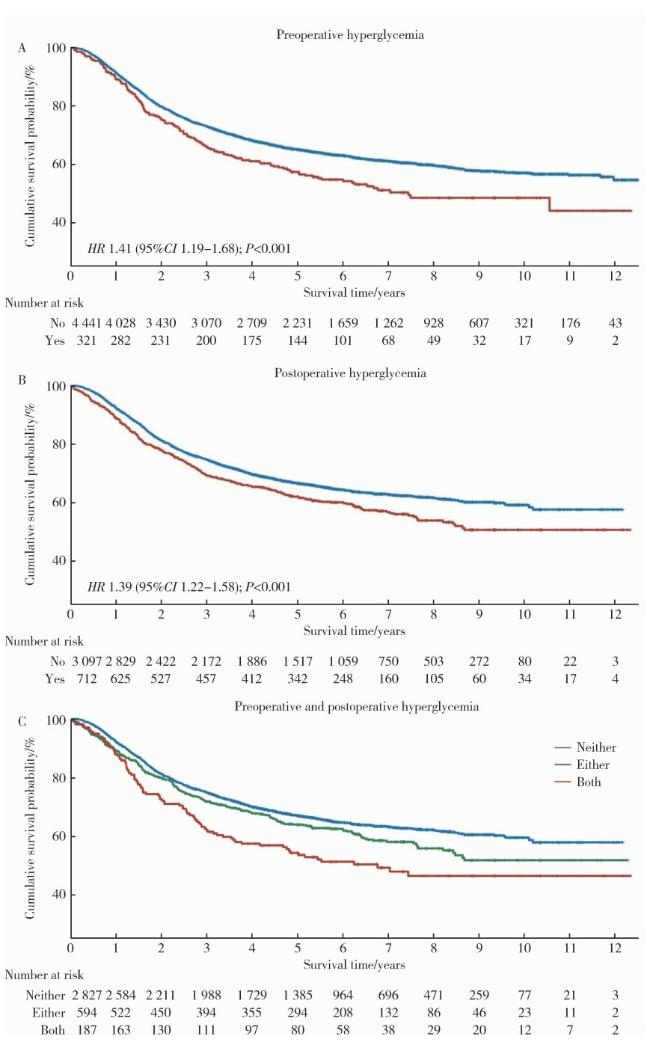
在纳入生存分析的4 963例患者中,中位随访时间为6.8年,随访期间共发生1 884例死亡事件。生存分析显示,术前高血糖患者5年生存率显著低于非高血糖者(57.3% vs. 65.0%),校正后HR=1.41(95%CI:1.19~1.68);术后高血糖患者亦呈现更差的5年生存率(61.8% vs. 66.4%),校正后HR=1.39(95%CI:1.22~1.58)(图 1)。此外,进一步校正“自报糖尿病病史”后,结果与上述分析无明显差异(数据未展示)。
图1 按围术期血糖状态分层的ESCC根治术患者总生存期Kaplan-Meier曲线

Figure 1 Kaplan-Meier survival curves for long-term OS by perioperative glucose status among ESCC patients who underwent radical esophagectomy

OS, overall survival; ESCC, esophageal squamous cell carcinoma.

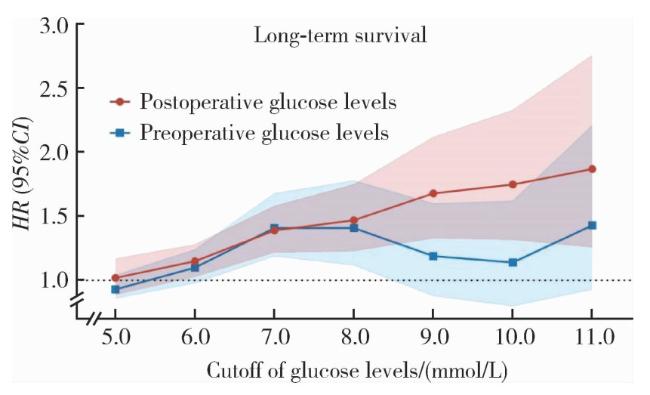
敏感性分析:采用不同血糖界值(6.0~11.0 mmol/L)重新定义高血糖状态后,较高血糖水平与较差生存结局之间的关联仍保持稳健(图 2)。
图2 不同血糖临界值定义的围术期高血糖与ESCC根治术患者总生存期的关联

Figure 2 Association of high perioperative glucose levels, defined using different cutoffs, with long-term OS of ESCC patients who underwent radical esophagectomy

Different cutoffs of glucose levels (from 5.0 to 11.0 mmol/L with an increment of 1.0 mmol/L) were used to divide patients into high and low-to-normal levels of blood glucose concentrations. HR and 95% CI representing the survival effect of high postoperative (red lines) and preoperative (blue lines) glucose levels as compared with low-to-normal glucose levels were obtained using multivariable Cox proportional-hazard models adjusting for age, gender, smoking, alcohol consumption, body mass index, presence of comorbidities, tumor location, tumor morphology, pathological tumor-lymph node-metastasis (pTNM) stage, tumor grade, tumor size, number of lymph nodes harvested, surgical margin status, calendar year of operation, and center. CI, confidence interval; ESCC, esophageal squamous cell carcinoma; HR, hazard ratio; OS, overall survival.

剂量-反应关系分析:与术前血糖 < 7.0 mmol/L者相比,7.0~ < 11.0 mmol/L及≥11.0 mmol/L患者的死亡风险呈递增趋势(HR校正 7.0~ < 11.0 vs. < 7.0=1.40,95%CI:1.17~1.69;HR校正 ≥11.0 vs. < 7.0=1.47,95%CI:0.95~2.27;P趋势 < 0.001)。术后血糖亦呈现类似的剂量-反应关系(HR校正 7.0~ < 11.0 vs. < 7.0=1.35,95%CI:1.18~1.55;HR校正 ≥11.0 vs. < 7.0=1.98,95%CI:1.34~2.94;P趋势 < 0.001,表 2)。
表2 围术期血糖水平与ESCC根治术患者长期总生存的剂量-反应关系

Table 2 Dose-response relationship of perioperative glucose levels with long-term OS among ESCC patients who underwent radical esophagectomy

Glucose levels/(mmol/L) Total,n (%) Death,n (%) 5-year survival/% (95%CI) Adjusted HR (95%CI)a P valuea
Preoperative
   < 7.0 4 441 (93.3) 1 667 (37.5) 66.5 (64.8-68.1) Reference
  7.0- < 11.0 271 (5.7) 126 (46.5) 56.7 (51.0-63.2) 1.40 (1.17-1.69) < 0.001
  ≥ 11.0 50 (1.1) 21 (42.0) 60.6 (48.3-76.2) 1.47 (0.95-2.27) 0.081
  Ptrend < 0.001
Postoperative
   < 7.0 3 097 (81.3) 1 086 (35.1) 66.4 (64.7-68.2) Reference
  7.0- < 11.0 668 (17.5) 267 (40.0) 63.0 (59.3-66.9) 1.35 (1.18-1.55) < 0.001
  ≥ 11.0 44 (1.2) 26 (59.1) 43.4 (30.5-61.7) 1.98 (1.34-2.94) 0.001
  Ptrend < 0.001

CI, confidence interval; ESCC, esophageal squamous cell carcinoma; HR, hazard ratio; OS, overall survival. a, HR, 95% CI and P values were obtained using multivariable Cox proportional-hazard models, adjusting for age, gender, smoking, alcohol consumption, body mass index, presence of comorbidities, tumor location, tumor morphology, pathological tumor-lymph node-metastasis (pTNM) stage, tumor grade, tumor size, margin status, postoperative treatment modality, calendar year of operation, and study center. To evaluate trends in HR, ordinal variables were modeled as single, continuous variables.

术前与术后血糖的联合分析:与术前及术后均无高血糖的患者相比,术前和术后均存在高血糖的患者死亡风险最高(HR校正=1.86,95%CI:1.49~2.32),其次为仅在术前或术后单一阶段出现高血糖的患者(HR校正=1.24,95%CI:1.07~1.43,图 1)。
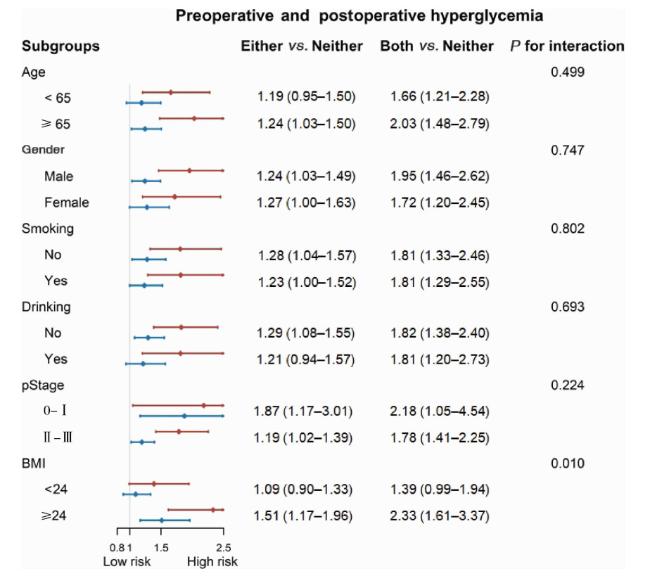
分层分析:BMI对围术期高血糖与OS的关联存在显著效应修饰(P交互=0.010)。该关联在BMI≥24.0 kg/m2患者中显著增强(HR校正Either vs. Neither= 1.51,95%CI:1.17~1.96;HR校正Both vs. Neither=2.33,95%CI:1.61~3.37),而在BMI < 24.0 kg/m2者中减弱且差异无统计学意义(HR校正Either vs. Neither=1.09,95%CI:0.90~1.33;HR校正Both vs. Neither=1.39,95%CI:0.99~1.94,图 3)。其他亚组未见显著交互作用。
图3 围术期血糖水平与ESCC根治术患者总生存期关联的分层分析

Figure 3 Subgroup analysis of the associations between perioperative glucose levels and long-term OS among ESCC patients who underwent radical esophagectomy

HR and 95% CI were obtained using multivariable Cox proportional-hazard models, adjusting for age, sex, smoking, alcohol consumption, body mass index (BMI), presence of comorbidities, tumor location, tumor morphology, pathological tumor-lymph node-metastasis (pTNM) stage, tumor grade, tumor size, margin status, postoperative treatment modality, calendar year of operation, and study center. The multiplicative interaction between hyperglycemia and each one of the stratified factors was evaluated by including an interaction term in the multivariable Cox proportional-hazard regression model. Both preoperative and postoperative hyperglycemia were defined as mean glucose levels ≥ 7.0 mmol/L (126 mg/dL). Perioperative glucose status was categorized as "Neither" (with no hyperglycemia), "Either" (with preoperative or postoperative hyperglycemia alone), and "Both" (with both preoperative and postoperative hyperglycemia). CI, confidence interval; ESCC, esophageal squamous cell carcinoma; HR, hazard ratio; OS, overall survival.

2.3 短期结局

在术后并发症方面,围术期高血糖与吻合口瘘的发生风险显著相关,其中术前和术后均存在高血糖的患者风险最高(OR校正Either vs. Neither=1.32, 95%CI: 0.86~2.04,OR校正Both vs. Neither=2.84,95%CI:1.63~4.98,P趋势=0.001)。此外,围术期高血糖亦与术后30 d及90 d死亡率升高显著相关(30 d死亡率: OR校正Either vs. Neither=5.54, 95%CI: 1.27~24.15, OR校正Both vs. Neither=7.82, 95%CI: 1.05~ 58.11, P趋势=0.012; 90 d死亡率: OR校正Either vs. Neither= 2.89, 95%CI: 1.36~6.16, OR校正Both vs. Neither=3.63, 95%CI: 1.14~11.49, P趋势=0.002),但上述时间点的死亡事件数较少(各亚组中发生率仅为1%~2%),统计估计不精确,结论应审慎解读。

3 讨论

ESCC总体预后不佳,识别易于获取且可干预的预后标志物对优化治疗决策至关重要。尽管高血糖已被证实与多种恶性肿瘤进展相关[9-10],但其在ESCC中的预后价值尚存争议[12-15]。本研究基于多中心真实世界数据,系统证实围术期高血糖,尤其是术前和术后均存在高血糖,与ESCC患者更差的总生存期、更高的吻合口瘘风险及术后30 d/90 d死亡率显著相关。上述发现提示,加强围术期血糖监测与控制应成为ESCC综合管理的重要环节。
本研究中,术后高血糖患病率(18.3%)显著高于术前(6.7%),可能与术后应激反应、血糖管理不足及辅助治疗(如含糖皮质激素的化疗方案)等因素有关[11]。糖皮质激素在ESCC及多种恶性肿瘤化疗中应用广泛,已被证实可诱发或加重高血糖[23]。上述发现提示,深入探究围术期高血糖对ESCC患者预后的影响及其干预策略,具有重要的临床意义。
基于最长达12年的随访数据,本研究发现,无论是术前高血糖还是术后高血糖,均与接受食管切除术的ESCC患者总生存期缩短显著相关,且呈现明确的剂量-反应关系。联合分析进一步揭示,术前和术后均存在高血糖的患者生存预后最差,而全程血糖正常者预后相对较好。单一阶段高血糖的预后风险相对较低,可能归因于术后血糖的有效管理(仅术前高血糖)或一过性应激性高血糖(仅术后高血糖)。相比之下,术前和术后均存在高血糖反映了围术期血糖控制欠佳,可能通过多重机制协同加剧不良预后。
高血糖及糖尿病与ESCC不良预后的关联涉及多重机制[9, 24]。一方面,长期未加以控制的高血糖可进展为糖尿病,进而诱发微血管功能障碍及靶器官损害(如心血管疾病、肾功能异常),削弱患者整体健康状况及抗肿瘤治疗耐受性;另一方面,血糖升高可通过诱发胰岛素抵抗及代偿性高胰岛素血症,上调生物活性胰岛素样生长因子的水平,并激活慢性炎症通路,从而促进肿瘤细胞的增殖、侵袭和转移。此外,肥胖作为与高血糖密切相关的代谢异常因素,可与之协同加重胰岛素抵抗及炎症状态,为肿瘤进展营造有利微环境[9]。与此机制假设一致,本研究发现BMI显著修饰围术期高血糖与ESCC预后的关联, 该关联在超重/肥胖患者中尤为显著,而在正常体重患者中则减弱至无统计学意义。
除长期生存外,本研究还发现围术期高血糖同样与不良短期预后相关。与既往研究结果一致,高血糖显著增加吻合口瘘的发生风险,这可能与高血糖状态下创面愈合延迟有关[11-14]。此外,围术期高血糖患者的术后30 d和90 d死亡率明显升高,可能与高血糖导致的血管损伤、器官功能障碍以及感染风险增加有关。值得注意的是,高血糖与术后并发症之间可能存在反向因果关联——术后并发症本身可诱发应激性高血糖,导致高血糖更多反映并发症的严重程度,而非其独立致病因素。为理清此问题,本课题组在敏感性分析中排除了发生严重感染性并发症(肺炎、吻合口瘘)的患者,所得结论与主分析保持一致(数据未列)。
本研究存在一定局限性。首先,血糖数据来源于临床常规检测,部分患者因数据缺失被排除,可能存在选择偏倚;尽管对已知混杂因素进行了校正,残余混杂仍无法完全排除。其次,缺乏糖尿病临床诊断、糖化血红蛋白及降糖药物使用等信息,限制了对围术期高血糖成因及其预后效应的深入解读。此外,术后30 d及90 d死亡事件较少,统计效能有限,导致置信区间较宽,相关结果需谨慎解读。尽管如此,上述不足并不影响本研究关于强化围术期血糖管理临床意义的核心结论。
综上所述,围术期高血糖,特别是术前、术后持续存在的高血糖,是接受根治性食管切除术的ESCC患者长期及短期不良结局的独立危险因素。围术期血糖水平作为一种潜在可干预因素,其优化管理有望成为改善ESCC患者生存的重要策略。未来需开展前瞻性干预研究,以量化围术期血糖控制对ESCC手术患者生存获益的具体效应。

利益冲突  所有作者均声明不存在利益冲突。

作者贡献声明  彭博、刘芳芳、柯骥、杨文蕾、何煜、刘震:设计研究方案,分析数据,撰写论文;杨伟、徐瑞平、陈蕾、李保中、王新家、侯波林、张利群、林妙萍、张立新、张凡、蔡奋、许铧文、刘萌飞、刘英、潘雅琪:收集、整理数据;柯杨、何忠虎:总体把关和审定论文。所有作者均参与论文修改,并对最终文稿进行审读和确认。

衷心感谢所有参与并支持本研究的患者!

1
Sung H , Ferlay J , Siegel RL , et al. Global cancer statistics 2020:GLOBOCAN estimates of incidence and mortality worldwide for 36 cancers in 185 countries[J]. CA Cancer J Clin, 2021, 71 (3): 209- 249.

2
Arnold M , Soerjomataram I , Ferlay J , et al. Global incidence of oesophageal cancer by histological subtype in 2012[J]. Gut, 2015, 64 (3): 381- 387.

DOI

3
Abnet CC , Arnold M , Wei WQ . Epidemiology of esophageal squamous cell carcinoma[J]. Gastroenterology, 2018, 154 (2): 360- 373.

DOI

4
Liang H , Liang H , Fan JH , et al. Epidemiology, etiology, and prevention of esophageal squamous cell carcinoma in China[J]. Cancer Biol Med, 2017, 14 (1): 33- 41.

DOI

5
Mao YS , Gao SG , Wang Q , et al. Analysis of a registry database for esophageal cancer from high-volume centers in China[J]. Dis Esophagus, 2020, 33 (8): doz091.

DOI

6
Rice TW , Rusch VW , Apperson-Hansen C , et al. Worldwide esophageal cancer collaboration[J]. Dis Esophagus, 2009, 22 (1): 1- 8.

DOI

7
Watanabe M , Toh Y , Ishihara R , et al. Comprehensive registry of esophageal cancer in Japan, 2015[J]. Esophagus, 2023, 20 (1): 1- 28.

DOI

8
Allemani C , Matsuda T , Di Carlo V , et al. Global surveillance of trends in cancer survival 2000-14 (CONCORD-3): analysis of individual records for 37 513 025 patients diagnosed with one of 18 cancers from 322 population-based registries in 71 countries[J]. Lancet, 2018, 391 (10125): 1023- 1075.

9
Gallagher EJ , LeRoith D . Obesity and diabetes: The increased risk of cancer and cancer-related mortality[J]. Physiol Rev, 2015, 95 (3): 727- 748.

DOI

10
Giovannucci E , Harlan DM , Archer MC , et al. Diabetes and cancer: A consensus report[J]. CA A Cancer J Clin, 2010, 60 (4): 207- 221.

11
Eshuis WJ , Hermanides J , van Dalen JW , et al. Early postoperative hyperglycemia is associated with postoperative complications after pancreatoduodenectomy[J]. Ann Surg, 2011, 253 (4): 739- 744.

DOI

12
Karl RC , Schreiber R , Boulware D , et al. Factors affecting morbidity, mortality, and survival in patients undergoing IVOR lewis esophagogastrectomy[J]. Ann Surg, 2000, 231 (5): 635- 643.

DOI

13
Yao W , Meng Y , Lu M , et al. Impact of type 2 diabetes mellitus on short-term and long-term outcomes of patients with esophageal squamous cell cancer undergoing resection: A propensity score analysis[J]. Cancer Commun, 2018, 38, 14.

DOI

14
Zheng X , Ma X , Deng HY , et al. Diabetes mellitus and survival of esophageal cancer patients after esophagectomy: A systematic review and meta-analysis[J]. Dis Esophagus, 2020, 33 (2): doz098.

DOI

15
Peng F , Hu D , Lin X , et al. Analysis of preoperative metabolic risk factors affecting the prognosis of patients with esophageal squamous cell carcinoma: The Fujian prospective investigation of cancer (FIESTA) study[J]. EBioMedicine, 2017, 16, 115- 123.

DOI

16
Lin Y , Totsuka Y , Shan B , et al. Esophageal cancer in high-risk areas of China: Research progress and challenges[J]. Ann Epidemiol, 2017, 27 (3): 215- 221.

DOI

17
Tian H , Yang W , Hu Y , et al. Estimating cancer incidence based on claims data from medical insurance systems in two areas lacking cancer registries in China[J]. EClinicalMedicine, 2020, 20, 100312.

DOI

18
Rice TW , Blackstone EH , Rusch VW . 7th edition of the AJCC cancer staging manual: Esophagus and esophagogastric junction[J]. Ann Surg Oncol, 2010, 17 (7): 1721- 1724.

DOI

19
Zhang Z . Missing data imputation: Focusing on single imputation[J]. Ann Transl Med, 2016, 4 (1): 9.

20
Groenwold RHH , White IR , Donders ART , et al. Missing covariate data in clinical research: When and when not to use the missing-indicator method for analysis[J]. Can Med Assoc J, 2012, 184 (11): 1265- 1269.

DOI

21
Baird TA , Parsons MW , Phan T , et al. Persistent poststroke hyperglycemia is independently associated with infarct expansion and worse clinical outcome[J]. Stroke, 2003, 34 (9): 2208- 2214.

DOI

22
Epstein FH . SPECIAL ARTICLE: Hyperglycemia a risk factor in coronary heart disease[J]. Circulation, 1967, 36 (4): 609- 619.

DOI

23
Jacob P , Chowdhury TA . Management of diabetes in patients with cancer[J]. Qjm, 2015, 108 (6): 443- 448.

DOI

24
Ramteke P , Deb A , Shepal V , et al. Hyperglycemia associated metabolic and molecular alterations in cancer risk, progression, treatment, and mortality[J]. Cancers, 2019, 11 (9): 1402.

Outlines

/