Impact of effective health information acquisition on hemophilia-related health literacy among caregivers of underage hemophilia patients

  • Rui YUAN 1 ,
  • Hanxing LIN 1, 2 ,
  • Qingbo XU 3 ,
  • Xinran LIU 1 ,
  • Danni SHI 3 ,
  • Chun CHANG , 1, * ,
  • Junyang CAO 3
Expand
  • 1. Peking University School of Public Health Department of Social Medicine and Health Education, Beijing 100191, China
  • 2. Beijing Ciyou Child Welfare Research Center, Beijing 100875, China
  • 3. Pfizer Investment Co., Ltd, Beijing 100010, China
CHANG Chun, e-mail,

Received date: 2026-03-03

  Online published: 2026-04-14

Copyright

All rights reserved. Unauthorized reproduction is prohibited.

Abstract

Objective: To examine the impact of effective health information acquisition on hemophilia-related health literacy among adult caregivers of children and adolescents with hemophilia in China, and to provide evidence-based recommendations for improving adult caregivers' hemophilia-related health literacy. Methods: Data were derived from the 2024 nationwide multicenter cross-sectional survey, "Health Literacy Survey of Hemophilia Patients in China". A total of 856 adult caregivers of children and adolescents with hemophilia were recruited through convenience sampling. To explore the differences in hemophilia-related health literacy and effective health information acquisition levels among caregivers across different demographic characteristics, univariate ANOVA and independent-samples t test were adopted for statistical analysis. The bootstrap method was employed to test the mediating role of effective health information acquisition in the relationship between hemophilia-related health literacy and its influencing factors. Results: The overall level of hemophilia-related health literacy among caregivers of minor patients with hemophilia was relatively low, with an average score of 11.87±2.92. Only 20.68% of the caregivers for underage patients with hemophilia had acquired hemophilia-related health literacy. Univariate ANOVA analysis indicated that marital status, educational attainment, annual household income, registered residence location, and employment status significantly influenced adult caregivers ' hemophilia-related health literacy (P < 0.05). The utilization rate of various health information channels by caregivers of underage hemophilia patients exceeded 70%. Over 95% of the caregivers reported obtaining hemophilia-related health information from medical staff and hemophilia patient organizations. While, the caregivers demonstrated relatively low overall effective health information acquisition (34.43±16.50). The level of effective health information acquisition was related to educational attainment, place of household registration and employment status. Caregivers with higher educational attainment, urban household registration and full-time employment had a higher level of effective health information acquisition, and the differences were statistically significant (P < 0.05). The mediation analysis showed that the level of effective health information acquisition was positively correlated with hemophilia health literacy (P < 0.01), and effective health information acquisition played a partial mediating role between "education attainment" and "hemophilia health literacy", "employment status" and "hemophilia health literacy", and "place of household registration" and "hemophilia health literacy" (P < 0.05). Higher educational attainment and favorable employment status not only directly improved health literacy, but also indirectly enhanced it by promoting effective information acquisition. Compared with urban household registration, rural household registration had a negative impact on health literacy in patients with hemophilia. Meanwhile, effective information acquisition also exerted a partial mediating effect between registered residence location and health literacy. Conclusion: The hemophilia-related health literacy among caregivers of underage hemophilia patients is relatively low. Enhancing adult caregivers' effective health information acquisition of health information will improve their hemophilia-related health literacy. Tailored strategies to optimize effective health information acquisition for adult caregivers with varying sociodemographic characteristics could indirectly contribute to improved health literacy outcomes.

Cite this article

Rui YUAN , Hanxing LIN , Qingbo XU , Xinran LIU , Danni SHI , Chun CHANG , Junyang CAO . Impact of effective health information acquisition on hemophilia-related health literacy among caregivers of underage hemophilia patients[J]. Journal of Peking University(Health Sciences), 2026 , 58(3) : 584 -591 . DOI: 10.19723/j.issn.1671-167X.2026.03.019

血友病是一种罕见的X染色体连锁隐性遗传性出血性疾病,因凝血因子Ⅷ或Ⅸ数量不足或功能缺陷,导致出血后无法止血,严重者可自发出血。未成年血友病患者是指经临床诊断确诊,且年龄小于18周岁的血友病患者[1]。血友病患者在其儿童期疾病未得到有效的治疗和管理,长期反复出血和疼痛,不仅严重影响患儿生活质量,还会导致不可逆的关节畸形、肌肉萎缩、终身残疾,严重影响其成年期生活质量甚至患者寿命[2-3]
健康素养是指个人获取和理解基本健康信息和服务,并运用这些信息和服务做出正确决策,以维护和促进自身健康的能力[4]。大量研究表明,缺乏健康素养的患者疾病愈后效果较差,疾病恶化或复发概率显著增加[5-6]。纳入49项研究的综述显示,无论在高收入国家还是中-低收入国家,家长健康素养水平低与慢性病患儿不良健康结局密切相关,父母低健康素养,儿童疾病控制更差、急诊/住院更多、生活质量更低[7];另有研究显示,家庭照护能力与1型糖尿病患儿生存质量呈负相关[8]。对于未成年血友病患者而言,其治疗和日常疾病管理更依赖于照护者,因此,了解照护者血友病健康素养水平及其影响因素,对于提升未成年患者照护者血友病健康素养具有重要意义。
获取高质量健康信息是提升健康素养的重要手段。使用与满足理论认为,受众会根据自己的需求和兴趣选择性地使用媒介,并根据自己的满足程度选择继续使用或更换媒介[9]。当前公众获取健康信息的途径众多,不同来源的信息质量良莠不齐,公众对各类信息来源信任度存在差异。本研究旨在了解未成年血友病患者照护者血友病健康素养水平及有效健康信息获取情况,分析有效健康信息获取与照护者血友病健康素养之间的关系,为开展未成年患者照护者健康教育,提升其血友病健康素养水平提供依据。

1 资料与方法

1.1 数据来源

数据来源于本研究团队2024年进行的《中国血友病患者健康素养调查》,调查依托山东、广东、安徽、四川省和天津、北京市的血友病诊疗中心进行,患者来自29个省市自治区。本文纳入全部未成年血友病患者的照护者856例,本研究开始前获得北京大学生物医学伦理委员会审查批准(批件号:IRB00001052-23054),所有研究对象均签署知情同意书。
血友病健康素养采用自行设计的量表进行调查,包括疾病基本知识、健康教育材料阅读理解、药品说明书阅读计算三个维度。题目与答案设计参考国家卫生健康委员会发布的《血友病防治健康教育核心信息》,经过中国血友病协作组(Hemophilia Treatment Center Collaborative Network of China, HTCCNC)的血友病临床诊疗专家讨论与预调查修订后使用。有效健康信息获取相关内容包括未成年血友病患者照护者健康信息获取渠道、不同健康信息获取渠道的使用频率,对不同健康信息获取渠道可信度、专业度的评价。其中可信度、专业度采用Likert五级量表分别对十个常见健康信息获取渠道按照“非常不可信”到“非常可信”、“非常不专业”到“非常专业”的1~5分进行测量。研究采用电子问卷进行调查,并进行了严格质控,数据质量良好[10]

1.2 数据预处理

1.2.1 血友病健康素养

参考中国居民健康素养监测采用的赋分原则,本研究照护者血友病健康素养问卷单选题选对计1分,多选题全部选对计2分,选错或漏选不计分,满分为18分,正确回答80%及以上问题者认定为具备血友病健康素养。

1.2.2 有效健康信息获取

由未成年血友病患者照护者对健康信息获取渠道的使用频率及对该健康信息获取渠道的认可度构成,对渠道的认可度高且使用频率高,则有效健康信息获取得分越高。其中,对不同渠道的认可度为可信度及专业度得分加和后取平均值,分值范围为1~5;对不同信息获取渠道的使用频率从“从不”到“总是”分别赋分0~4分。将照护者对每一信息获取渠道的认可度与使用频率相乘得到从每一渠道有效获取健康信息的水平,并进行标准化,分值在0~10之间;再将十个信息渠道的有效健康信息获取水平加和得到总体有效健康信息获取总分,分值在0~100之间。

1.3 统计学分析

使用SPSS 24.0软件,对856例未成年患者照护者社会人口学特征、血友病健康素养及有效健康信息获取水平进行描述性分析,使用单因素ANOVA分析或独立样本t检验比较不同社会人口学特征下健康素养及有效健康信息获取水平的差异;将单因素回归中具有显著相关的社会人口学因素作为自变量,血友病健康素养水平作为因变量,采用Bootstrap法检验有效健康信息获取在社会人口学因素与血友病健康素养间的中介作用。

2 结果

2.1 社会人口学特征

856例未成年患者的照护者中,母亲为最主要的照护角色(61.9%),且女性照护者占比超过2/3;多数照护者年龄在30~45岁(73.0%),农村户籍的照护者占比近2/3(67.3%),超过80%的照护者家庭年收入小于10万元;41.6%的照护者具有大专及以上文化程度,仅6.2%的照护者文化程度为小学及以下(表 1)。
表1 未成年血友病患者照护者社会人口学分布

Table 1 Distribution of demographic characteristics of caregivers for pediatric patients with hemophilia

Variables n(%)
Kinship Mother 530 (61.9)
Father 237 (27.7)
Other kinships 89 (10.4)
Gender Female 586 (68.5)
Male 270 (31.5)
Age range/years < 30 121 (14.1)
30- < 35 238 (27.8)
35- < 40 237 (27.7)
40- < 45 150 (17.5)
≥45 110 (12.9)
Marital status Married 788 (91.9)
Unmarried/Divorced/Widowed 68 (7.1)
Educational attainment No formal education/Primary school 53 (6.2)
Junior high school 249 (29.1)
Senior high school/Vocational school 198 (23.1)
Associate degree 176 (20.6)
Bachelor’s degree or above 170 (21.0)
Registered residence location Urban 280 (32.7)
Rural 576 (67.3)
Employment status Full-time employed 388 (45.3)
Part-time employed 145 (17.0)
Unemployed 256 (29.9)
Student/Retired/Others 67 (7.8)
Annual household income/yuan ≤100 000 698 (81.4)
>100 000-200 000 132 (15.4)
>200 000 26 (3.2)

n=856.

2.2 未成年血友病患者照护者健康素养水平及特征分布

未成年血友病患者照护者血友病健康素养水平整体较低,得分为11.87±2.92,照护者具备血友病健康素养水平者仅为20.68%;在亚维度层面,健康教育材料阅读理解的具备率最高(58.64%),其次为血友病基本知识的具备率(32.13%),药品说明书阅读计算具备率处于最低水平(16.82%,表 2)。
表2 未成年血友病患者照护者血友病健康素养水平

Table 2 Hemophilia-related health literacy levels of caregivers of pediatric patients with hemophilia

Items Adequacy rate/% Score, $\bar x \pm s$
Overall hemophilia-related health literacy 20.68 11.87±2.92
Hemophilia-related basic knowledge 32.13
Pathogenesis 0.98±0.15
Target joints 0.69±0.95
Awareness of high-risk situations 0.94±0.24
Medication contraindications 0.85±0.36
Vaccination considerations 0.83±0.38
Health education material comprehension 58.64
Clinical characteristics 0.82±0.38
Symptom recognition 1.2±0.98
Surgical risks 0.96±0.20
Prophylactic treatment 0.94±0.24
Risks of inhibitors 0.94±0.24
Medication label literacy 16.82
Dosage calculation for injections 0.53±0.50
Medication reconstitution 0.67±0.47
Treatment duration estimation 0.26±0.44
On-demand treatment 0.77±0.42
Auxiliary hemostatic measures 0.50±0.87

2.3 未成年血友病患者照护者有效健康信息获取水平

未成年血友病患者照护者有效健康信息获取总分处于较低水平(34.43±16.50), 并呈现右偏趋势,其对不同信息渠道的使用率、认可度有所不同。照护者对不同信息渠道的利用率均在75%以上,其中对“医护人员”“血友病患者组织”等信息渠道的使用率超过95%;照护者对“医护人员”渠道获取健康信息的可信度(4.33±1.04)及专业度(4.34±1.04)评价最高。位列认可度前三位的健康信息获取渠道分别为“医护人员”(4.34±1.00)、“血友病患者组织”(3.80±1.11)和“官方机构/学术组织”(3.66±1.37);对“短视频类新媒体”这一信息渠道的认可度最低(2.33±1.23,表 3)。
表3 未成年血友病患者照护者有效健康信息获取水平

Table 3 Effective health information acquisition among caregivers of pediatric patients with hemophilia

Variables Effective health information acquisition score, $\bar x \pm s$ Utilization rate/% Acceptance score, $\bar x \pm s$ Credibility score, $\bar x \pm s$ Professionalism score, $\bar x \pm s$
Overall effective health information acquisition channel 34.43±16.50 3.12±0.89 3.17±0.87 3.07±0.87
Medical doctors/nurses channel 6.29±2.87 97.5 4.34±1.00 4.33±1.04 4.34±1.04
NGO (Hemophilia patient channelorganizations, etc.) 5.61±2.85 95.8 3.80±1.11 3.88±1.16 3.72±1.18
Social media channel(WeChat/Weibo/Zhihu, etc.) 3.52±2.70 88.2 2.84±1.22 2.91±1.28 2.77±1.28
Official agencies/Academicinstitutions channel 3.45±2.97 79.8 3.66±1.37 3.71±1.41 3.61±1.44
Search engines channel(Baidu/Sogou, etc.) 3.02±2.34 88.7 2.68±1.22 2.87±1.38 2.66±1.27
Family members/Friends channel 2.78±2.50 82.6 2.69±1.26 2.87±1.38 2.51±1.35
Health-specific digital platforms channel (DingXiangYuan, etc.) 2.76±2.65 76.9 3.19±1.32 3.16±1.37 3.20±1.37
Newspapers/Magazines/Television/Radio/Books channel 2.47±2.41 78.9 2.93±1.32 2.97±1.40 2.89±1.40
Apps /Digital platforms channel(Tencent news/Toutiao, etc.) 2.30±2.27 79.6 2.77±1.29 2.84±1.34 2.69±1.36
Short-video platforms channel(TikTok/Kuaishou, etc.) 2.23±2.28 77.2 2.33±1.23 2.36±1.28 2.29±1.28

n=856.

2.4 不同社会人口特征未成年血友病患者照护者的健康素养及有效健康信息获取情况

受教育程度越高、家庭年收入越高的照护者血友病健康素养水平越高,已婚照护者血友病健康素养水平高于未婚/离异/丧偶者;城市户籍与有全职工作的照护者血友病健康素养水平分别高于农村户籍与无全职工作者,差异有统计学意义(P<0.05,表 4)。
表4 未成年血友病患者照护者在社会人口学因素下血友病健康素养和有效健康信息获取得分

Table 4 Hemophilia-related health literacy and effective health information acquisition score of caregivers of pediatric patients with hemophilia, stratified by sociodemographic characteristics

Variables n (%) Hemophilia-related health literacy score, $\bar x \pm s$ P Effective health information acquisition score, $\bar x \pm s$ P
Kinship Mother 530 (61.9) 11.89±2.86 0.971 34.40±16.66 0.514
Father 237 (27.7) 11.83±2.84 35.11±16.71
Other kinships 89 (10.4) 11.87±3.46 32.74±14.92
Gender Female 586 (68.5) 11.86±2.92 0.933 34.26±16.48 0.668
Male 270 (31.5) 11.88±2.92 34.78±16.56
Age range/years < 30 121 (14.1) 11.84±3.06 0.202 34.54±14.89 0.193
30- < 35 238 (27.8) 12.00±2.78 34.85±17.59
35- < 40 237 (27.7) 12.10±2.77 35.39±17.21
40- < 45 150 (17.5) 11.41±2.89 31.48±14.43
≥45 110 (12.9) 11.75±3.34 35.33±16.65
Marital status Married 788 (91.9) 11.94±2.88 0.017 34.66±16.69 0.157
Unmarried/Divorced/Widowed 68 (7.1) 11.06±3.19 31.71±13.84
Educational attainment No formal education/Primary school 53 (6.2) 10.83±2.83 < 0.001 28.88±15.20 < 0.001
Junior high school 249 (29.1) 11.13±2.96 31.15±15.87
Senior high school/Vocational school 198 (23.1) 11.69±2.76 34.61±17.17
Associate degree 176 (20.6) 12.45±2.68 36.90±16.02
Bachelor’s degree or above 170 (21.0) 12.82±2.90 37.97±16.31
Registered residence location Urban 280 (32.7) 12.35±2.93 0.001 36.65±16.71 0.006
Rural 576 (67.3) 11.63±2.88 33.34±16.30
Employment status Full-time employed 388 (45.3) 12.39±2.89 < 0.001 35.90±16.00 0.010
Part-time employed 145 (17.0) 11.30±3.01 35.62±18.89
Unemployed 256 (29.9) 11.57±2.79 31.61±15.75
Student/Retired/Others 67 (7.8) 11.22±2.88 34.09±15.53
Annual household income/yuan ≤100 000 698 (81.4) 11.69±2.93 0.001 34.17±16.92 0.107
>100 000-200 000 132 (15.4) 12.65±2.59 34.45±13.73
>200 000 26 (3.2) 12.77±3.31 41.13±16.50

n=856.

未成年血友病患者照护者有效健康信息获取水平与受教育程度、户籍所在地、就业状况相关,受教育程度越高、户籍所在地为城市及有全职工作的照护者有效健康信息获取水平更高,差异有统计学意义(P<0.05)。

2.5 有效健康信息获取对未成年血友病患者照护者健康素养的中介作用

由于有效健康信息获取水平呈偏态分布,不满足Pearson相关的分布假设,故对有效健康信息获取水平进行四分位划分,进而对未成年血友病患者照护者有效健康信息获取与血友病健康素养得分之间进行相关性分析,Pearson相关系数为0.906(P<0.01)。
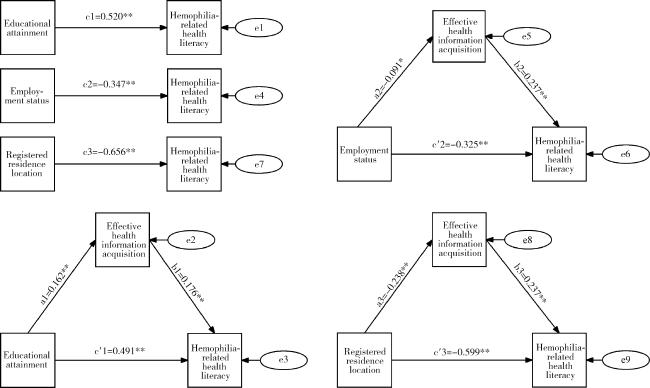
将血友病健康素养作为因变量,以单因素分析结果中,与血友病健康素养及有效健康信息获取同时具有相关性的变量(受教育程度、户籍所在地、就业状况)作为自变量,假设有效健康信息获取在自变量和因变量之间存在中介效应,采用Bootstrap法,控制婚姻状况、收入、年龄等其他社会人口学因素,进行中介作用分析,发现有效健康信息获取在“受教育程度”与“血友病健康素养”、“就业状况”与“血友病健康素养”,以及“户籍所在地”与“血友病健康素养”之间均存在部分中介作用(P<0.05,图 1)。受教育程度、就业状况和户籍所在地既直接影响照护者血友病健康素养水平,也可以通过有效健康信息获取间接影响其血友病健康素养水平(表 5)。
图1 有效健康信息获取的中介作用模型图

Figure 1 Mediation model with effective health information acquisition as a mediator

* P < 0.05 * * P < 0.01.

表5 有效健康信息获取在教育水平、就业状况、户籍所在地与血友病健康素养之间的中介作用

Table 5 Mediating role of effective health information acquisition in the association between educational attainment, employment status, registered residence location and hemophilia-related health literacy

Items Symbol Meaning B 95%CI SE z /t P
Lower limit Upper limit
Educational attainment → Effective health information acquisition → Hemophilia-related health literacy a1×b1 Indirect effect 0.029 0.000 0.063 0.015 1.858 0.063
Educational attainmen → Effective health information acquisition a1 X→M 0.162** 0.097 0.227 0.033 4.913 < 0.001
Effective health information acquisition → Hemophilia-related health literacy b1 M→Y 0.176** 0.004 0.348 0.088 2.006 0.045
Educational attainment → Hemophilia-related health literacy c'1 Direct effect 0.491** 0.324 0.659 0.086 5.748 < 0.001
Educational attainment → Hemophilia-related health literacy c1 Total effect 0.520** 0.354 0.686 0.084 6.156 < 0.001
Employment status → Effective health information acquisition → Hemophilia-related health literacy a2×b2 Indirect effect -0.021 -0.050 -0.002 0.013 -1.707 0.088
Employment status → Effective health information acquisition a2 X→M -0.091* -0.168 -0.013 0.039 -2.303 0.022
Effective health information acquisition→ Hemophilia-related health literacy b2 M→Y 0.237** 0.065 0.410 0.088 2.701 0.007
Employment status → Hemophilia-related health literacy c'2 Direct effect -0.325** -0.523 -0.127 0.101 -3.221 0.001
Employment status → Hemophilia-related health literacy c2 Total effect -0.347** -0.545 -0.148 0.101 -3.432 0.001
Registered residence location → Effective health information acquisition → Hemophilia-related health literacy a3×b3 Indirect effect -0.056 -0.125 -0.009 0.029 -1.922 0.055
Registered residence location → Effective health information acquisition a3 X→M -0.238** -0.406 -0.070 0.086 -2.783 0.006
Effective health information acquisition→ Hemophilia-related health literacy b3 M→Y 0.237** 0.064 0.410 0.088 2.687 0.007
Registered residence location →Hemophilia-related health literacy c'3 Direct effect -0.599** -1.033 -0.166 0.221 -2.717 0.007
Registered residence location →Hemophilia-related health literacy c3 Total effect -0.656** -1.089 -0.223 0.220 -2.975 0.003

* P < 0.05, * * P < 0.01.

3 讨论

3.1 未成年血友病患者照护者的血友病健康素养亟待提高

本研究中未成年血友病患者照护者的血友病健康素养水平较低,且整体和四个亚维度健康素养的具备率均低于成年患者血友病的健康素养水平[10]。照护者对疾病的理解以及对疾病护理知识的掌握与应用程度可直接影响到未成年患者的治疗过程和日常疾病管理;而儿童期进行有效的预防性治疗不仅能降低未成年患者出现合并症的风险,还能减少患者成年后的致残率[11]。因此,需要进一步提升照护者的血友病健康素养水平。

3.2 未成年血友病患者照护者有效健康信息获取水平较低

本研究未成年血友病患者照护者的有效健康信息获取水平总体偏低,且对不同信息渠道的使用率与认可度存在明显差异,表现为照护者对医护人员及血友病患者组织两个信息渠道的使用率与认可度“双高”。尽管超过75%的照护者会通过社交媒体、搜索引擎、短视频等互联网平台获取健康信息,但其对上述渠道的认可度远低于医务人员和血友病患者组织,这与互联网平台、社交媒体健康信息质量良莠不齐有关。有研究显示, 19位50岁以上微信用户转发的482条健康信息中,不可靠信息占比高达57%[12];另有研究显示, 抖音平台132个艾滋病相关视频的信息质量均未达到中等质量标准[13]。此外,随着人们检索健康信息的频率增加,大数据会推荐更多相似且混杂的内容,误导人们的判断,加之社交媒体平台信息夹杂着“卖货”“博流量”等获益目的,导致人们对互联网科普类信息的信任度逐渐降低。另外,人们对健康信息质量的感知直接影响其对信息的利用与健康决策[14],有效健康信息获取有助于照护者做出有益于健康的决策。为此,对于血友病这类罕见病,由于其在疾病治疗、管理等健康信息方面的需求较慢性病相关健康信息更为小众,故应充分发挥医护人员和血友病患者组织在提升未成年患者照护者血友病健康素养中的作用,以满足血友病患者和未成年患者照护者的需求。此外,随着互联网的广泛普及,网络平台、社交媒体已经成为人们获取健康信息的常见途径,研究提示政府有关部门需加大对网络健康信息传播的监管力度,通过筛选窗口、优先推荐官方媒体信息和医护人员在社交媒体发布健康信息等功能,辅助患者和照护者获取更优质、更专业的健康信息。

3.3 未成年血友病患者照护者有效健康信息获取的中介作用

既往大量研究证实受教育程度是健康素养最重要的影响因素[15-16],本研究也发现“受教育程度”“就业状况”和“户籍所在地”直接影响未成年血友病患者照护者的血友病健康素养水平,而有效健康信息获取则在“受教育程度”“就业状况”“户籍所在地”与“血友病健康素养”之间发挥部分中介作用。
健康社会决定因素是指那些直接致病因素背后的根源性健康影响因素,它们源于人们的社会阶层和所拥有的资源,塑造了其生活与工作环境(如收入、教育、居住条件、社区环境等),并最终影响健康[17]。因此,改善健康需要全社会共同努力,提升全民受教育程度和收入也是提升照护者血友病健康素养的基础。另外,在当前无法改变照护者受教育程度和就业状况的前提下,可以着重改善照护者有效健康信息获取情况以提高照护者的血友病健康素养,缩小照护者健康素养水平的社会经济差异,共同为改善未成年血友病患者生活质量做出贡献。
本研究存在一定局限性,研究采用便利抽样,可能对结论的外部效度与推广性产生一定影响。考虑到血友病患者人群的特殊性,难以获取具有全国代表性的研究样本,后续有待更多大样本、多中心研究对本研究的上述结果进行进一步印证与补充。

利益冲突  所有作者均声明不存在利益冲突。

作者贡献声明  袁睿:提出研究思路,整理、分析数据,撰写、修改论文;林含杏:参与问卷设计、收集资料;徐晴波、石丹妮、曹峻洋:参与研究设计,参与讨论论文初稿,提出修改完善建议;刘欣然:完善研究方案,修订中英文摘要;常春:负责项目,总体把关和审定论文。所有作者均参与论文修改,并对最终文稿进行审读和确认。

1
国家卫生健康委员会办公厅. 儿童血友病诊疗规范(2019年版)[J]. 全科医学临床与教育, 2020, 18 (1): 4- 9.

2
刘颖, 赵宏, 陈丽霞, 等. 成年血友病患者生活质量及其影响因素分析[J]. 中国康复, 2017, 32 (1): 33- 36.

3
Azeredo-da-Silva AF , Zanotto BS , Kuwabara YS , et al. Quality of life in children and adolescents with hemophilia A: A systematic review and meta-analysis[J]. Res Pract Thromb Haemost, 2023, 7 (1): 100008.

4
Nutbeam D , Muscat DM . Health promotion glossary 2021[J]. Health Promot Int, 2021, 36 (6): 1578- 1598.

DOI

5
李萌, 张鑫, 周雪梅, 等. 健康素养对心力衰竭患者预后影响的Meta分析[J]. 老年医学研究, 2024, 5 (1): 25- 30.

6
Berkman ND , Sheridan SL , Donahue KE , et al. Low health literacy and health outcomes: An updated systematic review[J]. Ann Intern Med, 2011, 155 (2): 97- 107.

DOI

7
Zaidman EA , Scott KM , Hahn D , et al. Impact of parental health literacy on the health outcomes of children with chronic disease globally: A systematic review[J]. J Paediatrics Child Health, 2023, 59 (1): 12- 31.

DOI

8
穆扎帕尔·麦麦提阿卜杜拉, 陈蕴, 雷瑞玲, 等. 新疆1型糖尿病患儿的家庭照护负担对患儿生存质量的影响: 照护能力的中介效应分析[J]. 中华糖尿病杂志, 2025, 17 (3): 351- 359.

9
郭庆光. 传播学教程[M]. 2版 北京: 中国人民大学出版社, 2011: 4.

10
林雨欣, 杨仁池, 陈蓉, 等. 中国血友病患者疾病相关健康素养现状及影响因素研究[J]. 中国健康教育, 2025, 41 (9): 771-776, 782.

11
Razmpoosh E , Olasupo OO , Bhatt M , et al. Clotting factor concentrates for preventing bleeding and bleeding-related complications in previously untreated or minimally treated children with hemophilia A or B[J]. Cochrane Database Syst Rev, 2025, 8 (8): Cd003429.

12
李月琳, 张秀, 王姗姗. 社交媒体健康信息质量研究: 基于真伪健康信息特征的分析[J]. 情报学报, 2018, 37 (3): 294- 304.

13
任苻友, 周心燕, 沈黛珺, 等. 基于抖音平台的艾滋病相关短视频质量评价[J]. 中国艾滋病性病, 2025, 31 (10): 1099- 1105.

14
薛翔, 马海云, 赵宇翔, 等. 用户感知视角下的健康信息质量评估研究: 以短视频平台为例[J]. 图书与情报, 2022, 42 (2): 69- 79.

15
李英华, 李莉, 王兰兰. 2012-2023年中国居民健康素养水平分析[J]. 中国健康教育, 2025, 41 (5): 426- 430.

16
石建辉, 齐力, 徐露婷, 等. 2012-2022年北京市女性居民健康素养水平及其影响因素分析[J]. 中国健康教育, 2026, 42 (1): 66- 71.

17
WHO, Commission on SDH. Closing the gap in a generation: Health equity through action on the social determinants of health[EB/OL]. (2008-08-27)[2026-02-01]. https://www.who.int/publications/i/item/WHO-IER-CSDH-08.1.

Outlines

/