Effect of modified hot-etching treatment on the mechanical properties of zirconia and zirconia/resin bond strength

  • Xin YANG 1 ,
  • Yu WU 2 ,
  • Pin LV , 2, *
Expand
  • 1. First Clinical Division, Peking University School and Hospital of Stomatology & National Center for Stomatology & National Clinical Research Center for Oral Diseases & National Engineering Research Center of Oral Biomaterials and Digital Medical Devices, Beijing 100081, China
  • 2. Department of Stomatology, Peking University Third Hospital, Beijing 100191, China
LV Pin, e-mail,

Received date: 2025-10-10

  Online published: 2026-05-19

Supported by

the Peking University Third Hospital Fund for Interdisciplinary Research(BYSYJC2024029)

Copyright

All rights reserved. Unauthorized reproduction is prohibited.

Abstract

Objective: To investigate the effect of modified hot-etching treatment on the flexural strength and surface crystalline phase proportions of zirconia and zirconia/resin bond strength. Methods: Zirconia specimens were divided into three groups according to different surface treatments, including blank group, sandblasting treatment group and modified hot-etching treatment group. A scanning electron microscope (SEM) was used to observe the surface morphology of the treated zirconia, an X-ray diffractometer (XRD) was employed to detect the surface crystalline phase proportions, and a universal mechanical testing machine was utilized to measure the three-point flexural strength of the zirconia specimens of different treatment groups. A bonding surface was prepared with bovine enamel, and the zirconia specimens were bonded using resin cement. Half of the bonded specimens underwent 5 000 cycles of thermal cycling fatigue test, and the immediate and fatigued shear bond strengths (SBS) were detected by using a universal mechanical testing machine. Results: SEM observations revealed that the surface of the control group was smooth, the surface of sandblasting treatment group exhibited irregular scratches, and the surface of modified hot-etching treatment group showed a honeycomb-like etched morphology. XRD results indicated that the monoclinic phase proportions were 8.18% for the control group, 28.34% for the sandblasting treatment group, and 9.69% for the modified hot-etching treatment group. The flexural strength of the sandblasting treatment group [(316.40±58.37) MPa] was significantly (P < 0.01) lower than that of the blank group [(415.30±47.64) MPa] and the modified hot-etching treatment group [(398.77±47.94) MPa]. The immediate SBS of the modified hot-etching treatment group [(53.77±8.36) MPa] was higher (P < 0.01) than that of blank group[(35.50±4.72) MPa] and sandblasting treatment group [(42.97±6.95) MPa]. After thermal cycling fatigue test, the fatigued SBS of the blank group [(21.65±4.01) MPa] was lower (P < 0.01) than that of the modified hot-etching treatment group [(30.69±7.36) MPa] and the sandblasting treatment group [(29.37±5.73) MPa]. Conclusion: The modified hot-etching treatment could enhance the immediate zirconia/resin SBS, exhibited similar resistance to thermal fatigue test with sandblasting treatment group, could not significantly reduce the flexural strength, and did not obviously alter the surface crystalline phase proportions.

Cite this article

Xin YANG , Yu WU , Pin LV . Effect of modified hot-etching treatment on the mechanical properties of zirconia and zirconia/resin bond strength[J]. Journal of Peking University(Health Sciences), 2026 , 58(4) : 855 -859 . DOI: 10.19723/j.issn.1671-167X.2026.04.024

氧化锆是口腔修复治疗中常用的全瓷材料,其材质有着优良的机械性能,在全冠修复中保证修复体抗力的最薄厚度为0.7 mm,也可用于种植修复的大跨度桥体设计[1-2]。由于氧化锆本身属于惰性材料,常规浓度的氢氟酸、磷酸等酸蚀剂很难蚀刻其表面,常用的粘接前处理剂也很难与之发生化学反应,从而导致氧化锆的粘接性能相对较差[3]。在临床冠高度不足或者种植基台较短的病例中,氧化锆修复体更容易出现脱粘接的现象;在粘接桥、牙合贴面等主要倚靠粘接固位的修复体中也很少选择氧化锆材料,因此,限制了氧化锆的临床应用[4]。酸蚀是齿科粘接技术中最常用的粘接面处理方法[5-6]。近年来,多位学者研究并试图探索合适的酸蚀剂浓度或酸蚀条件,但尚未得出理想的酸蚀处理流程,粘接强度的提升也距临床需求有一定差距[7-9]。本研究通过改良的热酸蚀溶液配方处理氧化锆表面,探索该方法对氧化锆树脂粘接强度、表面晶相组成及挠曲强度的影响。

1 资料与方法

1.1 材料和仪器

材料包括钇稳定氧化锆[氧化锆(摩尔分数)97%, 三氧化二钇(摩尔分数)3%]试件,由蓝鲸陶瓷有限公司加工完成,有圆柱体(直径5 mm, 高度3 mm)及长方体(长度50 mm, 宽度4 mm, 高度1 mm, 四角为45°倒角,倒角长度0.1 mm);树脂水门汀(RelyX U200, 3M ESPE公司, 美国);磷酸酸蚀剂(Gluma Etch 35 Gel, Kulzer Gmbh公司, 德国)。
仪器包括万能力学试验机(WDW-10, 中仪仪器公司, 中国)、冷热循环模拟机(TC-501F, 金坛良友仪器公司, 中国)、扫描电子显微镜(scanning electron microscope, SEM,S-4800, Hitachi公司, 日本)和X射线衍射仪(X-ray diffractometer, XRD,Xpert-3, Malvern Panalytical公司, 荷兰)。

1.2 离体牛牙试件的制备

收集唇面釉质层完整且无明显裂纹的新鲜拔除的牛牙,去除表面牙结石及软组织,沿牙颈部截取牙冠,置入5 g/L氯亚明溶液中,4 ℃保存。使用自制圆柱形模具将牙冠包埋在自凝树脂中,唇面釉质暴露于圆柱顶端,流水下使用砂纸(180、360目)逐级打磨暴露平整釉质表面,暴露面积不小于7 mm×7 mm,蒸馏水超声清洗5 min后待用。

1.3 氧化锆试件的制备

将氧化锆试件在流水下使用180、240、360、800、1 200、2 000目砂纸逐级打磨,蒸馏水超声清洗5 min后干燥待用。
根据不同表面处理方式将氧化锆试件随机进行分组:(1)空白组(n=20):蒸馏水超声清洗30 min,干燥;(2)喷砂组(n=20):使用直径50 μm的三氧化二铝颗粒, 0.35 MPa压强下垂直于处理面10 mm处喷砂处理10 s,蒸馏水超声清洗30 min,干燥;(3)改良热酸蚀组(n=20):使用80 mL N, N-二甲基甲酰胺(N, N-dimethylformamide, DMF)、20 mL 37%(质量分数)盐酸、1 g无水三氯化铁,制备混合酸蚀液,在100 ℃水浴下酸蚀处理60 min,蒸馏水超声清洗30 min,干燥。

1.4 表面形貌观察

选取空白组、喷砂组及改良热酸蚀组圆柱体氧化锆试件各一个,使用真空镀膜仪喷金处理80 s,SEM观察10 000倍及20 000倍下的表面形貌。

1.5 挠曲强度测试

选取空白组、喷砂组及改良热酸蚀组长方体氧化锆试件(每组n=10),使用万能力学试验机行三点挠曲强度测试。测试夹具由两个中心跨度为12 mm、直径5 mm的支撑圆柱,及一个位于支撑圆柱中间的直径5 mm的加载圆柱构成。万能力学试验机压头速率为1 mm/min,记录断裂前的最大压力(F)。挠曲强度(R)根据下述公式计算,其中L为试件长度,b为试件宽度,h为试件厚度,
$R=\frac{3 F \times L}{2 b \times h \times h} 。$

1.6 XRD分析

选取空白组、喷砂组及改良热酸蚀组圆柱体氧化锆试件各1个,使用XRD进行表面晶相分析,衍射角2θ的测试范围为15°~60°,记录氧化锆四方相t(111)及单斜相m(111)和m(${\rm{\bar 1}}$11)对应的2θ的最大峰面积(I),根据下述公式计算单斜相比例(Xm),
$X_{\mathrm{m}}=\frac{I_{\mathrm{m}}(111)+I_{\mathrm{m}}(\overline{1} 11)}{I_{\mathrm{m}}(111)+I_{\mathrm{m}}(\overline{1} 11)+I_{\mathrm{t}}(111)} 。$

1.7 粘接试件的制备

牛牙釉质使用磷酸酸蚀30 s,加压水汽冲洗15 s,无油气枪吹干。使用树脂水门汀将空白组、喷砂组及改良热酸蚀组圆柱体氧化锆试件(n=20)粘接于牛牙釉质表面,就位后于垂直加压器加载10 N压力下维持20 s,用小毛刷去除多余树脂水门汀,光固化30 s。

1.8 冷热循环疲劳模拟

将空白组、喷砂组及改良热酸蚀组氧化锆/牛牙粘接试件(n=20)随机分为即刻组(n=10)和温度疲劳组(n=10)。即刻组粘接试件于室温下蒸馏水保存24 h;温度疲劳组进行冷热循环5 000次,循环周期为5 ℃/55 ℃水浴中交替停留30 s,间隔5 s。

1.9 剪切粘接强度

使用万能力学试验机进行剪切粘接强度(shear bond strengths, SBS)测试,压头速度设置为1 mm/min,记录空白组、喷砂组及改良热酸蚀组粘接试件断裂的最大载荷及断裂模式,最大载荷除以粘接面积用于计算SBS。体视显微镜下观察粘接试件的断裂模式,分类标准为釉质/树脂界面断裂、氧化锆/树脂界面断裂和混合断裂。

1.10 统计学分析

使用SPSS 25.0软件对挠曲强度、即刻SBS和疲劳后SBS数据进行统计分析。Shapiro-Wilk检验和Levene检验分别对数据进行正态性和方差齐性验证。单因素方差分析结合Tukey诚实显著性差异法比较各组间挠曲强度、即刻SBS及疲劳后SBS的差异(α=0.05)。

2 结果

2.1 SEM结果

空白组试件表面平整,可见散在打磨划痕;喷砂组试件表面存在不同深度划痕;热酸蚀组表面酸蚀面呈蜂窝状(图 1)。
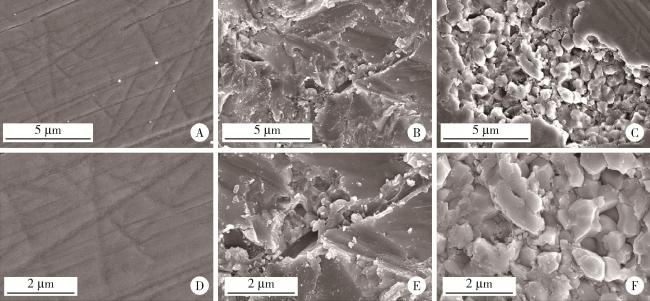
图1 扫描电镜下各组氧化锆表面形貌

Figure 1 Scanning electron microscope images of the zirconia surface morphology for each group

A, blank group at ×10 000; B, sandblasting group at ×10 000; C, modified hot-etching group at ×10 000; D, blank group at ×20 000; E, sandblasting group at ×20 000; F, modified hot-etching group at ×20 000.

2.2 挠曲强度结果

单因素方差分析提示各组间挠曲强度差异有统计学意义(F=10.56, P<0.001),组间比较结果提示喷砂组[(316.40±58.37) MPa]低于空白组[(415.30±47.64) MPa, P=0.001]及改良热酸蚀组[(398.77±47.94) MPa, P=0.004],差异均有统计学意义;改良热酸蚀组略低于空白组,差异无统计学意义(P=0.756)。

2.3 XRD结果

图 2,t代表四方相氧化锆衍射峰,m代表单斜相衍射峰,在空白组和热酸蚀组中单斜相m(111)衍射峰微弱,在喷砂组中可以检测到明显单斜相m(111)波峰。通过公式计算,空白组氧化锆中单斜相比例为8.18%, 喷砂组为28.34%, 热酸蚀组为9.69%。
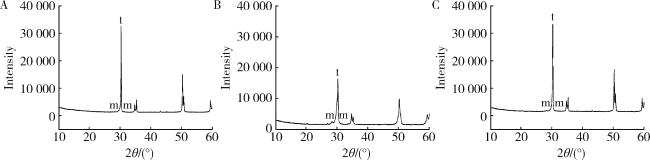
图2 各组氧化锆试件XRD图谱

Figure 2 XRD patterns of zirconia specimens of each group

A, blank group; B, sandblasting group; C, modified hot-etching group. m, monoclinic; t, tetragonal; XRD, X-ray diffractometer.

2.4 SBS结果及断裂模式

即刻SBS结果,单因素方差分析提示各组间差异有统计学意义(F=18.03, P<0.001), 改良热酸蚀组[(53.77±8.36) MPa]粘接强度显著高于喷砂组[(42.97±6.95) MPa, P = 0.004]与空白组[(35.50±4.72) MPa, P <0.001],喷砂组与空白组之间差异无统计学意义(P = 0.054)。
温度疲劳后SBS结果,单因素方差分析提示各组间差异有统计学意义(F=6.94, P<0.001), 空白组[(21.65±4.01) MPa]低于喷砂组[(29.37±5.73) MPa,P=0.017]和改良热酸蚀组[(30.69±7.36) MPa, P=0.005],差异有统计学意义,喷砂组与改良热酸蚀组无统计学差异(P = 0.870)。断裂模式以氧化锆/树脂界面断裂为主(图 3)。
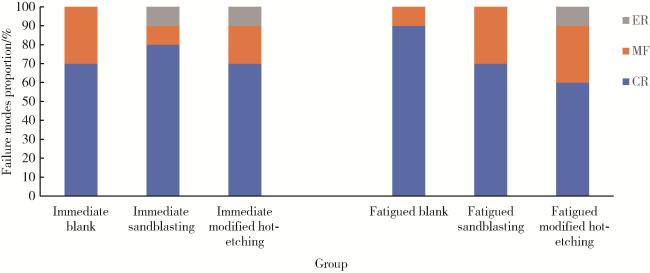
图3 各组氧化锆粘接试件断裂模式

Figure 3 Failure modes of zirconia bonded specimens by groups

ER, enamel/resin interfacial failure; MF, mixed failure; CR, ceramic/resin interfacial failure.

3 讨论

氧化锆粘接的基本原理包括微机械固位和化学结合,其中微机械固位是通过粗糙粘接表面,在粘接面上形成微倒凹,让粘接材料在流动状态下进入微倒凹中,在粘接材料固化后达到稳定的粘接效果[10]。有效提高氧化锆表面的微机械固位是氧化锆粘接的主要研究方向[11]
喷砂处理是常用的金属表面粗化方法,既往研究显示,喷砂可以有效地增加氧化锆的粘接强度[12],然而,不同于金属类材料,氧化锆材料属于脆性材料,喷砂会引起氧化锆表面的晶相改变,降低氧化锆本身相变增韧的能力,在表面留下微裂纹,导致挠曲强度下降[13]。本研究中喷砂组的扫描电镜结果显示,氧化锆表面除了划痕形式的粗糙面外,也出现了微裂纹,XRD结果中喷砂组单斜相比例增加,该结果与既往研究[14]结论一致。在挠曲强度试验中,喷砂组挠曲强度较空白组降低,这可能与喷砂处理引起氧化锆四方相向单斜相转变、氧化锆相变增韧能力降低以及表面微裂痕有关。
与喷砂等机械粗化的处理方式相比,酸蚀处理通过氧化反应将氧化锆表面的高能量分子移除,从而形成粗糙表面,这种化学粗化的方式较为温和,能避免氧化锆表面晶相的改变和微裂纹的产生[15]。本研究中XRD结果显示,改良热酸蚀处理后氧化锆表面单斜相比例和挠曲强度较空白组均未出现明显变化,与既往相关研究[16-17]结果一致。
传统热酸蚀处理氧化锆最早由Casucci等[18-19]和El-Korashy等[20]提出,多位学者对其做了进一步的研究和探索。在这些研究中,每100 mL热酸蚀液是由80 mL甲醇、20 mL浓盐酸和0.1 g Fe3+组成,热酸蚀反应需在100 ℃的条件下进行。甲醇作为热酸蚀液的主要溶剂,是一种毒性较强且高度易挥发的无色液体,闪点为11.1 ℃,沸点为64.7 ℃。因此,为了达到热酸蚀反应的温度,以甲醇为溶剂的热酸蚀反应必须在高压密闭容器中进行,加大了热酸蚀处理的操作难度,设备具有一定危险性,且无法直接观察处理过程。
本研究使用的改良酸蚀液配方中,三氯化铁中的Fe3+与氧化锆的表面分子进行氧化反应,浓盐酸提供的酸性环境促进氧化反应的发生。DMF取代甲醇作为溶剂,这一组成与既往研究[18-19]不同。DMF是一种透明液体,属于丙类低毒试剂,可以与水以及多数有机溶剂以任意比例混合,是化学反应中一种常用溶剂。DMF具有良好的热稳定性和化学稳定性,其沸点为153 ℃,在热酸蚀液加热到100 ℃时仍能保证酸蚀液的稳定,具有更好的操作性,无需使用加压装置,水浴就可达到实验温度,简化了热酸蚀设备,安全性更好。
本研究中改良热酸蚀组即刻SBS显著提升,温度疲劳后,虽然各组的SBS均下降,但是改良热酸蚀组仍和喷砂组获得了类似的疲劳后SBS,这可能与氧化锆表面酸蚀出的蜂窝状结构有关。蜂窝状的粗糙表面增加了表面的粗糙度和粘接面积,有利于树脂水门汀渗入,形成了微机械嵌合,与既往研究[21]一致。
改良热酸蚀对氧化锆的蚀刻效果受到各组成成分的比例、反应温度、酸蚀时间等因素影响。本研究参考既往研究[16-17]条件,选择100 ℃水浴,酸蚀处理60 min。但改良热酸蚀法用于氧化锆表面处理的理想参数及其与氧化锆表面粗糙度、以及树脂粘接强度之间的构效关系仍需进一步探讨。近些年,随着材料学的发展,不同类型的氧化锆及其衍生混合物被广泛应用于口腔领域,本研究仅评估了改良热酸蚀对3%(摩尔分数)三氧化二钇的氧化锆的影响,其对相关类似材料的影响并未涉及,这是本研究的不足之处。此外,咀嚼模拟疲劳、储水疲劳对改良热酸蚀后粘接强度的影响也需进一步研究。

利益冲突   所有作者均声明不存在利益冲突。

作者贡献声明  吕品:提出研究思路,设计研究方案,总体把关和审定论文;杨鑫:收集、分析、整理数据,撰写论文;吴煜:数据统计和图表制作。所有作者均参与论文修改,并对最终文稿进行审读和确认。

1
Zenthöfer A , Schwindling FS , Schmitt C , et al. Strength and reliability of zirconia fabricated by additive manufacturing tech-nology[J]. Dent Mater, 2022, 38 (10): 1565- 1574.

DOI

2
Sulaiman TA , Suliman AA , Abdulmajeed AA , et al. Zirconia restoration types, properties, tooth preparation design, and bon-ding. A narrative review[J]. J Esthet Restor Dent, 2024, 36 (1): 78- 84.

DOI

3
Alammar A , Att W . Bonding durability between zirconia and different types of tooth or implant abutments: A systematic review. Part II: Outcomes of clinical studies[J]. Int J Pros-thodont, 2022, 25 (4): 512- 529.

4
Lupu IC , Tatarciuc MS , Vitalariu AM , et al. Bonding strategies for zirconia fixed restorations: A scoping review of surface treatments, cementation protocols, and long-term durability[J]. Biomimetics, 2025, 10 (9): 632.

DOI

5
Nishizawa Y , Komagata Y , Nagamatsu Y , et al. Chemical etching of CAD-CAM glass-ceramic-based materials using fluoride solutions for bonding pretreatment[J]. Dent Mater J, 2024, 43 (4): 504- 516.

DOI

6
Komine F , Furuchi M , Honda J , et al. Clinical performance of laminate veneers: A review of the literature[J]. J Prosthodont Res, 2024, 68 (3): 368- 379.

DOI

7
D'Alessandro C , Josic U , Mazzitelli C , et al. Is zirconia surface etching a viable alternative to airborne particle abrasion? A syste-matic review and meta-analysis of in vitro studies[J]. J Dent, 2024, 151, 105394.

DOI

8
Sadid-Zadeh R , Strazzella A , Li R , et al. Effect of zirconia etching solution on the shear bond strength between zirconia and resin cement[J]. J Prosthet Dent, 2021, 126 (5): 693- 697.

DOI

9
You GE , Lim MJ , Min KS , et al. Surface property changes observed in zirconia during etching with high-concentration hydrofluoric acid over various immersion times[J]. Dent Mater J, 2024, 43 (1): 52- 57.

DOI

10
Cadenaro M , Josic U , Maravić T , et al. Progress in dental adhesive materials[J]. J Dent Res, 2023, 102 (3): 254- 262.

DOI

11
Lima RBW , Silva AF , da Rosa WLO , et al. Bonding efficacy of universal resin adhesives to zirconia substrates: Systematic review and meta-analysis[J]. J Adhes Dent, 2023, 25, 51- 62.

12
Akar T , İçen G . Effect of dentin and zirconia surface treatments with laser irradiation versus sandblasting on the bonding ability of zirconia[J]. Photobiomodul Photomed Laser Surg, 2023, 41 (9): 501- 508.

13
Kim HK , Yoo KW , Kim SJ , et al. Phase transformations and subsurface changes in three dental zirconia grades after sandblasting with various Al2O3 particle sizes[J]. Materials, 2021, 14 (18): 5321.

DOI

14
Jakovac M , Klaser T , Radatovic' B , et al. Impact of sandblasting on morphology, structure and conductivity of zirconia dental ceramics material[J]. Materials, 2021, 14 (11): 2834.

DOI

15
Jin C , Wang J , Huang Y , et al. Effects of hydrofluoric acid concentration and etching time on the bond strength to ceramic-coated zirconia[J]. J Adhes Dent, 2022, 24, 125- 136.

16
魏萌, 朱红, 梁琢然, 等. 不同热酸蚀液对氧化锆粘接强度和抗折性能的影响[J]. 实用口腔医学杂志, 2022, 38 (4): 445- 449.

17
梁琢然, 张研楠, 魏萌, 等. 2种酸液热酸蚀对氧化锆表面形貌及粘接强度的影响[J]. 上海口腔医学, 2023, 32 (4): 369- 374.

18
Casucci A , Osorio E , Osorio R , et al. Influence of different surface treatments on surface zirconia frameworks[J]. J Dent, 2009, 37 (11): 891- 897.

DOI

19
Casucci A , Mazzitelli C , Monticelli F , et al. Morphological analysis of three zirconium oxide ceramics: Effect of surface treatments[J]. Dent Mater, 2010, 26 (8): 751- 760.

DOI

20
El-Korashy DI , El-Refai DA . Mechanical properties and bonding potential of partially stabilized zirconia treated with different chemomechanical treatments[J]. J Adhes Dent, 2014, 16 (4): 365- 376.

21
Casucci A , Monticelli F , Goracci C , et al. Effect of surface pre-treatments on the zirconia ceramic: Resin cement microtensile bond strength[J]. Dent Mater, 2011, 27 (10): 1024- 1030.

DOI

Outlines

/