Efficacy and safety of laparoscopic nephron-sparing surgery for giant renal angio-myolipoma

  • Peichen DUAN * ,
  • Le YU * ,
  • Fan ZHANG ,
  • Xiaofei HOU ,
  • Guoliang WANG ,
  • Yichang HAO , * ,
  • Shudong ZHANG , *
Expand
  • Department of Urology, Peking University Third Hospital, Beijing 100191, China
HAO Yichang, e-mail,
zhang shudong, e-mail,

Received date: 2026-03-03

  Online published: 2026-05-15

Supported by

the National Nature Science Foundation of China(82273389)

the National Nature Science Foundation of China(82473287)

Copyright

All rights reserved. Unauthorized reproduction is prohibited.

Abstract

Objective: Giant renal angiomyolipoma (RAML), typically defined as having a maximum diameter of ≥8 cm, presents formidable surgical challenges and heightened clinical risks. These challenges primarily stem from the tumor's extensive volume, highly enriched but fragile vascularization, and significant susceptibility to spontaneous rupture and life-threatening hemorrhage. This study aims to comprehensively evaluate the clinical effectiveness and safety of laparoscopic nephron-sparing surgery (NSS) for the management of these complex giant lesions. Methods: A retrospective analysis was performed on 45 patients with giant (≥8 cm) RAML who received NSS at Peking University Third Hospital between January 2012 and September 2025. The cohort comprised 11 males and 34 females with a mean age of (40.9±14.1) years and a mean body mass index (BMI) of (23.7±4.0) kg/m2. Preoperatively, 5 patients had a history of spontaneous hemorrhage, and 2 were pregnant. The mean maximum tumor diameter was (10.3±2.2) cm, ranging from 8.0 to 15.4 cm. Surgical procedures included standard laparoscopy (39 cases) and Da Vinci robotic-assisted laparoscopy (6 cases), utilizing either a retro-peritoneal approach (32 cases, 71.1%) or a transperitoneal approach (13 cases, 28.9%). Pathological diagnosis and differentiation were conducted in strict accordance with the 2022 World Health Organization (WHO) classification of tumors. Key outcome measures included operative time, warm ischemia time, estimated blood loss, postoperative complications, and length of postoperative hospital stay. Results: All the 45 operations were successfully completed with complete tumor resection and nephron preservation, although 5 cases required conversion to open surgery due to severe adhesions or bleeding. The operative time was (180.6±55.7) min (range: 86-312 min), the warm ischemia time was (21.9±9.8) min (range: 6-40 min); 36 cases had a warm ischemia time ≤30 min, while a zero-ischemia technique was employed in 3 cases. The postoperative hospital stay was (6.2±2.6) days (range: 3-14 days), and the time to drainage tube removal was (5.1±2.2) days (range: 2-14 days). Postoperative patho-logy confirmed RAML in all cases, and all surgical margins were negative. Postoperative complications included one case of pulmonary infection and one case of renal insufficiency. During a follow-up of 3 to 43 months, no tumor recurrence or significant loss of renal function was documented. Conclusion: NSS for selected patients with giant RAML is effective in preserving renal function while ensuring complete tumor resection, negative margins, and avoiding short-term and long-term complications. Robotic-assisted systems, in particular, offer distinct advantages in complex wound reconstruction and the reduction of surgical complications.

Cite this article

Peichen DUAN , Le YU , Fan ZHANG , Xiaofei HOU , Guoliang WANG , Yichang HAO , Shudong ZHANG . Efficacy and safety of laparoscopic nephron-sparing surgery for giant renal angio-myolipoma[J]. Journal of Peking University(Health Sciences), 2026 , 58(4) : 860 -864 . DOI: 10.19723/j.issn.1671-167X.2026.04.025

肾血管平滑肌脂肪瘤(renal angiomyolipoma, RAML)是肾脏常见的良性肿瘤,50%~70%为散发性,30%~50%与遗传综合征相关。对于较小的RAML(<4 cm),可以基于主动监测进行保守治疗[1-2];而对于较大的RAML,因可能存在并发症(自发破裂、腹膜后出血、高血压等)或相关症状(腹部肿块、腰痛、血尿等),通常需要积极手术治疗,其中,自发性破裂出血是泌尿外科中常见的危急重症,可能引发失血性休克,严重时可危及患者生命,约14%的散发性RAML患者会出现这一并发症[3-5]。保留肾单位手术(nephron-sparing surgery, NSS)可在完整切除RAML的前提下最大程度地保留肾功能[6],但对于巨大(≥8 cm)RAML,由于存在肿物体积大、易出血且腹腔镜操作空间有限等难点,手术有一定困难,需要术者具备更好的经验与手术技巧。本研究回顾性分析2012年1月至2025年9月北京大学第三医院收治的45例巨大(≥8 cm)RAML行腹腔镜NSS治疗患者的临床资料,探讨该术式的疗效及安全性。

1 资料与方法

1.1 一般资料

本组共纳入45例患者,其中男11例,女34例,年龄20~74岁,平均(40.9±14.1)岁,体重指数(23.7±4.0) kg/m2,其中9例体重指数>25.0 kg/m2,5例手术前曾有自发性出血。所有病例术前均行肾脏CT或MRI检查(图 1),提示肿瘤呈外生性,边界清晰,肿瘤最大直径8.0~15.4 cm,平均(10.3±2.2) cm。2例合并妊娠,2例术前行介入栓塞治疗,1例诊断为结节性硬化病。术前血肌酐45~101 μmol/L,平均(66.1±11.8) μmol/L。
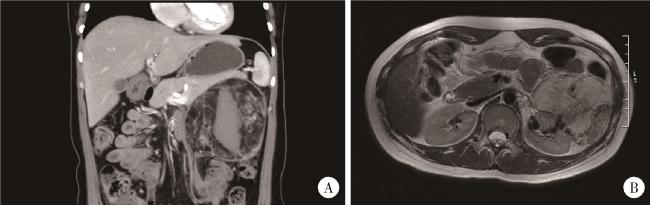
图1 巨大肾血管平滑肌脂肪瘤的术前影像学检查

Figure 1 Preoperative imaging of a giant renal angiomyolipoma

A, CTU examination shows a mass with mixed density anterior to the left kidney, containing fat and soft tissue densities, measuring approximately 12.8 cm×8.1 cm×12.3 cm. Contrast-enhanced scan reveals inhomogeneous enhancement. B, MRI examination shows a roundish mixed-signal mass in the left kidney, measuring approximately 8.9 cm×6.9 cm×10.8 cm, predominantly characterized by short T1 and long T2 signals. CTU, computed tomography urography; MRI, magnetic resonance imaging.

45例患者均行腹腔镜NSS,其中6例采用达芬奇机器人手术系统辅助腹腔镜手术,32例(71.1%)为经后腹腔入路,13例(28.9%)为经腹腔入路。
根据术后组织病理结果,参考《2022年世界卫生组织肿瘤分类:泌尿系与男性生殖系统肿瘤病理》[7],对RAML和上皮样血管平滑肌脂肪瘤进行鉴别,(1)RAML:光镜下可见存在厚壁血管,存在比例不等的肌样成分和/或脂肪样成分,免疫组织化学检测提示黑色素细胞标志物(Melan-A、HMB45)阳性;(2)上皮样血管平滑肌脂肪瘤:光镜下呈癌样外观和/或呈弥漫性生长的上皮样细胞及丰满的梭形细胞,同时,超过80%的肿瘤细胞为上皮样细胞,免疫组织化学检测提示黑色素细胞标志物(如Melan-A)和组织蛋白酶K呈阳性。
对于年龄<40岁且多发RAML的患者,进一步鉴别遗传性和散发性RAML。基因检测中检测到TSC1TSC2基因致病性突变,或符合结节性硬化症临床诊断标准的患者,进一步确诊为遗传性RAML(结节性硬化症相关的RAML)[8-9]。最终,本组中1例患者诊断为结节性硬化症,考虑为遗传性RAML。

1.2 手术方法

以后腹腔入路腹腔镜手术为例。气管插管、全身麻醉成功后,患者取完全健侧卧位,升高腰桥。制备气腹并放置套管,常规在第12肋下腋后线处、肋缘下腋前线处、髂棘上腋中线处三点建立通道,以手指及气囊扩张法制备腹膜后操作空间,气腹压力为12 mmHg。游离肾脏及肾蒂血管,顺肿瘤与肾包膜之间的层面向深方游离寻找并显露肿瘤基底部。显露困难时可通过旋转肾蒂来改善手术视野和操作空间,处理肾下极或肾门部RAML时注意保护输尿管。分离并阻断肾动脉,在距肿瘤基底部约0.5 cm处用剪刀楔形切除肿物及部分肾组织,完整切除肿瘤,缝合肾实质,恢复肾脏血供。若肿瘤与脂肪等周围结构粘连严重,可在解除动脉阻断后再游离粘连。确切止血后将肿物装入标本袋,经腋后线切口将肿瘤取出。放置引流,关闭切口。

1.3 观察指标

主要观察指标包括手术时长、术中出血量、肾动脉阻断时长、术后血肌酐变化、术后引流管拔管时长、术后住院时长、手术并发症、组织病理结果、术后复发情况等。

1.4 数据分析

采用SPSS 21.0软件,正态型连续性变量以均数±标准差表示,非正态型连续性变量以中位数(范围)表示,分类型变量以n (%)表示。

2 结果

45例患者的手术均顺利完成,5例中转开放手术。手术时长86~312 min,平均(180.6±55.7) min;术中出血量10~1 300 mL,中位值100 mL;术后住院3~14 d,平均(6.2±2.6) d;术后拔管时间2~14 d,平均(5.1±2.2) d;肾动脉阻断时长6~40 min,平均(21.9±9.8) min,其中36例≤30 min,6例>30 min。3例患者因考虑肿瘤位置较表浅、未侵及集合系统,经术者评估后采用无肾动脉阻断技术。
术后组织病理均为RAML,切缘均为阴性。术后血肌酐38~325 μmol/L,平均(70.3±42.9) μmol/L,1例在术后出现急性肾功能不全,1例术后出现肺部感染,经抗感染治疗后好转出院,其余患者无明确并发症。
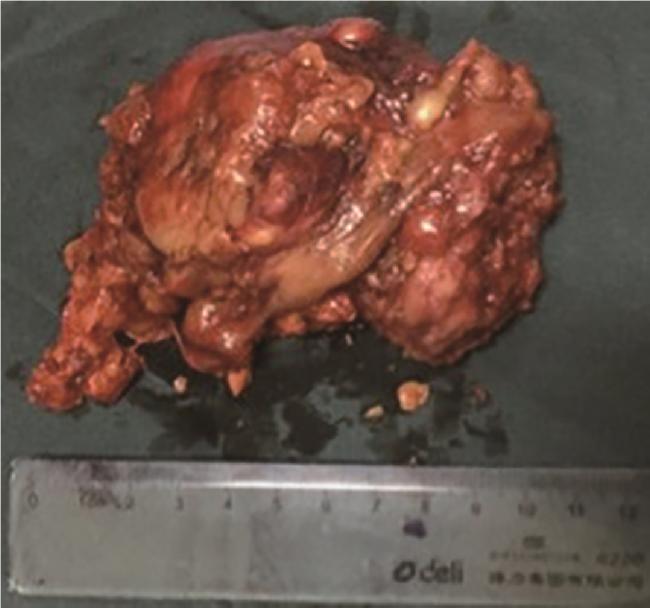
术后门诊随访3~43个月,肾脏超声或CT检查均无肿瘤复发。患者临床资料及观察指标见表 1,代表性手术切除的大体标本见图 2
表1 45例巨大RAML患者的临床资料及观察指标

Table 1 Clinical data and observational indicators of 45 patients with giant RAML

Characteristic Value
Age/years 40.9±14.1
Gender
    Male 11 (24.4)
    Female 34 (75.6)
Body mass index/(kg/m2) 23.7±4.0
Tumor diameter/cm 10.3±2.2
Surgical side
    Left 23 (51.1)
    Right 22 (48.9)
Preoperative imaging suggestive of contralateral RAML
    No 38 (84.4)
    Yes 7 (15.6)
Preoperative estimated residual renal volume/mL 85.4±23.6
Surgical method
    Laparoscopic 39 (86.7)
    Robotic 6 (13.3)
Surgical approach
    Transperitoneal 13 (28.9)
    Retroperitoneal 32 (71.1)
Operative time/min 180.6±55.7
Renal artery clamping time/min 21.9±9.8
Estimated blood loss/mL 100 (10, 1 300)
Postoperative hospital stay/d 6.2±2.6
Time to drainage removal/d 5.1±2.2

Data are presented as ${\bar x}$±s, n (%) or median (minimum, maximum). RAML, renal angiomyolipoma.

图2 巨大肾血管平滑肌脂肪瘤手术切除的大体标本

Figure 2 Gross specimen of the surgically resected giant renal angiomyolipoma

3 讨论

RAML起源于间充质,由不同比例的异常增生血管、平滑肌和脂肪组织构成,绝大多数为良性表现,组织病理学上可大致分为经典型和上皮样型。现有证据表明,RAML好发于女性,可能与雌激素相关[10]。RAML一般无典型临床表现,大约80%的病例为偶然发现,在约40%的病例中可存在腹部肿块、腰痛和血尿的经典三联征,其诊断依赖于MRI或CT[11]。破裂出血是RAML的严重并发症,常伴有严重的疼痛、贫血,可导致失血性休克,其风险严重程度通常与瘤体大小、血管分布、位置、生长速度等有关,直径越大的RAML发生破裂出血的可能性越高[12]。关于RAML患者的手术治疗指征目前尚无定论,一般包括破裂出血风险高、症状明显。
本研究遵循既有研究[13]所报道的,将巨大RAML定义为最大直径≥8 cm的病例,也有其他研究以7~10 cm为界[12, 14-16],肿瘤体积大小与手术难度、出血风险、预后、恶变风险有相关性。对于巨大RAML病例,非药物治疗方法通常包括选择性动脉栓塞术(selective artery embolization, SAE)、NSS、全肾切除术以及介入栓塞与手术联合治疗[6, 17]。NSS的目的在于完整切除肿瘤的同时,尽可能多地为患者保留肾功能以改善预后,通常适用于肿瘤呈外生性、边界清晰的病例,但由于肿瘤体积、质地、位置等因素,巨大RAML病例在施行NSS时,需要更高的手术技巧及医疗条件[18]。本文所报道45例接受NSS治疗的巨大RAML病例均取得了较为满意的效果。
近年来,机器人手术辅助平台在泌尿外科领域的应用日益广泛。对于最大径≥8 cm的巨大RAML,NSS面临较高的术中出血风险与复杂的创面重建挑战,机器人手术平台系统提供的三维高清放大视野配合可灵活调整的镜头角度,能够有效减少深部操作的视觉盲区,使肾门及肿瘤基底部的解剖结构得以充分显露[6, 19]。部分机器人手术平台所搭载的震颤滤除技术,可以提高操作稳定性,这种优势在肿瘤游离阶段寻找层面时尤为关键。在切除巨大肿瘤后的肾实质重建阶段,机器人平台的辅助也加快了双层或单层连续缝合的速度,有利于缩短患肾的热缺血时间[8]
在面对难以整块切除的肿瘤时,可以考虑采用分区切除技术,可将巨大的瘤体分步进行减容、游离和切除,以突破空间瓶颈,减少热缺血时间。使用该项技术需要考虑肿瘤的供血分支、肿瘤与集合系统的关系,例如,面对遮蔽肾门的巨大瘤体,可首先在远离正常肾实质的肿瘤“外周区”进行切除,为寻找肾门血管和暴露正常肾实质边界创造空间。既往有研究报道了类似技巧,RAML基底与肾脏粘连、且粘连组织内血供不丰富时,将附着于肾脏的RAML完整切除后其基底便能良好显露。RAML往往滋养血管丰富且缺乏正常血管结构,对于不清晰的条索状结构,可使用Hem-o-lock夹以减少撕扯血管造成的出血[20]。切除肿瘤和重建过程中,若出现突然的喷射性出血,首选电凝出血点,若效果不满意,则用双极钳夹闭出血点并以缝线结扎。对于多极供血的巨大肿瘤,可考虑将选择性分支动脉阻断技术与分区切除技术相结合。此外,早期肿瘤基底部离断、逆向游离技术也是一项可以应用于巨大RAML行NSS的技巧。进入手术空间后,可不急于游离巨大的瘤体表面,而是先暴露肾门血管以及肿瘤与正常肾实质交界的基底区域,在肿瘤基底部沿假包膜层面切开与分离,肿瘤脱离肾脏后即刻重建创面,之后再从周围组织中逐步剥离瘤体。该项技术使瘤体游离步骤移到恢复肾脏供血之后,有利于保护患肾功能,且可减少瘤体碎裂风险。
RAML出血后3周左右的粘连严重,手术风险较大。一般认为,肾脏热缺血时间的安全阈值应限制在25~30 min内,本研究中,6例肾热缺血时间较长的患者主要为肿瘤总体积及肾实质内体积大、粘连严重、游离肿瘤过程中需要控制出血所致,也进一步导致了手术时间的延长。术前手术方案的设计、术中的充分游离及有序操作可缩短肾脏缺血时间,亦可根据出血量变化实时收紧或放松止血带以缩短阻断时长,必要时可结合使用冰盐水、冰屑覆盖等冷缺血手段保护患肾功能。处理左侧RAML时,如肿瘤周边及肾蒂处严重粘连,可顺主动脉侧方向上分离,找到并游离左肾静脉及左肾动脉,将肾脏腹侧、背侧及下极进一步游离。经腹腔入路具有视野开阔、解剖显露难度较低、大血管损伤处理方便等优点;而经后腹腔入路对腹腔脏器干扰小,其有效性也已得到肯定,且随着术前影像评估技术的发展其安全性进一步提高[5, 13]
综上所述,对于巨大RAML病例施行NSS,可在完整切除肿瘤、保证切缘阴性、避免并发症的基础上,实现有效保留肾功能。采用机器人手术系统辅助,在缩短手术时间、减少并发症方面可能具有一定优势。我们也将在未来持续随访,关注患者的远期功能及肿瘤学结局。

利益冲突  所有作者均声明不存在利益冲突。

作者贡献声明  段佩辰、虞乐:数据收集与整理,统计分析,论文撰写与修改;张帆、侯小飞、王国良:数据收集,统计学分析;张树栋、郝一昌:研究设计与指导,数据质量控制,论文审定。所有作者均参与论文修改,并对最终文稿进行审读和确认。

1
Nason GJ , Morris J , Bhatt JR , et al. Natural history of renal angiomyolipoma favors surveillance as an initial approach[J]. Eur Urol Focus, 2021, 7 (3): 582- 588.

DOI

2
Jorgenson LC , Navin PJ , Adamo D , et al. Imaging and nonsurgical management of renal masses[J]. RadioGraphics, 2025, 45 (1): e240093.

DOI

3
陈克伟, 邓绍晖, 刘茁, 等. 肾血管平滑肌脂肪瘤破裂出血的手术时机[J]. 北京大学学报(医学版), 2024, 56 (2): 326- 331.

DOI

4
Fernández-Pello S , Hora M , Kuusk T , et al. Management of sporadic renal angiomyolipomas: A systematic review of available evidence to guide recommendations from the European association of urology renal cell carcinoma guidelines panel[J]. Eur Urol Oncol, 2020, 3 (1): 57- 72.

DOI

5
Li Z , Yang L , Yang H , et al. Comparison of superselective renal artery embolization versus retroperitoneal laparoscopic partial nephrectomy in ruptured hemorrhagic renal angiomyolipoma: A single-center study[J]. Diseases, 2024, 12 (9): 218.

DOI

6
Tang S , Song Y , Liu Y , et al. Robot-assisted and embolization-assisted partial nephrectomy versus laparoscopic partial nephrectomy for renal angiomyolipoma: A systematic review and meta-analysis[J]. J Rob Surg, 2025, 20 (1): 79.

DOI

7
Moch H , Amin MB , Berney DM , et al. The 2022 World Health Organization classification of tumours of the urinary system and male genital organs: Part A: Renal, penile, and testicular tumours[J]. Eur Urol, 2022, 82 (5): 458- 468.

DOI

8
中国抗癌协会泌尿男生殖系肿瘤专业委员会结节性硬化协作组. 结节性硬化症相关肾血管平滑肌脂肪瘤诊疗与管理专家共识[J]. 中国癌症杂志, 2020, 30 (1): 70- 78.

9
Northrup H , Aronow ME , Bebin EM , et al. Updated international tuberous sclerosis complex diagnostic criteria and surveillance and management recommendations[J]. Pediatr Neurol, 2021, 123, 50- 66.

DOI

10
Kobayashi M , Yokoyama M , Yuki H , et al. Natural history and management of ultrasound-detected small renal angiomyolipoma[J]. J Med Ultrasound, 2024, 32 (2): 154- 160.

DOI

11
Kuusk T , Biancari F , Lane B , et al. Treatment of renal angiomyolipoma: Pooled analysis of individual patient data[J]. BMC Urol, 2015, 15 (1): 123.

DOI

12
Lee KH , Tsai HY , Kao YT , et al. Clinical behavior and management of three types of renal angiomyolipomas[J]. J Formos Med Assoc, 2019, 118 (1): 162- 169.

DOI

13
邱敏, 田晓军, 卢剑, 等. 后腹腔镜肾部分切除术治疗巨大(≥ 8 cm)肾错构瘤的技巧探讨[J]. 中国微创外科杂志, 2017, 17 (10): 905- 908.

14
熊芸强, 刘霄强, 陈路遥, 等. 机器人辅助腹腔镜肾部分切除术治疗巨大肾血管平滑肌脂肪瘤的安全性及有效性[J]. 现代泌尿外科杂志, 2021, 26 (11): 927- 929.

15
Nasim A , Azam A , Mufti AF , et al. Giant renal angiomyolipoma (RAML): A case report and literature review[J]. J Pak Med Assoc, 2025, 75 (7): 1131- 1134.

DOI

16
Zhou X , Chen Q , Xiong Z , et al. Giant renal angiomyolipoma unmasks underlying lymphangioleiomyomatosis: A case report and literature review[J]. Front Med (Lausanne), 2025, 12, 1610464.

17
Su R , Huang T , Gu L , et al. Neoadjuvant everolimus in renal angiomyolipoma with or without tuberous sclerosis complex: Results from a multicenter, retrospective study[J]. Cancer Med, 2024, 13 (17): e70181.

DOI

18
Yang Z , Wang F , Lin D , et al. Modified laparoscopic nephron-sparing surgery for large renal hilar angiomyolipoma: Dual-center experience[J]. Front Surg, 2022, 9, 901033.

DOI

19
Zhang Y , Zhang Z , Li F , et al. Management of renal sinus angiomyolipoma: Modified robotic nephron-sparing surgery in a single center[J]. BMC Urol, 2024, 24 (1): 103.

DOI

20
Xue Y , Zhang G , Zhang H , et al. Off-clamp robot-assisted nephron-sparing surgery is associated with less operative time and potential for vascular complication in the treatment of renal angiomyolipoma > 4cm: A comparative study[J]. BMC Urol, 2025, 25 (1): 149.

DOI

Outlines

/