Genetic analysis of 46, XX, t(1;6;14) complex translocation: A case report

  • Yingnan ZHAI ,
  • Hongru LI ,
  • Jinzhi LV ,
  • Shuang YU ,
  • Li WANG , *
Expand
  • Department of Obstetrics and Gynecology, The Second Hospital of Jilin University, Changchun 130000, China

Received date: 2024-08-11

  Online published: 2026-02-13

Copyright

All rights reserved. Unauthorized reproduction is prohibited.

Abstract

This report details the cytogenetic and familial investigation of a 31-year-old female presenting with primary infertility of eight years' duration. Previous extensive evaluations, including assessment of hormonal profiles, tubal patency, and partner semen analysis, yielded no explanatory findings, prompting a genetic etiology workup. High-resolution G-banding chromosome analysis was subsequently performed. The patient's karyotype was characterized by a complex, apparently balanced, three-way re-arrangement involving chromosomes 1, 6, and 14. The precise nomenclature was 46, XX, der(1)(pter→q12:: q32→qter), der(6)(6pter→6q13:: 14p13→14pter), der(14)(6qter→6q13:: 1q12→1q32:: 14p13→14qter), formally interpreted as 46, XX, t(1;6;14). This result indicated a reciprocal translocation in which segments of chromosomes 1, 6, and 14 were rearranged, resulting in three derivative chromosomes: der(1), der(6), and der(14). To establish the inheritance pattern and provide accurate familial risk assessment, karyotypic analysis was extended to the proband's parents and her younger sister. Her father (46, XY) and sister (46, XX) were both found to have normal chromosomal constitutions. Crucially, her phenotypically normal mother was identified to carry an identical chromosomal re-arrangement: 46, XX, t(1;6;14). This confirmed a maternal origin and classified the mother as a balanced translocation carrier. The patient, inheriting this derivative chromosome complement, was thus also a balanced carrier. Her primary infertility, in the absence of a history of recurrent miscarriage, was highly likely attributable to this cytogenetic anomaly. The proposed mechanism is a markedly increased risk of producing gametes with unbalanced chromosomal segregation during meiosis, leading to conceptions with lethal aneuploidy or subviable genomic imbalances that precluded successful implantation or result in very early, undetected pregnancy loss. This case highlights several critical principles in reproductive genetics. First, it reaffirms that conventional karyotype analysis remains a fundamental and indispensable diagnostic tool in the evaluation of idiopathic primary infertility, capable of revealing cryptic balanced structural rearrangements that are not detectable by molecular karyotyping (chromosomal microarray). Second, it underscores the absolute necessity of systematic familial cytogenetic studies following the identification of an index case. Such studies are vital for distinguishing de novo from inherited rearrangements, providing precise recurrence risk quantification, and enabling comprehensive genetic counseling for all at-risk family members. Finally, for identified carriers of such translocations seeking biological parenthood, preimplantation genetic testing (PGT) for structural rearrangements represents the cornerstone of modern reproductive management. PGT allows for the selective transfer of embryos with a balanced or normal chromosomal complement, thereby offering a direct pathway to a healthy live birth while effectively preventing the intergenerational transmission of the chromosomal anomaly. This case also suggests the need for further investigation into whether the specific breakpoints in such complex rearrangements may disrupt genes critical for fertility, potentially explaining the phenotypic presentation of infertility in the absence of spontaneous abortion.

Cite this article

Yingnan ZHAI , Hongru LI , Jinzhi LV , Shuang YU , Li WANG . Genetic analysis of 46, XX, t(1;6;14) complex translocation: A case report[J]. Journal of Peking University(Health Sciences), 2026 , 58(4) : 881 -884 . DOI: 10.19723/j.issn.1671-167X.2026.04.029

染色体复杂易位指涉及三条或更多染色体的结构重排,因此,在配子形成过程中产生不平衡的配子比例相对更高,生育部分三体、部分单体和畸形儿的概率也会更高[1]。三向易位是最常见的复杂易位类型,其研究历史可以追溯到20世纪70年代,随着细胞遗传学技术的发展,科学家逐渐揭示了染色体易位的机制。然而,t(1;6;14)作为一种新的三向易位类型,尚未见文献报道。本研究首次报道了这一复杂易位,并对其遗传学特征及临床意义进行了分析。

1 病例资料

患者为女性,31岁,因与丈夫结婚8年一直未孕来到吉林大学第二医院进行检查,表型及智力均正常,否认近亲结婚。患者初潮14岁,月经不规律,有过半年闭经史,患有多囊卵巢综合征(polycystic ovary syndrome,PCOS)。患者血清内分泌检查结果如下(括号内为正常参考值):卵泡刺激素8.16 mIU/mL(3.40~9.50 mIU/mL),促黄体激素14.54 mIU/mL(2.20~10.60 mIU/mL),泌乳素7.10 μg /L (3.30~27.20 μg /L),雌二醇67.56 ng/L(26.10~122.00 ng/L),睾酮0.82 μg /L (0.2~0.75 μg /L),孕酮0.7 μg /L(0.31~2.10 μg /L)。其他血清学检查:抗缪勒氏管激素5.08 μg /L,抗精子抗体、血支原体、衣原体、弓形虫免疫球蛋白(immunoglo-bulin, Ig)M、风疹病毒IgM、巨细胞病毒IgM、单纯疱疹病毒IgM均为阴性。患者染色体核型分析结果异常,为46, XX, t(1;6;14),其丈夫的精子检测无异常。
为了探究染色体异常来源,对患者的直系亲属进行家族史调查。患者父母不是近亲结婚,患者母亲53周岁,怀孕4次,生产2次,流产2次,患者父亲54周岁,均身体健康,否认有与出生缺陷相关的感染病史。患者妹妹28岁,怀孕1次,生产1次。
本研究对患者、其父母及妹妹采用高分辨染色体核型分析技术,可检测细胞中期染色体的数目和结构异常,结构异常包括平衡易位,部分缺失、重复、倒位、插入,以及部分低比例的嵌合性异常。患者染色体核型为46, XX, der(1)(pter→q12:: q32→qter), der(6)(6pter→6q13:: 14p13→14pter), der(14)(6qter→6q13:: 1q12→1q32:: 14p13→14qter),简写为46, XX, t(1;6;14),即1号染色体短臂末端至长臂1区2带连接到1号染色体长臂3区2带至长臂末端,形成了一条新的衍生染色体1号;6号染色体短臂末端至长臂的1区3带连接到14号染色体短臂1区3带至短臂末端片段,形成了新的衍生染色体6号;6号染色体长臂末端至6号长臂的1区3带连接到1号染色体长臂的1区2带至1号长臂3区2带,连接到14号染色体短臂1区3带至14号长臂末端形成了一条新的衍生染色体14号。患者母亲染色体核型与患者相同,患者父亲染色体核型为46, XY,患者妹妹染色体核型为46, XX,如图 1,根据以上结果可确定患者复杂易位来源于母亲。
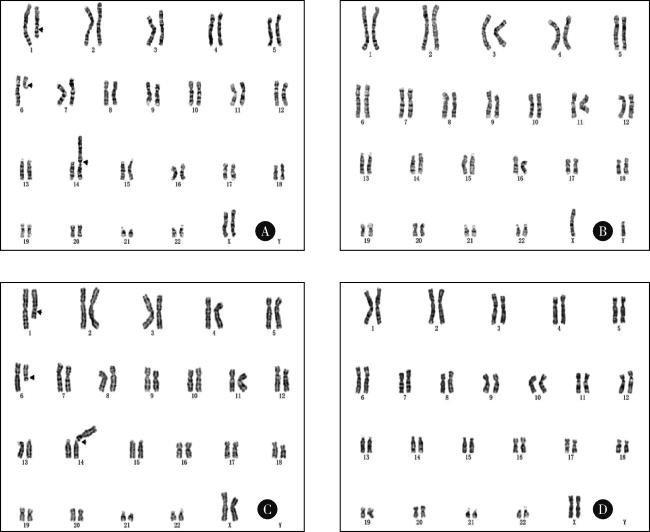
图1 患者、患者父亲、患者母亲及患者妹妹的染色体核型

Figure 1 Chromosomal karyotypes of the patient, the patient's father, the patient's mother, and the patient's younger sister

A, the patient; B, the patient's father; C, the patient's mother; D, the patient's younger sister.

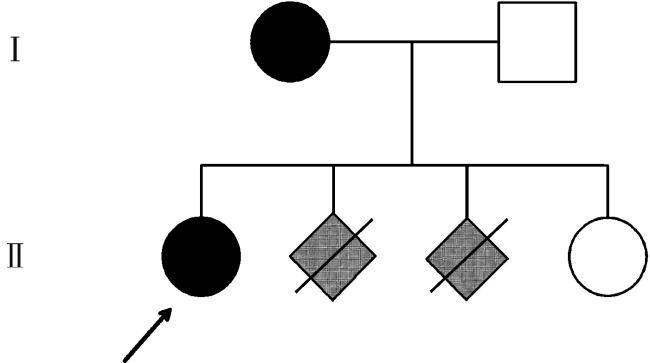
以患者为先证者、其母亲为起点深入调查家族相关人员,制作家族遗传图谱,其母亲一共怀孕4次,生育两女,还有一子不明原因流产,一子由于家庭主观原因实施人工流产,如图 2
图2 先证者家族遗传图谱

Figure 2 Familial genetic map of proband

The arrow indicates the proband.

2 分析与讨论

染色体复杂易位在配子形成过程中易产生不平衡配子,导致自然流产、死胎或畸形儿等不良妊娠结局[1]。1973年,Hayata等[2]首次报道了一种与费城染色体(Philadelphia chromosome)相关的新易位现象,为后续复杂易位的研究奠定了基础,陆续有更多三向易位病例被报道,例如t(5;9;22)、t(6;9;22)、t(13;14;22)等[3-5],这些病例多与血液系统疾病(如慢性粒细胞白血病)或生育异常相关。近年来,国内也有多例三向易位的报道,如t(2;4;13)、t(2;3;4)、t(5;13;6)等[6-8],这些也与胎停流产等相关。
此次发现的复杂t(1;6;14)三向易位,与以往报道的三向易位相比,在涉及的染色体种类及易位断点上存在明显差异,具有以下特点:首先,该易位涉及1号、6号和14号染色体,其中1号染色体是人类最大的染色体,包含约2.49亿个DNA碱基对,约占细胞总DNA含量的8%,携带约2 000多个基因;6号染色体包含约1.71亿个DNA碱基对,占细胞总DNA的5.5%~6.0%,可能包含1 000至1 100个基因;14号染色体跨越了超过1.07亿个DNA碱基对,约占细胞中总DNA的3.5%,可能包含800至900个基因,这些基因提供制造蛋白质的指令,这些蛋白质在体内发挥着多种不同的作用(https://medlineplus.gov/genetics/chromosome)。1号和6号、6号和14号、1号和14号染色体的易位可能导致基因表达异常,进而影响生育能力[9-11]。本病例中患者表型正常,有不孕史,为1, 6, 14三条染色体易位,一般情况下如果孕育胎儿会出现der(1)、der(6)、der(14)不平衡的染色体,导致胚胎发育异常,引起自然流产或出生缺陷,而其母亲虽有两次流产史,但仍成功生育两名健康后代,提示t(1;6;14)可能具有较低的胚胎致死性,这与部分三向易位[如t(2;5;13)] 的高流产率形成对比[12]。患者染色体核型与其母亲相同,但却8年未孕,可能与其患有PCOS有关,PCOS会导致排卵障碍和激素环境异常,从而影响受孕,但也不能排除其他未知因素的影响。t(1;6;14)的发现不仅丰富了人类染色体异常数据库,也为类似病例的遗传咨询和生育指导提供了新的参考。
复杂易位虽然增加了子代患病的风险,但也是能孕育正常后代的,生育表型正常胎儿的概率通常也高于理论值,所以目前针对复杂易位携带者,根据患者的实际情况,结合患者年龄、孕产史、身体状况及夫妇双方的意见,对于经济能力有限的携带者,通过自然受孕的方式来获取后代也是可行的,同时在遗传咨询中应充分告知风险并提醒其按时进行产前诊断检测。为了减少反复流产给患者及其家人带来的身体和精神上的伤害,同时避免染色体异常新生儿出生,本研究认为患者在怀孕后,应该及时进行全面的产前诊断,或采取辅助生殖技术,通过胚胎植入前遗传学检测选择染色体正常的胚胎进行宫内移植,以降低染色体复杂易位携带者的生育风险,减轻双方心理压力及对女性的身体损伤,使其得到出生缺陷的一级预防。但应注意辅助生殖技术费用昂贵且周期长,尚不能完全排除胚胎活检等方法对子代的远期不良影响,可以在孕中期行羊水穿刺术,对胎儿进行产前染色体核型分析和基因测序,进而避免有严重出生缺陷患儿的出生,做到及早进行干预。不论采用哪种方式,一定要进行充分的临床遗传咨询及沟通,让患者充分了解不同生育方式的优缺点,以及需要承担的风险,同时明确产前诊断的重要性,做到知情选择,避免出生缺陷的发生[13-18]
未来可以在功能基因组学、动物模型及表观遗传调控等方面进行研究。在功能基因组学方面,进一步研究t(1;6;14)易位断点附近的基因功能,探讨其与不孕症和胚胎发育异常的关系;动物模型方面,建立t(1;6;14)易位的动物模型,模拟其在不孕症和胚胎发育中的作用,为临床治疗提供理论依据;表观遗传调控方面,研究复杂易位对基因表达的表观遗传调控影响,尤其是组蛋白修饰和DNA甲基化在胚胎发育中的作用。除此以外,本研究未进行荧光原位杂交或者染色体微阵列分析验证,未来可进行分子水平确认,以排除隐匿性失衡,继续跟踪此家系的后续情况,研究其遗传规律。
综上,本研究报道了1例46, XX, t(1;6;14)染色体复杂易位,该核型为母源性遗传,研究结果提示,t(1;6;14)携带者仍有机会生育正常后代,但需通过遗传咨询和产前诊断降低生育风险,本研究为类似病例的临床管理提供了重要参考。

利益冲突  所有作者均声明不存在利益冲突。

作者贡献声明  翟英南、李鸿儒:提出研究思路,撰写论文;吕金芝、于双:收集、分析、整理数据;王丽:总体把关和审定论文。所有作者均参与论文修改,并对最终文稿进行审读和确认。

1
陈爽, 王轩, 李德军, 等. 复杂易位t (2;4;10) 女性携带者孕del (7)(q35q36) 胎儿一例[J]. 中华医学遗传学杂志, 2020, 37 (7): 802.

2
Hayata I , Kakati S , Sandberg AA . Letter: A new translocation related to the Philadelphia chromosome[J]. Lancet, 1973, 2 (7842): 1385.

3
Nowell PC , Jensen J , Gardner F . Two complex translocations in chronic granulocytic leukemia involving chromosomes 22, 9, and a third chromosome[J]. Humangenetik, 1975, 30 (1): 13- 21.

DOI

4
González GJ , Notohamiprodjo M . Translocation (6;9;22)(p25;q34;q11.2) identified by FISH in acute leukemia[J]. Cancer Genet Cytogenet, 1996, 92 (1): 82- 84.

DOI

5
Lespinasse J , North MO , Paravy C , et al. A balanced complex chromosomal rearrangement (BCCR) in a family with reproductive failure[J]. Hum Reprod, 2003, 18 (10): 2058- 2066.

DOI

6
陈英剑, 孙晓明, 张玮玮. 46, XX, t (2;4;13) 复杂易位伴自然流产一例[J]. 中华医学遗传学杂志, 2012, 29 (5): 616.

7
鲁宁, 王艳华, 孔祥东. 染色体复杂平衡易位1例[J]. 中华医学遗传学杂志, 2024, 41 (8): 1022.

8
鞠彩宁, 蓝信强. 46, XX, t(5;13;6)复杂易位伴反复流产1例[J]. 中华医学遗传学杂志, 2024, 41 (6): 748.

9
马金元. 罕见的染色体t(1;6)(p36;q21)易位伴家族性矮小一例[J]. 中国优生与遗传杂志, 2016, 24 (7): 48.

10
张梦汀, 肖海, 吴东, 等. 母源性平衡易位t(6;14)所致胎儿不平衡易位1例的分析[J]. 中华医学遗传学杂志, 2023, 40 (2): 230- 233.

11
田海晔, 宋明强, 刘晓丹, 等. 46, XY, t(1;14)(p36;q22)伴自然流产一例[J]. 中华医学遗传学杂志, 2004, 21 (2): 186.

12
Lazarczyk E , Drozniewska M , Pasinska M , et al. Complex balanced chromosomal translocation t(2;5;13) (p21;p15;q22) in a woman with four reproductive failures[J]. Mol Cytogenet, 2014, 7 (1): 83.

DOI

13
邢根宝, 陈佳, 田莉峰. 46, XY, t(1;18;9)(p34.1;q12.2;q32)复杂性染色体重排携带者的胚胎植入前遗传学检测[J]. 中华生殖与避孕杂志, 2024, 44 (4): 409- 412.

14
赵理平, 罗华玉, 罗桂香, 等. NIPT、CMA、高分辨染色体核型分析技术在珠海市产前诊断中的联合应用[J]. 国际遗传学杂志, 2022, 45 (1): 7- 13.

15
李偲, 肖梓逸, 勾晨雨, 等. 胚胎植入前遗传学检测后孕妇的侵入性产前诊断非靶向变异分析[J]. 中华医学遗传学杂志, 2024, 41 (11): 1283- 1289.

16
屈素真, 时盼来, 张田园, 等. CNV-seq与染色体核型分析在平衡易位携带者产前诊断中的应用[J]. 中华医学遗传学杂志, 2022, 39 (4): 366- 369.

17
朱若男, 吴庆华, 赵军红, 等. 无创DNA产前检测技术筛查唐氏综合征阳性结果的验证与分析[J]. 国际遗传学杂志, 2021, 44 (1): 1- 5.

18
黄如纯, 皮回春, 高玉山, 等. 染色体核型分析与单核苷酸多态性微阵列检测在高危孕妇产前诊断的应用[J]. 中华医学遗传学杂志, 2021, 38 (4): 397- 400.

Outlines

/