Journal of Peking University (Health Sciences) ›› 2026, Vol. 58 ›› Issue (1): 37-42. doi: 10.19723/j.issn.1671-167X.2026.01.005

Previous Articles     Next Articles

Treatment of peri-implant mucositis using an erythritol air-polishing or ultrasonic device: A randomized controlled trial

Fei SUN1,2, Cui WANG2, Siqi LI2, Yiping WEI2, Riyue YU1,*(), Wenjie HU2,*()   

  1. 1. Department of Stomatology, Beijing Shijitan Hospital, Capital Medical University, Beijing 100089, China
    2. Department of Periodontology, Peking University School and Hospital of Stomatology & National Center for Stomatology & National Clinical Research Center for Oral Diseases & National Engineering Research Center of Oral Biomaterials and Digital Medical Devices, Beijing 100081, China
  • Received:2025-10-10 Online:2026-02-18 Published:2025-12-10
  • Contact: Riyue YU, Wenjie HU

RICH HTML


Abstract:

Objective: To evaluate the short-term clinical treatment effects of erythritol air-polishing(EAP) and ultrasonic debridement (US) on peri-implant mucositis and to report patient-reported outcomes. Methods: This study is a single-blind, randomized controlled clinical trial. It enrolled patients diagnosed with peri-implant mucositis at the Department of Periodontology, Peking University School of Stomatology between June 2021 and May 2022. A total of 36 patients (with one implant included per patient) were randomly allocated to either the EAP group (n=18) or the US group (n=18). Clinical parameters were collected at baseline, 1 month, and 3 months. The primary outcome was the change in peri-implant probing depth (PPD). Secondary outcomes included the modified plaque index (mPLI), bleeding on probing (BOP), suppuration on probing (SoP), and the visual analogue scale (VAS) score for pain. As an exploratory analysis, the proportion of sites with PPD ≥ 4 mm was calculated. Oral hygiene instructions were reinforced, and the implant crown was polished at each visit. Results: Baseline clinical parameters were comparable between the EAP and US groups. Regarding the primary outcome of mean PPD, the EAP group showed a significant reduction from the baseline value (4.0±0.5) mm to (3.7±0.6) mm at 1 month and (3.4±0.5) mm at 3 months (P=0.011 and P < 0.001, respectively). Similarly, the US group showed a significant reduction from baseline (3.8±0.4) mm to (3.6±0.5) mm at 1 month and (3.5±0.4) mm at 3 months (P=0.038 and P=0.018, respectively). No statistically significant differences were observed between the groups (P>0.05). For the secondary outcomes, both groups showed significant improvement from baseline in mean mPLI (1 and 3 months, both P < 0.001) and BOP (1 month, P < 0.05; 3 months, P < 0.001). Pain VAS scores were low in both groups. However, no statistically significant differences were observed between the groups for these three outcomes (all P>0.05). At 3 months, the proportion of sites with PPD ≥ 4 mm was significantly lower in EAP group than in US group [(42.6±26.1) % vs. (57.4±25.1) %, P=0.029]. No adverse events were reported. Conclusion: Both EAP and US effectively treated peri-implant mucositis with comparable overall efficacy. However, EAP showed superior potential in reducing deep pockets over the short term, though this finding required further validation.

Key words: Peri-implant mucositis, Erythritol, Dental polishing

CLC Number: 

  • R781.4

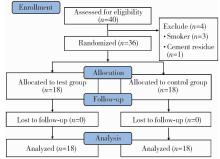
Figure 1

Research flow chart"

Table 1

Baseline patient characteristics"

Variable EAP (n= 18) US (n= 18) P value
Age/years, ${\bar x}$±s 51.0±10.5 50.1±9.9 0.785
Male/female, n 10 / 8 6 / 12 0.176
History of periodontitis/% 66.7 83.3 0.738
Implant position, n (%) 0.345
  Anterior maxilla 2 (11.1) 2 (11.1)
  Posterior maxilla 8 (44.4) 6 (33.3)
  Anterior mandible 4 (22.2) 1 (5.6)
  Posterior mandible 4 (22.2) 9 (50.0)
Prosthesis retention, n (%) 0.705
  Screw-retained 12 (66.7) 13 (72.2)
  Cement-retained 6 (33.3) 5 (27.8)
Baseline clinical parameters
  Mean PPD/mm, ${\bar x}$±s 4.0±0.5 3.8±0.4 0.187
  Mean mPLI, ${\bar x}$±s 1.4±0.7 1.5±0.9 0.712
  Mean BOP/%, ${\bar x}$±s 85.2±13.9 88.0±17.9 0.601
  SoP/% 27.8 22.2 0.700

Table 2

Changes in clinical parameters over the 3-month experimental period in the two groups"

Parameters Baseline 1 month P valuea 3 months P valueb
Mean PPD/mm, ${\bar x}$±s
  EAP 4.0±0.5 3.7±0.6 0.011 3.4±0.5 <0.001
  US 3.8±0.4 3.6±0.5 0.038 3.5±0.4 0.018
  P valuec 0.284 0.654 0.250
Mean mPLI, ${\bar x}$±s
  EAP 1.4±0.7 0.6±0.7 <0.001 0.2±0.2 <0.001
  US 1.5±0.9 0.5±0.6 <0.001 0.3±0.2 <0.001
  P valuec 0.791 0.546 0.058
PPD≥4 mm sites/%, ${\bar x}$±s
  EAP 73.1±24.8 53.7±22.8 <0.001 42.6±26.1 <0.001
  US 62.0±21.4 55.6±24.5 0.009 57.4±25.1 0.039
  P valuec 0.081 0.785 0.029
BOP/%, ${\bar x}$±s
  EAP 85.2±13.9 64.8±31.8 0.016 53.7±29.5 <0.001
  US 88.0±17.9 70.4±31.1 0.012 59.2±28.7 <0.001
  P valuec 0.606 0.601 0.573
SoP/%
  EAP 27.8 0 NA 0 NA
  US 22.2 0 NA 0 NA
  P valuec 0.700 NA NA

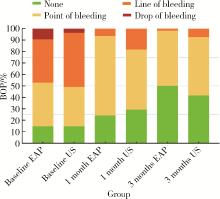
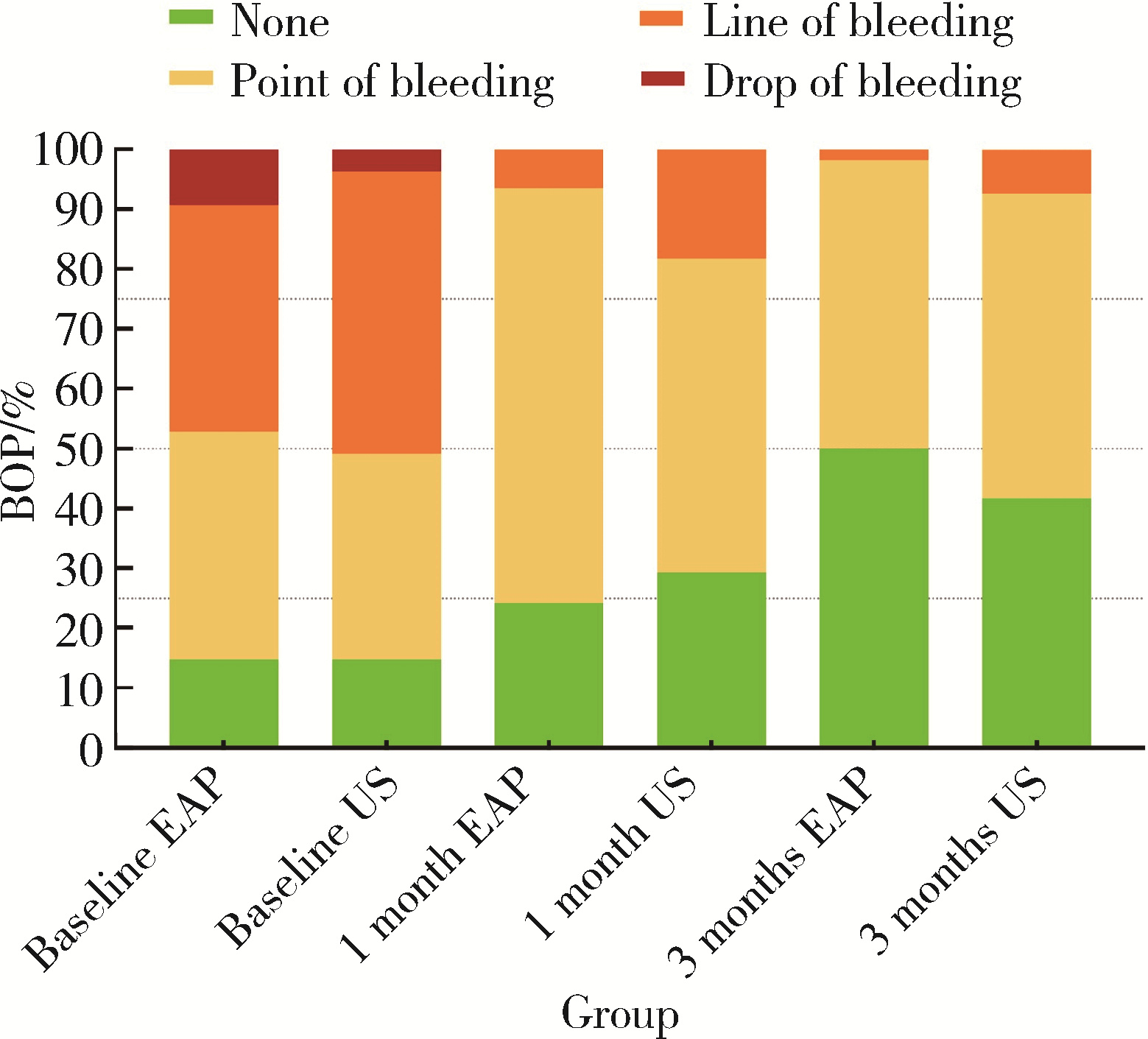
Figure 2

Distribution of graded bleeding on probing BOP, bleeding on probing; EAP, erythritol air-polishing; US, ultrasonic debridement."

1
Dos Reis INR, Huamán-Mendoza AA, Ramadan D, et al. The prevalence of peri-implant mucositis and peri-implantitis based on the world workshop criteria: A systematic review and meta-analysis[J]. J Dent, 2025, 160, 105914.

doi: 10.1016/j.jdent.2025.105914
2
Romandini M, Lima C, Pedrinaci I, et al. Prevalence and risk/protective indicators of peri-implant diseases: A university-representative cross-sectional study[J]. Clin Oral Implants Res, 2021, 32(1): 112- 122.

doi: 10.1111/clr.13684
3
Djuran B, Tatic Z, Perunovic N, et al. Underdiagnosis in background of emerging public health challenges related to peri-implant diseases: An interventional split-mouth study[J]. Int J Environ Res Public Health, 2022, 20(1): 477.

doi: 10.3390/ijerph20010477
4
Galarraga-Vinueza ME, Pagni S, Finkelman M, et al. Prevalence, incidence, systemic, behavioral, and patient-related risk factors and indicators for peri-implant diseases: An AO/AAP systematic review and meta-analysis[J]. J Periodontol, 2025, 96(6): 587- 633.

doi: 10.1002/JPER.24-0154
5
Berglundh T, Armitage G, Araujo MG, et al. Peri-implant diseases and conditions: Consensus report of workgroup 4 of the 2017 World Workshop on the Classification of Periodontal and Peri-Implant Diseases and Conditions[J]. J Clin Periodontol, 2018, 45(Suppl 20): S286- S291.
6
Salvi GE, Aglietta M, Eick S, et al. Reversibility of experimental peri-implant mucositis compared with experimental gingivitis in humans[J]. Clin Oral Implants Res, 2012, 23(2): 182- 190.

doi: 10.1111/j.1600-0501.2011.02220.x
7
Meyer S, Giannopoulou C, Courvoisier D, et al. Experimental mucositis and experimental gingivitis in persons aged 70 or over. Clinical and biological responses[J]. Clin Oral Implants Res, 2017, 28(8): 1005- 1012.

doi: 10.1111/clr.12912
8
Menini M, Delucchi F, Bagnasco F, et al. Efficacy of air-polishing devices without removal of implant-supported full-arch prostheses[J]. Int J Oral Implantol, 2021, 14(4): 401- 416.
9
Tan SL, Grewal GK, Mohamed Nazari NS, et al. Efficacy of air polishing in comparison with hand instruments and/or power-driven instruments in supportive periodontal therapy and implant maintenance: A systematic review and meta-analysis[J]. BMC Oral Health, 2022, 22(1): 85.

doi: 10.1186/s12903-022-02120-6
10
Bengtsson VW, Aoki A, Mizutani K, et al. Treatment of peri-implant mucositis using an Er: YAG laser or an ultrasonic device: A randomized, controlled clinical trial[J]. Int J Implant Dent, 2025, 11(1): 6.

doi: 10.1186/s40729-025-00591-0
11
Herrera D, Berglundh T, Schwarz F, et al. Prevention and treatment of peri-implant diseases: The EFP S3 level clinical practice guideline[J]. J Clin Periodontol, 2023, 50(Suppl 26): 4- 76.
12
Lupi SM, Granati M, Butera A, et al. Air-abrasive debridement with glycine powder versus manual debridement and chlorhexidine administration for the maintenance of peri-implant health status: A six-month randomized clinical trial[J]. Int J Dent Hyg, 2017, 15(4): 287- 294.

doi: 10.1111/idh.12206
13
Mensi M, Cochis A, Sordillo A, et al. Biofilm removal and bacterial re-colonization inhibition of a novel erythritol/chlorhexidine air-polishing powder on titanium disks[J]. Materials, 2018, 11(9): 1510.

doi: 10.3390/ma11091510
14
Verket A, Koldsland OC, Bunaes D, et al. Non-surgical therapy of peri-implant mucositis-mechanical/physical approaches: A systematic review[J]. J Clin Periodontol, 2023, 50(Suppl 26): S135- S145.
15
Riben-Grundstrom C, Norderyd O, André U, et al. Treatment of peri-implant mucositis using a glycine powder air-polishing or ultrasonic device: A randomized clinical trial[J]. J Clin Perio-dontol, 2015, 42(5): 462- 469.

doi: 10.1111/jcpe.12395
16
靖无迪, 王宪娥, 谢也斯, 等. 甘氨酸龈下喷砂治疗早期种植体周围病的疗效观察[J]. 中华口腔医学杂志, 2017, 52(8): 480- 485.
17
Nicola D, Isabella DR, Carolina C, et al. Treatment of peri-implant mucositis: Adjunctive effect of glycine powder air polishing to professional mechanical biofilm removal. 12 months randomized clinical study[J]. Clin Implant Dent Relat Res, 2024, 26(2): 415- 426.

doi: 10.1111/cid.13304
18
Corbella S, Radaelli K, Alberti A, et al. Erythritol powder airflow for the treatment of peri-implant mucositis: A randomized controlled clinical trial[J]. Int J Dent Hyg, 2024, 22(4): 982- 990.

doi: 10.1111/idh.12814
19
Ulvik IM, Sæthre T, Bunæs DF, et al. A 12-month randomized controlled trial evaluating erythritol air-polishing versus curette/ultrasonic debridement of mandibular furcations in supportive periodontal therapy[J]. BMC Oral Health, 2021, 21(1): 38.

doi: 10.1186/s12903-021-01397-3
[1] Fei SUN,Si-qi LI,Yi-ping WEI,Jin-sheng ZHONG,Cui WANG,Wen-jie HU. Efficacy of combined application of glycine powder air-polishing in non-surgical treatment of peri-implant diseases [J]. Journal of Peking University (Health Sciences), 2022, 54(1): 119-125.
Viewed
Full text


Abstract

Cited

  Shared   
  Discussed   
No Suggested Reading articles found!