Journal of Peking University (Health Sciences) ›› 2026, Vol. 58 ›› Issue (1): 99-106. doi: 10.19723/j.issn.1671-167X.2026.01.013

Previous Articles     Next Articles

Digital measurement and analysis of anatomical characteristics of protrusive and intercuspal position occlusal contacts in maxillary incisors

Liang SHAO, Wenjie MA, Ying CHEN, Qian DING*(), Lei ZHANG*()   

  1. Department of Prosthodontics, Peking University School and Hospital of Stomatology & National Center for Stomatology & National Clinical Research Center for Oral Diseases & National Engineering Research Center of Oral Biomaterials and Digital Medical Devices & Beijing Key Laboratory of Digital Stomatology, Beijing 100081, China
  • Received:2025-10-10 Online:2026-01-06 Published:2026-01-06
  • Contact: Qian DING, Lei ZHANG
  • Supported by:
    the Clinical Research Foundation of Peking University School and Hospital of Stomatology(PKUSS-2023CRF503); the Program for New Clinical Techniques and Therapies of Peking University School and Hospital of Stomatology(PKUSSNCT-25A09); Beijing Natural Science Foundation-Haidian Original Innovation Joint Fund Project(L232025)

RICH HTML


Abstract:

Objective: To digitally measure and analyze the anatomical characteristics of protrusive and intercuspal position (ICP) occlusal contacts in maxillary incisors, thereby establishing a standardized measurement protocol and obtaining characteristic functional data to optimize the incisal guidance design of prostheses. Methods: Thirty subjects with stable incisal guidance were recruited. Digital dental mo-dels were acquired via intraoral scanning, and protrusive movement data were captured using a modified patient-specific motion (PSM) technique. Computer-aided design software was used to record the distribution of the occlusal contacts during protrusive movement. Image analysis software was employed to measure the area proportion of guiding locations for each tooth. Reverse engineering software was used to measure and analyze the occlusal contacts in ICP and anatomical characteristics. Measured parameters included the area proportion and distribution of occlusal contacts in ICP, the area proportion of marginal ridges and incisal ridges, radius of curvature of lingual surface, lingual surface inclination, overbite, and overjet. Each parameter was measured twice to calculate the intraclass correlation coefficient for the assessment of test-retest reliability. Results: All measured parameters demonstrated good test-retest reliability. No significant differences were found in any parameters between homologous teeth (P>0.05). During protrusive movement, the area proportion of guiding locations was significantly larger for the central incisors than for the lateral incisors (73.4%±12.3% vs. 26.6%±12.3%, P < 0.001). The frequency of occlusal contacts was significantly higher on the mesial and distal marginal ridges and incisal ridges compared with the lingual fossa and cingulum (P < 0.05). In ICP, no significant difference was observed in the occlusal contact area proportion between the central and lateral incisors (48.8%±20.0% vs. 51.2%±20.0%, P=0.758). The frequency of the occlusal contact was significantly higher on the mesial and distal marginal ridges compared with the incisal ridge, lingual fossa, and cingulum (P < 0.05). Central incisors exhibited significantly higher overbite and overjet than lateral incisors (P < 0.05). The area proportion of mesial and distal marginal ridges was significantly smaller for the central incisors than for the lateral incisors (P < 0.05), but no significant difference was observed in the incisal ridge (P>0.05). No significant differences were observed in the lingual surface inclination or radius of curvature among the incisors (P>0.05). Conclusion: The anatomical characteristics of protrusive and ICP occlusal contacts in maxillary incisors demonstrated bilateral symmetry. Protrusive movement was primarily guided by the maxillary central incisors, with the guiding area of the central incisors being approximately three times that of the lateral incisors. The marginal ridges and incisal ridges were the main guiding locations. Central and lateral incisors exhibited comparable occlusal contact area in ICP.

Key words: Odontometry, Incisor, Dental occlusion, Imaging, three-dimensional

CLC Number: 

  • R783

Figure 1

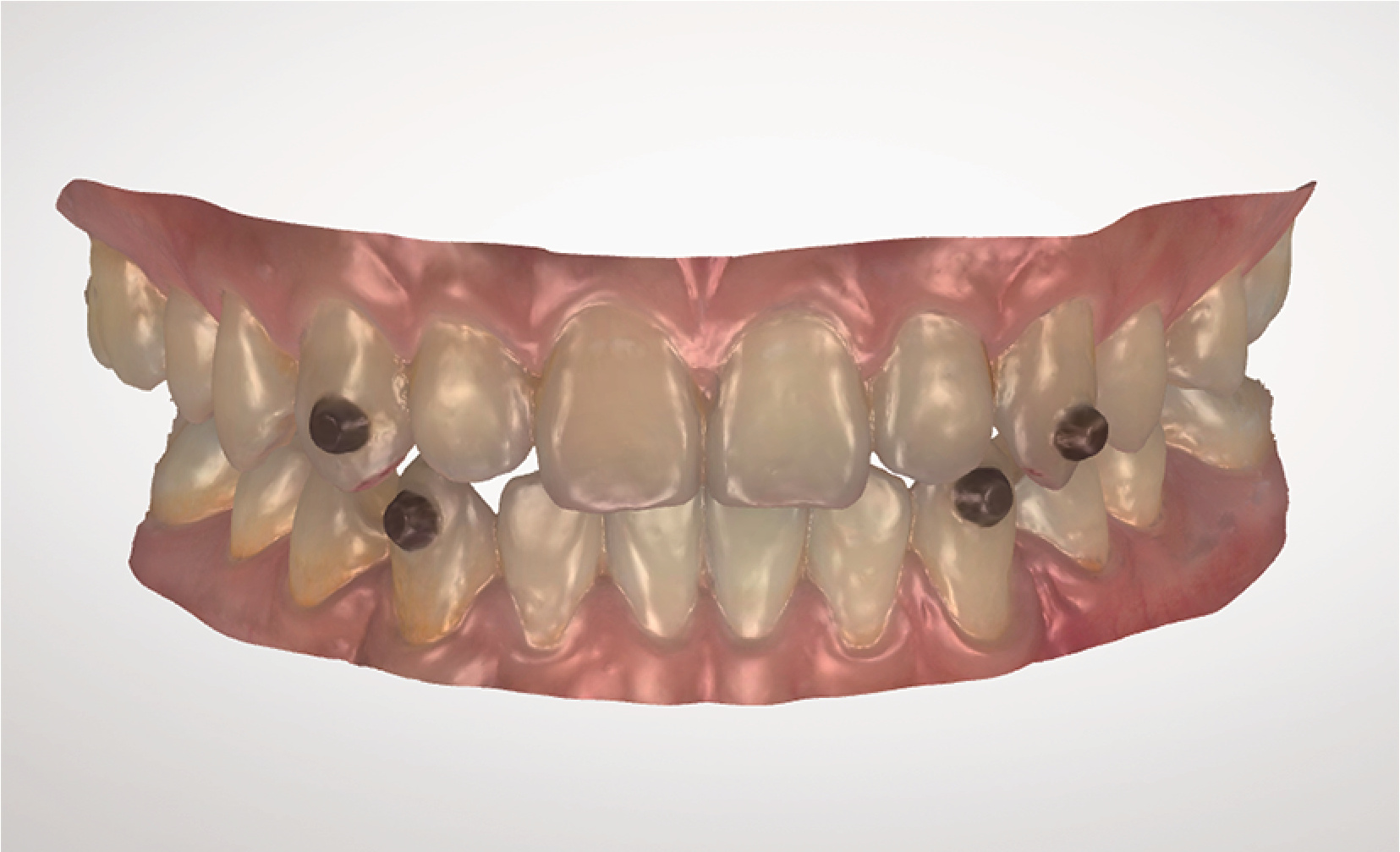
Adhesive bonding of artificial landmarks"

Figure 2

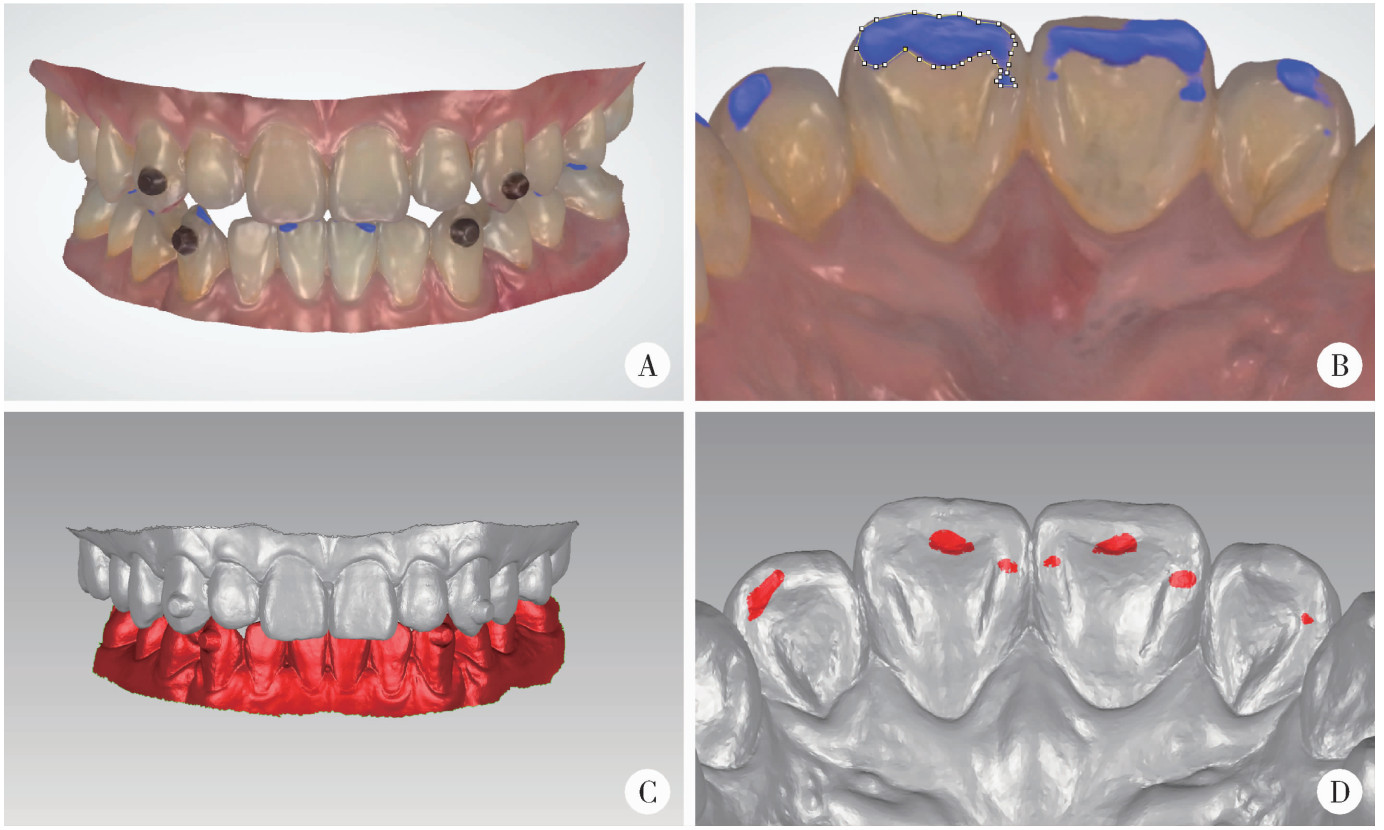
Measurement of the occlusal contacts in protrusive movement and intercuspal position A: Reproduce the mandibular protrusive movement by the patient-specific motion (PSM) function within the computer-aided design software (3Shape Dental System). B: Measure the area of the guiding locations (blue) during protrusive movement within the image analysis software (ImageJ Version 1.53q). C: Thicken the mandibular model occlusally by 200 μm by the Shell function within the reverse engineering software (Geomagic Wrap 2021); Obtain the intersection areas between the maxillary incisors and the mandibular dentition by the Boolean operation function, which was defined as the occlusal contact areas in intercuspal position (ICP). D: Measure the area of the occlusal contact areas (red) in ICP."

Figure 3

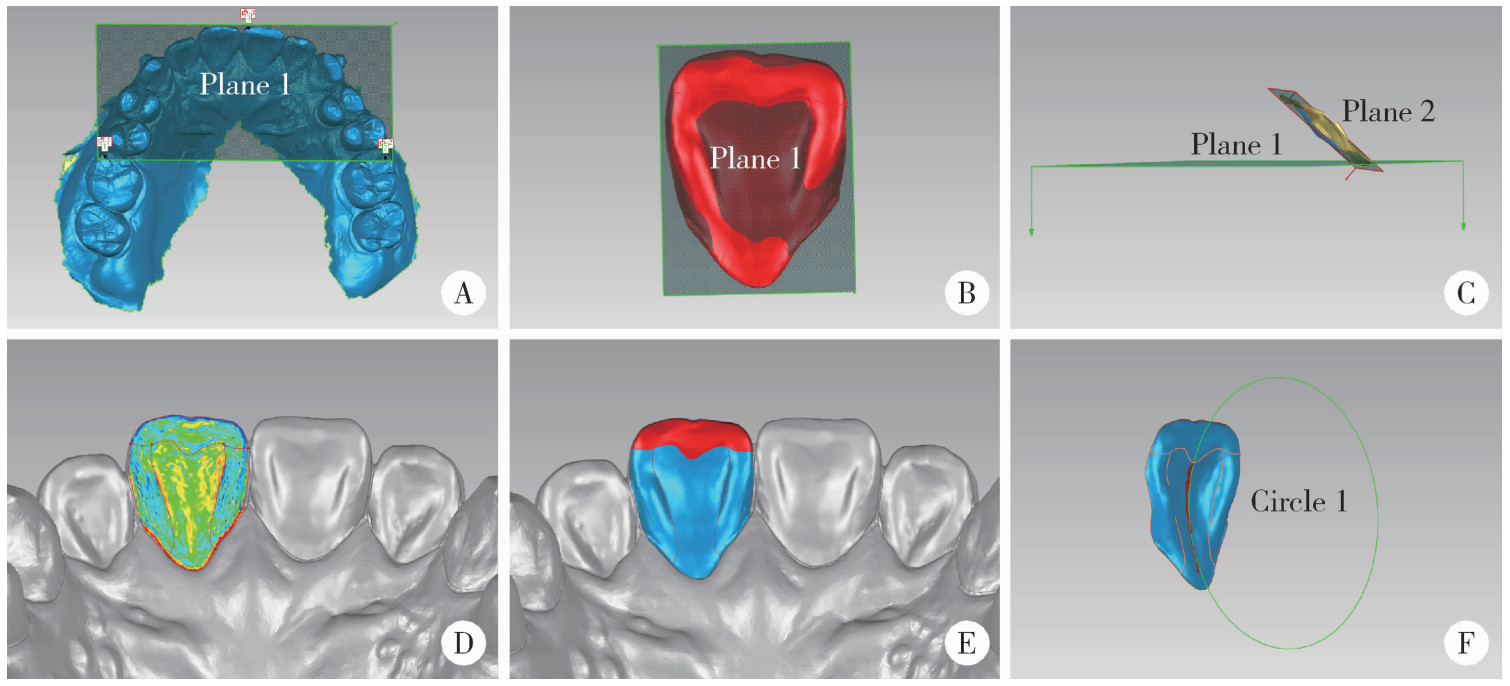
Measurement of lingual surface characteristics related to incisal guidance A: Generate the occlusal plane (plane 1) within Geomagic wrap 2021. B: Use the maxillary right central incisor as an example; Select the lingual surface and generate Plane 2 by the Best-Fit function. C: calculate the angle between Plane 2 and Plane 1, defined as the lingual surface inclination. D: Plot the curve based on the Curvature Map. E: Convert the curve into the boundary and calculate the areas of the marginal ridges and the incisal ridge. F: Select the central portion of the lingual surface, generate Circle 1 by the Best-Fit function, and calculate its radius."

Figure 4

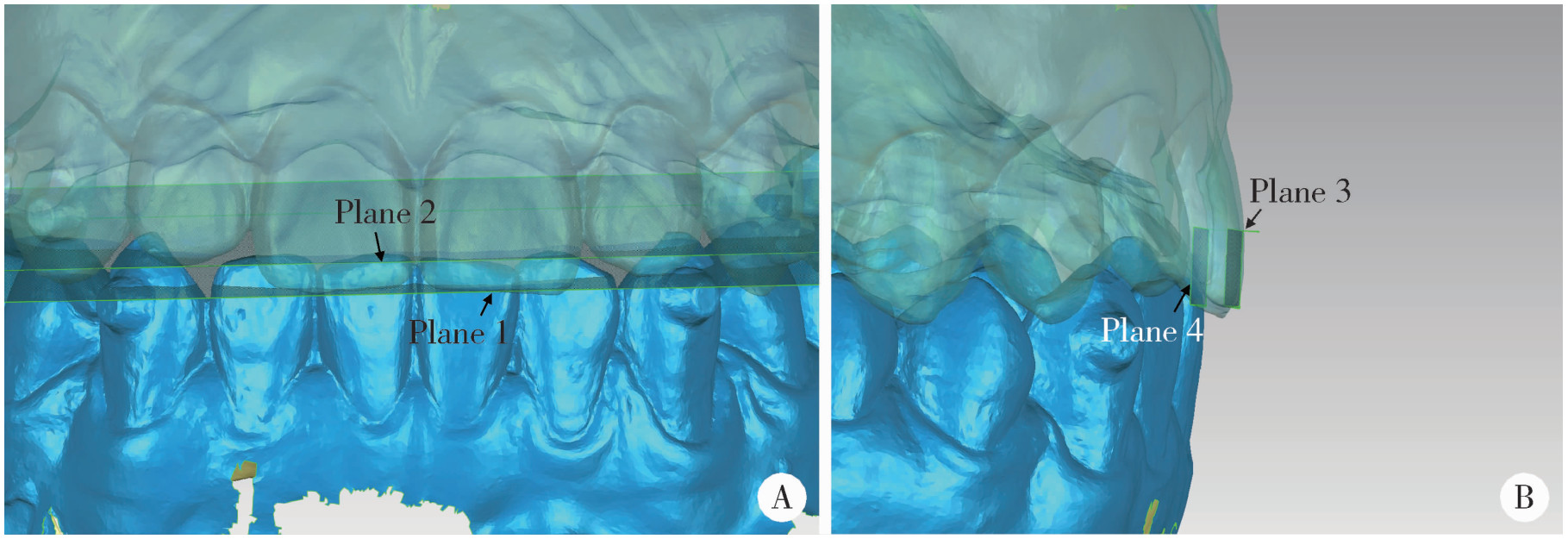
Measurement of overbite and overjet A: Use the maxillary right central incisor as an example within Geomagic Wrap 2021; Move the occlusal plane until it is tangent to the incisal edge, generating Plane 1; Move Plane 1 until it is tangent to the incisal edge of the corresponding mandibular incisor, generating Plane 2; Calculate the distance between Plane 1 and Plane 2, defined as the overbite. B: Select the incisal third region of the labial surface and generate Plane 3 by the Best-Fit function, which is tangent to the labial surface; Translate Plane 3 parallel until it is tangent to the labial surface of the corresponding mandibular incisor, generating Plane 4; Calculate the distance between Plane 3 and Plane 4, defined as the overjet."

Table 1

Occlusal contact area proportion (%) of maxillary incisors in protrusive movement and intercuspal position"

Items Central incisor Lateral incisor
Left Right t P Left Right t P
Protrusive movement (n=30) 39.3±10.1 34.1±11.2 -1.632 0.113 15.0±7.5 11.7±8.0 -1.953 0.061
Intercuspal position (n=28) 26.2±14.8 22.6±14.5 -0.896 0.378 29.2±15.2 22.0±15.2 -1.332 0.194

Table 2

Frequency distribution (%) of occlusal contacts across the anatomical structures of the lingual surface (n=30)"

Items Central incisor Lateral incisor
Left Right Left Right
Protrusive movement
  Mesial marginal ridge 86.2 79.3 86.2 79.3
  Distal marginal ridge 75.9 62.1 69.0 44.8
  Incisal ridge 93.1 89.7 86.2 69.0
  Lingual fossa 24.1 24.1 3.5 6.9
  Lingual cingulum 0 3.5 0 0
  No occlusal contact 0 0 3.5 3.5
Intercuspal position
  Mesial marginal ridge 80.0 76.7 73.3 76.7
  Distal marginal ridge 70.0 56.7 53.3 40
  Incisal ridge 13.3 10.0 30.0 26.7
  Lingual fossa 20.0 20.0 13.3 3.3
  Lingual cingulum 3.3 0 0 0
  No occlusal contact 10.0 13.3 13.3 16.7

Table 3

Anatomical features of maxillary incisors related to incisal guidance (n=30)"

Items Central incisor Lateral incisor F P
Left Right Left Right
Area proportion/%
  Mesial marginal ridge 20.2±3.0 20.2±2.8 25.3±4.3 25.9±4.4 28.263 < 0.001
  Distal marginal ridge 21.5±2.8 20.6±2.7 24.3±4.3 22.9±3.8 9.990 < 0.001
  Incisal ridge 20.6±3.1 21.5±3.2 21.8±3.8 21.8±2.5 1.390 0.252
Lingual surface inclination/(°) 41.87±5.87 41.36±5.87 41.23±6.92 41.76±7.62 0.214 0.886
Radius of curvature of lingual surface/mm 6.97±2.28 7.34±2.70 6.16±2.04 6.40±1.49 2.135 0.102
Overbite/mm 3.05±0.92 3.18±0.84 2.63±0.78 2.60±0.85 10.378 < 0.001
Overjet/mm 3.12±1.06 3.33±1.12 2.66±1.04 2.90±0.91 9.671 < 0.001
1
The glossary of prosthodontic terms 2023: Tenth edition[J]. J Prosthet Dent, 2023, 130(4 Suppl 1): e7-e126.
2
谢秋菲. 临床牙合学——成功修复指导[M]. 北京: 科学出版社, 2012.
3
王美青. 牙合学[M]. 4版 北京: 人民卫生出版社, 2020.
4
Feng Y , Sun X , Li J , et al. Is dynamic occlusal design necessary for anterior guidance recovery in the computer-aided design process? An in vitro study[J]. J Dent, 2024, 142, 104833.

doi: 10.1016/j.jdent.2024.104833
5
Lepidi L , Grande F , Kim BC , et al. Dynamic modelling of the anterior guidance slope using a jaw tracking system in a fully digi-tal CAD-CAM workflow[J]. J Prosthet Dent, 2025, S0022-S3913 (25): 00373- 7.
6
Bauer W , van den Hoven F , Diedrich P . Wear in the upper and lower incisors in relation to incisal and condylar guidance[J]. J Orofac Orthop, 1997, 58 (6): 306- 319.

doi: 10.1007/BF02682671
7
Kulmer S , Ruzicka B , Niederwanger A , et al. Incline and length of guiding elements in untreated naturally grown dentition[J]. J Oral Rehabil, 1999, 26 (8): 650- 660.

doi: 10.1046/j.1365-2842.1999.00430.x
8
Lulla SS , Adaki R , Samant A , et al. Evaluation of influence of incisal guidance on the force exerted at the maximum possible intercuspal position and in protrusion: An in vivo study[J]. J Pharm Bioallied Sci, 2023, 15 (Suppl 2): S931- S933.

doi: 10.4103/jpbs.jpbs_284_23
9
Çakmak G , Cho JH , Choi J , et al. Can deep learning-designed anterior tooth-borne crown fulfill morphologic, aesthetic, and functional criteria in clinical practice?[J]. J Dent, 2024, 150, 105368.

doi: 10.1016/j.jdent.2024.105368
10
Tiwari S , Santosh A , Ramegowda S , et al. An analysis of the palatal surface anatomy of maxillary central incisors: Complexity behind the simplicity[J]. Int J Esthet Dent, 2021, 16 (4): 570- 578.
11
Botzenhart UU , Henningsen A , Quaas S , et al. 3D assisted morphological analysis of lingual upper central and lateral incisor surfaces[J]. Biomed Tech (Berl), 2012, 57 (1): 71- 77.

doi: 10.1515/bmt-2011-0057
12
Donegan SJ , Knap FJ . A study of anterior guidance[J]. J Pros-thodont, 1995, 4 (4): 226- 232.
13
Knösel M , Jung K , Gripp-Rudolph L , et al. Changes in incisor third-order inclination resulting from vertical variation in lingual bracket placement[J]. Angle Orthod, 2009, 79 (4): 747- 754.

doi: 10.2319/072308-385.1
14
Hasegawa Y , Ezura A , Nomintsetseg B . The relationship between the incisor position and lingual surface morphology in normal occlusion[J]. Odontology, 2017, 105 (1): 84- 90.

doi: 10.1007/s10266-016-0240-y
15
Chughtai AM , Jeelani W , Ahmed M , et al. Correlation between faciolingual inclination of maxillary central incisors and molars with maxillary and mandibular morphology[J]. J Ayub Med Coll Abbottabad, 2024, 36 (1): 29- 34.

doi: 10.55519/JAMC-01-12439
16
张瑞, 薛绯, 张勇, 等. 口腔扫描数字化测量法在评估膜龈手术疗效中的可靠性及有效性研究[J]. 实用口腔医学杂志, 2021, 37 (3): 357- 361.
17
金春晓, 娄梦伟, 蔡新杰, 等. 美学区牙齿二维口内照片与三维数字模型的测量对比研究[J]. 中华口腔医学杂志, 2024, 59 (6): 565- 570.
18
Nishine M , Kobayashi H , Ito K , et al. Comparison between interocclusal registration using silicone bite registration material and intraoral scanner on clenching strength[J]. Int J Prosthodont, 2024, 37 (4): 457- 459.

doi: 10.11607/ijp.8445
19
Rovira-Lastra B , Khoury-Ribas L , Flores-Orozco EI , et al. Accuracy of digital and conventional systems in locating occlusal contacts: A clinical study[J]. J Prosthet Dent, 2024, 132 (1): 115- 122.

doi: 10.1016/j.prosdent.2023.06.036
20
Lee YC , Lee C , Shim JS , et al. Comparison between occlusal errors of single posterior crowns adjusted using patient specific motion or conventional methods[J]. Appl Sci (Basel), 2020, 10, 9140.

doi: 10.3390/app10249140
21
Jirajariyavej B , Ounvorawong P , Pornprasertsuk-Damrongsri S , et al. Accuracy of individual mandibular motion records using intra-oral scanner for fixed implant- supported prosthesis designs: A comparative study[J]. BMC Oral Health, 2025, 25 (1): 878.

doi: 10.1186/s12903-025-06282-x
22
Li L , Chen H , Li W , et al. Design of wear facets of mandibular first molar crowns by using patient-specific motion with an intraoral scanner: A clinical study[J]. J Prosthet Dent, 2023, 129 (5): 710- 717.

doi: 10.1016/j.prosdent.2021.06.048
23
Wang H , Shao L , Sun J , et al. A fully digital workflow to design anterior guidance for an implant-supported single crown using a modified patient-specific motion technique[J]. J Prosthet Dent, 2025, 134 (4): 947- 951.

doi: 10.1016/j.prosdent.2024.01.036
24
李穗, 马雯洁, 王时敏, 等. 上前牙种植单冠修复体切导的数字化设计正确度[J]. 北京大学学报(医学版), 2024, 56 (1): 81- 87.

doi: 10.19723/j.issn.1671-167X.2024.01.013
25
Tu Y , Zhao X , Zhao G , et al. Assessment of physiological posterior-tooth displacement under habitual occlusal force by intraoral scanning using implant-supported crowns as the reference[J]. J Prosthet Dent, 2025, 133 (5): 1260- 1267.

doi: 10.1016/j.prosdent.2023.06.019
26
Zhao Z , Wang Q , Li J , et al. Occlusal contact characteristics of molar teeth with food impaction: Insights from a new digital technique[J]. J Dent, 2024, 147, 105133.

doi: 10.1016/j.jdent.2024.105133
27
谢秋菲, 张磊. 牙体解剖与口腔生理学[M]. 3版 北京: 北京大学医学出版社, 2021.
28
Lee W , Lim YJ , Kim MJ , et al. Occlusal consequence of using average condylar guidance settings: An in vitro study[J]. J Prosthet Dent, 2017, 117 (4): 532- 538.

doi: 10.1016/j.prosdent.2016.09.014
29
王富, 牛丽娜, 陈吉华. 数字化咬合分析的方案与效能[J]. 中华口腔医学杂志, 2025, 60 (8): 822- 828.
[1] Jingqian LI, Zilu ZHU, Jian JIAO, Jie SHI. Clinical efficacy of clear aligner treatment for pathologically migrated teeth in the anterior region of patients with severe periodontitis [J]. Journal of Peking University (Health Sciences), 2025, 57(1): 51-56.
[2] Wei-liang WU,Xiao ZENG,Xiao-qiang LIU,Jian-guo TAN. Esthetic proportions of maxillary anterior teeth of 120 Chinese adults [J]. Journal of Peking University (Health Sciences), 2020, 52(6): 1130-1134.
[3] Xiao-xian CHEN,Jie ZHONG,Wen-juan YAN,Hong-mei ZHANG,Xia JIANG,Qian HUANG,Shi-hua XUE,Xing-gang LIU. Clinical performance of rensin-bonded composite strip crowns in primary incisors [J]. Journal of Peking University (Health Sciences), 2020, 52(5): 907-912.
[4] Min LIU,Jun-dang ZHANG,Hong-qiang YE,Yi-jiao ZHAO,Xu-bin ZHAO,Wen-yan ZHAO,Yun-song LIU,Yong-sheng ZHOU. Application and exploration of Smile Lite MDP portable photography system in aesthetic photography of anterior teeth [J]. Journal of Peking University(Health Sciences), 2020, 52(1): 187-192.
[5] Ning XIAO,Yu-chun SUN,Yi-jiao ZHAO,Yong WANG. Preliminary study on three digital analysis methods for analyzing the distribution and area of occlusal contacts [J]. Journal of Peking University(Health Sciences), 2020, 52(1): 144-151.
[6] Lin-lin LI,Yi-jiao ZHAO,Hu CHEN,Yong WANG,Yu-chun SUN. Accuracy of intercuspal occlusion in 3D reconstruction with the dental articulator position method [J]. Journal of Peking University(Health Sciences), 2020, 52(1): 138-143.
[7] Peng WANG,Da-jun LI,Jian-zhang LIU. Analysis of the relationship among maxillary anterior teeth width, anterior arch perimeter and anterior segment depth [J]. Journal of Peking University(Health Sciences), 2020, 52(1): 124-128.
[8] Qiang LUO,Qian DING,Lei ZHANG,Qiu-fei XIE. Quantitative analysis of occlusal changes in posterior partial fixed implant supported prostheses [J]. Journal of Peking University(Health Sciences), 2019, 51(6): 1119-1123.
[9] Meng-meng ZHU,Ying-long LI,Jie PAN. Staining effect of bovine incisors in vitro by tea solutions [J]. Journal of Peking University(Health Sciences), 2018, 50(6): 1083-1087.
[10] CHENG Ming-xuan, JIANG Ting, SUN Yu-chun, ZHANG Hao-yu. Influence of intraoral scan and dental cast scan on occlusal quantitative analysis of virtual dental model [J]. Journal of Peking University(Health Sciences), 2018, 50(1): 136-140.
[11] XU Xiao-xiang, CAO Ye, FU Kai-yuan, XIE Qiu-fei. Changes of productions of energy metabolism in masseter of rats induced by occlusal interference [J]. Journal of Peking University(Health Sciences), 2017, 49(1): 25-030.
[12] YANG Xuan,LE Di,ZHANG Yan-ling,LIANG ling-zhi,YANG Gang,HU Wen-jie. Relationship between crown form of upper central incisors and papilla filling in Chinese Han-nationality youth [J]. Journal of Peking University(Health Sciences), 2016, 48(5): 866-870.
[13] LIU Cun-rui, XU Xiao-xiang, CAO Ye, XIE Qiu-fei. Influence of the occlusal interference time on masticatory muscle mechanical hyperalgesia in rats [J]. Journal of Peking University(Health Sciences), 2016, 48(1): 51-56.
[14] QIN Yi-Fei, XU Tian-Min. Reproducibility and repeatability of the determination of occlusal plane on digital dental models [J]. Journal of Peking University(Health Sciences), 2015, 47(3): 536-540.
[15] ZHAO Ying, DONG Ying-tao, WANG Xiao-yan, WANG Zu-hua, LI Gang, LIU Mu-qing, FU Kai-yuan. Cone-beam computed tomography analysis of root canal configuration of 4 674 mandibular anterior teeth [J]. Journal of Peking University(Health Sciences), 2014, 46(1): 95-99.
Viewed
Full text


Abstract

Cited

  Shared   
  Discussed   
No Suggested Reading articles found!