Journal of Peking University (Health Sciences) ›› 2026, Vol. 58 ›› Issue (1): 139-144. doi: 10.19723/j.issn.1671-167X.2026.01.018

Previous Articles     Next Articles

Method of constructing 3D facial smile simulation sequence data based on non-rigid registration

Aonan WEN1, Xiaohui ZHANG2, Yongtao YANG3, Zixiang GAO1, Wenbo LI3, Shenyao SHAN3, Xiangyi SHANG3, Yuwen TIAN3, Shuwei GUO1, Yizhen WANG3, Yong WANG1,3,*(), Yijiao ZHAO1,3,*()   

  1. 1. Center of Digital Dentistry, Department of Prosthodontics, Peking University School and Hospital of Stomatology & National Center for Stomatology & National Clinical Research Center for Oral Diseases & National Engineering Research Center of Oral Biomaterials and Digital Medical Devices & Beijing Key Laboratory of Digital Stomatology & NHC Key Laboratory of Digital Stomatology, Beijing 100081, China
    2. National Center for Applied Mathematics, Academy for Multidisciplinary Studies, Capital Normal University, Beijing 100089, China
    3. Institute of Medical Technology, Peking University Health Science Center, Beijing 100191, China
  • Received:2025-10-10 Online:2026-02-18 Published:2025-11-25
  • Contact: Yong WANG, Yijiao ZHAO
  • Supported by:
    the National Natural Science Foundation of China(82271039); the National Key Research and Development Program of China(2022YFC2405401); the Beijing Natural Science Foundation(L232100); the Beijing Natural Science Foundation(L242132); the Open Subject Foundation of Peking University School and Hospital of Stomatology(PKUSS20230201)

RICH HTML


Abstract:

Objective: To propose a novel method for constructing facial smile simulation sequence data based on static three-dimensional (3D) facial data captured at the start and end of smiling, and to preliminarily evaluate the accuracy and feasibility of the proposed method. Methods: The 3D dynamic facial data of participants transitioning from a neutral expression to a maximum smile were captured using the 3dMD dynamic facial scanning system. A structured 3D face template was deformed and registered to both the smile starting and ending facial data using the Procrustes analysis non-rigid iterative closest point (PA-NICP) registration algorithm developed by our research group, obtaining two sets of structured homologous data. In MATLAB software, the vertex displacements between the corresponding points of the starting and ending homologous datasets were calculated, and intermediate transitional data with a consistent triangular mesh topology were generated through linear interpolation, thereby constructing the facial smile simulation sequence data. The real 3D dynamic facial data captured from the 3dMD system were used as reference data, and the simulation sequence data constructed in this study were used as test data. The 3D morphological deviations between the reference and test data at multiple time points during the smiling process were calculated to evaluate the accuracy of the constructed smile simulation sequence data. Results: The 3D facial smile simulation sequence data were successfully constructed for one male and one female participants. The average 3D morphological deviation for the simulated sequence of the male participant was (0.31±0.04) mm, and the average 3D morphological deviation for the simulated sequence of the female participant was (0.44±0.08) mm. Conclusion: Based on the PA-NICP registration algorithm, the construction of facial smile simulation sequence data can be achieved. The intermediate transitional data can be parametrically generated and flexibly adjusted using interpolation functions, providing a novel method for 3D dynamic facial data generation that supports esthetic prosthodontic design, treatment outcome evaluation, and communication between clinicians and patients.

Key words: Esthetics, dental, Facial expression, Smiling, Three-dimensional imaging, Structured data, Homologous data, Virtual simulation

CLC Number: 

  • R783

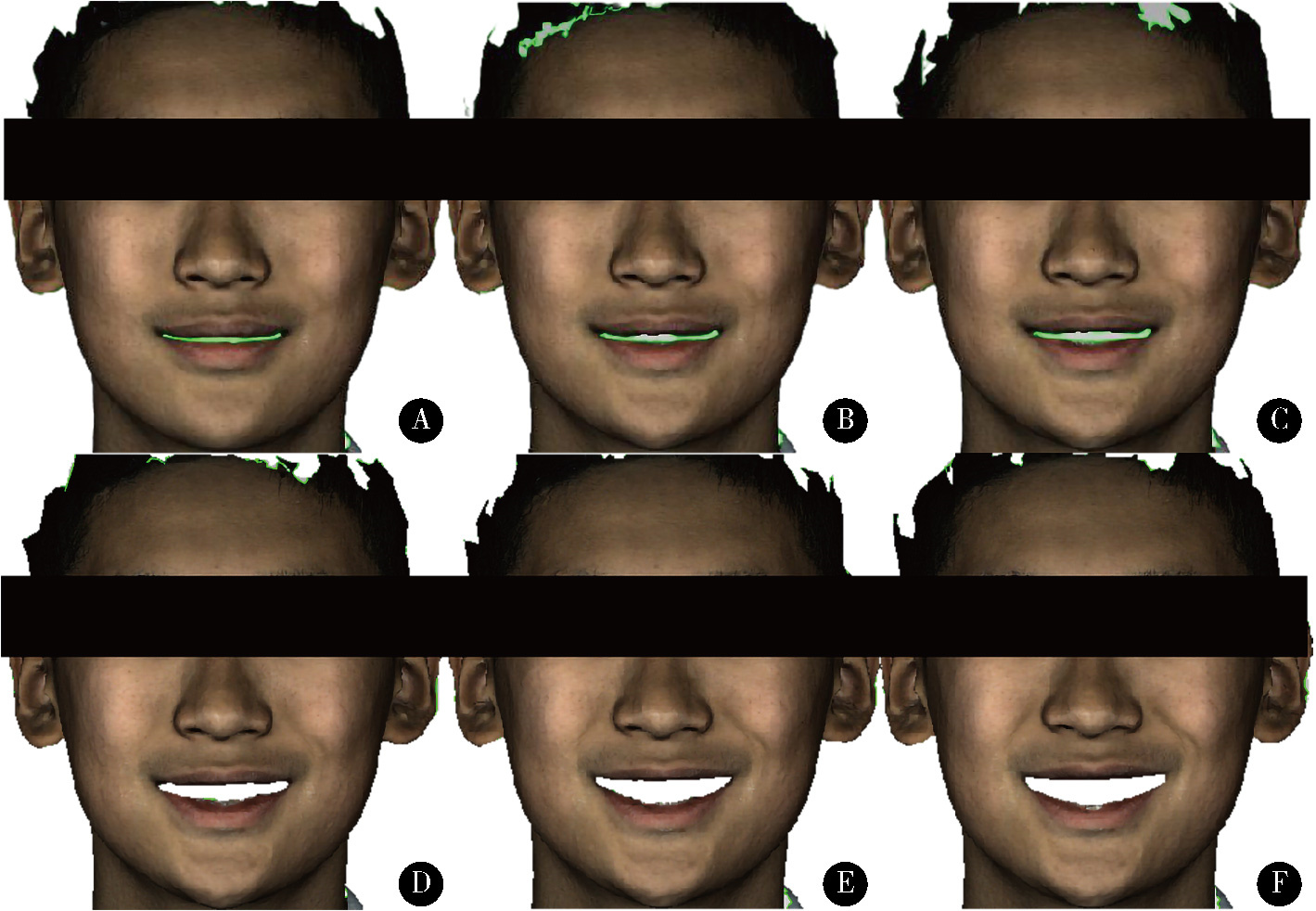
Figure 1

Schematic diagram of dynamic facial data during the participant's smiling process A, the participant' s smile starting data; B-E, smile process data between starting data and ending data of participant' s smiles; F, the participant' s smile ending data."

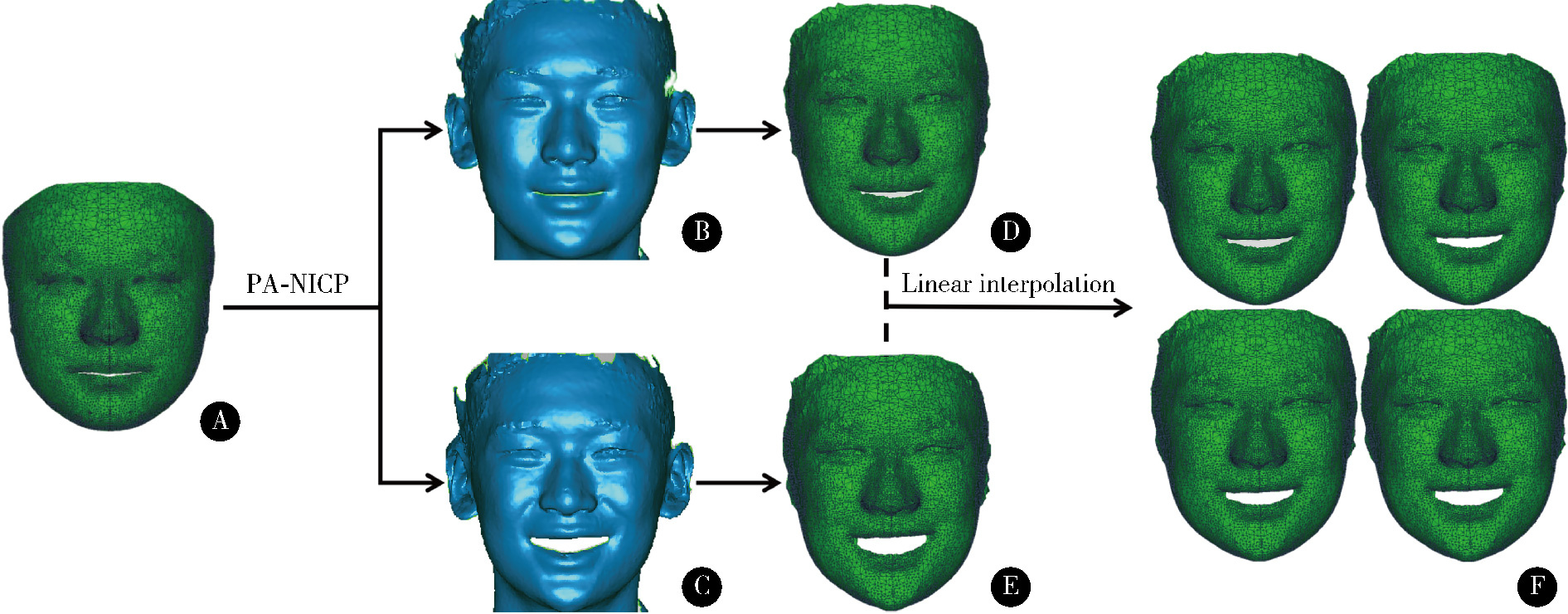
Figure 2

Flowchart of the facial smile simulation sequence data construction method A, processed three-dimensional face template; B, the participant' s smile starting data; C, the participant' s smile ending data; D, structured smile starting data of participant (homologous data); E, structured smile ending data of participant (homologous data); F, smile simulation data obtained by linear interpolation. PA-NICP, Procrustes analysis non-rigid iterative closest point."

Figure 3

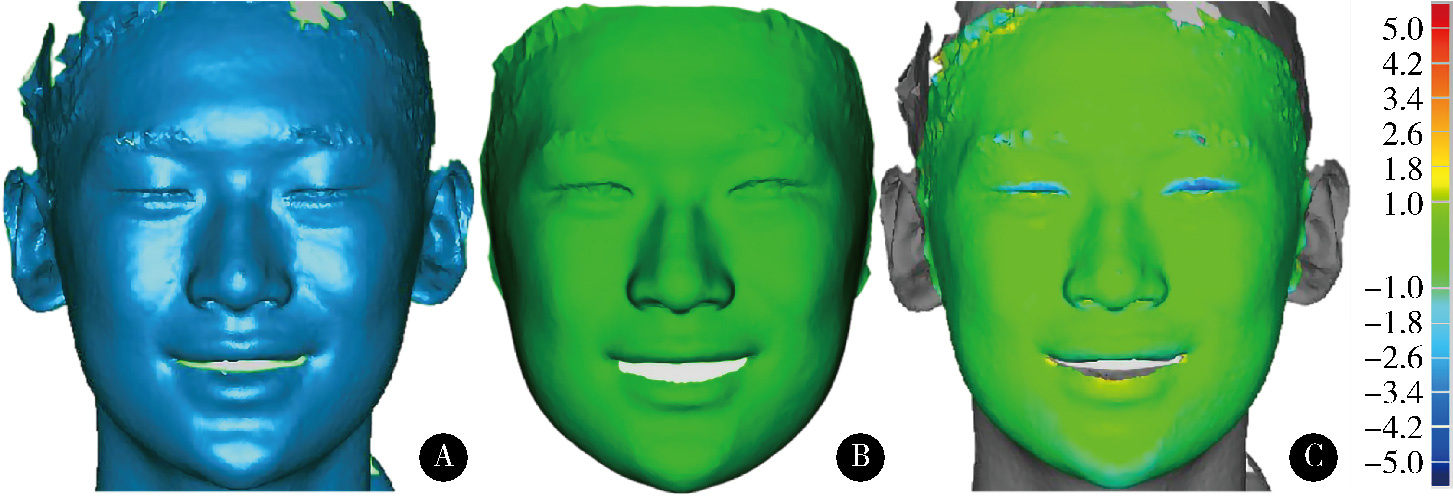
Three-dimensional morphological deviation of the constructed smile simulation sequence data A, smile process data between the participant' s smile starting and ending data; B, smile simulation data corresponding to data A; C, three-dimensional deviation chromatogram between data A and data B."

Figure 4

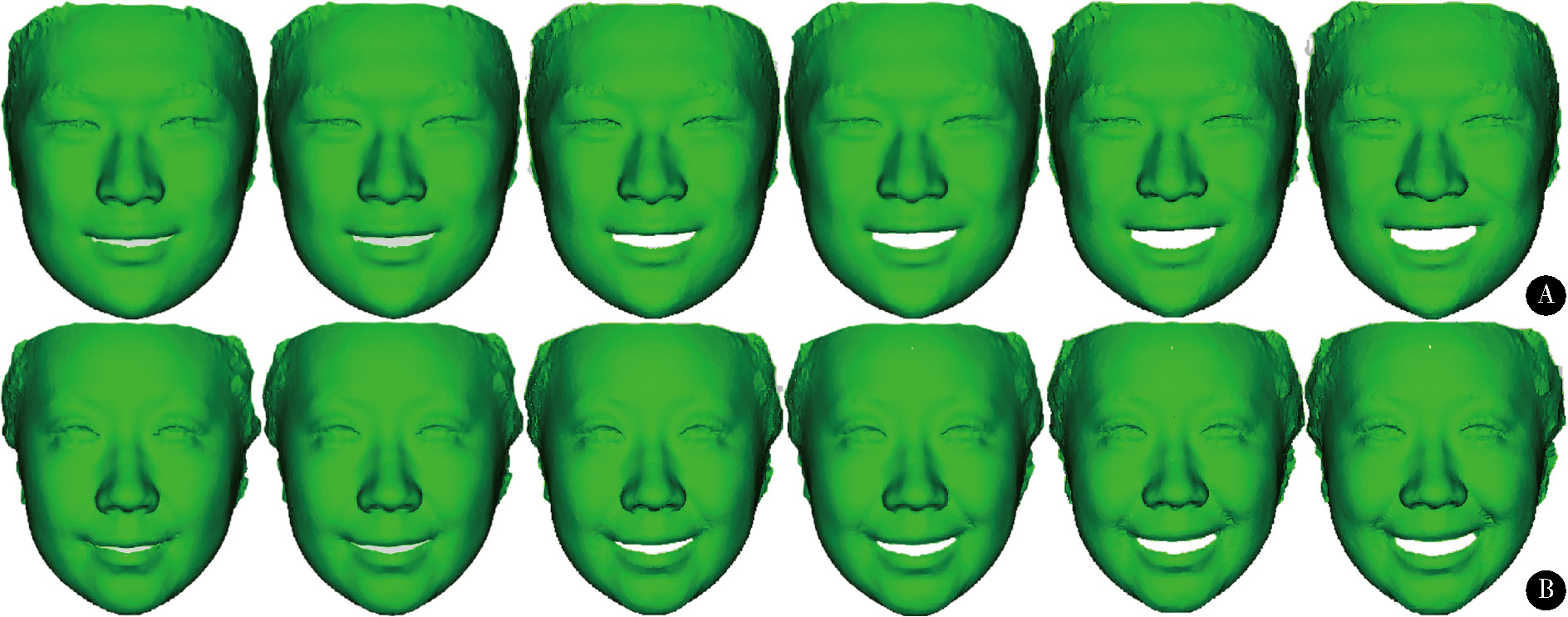
Schematic diagram of the construction effect of three-dimensional facial smile simulation sequence data of participants A, three-dimensional facial smile simulation sequence data of male participant; B, three-dimensional facial smile simulation sequence data of female participant."

1
Jafri Z , Ahmad N , Sawai M , et al. Digital smile design: An innovative tool in aesthetic dentistry[J]. J Oral Biol Craniofac Res, 2020, 10 (2): 194- 198.

doi: 10.1016/j.jobcr.2020.04.010
2
Alharkan HM . Integrating digital smile design into restorative dentistry: A narrative review of the applications and benefits[J]. Saudi Dent J, 2024, 36 (4): 561- 567.

doi: 10.1016/j.sdentj.2023.12.014
3
Sabbah A . Smile analysis: Diagnosis and treatment planning[J]. Dent Clin North Am, 2022, 66 (3): 307- 341.

doi: 10.1016/j.cden.2022.03.001
4
Alhammadi MS , Halboub E , Al-Mashraqi AA , et al. Perception of facial, dental, and smile esthetics by dental students[J]. J Esthet Restor Dent, 2018, 30 (5): 415- 426.

doi: 10.1111/jerd.12405
5
苏佳峰, 武峰, 罗晓晋. 数码微笑设计在前牙美学修复中的应用[J]. 中国实用口腔科杂志, 2016, 9 (10): 632- 634.
6
刘云松, 叶红强, 谷明, 等. 患者参与的数字化设计在前牙美学修复中的应用[J]. 北京大学学报(医学版), 2014, 46 (1): 90- 94.
7
叶红强, 柳玉树, 王冠博, 等. 三维数字化仿真设计与实现技术在前牙美学修复中的应用[J]. 中华口腔医学杂志, 2020, 55 (10): 729- 736.
8
Ye H , Wang KP , Liu Y , et al. Four-dimensional digital prediction of the esthetic outcome and digital implementation for rehabilitation in the esthetic zone[J]. J Prosthet Dent, 2020, 123 (4): 557- 563.

doi: 10.1016/j.prosdent.2019.04.007
9
Wright C, Benington P, Ju X, et al. The correlation between static and dynamic facial asymmetry in unilateral cleft lip and palate [J/OL]. Cleft Palate Craniofac J, 2024: 1055665624 1298143. [2024-11-14]. https://pubmed.ncbi.nlm.nih.gov/39539143/.
10
Quast A , Sadlonova M , Asendorf T , et al. The impact of orthodontic-surgical treatment on facial expressions: A four-dimensional clinical trial[J]. Clin Oral Investig, 2023, 27 (10): 5841- 5851.

doi: 10.1007/s00784-023-05195-9
11
Wen A , Zhang X , Wang Y , et al. Constructing nasal prosthesis morphological data based on a nonrigid registration algorithm[J]. J Prosthet Dent, 2025, 134 (3): 864. e1- 864. e8.

doi: 10.1016/j.prosdent.2025.02.056
12
温奥楠, 朱玉佳, 郑盛文, 等. 基于三维人脸模板的颜面解剖标志点自动定点方法初探[J]. 中华口腔医学杂志, 2022, 57 (4): 358- 365.
13
Miyazaki J , Kondo S , Tanijiri T , et al. Morphological differences between the first and second maxillary premolar crowns: A three-dimensional surface homologous modeling analysis[J]. J Oral Biosci, 2024, 66 (1): 20- 25.

doi: 10.1016/j.job.2024.01.010
14
Matsumura H , Tanijiri T , Kouchi M , et al. Global patterns of the cranial form of modern human populations described by analysis of a 3D surface homologous model[J]. Sci Rep, 2022, 12 (1): 13826.

doi: 10.1038/s41598-022-15883-3
15
Kroczek LOH , Mühlberger A . Returning a smile: Initiating a social interaction with a facial emotional expression influences the evaluation of the expression received in return[J]. Biol Psychol, 2022, 175, 108453.

doi: 10.1016/j.biopsycho.2022.108453
16
Beamish AJ , Foster JJ , Edwards H , et al. What's in a smile? A review of the benefits of the clinician's smile[J]. Postgrad Med J, 2019, 95 (1120): 91- 95.

doi: 10.1136/postgradmedj-2018-136286
17
Thomas PA , Krishnamoorthi D , Mohan J , et al. Digital smile design[J]. J Pharm Bioallied Sci, 2022, 14 (Suppl 1): S43- S49.

doi: 10.4103/jpbs.jpbs_164_22
18
Mai HN , Lee DH . Accuracy of mobile device-compatible 3D scanners for facial digitization: Systematic review and meta-analysis[J]. J Med Internet Res, 2020, 22 (10): e22228.

doi: 10.2196/22228
19
Cho RY , Byun SH , Yi SM , et al. Comparative analysis of three facial scanners for creating digital twins by focusing on the difference in scanning method[J]. Bioengineering (Basel), 2023, 10 (5): 545.

doi: 10.3390/bioengineering10050545
20
Zhao YJ , Xiong YX , Wang Y . Three-dimensional accuracy of facial scan for facial deformities in clinics: A new evaluation method for facial scanner accuracy[J]. PLoS One, 2017, 12 (1): e0169402.

doi: 10.1371/journal.pone.0169402
21
温奥楠, 刘微, 柳大为, 等. 5种椅旁三维颜面扫描技术正确度的初步评价[J]. 北京大学学报(医学版), 2023, 55 (2): 343- 350.

doi: 10.19723/j.issn.1671-167X.2023.02.021
22
Luo Y , Zhao M , Lu J . Accuracy of smartphone-based three-dimensional facial scanning system: A systematic review[J]. Aesthetic Plast Surg, 2024, 48 (21): 4500- 4512.

doi: 10.1007/s00266-024-04121-y
23
Tarkan H . Evaluation of the accuracy and usability of facial scans obtained with smartphones by different users[J]. Am J Orthod Dentofacial Orthop, 2025, 168 (3): 285- 296.

doi: 10.1016/j.ajodo.2025.03.009
24
White JD , Ortega-Castrillón A , Matthews H , et al. MeshMonk: Open-source large-scale intensive 3D phenotyping[J]. Sci Rep, 2019, 9 (1): 6085.

doi: 10.1038/s41598-019-42533-y
25
Deng Y, Yang J, Xu S, et al. Accurate 3D face reconstruction with weakly-supervised learning: From single image to image set [C]//2019 IEEE/CVF Conference on Computer Vision and Pattern Recognition Workshops (CVPRW). Long Beach, CA: IEEE, 2019: 285-295.
26
Feng Y, Wu F, Shao X, et al. Joint 3D face reconstruction and dense alignment with position map regression network [C]//Computer Vision-ECCV 2018. Cham: Springer International Publi-shing, 2018: 557-574.
27
Fathallah M , Eletriby S , Alsabaan M , et al. Advanced 3D face reconstruction from single 2D images using enhanced adversarial neural networks and graph neural networks[J]. Sensors (Basel), 2024, 24 (19): 6280.

doi: 10.3390/s24196280
28
Lium O , Kwon YB , Danelakis A , et al. Robust 3D face reconstruction using one/two facial images[J]. J Imag, 2021, 7 (9): 169.

doi: 10.3390/jimaging7090169
[1] Xiaotong LING,Liuyang QU,Danni ZHENG,Jing YANG,Xuebing YAN,Denggao LIU,Yan GAO. Three-dimensional radiographic features of calcifying odontogenic cyst and calcifying epithelial odontogenic tumor [J]. Journal of Peking University (Health Sciences), 2024, 56(1): 131-137.
[2] Wen ZHANG,Xiao-jing LIU,Zi-li LI,Yi ZHANG. Effect of alar base cinch suture based on anatomic landmarks on the morphology of nasolabial region in patients after orthognathic surgery [J]. Journal of Peking University (Health Sciences), 2023, 55(4): 736-742.
[3] Ao-nan WEN,Wei LIU,Da-wei LIU,Yu-jia ZHU,Ning XIAO,Yong WANG,Yi-jiao ZHAO. Preliminary evaluation of the trueness of 5 chairside 3D facial scanning techniques [J]. Journal of Peking University (Health Sciences), 2023, 55(2): 343-350.
[4] Tian-cheng QIU,Xiao-jing LIU,Zhu-lin XUE,Zi-li LI. Evaluation of the reproducibility of non-verbal facial expressions in normal persons using dynamic stereophotogrammetric system [J]. Journal of Peking University (Health Sciences), 2020, 52(6): 1107-1111.
Viewed
Full text


Abstract

Cited

  Shared   
  Discussed   
No Suggested Reading articles found!