Journal of Peking University (Health Sciences) ›› 2026, Vol. 58 ›› Issue (3): 606-615. doi: 10.19723/j.issn.1671-167X.2026.03.022

Previous Articles     Next Articles

Relationship between family trauma, school bullying and suicidal behavior in adolescents: Regulatory effect of DRD2 gene polymorphism

Hongjuan BAI1, Yang CHEN2, Kun WANG3, Xuebing XU4,*()   

  1. 1. Department of Child and Adolescent Psychiatry, Ningxia Hui Autonomous Region, Yinchuan 750021, China
    2. Department of Pharmacy, Ningan Hospital, Ningxia Hui Autonomous Region, Yinchuan 750021, China
    3. Department of Occupational Injury Rehabilitation Evaluation and Guidance Center, Ningxia Hui Autonomous Region, Yinchuan 750021, China
    4. Department of Psychiatry, Ningan Hospital, Ningxia Hui Autonomous Region, Yinchuan 750021, China
  • Received:2025-06-19 Online:2026-06-18 Published:2026-04-09
  • Contact: Xuebing XU
  • Supported by:
    the Health Research Project of Ningxia Hui Autonomous Region(2025-NWZC-A019)

RICH HTML


Abstract:

Objective: To explore the relationship between family trauma, school bullying and adolescent suicidal behavior, and the regulatory role of DRD2 gene polymorphism. Methods: A total of 98 adolescent patients with depressive disorders who visited our hospital from June 2022 to June 2024 were selected. They were divided into the non-suicide group (n=62) and the suicide group (n=36) based on their suicide behavior in the previous 6 months and their attitudes towards suicide behavior. The general data of the two groups were compared. The relationship between each genotype and suicide behavior, the influencing factors of suicide behavior, the interaction between family trauma and school bullying on suicide behavior, and the regulatory effects of depression and genetic polymorphisms were analyzed. The possible regulatory effects of depression and genetic polymorphisms were also investigated. Results: Compared with the non-suicide group, the duration of illness, non-suicidal self-harm behavior, family trauma, school bullying, anxiety, depression scores in the suicide group increased, while the life meaning score decreased (P < 0.05). The genotype A2A2 was associated with an increased risk of suicidal behavior compared to genotype A1A1 (P < 0.05). In the recessive model, the genotype A2A2 was associated with an increased risk of suicidal behavior compared to genotype A1A1 and A1A2 (P < 0.05); in the additive model, there were significant associations between the genotypes A1A1, A1A2, A2A2 and suicidal behavior (P < 0.05). Non-suicidal self-harm behavior, family trauma, school bullying, depression, and the A2A2 genotype were independent risk factors for suicidal behavior, while life meaning was an independent protective factor. Family trauma > 54.78 points and school bullying > 10.37 points had a multiplicative (OR=6.585, 95%CI: 5.478-7.367) and additive (OR=7.849, 95%CI: 7.231-8.294) interaction effect on adolescent suicidal behavior. Depression exerted a regulatory effect between family trauma (β=0.092, 95%CI: 0.084-0.103), school bullying (β=0.090, 95%CI: 0.081-0.098) and suicidal behavior. In the additive genetic model, the TaqⅠA gene had a significant regulatory effect on "family trauma, school bullying → depression → suicidal behavior" in adolescents with the A1A2/ A2A2 genotype. Conclusion: The risk of suicidal behavior is higher in adolescents with both family trauma and school bullying, and depression plays a part of the mediating effect. The TaqⅠA polymorphism of DRD2 gene has a significant regulatory effect on adolescents carrying A2 allele.

Key words: Family trauma, School bullying, Suicidal behavior, DRD2 gene polymorphism, Regulating effect

CLC Number: 

  • B846

Table 1

Primer sequences for DRD2 gene polymorphism detection"

Site Primer type Primer sequence(5′ to 3′) Primer length/bp
rs1800497 PCR upstream primer GCTTAGAACCACCCAGAGTG 21
PCR downstream primer TGTCCACGCCCGCAA 16
Single-base extension primer CAGCACTTTGAGGATGGCTGGGCTGGAC 28
rs2283265 PCR upstream primer ACGTGGTGCTGGTGCTGAT 19
PCR downstream primer GCCGCTGGTGTTGGTGTA 18
Single-base extension primer GCTGGTGTTGGTGTAGCCGCTGGTG 27

Table 2

Comparison of general data between the non-suicide group and the suicide group"

Items Non-suicide group (n=62) Suicide group (n=36) χ2/t P
Gender 0.170 0.680
  Male 37 (59.68) 23 (63.89)
  Female 25 (40.32) 13 (36.11)
Age/years 15.34±2.62 15.03±2.48 0.576 0.566
Disease duration/years 3.16±0.43 3.51±0.67 3.150 0.002
Years of education 12.32±1.51 11.84±1.25 1.612 0.110
Living area 0.283 0.595
  Urban 38 (61.29) 24 (66.67)
  Rural 24 (38.71) 12 (33.33)
Father’s education level 0.151 0.697
  High school and above 42 (67.74) 23 (63.89)
  Junior high school and below 20 (32.26) 13 (36.11)
Mother’s education level 0.214 0.644
  High school and above 34 (54.84) 18 (50.00)
  Junior high school and below 28 (45.16) 18 (50.00)
Family structure 0.170 0.680
  Nuclear family 25 (40.32) 13 (36.11)
  Non-nuclear family 37 (59.68) 23 (63.89)
The only child 0.088 0.767
  Yes 26 (41.94) 14 (38.89)
  No 36 (58.06) 22 (61.11)
Experience of staying behind 0.074 0.785
  Yes 14 (22.58) 9 (25.00)
  No 48 (77.42) 27 (75.00)
Conditions of boarding 0.033 0.856
  Yes 35 (56.45) 21 (58.33)
  No 27 (43.55) 15 (41.67)
Non-suicidal self-injury 35.61±4.08 44.94±5.32 9.741 <0.001
Meaning of life 45.61±5.84 34.12±5.12 9.812 <0.001
Family trauma 49.34±5.21 64.16±7.21 11.755 <0.001
School bullying/points 8.69±1.76 13.26±2.28 11.096 <0.001
Anxiety/score 56.16±6.31 68.91±7.02 9.251 <0.001
Depression/score 58.32±5.87 72.64±6.65 11.084 <0.001

Table 3

Hardy-Weinberg genetic equilibrium test"

SNP locus Genotype Non-suicide group (n=62) Suicide group (n=36)
Actual value Theoretical value χ2 P Actual value Theoretical value χ2 P
TaqⅠA A1A1 29 28.615 0.006 0.997 6 6.215 0.007 0.996
A1A2 23 23.154 8 7.761
A2A2 10 10.231 22 22.024

Table 4

Analysis of genetic patterns of DRD2 gene (TaqⅠA) in two groups"

DRD2 gene (TaqⅠA) Non-suicide group (n=62) Suicide group (n=36) OR (95%CI) P
A1A1 29(46.77) 6(16.67)
A1A2 23(37.10) 8(22.22) 1.125(0.846-1.432) 0.154
A2A2 10(16.13) 22(61.11) 1.874(1.496-2.328) <0.001
Explicit mode A1A1 vs. (A1A2+A2A2) 29(46.77)/33(53.23) 6(16.67)/30(83.33) 1.231(0.892-1.476) 0.106
Implicit mode(A1A1+A1A2) vs. A2A2 52(83.87)/10(16.13) 14(38.89)/22(61.11) 1.695(1.326-2.021) <0.001
Additive mode A1A1 vs. A1A2 vs. A2A2 29(46.77)/23(37.10)/10(16.13) 6(16.67)/8(22.22)/22(61.11) 0.008

Table 5

Multivariate Logistic regression analysis"

Variables β SE Wald χ2 OR(95%CI) P
Course of disease 0.210 0.216 0.948 1.234 (0.911-1.485) 0.062
Non-suicidal self-injury 0.623 0.284 4.808 1.864 (1.549-2.297) 0.012
Meaning of life -0.481 0.305 2.490 0.618 (0.405-0.859) 0.018
Family trauma 0.853 0.264 10.433 2.346 (2.031-2.695) 0.006
School bullying 0.709 0.281 6.358 2.031 (1.745-2.397) 0.010
Anxiety 0.193 0.225 0.737 1.213 (0.846-1.594) 0.058
Depression 0.948 0.269 12.424 2.581 (2.169-2.882) 0.005
A2A2 genotype of DRD2 gene (TaqⅠA) 0.772 0.247 9.768 2.164 (1.793-2.455) 0.009

Table 6

The interaction effect of family trauma and school bullying on teenagers ' suicidal behavior"

Factors 1 Factors 2 Suicidal behavior OR (95%CI) OR (95%CI)a
Family trauma School bullying No/Yes
≤54.78 ≤10.37 27/2 1.000 1.000
≤54.78 >10.37 13/7 2.864 (2.249-3.516) 3.161 (2.794-3.857)
>54.78 ≤10.37 14/6 1.593 (1.194-1.932) 1.895 (1.329-2.363)
>54.78 >10.37 8/21 7.596 (7.031-7.917) 7.849 (7.231-8.294)
Interactions Additive model RERI=4.122 (95%CI:-1.845-5.638),P>0.05
AP=0.854 (95%CI:0.436-1.425),P<0.05
S=4.832 (95%CI:0.931-13.524),P>0.05
Multiplication model OR=6.585 (95%CI:5.478-7.367),P<0.05

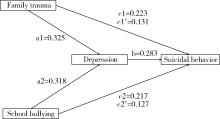
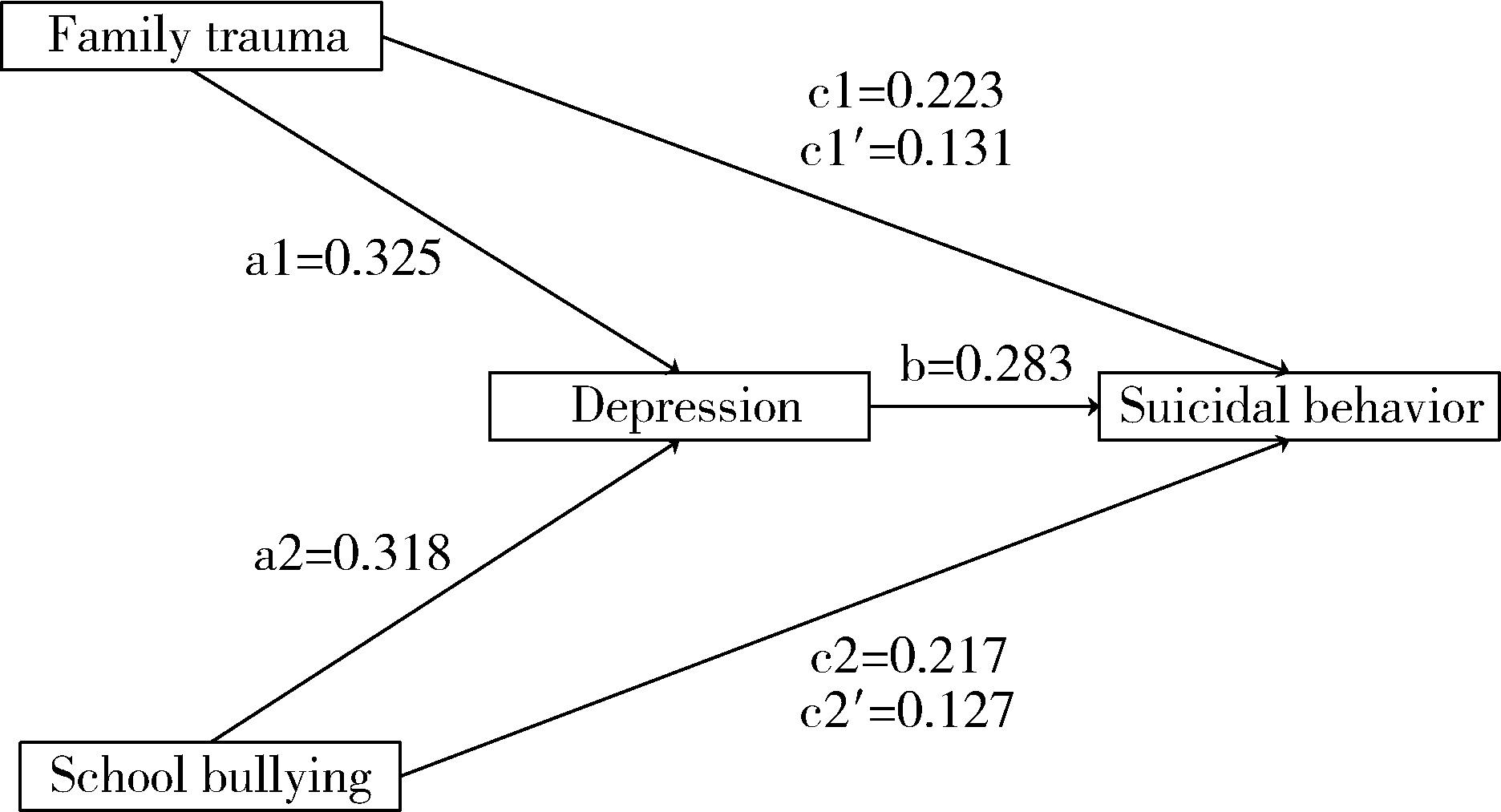
Figure 1

The mediating effect of depression between family trauma, school bullying and adolescent suicidal behavior"

Table 7

Regression analysis of TaqⅠA regulating the influence of family trauma and school bullying on suicide behavior under additive genetic model"

Items Equation 1 criterion: Depression Equation 2 criterion: Suicidal behavior
β SE t 95%CI β SE t 95%CI
Family trauma 0.068 0.042 1.619 -0.043-0.112 0.059 0.045 1.311 -0.061-0.091
TaqⅠA 0.051 0.051 1.000 -0.065-0.128 0.044 0.055 0.800 -0.058-0.112
Family trauma×TaqⅠA 0.174 0.050 3.480 0.123-0.228 0.134 0.053 2.528 -0.049-0.105
School bullying 0.061 0.043 1.419 -0.068-0.135 0.055 0.050 1.100 -0.052-0.128
School bullying×TaqⅠA 0.152 0.048 3.167 0.108-0.211 0.128 0.048 2.667 -0.087-0.184
Depression 0.298 0.046 6.478 0.231-0.348
Depression×TaqⅠA 0.071 0.044 1.614 0.044-0.102
Control variables
Non-suicidal self-injury 0.097 0.043 2.256 -0.055-0.159 0.072 0.038 1.895 -0.033-0.064
Meaning of life -0.069 0.051 -1.353 -0.123-0.074 -0.051 0.040 -1.275 -0.098-0.031
R2 0.135 0.197
F 20.614 21.623
P <0.001 <0.001

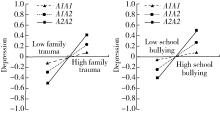
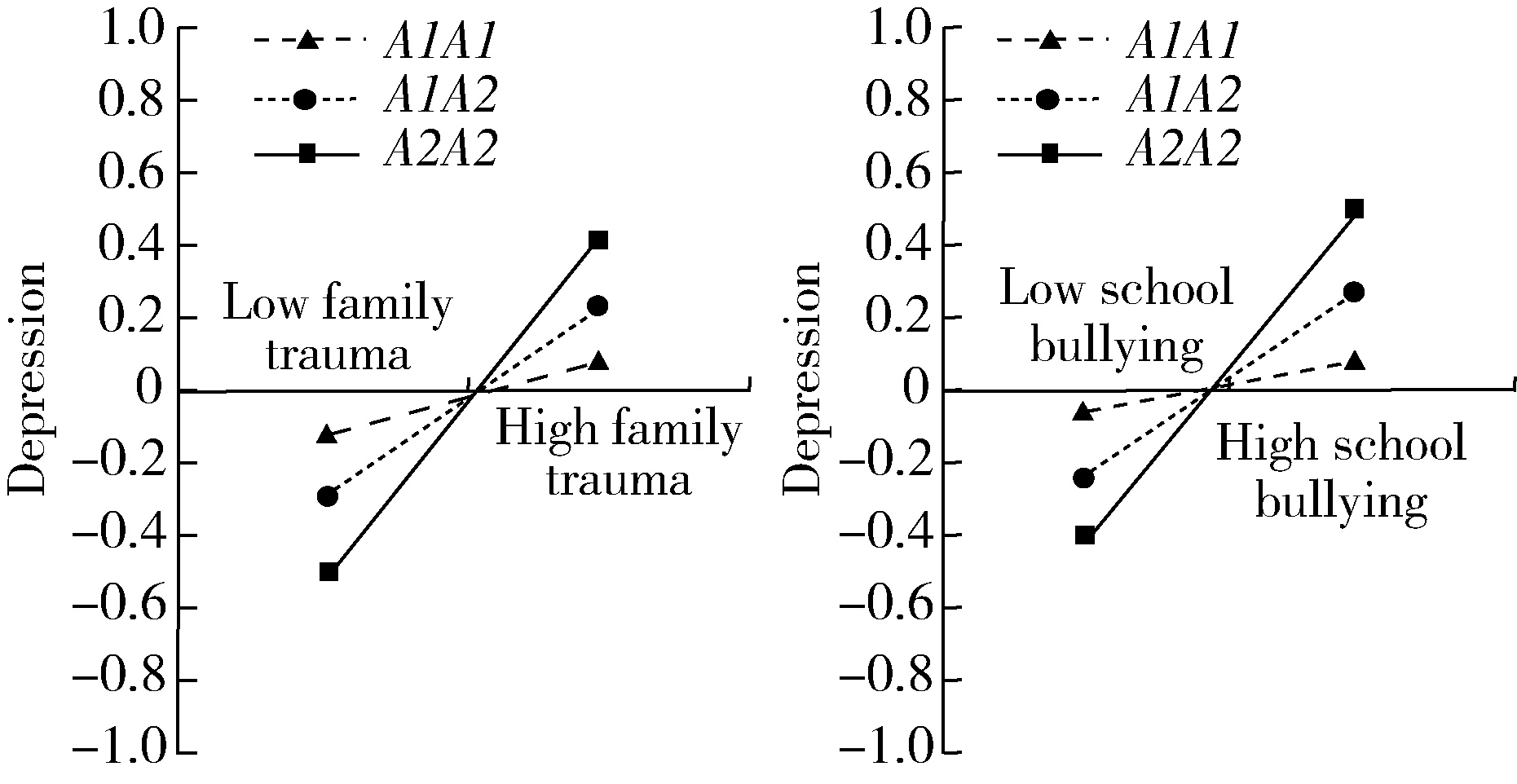
Figure 2

The moderating effect of TaqⅠA in the additive genetic model between family trauma, school bullying and suicidal behavior"

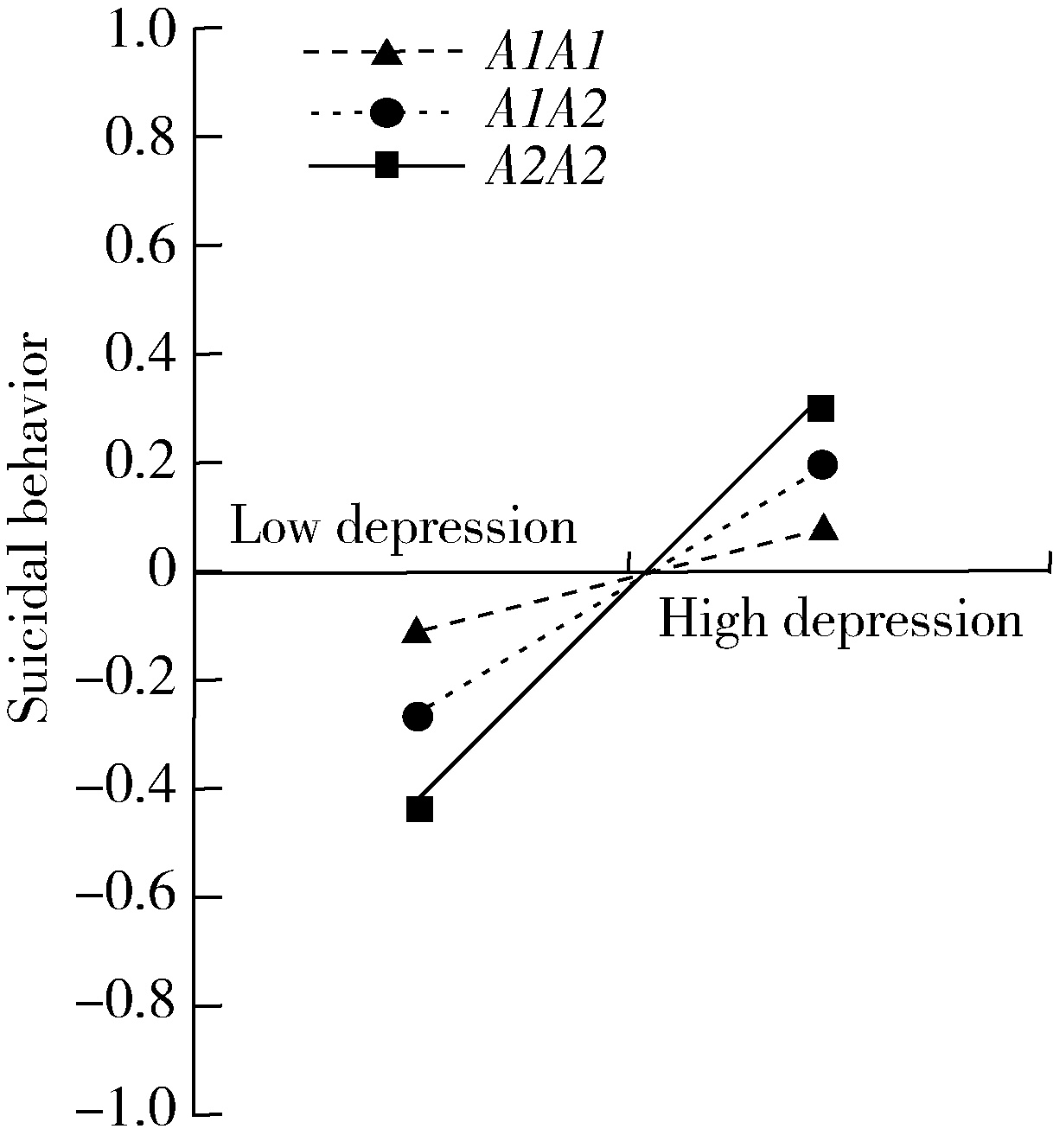
Figure 3

The regulatory role of TaqⅠA in depression and suicidal behavior under the additive genetic model"

1
Pilkay S , Halevy D , Femia D , et al. Adolescent depression and cognition risk for suicide: An investigation of risk factors and gene environment interactions[J]. Brain Behav, 2025, 15 (2): e70247.

doi: 10.1002/brb3.70247
2
Donnelly HK , Richardson D , Solberg VSH . Identifying important predictors of adolescent suicide ideation, planning, and attempt in low- and middle-income countries[J]. Suicide Life Threat Behav, 2025, 55, e13032.

doi: 10.1111/sltb.13032
3
Guo J , Wang C , Shen Y , et al. The bidirectional longitudinal relationship between family affective responsiveness and suicidal ideation among adolescents: Mediation by depressive symptoms[J]. Fam Process, 2025, 64, e70017.

doi: 10.1111/famp.70017
4
杨晓帆, 刘珍珍, 贾存显. 家庭矛盾与青少年自杀行为关系的队列研究[J]. 中华流行病学杂志, 2021, 42 (11): 1976- 1982.
5
Chen Z , Zhang J , Zhang T , et al. The relationship between early adolescent bullying victimization and suicidal ideation: The longitudinal mediating role of self-efficacy[J]. BMC Public Health, 2025, 25 (1): 1000.

doi: 10.1186/s12889-025-22201-9
6
Wang Y , Wang T , Wang J , et al. The school bullying victimization in adolescents with non-suicidal self-injury: The role of coping strategies and emotion regulation[J]. Stress Health, 2024, 40 (6): e3506.

doi: 10.1002/smi.3506
7
Xu Q , Xu H , Li S . Alpha-2-macroglobulin (A2M) and dopamine receptor D2 (DRD2) expression analysis and influence of separation from parents in childhood on the suicide and self-injury behavior and psychological adjustment in adolescence[J]. Cell Mol Biol, 2023, 69 (1): 67- 74.

doi: 10.14715/cmb/2022.69.1.12
8
Sanabrais-Jiménez MA , Aguilar-García A , Hernández-Muñoz S , et al. Association study of Catechol-O-Methyltransferase (COMT) rs4680 Val158Met gene polymorphism and suicide attempt in Mexican adolescents with major depressive disorder[J]. Nord J Psychiatry, 2022, 76 (3): 202- 206.

doi: 10.1080/08039488.2021.1945682
9
Pomohaibo V , Karapuzova N , Pavlenko Y , et al. The influence of heredity and environment on human cognitive ability[J]. Wiadomości Lekarskie, 2024, 77 (12): 2517- 2522.

doi: 10.36740/WLek/195173
10
Massoodi A , Aghajantabar Z , Moudi S , et al. The motives for non-suicidal self-injury among adolescents with psychiatric disorders[J]. BMC Psychiatry, 2025, 25 (1): 35.

doi: 10.1186/s12888-025-06471-6
11
Travezaño-Cabrera A , Vilca LW , Quiroz-Becerra J , et al. Meaning of life questionnaire (MLQ) in Peruvian undergraduate students: Study of its psychometric properties from the perspective of classical test theory (CTT)[J]. BMC Psychol, 2022, 10 (1): 206.

doi: 10.1186/s40359-022-00913-6
12
Goerigk S , Elsaesser M , Reinhard MA , et al. Childhood trauma questionnaire-based child maltreatment profiles to predict efficacy of the Cognitive Behavioral Analysis System of Psychotherapy versus non-specific psychotherapy in adults with early-onset chronic depression: Cluster analysis of data from a randomised controlled trial[J]. Lancet Psychiatry, 2024, 11 (9): 709- 719.

doi: 10.1016/S2215-0366(24)00209-8
13
Chu X , Chen Z . The associations between parenting and bullying among children and adolescents: A systematic review and meta-analysis[J]. J Youth Adolesc, 2025, 54 (4): 928- 954.
14
Wang TS , Jing LJ . Therapeutic effect and psychological impact of aspirin plus edaravone on patients with cerebral infarction[J]. World J Psychiatry, 2024, 14 (5): 644- 652.

doi: 10.5498/wjp.v14.i5.644
15
龚文玥, 邹浩文, 陈志璐, 等. 童年创伤与抑郁症患者非自杀性自伤行为关联的Meta分析[J]. 中华精神科杂志, 2025, 58 (1): 37- 46.
16
刘浩, 周小艳, 向桢玉, 等. 基于决策树算法构建中青年重度抑郁症患者发生非自杀性自伤行为风险的预测模型[J]. 重庆医学, 2024, 53 (10): 1484- 1490.
17
Wang D , Zhao J , Wang Y . Cumulative interpersonal risk, non-suicidal self-injury, and suicide attempts in early adolescence: Between-person differences and within-person effects[J]. J Youth Adolesc, 2025, 54 (4): 967- 980.
18
Yu C , Cai Y , Pan M . Correlation analysis of non-suicidal self-injury behavior with childhood abuse, peer victimization, and psychological resilience in adolescents with depression[J]. Actas Esp Psiquiatr, 2024, 52 (3): 289- 300.

doi: 10.62641/aep.v52i3.1650
19
Li J , Liao J , Chen S , et al. The mediating role of basic psychological needs and meaning in life in adolescent suicidal ideation[J]. Behav Sci, 2025, 15 (1): 14.
20
张至贤, 黄雪雪, 胡婕, 等. 中学生心理健康素养和非自杀性自伤行为交互作用与自杀相关行为关联[J]. 中国公共卫生, 2022, 38 (12): 1517- 1522.
No related articles found!
Viewed
Full text


Abstract

Cited

  Shared   
  Discussed   
No Suggested Reading articles found!