Journal of Peking University (Health Sciences) ›› 2025, Vol. 57 ›› Issue (3): 417-422. doi: 10.19723/j.issn.1671-167X.2025.03.002

Previous Articles     Next Articles

Policy objectives and tools for the construction of Chinese Medical Consortium: A quantitative study based on policy texts

Biao LI1, Yangcuoji BAO1,2, Xinglin FENG1,*()   

  1. 1. Department of Health Policy and Management, Peking University School of Public Health, Beijing 100191, China
    2. Medical Affairs Department, People's Hospital of Golog Tibetan Autonomous Prefecture, Golog Tibetan Autonomous Prefecture 814000, Qinghai, China
  • Received:2025-02-07 Online:2025-06-18 Published:2025-06-13
  • Contact: Xinglin FENG

RICH HTML


Abstract:

Objective: This study conducts a text analysis of the policy documents related to Medical Consortium issued at the national level, identify the structural characteristics and utilization of Chinese Medical Consortium policy instruments, evaluate their alignment with policy objectives, uncover the structural contradictions in policy design, and provide a basis for optimizing the Medical Consortium system. Methods: This study systematically searched national-level Medical Consortium policy documents from the PKU Law Database, CNKI Government Document Database using keyword like Medical Consortium. A two-dimensional "policy instrument-policy objective" analytical framework was constructed based on policy instrument theory to quantitatively analyze the frequency, distribution characteristics, and interactive relationships between policy instruments and objectives. Results: A total of 50 national-level Me-dical Consortium policy documents from 2009 to 2024 were included, with 56% issued solely by single departments. The policy text analysis results showed that the government could use diverse policy instruments to achieve objectives, but the structural imbalances existed, environmental policy instruments accounted for the highest proportion (46.48%), mainly focusing on institutional safeguards (27.27%) and organizational governance (22.73%), with minimal focus on public awareness guidance (6.82%). Supply-side policy instruments (38.38%) overly relied on IT infrastructure development (24.77%) and rational allocation of medical resources (24.77%), with insufficient attention to workforce capacity building (9.17%) and financial input (4.59%). Demand-side policy instruments constituted only 15.14%, dominated by health insurance payment (37.21%) and pilot program promotion (32.56%), while market-oriented instruments such as service outsourcing (9.30%) were rarely used. Interaction analysis revealed that policy instruments were concentrated on enhancing primary care service capacity but provided inadequate support for optimizing allocation of medical resources, which indicated a misalignment between policy instruments and policy objective. Conclusion: Chinese Medical Consortium policies exhibit weak interdepartmental coordination and structural imbalances, characterized by excessive reliance on environmental and supply-side instruments, underuse of demand-side tools, and internal misalignment within instrument categories. And policy instruments and objectives are not well matched. To address these issues, future policy formulation should strengthen cross-departmental collaboration, diversify policy instruments, optimize their internal structures, and improve the alignment between instruments and objectives.

Key words: Medical Consortium, Policy analysis, Policy tools, Policy objectives

CLC Number: 

  • R197.1

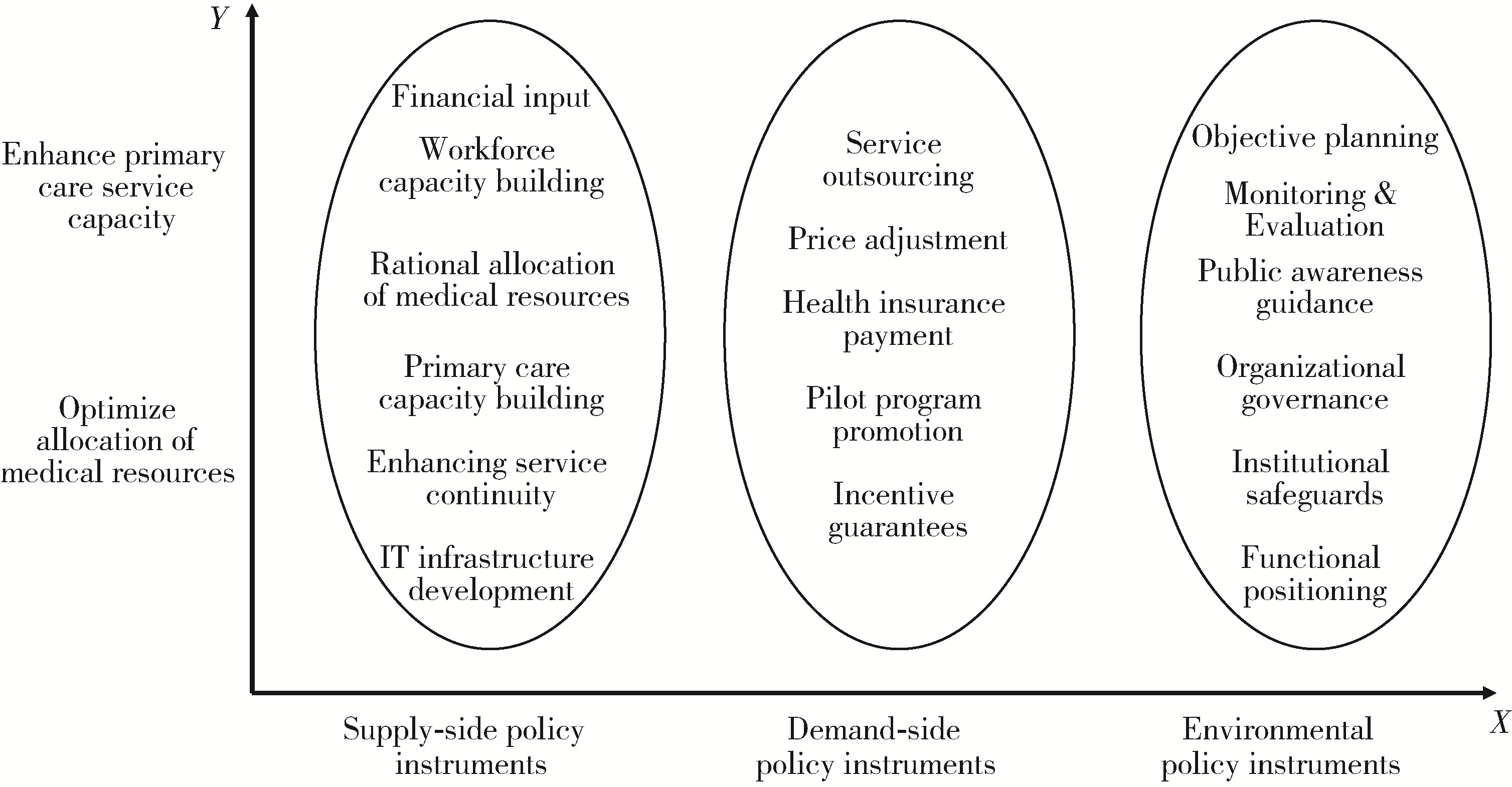
Figure 1

Medical Consortium policy analysis framework IT, information technology."

Table 1

Distribution of policy instruments"

Instrument type Instrument name Frequency Percentage/%
Supply-side policy instruments Financial input 5 4.59
Workforce capacity building 10 9.17
IT infrastructure development 27 24.77
Primary care capacity building 24 22.02
Enhancing service continuity 16 14.68
Rational allocation of medical resources 27 24.77
Demand-side policy instruments Service outsourcing 4 9.30
Price adjustment 3 6.98
Health insurance payment 16 37.21
Pilot program promotion 14 32.56
Incentive guarantees 6 13.95
Environmental policy instruments Objective planning 29 21.97
Monitoring & Evaluation 17 12.88
Public awareness guidance 9 6.82
Organizational governance 30 22.73
Institutional safeguards 36 27.27
Functional positioning 11 8.33

Table 2

Distribution of policy objectives"

Objective Specific objectives Frequency Percentage/%
Enhance primary care service capacity Improve management proficiency 44 38.94
Elevate service quality 43 38.05
Establish digital health platforms 27 23.89
Optimize allocation of medical resources Strengthen collaborative coordination 13 24.53
Achieve regional resource sharing 30 56.60
Implement two-way referral systems 10 18.87

Table 3

Interaction analysis of policy instrument and objective dimensions"

Dimension Enhance primary care service capacity Optimize allocation of medical resources
Elevate service quality Improve management proficiency Establish digital health platforms Implement two-way referral systems Achieve regional resource sharing Strengthen collaborative coordination
Supply-side policy instruments
  Enhancing service continuity 0 2 0 10 1 2
  Primary care capacity building 19 1 0 0 3 0
  Workforce capacity building 10 0 0 0 0 0
  IT infrastructure development 0 0 27 0 1 0
  Rational allocation of medical resources 3 0 0 0 22 1
  Financial input 2 0 0 0 0 0
  Total 34 3 27 10 27 3
  Percentage/% 32.69 2.88 25.96 9.62 25.96 2.88
Environmental policy instruments
  Functional positioning 0 0 0 0 0 10
  Monitoring & Evaluation 1 2 0 0 0 0
  Objective planning 1 1 0 0 1 0
  Public awareness guidance 0 0 0 0 0 0
  Institutional safeguards 7 15 0 0 2 0
  Organizational governance 0 24 0 0 0 0
  Total 9 42 0 0 3 10
  Percentage/% 14.06 65.63 0.00 0.00 4.69 15.63
Demand-side policy instruments
  Incentive guarantees 0 1 0 0 0 0
  Service outsourcing 0 0 0 0 1 0
  Price adjustment 0 0 0 0 0 0
  Pilot program promotion 2 0 0 0 0 0
  Health insurance payment 0 2 0 0 1 0
  Total 2 3 0 0 2 0
  Percentage/% 28.57 42.86 0.00 0.00 28.57 0.00
1
赵锐, 高晶磊, 肖洁, 等. 我国医疗联合体建设现状与发展思考[J]. 中国医院管理, 2021, 41 (2): 1- 4.
2
高晶磊, 赵锐, 刘春平, 等. "十三五"期间我国医疗联合体建设成效及发展建议[J]. 中国医院管理, 2021, 41 (2): 23- 26.
3
郁菁, 申俊龙, 朱佩枫, 等. 我国医联体集团建设与国际医疗资源整合利用方式的比较分析[J]. 中国医院, 2023, 27 (12): 27- 32.
4
王俊, 王雪瑶. 中国整合型医疗卫生服务体系研究: 政策演变与理论机制[J]. 公共管理学报, 2021, 18 (3): 152- 167.
5
袁浩文, 杨莉. 国内外整合医疗理论、实践及效果评价[J]. 中国循证医学杂志, 2020, 20 (5): 585- 592.
6
Wang X , Yang E , Zheng C , et al. Effects of vertical integration on the healthcare system in China: A systematic review and meta-analysis[J]. Health Policy Plan, 2024, 39 (1): 66- 79.

doi: 10.1093/heapol/czad085
7
Rothwell R , Zegveld W . Industrial innovation and public policy: Preparing for the 1980s and the 1990s[M]. Westport, Conn., USA: Greenwood Press, 1981.
8
石敏, 徐梦丹, 许星莹, 等. 我国医联体政策量化研究: 基于政策目标、工具和力度的内容分析[J]. 中国卫生事业管理, 2021, 38 (5): 352- 356.
9
袁有树, 邬卫东, 刘平, 等. 贵州省医联体内中西医师对多点执业政策认知与推行意愿的比较研究[J]. 中国卫生事业管理, 2022, 39 (2): 105- 109.
10
程念, 汪早立. 典型地区医联体模式与成效对比研究[J]. 中国卫生经济, 2018, 37 (7): 12- 15.
11
李念念, 赵允伍, 尹红艳, 等. 医联体发展困境与策略浅析[J]. 中国卫生事业管理, 2017, 34 (8): 561- 562.
12
马颖颖, 张开云. 医保政策推进分级诊疗: 作用机理与未来路径--基于东莞市医改实践的考察[J]. 浙江学刊, 2024 (3): 171- 180.
13
吕一星, 郑儒春, 覃岳香, 等. 我国社会办医发展现状及对策研究[J]. 中国医院, 2021, 25 (7): 78- 80.
14
刘庆, 王清亮, 费剑春, 等. 我国医疗联合体主要运行模式及存在的问题[J]. 中国医院管理, 2017, 37 (9): 33- 35.
[1] Huyang ZHANG, Rize JING, Jinxi WANG, Hai FANG. Impact of outpatient services utilization of heart failure patients on hospitalization rate and its threshold effect: Taking patients with Urban Employee Basic Medical Insurance in Zhejiang Province as an example [J]. Journal of Peking University (Health Sciences), 2025, 57(4): 753-758.
[2] Yu WANG, Rui YUAN, Shupeng LI, Chun CHANG. Three-party game and simulation analysis of health-related information quality regulation in public health emergencies [J]. Journal of Peking University (Health Sciences), 2025, 57(3): 514-521.
[3] Qingbo WANG,Hongqiao FU. Main characteristics and historical evolution of China' s health financing transition [J]. Journal of Peking University (Health Sciences), 2024, 56(3): 462-470.
[4] Zhe-bin WANG,Zhi-jie ZHENG. Research on equity and influencing factors of disability among Chinese middle-aged and old people [J]. Journal of Peking University (Health Sciences), 2020, 52(3): 500-505.
[5] JIAN Wei-Yan, FANG Hai. An empirical analysis on the substitution effect of outpatient services on inpatient services [J]. Journal of Peking University(Health Sciences), 2015, 47(3): 459-463.
[6] ZHAO Xin, MING Di-Yao, MA Wen-Jun. Utilization and cost of outpatient care and their influencing factors among middle and aged peasant-workers in China [J]. Journal of Peking University(Health Sciences), 2015, 47(3): 464-468.
Viewed
Full text


Abstract

Cited

  Shared   
  Discussed   
No Suggested Reading articles found!