Journal of Peking University (Health Sciences) ›› 2025, Vol. 57 ›› Issue (3): 481-486. doi: 10.19723/j.issn.1671-167X.2025.03.011

Previous Articles     Next Articles

Influencing factors of responsive caregiving among infant mothers in Weifang City

Ziyuan FU1, Fei YANG1, Mo ZHOU1, Xinxuan LI1, Ruoning WANG1, Ningxuan CUI1, Jing HUANG1, Yixin ZHANG1, Huafang JIANG2, Yuhua GUO2, Hong ZHOU1,*()   

  1. 1. Department of Maternal and Child Health, Peking University School of Public Health / Peking University Health Science Center-Weifang Joint Research Center for Maternal and Child Health / National Health Commission Key Laboratory of Reproductive Health, Beijing 100191, China
    2. Weifang Maternal and Child Health Hospital, Weifang 261000, Shandong, China
  • Received:2025-02-08 Online:2025-06-18 Published:2025-06-13
  • Contact: Hong ZHOU
  • Supported by:
    Key Project of Peking University Health Science Center-Weifang Joint Research Center for Maternal and Child Health

RICH HTML


Abstract:

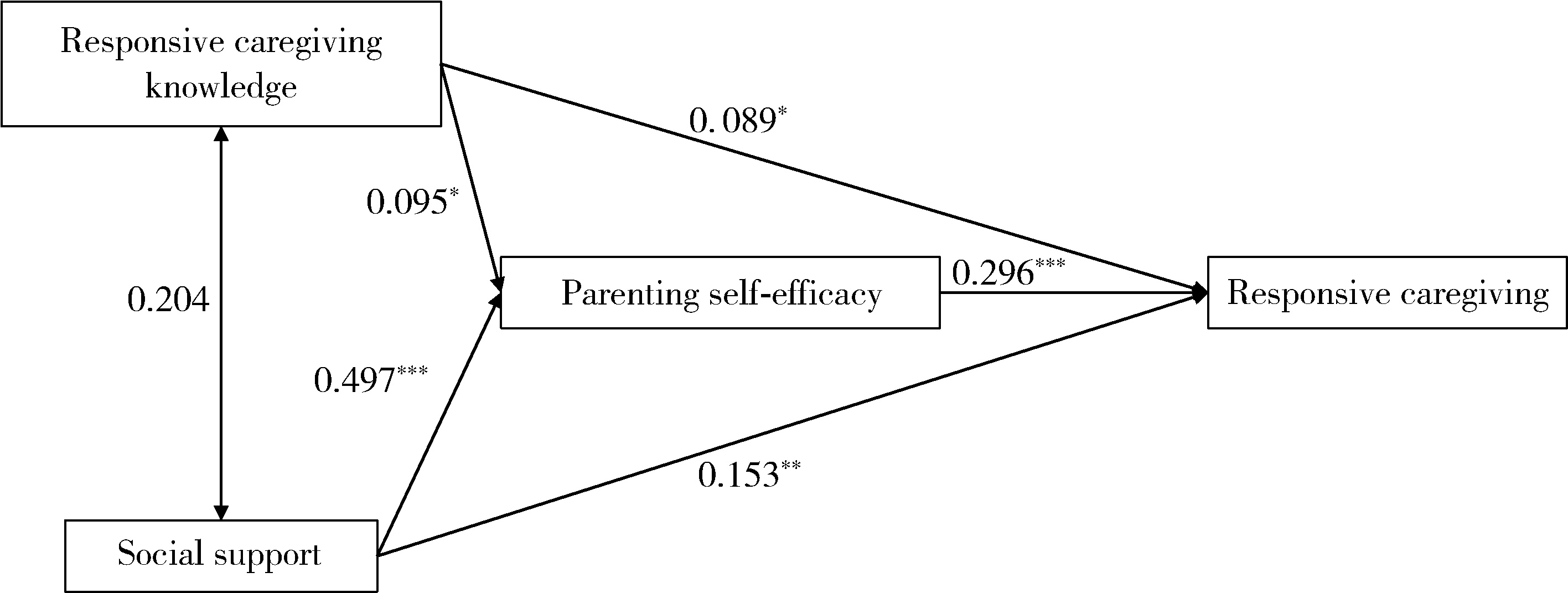
Objective: To describe the current status of responsive caregiving behavior of infant mothers, to analyze their influencing factors and pathways using the information-motivation-behavioral skills (IMB) model, and to provide a basis for further interventions related to responsive caregiving behaviors and comprehensive promotion of early childhood development. Methods: This study was a cross-sectional survey using convenience sampling. Questionnaires were used to collect basic information about mothers and their infants, as well as data on mothers' responsive caregiving behavior, knowledge of responsive caregiving, social support, and parenting self-efficacy. Multivariate linear regression models were employed to analyze the influencing factors of responsive caregiving behavior, and structural equation modeling was used to analyze the pathways of these influencing factors. The criterion for inadequate responsive caregiving is defined as scores not exceeding the lower quartile (P25) of the total score. Results: Among 510 mothers of aged 0-12 months infants in Weifang City, the average score for responsive caregiving behavior was 16.41±3.99. The proportion of inadequate responsive caregiving was 25.7%. Mothers in the insufficient responsive caregiving group had lower scores in knowledge (7.70±1.41), social support (57.92±15.16), and parenting self-efficacy (30.36±6.48) compared with those in the sufficient group, with statistically significant differences (P < 0.001). Logistic regression analysis indicated that the influencing factors for responsive caregiving included the level of know-ledge about responsive parenting [adjusted OR (aOR)=0.795, 95%CI: 0.566-0.838], social support (aOR=0.979, 95%CI: 0.961-0.996), and parenting self-efficacy (aOR=0.894, 95%CI: 0.857-0.932). Structural equation modeling revealed that knowledge of responsive caregiving (β=0.089, P=0.031), social support (β=0.153, P=0.001), and parenting self-efficacy (β=0.296, P < 0.001) were directly related to responsive caregiving behavior. Additionally, knowledge of responsive caregiving indirectly affected responsive caregiving behavior through parenting self-efficacy (β=0.095, P=0.014), and social support indirectly affected responsive caregiving behavior through parenting self-efficacy (β=0.497, P < 0.001). Conclusion: The current level of responsive caregiving behavior among mothers of 0-1-year-old infants in Weifang City is not satisfactory. Future development of responsive caregiving interventions should focus on providing caregivers with relevant knowledge of responsive caregiving based on their needs. Additionally, it is essential to offer social support from multiple aspects to enhance caregivers' parenting self-efficacy, thereby promoting improvements in responsive caregiving behavior.

Key words: Responsive caregiving, Knowledge, Social support, Parenting self-efficacy

CLC Number: 

  • R174

Table 1

Responsive caregiving of investigated infant mothers"

Characteristics Total Inadequate responsive caregiving, n(%) χ2 P
Maternal age 2.752 0.253
  <30 years 226 50 (22.1)
  30-34 years 174 50 (28.7)
  ≥35 years 102 29 (28.4)
Maternal education level 4.117 0.128
  High school or below 38 15 (39.5)
  Junior college/Undergraduate 389 95 (24.4)
  Graduate or above 83 21 (25.3)
Age of child 4.322 0.229
  0-3 months 199 55 (27.6)
  4-6 months 140 29 (20.7)
  7-9 months 94 22 (23.4)
  10-12 months 77 25 (32.5)
Gender of child 1.181 0.277
  Male 270 64 (23.7)
  Female 240 67 (27.9)
Total income of household 5.730 0.057
  Low 206 64 (31.1)
  Middle 202 46 (22.8)
  High 100 20 (20.0)

Figure 1

Influencing factor scores in groups with inadequate and adequate responsive caregiving"

Table 2

Logistics regression of factors influencing inadequate responsive caregiving of infant mothers"

Characteristics Crude OR (95%CI) Adjusted OR (95%CI)
Maternal education level
  High school or below 0.954 (0.552-1.647) 0.832 (0.456-1.517)
  Junior college/Undergraduate 1.925 (0.850-4.360) 1.351 (0.526-3.469)
  Graduate or above 1.00 1.00
Total income of household
  Low 1.179 (0.654-2.128) 1.063 (0.552-2.047)
  Middle 1.803 (1.018-3.194) 1.577 (0.832-2.990)
  High 1.00 1.00
Responsive cargiving knowledge 0.689 (0.566-0.838) 0.795 (0.639-0.988)
Social support 0.953 (0.938-0.967) 0.979 (0.961-0.996)
Parenting self-efficacy 0.871 (0.839-0.904) 0.894 (0.857-0.932)

Figure 2

Path analysis of influencing factors on responsive caregiving among mothers of aged 0-12 months infants in Weifang City"

1
World Health Organization, United Nations Children's Fund, World Bank Group. Nurturing care for early childhood development: A framework for helping children survive and thrive to transform health and human potential [R]. Geneva, Switzerland: WHO, 2018.
2
Eshel N , Daelmans B , de Mello MC , et al. Responsive parenting: Interventions and outcomes[J]. Bull World Health Organ, 2006, 84 (12): 991- 998.

doi: 10.2471/BLT.06.030163
3
Ma G , Li M , Shi H , et al. Early stimulation and responsive care: A mediator of caregivers' depression on the suspected developmental delay of left-behind children in China[J]. J Affect Disord, 2023, 341, 88- 95.

doi: 10.1016/j.jad.2023.08.118
4
Yousafzai AK , Obradović J , Rasheed MA , et al. Effects of responsive stimulation and nutrition interventions on children's development and growth at age 4 years in a disadvantaged population in Pakistan: A longitudinal follow-up of a cluster-randomised factorial effectiveness trial[J]. Lancet Glob Health, 2016, 4 (8): e548- e558.

doi: 10.1016/S2214-109X(16)30100-0
5
祁月, 张羽頔, 蒋子晗, 等. 2月龄时回应性照护对婴儿6个月内发育影响的出生队列研究[J]. 中国儿童保健杂志, 2020, 28 (1): 23- 27.
6
黄楹, 张海峰, 童连. 婴幼儿回应性照护评价量表的初步编制与评价[J]. 中国儿童保健杂志, 2022, 30 (4): 386- 391.
7
Fisher JD , Fisher WA , Amico KR , et al. An information-motivation-behavioral skills model of adherence to antiretroviral therapy[J]. Health Psychol, 2006, 25 (4): 462- 473.

doi: 10.1037/0278-6133.25.4.462
8
Wang H , Chang R , Shen Q , et al. Information-motivation-behavioral skills model of consistent condom use among transgender women in Shenyang, China[J]. BMC Public Health, 2020, 20 (1): 394.

doi: 10.1186/s12889-020-08494-y
9
张卉. 基于IMB技巧模型的微信平台延续性护理在COPD患者中的应用研究[D]. 太原: 山西医科大学, 2023.
10
Nelson LA , Wallston KA , Kripalani S , et al. Assessing barriers to diabetes medication adherence using the information-motivation-behavioral skills model[J]. Diabetes Res Clin Pract, 2018, 142, 374- 384.

doi: 10.1016/j.diabres.2018.05.046
11
杨晓, 高玲玲, 张振香, 等. 中文版育儿胜任感量表在产妇中应用的信效度检验[J]. 中华护理杂志, 2014, 49 (7): 881- 885.
12
姜乾金, 黄丽, 卢抗生, 等. 心理应激: 应对的分类与心身健康[J]. 中国心理卫生杂志, 1993 (4): 145- 147.
13
徐玉英, 郭晨鸣, 王蕾, 等. 婴幼儿回应性照护与社会支持的关系研究[J]. 中国儿童保健杂志, 2025, 33 (3): 319- 323.
14
刘潘婷, 张蕾, 洪琴, 等. 婴幼儿回应性照护水平和育儿信心的关系[J]. 中国儿童保健杂志, 2024, 32 (2): 133- 137.
15
Ma G , Li M , Shi H , et al. Early stimulation and responsive care: A mediator of caregivers' depression on the suspected developmental delay of left-behind children in China[J]. J Affect Disord, 2023, 341, 88- 95.

doi: 10.1016/j.jad.2023.08.118
16
Scherer E , Hagaman A , Chung E , et al. The relationship between responsive caregiving and child outcomes: Evidence from direct observations of mother-child dyads in Pakistan[J]. BMC Public Health, 2019, 19 (1): 252.

doi: 10.1186/s12889-019-6571-1
17
Nelson AK , Sánchez-Vincitore L , Patricia Frias M , et al. Home-based nurturing care practices for children under five with low socioeconomic position in Santo Domingo, Dominican Republic[J]. PLoS One, 2025, 20 (2): e0314432.

doi: 10.1371/journal.pone.0314432
18
Ahun MN , Bliznashka L , Karuskina-Drivdale S , et al. A qualitative study of maternal and paternal parenting knowledge and practices in rural Mozambique[J]. BMC Public Health, 2024, 24 (1): 1778.

doi: 10.1186/s12889-024-19291-2
19
Dukuzumuremyi JPC , Acheampong K , Abesig J , et al. Know-ledge, attitude, and practice of exclusive breastfeeding among mothers in East Africa: A systematic review[J]. Int Breastfeed J, 2020, 15 (1): 70.

doi: 10.1186/s13006-020-00313-9
20
Bandura A . Human agency in social cognitive theory[J]. Am Psychol, 1989, 44 (9): 1175- 1184.

doi: 10.1037/0003-066X.44.9.1175
21
Dzerounian J , Pirrie M , Alshenaiber L , et al. Health knowledge and self-efficacy to make health behaviour changes: A survey of older adults living in Ontario social housing[J]. BMC Geriatr, 2022, 22 (1): 473.

doi: 10.1186/s12877-022-03116-1
22
Kulik NL , Moore EW , Centeio EE , et al. Knowledge, attitudes, self-efficacy, and healthy eating behavior among children: Results from the building healthy communities trial[J]. Health Educ Behav, 2019, 46 (4): 602- 611.

doi: 10.1177/1090198119826298
23
Ge J , Zhao S , Peng X , et al. Analysis of the weight management behavior of Chinese pregnant women: An integration of the protection motivation theory and the information-motivation-behavioral skills model[J]. Front Public Health, 2022, 10, 759946.

doi: 10.3389/fpubh.2022.759946
24
Tsamlag L , Wang H , Shen Q , et al. Applying the information-motivation-behavioral model to explore the influencing factors of self-management behavior among osteoporosis patients[J]. BMC Public Health, 2020, 20 (1): 198.

doi: 10.1186/s12889-020-8292-x
25
Zhang X , Dong S . The relationships between social support and loneliness: A meta-analysis and review[J]. Acta Psychol (Amst), 2022, 227, 103616.

doi: 10.1016/j.actpsy.2022.103616
26
Tracy M , Salo M , Appleton AA . The mitigating effects of maternal social support and paternal involvement on the intergenerational transmission of violence[J]. Child Abuse Negl, 2018, 78, 46- 59.

doi: 10.1016/j.chiabu.2017.09.023
27
曾子芸. 幼儿母亲的社会支持、心理一致感及其教养方式的关系[D]. 重庆: 西南大学, 2015.
28
Miller JD , Collins SM , Boateng GO , et al. Pathways linking social support, self-efficacy, and exclusive breastfeeding among women in northern Uganda[J]. Glob Public Health, 2022, 17 (12): 3506- 3518.

doi: 10.1080/17441692.2022.2110918
29
Kim SR , Kim S , Kim HY , et al. Predictive model of self-management in patients with stroke based on the information-motivation-behavioral skills model[J]. J Cardiovasc Nurs, 2023, 38 (2): 158- 167.

doi: 10.1097/JCN.0000000000000883
[1] Shan CAI,Yihang ZHANG,Ziyue CHEN,Yunfe LIU,Jiajia DANG,Di SHI,Jiaxin LI,Tianyu HUANG,Jun MA,Yi SONG. Status and pathways of factors influencing physical activity time among elementary and junior high school students in Beijing [J]. Journal of Peking University (Health Sciences), 2024, 56(3): 403-410.
[2] Ming-long CHEN,Xiao-han LIU,jing GUO. Relationship between social support and parental burnout in COVID-19 among Chinese young parents [J]. Journal of Peking University (Health Sciences), 2022, 54(3): 520-525.
[3] LI Yuan-cheng, CUI Wen-xin, GUO Xue-er, ZHU Fan, LIU Si-chen, JIA Bi-bo, WANG Pei, MA Ying-hua. Comparison of acquired immure deficiency syndrome-related knowledge and behavior between persons with and without human immunodeficiency virus-infection among young male students who have sex with men [J]. Journal of Peking University (Health Sciences), 2021, 53(3): 511-517.
[4] Shuang-jia WANG,Ting-ting WANG,Jun-bo WANG. Nutritional knowledge, attitudes and dietary behaviors of teachers and students in a medical college in Beijing and their influencing factors [J]. Journal of Peking University (Health Sciences), 2020, 52(5): 881-885.
[5] ZHANG Xu-xi, WU Shi-yan, WANG Feng-bin, Mayinuer YUSUFU, SUN Kai-ge, HU Kang, ZHANG Xing, SUN Xin-ying, Edwin B. FISHER. Association between social support and self-management behaviors among patients with diabetes in community [J]. Journal of Peking University(Health Sciences), 2017, 49(3): 455-461.
[6] LIU Guo-feng, SUN Mei-ping, WANG Zhi-yong, JIAN Wei-yan. Association analysis between urbanization and non-communicable diseases and health-related behavior [J]. Journal of Peking University(Health Sciences), 2016, 48(3): 478-482.
[7] CHEN Juan, LIAO Yi-Xing, LI Zhuo-Ting, TIAN Ye, YANG Shuai-Shuai, TU Da-Hong, HE Chao, SUN Xin-Yang. Analysis of the determinants of salt-restriction behavior among urban and rural residents in Beijing with health belief model [J]. Journal of Peking University(Health Sciences), 2014, 46(2): 242-246.
[8] LI Zheng, SHA Yue-qin, ZHU Ling, ZHANG Bo-xue , XU Jing-ling. Effects of dental health awareness and behaviours on the glycemic metabolic characteristics and periodontal disease of patients with type 2 diabetic [J]. Journal of Peking University(Health Sciences), 2013, 45(6): 979-983.
[9] SUN Xin-ying;GUO Yan;SUN Jing . Validation of the integration of health belief model and planned behavior theory [J]. Journal of Peking University(Health Sciences), 2009, 41(2): 129-134.
Viewed
Full text


Abstract

Cited

  Shared   
  Discussed   
No Suggested Reading articles found!