Journal of Peking University (Health Sciences) ›› 2026, Vol. 58 ›› Issue (2): 351-358. doi: 10.19723/j.issn.1671-167X.2026.02.020

Previous Articles     Next Articles

Risk factors for ventilator-associated pneumonia in patients with chest trauma in intensive care unit

Jie ZHAO, Chun FU, Xiujuan ZHAO, Haiyan XUE, Shu LI, Zhenzhou WANG, Fengxue ZHU*()   

  1. Department of Critical Care Medicine, Trauma Treatment Center, Peking University People's Hospital, Beijing 100044, China
  • Received:2024-02-22 Online:2026-04-18 Published:2025-09-24
  • Contact: Fengxue ZHU
  • Supported by:
    the National Natural Science Foundation of China(81971808)

RICH HTML


Abstract:

Objective: To explore the risk factors associated with ventilator-associated pneumonia (VAP) in the patients with chest trauma in the intensive care unit (ICU). Methods: A retrospective analysis was conducted on the clinical data of 124 adult trauma patients admitted to the surgical ICU of Peking University People' s Hospital between June 2019 and June 2023. These patients underwent tra-cheal intubation within 24 hours of admission and received mechanical ventilation for more than 48 hours. Based on whether VAP occurred during hospitalization, the patients were divided into a VAP group (46 cases) and a non-VAP group (78 cases). Lasso regression analysis was employed for variable selection, followed by Logistic regression analysis to determine the risk factors for VAP in these patients with chest trauma in the ICU. Results: The multivariate regression analysis indicated that the injury severity score (ISS) (OR=1.08, 95%CI: 1.02-1.14, P=0.007) and tracheostomy (OR=4.61, 95%CI: 1.74-13.11, P=0.003) were independent risk factors for VAP in the patients with chest trauma (P < 0.05). Among all VAP cases, early-onset VAP was observed in 19 patients, while late-onset VAP was observed in 27 patients. The most common pathogen in all VAP cases was Klebsiella pneumoniae, identified in 18 cases (39.1%). In early-onset VAP, Klebsiella pneumoniae was the most frequently detected pathogen, found in 10 cases (52.6%). Conversely, in late-onset VAP, Pseudomonas aeruginosa and Acinetobacter baumannii were the most prevalent pathogens, each appearing in 10 cases (37.0%). Conclusion: The occurrence of VAP in the patients with chest trauma in the ICU was influenced by multiple factors. This study identified that a higher ISS and the presence of a tracheostomy were independent risk factors for VAP in these patients. These findings suggest that in clinical practice, special attention should be given to the chest trauma patients with high ISS scores, and the timing and necessity of tracheostomy should be carefully considered to reduce the incidence of VAP and improve patient outcomes. Furthermore, the study highlights the importance of early identification and appropriate management of the patients at higher risk for developing VAP. By recognizing the significance of these risk factors, healthcare providers can implement targeted interventions and preventive measures, such as optimizing ventilation strategies and enhancing infection control practices. Future research should further explore additional factors that may influence the occurrence of VAP and verify these findings to provide stronger evidence for the prevention and treatment of VAP. Additionally, multicenter studies with larger sample sizes are recommended to validate these results and develop comprehensive guidelines for managing the chest trauma patients in the ICU.

Key words: Ventilator-associated pneumonia, Thoracic injuries, Mechanical ventilation, Intensive care units, Risk factors

CLC Number: 

  • R563.1

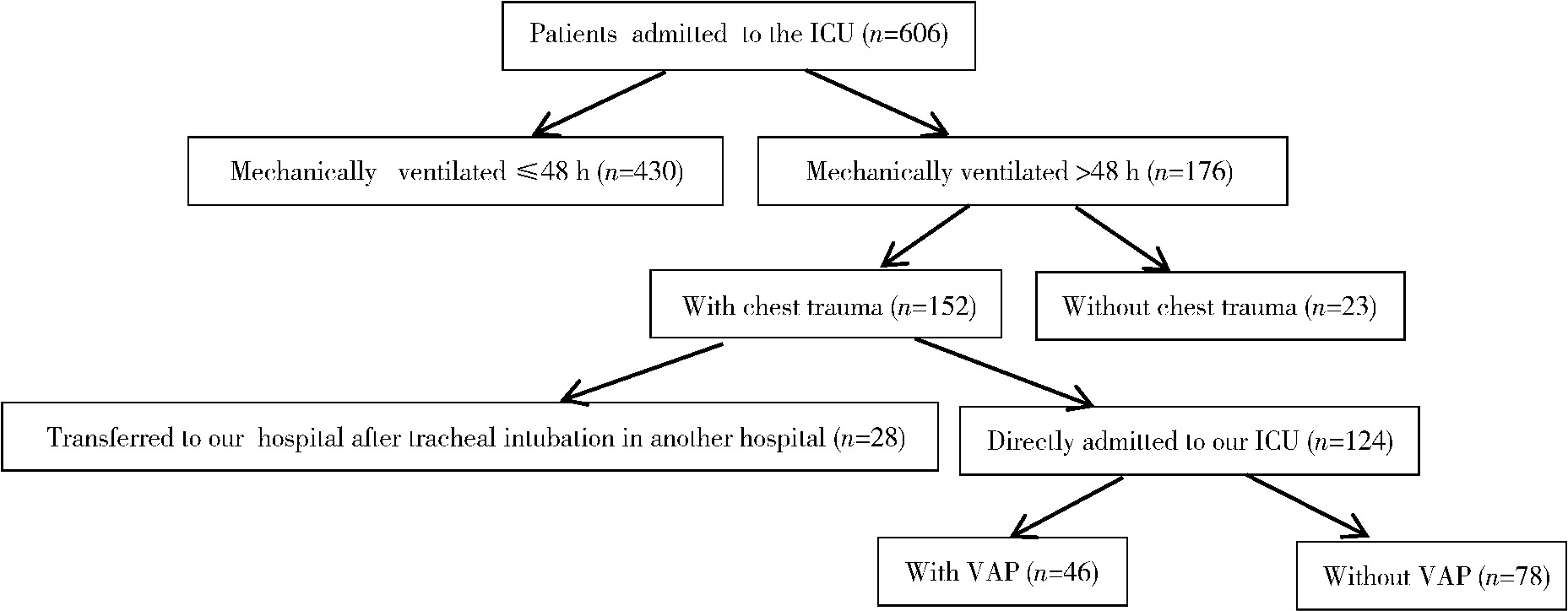
Figure 1

Patients enrollment flowchart ICU, intensive care unit; VAP, ventilator-associated pneumonia."

Table 1

Baseline data of patients (n=124)"

Feature Non-VAP (n=78) VAP (n=46) P value
General information
  Age/years, M (P25, P75) 58 (46, 66) 54 (43, 64) 0.660
  Gender (male), n (%) 55 (70.5) 39 (84.8) 0.073
Medical history, n (%)
  Diabetes 7 (9.0) 5 (10.9) 0.760
  Hypertension 15 (19.2) 16 (34.8) 0.053
  Chronic kidney disease 1 (1.3) 1 (2.2) 0.999
  Hepatitis B 2 (2.6) 1 (2.2) 0.999
  Cerebrovascular disease 5 (6.4) 5 (10.9) 0.497
  Emphysema 5 (6.4) 1 (2.2) 0.411
  Coronary heart disease 1 (1.3) 3 (6.5) 0.144
  Smoking history 9 (11.5) 5 (10.9) 0.909
  Drinking history 6 (7.7) 4 (8.7) 0.999
Type of trauma, n (%) 0.854
  Traffic accident injury 50 (64.1) 32 (69.6)
  Fall injury 18 (23.1) 9 (19.6)
  Slip injury 6 (7.7) 2 (4.3)
  Crush injury 4 (5.1) 3 (6.5)
Overall trauma condition
  Shock, n (%) 26 (33.3) 20 (43.5) 0.259
  Head injury, n (%) 39 (50.0) 32 (69.6) 0.033
  Facial injury, n (%) 28 (35.9) 18 (39.1) 0.719
  Abdominal injury, n (%) 35 (44.9) 19 (41.3) 0.699
  Spinal injury, n (%) 32 (41.0) 23 (50.0) 0.331
  Pelvic injury, n (%) 38 (48.7) 25 (54.3) 0.545
  ISS score, M (P25, P75) 26 (19, 34) 29 (26, 34) 0.003
  GCS score, M (P25, P75) 14 (11, 15) 13 (7, 15) 0.022
Chest trauma condition
  Chest AIS score, ${\bar x}$±s 3.15±0.77 3.33±0.70 0.207
  Number of rib fractures, M (P25, P75) 5 (2, 10) 4 (2, 10) 0.801
  Clavicle fracture, n (%) 12 (15.4) 12 (26.1) 0.145
  Sternum fracture, n (%) 7 (9.0) 3 (6.5) 0.743
  Lung contusion, n (%) 53 (67.9) 33 (71.7) 0.658
  Pleural effusion, n (%) 49 (62.8) 31 (67.4) 0.607
  Pneumothorax, n (%) 29 (37.2) 20 (43.5) 0.488
Routine blood tests
  White blood cell count/(×109/L), M (P25, P75) 16.71 (12.58, 21.53) 18.41 (14.92, 22.57) 0.145
  Neutrophil percentage/%, M (P25, P75) 90.6 (88.6, 92.8) 90.2 (87.7, 92.1) 0.247
  Hemoglobin level/(g/L), ${\bar x}$±s 79.31±17.55 79.80±16.98 0.402
  Platelet count/(×109/L), M (P25, P75) 65 (47, 110) 75 (49, 120) 0.284
Blood product usage
  Red blood cells/U, M (P25, P75) 6 (1, 13) 8 (4, 14) 0.327
  Plasma/mL, M (P25, P75) 400 (0, 900) 400 (0, 1 050) 0.580
  Platelets/U, ${\bar x}$±s 0.51±1.36 0.43±0.91 0.703
Complications, n (%)
  VTE 4 (5.1) 2 (4.3) 0.999
  AKI 6 (7.7) 3 (6.5) 0.999
  ARDS 2 (2.6) 3 (6.5) 0.359
ICU procedures, n (%)
  CVC 48 (61.5) 30 (65.2) 0.682
  Thoracentesis 34 (43.6) 15 (32.6) 0.227
  Tracheostomy 8 (10.3) 18 (39.1) < 0.001
  Multiple intubations 2 (2.6) 4 (8.7) 0.193
Surgeries, n (%)
  Thoracic surgery 29 (37.2) 14 (30.4) 0.446
  Cranial surgery 13 (16.7) 8 (17.4) 0.917
  Pelvic surgery 17 (21.8) 12 (26.1) 0.585
  Spinal surgery 9 (11.5) 6 (13.0) 0.804
  Abdominal surgery 9 (11.5) 9 (19.6) 0.220
  Femoral surgery 11 (14.1) 4 (8.7) 0.372
Mechanical ventilation duration/h, ${\bar x}$±s 183±116 299±290 0.012
Outcomes
  ICU stay duration/d, ${\bar x}$±s 16±9 19±12 0.140
  Discharge outcome (mortality), n (%) 10 (12.8) 5 (10.9) 0.748

Table 2

Pathogen distribution in VAP patients"

Pathogen Total VAP patients (n=46), n (%) Early-onset VAP (n=19), n (%) Late-onset VAP (n=27), n (%)
Pseudomonas aeruginosa 12 (26.1) 2 (10.5) 10 (37.0)
Acinetobacter baumannii 13 (28.3) 3 (15.8) 10 (37.0)
Klebsiella pneumoniae 18 (39.1) 10 (52.6) 8 (29.6)
Stenotrophomonas maltophilia 7 (15.2) 0 (0) 7 (25.9)
Escherichia coli 2 (4.3) 2 (10.5) 0 (0)
Candida albicans 2 (4.3) 0 (0) 2 (7.4)
Enterobacter cloacae 2 (4.3) 0 (0) 2 (7.4)

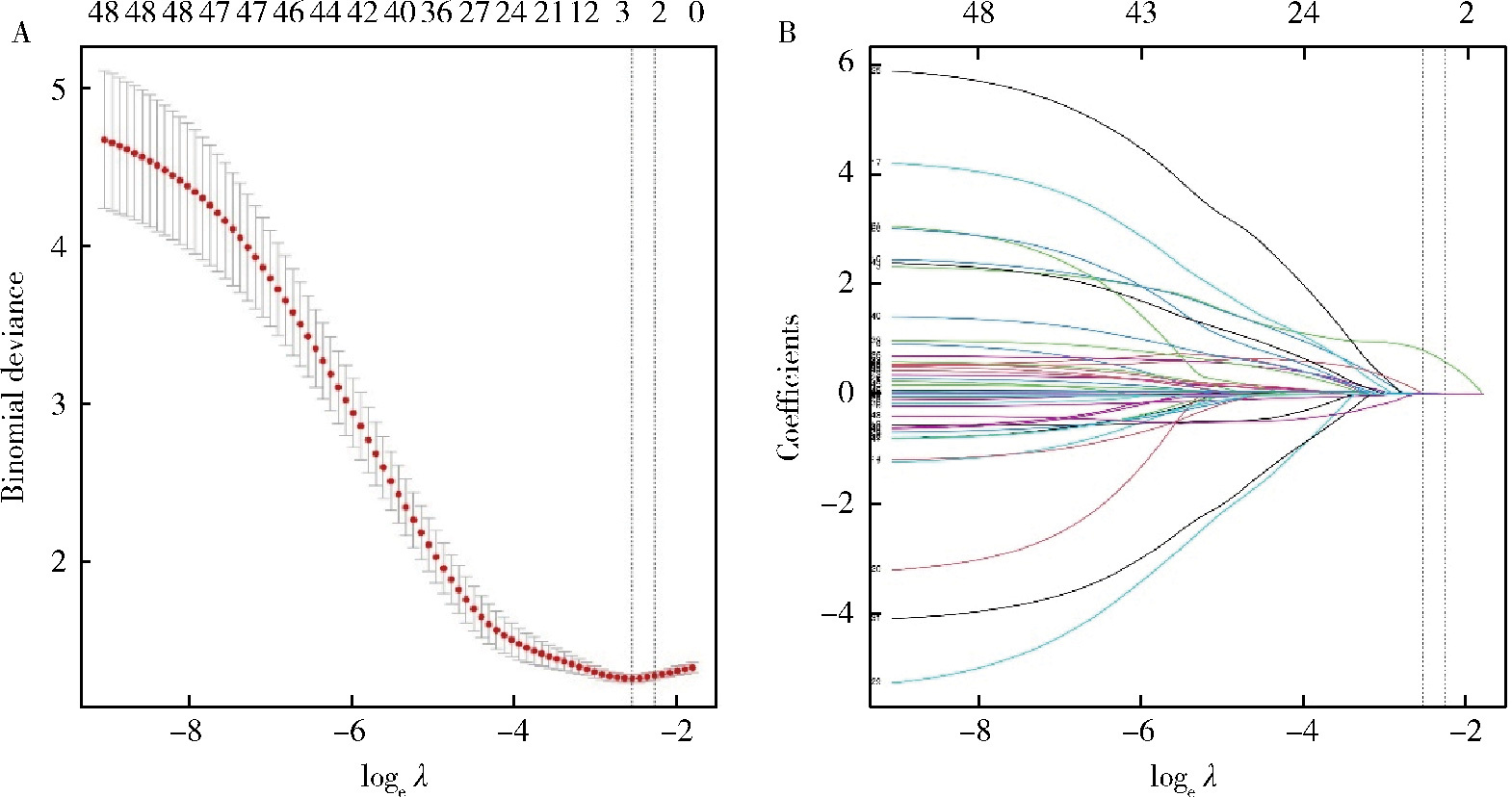
Figure 2

Lasso regression coefficient penalty plot A, Lasso coefficient profiles plotted against the logeλ. The upper axis indicates the number of non-zero coefficients. B, ten-fold cross-validation for determining the optimal tuning parameter λ (λ_min and λ_1se) in the Lasso regression model."

Table 3

Multivariate analysis in the Logistic regression model"

Predictor Estimate SE Z P Odds ratio Lower Upper
(Intercept) -2.773 0.783 -3.543 0.000 0.062 0.012 0.268
ISS score 0.067 0.026 2.550 0.011 1.069 1.017 1.128
Tracheostomy 1.608 0.499 3.224 0.001 4.995 1.928 13.904
1
中华医学会呼吸病学分会感染学组. 中国成人医院获得性肺炎与呼吸机相关性肺炎诊断和治疗指南(2018年版)[J]. 中华结核和呼吸杂志, 2018, 41 (4): 255- 280.
2
Bonell A , Azarrafiy R , Huong VTL , et al. A systematic review and meta-analysis of ventilator-associated pneumonia in adults in Asia: An analysis of national income level on incidence and etiology[J]. Clin Infect Dis, 2019, 68 (3): 511- 518.

doi: 10.1093/cid/ciy543
3
Johnstone J , Muscedere J , Dionne J , et al. Definitions, rates and associated mortality of ICU-acquired pneumonia: A multicenter cohort study[J]. J Crit Care, 2023, 75, 154284.

doi: 10.1016/j.jcrc.2023.154284
4
Papazian L , Klompas M , Luyt CE . Ventilator-associated pneumonia in adults: A narrative review[J]. Intensive Care Med, 2020, 46 (5): 888- 906.

doi: 10.1007/s00134-020-05980-0
5
Koulenti D , Arvaniti K , Judd M , et al. Ventilator-associated tracheobronchitis: To treat or not to treat?[J]. Antibiotics (Basel), 2020, 9 (2): 51.

doi: 10.3390/antibiotics9020051
6
Kalanuria AA , Ziai W , Mirski M . Ventilator-associated pneumonia in the ICU[J]. Crit Care, 2014, 18 (2): 208.

doi: 10.1186/cc13775
7
Hayashi Y , Morisawa K , Klompas M , et al. Toward improved surveillance: The impact of ventilator-associated complications on length of stay and antibiotic use in patients in intensive care units[J]. Clin Infect Dis, 2013, 56 (4): 471- 477.

doi: 10.1093/cid/cis926
8
Park DR . The microbiology of ventilator-associated pneumonia[J]. Respir Care, 2005, 50 (6): 742- 763.

doi: 10.4187/respcare.05500742
9
El-Saed A , Balkhy HH , Al-Dorzi HM , et al. Acinetobacter is the most common pathogen associated with late-onset and recurrent ventilator-associated pneumonia in an adult intensive care unit in Saudi Arabia[J]. Int J Infect Dis, 2013, 17 (9): e696- e701.

doi: 10.1016/j.ijid.2013.02.004
10
Chaudhary U , Ranjan N , Ranjan KP . Ventilator-associated pneumonia in a tertiary care intensive care unit: Analysis of incidence, risk factors and mortality[J]. Indian J Crit Care Med, 2014, 18 (4): 200- 204.

doi: 10.4103/0972-5229.130570
11
Charles MP , Easow JM , Joseph NM , et al. Aetiological agents of ventilator-associated pneumonia and its resistance pattern: A threat for treatment[J]. Australas Med J, 2013, 6 (9): 430- 434.

doi: 10.4066/AMJ.2013.1710
12
Craven DE , Steger KA . Ventilator-associated bacterial pneumo-nia: Challenges in diagnosis, treatment, and prevention[J]. New Horiz, 1998, 6 (Suppl 2): S30- S45.
13
Cook A , Norwood S , Berne J . Ventilator-associated pneumonia is more common and of less consequence in trauma patients compared with other critically ill patients[J]. J Trauma, 2010, 69 (5): 1083- 1091.
14
Younan D , Delozier SJ , Adamski J , et al. Factors predictive of ventilator-associated pneumonia in critically ill trauma patients[J]. World J Surg, 2020, 44 (4): 1121- 1125.

doi: 10.1007/s00268-019-05286-3
15
Patel N , Modi C , Singh S . Risk factors for ventilator associated pneumonia in patients with trauma and head injury in a tertiary care teaching hospital of rural Gujarat[J]. J Med Allied Sci, 2021, 11 (2): 137.

doi: 10.5455/jmas.42509
16
Darvishi-Khezri H , Alipour A , Emami Zeydi A , et al. Is type 2 diabetes mellitus in mechanically ventilated adult trauma patients potentially related to the occurrence of ventilator-associated pneumonia?[J]. J Res Med Sci, 2016, 21, 19.
17
Leone M , Delliaux S , Bourgoin A , et al. Risk factors for late-onset ventilator-associated pneumonia in trauma patients receiving selective digestive decontamination[J]. Intensive Care Med, 2005, 31 (1): 64- 70.

doi: 10.1007/s00134-004-2514-z
18
Jovanovic B , Milan Z , Markovic-Denic L , et al. Risk factors for ventilator-associated pneumonia in patients with severe traumatic brain injury in a Serbian trauma centre[J]. Int J Infect Dis, 2015, 38, 46- 51.

doi: 10.1016/j.ijid.2015.07.005
19
Mangram AJ , Sohn J , Zhou N , et al. Trauma-associated pneumonia: Time to redefine ventilator-associated pneumonia in trauma patients[J]. Am J Surg, 2015, 210 (6): 1056- 1061.

doi: 10.1016/j.amjsurg.2015.06.029
20
Park HO , Kang DH , Moon SH , et al. Risk factors for pneumonia in ventilated trauma patients with multiple rib fractures[J]. Korean J Thorac Cardiovasc Surg, 2017, 50 (5): 346- 354.

doi: 10.5090/kjtcs.2017.50.5.346
21
Arumugam SK , Mudali I , Strandvik G , et al. Risk factors for ventilator-associated pneumonia in trauma patients: A descriptive analysis[J]. World J Emerg Med, 2018, 9 (3): 203- 210.

doi: 10.5847/wjem.j.1920-8642.2018.03.007
22
Bochicchio GV , Napolitano L , Joshi M , et al. Blood product transfusion and ventilator-associated pneumonia in trauma patients[J]. Surg Infect (Larchmt), 2008, 9 (4): 415- 422.

doi: 10.1089/sur.2006.069
23
Robba C , Rebora P , Banzato E , et al. Incidence, risk factors, and effects on outcome of ventilator-associated pneumonia in patients with traumatic brain injury: Analysis of a large, multicenter, prospective, observational longitudinal study[J]. Chest, 2020, 158 (6): 2292- 2303.

doi: 10.1016/j.chest.2020.06.064
24
Li Y , Liu C , Xiao W , et al. Incidence, risk factors, and outcomes of ventilator-associated pneumonia in traumatic brain injury: A meta-analysis[J]. Neurocrit Care, 2020, 32 (1): 272- 285.

doi: 10.1007/s12028-019-00773-w
25
Li L , Yuan W , Zhang S , et al. Analysis of risk factors for pneumonia in 482 patients undergoing oral cancer surgery with tracheo-tomy[J]. J Oral Maxillofac Surg, 2016, 74 (2): 415- 419.

doi: 10.1016/j.joms.2015.08.018
26
Marra A , Vargas M , Buonanno P , et al. Early vs. late tracheostomy in patients with traumatic brain injury: Systematic review and meta-analysis[J]. J Clin Med, 2021, 10 (15): 3319.

doi: 10.3390/jcm10153319
27
Qiu Y , Yin Z , Wang Z , et al. Early versus late tracheostomy in stroke-related patients: A systematic review and meta-analysis[J]. J Clin Neurosci, 2023, 114, 48- 54.

doi: 10.1016/j.jocn.2023.06.004
28
Altinsoy S , Catalca S , Sayin MM , et al. The risk factors of ventilator associated pneumonia and relationship with type of tracheostomy[J]. Trends Anaesth Crit Care, 2020, 35, 38- 43.
29
Pawlik J , Tomaszek L , Mazurek H , et al. Risk factors and protective factors against ventilator-associated pneumonia: A single-center mixed prospective and retrospective cohort study[J]. J Pers Med, 2022, 12 (4): 597.

doi: 10.3390/jpm12040597
30
Ding C , Zhang Y , Yang Z , et al. Incidence, temporal trend and factors associated with ventilator-associated pneumonia in mainland China: A systematic review and meta-analysis[J]. BMC Infect Dis, 2017, 17 (1): 468.

doi: 10.1186/s12879-017-2566-7
31
Chaari A , Kssibi H , Zribi W , et al. Ventilator-associated pneumonia in trauma patients with open tracheotomy: Predictive factors and prognosis impact[J]. J Emerg Trauma Shock, 2013, 6 (4): 246- 251.

doi: 10.4103/0974-2700.120364
32
Gunalan A , Sistla S , Ramanathan V , et al. Early- vs late-onset ventilator-associated pneumonia in critically ill adults: Comparison of risk factors, outcome, and microbial profile[J]. Indian J Crit Care Med, 2023, 27 (6): 411- 415.

doi: 10.5005/jp-journals-10071-24465
33
Male PV , Kashyap MK , Bora RA , et al. Ventilator associated pneumonia (VAP) in an intensive care unit of a tertiary care hospital: Incidence, their microbial etiology, risk factors and role of multidrug resistant pathogens[J]. Indian J Appl Res, 2017, 7 (2): 214- 216.
[1] Hui WEI, Jingfeng ZHANG, Zhongqiang YAO, Jinxia ZHAO. Clinical characteristics and relevant factors of rheumatoid arthritis patients with anemia of chronic disease [J]. Journal of Peking University (Health Sciences), 2026, 58(2): 307-312.
[2] Bowen LI, Qiang ZHANG, Yixin SUN. Establishment and validation of a risk prediction model for scoliosis after Nuss procedure in children and young adults with pectus excavatum [J]. Journal of Peking University (Health Sciences), 2025, 57(5): 941-946.
[3] Xiaoyong YANG, Fan ZHANG, Lulin MA, Cheng LIU. Clinical characteristics and influencing factors of extraglandular invasion of prostatic ductal adenocarcinoma [J]. Journal of Peking University (Health Sciences), 2025, 57(5): 956-960.
[4] Wei LIU, Wen GUO, Zhe GUO, Chunyan LI, Yunlong LI, Siqi LIU, Liang ZHANG, Hui SONG. Risk factors associated with non-radiographic bone erosion in patients with gout [J]. Journal of Peking University (Health Sciences), 2025, 57(4): 735-739.
[5] Mengxi LU, Qiuping LIU, Tianjing ZHOU, Xiaofei LIU, Yexiang SUN, Peng SHEN, Hongbo LIN, Xun TANG, Pei GAO. Association of triglyceride-glucose index and cardiovascular disease in a community-based Chinese cohort [J]. Journal of Peking University (Health Sciences), 2025, 57(3): 430-435.
[6] Huaqiu GUO, Zhe WANG, Xue YANG, Jie BAI. Clinical features and risk factors of patients with oral bleeding in dental emergency [J]. Journal of Peking University (Health Sciences), 2025, 57(1): 142-147.
[7] Minting DENG, Nan WANG, Bin XIA, Yuming ZHAO, Junxia ZHU. Factors associated with spontaneous re-eruption of traumatically intruded permanent anterior teeth in children and adolescents [J]. Journal of Peking University (Health Sciences), 2025, 57(1): 148-153.
[8] Yukai LI, Hongyan WANG, Liang LUO, Yun LI, Chun LI. Clinical significance of antiphospholipid antibodies in Behcet disease with thrombosis [J]. Journal of Peking University (Health Sciences), 2024, 56(6): 1036-1040.
[9] Yang TIAN, Yongzheng HAN, Jiao LI, Mingya WANG, Yinyin QU, Jingchao FANG, Hui JIN, Min LI, Jun WANG, Mao XU, Shenglin WANG, Xiangyang GUO. Incidence and risk factors of postoperative epidural hematoma following anterior cervical spine surgery [J]. Journal of Peking University (Health Sciences), 2024, 56(6): 1058-1064.
[10] Mingrui WANG, Jinhui LAI, Jiaxiang JI, Xinwei TANG, Haopu HU, Qi WANG, Kexin XU, Tao XU, Hao HU. Risk factors for decreased quality of life in patients with kidney stones predicted by the Chinese version of Wisconsin stone quality of life questionnaire [J]. Journal of Peking University (Health Sciences), 2024, 56(6): 1069-1074.
[11] Zhicun LI, Tianyu WU, Lei LIANG, Yu FAN, Yisen MENG, Qian ZHANG. Risk factors analysis and nomogram model construction of postoperative pathological upgrade of prostate cancer patients with single core positive biopsy [J]. Journal of Peking University (Health Sciences), 2024, 56(5): 896-901.
[12] Ye YAN,Xiaolong LI,Haizhui XIA,Xuehua ZHU,Yuting ZHANG,Fan ZHANG,Ke LIU,Cheng LIU,Lulin MA. Analysis of risk factors for long-term overactive bladder after radical prostatectomy [J]. Journal of Peking University (Health Sciences), 2024, 56(4): 589-593.
[13] Yan CHEN,Kuangmeng LI,Kai HONG,Shudong ZHANG,Jianxing CHENG,Zhongjie ZHENG,Wenhao TANG,Lianming ZHAO,Haitao ZHANG,Hui JIANG,Haocheng LIN. Retrospective study on the impact of penile corpus cavernosum injection test on penile vascular function [J]. Journal of Peking University (Health Sciences), 2024, 56(4): 680-686.
[14] Bo PANG,Tongjun GUO,Xi CHEN,Huaqi GUO,Jiazhang SHI,Juan CHEN,Xinmei WANG,Yaoyan LI,Anqi SHAN,Hengyi YU,Jing HUANG,Naijun TANG,Yan WANG,Xinbiao GUO,Guoxing LI,Shaowei WU. Personal nitrogen oxides exposure levels and related influencing factors in adults over 35 years old in Tianjin and Shanghai [J]. Journal of Peking University (Health Sciences), 2024, 56(4): 700-707.
[15] Jing HE,Zhongze FANG,Ying YANG,Jing LIU,Wenyao MA,Yong HUO,Wei GAO,Yangfeng WU,Gaoqiang XIE. Relationship between lipid metabolism molecules in plasma and carotid atheroscle-rotic plaques, traditional cardiovascular risk factors, and dietary factors [J]. Journal of Peking University (Health Sciences), 2024, 56(4): 722-728.
Viewed
Full text


Abstract

Cited

  Shared   
  Discussed   
No Suggested Reading articles found!