Impact of coexistent low-grade components on the prognosis of high-grade non-muscle invasive bladder cancer

  • Jiaxiang JI ,
  • Chinhui LAI ,
  • Fei WANG ,
  • Hao HU , *
Expand
  • Department of Urology, Peking University People's Hospital, Beijing 100044, China
HU Hao, e-mail,

Received date: 2024-03-18

  Online published: 2026-02-25

Copyright

All rights reserved. Unauthorized reproduction is prohibited.

Abstract

Objective: To evaluate the impact of coexisted low-grade components on the prognosis of patients with high-grade solitary primary non-muscle invasive bladder cancer (NMIBC). Methods: A retrospective analysis was conducted on patients diagnosed with primary, solitary, high-grade non-muscle invasive bladder cancer (NMIBC) who underwent transurethral resection of bladder tumor (TURBT) at Peking University People' s Hospital between January 2015 and December 2019. All patients received single-dose intravesical chemotherapy within 24 hours after TURBT. Only patients accetpting adequate adjuvant intravesical chemotherapy were included for further analysis. Adequate intravesical chemotherapy was defined as weekly instillation for 8 weeks and monthly instillation for at least 6 months. All patients were strictly followed up according to the preestablished schedule with cystoscopic surveillance. The primary endpoint was recurrence free survival. Kaplan-Meier curve was used to compare the recurrence free survival of mHG group and pHG group. Univariable and multivariable Cox regression was conducted to evaluate the risk factors for tumor recurrence. Patients with variant histology, concurrent upper tract urothelial carcinoma, and incomplete resection which required re-TURBT were excluded. Patients without single instillation postoperative were also eliminated from the final cohort. Results: A total of 167 patients were enrolled in the final cohort, with 35 patients having mixed high-grade tumors (mHG) and 132 patients having pure high-grade tumors (pHG). The median follow-up time was 39.32 (26.82, 61.37) months. Baseline characteristics were well balanced between the two groups with regard to age, gender, pathological characteristics and instillation doses. Compared with the mHG group, the 5-year recurrence-free survival rate (RFS) of the pHG group was significantly lower (80.0% vs. 50.5%, P=0.01). Multivariate Cox regression analysis further confirmed that the presence of mixed low-grade components was an independent protective factor for recurrence free survival (HR=0.42, P=0.02), and other risk factors included T1 stage (HR=2.09, P=0.01). while tumor size was not associated with recurrence free survival. Conclusion: Coexistence of low-grade component in pathological specimen was associated with lower recurrence rate in patients with primary, solitary high-grade non-muscle invasive bladder cancer. Thus, it should be considered as a favorable pathological feature in bladder cancer patients.

Cite this article

Jiaxiang JI , Chinhui LAI , Fei WANG , Hao HU . Impact of coexistent low-grade components on the prognosis of high-grade non-muscle invasive bladder cancer[J]. Journal of Peking University(Health Sciences), 2026 , 58(4) : 803 -807 . DOI: 10.19723/j.issn.1671-167X.2026.04.017

膀胱癌是最常见的泌尿生殖系统恶性肿瘤之一,全球每年约有50万例新发病例和20万例死亡病例[1]。大多数患者(约75%)最初诊断为非肌层浸润性膀胱癌(non-muscle invasive bladder cancer, NMIBC),其特征是病灶局限于黏膜或黏膜下[2]。尽管患者接受了经尿道膀胱肿瘤切除术(transurethral resection of bladder tumor, TURBT)和辅助的膀胱内治疗(包括化学治疗或免疫治疗),仍有50%的NMIBC患者出现疾病复发或进展为肌层浸润性膀胱癌(muscle invasive bladder cancer, MIBC), 极大地加重了患者和医疗保健系统的负担[3]
肿瘤分级是影响恶性肿瘤预后最为重要的因素之一。2004年,世界卫生组织(World Health Organization, WHO)将膀胱癌的1973分级系统更新为国际泌尿病理学会(International Society of Urological Pathology, ISUP)二级分级系统,ISUP分级系统自推出以来已被广泛应用[4]。ISUP分级系统强调了低级别和高级别肿瘤的迥异的自然病史,突出了肿瘤分级作为NMIBC关键预后因素的重要性[5]。根据国际膀胱癌协作组和中国临床肿瘤学会的膀胱癌危险因素分级,任何高级别病变的存在都被认定为高危NMIBC。
低级别尿路上皮癌的特征是HRAS基因和成纤维细胞生长因子受体FGFR3基因的激活突变,而高级别肿瘤的特征是p53和视网膜母细胞瘤蛋白肿瘤抑制通路的结构和功能缺陷[6-7]。从这一意义上说,低级别尿路上皮癌和高级别尿路上皮癌可视为截然不同的两种疾病[8]。就临床实践而言,高级别和低级别病变的预后和治疗策略也有显著差异,特别是在NMIBC中。对于低级别NMIBC患者,通常建议接受TURBT。相反,高级别NMIBC患者需要更加积极的干预措施,包括强度更高的术后辅助治疗及膀胱镜随访,甚至根治性膀胱切除术、全身化学治疗和放射治疗[5]
然而,在同一组织学标本中可能同时存在低级别和高级别成分肿瘤。在这种情况下,特别是肿瘤组织中仅有少量高级别成分时,临床医师在进行治疗决策的过程中常常会面对两难处境。在实际的临床实践中,特别是当前紧张的医患关系背景下,高级别肿瘤患者无论是否同时存在低级别病变,往往均接受同样的术后膀胱灌注方案和基本一致的随访治疗策略。然而,这一做法目前尚缺乏临床证据的支持。
本研究旨在评估合并低级别成分对高级别NMIBC预后的影响,希望有助于进一步改进高级别NMIBC患者的风险分层和治疗策略。

1 资料与方法

1.1 病例资料

选择2015年1月1日至2019年12月31日在北京大学人民医院接受TURBT患者的病例资料进行回顾性分析。本研究已经北京大学人民医院伦理委员会审查批准。
纳入标准:接受足疗程膀胱内灌注化疗的单发、原发性、高级别NMIBC患者。足疗程膀胱内灌注化疗定义为术后前8周每周进行1次膀胱灌注化疗,之后进行至少6个月每月一次的维持灌注治疗。患者行TURBT后,根据随访计划对患者进行监测,术后最初2年每3个月评估一次,随后的3年每6个月评估一次,此后每年进行一次评估。
排除标准:(1)合并异常组织分化的患者;(2)同时进行上尿路尿路上皮癌治疗的患者;(3)膀胱肿瘤未完全切除而需要进行二次TURBT的患者;(4)术后24 h内未接受单次膀胱灌注治疗的患者;(5)数据缺失或随访时间不足的患者。
本研究根据是否合并低级别成分肿瘤将患者分为混合性高级别肿瘤组(mixed high-grade, mHG,即高级别肿瘤合并低级别成分,35例)和单纯高级别肿瘤组(pure high grade, pHG,132例)。收集患者人口学、临床和病理资料[如年龄、性别、体重指数(body mass index, BMI)、吸烟史、高血压或糖尿病病史、病理分级、肿瘤分期、肿瘤数量和肿瘤大小]。结局指标是肿瘤复发。肿瘤复发的定义是膀胱肿瘤的再次出现(无论其为何种分期或分级)。

1.2 统计学分析

使用SPSS 25.0软件,连续变量以M(P25, P75)表示,而分类变量则以n(%)表示。采用Student’ s双侧t检验、Wilcoxon秩和检验以及双侧卡方检验进行临床病理特征的比较。采用Kaplan-Meier进行生存分析。通过单因素和多因素Cox比例危险回归分析评估临床病理参数与肿瘤复发之间的关系。仅对单因素分析中P<0.1的参数进行多因素分析,P<0.05认为差异有统计学意义。

2 结果

2.1 基线资料

本研究最终纳入167例原发性且单发的高级别NMIBC患者。中位随访时间为39.32(26.82, 61.37) 个月,包括127名男性患者和40例女性患者。其中,35例(20.9%)为mHG组,132例(80.1%)为pHG组。两组患者的基线特征见表 1,总体而言,两组之间的基线特征均衡性良好(P>0.05)。
表1 患者的基线特征资料

Table 1 Baseline characteristics of the whole cohort

Variable mHG (n=35) pHG (n=132) P
Age/years 0.58
  ≤65 12 52
  >65 23 80
Gender 0.86
  Male 27 100
  Female 8 32
Smoking status 0.66
  Never 27 97
  Former/current 8 35
UTUC history 0.18
  Yes 0 8
  No 35 124
Hypertension 0.59
  No 20 82
  Yes 15 50
Diabetes mellitus 0.46
  No 30 106
  Yes 5 26
Tumor size/cm 0.34
  ≤3 32 126
  >3 3 6
Pathological stage 0.13
  Ta 32 112
  T1 3 20
Median instillation numbers 15 16 0.54
Recurrence 0.01
  No 28 76
  Yes 7 56

mHG, mixed high grade; pHG, pure high grade; UTUC, upper tract urothelial carcinoma.

2.2 生存分析

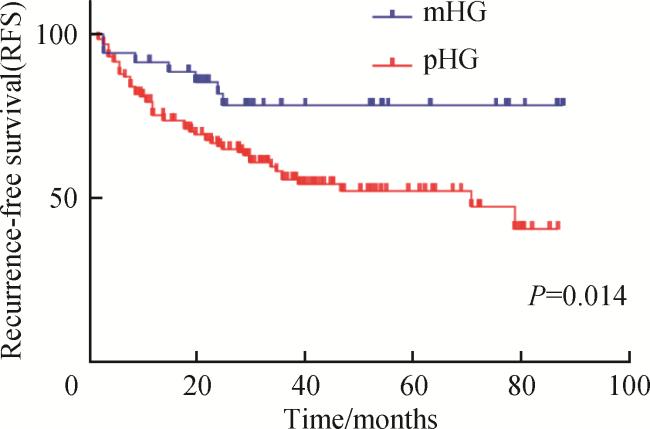
全部患者的中位随访时间为39.32(26.82, 61. 37)个月,mHG组有7例(20.0%)复发,pHG组有56例(42.4%)复发。Kaplan-Meier曲线提示两组的无复发生存(recurrence free survival, RFS)差异有统计学意义(图 1)。mHG组的5年RFS率显著优于pHG组(80.0% vs. 50.5%,P=0.01,图 1)。单因素Cox回归分析显示,T分期和肿瘤级别均与RFS相关。随后的多因素Cox回归分析进一步证实mHG是复发的独立保护因素(HR=0.42,P=0.02), 而T1是复发的独立危险因素(HR=2.09,P=0.01,表 2)。
图1 两组患者无复发生存期RFS的Kaplan-Meier曲线

Figure 1 Kaplan-Meier curve of RFS in the two groups

mHG, mixed high grade; pHG, pure high grade.

表2 单因素和多因素Cox风险回归分析

Table 2 Univariable and multivariable Cox regression analysis

Variables Univariate Multivariate
HR P HR P
Age/years 0.10
  ≤65 Reference
  >65 0.65 (0.39, 1.09)
Gender 0.64
  Male reference
  Female 1.08 (0.78, 1.51)
Smoking status 0.51
  Never reference
  Former/current 0.81 (0.44, 1.49)
Hypertension 0.88
  No reference
  Yes 0.96 (0.56, 1.64)
Diabetes mellitus 0.64
  No reference
  Yes 0.84 (0.41, 1.73)
Tumor size/cm 0.58
  ≤3 reference
  >3 0.67 (0.16, 2.82)
Stage 0.02 0.01
  Ta reference reference
  T1 2.02 (1.07, 3.81) 2.09
Pathology 0.03 0.02
  mHG 0.52 (0.19, 0.94) 0.52
  pHG reference reference
UTUC history 0.59
  No reference
  Yes 1.32 (0.46, 1.75)

mHG, mixed high grade; pHG, pure high grade; UTUC, upper tract urothelial carcinoma.

3 讨论

膀胱癌发生发展的分子机制仍不完全明确,与其他上皮性肿瘤类似,膀胱癌的发生通常遵循癌场变化理论,即长期逐渐发展的癌前组织和分子变化最终导致肿瘤的发生[9]。在临床实践和动物模型中,已经观察到增生、异常增生、非浸润性肿瘤、浸润性肿瘤等不同阶段的肿瘤表现[10-11]。低级别与高级别尿路上皮癌的来源并不相同,低级别尿路上皮癌多由异常增生的尿路上皮发展而来,而高级别尿路上皮癌更多由异型增生或原位癌发展而来,但两者的病程进展并非互不兼容,临床上部分初发为低级别病变的患者之后进展为高级别病变。同时,在膀胱癌组织中经常会出现低级别和高级别病变共存的情况,这种特征对于患者预后的影响并不明确。
本研究发现,pHG组的无复发生存显著优于mHG组。多因素Cox回归分析进一步证实合并低级别成分是复发的独立保护因素,这一结果说明,合并低级别成分的高级别尿路上皮癌对灌注化疗的反应性更好,在进行灌注化疗后复发率低于一般的高级别尿路上皮癌。
不同级别成分共存于同一瘤体和不同级别肿瘤共存于同一机体并不相同, 后者更可能是多原发肿瘤,提示存在广泛的癌变区域,这一现象在多原发性肺癌(multiple primary lung cancer, MPLC)病例中较为常见[12-13]。多原发肿瘤的分期、分级和预后通常根据最晚期的肿瘤来确定[14-15]。但是,当不同级别成分共存于同一瘤体时,情况却并不一样。本研究说明合并低级别成分的高级别尿路上皮癌预后更好。这一差异背后有两个可能的潜在机制:第一,高级别尿路上皮癌可由低级别尿路上皮癌进展而来,而在这一进展过程中可能出现高级别尿路上皮癌与低级别尿路上皮癌共存的状态,这种共存状态可视为早期的高级别尿路上皮癌,其预后显然会优于进展“完全”的高级别尿路上皮癌;第二,合并低级别成分的高级别尿路上皮癌可能为高级别尿路上皮癌与低级别尿路上皮癌同时发生于同一瘤体,相对于pHG,mHG可视为肿瘤直径更小的高级别肿瘤,而肿瘤直径是尿路上皮癌重要的预后影响因素,因此mHG的预后优于pHG。
基于本研究结果,mHG患者预后更好,其RFS显著优于pHG患者。从临床角度来说,这一结果具有一定意义,有可能改进NMIBC患者的风险分层,并为随访策略提供信息。
本研究存在一定的局限性。首先,所采用的回顾性队列设计可能会引入未被考虑在内的混杂变量;其次,研究仅仅纳入了原发性且单发的膀胱尿路上皮癌患者,其结论有待推广到其他膀胱癌人群;最后,本研究分析仅就接受了足疗程膀胱灌注化疗的患者进行,这可能导致选择偏倚。
本研究并未对患者的肿瘤进展率进行比较,其原因是本机构病理科并不能准确报告肌层浸润情况。此外,类似于前列腺的Gleason评分系统,肿瘤标本中高级别与低级别成分的比例也可能对预后有重要影响,但同样因标本质量和回顾性研究所限,病理报告中并未提及这类信息。通过标本质量的提高和进一步的前瞻性研究可以更深入地回答这一问题。
综上所述,mHG患者的预后与pHG患者不同。高级别尿路上皮癌合并低级别成分的NMIBC患者在接受足疗程膀胱灌注化疗后预后更好,其复发率显著低于单纯高级别NMIBC患者。对于那些频繁进行膀胱镜随访的高级别NMIBC患者,这一观察结果尤为重要。本课题组未来需要进行更深入的研究,以优化mHG亚组患者的治疗和随访策略。

利益冲突   所有作者均声明不存在利益冲突。

作者贡献声明   姬家祥:设计研究方案,撰写论文;赖金惠:统计分析数据,修改论文;王飞:收集数据,随访患者;胡浩:总体把关和审定论文。所有作者均参与论文修改,并对最终文稿进行审读和确认。

1
Richters A , Aben KKH , Kiemeney LALM . The global burden of urinary bladder cancer: An update[J]. World J Urol, 2020, 38 (8): 1895- 1904.

DOI

2
Kamat AM , Hahn NM , Efstathiou JA , et al. Bladder cancer[J]. Lancet, 2016, 388 (10061): 2796- 2810.

DOI

3
Koti M , Robert Siemens D . A step closer to predicting progression after bacillus calmette-guérin immunotherapy in high-risk non-muscle-invasive bladder cancer[J]. Eur Urol, 2023, 84 (5): 447- 448.

DOI

4
Epstein JI , Amin MB , Reuter VR , et al. The World Health Organization/International Society of Urological Pathology Consensus Classification of Urothelial (transitional cell) Neoplasms of the Urinary Bladder[J]. Am J Surg Pathol, 1998, 22 (12): 1435- 1448.

DOI

5
Budson AE , Droller DBJ , Dodson CS , et al. Electrophysiological dissociation of picture versus word encoding: The distinctiveness heuristic as a retrieval orientation[J]. J Cogn Neurosci, 2005, 17 (8): 1181- 1193.

DOI

6
Tang Q , Zuo W , Wan C , et al. Comprehensive genomic profiling of upper tract urothelial carcinoma and urothelial carcinoma of the bladder identifies distinct molecular characterizations with potential implications for targeted therapy & immunotherapy[J]. Front Immunol, 2023, 13, 1097730.

DOI

7
van Rhijn BWG , Mertens LS , Mayr R , et al. FGFR3 mutation status and FGFR3 expression in a large bladder cancer cohort treated by radical cystectomy: Implications for anti-FGFR3 treatment?[J]. Eur Urol, 2020, 78 (5): 682- 687.

DOI

8
Richter J , Jiang F , Gorog JP , et al. Marked genetic differences between stage pTa and stage pT1 papillary bladder cancer detected by comparative genomic hybridization[J]. Cancer Res, 1997, 57 (14): 2860- 2864.

9
Strandgaard T , Nordentoft I , Birkenkamp-Demtr der K , et al. Field cancerization is associated with tumor development, T-cell exhaustion, and clinical outcomes in bladder cancer[J]. Eur Urol, 2024, 85 (1): 82- 92.

DOI

10
Oliveira PA , Arantes-Rodrigues R , Vasconcelos-Nóbrega C . Animal models of urinary bladder cancer and their application to novel drug discovery[J]. Expert Opin Drug Discov, 2014, 9 (5): 485- 503.

DOI

11
Bondaruk J , Jaksik R , Wang Z , et al. The origin of bladder cancer from mucosal field effects[J]. iScience, 2022, 25 (7): 104551.

DOI

12
Wu SC , Lin ZQ , Xu CW , et al. Multiple primary lung cancers[J]. Chest, 1987, 92 (5): 892- 896.

DOI

13
Shintani Y , Okami J , Ito H , et al. Clinical features and outcomes of patients with stage Ⅰ multiple primary lung cancers[J]. Cancer Sci, 2021, 112 (5): 1924- 1935.

DOI

14
Romaszko AM , Doboszyńska A . Multiple primary lung cancer: A literature review[J]. Adv Clin Exp Med, 2018, 27 (5): 725- 730.

DOI

15
Wang H , Hou J , Zhang G , et al. Clinical characteristics and prognostic analysis of multiple primary malignant neoplasms in patients with lung cancer[J]. Cancer Gene Ther, 2019, 26 (11/12): 419- 426.

Outlines

/