Journal of Peking University (Health Sciences) ›› 2026, Vol. 58 ›› Issue (4): 803-807. doi: 10.19723/j.issn.1671-167X.2026.04.017

Previous Articles     Next Articles

Impact of coexistent low-grade components on the prognosis of high-grade non-muscle invasive bladder cancer

Jiaxiang JI, Chinhui LAI, Fei WANG, Hao HU*()   

  1. Department of Urology, Peking University People's Hospital, Beijing 100044, China
  • Received:2024-03-18 Online:2026-08-18 Published:2026-02-25
  • Contact: Hao HU

RICH HTML


Abstract:

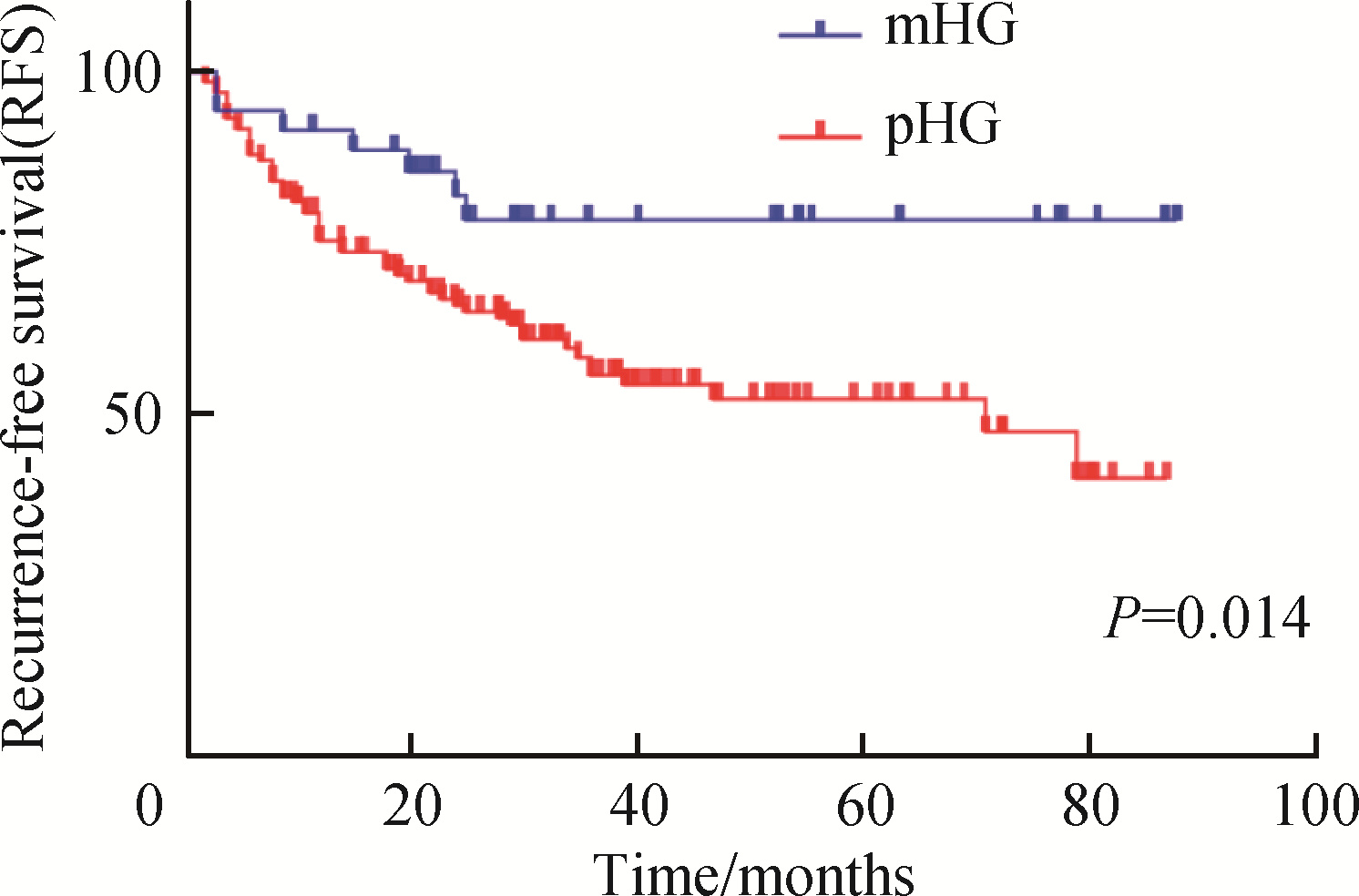
Objective: To evaluate the impact of coexisted low-grade components on the prognosis of patients with high-grade solitary primary non-muscle invasive bladder cancer (NMIBC). Methods: A retrospective analysis was conducted on patients diagnosed with primary, solitary, high-grade non-muscle invasive bladder cancer (NMIBC) who underwent transurethral resection of bladder tumor (TURBT) at Peking University People' s Hospital between January 2015 and December 2019. All patients received single-dose intravesical chemotherapy within 24 hours after TURBT. Only patients accetpting adequate adjuvant intravesical chemotherapy were included for further analysis. Adequate intravesical chemotherapy was defined as weekly instillation for 8 weeks and monthly instillation for at least 6 months. All patients were strictly followed up according to the preestablished schedule with cystoscopic surveillance. The primary endpoint was recurrence free survival. Kaplan-Meier curve was used to compare the recurrence free survival of mHG group and pHG group. Univariable and multivariable Cox regression was conducted to evaluate the risk factors for tumor recurrence. Patients with variant histology, concurrent upper tract urothelial carcinoma, and incomplete resection which required re-TURBT were excluded. Patients without single instillation postoperative were also eliminated from the final cohort. Results: A total of 167 patients were enrolled in the final cohort, with 35 patients having mixed high-grade tumors (mHG) and 132 patients having pure high-grade tumors (pHG). The median follow-up time was 39.32 (26.82, 61.37) months. Baseline characteristics were well balanced between the two groups with regard to age, gender, pathological characteristics and instillation doses. Compared with the mHG group, the 5-year recurrence-free survival rate (RFS) of the pHG group was significantly lower (80.0% vs. 50.5%, P=0.01). Multivariate Cox regression analysis further confirmed that the presence of mixed low-grade components was an independent protective factor for recurrence free survival (HR=0.42, P=0.02), and other risk factors included T1 stage (HR=2.09, P=0.01). while tumor size was not associated with recurrence free survival. Conclusion: Coexistence of low-grade component in pathological specimen was associated with lower recurrence rate in patients with primary, solitary high-grade non-muscle invasive bladder cancer. Thus, it should be considered as a favorable pathological feature in bladder cancer patients.

Key words: Non-muscle invasive bladder cancer (NMIBC), High-grade, Coexistence, Low-grade, Prognosis

CLC Number: 

  • R737.14

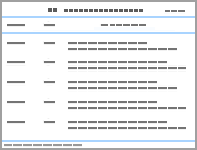
Table 1

Baseline characteristics of the whole cohort"

Variable mHG (n=35) pHG (n=132) P
Age/years 0.58
  ≤65 12 52
  >65 23 80
Gender 0.86
  Male 27 100
  Female 8 32
Smoking status 0.66
  Never 27 97
  Former/current 8 35
UTUC history 0.18
  Yes 0 8
  No 35 124
Hypertension 0.59
  No 20 82
  Yes 15 50
Diabetes mellitus 0.46
  No 30 106
  Yes 5 26
Tumor size/cm 0.34
  ≤3 32 126
  >3 3 6
Pathological stage 0.13
  Ta 32 112
  T1 3 20
Median instillation numbers 15 16 0.54
Recurrence 0.01
  No 28 76
  Yes 7 56

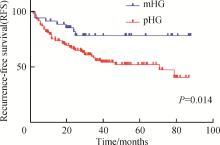
Figure 1

Kaplan-Meier curve of RFS in the two groups mHG, mixed high grade; pHG, pure high grade."

Table 2

Univariable and multivariable Cox regression analysis"

Variables Univariate Multivariate
HR P HR P
Age/years 0.10
  ≤65 Reference
  >65 0.65 (0.39, 1.09)
Gender 0.64
  Male reference
  Female 1.08 (0.78, 1.51)
Smoking status 0.51
  Never reference
  Former/current 0.81 (0.44, 1.49)
Hypertension 0.88
  No reference
  Yes 0.96 (0.56, 1.64)
Diabetes mellitus 0.64
  No reference
  Yes 0.84 (0.41, 1.73)
Tumor size/cm 0.58
  ≤3 reference
  >3 0.67 (0.16, 2.82)
Stage 0.02 0.01
  Ta reference reference
  T1 2.02 (1.07, 3.81) 2.09
Pathology 0.03 0.02
  mHG 0.52 (0.19, 0.94) 0.52
  pHG reference reference
UTUC history 0.59
  No reference
  Yes 1.32 (0.46, 1.75)
1
Richters A , Aben KKH , Kiemeney LALM . The global burden of urinary bladder cancer: An update[J]. World J Urol, 2020, 38 (8): 1895- 1904.

doi: 10.1007/s00345-019-02984-4
2
Kamat AM , Hahn NM , Efstathiou JA , et al. Bladder cancer[J]. Lancet, 2016, 388 (10061): 2796- 2810.

doi: 10.1016/S0140-6736(16)30512-8
3
Koti M , Robert Siemens D . A step closer to predicting progression after bacillus calmette-guérin immunotherapy in high-risk non-muscle-invasive bladder cancer[J]. Eur Urol, 2023, 84 (5): 447- 448.

doi: 10.1016/j.eururo.2023.06.017
4
Epstein JI , Amin MB , Reuter VR , et al. The World Health Organization/International Society of Urological Pathology Consensus Classification of Urothelial (transitional cell) Neoplasms of the Urinary Bladder[J]. Am J Surg Pathol, 1998, 22 (12): 1435- 1448.

doi: 10.1097/00000478-199812000-00001
5
Budson AE , Droller DBJ , Dodson CS , et al. Electrophysiological dissociation of picture versus word encoding: The distinctiveness heuristic as a retrieval orientation[J]. J Cogn Neurosci, 2005, 17 (8): 1181- 1193.

doi: 10.1162/0898929055002517
6
Tang Q , Zuo W , Wan C , et al. Comprehensive genomic profiling of upper tract urothelial carcinoma and urothelial carcinoma of the bladder identifies distinct molecular characterizations with potential implications for targeted therapy & immunotherapy[J]. Front Immunol, 2023, 13, 1097730.

doi: 10.3389/fimmu.2022.1097730
7
van Rhijn BWG , Mertens LS , Mayr R , et al. FGFR3 mutation status and FGFR3 expression in a large bladder cancer cohort treated by radical cystectomy: Implications for anti-FGFR3 treatment?[J]. Eur Urol, 2020, 78 (5): 682- 687.

doi: 10.1016/j.eururo.2020.07.002
8
Richter J , Jiang F , Gorog JP , et al. Marked genetic differences between stage pTa and stage pT1 papillary bladder cancer detected by comparative genomic hybridization[J]. Cancer Res, 1997, 57 (14): 2860- 2864.
9
Strandgaard T , Nordentoft I , Birkenkamp-Demtr der K , et al. Field cancerization is associated with tumor development, T-cell exhaustion, and clinical outcomes in bladder cancer[J]. Eur Urol, 2024, 85 (1): 82- 92.

doi: 10.1016/j.eururo.2023.07.014
10
Oliveira PA , Arantes-Rodrigues R , Vasconcelos-Nóbrega C . Animal models of urinary bladder cancer and their application to novel drug discovery[J]. Expert Opin Drug Discov, 2014, 9 (5): 485- 503.

doi: 10.1517/17460441.2014.902930
11
Bondaruk J , Jaksik R , Wang Z , et al. The origin of bladder cancer from mucosal field effects[J]. iScience, 2022, 25 (7): 104551.

doi: 10.1016/j.isci.2022.104551
12
Wu SC , Lin ZQ , Xu CW , et al. Multiple primary lung cancers[J]. Chest, 1987, 92 (5): 892- 896.

doi: 10.1378/chest.92.5.892
13
Shintani Y , Okami J , Ito H , et al. Clinical features and outcomes of patients with stage Ⅰ multiple primary lung cancers[J]. Cancer Sci, 2021, 112 (5): 1924- 1935.

doi: 10.1111/cas.14748
14
Romaszko AM , Doboszyńska A . Multiple primary lung cancer: A literature review[J]. Adv Clin Exp Med, 2018, 27 (5): 725- 730.

doi: 10.17219/acem/68631
15
Wang H , Hou J , Zhang G , et al. Clinical characteristics and prognostic analysis of multiple primary malignant neoplasms in patients with lung cancer[J]. Cancer Gene Ther, 2019, 26 (11/12): 419- 426.
[1] Zhiming DU, Weiliang ZHANG, Lei ZHAO, Min QIU, Lulin MA, Ye YAN, Huiying HE, Ruiyang XIE, Shudong ZHANG. Clinicopathological features and prognostic factors associated with long-term survival (≥5 years) in patients with clear cell renal cell carcinoma and venous tumor thrombus [J]. Journal of Peking University (Health Sciences), 2026, 58(4): 692-699.
[2] Guangwei ZHENG, Yun PENG, Yiqing DU, Tao XU. Expression characteristics and clinical significance of ERBB2 in bladder urothelial carcinoma based on the TCGA database [J]. Journal of Peking University (Health Sciences), 2026, 58(4): 818-826.
[3] Bo PENG, Fangfang LIU, Wei YANG, Ruiping XU, Lei CHEN, Baozhong LI, Xinjia WANG, Ji KE, Wenlei YANG, Yu HE, Zhen LIU, Bolin HOU, Liqun ZHANG, Miaoping LIN, Lixin ZHANG, Fan ZHANG, Fen CAI, Huawen XU, Mengfei LIU, Ying LIU, Yaqi PAN, Zhonghu HE, Yang KE. Perioperative hyperglycemia predicts poorer prognosis of esophageal squamous cell carcinoma patients treated with esophagectomy [J]. Journal of Peking University (Health Sciences), 2026, 58(3): 567-574.
[4] Fan SHU, Liyuan GE, Hanzhang DENG, Haoming YIN, Junyong OU, Shaohui DENG, Yichang HAO, Min LU, Zhanyi ZHANG, Peichen DUAN, Shudong ZHANG. Molecular characteristics for poor prognosis related renal cell carcinoma with lymph metastases [J]. Journal of Peking University (Health Sciences), 2026, 58(3): 631-640.
[5] Lingfu ZHANG, Ming CHEN, Xiaoyu ZHAO, Gang WANG, Long CUI, Xiaofeng LING, Lixin WANG, Zhi XU, Limei GUO, Chunsheng HOU. Gross classification of gallbladder cancer with primary lesion limited to the gallbladder wall and its correlation with prognosis and precancerous lesions [J]. Journal of Peking University (Health Sciences), 2026, 58(1): 184-189.
[6] Boda GUO, Min LU, Guoliang WANG, Hongxian ZHANG, Lei LIU, Xiaofei HOU, Lei ZHAO, Xiaojun TIAN, Shudong ZHANG. Clinicopathological and prognostic differences between clear cell and non-clear cell renal cell carcinoma with venous tumor thrombus [J]. Journal of Peking University (Health Sciences), 2025, 57(4): 644-649.
[7] Weihao LI, Jing LI, Xuemin ZHANG, Wei LI, Qingle LI, Xiaoming ZHANG. Effect of intraoperative blood salvage autotransfusion on the prognosis of patients after carotid body tumor resection [J]. Journal of Peking University (Health Sciences), 2025, 57(2): 272-276.
[8] Yaqing MAO, Zhen CHEN, Yao YU, Wenbo ZHANG, Yang LIU, Xin PENG. Impact of type 2 diabetes mellitus on the prognosis of patients with oral squamous cell carcinoma [J]. Journal of Peking University (Health Sciences), 2024, 56(6): 1089-1096.
[9] Junyong OU,Kunming NI,Lulin MA,Guoliang WANG,Ye YAN,Bin YANG,Gengwu LI,Haodong SONG,Min LU,Jianfei YE,Shudong ZHANG. Prognostic factors of patients with muscle invasive bladder cancer with intermediate-to-high risk prostate cancer [J]. Journal of Peking University (Health Sciences), 2024, 56(4): 582-588.
[10] Shuai LIU,Lei LIU,Zhuo LIU,Fan ZHANG,Lulin MA,Xiaojun TIAN,Xiaofei HOU,Guoliang WANG,Lei ZHAO,Shudong ZHANG. Clinical treatment and prognosis of adrenocortical carcinoma with venous tumor thrombus [J]. Journal of Peking University (Health Sciences), 2024, 56(4): 624-630.
[11] Le YU,Shaohui DENG,Fan ZHANG,Ye YAN,Jianfei YE,Shudong ZHANG. Clinicopathological characteristics and prognosis of multilocular cystic renal neoplasm of low malignant potential [J]. Journal of Peking University (Health Sciences), 2024, 56(4): 661-666.
[12] Zezhen ZHOU,Shaohui DENG,Ye YAN,Fan ZHANG,Yichang HAO,Liyuan GE,Hongxian ZHANG,Guoliang WANG,Shudong ZHANG. Predicting the 3-year tumor-specific survival in patients with T3a non-metastatic renal cell carcinoma [J]. Journal of Peking University (Health Sciences), 2024, 56(4): 673-679.
[13] Yangyi FANG,Qiang LI,Zhigao HUANG,Min LU,Kai HONG,Shudong ZHANG. Well-differentiated papillary mesothelial tumour of the tunica vaginalis: A case report [J]. Journal of Peking University (Health Sciences), 2024, 56(4): 741-744.
[14] Yuanyuan ZENG,Yun XIE,Daonan CHEN,Ruilan WANG. Related factors of euthyroid sick syndrome in patients with sepsis [J]. Journal of Peking University (Health Sciences), 2024, 56(3): 526-532.
[15] Jian-bin LI,Meng-na LYU,Qiang CHI,Yi-lin PENG,Peng-cheng LIU,Rui WU. Early prediction of severe COVID-19 in patients with Sjögren’s syndrome [J]. Journal of Peking University (Health Sciences), 2023, 55(6): 1007-1012.
Viewed
Full text


Abstract

Cited

  Shared   
  Discussed   
No Suggested Reading articles found!