Journal of Peking University (Health Sciences) ›› 2025, Vol. 57 ›› Issue (3): 545-553. doi: 10.19723/j.issn.1671-167X.2025.03.019

Previous Articles     Next Articles

Disease burden and future trend predictions of age-related hearing loss in China and worldwide from 1990 to 2021

Abudurexiti ANARGUL1, Yinghao SONG1, Xiaojin YAN2, Yongkang GAO1, Bo LIU3,*(), Gang HU1,4,*()   

  1. 1. College of Health Management, Xinjiang Medical University, Urumqi 830000, China
    2. Institute of Population Research, Peking University, Beijing 100871, China
    3. Administration of Traditional Chinese Medicine of Xinjiang Uygur Autonomous Region, Urumqi 830000, China
    4. Health Management Center, The First Affiliated Hospital of Xinjiang Medical University, Urumqi 830000, China
  • Received:2025-01-03 Online:2025-06-18 Published:2025-06-13
  • Contact: Bo LIU, Gang HU
  • Supported by:
    the Natural Science Foundation of Xinjiang Uygur Autonomous Region(2023D01C37)

RICH HTML


Abstract:

Objective: To describe the trend of changes in the disease burden of age-related hearing loss in China and globally from 1990 to 2021, to forecast the prevalence and years lived with disability (YLD) rates of age-related hearing loss from 2022 to 2036, and to provide a reference for the prevention and control of the disease burden associated with age-related hearing loss. Methods: Using the Global Burden of Disease 2021 (GBD2021) data, this study selected age-standardized prevalence rate (ASPR) and YLD as indicators. The disease burden and long-term trends of age-related hearing loss in China and globally from 1990 to 2021 were described by different socio-demographic index (SDI) and gender. Joinpoint regression was used to calculate the average annual percent change (AAPC) to assess the trend changes in the disease burden. Decomposition analysis was applied to explore the relative impacts of aging, population growth, and epidemiological changes on the variation in disease burden. An autoregressive integrated moving average (ARIMA) model was used to forecast the age-standardized pre-valence rate and YLD rates from 2022 to 2036. Results: The prevalence of age-related hearing loss in China in 2021 was 82 162.49 (73 288.08-89 187.21) per 100 000, higher than the global SDI level of 66 238.16 (59 982.54-72 669.82) per 100 000, the high SDI region ' s level of 57 650.42 (52 059.12-63 889.02) per 100 000, the upper-middle SDI region ' s level of 69 115.59 (62 494.18- 75 340.64) per 100 000, the middle SDI region ' s level of 72 365.56 (65 181.43-78 912.01) per 100 000, the lower-middle SDI region ' s level of 64 439.66 (58 368.22-71 468.27) per 100 000, and the low SDI region ' s level of 61 725.25 (55 749.18-68 477.67) per 100 000. The age- related hearing loss YLD rate in China was 2 762.98 [95% uncertainty interval (UI): 1 855.28-3 880.68] per 100 000, higher than the global SDI level of 2 236.75 (95%UI: 1 511.56-3 155.88) per 100 000, the high SDI region ' s level of 1 805.79 (95%UI: 1 212.69-2 577.17) per 100 000, the upper-middle SDI region ' s level of 2 316.58 (95%UI: 1 557.53-3 274.87) per 100 000, the middle SDI region ' s level of 2 480.99 (95%UI: 1 678.17-3 489.24) per 100 000, the lower-middle SDI region ' s level of 2 313.28 (95%UI: 1 578.35-3 271.50) per 100 000, and the low SDI region ' s level of 2 383.55 (95%UI: 1 623.66-3 365.68) per 100 000. From 1990 to 2021, both the prevalence and YLD rate of age-related hearing loss in China showed an increasing trend, rising by an average of 0.18% (95%CI: 0.16%-0.19%) and 0.29% (95%CI: 0.27%-0.30%) per year, respectively. The rates of increase in prevalence were the same for both men and women, with men showing a 0.18% increase (95%CI: 0.17%-0.19%, P < 0.001) and women showing a 0.18% increase (95%CI: 0.16%-0.19%, P < 0.001). However, the YLD rate increase was faster in men than in women, with men experiencing a 0.32% increase (95%CI: 0.27%-0.37%, P < 0.001) and women experiencing a 0.27% increase (95%CI: 0.26%-0.28%, P < 0.001). Decomposition analysis showed that population growth was the main factor driving the increase in prevalence and YLD rate globally and across different SDI regions. However, aging was the primary factor contributing to the increase in prevalence and YLD rate in China. ARIMA model predictions suggested that the prevalence and YLD rate of age-related hearing loss would continue to rise from 2022 to 2036, with the predicted prevalence and YLD rate in 2036 reaching 89 723.99 per 100 000 and 2 872.47 per 100 000, respectively. Conclusion: The prevalence and disease burden of age-related hearing loss in individuals aged 60 and above in China rank first globally. From 1990 to 2021, both the prevalence and YLD rate of age-related hearing loss have shown a continuous upward trend, consistently surpassing the levels observed in various SDI regions worldwide. The prevalence and disease burden of age-related hearing loss are particularly significant among elderly men. Moreover, projections indicate that the disease burden of age-related hearing loss will continue to rise over the next 15 years. Therefore, it is urgent to pay close attention to age-related hearing loss in this specific population, and early intervention measures are crucial to reduce the disease burden associated with age-related hearing loss.

Key words: Age-related hearing loss, Prevalence, Years of life lost due to disability, Disease burden

CLC Number: 

  • R195.4

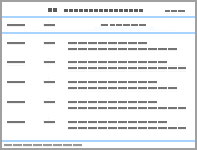
Table 1

The prevalence and YLD rates of age-related hearing loss in China and different SDI regions around the world in 2021"

Items Prevalence (/100 000) (95%UI)
Total Male Female
Worldwide 66 238.16 (59 982.54, 72 669.82) 69 157.43 (62 608.42, 75 808.62) 63 650.49 (57 619.38, 69 924.12)
China 82 162.49 (73 288.08, 89 187.21) 83 239.67 (74 116.27, 90 367.20) 81 109.96 (72 320.34, 88 205.83)
High SDI 57 650.42 (52 059.12, 63 889.02) 62 629.90 (56 393.55, 69 611.13) 53 157.72 (48 076.72, 58 752.49)
Upper-middle SDI 69 115.59 (62 494.18, 75 340.64) 72 115.95 (65 119.49, 78 576.69) 66 629.62 (60 161.80, 72 700.20)
Middle SDI 72 365.56 (65 181.43, 78 912.01) 74 117.43 (66 896.74, 80 775.69) 70 764.28 (63 699.81, 77 225.86)
Lower-middle SDI 64 439.66 (58 368.22, 71 468.27) 66 760.33 (60 541.34, 73 990.02) 62 339.07 (56 372.16, 69 287.31)
Low SDI 61 725.25 (55 749.18, 68 477.67) 64391.41 (58 283.87, 71 048.12) 59 216.28 (53 338.05, 65 940.98)
Items YLD rate (/100 000) (95%UI)
Total Male Female
Worldwide 2 236.75 (1 511.56, 3 155.88) 2 340.52 (1 579.79, 3 313.09) 2 146.71 (1 452.03, 3 029.75)
China 2 762.98 (1 855.28, 3 880.68) 2 854.99 (1 910.45, 4 017.34) 2 675.33 (1 796.64, 3 751.90)
High SDI 1 805.79 (1 212.69, 2 577.17) 1 958.63 (1 308.65, 2 798.77) 1 671.24 (1 126.65, 2 381.55)
Upper-middle SDI 2 316.58 (1 557.53, 3 274.87) 2 440.79 (1 639.39, 3 448.78) 2 215.41 (1 491.18, 3 132.33)
Middle SDI 2 480.99 (1 678.17, 3 489.24) 2 559.40 (1 735.57, 3 607.99) 2 409.93 (1 630.03, 3 394.81)
Lower-middle SDI 2 313.28 (1 578.35, 3 271.50) 2 376.01 (1 622.71, 3 355.52) 2 257.96 (1 539.18, 3 194.87)
Low SDI 2 383.55 (1 623.66, 3 365.68) 2 429.69 (1 652.47, 3 414.24) 2 340.55 (1 595.58, 3 305.33)

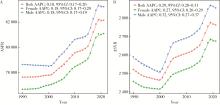
Figure 1

Sex-age-standardized prevalence rate(A) and YLD rate(B) of age-related hearing loss in China from 1990 to 2021 ASPR, age-standardized prevalence rate; AAPC, average annual percent change; ASYR, age-standardized YLD rate; YLD, years lived with disability."

Figure 2

Regional-age-standardized prevalence(A) and YLD rates(B) of age-related hearing loss in China and different SDI countries from 1990 to 2021 SDI, socio-demographic index; ASPR, age-standardized prevalence rate; AAPC, average annual percent change; ASYR, age-standardized YLD rate; YLD, years lived with disability."

Figure 3

Decomposition analysis of age-standardized incidence(A) and YLDs(B) of age-related hearing loss in China and different SDI regions from 1990 to 2021 SDI, socio-demographic index; YLD, years lived with disability."

Figure 4

Prediction of trends in sex-age-standardized prevalence of age-related hearing loss over the next 15 years (from 2022 to 2036) ASPR, age-standardized prevalence rate."

Figure 5

Prediction of trends in sex-age-standardized YLD rates of age-related hearing loss over the next 15 years (from 2022 to 2036) ASYR, age-standardized YLD rate; YLD, years lived with disability."

1
NIDCD. Age-related hearing loss [EB/OL]. (2018-11-25) [2023-03-17]. https://www.nidcd.nih.gov/health/age-related-hearing-loss.
2
Bowl MR , Dawson SJ . Age-related hearing loss[J]. Cold Spring Harb Perspect Med, 2019, 9 (8): a033217.

doi: 10.1101/cshperspect.a033217
3
Vaisbuch Y , Santa Maria PL . Age-related hearing loss: Innovations in hearing augmentation[J]. Otolaryngol Clin North Am, 2018, 51 (4): 705- 723.

doi: 10.1016/j.otc.2018.03.002
4
World Health Organization. World report on hearing [R]. Geneva: WHO, 2021.
5
World Health Organization. World report on hearing [R]. Geneva: WHO, 2024.
6
Li J , Zhao H , Huang B , et al. A survey on hearing acuity of centenarians in Hainan Province[J]. J Otol, 2018, 13 (4): 135- 137.

doi: 10.1016/j.joto.2018.11.008
7
Chang HP , Chou P . Presbycusis among older Chinese people in Taipei, Taiwan: A community-based study[J]. Int J Audiol, 2007, 46 (12): 738- 745.

doi: 10.1080/14992020701558529
8
国家卫健委发布2020年度国家老龄事业发展公报我国60岁以上老人2.6亿多人[EB/OL]. (2021-10-15) [2024-11-09]. https://baijiahao.baidu.com/s?id=1713692922453334407&wfr=spider&for=pc.
9
GBD 2019 Mental Disorders Collaborators . Global, regional, and national burden of 12 mental disorders in 204 countries and territories, 1990-2019: A systematic analysis for the Global Burden of Disease Study 2019[J]. Lancet Psychiatry, 2022, 9 (2): 137- 150.

doi: 10.1016/S2215-0366(21)00395-3
10
GBD 2019 Diseases and Injuries Collaborators . Global burden of 369 diseases and injuries in 204 countries and territories, 1990-2019: A systematic analysis for the Global Burden of Disease Study 2019[J]. Lancet, 2020, 396 (10258): 1204- 1222.

doi: 10.1016/S0140-6736(20)30925-9
11
GBD 2019 Hearing Loss Collaborators . Hearing loss prevalence and years lived with disability, 1990-2019: Findings from the Global Burden of Disease Study 2019[J]. Lancet, 2021, 397 (10278): 996- 1009.

doi: 10.1016/S0140-6736(21)00516-X
12
GBD 2016 Disease and Injury Incidence and Prevalence Collaborators . Global, regional, and national incidence, prevalence, and years lived with disability for 328 diseases and injuries for 195 countries, 1990-2016: A systematic analysis for the Global Burden of Disease Study 2016[J]. Lancet, 2017, 390 (10100): 1211- 1259.

doi: 10.1016/S0140-6736(17)32154-2
13
Kassebaum NJ , Arora M , Barber RM . Global, regional, and national disability-adjusted life-years (DALYs) for 315 diseases and injuries and healthy life expectancy (HALE), 1990-2015: A systematic analysis for the Global Burden of Disease Study 2015[J]. Lancet, 2016, 388 (10053): 1603- 1658.

doi: 10.1016/S0140-6736(16)31460-X
14
曾四清. Joinpoint回归模型及其在传染病流行趋势分析中的应用[J]. 中国卫生统计, 2019, 36 (5): 787- 791.
15
Kim HJ , Fay MP , Feuer EJ , et al. Permutation tests for Joinpoint regression with applications to cancer rates[J]. Stat Med, 2000, 19 (3): 335- 351.

doi: 10.1002/(SICI)1097-0258(20000215)19:3<335::AID-SIM336>3.0.CO;2-Z
16
Deng XX , Li H , Zhong YR , et al. Burden of liver cancer attribu-table to hepatitis B and alcohol globally, in China, and for five sociodemographic index regions from 1990 to 2021: A population-based study[J]. J Clin Transl Hepatol, 2025, 13 (1): 1- 14.
17
李欣欣, 柳安琪, 王丹, 等. 2020年中国工业企业接触噪声劳动者听力损失流行病学特征分析[J]. 中华疾病控制杂志, 2022, 26 (8): 882- 887.
18
Man J , Chen H , Zhang T , et al. Global, regional, and national burden of age-related hearing loss from 1990 to 2019[J]. Aging (Albany NY), 2021, 13 (24): 25944- 25959.
19
Stevens G , Flaxman S , Brunskill E , et al. Global and regional hearing impairment prevalence: An analysis of 42 studies in 29 countries[J]. Eur J Public Health, 2013, 23 (1): 146- 152.

doi: 10.1093/eurpub/ckr176
20
Orji A , Kamenov K , Dirac M , et al. Global and regional needs, unmet needs and access to hearing aids[J]. Int J Audiol, 2020, 59 (3): 166- 172.

doi: 10.1080/14992027.2020.1721577
21
Vollset SE , Goren E , Yuan CW , et al. Fertility, mortality, migration, and population scenarios for 195 countries and territories from 2017 to 2100: A forecasting analysis for the Global Burden of Disease Study[J]. Lancet, 2020, 396 (10258): 1285- 1306.

doi: 10.1016/S0140-6736(20)30677-2
22
乔晓春. 中国人口老龄化的过去、现在和未来[J]. 社会政策研究, 2024, 34 (1): 47- 63.
23
中华人民共和国中央人民政府. 第七次全国人口普查公报[EB/OL]. (2021-05-11) [2025-01-12]. https://www.gov.cn/guoqing/2021-05/13/content_5606149.htm.
24
徐杰茹, 陈磊, 王冕, 等. 1990—2019年中国女性卵巢癌发病趋势分析与预测[J]. 现代预防医学, 2021, 48 (19): 3457- 3460.
25
马一鸣, 丁勇. 我国2012—2021年4种肝炎流行趋势的时间序列分析和预测[J]. 南京医科大学学报(自然科学版), 2024, 44 (1): 72- 79.
26
王丽, 曹世义, 宋开发, 等. ARIMA模型在荆州市手足口病疫情预测中的应用[J]. 中国社会医学杂志, 2023, 40 (5): 623- 626.
27
陈雯, 刘艳, 宇传华. 1990—2019年中国归因于吸烟的膀胱癌疾病负担年龄-时期-队列分析及预测[J]. 中国卫生统计, 2023, 40 (5): 642- 645.
28
GBD 2019 Risk Factors Collaborators . Global burden of 87 risk factors in 204 countries and territories, 1990-2019: A systematic analysis for the Global Burden of Disease Study 2019[J]. Lancet, 2020, 396 (10258): 1223- 1249.
[1] Xin CHEN, Junting YANG, Jinxin GUO, Shuya LI, Zhike LIU, Yingliang ZHU, Fengjuan LI, Siyan ZHAN, Juanjuan GUO. Prevalence characteristics of autoimmune thyroid disease in women aged 10-59 years in Qingdao City from 2022 to 2024 [J]. Journal of Peking University (Health Sciences), 2025, 57(3): 507-513.
[2] Fangru LIN, Zhihui TANG. Correlation analysis of peri-implant health after single-tooth dental implant [J]. Journal of Peking University (Health Sciences), 2025, 57(2): 347-353.
[3] Yuanyuan ZENG,Yun XIE,Daonan CHEN,Ruilan WANG. Related factors of euthyroid sick syndrome in patients with sepsis [J]. Journal of Peking University (Health Sciences), 2024, 56(3): 526-532.
[4] Qiang FU,Guan-ying GAO,Yan XU,Zhuo-hua LIN,You-jing SUN,Li-gang CUI. Comparative study of ultrasound and magnetic resonance imaging in the diagnosis of asymptomatic anterosuperior acetabular labrum tears [J]. Journal of Peking University (Health Sciences), 2023, 55(4): 665-669.
[5] Yong-wei LIN,Ya-lin ZHOU,Run-long ZHAO,Ya-jun XU,Yan-ping LIU. Analysis on the iron status and associated factors during the first trimester of pregnancy [J]. Journal of Peking University (Health Sciences), 2023, 55(4): 600-605.
[6] WU Jun-hui,CHEN Hong-bo,WU Yi-qun,WU Yao,WANG Zi-jing,WU Tao,WANG Meng-ying,WANG Si-yue,WANG Xiao-wen,WANG Jia-ting,YU Huan,HU Yong-hua. Prevalence and risk factors of osteoarthritis in patients with type 2 diabetes in Beijing, China from 2015 to 2017 [J]. Journal of Peking University (Health Sciences), 2021, 53(3): 518-522.
[7] Yan GENG,Zhi-bo SONG,Xiao-hui ZHANG,Xue-rong DENG,Yu WANG,Zhuo-li ZHANG. Depression and anxiety in patients with psoriatic arthritis: Prevalence and associated factors [J]. Journal of Peking University (Health Sciences), 2020, 52(6): 1048-1055.
[8] Si-wei DENG,Ze-yi CHEN,Zhi-ke LIU,Jian WANG,Lin ZHUO,Shuang-qing GAO,Jia-kuo YU,Si-yan ZHAN. Epidemiological study of bone and joint injury based on urban medical insurance database [J]. Journal of Peking University (Health Sciences), 2020, 52(3): 527-534.
[9] Lu XU,Lu CHEN,Dong-sheng FAN,Jing-nan FENG,Li-li LIU,Si-yan ZHAN,Sheng-feng WANG. Calculation of the prevalence of progressive muscular atrophy among adults in China based on urban medical insurance data from 15 provinces [J]. Journal of Peking University (Health Sciences), 2020, 52(3): 521-526.
[10] SHI Hui-feng, ZHANG Jing-xu, ZHANG Rong, WANG Xiao-li. Prevalence of autism spectrum disorders in children aged 0-6 years in China: a meta-analysis [J]. Journal of Peking University(Health Sciences), 2017, 49(5): 798-806.
[11] LI Heng, HUANG Yue-Qin, MA Ya-Ting, LIU Zhao-Rui. Descriptive epidemiological study on disabilities attributed to non-dementia organic mental disorder in China [J]. Journal of Peking University(Health Sciences), 2014, 46(2): 247-253.
Viewed
Full text


Abstract

Cited

  Shared   
  Discussed   
No Suggested Reading articles found!