Journal of Peking University (Health Sciences) ›› 2025, Vol. 57 ›› Issue (4): 721-726. doi: 10.19723/j.issn.1671-167X.2025.04.015

Previous Articles     Next Articles

Sperm donation utilization rates in nonobstructive azoospermia patients under different testicular sperm retrieval methods during assisted reproductive technology cycles

Qianxi CHEN1,2, Yan CHEN1,2, Zhongjie ZHENG1,2, Wenhao TANG1,2, Zhen LIU1,2, Kai HONG1,2,*(), Haocheng LIN1,2,*()   

  1. 1. Department of Urology, Peking University Third Hospital, Beijing 100191, China
    2. Center for Reproductive Medicine, Peking University Third Hospital, Beijing 100191, China
  • Received:2025-02-28 Online:2025-08-18 Published:2025-08-02
  • Contact: Kai HONG, Haocheng LIN
  • Supported by:
    the National Natural Science Foundation of China(82371633)

RICH HTML


Abstract:

Objective: To analyze the proportion of nonobstructive azoospermia (NOA) patients opting for sperm bank donation under different sperm retrieval methods [percutaneous testicular sperm aspiration (TESA), microdissection testicular sperm extraction (mTESE)] and its influencing factors. Methods: Retrospective data from assisted reproductive technology (ART) cycles at the Center for Reproductive Medical, Peking University Third Hospital (from January 2019 to December 2023) were collected. Data-complete ART cycles involving NOA patients and their partners (using the last treatment cycle as the endpoint) were selected. Sperm donation utilization rates were compared across retrieval methods (fresh mTESE, fresh TESA, thawed mTESE, thawed TESA). Log-linear models were used to analyze the relationship between sperm retrieval method and sperm source. Results: Among the 1 730 couples, the overall sperm donation utilization rate was 12.66%. The highest rate occurred in the fresh mTESE group (23.42%), followed by the thawed mTESE group (5.87%). The rates for the fresh TESA and thawed TESA groups were 5.22% and 0%, respectively. Log-linear analysis demonstrated that sperm retrieval method was significantly associated with sperm source (mTESE: Estimate=4.499; TESA: Estimate=2.780; P < 0.001). Conclusion: The low overall sperm donation utilization rate in ART cycles may reflect the efficacy of synchronous sperm retrieval ART. The proportion of NOA patients opting for sperm donation was influenced by the retrieval method. Compared with patients undergoing TESA, those undergoing mTESE were more inclined to utilize donor sperm after retrieval failure.

Key words: Nonobstructive azoospermia, Sperm banks, Sperm retrieval, Assisted reproductive techniques

CLC Number: 

  • R698.2

Figure 1

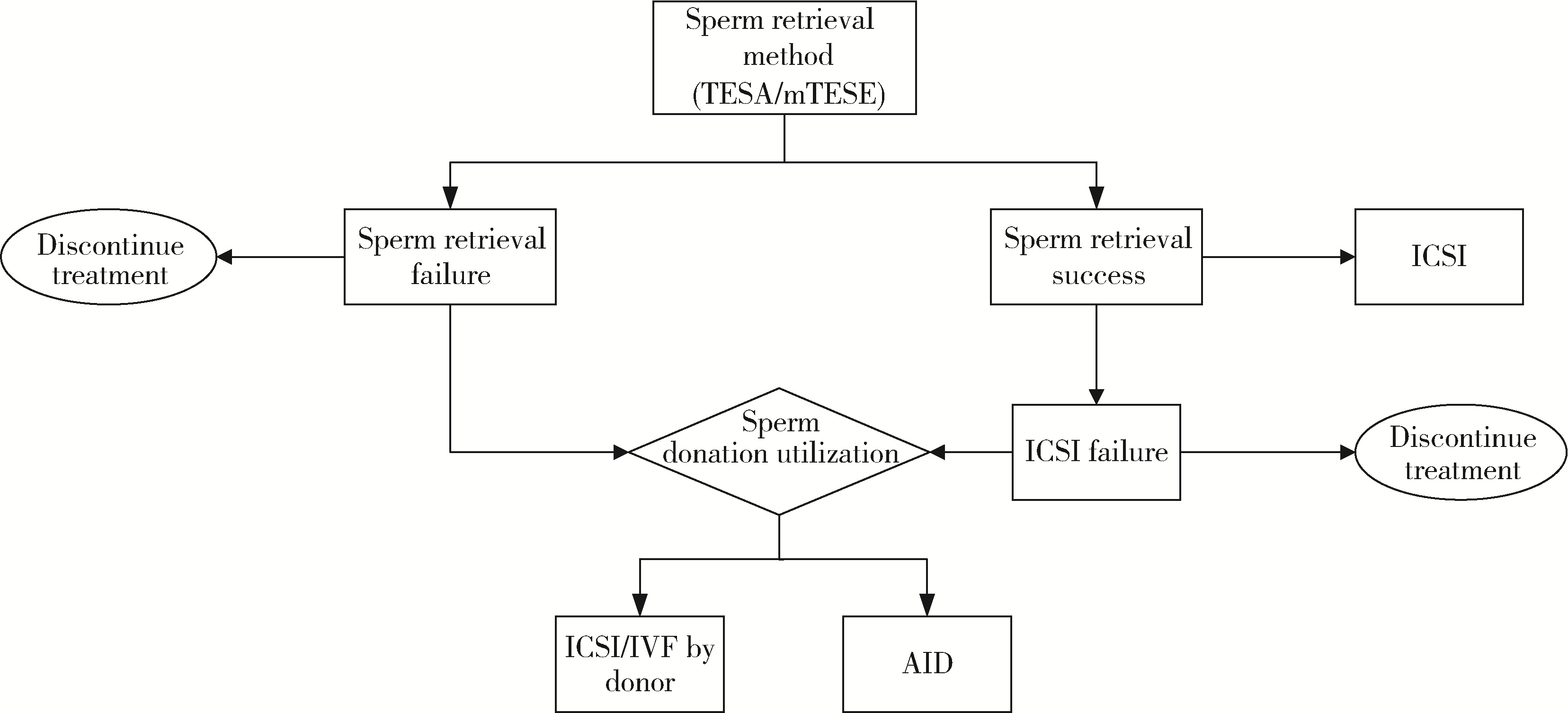
Treatment decision flowchart for NOA patients Patients diagnosed with nonobstructive azoospermia (NOA) begin clinical management with surgical sperm retrieval procedures, either percutaneous testicular sperm aspiration (TESA) or microdissection testicular sperm extraction (mTESE). Following the retrieval outcome, those who successfully obtain sperm proceed directly to intracytoplasmic sperm injection (ICSI) using autologous sperm. If sperm retrieval fails, patients may choose artificial insemination by donor (AID) or opt for donor sperm in vitro fertilization (IVF)/intracytoplasmic sperm injection (ICSI). In cases where these treatments are unsuccessful, patients face further decisions, including abandoning treatment entirely or reattempting donor sperm assisted reproductive technology (ART) cycles. Importantly, treatment discontinuation may occur at any stage due to patient preferences (e. g., refusal to continue after initial attempt to retrieve autologous sperm), financial constraints, or medical advice (e. g., halting treatment following repeated ART/AID failures)."

Table 1

Baseline information of NOA patients"

Parameters Total
(n=1 730)
Fresh sperm with synchronous ART Frozen-thawed sperm with non-synchronous ART
Fresh mTESE (n=696) Fresh TESA (n=632) Thawed mTESE (n=392) Thawed TESA (n=10)
Age/years, ${\bar x}$±s 30.43±4.21 29.76±3.97 30.79±4.33 30.97±4.22 32.7±5.66
BMI/(kg/m2), ${\bar x}$±s 25.57±3.89 25.46±4.07 25.38±3.63 26.03±3.91 26.97±4.48
Testicle volume/mL, ${\bar x}$±s
    Left 8.73±5.54 5.49±3.96 13.49±4.27 6.64±4.11 15.10±4.43
    Right 8.82±5.55 5.57±3.93 13.65±4.21 6.64±4.16 14.60±5.28

Table 2

Case numbers of patients corresponding to different sperm retrieval methods"

Sperm source Fresh sperm with synchronous ART Frozen-thawed sperm with non-synchronous ART Total
Fresh mTESE Fresh TESA Thawed mTESE Thawed TESA
Total 696 632 392 10 1 730
Paternal 533 599 369 10 1 511
Donor 163 33 23 0 219
Donor proportion 23.42% 5.22% 5.87% 0.00% 12.66%

Table 3

Log-linear model saturated model results"

Parameters Estimate (95%CI) SE Z P
Whether fresh or frozen-thawed×Sperm retrieval method×Sperm source -0.177 (-0.538, 0.185) 0.185 -0.957 0.339
Whether fresh or frozen-thawed×Sperm retrieval method -0.743 (-1.105, -0.381) 0.185 -4.025 <0.001
Whether fresh or frozen-thawed×Sperm source -0.217 (-0.578, 0.145) 0.185 -1.173 0.241
Sperm retrieval method×Sperm source -0.249 (-0.611, 0.113) 0.185 -1.349 0.177
Whether fresh or frozen-thawed 1.320 (0.958, 1.681) 0.185 7.150 <0.001
Sperm retrieval method 1.110 (0.748, 1.472) 0.185 6.014 <0.001
Sperm source 1.233 (0.872, 1.595) 0.185 6.683 <0.001

Table 4

Log-linear model reduced model results"

Parameters Estimate (95%CI) SE Z P
TESA×Paternal source 2.780 (2.359, 3.202) 0.215 12.941 <0.001
TESA×Donor source Reference
mTESE×Paternal source 4.499 (3.925, 5.072) 0.293 15.37 <0.001
mTESE×Donor source Reference
1
Jarow JP , Espeland MA , Lipshultz LI . Evaluation of the azoospermic patient[J]. J Urol, 1989, 142 (1): 62- 65.
2
Shin DH , Turek PJ . Sperm retrieval techniques[J]. Nat Rev Urol, 2013, 10 (12): 723- 730.
3
Piechka A , Sparanese S , Witherspoon L , et al. Molecular mechanisms of cellular dysfunction in testes from men with non-obstructive azoospermia[J]. Nat Rev Urol, 2024, 21 (2): 67- 90.
4
Aboulghar M , Aboulghar M . Perinatal outcome of assisted reproductive technology: Is stillbirth of significant importance?[J]. Fertil Steril, 2021, 116 (3): 670- 671.
5
Tournaye H , Krausz C , Oates RD . Concepts in diagnosis and therapy for male reproductive impairment[J]. Lancet Diabetes Endocrinol, 2017, 5 (7): 554- 564.
6
Dabaja AA . Microdissection testicular sperm extraction: An update[J]. Asian J Androl, 2013, 15 (1): 35- 39.
7
洪伟, 王莹, 朱琳, 等. 显微镜下睾丸切开取精术在非梗阻性无精子症助孕治疗中的应用[J]. 陆军军医大学学报, 2023, 45 (3): 251- 256.
8
Minhas S , Bettocchi C , Boeri L , et al. European Association of Urology guidelines on male sexual and reproductive health: 2021 update on male infertility[J]. Eur Urol, 2021, 80 (5): 603- 620.
9
Sangster P . Sperm retrieval: Who does it best?[J]. Eur Urol, 2022, 82 (4): 385- 386.
10
Zhang HL , Zhao LM , Mao JM , et al. Sperm retrieval rates and clinical outcomes for patients with different causes of azoospermia who undergo microdissection testicular sperm extraction-intracytoplasmic sperm injection[J]. Asian J Androl, 2021, 23 (1): 59- 63.
11
Suleymanova L , Bayram H , Dönmez Çakıl Y , et al. Pregnancy outcomes in patients with non-obstructive azoospermia undergoing micro-TESE: Comparison of fresh vs. frozen-thawed testicular sperm[J]. J Assist Reprod Genet, 2024, 41 (12): 3399- 3404.
12
Borate GM , Meshram A . Cryopreservation of sperm: A review[J]. Cureus, 2022, 14 (11): e31402.
13
Zheng JF , Chen XB , Zhao LW , et al. ICSI treatment of severe male infertility can achieve prospective embryo quality compared with IVF of fertile donor sperm on sibling oocytes[J]. Asian J Androl, 2015, 17 (5): 845- 849.
[1] MAO Jia-ming, LIU De-feng,ZHAO Lian-ming,HONG Kai, ZHANG Li, MA Lu-lin, JIANG Hui, QIAO Jie. Effect of testicular puncture biopsy on the success rate of microdissection testicular sperm extraction for idiopathic non-obstructive azoospermia [J]. Journal of Peking University(Health Sciences), 2018, 50(4): 613-616.
Viewed
Full text


Abstract

Cited

  Shared   
  Discussed   
No Suggested Reading articles found!