Journal of Peking University (Health Sciences) ›› 2026, Vol. 58 ›› Issue (1): 43-49. doi: 10.19723/j.issn.1671-167X.2026.01.006

Previous Articles     Next Articles

Microbial communities in extraradicular infections of post-treatment apical periodontitis without or with sinus tracts

Rentao TANG, Liuchang YANG, Jie NIE*(), Xiaoyan WANG   

  1. Department of Cariology and Endodontology, Peking University School and Hospital of Stomatology & National Center for Stomatology & National Clinical Research Center for Oral Diseases & National Engineering Research Center of Oral Biomaterials and Digital Medical Devices, Beijing 100081, China
  • Received:2025-10-10 Online:2026-02-18 Published:2025-12-09
  • Contact: Jie NIE
  • Supported by:
    the Foundation of Peking University School and Hospital of Stomatology(PKUSS20180101)

RICH HTML


Abstract:

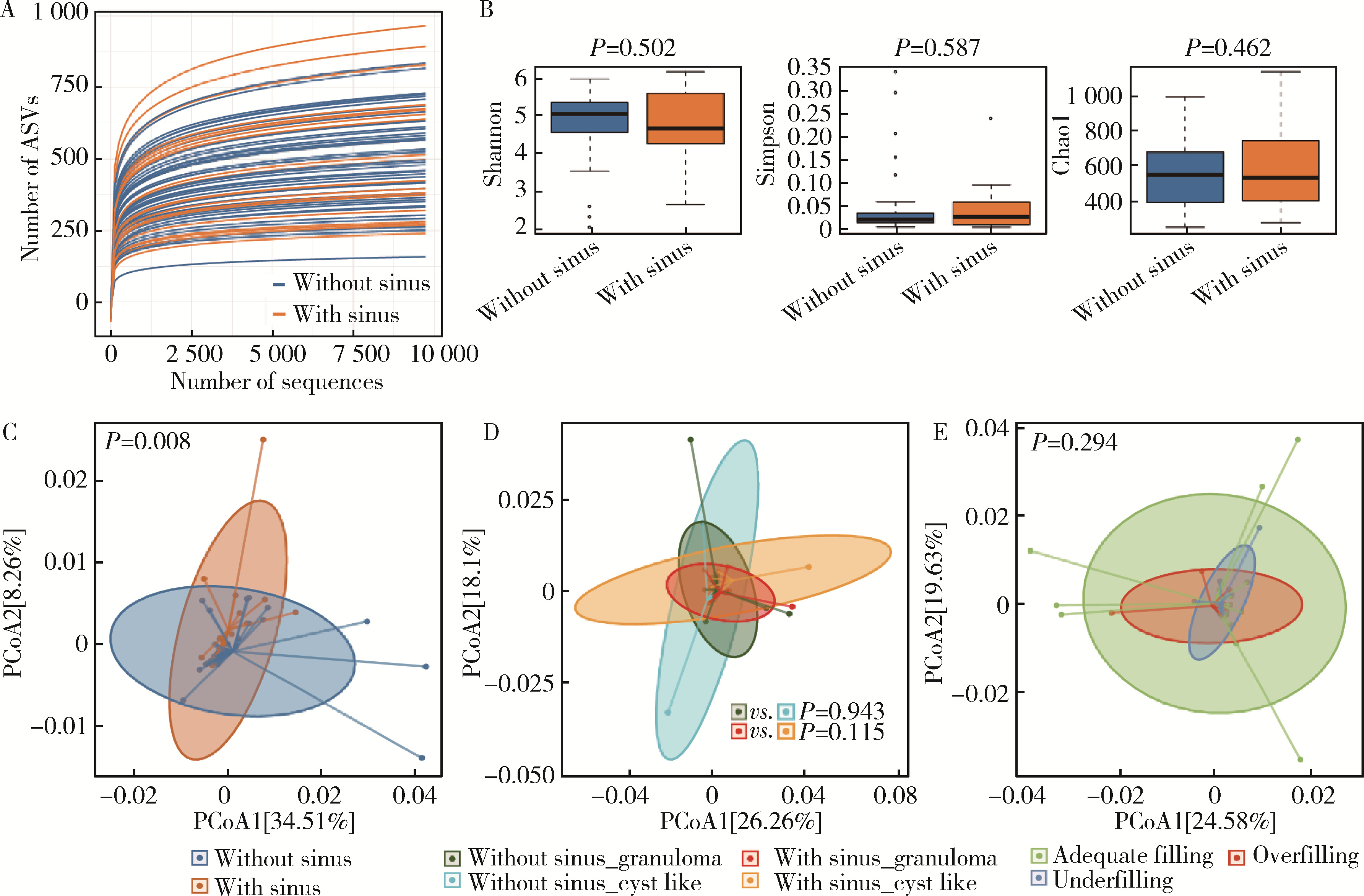
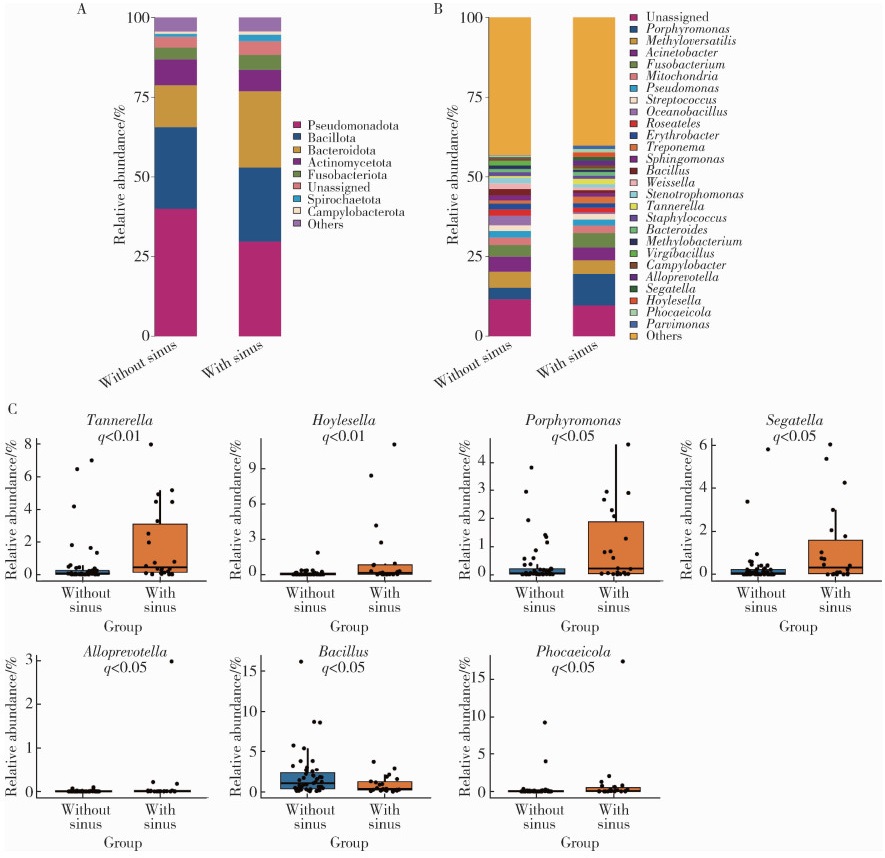
Objective: To compare the composition and structure of extraradicular bacterial communities in periapical lesions of teeth with post-treatment apical periodontitis (PoAP) between cases with and without sinus tracts. Methods: Patients requiring apical surgery were recruited from the Department of Cariology and Endodontology, Peking University School and Hospital of Stomatology. Periapical lesion samples were collected from teeth with sinus tracts and without sinus tracts during apical microsurgery. The remaining lesion samples were submitted for pathological examination. Following the extraction of the bacterial DNA, the V3-V4 region of the bacterial 16S rRNA gene was subjected to high-throughput sequencing using Illumina NovaSeq 6000. Bioinformatics analysis was performed using QIIME2 software. α diversity indices (Shannon, Simpson, Chao1) were calculated, and intergroup differences were analyzed using Wilcoxon test. β diversity was assessed by principal coordinate analysis based on Weighted Unifrac test, and community composition differences were analyzed with permutational multivariate analysis of variance (PERMANOVA). Differences in relative abundance between the groups were compared using the Wilcoxon test, followed by Benjamini-Hochberg false discovery rate (FDR) correction to convert P value to q value. Results: A total of 66 subjects were enrolled, including 21 male and 45 female patients, with a mean age of (33.91±9.16) years. Three subjects each had two teeth enrolled. In total, 69 teeth were included. These teeth included 47 cases without sinus tracts and 22 cases with sinus tracts. No significant differences were observed between the two groups in the distribution of obturation quality or pathological types (P>0.05). No statistically significant differences were found in α diversity indices between the two groups (P>0.05). However, β diversity analysis revealed a significant difference between the two groups (P=0.008). At the phylum level, the relative abundance of Bacteroidota was significantly higher in the group with sinus tracts (16.98% vs. 9.22%, q < 0.01), while the relative abundance of Pseudomonadota was significantly lower in the group with sinus tracts (30.70% vs. 42.19%, q < 0.05). At the genus level, Porphyromonas, Tannerella, Segatella, Phocaeicola, and Hoylesella were significantly enriched in the group with sinus tracts (q < 0.05), whereas Bacillus was more abundant in the group without sinus tracts (q < 0.05). Conclusion: The extraradicular bacterial community structure significantly differs between PoAP with and without sinus tracts. Porphyromonas, Tannerella, Segatella, Phocaeicola, and Hoylesella may be associated with the formation and persistence of sinus tracts.

Key words: Apical periodontitis, Apical microsurgery, Sinus tract, 16S rRNA, High-throughput sequencing

CLC Number: 

  • R781.3

Figure 1

Analysis of microbial community diversity A, rarefaction curves based on ASVs; B, α diversity index (Shannon, Simpson, Chao1) of bacterial communities in the periapical lesions of PoAP without and with sinus tracts, Wilcoxon test was used to compare differences, Boxplots were used to present the median and quartiles; C, β diversity of bacterial communities in the periapical lesions of PoAP without and with sinus tracts; D, β diversity of bacterial communities in PoAP with different pathological manifestations; E, β diversity of bacterial communities in PoAP with different obturation qualities (adequate filling, underfilling, over-filling). ASVs, amplicon sequence variants; PoAP, post-treatment apical periodontitis; PCoA, principal coordinates analysis."

Figure 2

Comparison of microbial composition A, component of bacterial communities at phylum level in the periapical lesions of PoAP without and with sinus tracts; B, component of bacterial communities at genus level in the periapical lesions of PoAP without and with sinus tracts; C, comparison of bacterial communities at genus level in the periapical lesions of PoAP without and with sinus tracts. Wilcoxon test was used to compare differences followed by Benjamini-Hochberg FDR correction to convert P value to q value. Boxplots were used to present the median and quartiles. PoAP, post-treatment apical periodontitis; FDR, false discovery rate."

1
Nair PNR, Henry S, Cano V, et al. Microbial status of apical root canal system of human mandibular first molars with primary apical periodontitis after "one-visit" endodontic treatment[J]. Oral Surg Oral Med Oral Pathol Oral Radiol Endod, 2005, 99(2): 231- 252.

doi: 10.1016/j.tripleo.2004.10.005
2
Nair PNR. On the causes of persistent apical periodontitis: A review[J]. Int Endod J, 2006, 39(4): 249- 281.

doi: 10.1111/j.1365-2591.2006.01099.x
3
Bronzato JD, Davidian MES, de Castro M, et al. Bacteria and virulence factors in periapical lesions associated with teeth following primary and secondary root canal treatment[J]. Int Endod J, 2021, 54(5): 660- 671.

doi: 10.1111/iej.13457
4
Sun X, Yang Z, Nie Y, et al. Microbial communities in the extraradicular and intraradicular infections associated with persistent apical periodontitis[J]. Front Cell Infect Microbiol, 2022, 11, 798367.

doi: 10.3389/fcimb.2021.798367
5
Zhang JL, Yun J, Yue L, et al. Distinctive microbiota distribution from healthy oral to post-treatment apical periodontitis[J]. Front Cell Infect Microbiol, 2022, 12, 980157.

doi: 10.3389/fcimb.2022.980157
6
Gupta R, Hasselgren G. Prevalence of odontogenic sinus tracts in patients referred for endodontic therapy[J]. J Endod, 2003, 29(12): 798- 800.

doi: 10.1097/00004770-200312000-00003
7
Ng YL, Mann V, Gulabivala K. A prospective study of the factors affecting outcomes of nonsurgical root canal treatment: Part 1: Periapical health[J]. Int Endod J, 2011, 44(7): 583- 609.

doi: 10.1111/j.1365-2591.2011.01872.x
8
Wang W, Qu Y, Chen H, et al. The microbial co-infection interaction network in apical periodontitis with sinus tracts[J]. J Dent, 2025, 153, 105496.

doi: 10.1016/j.jdent.2024.105496
9
漆正楠, 尹君, 唐子圣, 等. 有窦型与无窦型根尖周炎微生物群落比较[J]. 牙体牙髓牙周病学杂志, 2016, 26(1): 1- 6.
10
Griffee MB, Patterson SS, Miller CH, et al. The relationship of Bacteroides melaninogenicus to symptoms associated with pulpal necrosis[J]. Oral Surg Oral Med Oral Pathol, 1980, 50(5): 457- 461.

doi: 10.1016/S0030-4220(80)80015-6
11
Sassone LM, Fidel R, Faveri M, et al. Microbiological evaluation of primary endodontic infections in teeth with and without sinus tract[J]. Int Endod J, 2008, 41(6): 508- 515.

doi: 10.1111/j.1365-2591.2008.01397.x
12
Qi Z, Cao H, Jiang H, et al. Combinations of bacterial species associated with symptomatic endodontic infections in a Chinese population[J]. Int Endod J, 2016, 49(1): 17- 25.

doi: 10.1111/iej.12428
13
Zhang C, Yang Z, Hou B. Diverse bacterial profile in extraradicular biofilms and periradicular lesions associated with persistent apical periodontitis[J]. Int Endod J, 2021, 54(9): 1425- 1433.

doi: 10.1111/iej.13512
14
Bolyen E, Rideout JR, Dillon MR, et al. Reproducible, interactive, scalable and extensible microbiome data science using QIIME 2[J]. Nat Biotechnol, 2019, 37(8): 852- 857.

doi: 10.1038/s41587-019-0209-9
15
Alquria TA, Acharya A, Kabir B, et al. Clinical investigation of bacteriome in primary endodontic infections with apical periodontitis using high-throughput sequencing analysis[J]. J Endod, 2024, 50(10): 1393- 1402.

doi: 10.1016/j.joen.2024.07.016
16
Buonavoglia A, Zamparini F, Lanave G, et al. Endodontic microbial communities in apical periodontitis[J]. J Endod, 2023, 49(2): 178- 189.

doi: 10.1016/j.joen.2022.11.015
17
李昱志, 苏旭, 陈晓涛, 等. 基于16S rDNA测序的慢性牙髓炎及根尖周炎感染根管内菌群多样性研究[J]. 安徽医科大学学报, 2024, 59(9): 1669- 1674.
18
Mominkhan D, Brito LCN, Yakubu AR, et al. Exploring relationships within the microbiome of root canal infections and the influence of associated clinical parameters[J]. Int Endod J, 2025, 58(11): 1751- 1763.

doi: 10.1111/iej.70011
19
Lyu P, Song Y, Bi R, et al. Protective actions in apical periodontitis: The regenerative bioactivities led by mesenchymal stem cells[J]. Biomolecules, 2022, 12(12): 1737.

doi: 10.3390/biom12121737
20
Barbosa-Ribeiro M, Arruda-Vasconcelos R, Louzada LM, et al. Microbiological analysis of endodontically treated teeth with apical periodontitis before and after endodontic retreatment[J]. Clin Oral Investig, 2021, 25(4): 2017- 2027.

doi: 10.1007/s00784-020-03510-2
21
Ordinola-Zapata R, Costalonga M, Dietz M, et al. The root canal microbiome diversity and function: A whole-metagenome shotgun analysis[J]. Int Endod J, 2024, 57(7): 872- 884.

doi: 10.1111/iej.13911
22
Darveau RP. Periodontitis: A polymicrobial disruption of host homeostasis[J]. Nat Rev Microbiol, 2010, 8(7): 481- 490.

doi: 10.1038/nrmicro2337
23
Tak EJ, Park OJ, Lee JS, et al. Microbiota associated with caries and apical periodontitis: A next-generation sequencing study[J]. Int Endod J, 2025, 58(6): 890- 901.

doi: 10.1111/iej.14218
24
Zhao W, Ji L, Li J, et al. Mesaconate from bacillus subtilis R0179 supernatant attenuates periodontitis by inhibiting porphyromonas gingivalis in mice[J]. J Periodontal Res, 2025, 60(6): 617- 627.

doi: 10.1111/jre.13363
25
Tsubura S, Mizunuma H, Ishikawa S, et al. The effect of Bacillus subtilis mouth rinsing in patients with periodontitis[J]. Eur J Clin Microbiol Infect Dis, 2009, 28(11): 1353- 1356.

doi: 10.1007/s10096-009-0790-9
26
Turan Gökduman C, Çanakçi BC, Arili Öztürk E, et al. Factors affecting long-term success and survival in non-surgical root canal retreatment: A retrospective cohort study[J]. Clin Oral Investig, 2025, 29(11): 491.

doi: 10.1007/s00784-025-06592-y
[1] Jing-cheng XIE,Xiao-dong CHEN,Jun YANG. Diagnosis and surgical treatment of tethered cord syndrome accompanied by congenital dermal sinus tract in adults [J]. Journal of Peking University (Health Sciences), 2022, 54(6): 1163-1166.
[2] Jia-he ZHANG, Jia-qi SHI, Zhang-jian CHEN, Guang JIA. Effects of nano titanium dioxide on gut microbiota based on human digestive tract microecology simulation system in vitro [J]. Journal of Peking University (Health Sciences), 2022, 54(3): 468-476.
[3] ZHU Shi-wei, LIU Zuo-jing, LI Mo, ZHU Huai-qiu, DUAN Li-ping. Comparison of gut microbiotal compositional analysis of patients with irritable bowel syndrome through different bioinformatics pipelines [J]. Journal of Peking University(Health Sciences), 2018, 50(2): 231-238.
Viewed
Full text


Abstract

Cited

  Shared   
  Discussed   
No Suggested Reading articles found!