Journal of Peking University (Health Sciences) ›› 2026, Vol. 58 ›› Issue (3): 496-502. doi: 10.19723/j.issn.1671-167X.2026.03.008

Previous Articles     Next Articles

Joint trajectories and evolution patterns of direct and indirect maternal mortality across 204 countries from 2000 to 2021

Yi ZHOU, Zhao CHENG, Xinglin FENG*()   

  1. Department of Health Policy and Management, Peking University School of Public Health, Beijing 100191, China
  • Received:2026-02-24 Online:2026-06-18 Published:2026-04-09
  • Contact: Xinglin FENG

RICH HTML


Abstract:

Objective: To identify joint trajectory patterns of direct and indirect maternal mortality ratios (MMR) at the country level from 2000 to 2021, and to compare phase-specific changes during the millennium development goals (MDG, 2000 to 2015) and the sustainable development goals (SDG, 2015 to 2021) periods, as well as differences in health system and policy environments across trajectory groups. Methods: Data on maternal mortality among women aged 15-49 years in 204 countries and territories from 2000 to 2021 were obtained from the Global Burden of Disease (GBD) Study. Direct cause MMR and indirect cause MMR at five time points (2000, 2005, 2010, 2015, and 2021) were jointly analyzed using longitudinal K-means clustering (k=2-6). The optimal number of clusters was determined by the Calinski-Harabasz (CH) index. Based on the clustering results, a piecewise linear mixed effects model with random intercepts was fitted with a knot in 2015 to estimate the baseline intercept in 2000 and period-specific slopes for the MDG and SDG phases. For 2021, health system and policy-related indicators, including antenatal care coverage (≥4 visits, ANC4), proportion of women with a demand for contraception that are using a modern method, cesarean section rate, female human immunodeficiency virus (HIV) prevalence, in facility delivery rate, skilled birth attendance, and an abortion legality index were compared across clusters using the Kruskal-Wallis H test. All tests were two-sided, and P < 0.05 was considered statistically significant. Results: The CH index peaked at k=3 (CH=342.63), classifying the 204 countries and territories into three joint trajectory clusters: high burden (n= 66), medium burden (n=88), and low burden (n=50). In 2021, direct MMR was 334.6 (95%CI: 282.5- 386.7), 65.6 (95%CI: 50.4-80.7), and 5.4 (95%CI: 3.7-7.0) per 100 000 live births in the high, medium, and low burden clusters, respectively; indirect MMR was 33.6 (95%CI: 27.9-39.2), 18.2 (95%CI: 13.5-22.9), and 0.9 (95%CI: 0.6-1.3) per 100 000 live births, respectively. The piecewise mixed effects model showed significant declines in direct MMR during the MDG period in all clusters (slopes: -0.020, -0.016, and -0.036; P < 0.001), whereas declines slowed and became non-significant during the SDG period (-0.011, 0.011, and -0.006; P > 0.05). For indirect MMR, modest increases were observed during the MDG period in the high and medium burden clusters (0.029 and 0.015; P < 0.05), with no significant change in the low burden cluster (P > 0.05). During the SDG period, indirect MMR increased markedly in the medium burden cluster (slope: 0.121; 95%CI: 0.092-0.151; P < 0.001), while remaining broadly stable in the high and low burden clusters (P > 0.05). Health system and policy indicators differed significantly across the clusters (P < 0.001): the high burden cluster showed lower ANC4 coverage, lower in facility delivery and skilled birth attendance, lower demand for contraception satisfied by modern methods, and higher female HIV prevalence; the medium burden cluster achieved near universal in facility delivery and skilled birth attendance but had a higher cesarean section rate; the low-burden cluster generally showed more favorable indicator profiles and a higher abortion legality index. Conclusion: Distinct joint trajectories of direct and indirect maternal mortality were observed globally from 2000 to 2021. While reductions in direct maternal mortality were substantial during the MDG era, progress broadly slowed and plateaued during the SDG era. Meanwhile, the pronounced rise in indirect maternal mortality in medium-burden countries during the SDG period suggests potential structural risk accumulation even when overall MMR appears stable. Incorporating joint direct-indirect trajectories into routine monitoring may facilitate stage and cluster specific prioritization of maternal health interventions.

Key words: Maternal mortality ratio, Direct maternal deaths, Indirect maternal deaths, Joint trajectory, Longitudinal clustering

CLC Number: 

  • R173

Table 1

Cause-specific maternal mortality ratios by joint trajectory cluster in 2021 (per 100 000 live births)"

Cause-specific category High burden (Cluster 1) Medium burden (Cluster 2) Low burden (Cluster 3)
Direct maternal deaths 334.6 (282.5, 386.7) 65.6 (50.4, 80.7) 5.4 (3.7, 7.0)
Ectopic pregnancy 23.9 (18.9, 29.0) 3.0 (2.0, 3.9) 0.2 (0.1, 0.2)
Maternal abortion and miscarriage 41.1 (32.5, 49.7) 4.2 (3.3, 5.1) 0.2 (0.1, 0.3)
Maternal obstructed labor and uterine rupture 17.7 (14.1, 21.4) 4.0 (2.2, 5.7) 0.2 (0.1, 0.3)
Maternal hemorrhage 74.3 (59.7, 88.8) 9.4 (6.4, 12.3) 0.8 (0.5, 1.0)
Maternal hypertensive disorders 71.4 (59.0, 83.9) 14.8 (11.5, 18.1) 1.0 (0.7, 1.2)
Maternal sepsis and other maternal infections 44.9 (31.9, 57.9) 4.3 (3.0, 5.5) 0.2 (0.1, 0.2)
Other direct maternal disorders 61.3 (50.5, 72.0) 26.0 (17.3, 34.7) 2.9 (1.5, 4.2)
Indirect maternal deaths 33.6 (27.9, 39.2) 18.2(13.5, 22.9) 0.9 (0.6, 1.3)

Figure 1

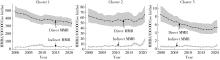
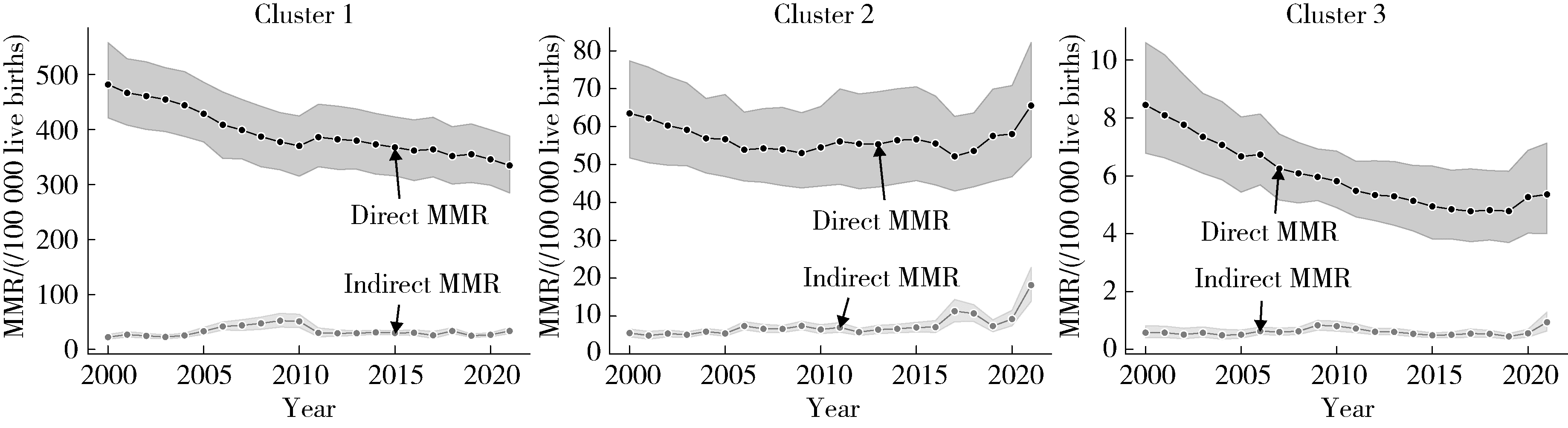
Mean trajectories of direct and indirect maternal mortality ratios by joint trajectory cluster from 2000 to 2021 Black solid lines represent direct maternal mortality ratios, and gray dashed lines represent indirect maternal mortality ratios. Shaded areas indicate 95% confidence intervals. MMR, matermal mortality ratios."

Table 2

Estimated intercepts (baseline 2000) and period-specific slopes from the piecewise linear mixed-effects model"

Trajectory cluster Intercept (2000 baseline) MDG slope (2000-2015) SDG slope (2015-2021)
Direct
  Cluster 1 5.979 (5.824, 6.135)*** -0.020 (-0.025, -0.016)*** -0.011 (-0.022, 0.001)
  Cluster 2 3.842 (3.666, 4.018)*** -0.016 (-0.024, -0.008)*** 0.011 (-0.008, 0.030)
  Cluster 3 1.934 (1.769, 2.100)*** -0.036 (-0.043, -0.029)*** -0.006 (-0.023, 0.012)
Indirect
  Cluster 1 2.958 (2.781, 3.135)*** 0.029 (0.014, 0.044)*** -0.011 (-0.048, 0.026)
  Cluster 2 1.346 (1.164, 1.528)*** 0.015 (0.003, 0.028)* 0.121 (0.092, 0.151)***
  Cluster 3 -1.009 (-1.293, -0.726)*** 0.009 (-0.008, 0.026) 0.006 (-0.035, 0.047)

Table 3

Comparison of health resources among countries with different maternal mortality trajectories in 2021"

Variable High burden (Cluster 1) Medium burden (Cluster 2) Low burden (Cluster 3) Kruskal-Wallis H
ANC(≥4 visits)/% 63.25 (50.05, 81.66) 93.60 (86.34, 96.34) 99.18 (97.93, 99.67) 126.69***
Demand for contraception using a modern method/% 52.73 (39.85, 73.38) 74.94 (57.49, 84.60) 89.78 (71.21, 92.98) 54.25***
Cesarean section rate/% 10.66 (6.02, 20.72) 32.03 (21.05, 42.43) 30.72 (22.00, 36.40) 63.36***
HIV prevalence in women/% 1.22 (0.16, 3.60) 0.13 (0.05, 0.29) 0.04 (0.01, 0.12) 59.44***
In-facility delivery rate/% 85.95 (64.28, 92.79) 99.35 (96.99, 99.76) 99.82 (99.61, 99.91) 105.19***
Skilled birth attendance/% 87.13 (70.59, 94.23) 99.56 (98.65, 99.83) 99.80 (99.49, 99.90) 102.54***
Abortion legality index 50.72 (40.00, 65.00) 60.00 (40.00, 90.00) 85.00 (70.00, 90.00) 35.50***
1
World Health Organization, UNICEF, UNFPA, et al. Trends in maternal mortality 2000 to 2020: Estimates by WHO, UNICEF, UNFPA, World Bank Group and UNDESA/Population Division[M/OL]. Geneva: World Health Organization, 2023[2026-02-01]. https://iris.who.int/server/api/core/bitstreams/c3957b94-cdd5-47d7-85f8-6202be229f8e/content.
2
World Health Organization. SDG target 3.1 maternal mortality[EB/OL]. [2026-02-01]. https://www.who.int/data/gho/data/themes/topics/sdg-target-3-1-maternal-mortality.
3
World Health Organization. Millennium development goals (MDG)[EB/OL]. [2026-02-01]. https://www.who.int/zh/news-room/fact-sheets/detail/millennium-development-goals-%28mdgs%29.
4
Souza JP , Tunçalp , Vogel JP , et al. Obstetric transition: The pathway towards ending preventable maternal deaths[J]. BJOG, 2014, 121 (Suppl 1): 1- 4.
5
Souza JP , Day LT , Rezende-Gomes AC , et al. A global analysis of the determinants of maternal health and transitions in maternal mortality[J]. Lancet Glob Health, 2024, 12 (2): e306- e316.

doi: 10.1016/S2214-109X(23)00468-0
6
Cresswell JA , Alexander M , Chong MYC , et al. Global and regional causes of maternal deaths 2009-20: A WHO systematic analysis[J]. Lancet Glob Health, 2025, 13 (4): e626- e634.

doi: 10.1016/S2214-109X(24)00560-6
7
Feng J , Huang J , Wu Q , et al. Maternal mortality ratios in Southeast Asia (1990-2021): Trends, disparities, and projections through 2050 based on the global burden of disease 2021, with reference to SDG 3.1[J]. BMC Pregnancy Childbirth, 2025, 25 (1): 1264.

doi: 10.1186/s12884-025-08443-w
8
Sepanlou SG , Rezaei Aliabadi H , Malekzadeh R , et al. Levels and trends of maternal mortality and morbidity by cause in north Africa and middle east, 1990 to 2019: An analysis for the global burden of disease study 2019[J]. Arch Iran Med, 2022, 25 (10): 666- 675.

doi: 10.34172/aim.2022.105
9
GBD 2023 Causes of Death Collaborators . Global burden of 292 causes of death in 204 countries and territories and 660 subnational locations, 1990-2023: A systematic analysis for the Global Burden of Disease Study 2023[J]. Lancet, 2025, 406 (10513): 1811- 1872.
10
Hay SI , Ong KL , Santomauro DF , et al. Burden of 375 diseases and injuries, risk-attributable burden of 88 risk factors, and healthy life expectancy in 204 countries and territories, including 660 subnational locations, 1990-2023: A systematic analysis for the Global Burden of Disease Study 2023[J]. Lancet, 2025, 406 (10513): 1873- 1922.
11
Global Burden of Disease Collaborative Network. Global Burden of Disease Study 2023 (GBD 2023) Covariates 1980-2023[EB/OL]. [2026-02-15]. https://doi.org/10.6069/b09t-1r53.
12
Kruk ME , Gage AD , Joseph NT , et al. Mortality due to low-quality health systems in the universal health coverage era: A systematic analysis of amenable deaths in 137 countries[J]. Lancet, 2018, 392 (10160): 2203- 2212.

doi: 10.1016/S0140-6736(18)31668-4
13
Marthias T , Anindya K , Saputri NS , et al. Effective coverage for reproductive, maternal, neonatal and newborn health: An analysis of geographical and socioeconomic inequalities in 39 low- and middle-income countries[J]. BMJ Glob Health, 2025, 10 (2): e016549.

doi: 10.1136/bmjgh-2024-016549
14
Priebe J , Amuasi J , Dartanto T , et al. Factors associated with skilled birth attendance in 37 low-income and middle-income countries: A secondary analysis of nationally representative, individual-level data[J]. Lancet Glob Health, 2024, 12 (7): e1104- e1110.

doi: 10.1016/S2214-109X(24)00145-1
15
Say L , Chou D , Gemmill A , et al. Global causes of maternal death: A WHO systematic analysis[J]. Lancet Glob Health, 2014, 2 (6): e323- e333.
16
Chaves SC , Cecatti JG , Carroli G , et al. Obstetric transition in the World Health Organization multicountry survey on maternal and newborn health: Exploring pathways for maternal mortality reduction[J]. Rev Panam Salud Publica, 2015, 37 (4/5): 203- 210.
17
Cirelli JF , Surita FG , Costa ML , et al. The burden of indirect causes of maternal morbidity and mortality in the process of obstetric transition: A cross-sectional multicenter study[J]. Rev Bras Ginecol Obstet, 2018, 40 (3): 106- 114.
18
Banke-Thomas A , Wong KLM , Olubodun T , et al. Geographical accessibility to functional emergency obstetric care facilities in urban Nigeria using closer-to-reality travel time estimates: A population-based spatial analysis[J]. Lancet Glob Health, 2024, 12 (5): e848- e858.
19
Ferede Gebremedhin A , Dawson A , Hayen A . Evaluations of effective coverage of maternal and child health services: A systematic review[J]. Health Policy Plan, 2022, 37 (7): 895- 914.
20
Boerma T , Campbell OMR , Amouzou A , et al. Maternal mortality, stillbirths, and neonatal mortality: A transition model based on analyses of 151 countries[J]. Lancet Glob Health, 2023, 11 (7): e1024- e1031.
21
Langlois EV , Reid A , Khosla R . Mothers deserve better: Evidence-based strategies to address maternal mortality[J]. Lancet Glob Health, 2025, 13 (5): e797- e798.
22
Nove A , Friberg IK , de Bernis L , et al. Potential impact of midwives in preventing and reducing maternal and neonatal mortality and stillbirths: A lives saved tool modelling study[J]. Lancet Glob Health, 2021, 9 (1): e24- e32.
23
GBD 2019 Risk Factors Collaborators . Global burden of 87 risk factors in 204 countries and territories, 1990-2019: A systematic analysis for the Global Burden of Disease Study 2019[J]. Lancet, 2020, 396 (10258): 1223- 1249.
[1] Xiao-wei WANG,Ying-chao MU,Zhen-yu GUO,Yu-bo ZHOU,Yong ZHANG,Hong-tian LI,Jian-meng LIU. Secular trends of age at menarche and age at menopause in women born since 1951 from a county of Shandong Province, China [J]. Journal of Peking University (Health Sciences), 2023, 55(3): 502-510.
[2] HE Wei,YANG Si-wen,CHEN Juan,ZHU Xiao-jun,CHEN Zhi-zhong,MA Wen-jun. Effects of 275 nm and 310 nm ultraviolet irradiation on bone metabolism in ovariectomized osteoporotic rats [J]. Journal of Peking University (Health Sciences), 2022, 54(2): 236-243.
[3] SONG Qin-feng,LI Hong-tian,YANG Jing,YUAN Peng-bo,CHENG Zhi-hao,LIU Jian-meng,ZHAO Yang-yu. Thyroid function of first-trimester twin pregnant women and its association with preterm delivery [J]. Journal of Peking University (Health Sciences), 2021, 53(3): 473-478.
[4] LI Xue-ying, MAO Kang-na, MI Xiao-yi, GAO Ling-ling, YANG Xiao, TAO Hui-fen, ZHANG Ying-wu, CHEN Jing, WANG Xing, SHEN Li-juan, YUAN Jie-ling, MIAO Miao, ZHOU Hong. Reliability and validity of the Chinese version of parenting sense of competence scale in mothers of preschool children [J]. Journal of Peking University (Health Sciences), 2021, 53(3): 479-484.
Viewed
Full text


Abstract

Cited

  Shared   
  Discussed   
No Suggested Reading articles found!