Journal of Peking University (Health Sciences) ›› 2026, Vol. 58 ›› Issue (4): 748-753. doi: 10.19723/j.issn.1671-167X.2026.04.010

Previous Articles     Next Articles

Effect of leg-split-free lateral decubitus position and lithotomy position on renal pelvic pressure and clinical outcomes during flexible ureteroscopic lithotripsy

Shicong LAI, Huanrui WANG, Runfeng NI, Haopu HU, Chenlong WANG, Tao XU, Hao HU*()   

  1. Department of Urology, Peking University People' s Hospital; The Institute of Applied Lithotripsy Technology, Peking University People' s Hospital, Beijing 100044, China
  • Received:2026-02-28 Online:2026-08-18 Published:2026-05-19
  • Contact: Hao HU

RICH HTML


Abstract:

Objective: To compare intrarenal pelvic pressure profiles and clinical outcomes between the leg-split-free lateral decubitus position and the conventional lithotomy position during flexible ureteroscopy with a negative-pressure aspiration sheath. Methods: A prospective study was conducted at Peking University People' s Hospital among patients undergoing unilateral flexible ureteroscopy with a negative-pressure aspiration sheath from January 2024 to December 2025. Participants were allocated into two groups according to surgical positioning: Leg-split-free lateral decubitus group and conventional lithotomy group. An intelligent, pressure- and temperature-controlled flexible ureteroscopy system was employed to continuously monitor intrapelvic pressure and temperature throughout the procedure. The incidence, duration, and clinical implications of intrapelvic hypertension were compared between the two groups. Results: A total of 40 patients were enrolled, 20 in each group. No statistically significant differences were observed between the groups in baseline characteristics, including gender, age, stone diameter, stone number, stone location, or degree of hydronephrosis (all P>0.05). Intraoperative analysis revealed that the duration of intrapelvic hypertension was significantly shorter in the leg-split-free lateral decubitus group than in the lithotomy group [25.0 (0.0, 31.8) s vs. 115.0 (79.8, 176.0) s, P < 0.01]; similarly, the duration of elevated intrapelvic temperature was also significantly reduced [3.0 (2.0, 9.8) s vs. 18.5(16.0, 24.5) s, P < 0.01]. Postoperative follow-up showed no cases of fever in the leg-split-free lateral decubitus group, whereas two patients in the lithotomy group developed fever; however, this difference in febrile complication rate did not reach statistical significance (P=0.15). All the patients underwent computed tomography three months postoperatively to assess stone-free status. The results indicated that the stone-free rate in the leg-split-free lateral decubitus position group was significantly higher than that in the lithotomy position group (P=0.04). Conclusion: This prospective exploratory study suggests that compared with the lithotomy position, the leg-free lateral decubitus position may be more conducive to maintaining lower intrapelvic pressure and temperature during the operation and is associated with a higher stone clearance rate postoperatively. However, these findings still need to be verified by large-sample, multi-center, randomized controlled trials.

Key words: Upper urinary tract stones, Negative-pressure sheath, Patient position, Intrarenal hypertension, Clinical outcomes

CLC Number: 

  • R699.2

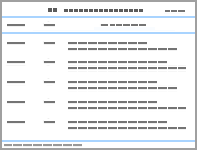
Table 1

Baseline characteristics of the leg-split-free lateral decubitus position group and the lithotomy position group"

Items Total (n=40) Lateral decubitus group (n=20) Lithotomy group (n=20) P value
Age/years, $\bar x \pm s$ 57.4±11.9 57.3±11.1 57.6±13.0 0.938
BMI/(kg/m2), $\bar x \pm s$ 25.2±3.2 25.4±2.5 25.1±3.8 0.802
Gender, n (%) >0.999
  Male 20 (50) 10 (50) 10 (50)
  Female 20 (50) 10 (50) 10 (50)
Stone lateral, n (%) 0.580
  Left 24 (60.0) 13 (65.0) 11 (55.0)
  Right 16 (40.0) 7 (35.0) 9 (45.0)
Stone location, n (%) 0.190
  Ureter 12 (30.0) 4 (20.0) 8 (40.0)
  Renal 20 (50.0) 10 (50.0) 10 (50.0)
  Both 8 (20.0) 6 (30.0) 2 (10.0)
Stone diameter /cm, $\bar x \pm s$ 1.5±0.7 1.5±0.7 1.4±0.7 0.830
Stone number, n (%) 0.530
  Solitary 20 (50.0) 11 (55.0) 9 (45.0)
  Multiple 20 (50.0) 9 (45.0) 11 (55.0)
Urine culture, n (%) >0.999
  Negative 36 (90.0) 18 (90.0) 18 (90.0)
  Positive 4 (10.0) 2 (10.0) 2 (10.0)
Hydronephrosis, n (%) 0.470
  None 10 (25.0) 4 (20.0) 6 (30.0)
  Yes 30 (75.0) 16 (80.0) 14 (70.0)

Table 2

Perioperative data, stone clearance rate, and complication rates between the leg-split-free lateral decubitus position group and the lithotomy position group"

Items Total (n=40) Lateral Decubitus group (n=20) Lithotomy group (n=20) P value
Operation time/min, M (P25P75) 80.5 (60.0, 117.5) 87.5 (62.3, 115.0) 77.5 (47.8, 117.5) 0.51
High IPP time/s, M (P25P75) 38.5 (24.5, 116.0) 25 (0, 31.8) 115.0 (79.8, 176.0) < 0.01
High temperature time/s, M (P25P75) 15.0 (3.0, 19.0) 3 (2.0, 9.8) 18.5 (16.0, 24.5) < 0.01
Residual stones, n (%) 0.04
  No 33 (82.50) 19 (95.0) 14 (70.0)
  Yes 7 (17.5) 1 (5.0) 6 (30.0)
2 h-WBC (×109/L), $\bar x \pm s$ 6.96±2.45 6.87±2.49 7.06±2.48 0.80
2 h-PCT/(μg/L), $\bar x \pm s$ 0.04±0.04 0.04±0.04 0.04±0.04 0.56
Fever, n (%) 0.15
  No 38 (95.0) 20 (100.0) 18 (90.0)
  Yes 2 (5.0) 0 (0.0) 2 (10.0)
1
He M , Dong Y , Cai W , et al. Recent advances in the treatment of renal stones using flexible ureteroscopys[J]. Int J Surg, 2024, 110(7): 4320- 4328.

doi: 10.1097/JS9.0000000000001345
2
Vagionis A , Tatanis V , Peteinaris A , et al. Is a ureteral access sheath necessary for maintaining safe intrarenal pressures during retrograde lithotripsy using a flexible 7.5F scope and a high-power TFL? In vivo experimental study[J]. Medicina (Kaunas), 2025, 61(10): 1829.

doi: 10.3390/medicina61101829
3
Shi J , Huang T , Song B , et al. The optimal ratio of endoscope-sheath diameter with negative-pressure ureteral access sheath: An in vitro research[J]. World J Urol, 2024, 42(1): 122.

doi: 10.1007/s00345-024-04815-7
4
Xie Y , Gong H , Zheng Q , et al. Efficacy and safety of flexible and navigable suction access sheaths versus traditional access sheath in flexible ureteroscopic lithotripsy: A systematic review and meta-analysis[J]. World J Urol, 2025, 43(1): 487.

doi: 10.1007/s00345-025-05856-2
5
Kayano S , Yanagisawa T , Shibata K , et al. Intrarenal pressure during the flexible and navigable suction ureteral access sheath-assisted retrograde intrarenal surgery: A two-center study[J]. Int Urol Nephrol, 2026, 58(5): 1711- 1717.
6
Pan D , Zhang L , Pan J , et al. A retrospective analysis on the effect of single-channel minimally invasive percutaneous nephrolithotomy combined with retrograde flexible ureteroscopy using the completely lateral decubitus and semi-lithotomy positions to treat complex kidney stones[J]. Transl Androl Urol, 2021, 10(9): 3638- 3645.

doi: 10.21037/tau-21-635
7
Nedbal C , Yuen SKK , Akram M , et al. First clinical evaluation of a flexible digital ureteroscope with direct in scope suctioning system (Pusen DISS 7.5Ch): Prospective multicentric feasibility study[J]. World J Urol, 2024, 42(1): 560.

doi: 10.1007/s00345-024-05275-9
8
Kwok JL , Somani B , Sarica K , et al. Multicenter outcome analysis of different sheath sizes for flexible and navigable suction ureteral access sheath (FANS) ureteroscopy: An EAU endourology collaboration with the global FANS study group[J]. Urolithiasis, 2024, 52(1): 162.

doi: 10.1007/s00240-024-01662-4
9
Zhong Y , Xie D , Luo C , et al. Clinical application of flexible ureteroscopic sheath with controllable intraluminal pressure in treating ureteral stones[J]. Asian J Urol, 2023, 10(2): 166- 171.

doi: 10.1016/j.ajur.2021.08.007
10
Vrettos T , Martinez BB , Tsaturyan A , et al. Effect of patient positioning on anesthesiologic risk in endourological procedures[J]. Urol Ann, 2023, 15(3): 261- 265.

doi: 10.4103/ua.ua_113_22
11
Ding T , Xu Z , Huang Z , et al. Optimizing aspiration efficiency in RIRS: The impact of ratio of endoscope-sheath diameter, irrigation flow, and negative pressure in vitro study[J]. Urolithiasis, 2025, 53(1): 102.

doi: 10.1007/s00240-025-01773-6
12
Wang G , Zhang L , Jin Q , et al. Renal pelvic pressure drives fluid absorption in mini-percutaneous nephrolithotomy: A quantitative model for absorption rate[J]. BJU Int, 2025, 136(3): 529- 536.

doi: 10.1111/bju.16812
13
Nishimura K , Imada S , Sugihara N , et al. Novel modality using computational fluid dynamics to estimate renal pelvic pressure and evaluate severity of obstruction in congenital hydronephrosis[J]. Front Urol, 2025, 5, 1634278.

doi: 10.3389/fruro.2025.1634278
14
Li X , Yang K , Zhu W , et al. The whitaker test in the follow-up of complex upper urinary tract reconstruction: Is it clinical useful or not[J]. Urol J, 2021, 19(1): 56- 62.
15
Abdulla MH , AlMarabeh S , Bolger T , et al. Effects of intrarenal pelvic infusion of tumour necrosis factor-α and interleukin 1-β on reno-renal reflexes in anaesthetised rats[J]. J Hypertens, 2024, 42(6): 1027- 1038.

doi: 10.1097/HJH.0000000000003689
16
Khotko DN , Khotko AI , Popkov VM , et al. Dynamics of osteopontin in serum and urine in the early postoperative period after percutaneous nephrolitho- tomy[J]. Urologiia, 2023(2): 48- 52.
17
Sullivan JB , DeLalio LJ , Stocker SD . Deletion of the TRPV1 channel attenuates afferent renal nerve responses to renal artery occlusion but not elevated renal pelvic pressure[J]. J Physiol, 2026, 604(3): 1415- 1427.

doi: 10.1113/JP289721
18
DeLalio LJ , Stocker SD . Sympathoexcitatory responses to renal chemosensitive stimuli are exaggerated at nighttime in rats[J]. Am J Physiol Heart Circ Physiol, 2022, 323(3): H437- H448.

doi: 10.1152/ajpheart.00665.2021
19
DeLalio LJ , Stocker SD . Impact of anesthesia and sex on sympathetic efferent and hemodynamic responses to renal chemo- and mechanosensitive stimuli[J]. J Neurophysiol, 2021, 126(2): 668- 679.

doi: 10.1152/jn.00277.2021
20
AlMarabeh S , Lucking EF , O'Halloran KD , et al. Intrarenal pelvic bradykinin-induced sympathoexcitatory Reno-renal reflex is attenuated in rats exposed to chronic intermittent hypoxia[J]. J Hypertens, 2022, 40(1): 46- 64.

doi: 10.1097/HJH.0000000000002972
21
Tanaka N , Elises JC , Yamamichi F , et al. Real-time measurement of intrarenal pressure using LithoVueTM Elite: Focus on small ureteral access sheaths and appropriate irrigation settings[J]. J Clin Med, 2025, 14(10): 3573.

doi: 10.3390/jcm14103573
22
Zhou L , Zhang C , Zhan XL , et al. Effect of intrarenal pelvic pressure on pyelo-tubular backflow and renal cortical blood perfusion during mini-percutaneous nephrolithotomy[J]. World J Urol, 2024, 42(1): 595.

doi: 10.1007/s00345-024-05313-6
23
Lin S , Ding W , Chen J , et al. Novel noninvasive assessment of upper urinary tract urine flow dynamics: A deep learning-driven reconstruction model combined with CFD simulation[J]. Eur J Med Res, 2025, 31(1): 142.

doi: 10.1186/s40001-025-03730-w
24
Tasbihi E , Gladytz T , Millward JM , et al. In vivo monitoring of renal tubule volume fraction using dynamic parametric MRI[J]. Magn Reson Med, 2024, 91(6): 2532- 2545.

doi: 10.1002/mrm.30023
25
Gladytz T , Millward JM , Cantow K , et al. Reliable kidney size determination by magnetic resonance imaging in pathophysiological settings[J]. Acta Physiol (Oxf), 2021, 233(2): e13701.

doi: 10.1111/apha.13701
[1] Ruotao XIAO, Zhifei XIE, Peng HONG, Bin YANG, Lei LIU, Shudong ZHANG. Risk factors for perioperative acute kidney injury following partial nephrectomy in patients with stage 3 chronic kidney disease [J]. Journal of Peking University (Health Sciences), 2026, 58(4): 723-728.
[2] Wenlin LI, Lei YU, Wenbo YANG, Jiankang DONG, Yujie YANG, Zhao ZHAO, Jianfei WANG, Weiyu ZHANG, Qiang WANG. Incidence and associated factors of anemia within six months after kidney transplantation in pediatric recipients [J]. Journal of Peking University (Health Sciences), 2026, 58(4): 729-737.
[3] Zonghan LI, Yangyue HUANG, Ning LI, Minglei LI, Hongcheng SONG, Weiping ZHANG, Chao LIU. Preliminary application of domestic single-port serpentine arm robotic surgical system in children's pyeloplasty [J]. Journal of Peking University (Health Sciences), 2025, 57(4): 662-665.
[4] 佳佳 乔,聪 田,晓波 黄,军 刘. [J]. Journal of Peking University (Health Sciences), 2024, 56(4): 745-749.
[5] Hai-yue ZHAO,Xiong-jun YE,Wei-nan CHEN,Li-zhe AN,Jun LIU,Liu-lin XIONG,Xiao-bo HUANG. Treatment of crossing vessels in laparoscopic pyeloplasty [J]. Journal of Peking University(Health Sciences), 2019, 51(4): 660-664.
[6] . [J]. Journal of Peking University(Health Sciences), 2018, 50(5): 941-944.
[7] HAO Yi-chang, HOU Xiao-fei, ZHAO Lei, XIAO Chun-lei, LIU Zhuo, ZHANG fan, MA Lu-lin. Laparoscopic ureterovesical reimplantation for ureteral stricture after renal transplantation [J]. Journal of Peking University(Health Sciences), 2018, 50(4): 705-710.
[8] . [J]. Journal of Peking University(Health Sciences), 0, (): 753-755.
[9] ZHAO Lei, MA Lu-lin, ZHANG Hong-xian, HOU Xiao-fei, LIU Lei, FU Yan, KOU Yun-geng, SONG Yi-meng. Technical improvement in retroperitoneal laparoscopic living donor nephrectomy: report of 193 cases [J]. Journal of Peking University(Health Sciences), 0, (): 867-871.
[10] . [J]. Journal of Peking University(Health Sciences), 2017, 49(5): 753-755.
[11] ZHAO Lei, MA Lu-lin, ZHANG Hong-xian, HOU Xiao-fei, LIU Lei, FU Yan, KOU Yun-geng, SONG Yi-meng. Technical improvement in retroperitoneal laparoscopic living donor nephrectomy: report of 193 cases [J]. Journal of Peking University(Health Sciences), 2017, 49(5): 867-871.
[12] ZENG Hong, RONG Xiao-ying, ZHANG Xiao-qing, GUO Xiang-yang. Application of intraoperative cell salvage combined with leukocyte depletion filter on radical nephrectomy for renal carcinoma with inferior vena cava tumor thrombus:2 case reports#br# [J]. Journal of Peking University(Health Sciences), 2017, 49(4): 736-739.
Viewed
Full text


Abstract

Cited

  Shared   
  Discussed   
No Suggested Reading articles found!