Journal of Peking University (Health Sciences) ›› 2026, Vol. 58 ›› Issue (4): 827-832. doi: 10.19723/j.issn.1671-167X.2026.04.020

Previous Articles     Next Articles

Efficacy of thermo-expandable nickel-titanium alloy ureteral stent placement as maintenance therapy for ureteral strictures

Guowei CHEN1, Zunke XIE1, Lei SHI1, Xuejing GUO1, Junxin WANG1, Ben CAO1, Hao HU2,*(), Lianchao JIN1   

  1. 1. Department of Urology, Beijing Geriatric Hospital, Beijing 100095, China
    2. Department of Urology, Peking University People's Hospital, Beijing 100044, China
  • Received:2026-02-28 Online:2026-08-18 Published:2026-05-19
  • Contact: Hao HU

RICH HTML


Abstract:

Objective: To evaluate the clinical efficacy and safety of thermo-expandable nickel-titanium alloy ureteral stents (Memokath-051) for maintenance therapy of ureteral strictures. Methods: A retrospective analysis was conducted on the clinical data of 16 patients with ureteral strictures admitted to Beijing Geriatric Hospital from January 2024 to April 2025. The cohort comprised 3 males and 13 females, with a mean age of (57.60±9.79) years. Etiologies included post-radiation stricture following abdominopelvic tumor radiotherapy in 13 patients, retroperitoneal fibrosis in 2, and ureteral granuloma in 1. All the 16 patients had experienced failure of previous indwelling double-J stent placement and subsequently underwent conversion to thermo-expandable nickel-titanium alloy ureteral stent insertion. Among the 16 patients, 7 had bilateral ureteral lesions, with a total of 23 ureteral units treated. Operative time, complications (graded according to the Clavien-Dindo classification), stent patency rate, and ureteral stent symptom questionnaire (USSQ) scores were recorded. Follow-up assessments of serum creatinine levels and hydronephrosis improvement were performed 3, 6, and 12 months postoperatively. Results: All 23 stents were successfully placed in the 16 patients (technical success rate, 100%), with a mean operative time of (51.52±9.55) min. The overall stent patency rate 12 months postoperatively was 82.61% (19/23). Early complications occurred in 7 patients. Long-term complications developed in 4 patients, including stent migration (n=1), tissue hyperplasia-induced obstruction (n=2), and stone-related obstruction (n=1); the remaining 5 patients had no complications. Three months postoperatively, serum creatinine decreased from the preoperative baseline of 186.80 (111.80, 244.93) μmol/L to 103.05 (96.20, 135.97) μmol/L (P < 0.01), and hydronephrosis width decreased from 3.20 (2.78, 3.40) cm to 2.05 (1.08, 2.20) cm (P < 0.01). Serum creatinine levels and hydronephrosis remained stable 6 and 12 months postoperatively. Compared with the previous indwelling period of double-J stents, USSQ scores showed significant improvements in urinary symptoms (34.75±2.34 vs. 23.75±3.26), bodily pain (6.50±2.26 vs. 3.00±1.22), general health status, and work performance (all P < 0.001). Conclusion: Placement of thermo-expandable nickel-titanium alloy ureteral stents (Memokath-051) as maintenance therapy for ureteral strictures is safe and effective. Compared with double-J stenting, it improves renal function and hydronephrosis, and enhances patient quality of life. This approach is particularly applicable to patients with long-segment ureteral strictures secondary to post-radiation etiologies.

Key words: Ureteral stricture, Ureteral stent, Thermal-expansion, Nitinol, Minimally invasive therapy

CLC Number: 

  • R693.2

Table 1

General clinical data of 16 patients with ureteral stricture"

Case No. Gender Age/years Laterality Pathogenesis Double J stent duration/months
1 F 56 Bilateral Retroperitoneal fibrosis 24
2 F 46 Left Radiotherapy after cervical cancer surgery 15
3 F 55 Bilateral Radiotherapy after cervical cancer surgery 20
4 F 53 Left Immune-related ureteral granuloma 19
5 F 67 Bilateral Radiotherapy after cervical cancer surgery 3
6 F 52 Left Radiotherapy after cervical cancer surgery 20
7 F 71 Bilateral Radiotherapy after cervical cancer surgery 60
8 M 67 Left Radiotherapy after colon cancer surgery 12
9 M 65 Right Chemoradiation for ureteral carcinoma 4
10 F 30 Bilateral Radiotherapy after cervical cancer surgery 2
11 F 62 Bilateral Radiotherapy after cervical cancer surgery 36
12 F 63 Right Radiotherapy after cervical cancer surgery 19
13 F 61 Right Chemoradiotherapy after cervical cancer surgery 20
14 F 57 Bilateral Chemoradiotherapy after cervical cancer surgery 8
15 F 62 Right Radiotherapy after cervical cancer surgery 54
16 M 66 Left Retroperitoneal fibrosis 10

Figure 1

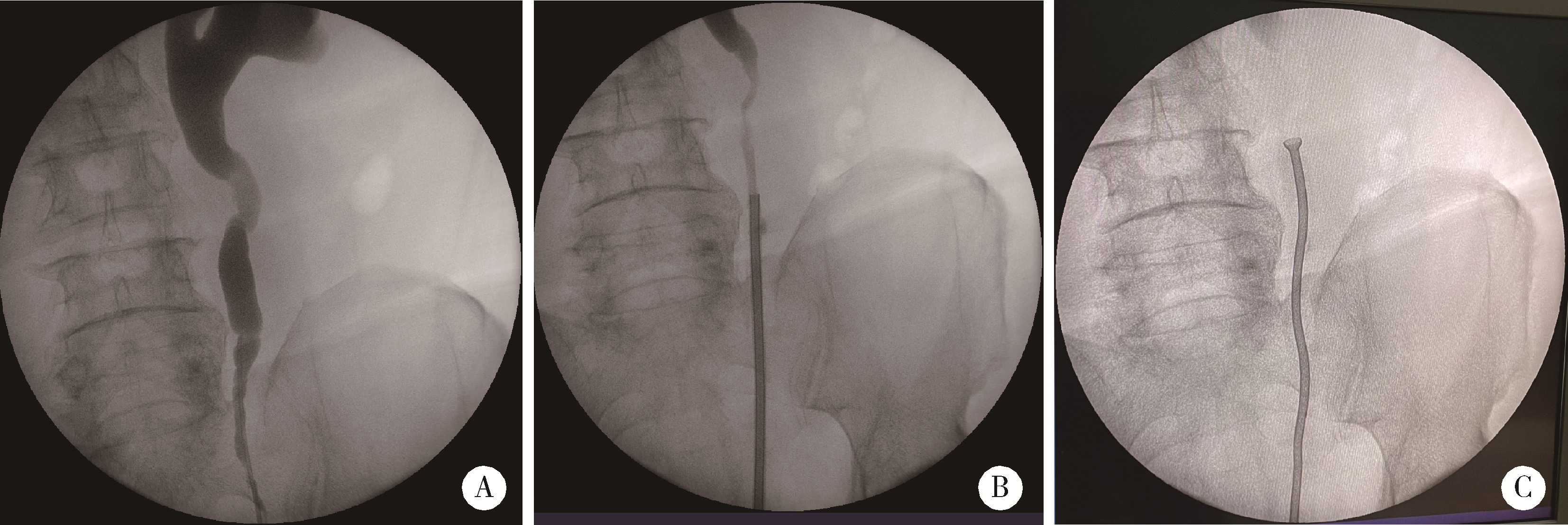
Procedural steps of Memokath-051 ureteral stent insertion A, retrograde pyelography demonstrating the length of the ureteral stricture; B, deployment of the Memokath-051 stent with its proximal end placed 1 cm above the stricture segment; C, injection of 55 ℃ normal saline to expand the proximal stent into a funnel shape."

Figure 2

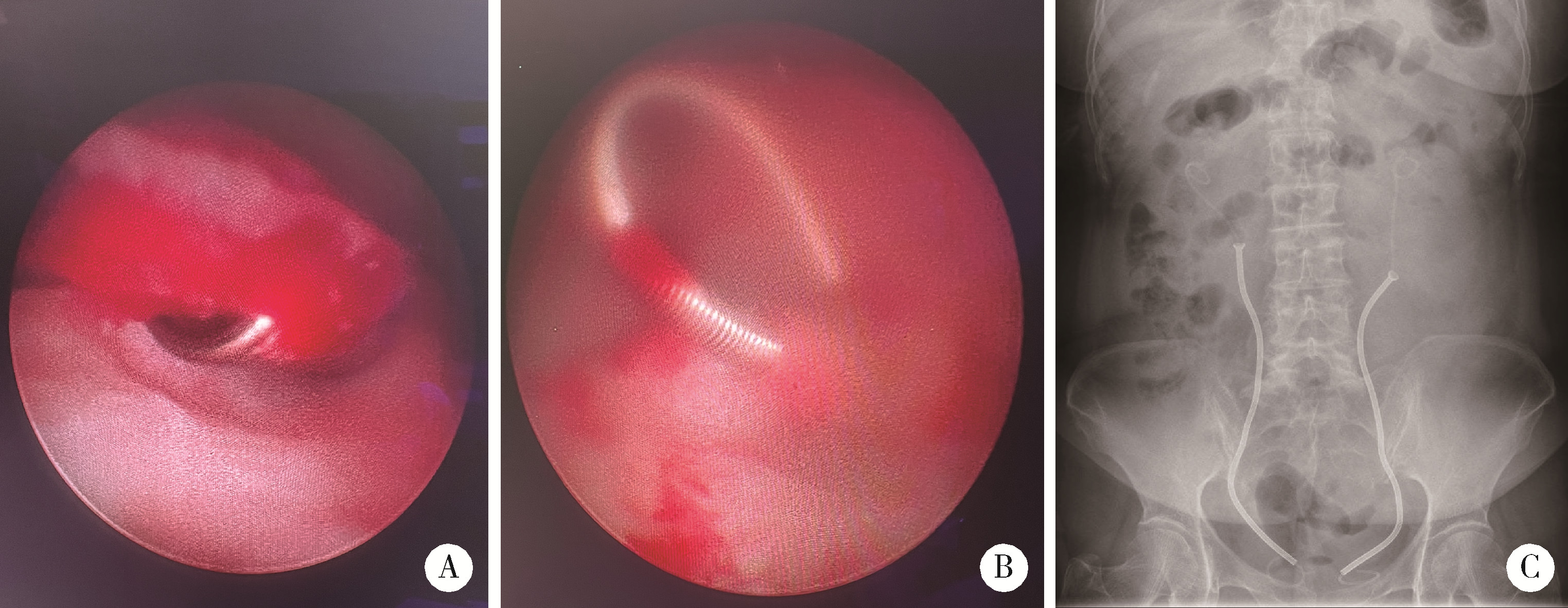
Management of intraluminal blood clot obstruction in a Memokath-051 ureteral stent with double-J stent placement and postoperative kidney-ureter-bladder plain film A, blood clot occlusion within the lumen of the Memokath-051 ureteral stent; B, insertion of a 5F/26 cm double-J stent through the Memokath-051 stent; C, kidney-ureter-bladder plain film after placement of the double-J stent inside a Memokath-051 ureteral stent."

Table 2

Complications in 16 patients (23 renal units) undergoing Memokath-051 ureteral stent placement"

Patients Stents Length/cm Complication Clavien-Dindo grade Management
1 1 15 Occlusion Double J stenting in lumen (2 weeks)
1 2 20 Occlusion Double J stenting in lumen (2 weeks)
2 3 25 None
3 4 15 Pain Analgesics
3 5 10 None
4 6 15 Migration Stent replacement
5 7 20 None
5 8 20 None
6 9 15 Stone obstruction Stent replacement
7 10 20 Tissue obstruction Stent replacement
8 11 10 Tissue obstruction Stent replacement
8 12 20 None
9 13 15 None
10 14 25 Fever Antibiotics
10 15 15 Fever Antibiotics
11 16 20 None
11 17 20 Pain Analgesics
12 18 25 None
13 19 25 None
14 20 15 Pain Analgesics
14 21 20 None
15 22 25 Pain Analgesics
16 23 25 Pain Analgesics

Table 3

Comparison of preoperative and postoperative serum creatinine and hydronephrosis"

Items Preoperative 3 months postoperatively 6 months postoperatively 12 months postoperatively χ2 P
Scr/(μmol/L), M (P25, P75) 186.80 (111.80, 244.93) 103.05 (96.20, 135.97) 97.45 (87.18, 124.50) 105.90 (87.08, 126.45) 19.50 <0.01
Width of hydronephrosis/cm, M (P25, P75) 3.20 (2.78, 3.40) 2.05 (1.08, 2.20) 1.98 (1.08, 2.10) 1.69 (1.23, 2.30) 27.94 <0.01

Table 4

Comparison of preoperative and postoperative USSQ scores"

USSQ domain Preoperative 3 months postoperatively t P
Urinary symptoms 34.75±2.34 23.75±3.26 11.10 <0.001
Physical pain 6.50±2.26 3.00±1.22 5.27 <0.001
General health status 14.19±1.52 9.37±2.09 7.24 <0.001
Work performance 9.06±1.18 4.44±1.09 10.58 <0.001
1
Caamiña L , Pietropaolo A , Prudhomme T , et al. Endourological management of ureteral stricture in patients with renal transplant: A systematic review of literature[J]. J Endourol, 2024, 38 (3): 290- 300.
2
Lee M , Lee Z , Houston N , et al. Robotic ureteral reconstruction for recurrent strictures after prior failed management[J]. BJUI Compass, 2023, 4 (3): 298- 304.

doi: 10.1002/bco2.224
3
王明瑞, 胡浩, 王起, 等. Allium覆膜金属输尿管支架长期留置治疗放疗后输尿管狭窄的有效性和安全性[J]. 中华泌尿外科杂志, 2020, 41 (12): 921- 926.
4
Forster LR , Watson L , Breeze CE , et al. The fate of ureteral memokath stent(s) in a high-volume referral center: An indepen-dent long-term outcomes review[J]. J Endourol, 2021, 35 (2): 180- 186.

doi: 10.1089/end.2020.0542
5
Zhong Q , Song T , Zeng J , et al. Initial experiment of self-expanding metal ureteral stent in recurrent ureteral stenosis after kidney transplantation[J]. Am J Transplant, 2021, 21 (5): 1983- 1984.

doi: 10.1111/ajt.16444
6
Buksh O , Jar A , Khogeer A , et al. Thermoexpandable Memokath stent: Usage and efficacy in ureteral and urethral strictures in Saudi Arabia[J]. Urol Ann, 2024, 16 (1): 98- 103.

doi: 10.4103/ua.ua_160_22
7
Su B , Hu W , Xiao B , et al. Long-term outcomes of allium ureteral stent as a treatment for ureteral obstruction[J]. Sci Rep, 2024, 14, 21958.

doi: 10.1038/s41598-024-73125-0
8
Vogt B , Dove-Rumé J . It is possible to reduce ureteral stent clogging and stent-related symptoms to soothe the pain of the patient: A case report[J]. Res Rep Urol, 2023, 15, 315- 319.
9
Khoo CC , Ho C , Palaniappan V , et al. Single-center experience with three metallic ureteral stents (AlliumURS, MemokathTM-051, and Resonance) for chronic ureteral obstruction[J]. J Endourol, 2021, 35 (12): 1829- 1837.

doi: 10.1089/end.2021.0208
10
Gao X , Di X , Chen G , et al. Metal ureteral stents for ureteral stricture: 2 years of experience with 246 cases[J]. Int J Surg, 2024, 110 (1): 66- 71.

doi: 10.1097/JS9.0000000000000841
11
Moretto S , Saita A , Scoffone CM , et al. Ureteral stricture rate after endoscopic treatments for urolithiasis and related risk factors: Systematic review and meta-analysis[J]. World J Urol, 2024, 42 (1): 234.

doi: 10.1007/s00345-024-04933-2
12
Yang K , Pang KH , Fan S , et al. Robotic ureteral reconstruction for benign ureteral strictures: A systematic review of surgical techniques, complications and outcomes[J]. BMC Urol, 2023, 23 (1): 160.

doi: 10.1186/s12894-023-01313-7
13
Heo JE , Kang SK , Lee J , et al. Outcomes of single-port robotic ureteral reconstruction using the da Vinci SP system[J]. Investig Clin Urol, 2023, 64 (4): 373.

doi: 10.4111/icu.20230005
14
Sugino T , Taguchi K , Hamamoto S , et al. Risk factors for failure of endoscopic management of stone-related ureteral strictures[J]. Urol J, 2021, 19 (2): 95- 100.
15
Bilotta A , Wiegand LR , Heinsimer KR . Ureteral reconstruction for complex strictures: A review of the current literature[J]. Int Urol Nephrol, 2021, 53 (11): 2211- 2219.

doi: 10.1007/s11255-021-02985-6
16
Hu H , Wang M , Tang X , et al. Allium ureteral stent for the treatment of malignant ureteral obstruction: A median term study[J]. Medicine, 2023, 102 (30): e34309.

doi: 10.1097/MD.0000000000034309
[1] Hao HU, Xiaolong BIAN, Tao XU. Clinical application progress, hot topics, controversies and future prospects of segmental metallic ureteral stents [J]. Journal of Peking University (Health Sciences), 2026, 58(4): 679-685.
[2] Wanwei HUANG, Xianshen SHA, Yibao ZHANG, Guohao WU, Feng LUO, Zhihui CHEN, Dongming YE, Xuesong LI, Caiyong LAI. Total 3D laparoscopic ileal ureters replacement for bilateral ureters combined with bladder augmentation in the management of post-radiotherapy bilateral ureteral strictures and contracted bladder [J]. Journal of Peking University (Health Sciences), 2025, 57(4): 789-795.
[3] Huanrui WANG, Shicong LAI, Haopu HU, Zehua DING, Tao XU, Hao HU. Efficacy analysis of laparoscopy combined with flexible ureteroscope in the treatment of complex ureteral stricture [J]. Journal of Peking University (Health Sciences), 2025, 57(4): 784-788.
[4] Mingrui WANG, Qi WANG, Hao HU, Jinhui LAI, Xinwei TANG, Chunyan WAN, Kexin XU, Tao XU. Efficacy of coated metal ureteral stent in the treatment of pelvic lipomatosis induced hydronephrosis [J]. Journal of Peking University (Health Sciences), 2024, 56(5): 919-922.
[5] Yicen YING,Yicong DU,Zhihua LI,Yiming ZHANG,Xinfei LI,Bing WANG,Peng ZHANG,Hongjian ZHU,Liqun ZHOU,Kunlin YANG,Xuesong LI. Robot-assisted laparoscopic ureteroplasty with buccal mucosa graft for complex ureteral stricture [J]. Journal of Peking University (Health Sciences), 2024, 56(4): 640-645.
[6] Jin-hui LAI,Qi WANG,Jia-xiang JI,Ming-rui WANG,Xin-wei TANG,Ke-xin XU,Tao XU,Hao HU. Effects of delayed ureteral stents removal during the COVID-19 pandemic on the quality of life and psychological status of postoperative patients with urinary calculi [J]. Journal of Peking University (Health Sciences), 2023, 55(5): 857-864.
[7] Chun-long ZHANG,Ming-rui WANG,Ming-rui WANG,Ke-xin XU,Tao XU,Hao HU. Long-term efficacy evaluation of coated metal stent implantation for ureteroscopic lithotripsy related refractory ureteral stricture [J]. Journal of Peking University (Health Sciences), 2022, 54(4): 674-679.
[8] Bing-wei HUANG,Jie WANG,Peng ZHANG,Zhe LI,Si-cheng BI,Qiang WANG,Cai-bo YUE,Kun-lin YANG,Xue-song LI,Li-qun ZHOU. Application of indocyanine green in complex upper urinary tract repair surgery [J]. Journal of Peking University (Health Sciences), 2020, 52(4): 651-656.
[9] HAO Yi-chang, HOU Xiao-fei, ZHAO Lei, XIAO Chun-lei, LIU Zhuo, ZHANG fan, MA Lu-lin. Laparoscopic ureterovesical reimplantation for ureteral stricture after renal transplantation [J]. Journal of Peking University(Health Sciences), 2018, 50(4): 705-710.
Viewed
Full text


Abstract

Cited

  Shared   
  Discussed   
No Suggested Reading articles found!