Journal of Peking University (Health Sciences) ›› 2025, Vol. 57 ›› Issue (4): 789-795. doi: 10.19723/j.issn.1671-167X.2025.04.026

Previous Articles     Next Articles

Total 3D laparoscopic ileal ureters replacement for bilateral ureters combined with bladder augmentation in the management of post-radiotherapy bilateral ureteral strictures and contracted bladder

Wanwei HUANG1, Xianshen SHA1, Yibao ZHANG1, Guohao WU2, Feng LUO2, Zhihui CHEN2, Dongming YE2, Xuesong LI3,*(), Caiyong LAI1,2,*()   

  1. 1. Department of Urology, The First Affiliated Hospital of Jinan University, Guangzhou 510630, China
    2. Department of Urology, The Sixth Affiliated Hospital of Jinan University, Dongguan 523570, Guangdong, China
    3. Department of Urology, Peking University First Hospital, Beijing 100034, China
  • Received:2025-02-12 Online:2025-08-18 Published:2025-08-02
  • Contact: Xuesong LI, Caiyong LAI
  • Supported by:
    the Guangzhou Science and Technology Plan Project(2023A03J0569); the Jinan University Medical Joint Fund Project(YXZY2022032); the Dongguan City Social Development Science and Technology Project(20231800940732)

RICH HTML


Abstract:

Objective: To retrospectively evaluate the clinical efficacy and safety of total 3D laparoscopic ileal ureters replacement for bilateral ureters combined with bladder augmentation in patients with post-radiotherapy long-segment bilateral ureteral strictures and contracted bladder. Methods: Clinical data of two patients (aged 72 and 54 years) with radiation-induced long-segment bilateral ureteral strictures and reduced bladder capacity, treated at the Sixth Affiliated Hospital of Jinan University from October 2023 to June 2024, were analyzed. Both presented with bilateral flank pain, recurrent chills/fever, urinary frequency, and urgency. Preoperative ureteral stricture lengths were measured as follows: left 10.4 cm and right 8.7 cm in the first case; left 10.6 cm and right 11.7 cm in the second case. Bladder capacity assessed by nephrostomy-assisted antegrade urography was 90 mL and 130 mL respectively. Both underwent single-position, one-stage totally 3D laparoscopic bilateral ileal ureteral replacement and bladder augmentation based on membrane anatomy principles, with regular postoperative follow-up. Results: Procedures were completed by the same experienced urologist. Operative times were 420 min and 355 min, with intraoperative blood loss of 50 mL (no transfusion required). Postoperative bowel function resumed at the end of 4.5 and 3 days. No major perioperative complications occurred. Ureteral stents were removed at 2 months postoperatively, with imaging showing improved hydronephrosis, unobstructed ureteral drainage, symmetrical bladder morphology, and smooth walls. Postoperative bladder capacities were 230 mL and 250 mL. Follow-up durations were 10 and 8 months. Both patients experienced significant relief of flank pain and lower urinary tract symptoms. No complications (enteric fistula, urinary fistula, or metabolic acidosis) were observed. At the final follow-up, one patient had mildly elevated serum creatinine, while the other showed reduced levels compared with preoperative values; both remained stable. Conclusion: Membrane anatomy-based dissection facilitates safe mobilization of fibrotic ureters with minimal bleeding and collateral damage. Total intracorporeal 3D laparoscopic ileal ureters replacement for bilateral ureters combined with bladder augmentation effectively addresses long-segment ureteral obstruction and improves bladder capacity. This approach is technically safe and feasible, though further validation with larger clinical cohorts is warranted.

Key words: Ureteral obstruction, Urinary bladder, Radiotherapy, Radiation-induced extensive ureteral strictures, Ileal ureteral replacement, Totally laparoscopic surgery

CLC Number: 

  • R699

Table 1

Patient baseline characteristics"

Items Case 1 Case 2
Age/years 72 54
Gender Female Female
Affected side Bilateral Bilateral
Etiology Radiotherapy for cervical high-grade squamous intraepithelial lesion Radiotherapy after cervical cancer surgery

Symptom manifestation
Low back pain, intermittent fever, urinary frequency and urgency Low back pain, intermittent fever,
urinary frequency and urgency
Length of ureteral stricture/cm Left 10.4, right 8.7 Left 10.6, right 11.7
Preoperative hydronephrosis degree Bilateral moderate to severe hydronephrosis Bilateral moderate to severe hydronephrosis
Past surgical history Open pyelolithotomy on the left side Hysterectomy and bilateral adnexectomy
Preoperative management Nephrostomy for 2 months Nephrostomy for 2 months

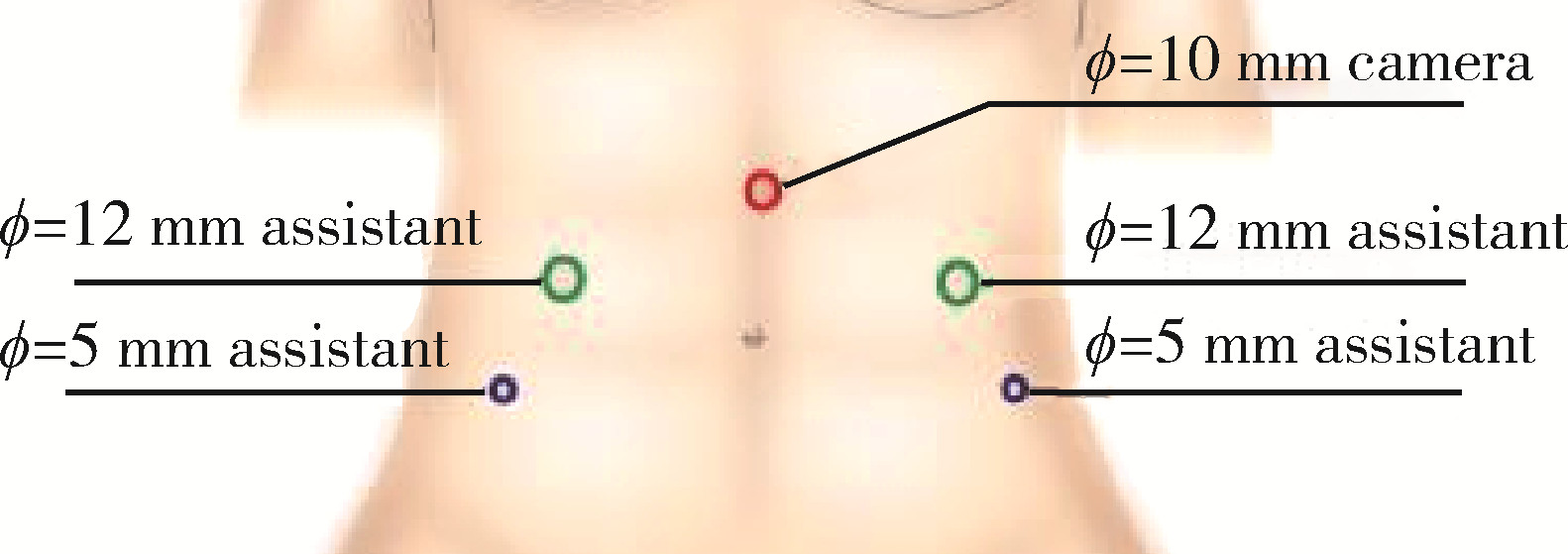
Figure 1

Surgical position and trocar layout"

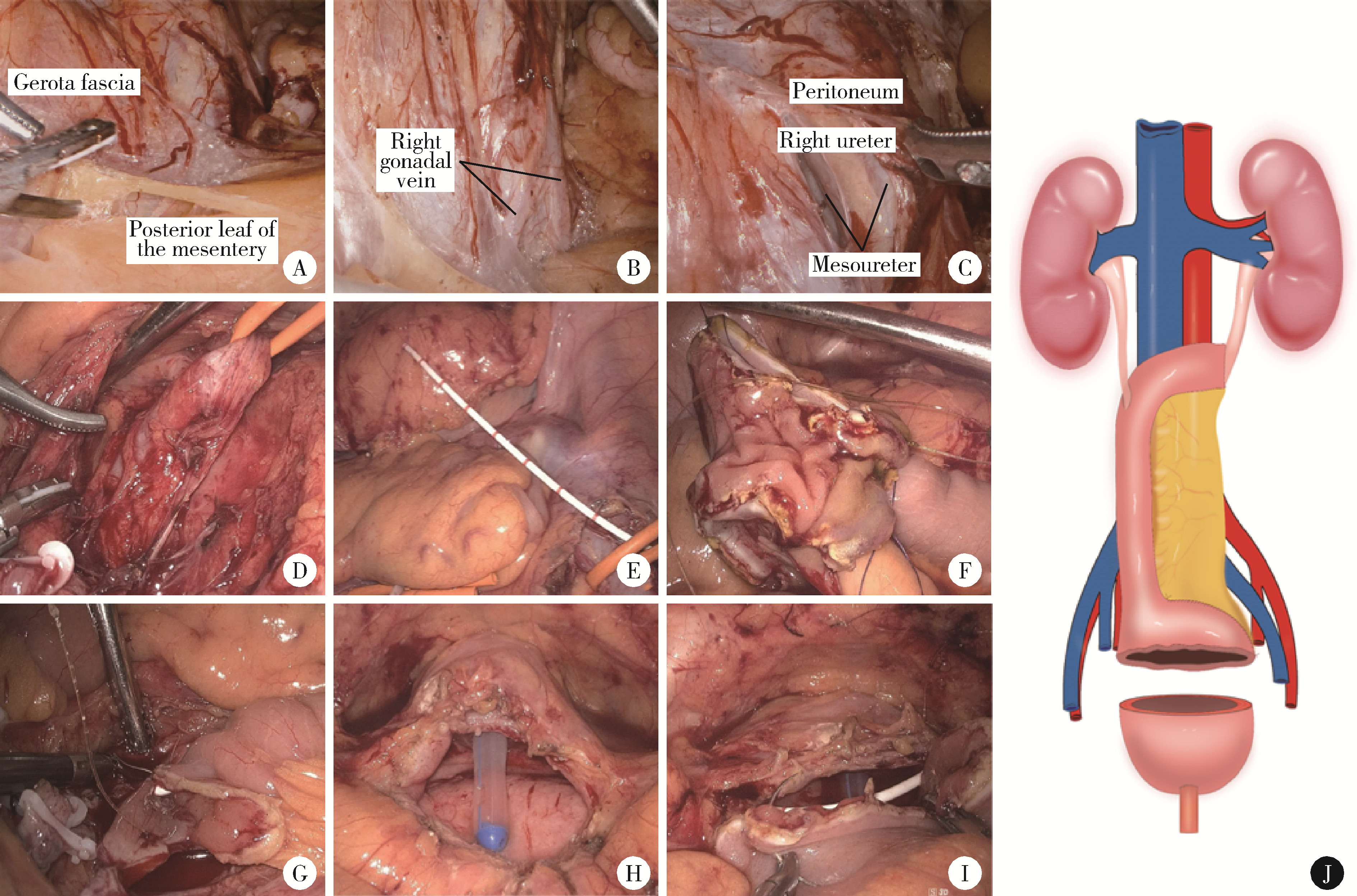
Figure 2

Surgical and schematic diagrams of total 3D laparoscopic ileal replacement of bilateral ureters with cystoplasty A, dissection into the plane between the retromesenteric leaf and prerenal fascia; B, incising the continuation of renal fascia followed by dissection and ligation of right gonadal vein; C, dissection of right ureter along the extra-mesenteric plane; D, mobilization and tagging of right ureter; E, performing precise measurement for ileal segment required for ureteral replacement; F, intracorporeal suturing of ileal bladder flap; G, clamp-free end-to-end anastomosis between right ureter and ileal conduit; H, transverse incision (4 cm) on bladder dome; I, continuous suture of ileal bladder flap to native bladder; J, schematic diagram of surgical procedure."

Figure 3

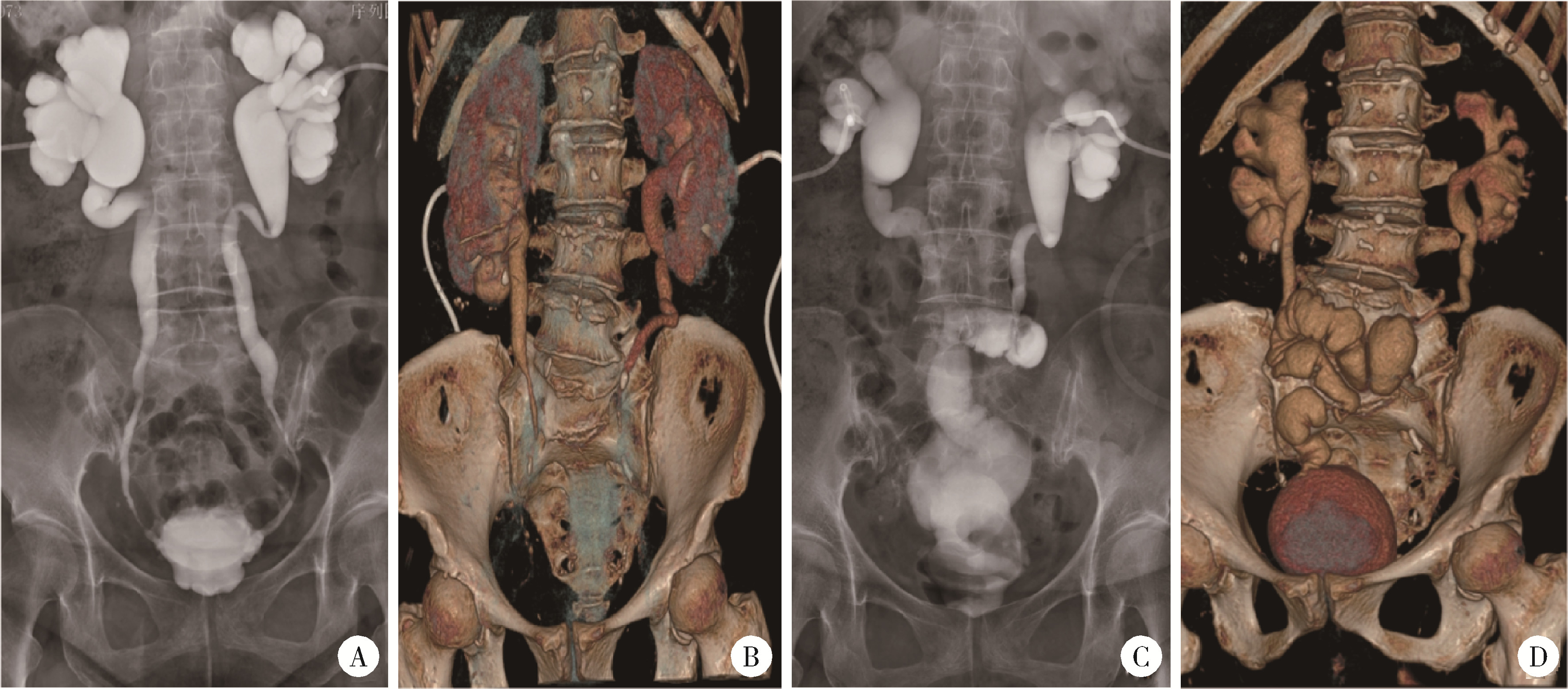
Preoperative and postoperative imaging examinations A and B, preoperative nephrostogram and 3D CT reconstruction demonstrated bilateral long-segment ureteral strictures, contracted bladder with reduced capacity, and rigid, thickened bladder walls; C and D, two-month follow-up 3D CT reconstruction revealed good peristalsis in the ileal ureteral substitute segment. The bladder exhibited symmetrical morphology with smooth wall contour."

Table 2

Perioperative and postoperative follow-up conditions of patients"

Items Case 1 Case 2
Surgical method Total 3D laparoscopy Total 3D laparoscopy
Surgical duration/min 420 355
Intraoperative blood loss/mL 50 50
Length of bowel resection/cm 40 38
Perioperative complications None None
Time to flatus passage after surgery/d 4.5 3
Hospital stay duration/d 10 8
Residual urine volume (preoperative/2 months postoperative)/mL 45/50 60/55
Bladder capacity (preoperative/2 months postoperative)/mL 90/230 130/250
24-hour urination frequency (preoperative/2 months postoperative) (16-18)/(9-10) (12-14)/(8-9)
Nocturia frequency (preoperative/2 months postoperative) (3-5)/(1-2) (2-3)/(1-2)
Clean intermittent self-catheterization No No
Base excess/(mmol/L)
  Preoperative +0.8 -1.2
  2 months postoperative -1.8 -2.6
  6 months postoperative -2.2 -2.4
Serum creatinine/(μmol/L)
  Preoperative 118.11 179.63
  1 day postoperative 131.77 180.41
  2 months postoperative 125.31 100.03
  6 months postoperative 136.83 110.67
  8 months postoperative 138.40 107.89
  10 months postoperative 126.65 -
Follow-up duration/months 10 8
1
Fokdal L , Tanderup K , Pötter R , et al. Risk factors for ureteral stricture after radiochemotherapy including image guided adaptive brachytherapy in cervical cancer: Results from the EMBRACE studies[J]. Int J Radiat Oncol Biol Phys, 2019, 103 (4): 887- 894.
2
Kushwaha SS , Kalra S , Dorairajan LN , et al. Robot-assisted complex urinary tract reconstruction using intestinal segments: Redefining the paradigm[J]. J Robot Surg, 2023, 17 (3): 1113- 1123.
3
杨昆霖, 吴昱晔, 丁光璞, 等. 回肠代输尿管联合膀胱扩大术治疗输尿管狭窄合并膀胱挛缩的初步研究[J]. 中华泌尿外科杂志, 2019, 40 (6): 416- 421.
4
Huang C , Yang K , Gao W , et al. Ileal ureter replacement and ileocystoplasty for the treatment of bilateral ureteral strictures and bladder contracture: Technique and outcomes[J]. Minerva Urol Nephrol, 2024, 76 (1): 97- 109.
5
李兵, 梁超启. 输尿管狭窄修复重建策略[J]. 临床泌尿外科杂志, 2019, 34 (5): 335- 339.
6
Jeong IG , Han KS , Park SH , et al. Ileal augmentation cystoplasty combined with ileal ureter replacement after radical treatment for cervical cancer[J]. Ann Surg Oncol, 2016, 23 (5): 1646- 1652.
7
Joshi P , Lin J , Sura T , et al. Kidney autotransplantation for treatment of ureteric obstruction: A case report and brief review of the literature[J]. Case Rep Surg, 2021, 2021, 6646958.
8
Fenger C . Surgery of the ureter[J]. Ann Surg, 1894, 20 (3): 257- 296.
9
Gill IS , Savage SJ , Senagore AJ , et al. Laparoscopic ileal ureter[J]. J Urol, 2000, 163 (4): 1199- 1202.
10
Liang C , Chai S , Gao X , et al. Laparoscopic "reverse 7" ileal ureteral replacement for bilateral extensive ureteral strictures performed completely intracorporeally: The initial experience[J]. Int Urol Nephrol, 2021, 53 (5): 919- 924.
11
Kochkin A , Tokas T , Gallyamov E , et al. Laparoscopic totally intracorporeal ileal ureter replacement: A multi-institutional study[J]. Minim Invasive Ther Allied Technol, 2022, 31 (1): 119- 126.
12
Wit EMK , Horenblas S . Urological complications after treatment of cervical cancer[J]. Nat Rev Urol, 2014, 11 (2): 110- 117.
13
祁小龙, 徐智慧, 刘锋, 等. 腹腔镜下回肠膀胱扩大术治疗低顺应性膀胱的初步临床结果[J]. 中华外科杂志, 2015, 53 (8): 594- 598.
14
Carl P , Stark L . Ileal bladder augmentation combined with ileal ureter replacement in advanced urogenital tuberculosis[J]. J Urol, 1994, 151 (5): 1345- 1347.
15
Chung BI , Hamawy KJ , Zinman LN , et al. The use of bowel for ureteral replacement for complex ureteral reconstruction: Long-term results[J]. J Urol, 2006, 175 (1): 179- 184.
16
Poujade L , Branchereau J , Rigaud J , et al. Ileal ureter replacement: Early morbidity and long-term results[J]. Prog Urol, 2021, 31 (6): 357- 367.
17
Pamecha Y , Shelke U , Patil B , et al. Use of ileum for complex ureteric reconstruction: Assessment of long-term outcome, complications, and impact on renal function[J]. Urology Ann, 2018, 10 (4): 369- 374.
18
Wu G , Li H , Luo F , et al. Total intracorporeal laparoscopic ileal ureter replacement in a single position for ureteral stricture based on membrane anatomy[J]. BMC Surg, 2024, 24 (1): 88.
[1] Qiushi XU, Tong LIU, Junjie WANG. Ferroptosis-related long non-coding RNA to predict the clinical outcome of non-small cell lung cancer after radiotherapy [J]. Journal of Peking University (Health Sciences), 2025, 57(3): 569-577.
[2] Junyong OU,Kunming NI,Lulin MA,Guoliang WANG,Ye YAN,Bin YANG,Gengwu LI,Haodong SONG,Min LU,Jianfei YE,Shudong ZHANG. Prognostic factors of patients with muscle invasive bladder cancer with intermediate-to-high risk prostate cancer [J]. Journal of Peking University (Health Sciences), 2024, 56(4): 582-588.
[3] Wenbo YANG,Lei YU,Weiyu ZHANG,Tao XU,Qiang WANG. Effect and safety of self-draining ureteral stent with thread in kidney transplant reci-pients [J]. Journal of Peking University (Health Sciences), 2024, 56(4): 656-660.
[4] Shengjia PENG,Yu QI,Lijie SUN,Dan LI,Xinyu WANG,Jiangli HAN,Baoxia CHEN,Yuan ZHANG. Afferent baroreflex failure with hyponatremia: A case report [J]. Journal of Peking University (Health Sciences), 2024, 56(2): 357-361.
[5] Hai-hong JIANG,Xiao-fan LI,Jian-liu WANG. Relationship between chronic radiation enteritis of cervical cancer and gut microbiota [J]. Journal of Peking University (Health Sciences), 2023, 55(4): 619-624.
[6] Su-huan XU,Bei-bei WANG,Qiu-ying PANG,Li-jun ZHONG,Yan-ming DING,Yan-bo HUANG,Xin-yan CHE. Effect of equal temperature bladder irrigation in patients with transurethral resection of prostate: A meta-analysis [J]. Journal of Peking University (Health Sciences), 2023, 55(4): 676-683.
[7] WANG Jia-wen,LIU Jing-chao,MENG Ling-feng,ZHANG Wei,LIU Xiao-dong,ZHANG Yao-guang. Quality of life and related factors in patients with interstitial cystitis/bladder pain syndrome [J]. Journal of Peking University (Health Sciences), 2021, 53(4): 653-658.
[8] Tian WANG,Xin HONG,Xiao-feng WANG. Clinical application of the needle electrode in transurethral plasmakinetic resection of bladder tumor around ureteral orifice: A report of 16 cases [J]. Journal of Peking University (Health Sciences), 2020, 52(4): 632-636.
[9] Wen-min DONG,Ming-rui WANG,Hao HU,Qi WANG,Ke-xin XU,Tao XU. Initial clinical experience and follow-up outcomes of treatment for ureteroileal anastomotic stricture with Allium coated metal ureteral stent [J]. Journal of Peking University (Health Sciences), 2020, 52(4): 637-641.
[10] Hao WANG,Shu-kun JIANG,Ran PENG,Yi HUANG,Ming-qing WANG,Jun-jie WANG,Cheng LIU,Fan ZHANG,Lu-lin MA. Individual control of urine volume to improve stability of bladder volume in radiotherapy of urinary tumor [J]. Journal of Peking University (Health Sciences), 2020, 52(4): 688-691.
[11] Shi-ming ZHAO,Tie-jun YANG,Chun-miao XU,Xiao-feng GUO,Yong-kang MA,Xue-jun CHEN,Xiang LI,Chao-hong HE. Bladder cancer local staging about muscle invasion: 3.0T MRI performance following transurethral resection [J]. Journal of Peking University (Health Sciences), 2020, 52(4): 701-704.
[12] Kai MA,Xing-ke QU,Qing-quan XU,Liu-lin XIONG,Xiong-jun YE,Li-zhe AN,Wei-nan CHEN,Xiao-bo HUANG. Endoscopic treatment for ureterovesical junction stenosis in patients with kidney transplantation: 13 cases report [J]. Journal of Peking University(Health Sciences), 2019, 51(6): 1155-1158.
[13] Wei-yu ZHANG,Qiu-xiang XIA,Hao HU,Jing-wen CHEN,Yi-ran SUN,Ke-xin XU,Xiao-peng ZHANG. Analysis of urodynamic study of female outpatients with lower urinary tract symptoms and follow-up of the patients with detrusor underactive [J]. Journal of Peking University(Health Sciences), 2019, 51(5): 856-862.
[14] Hai-wen HUANG,Bing YAN,Mei-xia SHANG,Li-bo LIU,Han HAO,Zhi-jun XI. Propensity-matched comparison of laparoscopic and open radical cystectomy for female patients with bladder cancer [J]. Journal of Peking University(Health Sciences), 2019, 51(4): 698-705.
[15] Chen LIANG,Wei-yu ZHANG,Hao HU,Qi WANG,Zhi-wei FANG,Ke-xin XU. Comparison of effectiveness and complications between two different methods of augmentation cystoplasty [J]. Journal of Peking University(Health Sciences), 2019, 51(2): 293-297.
Viewed
Full text


Abstract

Cited

  Shared   
  Discussed   
No Suggested Reading articles found!