Analysis of early complications and risk factors in patients with amyotrophic lateral sclerosis after percutaneous endoscopic gastrostomy

  • Xueli TIAN 1 ,
  • Zhiqiang SONG 1 ,
  • Yonghui HUANG , 2, * ,
  • Wei YAO 1
Expand
  • 1. Department of Gastroenterology, Peking University Third Hospital, Beijing 100191, China
  • 2. Department of Gastroenterology, Beijing Tsinghua Changgung Hospital, Beijing 102218, China
HUANG Yonghui, e-mail,

Received date: 2025-05-26

  Online published: 2025-08-27

Copyright

All rights reserved. Unauthorized reproduction is prohibited.

Abstract

Objective: To explore risk factors of early complications (≤14 days) and the clinical characteristics in patients with amyotrophic lateral sclerosis (ALS) after percutaneous endoscopic gastrostomy (PEG). Methods: Patients diagnosed with ALS who underwent first PEG insertion between January 2011 and December 2020 were eligible. Medical records were retrospectively reviewed to determine clinical characteristics and outcomes (≤14 days) of patients who underwent the pull type PEG. Grouping was performed based on the presence and severity of complications, and SPSS 27.0 statistical software was used for data analysis. Finally, Logistic regression model was applied for multivariate factor analysis of risk factors related to complications. Results: In the study, 192 cases of PEG were all successfully completed, with 97 (51%) males, mean age of ALS onset disease (55±11) years and 93 (48%) bulbar onset symptoms included. Complications occurred in 40 (21%) cases after PEG within 14 days, all of which had fever, including 16 cases without clear infection focus, 18 cases of respiratory tract infections, and 6 cases of fistula site infections. In the study, 13 (7%) cases had major complications, including 11 cases of respiratory tract infection and 2 cases of stoma infection. Two cases of respiratory tract infection died due to respiratory failure, and the remaining 11 cases recovered after upgraded antibiotic. No complications, such as tube dislodgement, benign pneumoperitoneum, hemorrhage or buried bumper syndrome occurred. The operation time and postoperative hospital stay were longer in the complication group than in the non-complication group [(16±5) min vs. (13±5) min, P < 0.001; 6 (5, 9) d vs. 5 (3, 7) d, P=0.009]. Compared with the mild complication group, the creatinine and triglyceride in the major complication group were significantly lower [(46.5±16.2) μmol/L vs.(66.8±16.4) μmol/L, P<0.001; (1.1±0.5) mmol/L vs.(1.6±0.7) mmol/L, P=0.038], and the operation time was significantly longer [(20±5) min vs. (15±5) min, P=0.002]. Further, Logistic regression model analysis revealed that the operation time was also independent associated with complications (OR=1.132, 95%CI: 1.051-1.220, P=0.001). Conclusion: PEG was a reliable method for ALS patients to put nutrition tube. Postoperative fever was the most common complications. Long surgical duration was an independent risk factor for the occurrence of complications (≤14 d).

Cite this article

Xueli TIAN , Zhiqiang SONG , Yonghui HUANG , Wei YAO . Analysis of early complications and risk factors in patients with amyotrophic lateral sclerosis after percutaneous endoscopic gastrostomy[J]. Journal of Peking University(Health Sciences), 2026 , 58(1) : 190 -195 . DOI: 10.19723/j.issn.1671-167X.2026.01.025

肌萎缩侧索硬化症(amyotrophic lateral sclerosis,ALS)是一种神经退行性疾病,其特征是对上运动神经元和下运动神经元及其支配的躯干、四肢和头面部肌肉造成损伤,发病率约为每10万人2~3例[1]。吞咽困难和营养不良是ALS的常见临床表现[2],经皮内镜下胃造瘘术(percutaneous endoscopic gastrostomy,PEG)后的营养支持可改善ALS患者的营养状态[3]。然而,由于ALS为少见疾病,以及PEG是有创操作,消化内镜医师为ALS患者行PEG的操作并不常见。虽然有研究阐述了PEG后早期和长期并发症的危险因素[4-6],但本课题组发现其研究对象是各种疾病的患者,尤其是脑血管疾病和恶性肿瘤患者,ALS仅占很小比例(11.5%~13.2%),并且有研究提示基础疾病与PEG并发症的发生率有关[7-8]。所以仅就ALS患者行PEG早期并发症的风险因素评估而言,上述研究结果并不适用,国内外相关研究较为匮乏。
为了明确ALS患者在PEG早期(≤14 d)并发症的发生率及相关危险因素,本研究回顾分析了北京大学第三医院10年来行PEG的ALS患者的病例资料,旨在为消化内镜医师与神经内科医师的临床决策提供循证医学证据。

1 资料与方法

1.1 研究对象

连续纳入2011年1月至2020年12月在北京大学第三医院首次行PEG的ALS患者的临床资料进行回顾性分析。入选标准:按照修订版EI Escorial标准在神经内科明确诊断为ALS;有长期营养支持需求并于北京大学第三医院首次行PEG。排除标准:其他病因行PEG者;PEG管置换术者;数据资料有明显缺失者。本研究开始前已经北京大学第三医院医学科学伦理委员会的审查批准(IRB00006761-M2023281)。

1.2 研究方法

1.2.1 观察指标

收集的临床资料主要包括年龄、性别、ALS发病起始部位(延髓)、ALS诊断延迟时间、ALS发病至PEG间隔时间、ALS功能评定量表(ALS functional rating scale,ALSFRS)评分、术前实验室检查结果(白蛋白、肌酐、钠、钾、甘油三酯)、鼻胃镜(或经口胃镜)检查结果、手术时间、住院时间(PEG术后)和手术并发症等。

1.2.2 并发症的定义

出血:PEG后发生的具有临床意义的显性出血(黑便、便血,以及造瘘口周围活动性出血);良性气腹:PEG操作时气体异常积聚在腹腔内,不经干预自行吸收;包埋综合征:内外固定垫之间组织压力过大致胃内垫沿着胃和腹壁的胃造瘘口向周围迁移,可能嵌入胃壁外层或者胃壁以外的其他结构。术后并发症(≤14 d)分为轻度并发症和严重并发症。造瘘管脱管、良性气腹、预防性抗生素可控制的发热被定义为轻度并发症。严重并发症包括升级抗生素后控制的感染、出血、呼吸衰竭、内脏器官损伤、包埋综合征和死亡。

1.2.3 PEG操作前注意事项

在PEG前一周停用抗血小板和抗凝药物。静脉注射1.5 g头孢呋辛(术前30 min)预防感染。

1.2.4 主要仪器与耗材

胃镜(EG-601WR、EG-580NM)购自日本富士胶片株式会社,胃镜(GIF-XP290N)购自日本奥林巴斯胶片株式会社;经皮内窥镜胃造瘘套装(PEG-24-PULL-I-3)购自美国库克公司。

1.2.5 PEG操作

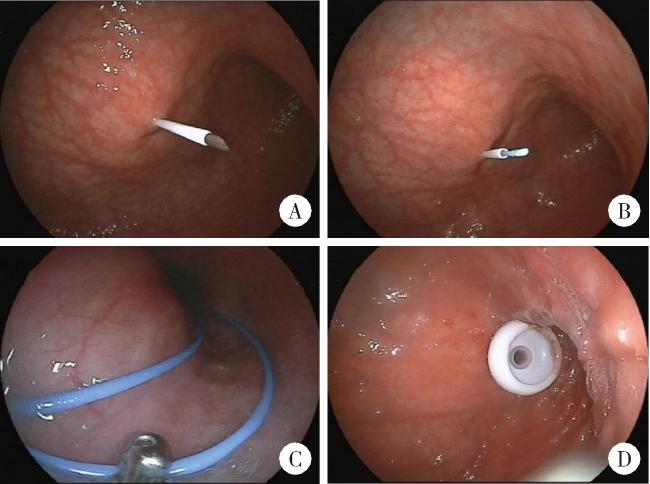
使用牵拉法进行(图 1)PEG操作[9]。患者左侧卧位,胃镜检查食管、胃及十二指肠,排除胃壁病变。体位至仰卧位,头偏于左侧,胃镜调整注气使胃前壁紧贴腹壁。穿刺点定位:通过腹壁透光法(胃镜光源引导)选择左上腹肋缘下4~8 cm处,避开血管及脏器。局部消毒、铺巾、麻醉、切开,切口1~2 cm。穿刺与导丝置入:穿刺针和套管垂直入胃腔,退出针芯,经套管置入导丝。胃镜下用抓钳夹住导丝,随胃镜退出口腔,保留导丝两端(口腔及腹部)。造瘘管置入:将造瘘管与导丝末端连接,反向牵拉导丝,使造瘘管蘑菇头端固定于胃内。胃镜直视下观察造瘘管位置,确认无出血及胃壁损伤。外固定钮固定于腹壁,剪断造瘘口的尖端部分,连接注射接头。
图1 应用牵引法行内镜下胃造瘘术

Figure 1 Percutaneous endoscopic gastrostomy (PEG) using the pull technique

A, puncture needle with plastic sheath into abdominal and gastric walls; B, the needle was removed and the guide wire was inserted through the plastic sheath; C, biopsy forceps grasping guidewire through the endoscopic channel; D, PEG tube was placed by the pull technique using an internal bumper.

1.2.6 PEG术后注意事项

密切监测腹痛、腹胀、发热、呕血、黑便等症状,关注造瘘口有无渗液、导管移位或出血,必要时监测生命体征,定期造瘘口换药。术后4 h从营养管注入50 mL饮用水,确认无不适后逐步开始注入营养液。术后8 h再次静脉注射1.5 g头孢呋辛预防感染。

1.3 统计学分析

采用SPSS 27.0软件,符合正态分布的连续变量以 $\bar x \pm s$表示,组间比较使用Student的t检验;不符合正态分布的连续变量以M (P25, P75)表示,组间比较使用Mann-Whitney U检验。分类变量以n(%)表示,组间比较采用卡方检验或Fisher精确检验。使用Logistic回归模型进行多因素分析,评价并发症发生的危险因素,并计算比值比(odds ratios,OR)和95%置信区间(confidence intervals,CI)。双侧检验,P<0.05认为差异有统计学意义。

2 结果

2.1 入组患者的一般资料

研究期间282例患者接受了牵引法PEG,其中,52例行PEG置换术,导致了例数的重复计算,28例为非ALS患者,10例患者数据不全。因此,192例被纳入分析。192例ALS患者均成功接受了PEG。ALS的平均发病年龄为(55±11)岁,诊断延迟时间为12(6,22)个月。在所有患者中,93例(48%)为延髓起病的ALS。平均ALSFRS评分为24±10。从发病到PEG的间隔时间为26(18,40)个月。为了减少咽部刺激,141例患者接受了经鼻内镜检查(73%)。PEG后的中位住院时间为5 d。

2.2 患者术后并发症

共40例(21%)发生并发症(表 1),其中13例(7%)为严重并发症。40例均出现了发热,16例没有明确的感染灶,通常持续数小时后自行退热;另24例有明确的感染部位,其中呼吸道感染18例,造瘘口感染6例。在11例呼吸道感染的严重并发症中,2例并发呼吸衰竭,最终死亡,另外9例通过调整抗生素后感染被控制。造瘘口周围感染患者中,2例在升级抗生素后好转,余4例患者通过加强造瘘口处的敷料更换和单纯预防性抗生素好转。未观察到营养管脱落、脏器损伤、良性气腹、出血或包埋综合征。
表1 PEG术后14 d内的并发症

Table 1 Complications after PEG tube placement within 14 days

Complications within 14 days n
Minor complications
  Post-operative fever (prophylactic antibiotics) 27
    Without evident infection 16
    Respiratory tract infection 7
    Peristomal wound infection 4
  Tube dislodgement 0
  Benign pneumoperitoneum 0
Major complications
  Post-operative fever (upgraded antibiotics)) 13a
    Respiratory tract infection 11a
    Peristomal wound infection 2
  Hemorrhage 0
  Injury to internal organs 0
  Buried bumper syndrome 0
  Respiratory failure 2a
  Death 2a

a,one patient had more than two complications at the same time;PEG,percutaneous endoscopic gastrostomy.

2.2.1 有并发症组和无并发症组的比较分析

年龄、性别、ALS发病部位、诊断延迟时间、ALSFRS评分、ALS发病到PEG的间隔时间、实验室检查结果,以及是否经鼻胃镜检查在并发症组和无并发症组间差异均无统计学意义。但是并发症组的手术时间[(16±5) min vs.(13±5) min,P<0.001]和术后住院时间[6(5, 9) d vs.5(3, 7) d,P=0.009]明显长于无并发症组(表 2)。
表2 有无并发症的两组患者组间数据比较分析

Table 2 Descriptive statistics and bivariate comparisons of patients who had complication vs. non-complication

Items Complication (n=46) Non-complication (n=146) Statistics (χ2/t/z) P
Male, n (%) 25 (54) 72 (49) 0.354 0.552
Site of disease onset (bulbar), n (%) 21 (46) 72 (49) 0.188 0.665
Age at disease onset /years, $\bar x \pm s$ 54±11 56±12 0.897 0.572
Diagnose delay/months, M (P25, P75) 12 (7, 18) 12 (6, 24) -0.192 0.848
ALSFRS, $\bar x \pm s$ 24±10 24±10 -0.247 0.805
Interval from disease onset to PEG/months, M (P25, P75) 25 (17, 39) 26 (18, 40) -0.329 0.742
Laboratory data, $\bar x \pm s$
  Albumin/(g/L) 41.5±4.1 41.2±3.2 0.512 0.610
  Creatinine/(μmol/L) 61.0±18.6 60.0±18.0 0.327 0.744
  Sodium/(mmol/L) 140.5±2.4 139.9±8.9 0.388 0.698
  Potassium/(mmol/L) 3.8±0.3 3.9±0.3 -1.247 0.214
  Triglyceride/(mmol/L) 1.5±0.7 1.3±0.6 1.442 0.223
Transnasal gastroscopy, n (%) 34 (73) 107 (73) 0.007 0.933
Operation time/min, $\bar x \pm s$ 16±5 13±5 3.606 0.000
Hospital days, M(P25, P75) 6 (5, 9) 5 (3, 7) 2.692 0.009

ALSFRS, amyotrophic lateral sclerosis functional rating scale;PEG, percutaneous endoscopic gastrostomy.

2.2.2 轻度并发症亚组和严重并发症亚组比较分析

严重并发症亚组与轻度并发症亚组相比,肌酐和甘油三酯显著降低[(46.5±16.2) μmol/L vs. (66.8± 16.4) μmol/L,P<0.001;(1.1±0.5) mmol/L vs. (1.6±0.7) mmol/L,P=0.038,表 3],手术时间显著延长[(20.0±4.7) min vs. (14.7±4.9) min,P=0.002]。两个亚组的术后住院时间差异无统计学意义。这可能由于2例发生严重并发症的患者在PEG后的第2天和第4天死于呼吸衰竭,这明显缩短了住院时间。
表3 轻度并发症组与严重并发症组间的数据比较分析

Table 3 Descriptive statistics and bivariate comparison of patients who had minor complication vs. major complication

Items Minor complication (n=33) Major complication (n=13) Statistics (χ2/t/z) P
Male, n (%) 20 (61) 5 (39) 1.843 0.175
Site of disease onset (bulbar), n (%) 18 (55) 3 (23) 3.722 0.054
Age at disease onset/years,$\bar x \pm s$ 56±12 51±10 1.368 0.178
Diagnose delay (months), M (P25, P75) 12 (9, 20) 11 (5, 18) -0.880 0.379
ALSFRS,$\bar x \pm s$ 25±10 23±11 0.438 0.664
Interval from disease onset to PEG/months, M (P25, P75) 25 (15, 35) 25(19, 65) -1.000 0.317
Laboratory data, $\bar x \pm s$
  Albumin/(g/L) 42.2±3.3 39.6±5.4 1.915 0.062
  Creatinine/(μmol/L) 66.8±16.4 46.5±16.2 3.788 0.000
  Sodium/(mmol/L) 140.7±2.6 139.9±1.7 1.004 0.321
  Potassium/(mmol/L) 3.8±0.3 3.9±0.4 -0.889 0.379
  Triglyceride/(mmol/L) 1.6±0.7 1.1±0.5 2.148 0.038
Transnasal gastroscopy, n (%) 24 (73) 10 (77) N/A >0.999
Operation time/min, $\bar x \pm s$ 15±5 20±5 -3.336 0.002
Hospital days, M(P25, P75) 6 (5, 8) 5 (4, 14) -0.841 0.400

ALSFRS,amyotrophic lateral sclerosis functional rating scale; PEG,percutaneous endoscopic gastrostomy;N/A, not applicable.

2.2.3 并发症相关危险因素的Logistic回归分析

将并发症组间比较、并发症严重程度的亚组间比较分析中P<0.1的自变量拟纳入回归模型(排除住院时间),并通过共线性诊断最终纳入单变量因素(ALS发病部位、白蛋白、肌酐、甘油三酯和手术时间)进入Logistic回归模型,结果显示手术时间延长是早期并发症发生的独立危险因素(OR=1.132,95%CI: 1.051~1.220,P=0.001,表 4)。
表4 并发症相关危险因素的多变量分析

Table 4 Multivariate analysis of risk factors related complications

Predictors OR 95%CI P
Site of disease onset 0.889 0.406-1.946 0.769
Albumin 1.020 0.907-1.146 0.743
Creatinine 0.727 0.975-1.018 0.727
Triglyceride 1.453 0.834-2.532 0.187
Operation time 1.132 1.051-1.220 0.001

3 讨论

1980年,Gauderer等[10]首次提出胃镜辅助下经皮向胃内插入营养管,因其成本低、侵入性小、在大多数情况下无需全身麻醉,与传统外科手术相比,PEG被认为是营养管置入的更好选择方式之一。虽然实施PEG能否改善ALS的预后仍存争议,但毋庸置疑的是早期实施PEG可以改善ALS的营养状态[3]。目前关于ALS患者实施PEG后早期并发症相关危险因素的研究较为匮乏,且多为小样本(小于50例)的临床研究或者亚组分析,其临床指导意义有限。
本研究中PEG的成功置管率达100%,术后总体并发症发生率为24%,其中严重并发症为7.6%。这与既往学者研究结果一致(7%~30%)[11-12],进一步验证了PEG技术的可靠性和安全性。Castanheira等[3]仅对ALS行PEG的研究综述中发现呼吸道感染、出血、造瘘口感染和营养管脱落等并发症相对常见,但是未界定发生时间。本研究结果表明,PEG术后14 d内发热(40/40)是最常见的并发症(100%)。其中18例确诊呼吸道感染,可能源于ALS的呼吸肌受累致痰液排出不畅或术中误吸,而年龄较大、术中仰卧位无疑是加重危险的因素[13],即使在操作过程中尽可能让患者头部偏向一侧,但其他危险因素均无法避免。大多数患者通过抗生素调整后感染得到控制,但2例死于呼吸衰竭。为了降低呼吸道感染的风险,可以预防性应用抗生素[14-15],评估呼吸功能并在患者呼吸功能尚好时手术(用力肺活量>50%)[16],以及应用鼻内镜来获益[17]。6例发生造瘘口感染,均在接受抗生素治疗和加强换药后康复。此外,有16例无明确感染灶的发热病例,为短暂的低热,且24 h内退热,未追加或更换抗生素。Lee等[18]的研究中也发现了无明显感染来源的发热(4.0%),预防性抗生素治疗组发生率为3.3%,对照组为6.8%,且差异有统计学意义(P=0.021),提示预防性抗生素的应用可能有利于控制术后发热。PEG后发热仍然是一个需要关注的重要问题,推荐应用预防性抗生素。ALS患者在PEG后发生呼吸道感染有重症倾向,这可能与其呼吸功能障碍有关,因此,也推荐术前肺功能评估。本研究未观察到出血并发症,可能的原因为患者在内镜手术前被要求停止使用抗凝剂或抗血小板药物至少1周;且本研究定义该并发症为有临床意义的显性出血。营养管脱落通常发生在长期随访人群中,在早期并发症中发生率很少。
目前的指南推荐将营养不良(定义为体重减轻大于10%)视为评估ALS患者实施PEG的重要指标[19],同时这个指标也是任何手术在围手术期减少并发症的重要管理目标[20]。评估营养不良的参考数据较多,例如体重指数、白蛋白、肌酐等,并无统一标准。本研究中体重指数的数据缺失较多,故未纳入分析,最终纳入了白蛋白、肌酐和甘油三酯,其中后两个因素在既往研究中尚未明确报道。有学者认为低白蛋白增加PEG后30 d死亡率[18],但该研究对象未限定ALS患者,且观察的结局指标是30 d死亡率。本研究发现,在有无并发症的两组比较分析中,以上三个指标的组间差异并无统计学意义,而进一步亚组分析中,严重并发症亚组的肌酐和甘油三酯明显低于轻度并发症亚组(P<0.05),白蛋白显示出相似的趋势,但差异没有统计学意义,这些结果也支持ALS患者易尽早实施PEG[15, 21],既减少并发症,又早期提供营养支持。
本研究Logistic多因素回归分析显示,手术时间延长是术后早期(≤14 d)并发症发生的独立危险因素。这一发现提示,在临床实践中为降低PEG并发症风险,应采取有效措施缩短手术时间,如完善术前准备、由经验丰富的医师操作等。值得注意的是,本结论在既往文献中尚未见相关报道,这可能与本研究采用的严格病例筛选标准或独特的术中监测指标有关。既往研究表明,PEG后30 d内的预后不良因素包括延髓发病、高龄[22-23]。然而,笔者认为该观察时间窗内的不良结局可能主要与ALS原发病进展相关,而非直接归因于PEG手术本身。本研究中共观察到13例严重并发症病例,因样本量限制未进行并发症严重程度的多因素Logistic回归分析。
本研究存在一定局限性,首先,作为单中心回顾性研究,样本量较小,而且可能存在一定的数据选择偏倚。其次,某些变量如体重指数、肺功能等数据缺失,在一定程度上限制了危险因素分析的全面性。为提升研究结论的可靠性,后续将开展多中心、前瞻性、随机对照设计的研究予以验证。
综上所述,PEG是ALS患者置入营养管、改善营养的可靠手段。术后发热是最常见的早期并发症,手术时间延长是发生早期(≤14 d)并发症的独立危险因素。

利益冲突  所有作者均声明不存在利益冲突。

作者贡献声明  田雪丽:提出研究思路,设计研究方案,撰写论文;田雪丽、宋志强、姚炜:收集、分析、整理数据;黄永辉总体把关和审定论文。所有作者均参与论文修改,并对最终文稿进行审读和确认。

1
Rizea RE , Corlatescu AD , Costin HP , et al. Understanding amyotrophic lateral sclerosis: Pathophysiology, diagnosis, and therapeutic advances[J]. Int J Mol Sci, 2024, 25 (18): 9966.

2
Feldman EL , Goutman SA , Petri S , et al. Amyotrophic lateral sclerosis[J]. Lancet, 2022, 400 (10360): 1363- 1380.

3
Castanheira A , Swash M , De Carvalho M . Percutaneous gastrostomy in amyotrophic lateral sclerosis: A review[J]. Amyotroph Lateral Scler Frontotemporal Degener, 2022, 23 (3/4): 176- 189.

4
Mendes I , Vara-Luiz F , Palma C , et al. Percutaneous endoscopic gastrostomy in the 21st century: An overview of 1415 consecutive dysphagic adult patients[J]. Nutrients, 2025, 17 (5): 747.

5
Farag M , Coleman A , Knights H , et al. Outcomes of percutaneous endoscopic gastrostomy in Huntington ' s disease at a tertiary center[J]. Mov Disord Clin Pract, 2024, 11 (8): 998- 1007.

6
Meine MC , Tusato IH , Hoffmeister N , et al. Percutaneous radiologic gastrostomy versus percutaneous endoscopic gastrostomy for enteral feeding: A systematic review and meta-analysis[J]. JPEN J Parenter Enteral Nutr, 2024, 48 (6): 667- 677.

7
Suzuki H , Joshita S , Nagaya T , et al. Relationship of early acute complications and insertion site in push method percutaneous endoscopic gastrostomy[J]. Sci Rep, 2020, 10 (1): 20551.

8
Pih GY , Na HK , Ahn JY , et al. Risk factors for complications and mortality of percutaneous endoscopic gastrostomy insertion[J]. BMC Gastroenterol, 2018, 18 (1): 101.

9
Allen JA , Chen R , Ajroud-Driss S , et al. Gastrostomy tube placement by endoscopy versus radiologic methods in patients with ALS: A retrospective study of complications and outcome[J]. Amyotroph Lateral Scler Frontotemporal Degener, 2013, 14 (4): 308- 314.

10
Gauderer MWL , Ponsky JL , Izant RJ . Gastrostomy without laparotomy: A percutaneous endoscopic technique[J]. J Pediatr Surg, 1980, 15 (6): 872- 875.

11
Carbó Perseguer J , Madejón Seiz A , Romero Portales M , et al. Percutaneous endoscopic gastrostomy in patients with amyotrophic lateral sclerosis: Mortality and complications[J]. Neurol Engl Ed, 2019, 34 (9): 582- 588.

12
Elbe P , Markus K , Valente R , et al. Effectiveness of percutaneous endoscopic gastrostomy in amyotrophic lateral sclerosis[J]. Minerva Gastroenterol Dietol, 2020, 66 (3): 219- 224.

13
Schrag SP , Sharma R , Jaik NP , et al. Complications related to percutaneous endoscopic gastrostomy (PEG) tubes. A comprehensive clinical review[J]. J Gastrointestin Liver Dis, 2007, 16 (4): 407- 418.

14
Tae CH , Lee JY , Joo MK , et al. Clinical practice guidelines for percutaneous endoscopic gastrostomy[J]. Clin Endosc, 2023, 56 (4): 391- 408.

15
Boeykens K , Duysburgh I , Verlinden W . Prevention and management of minor complications in percutaneous endoscopic gastrostomy[J]. BMJ Open Gastroenterol, 2022, 9 (1): e000975.

16
Conde B , Martins N , Rodrigues I , et al. Functional and endoscopic indicators for percutaneous endoscopic gastrostomy (PEG) in amyotrophic lateral sclerosis patients[J]. J Clin Med, 2018, 7 (10): 352.

17
Chang H , Huang Y , Yao W , et al. Improved method of gastrostomy tube replacement using a small-caliber transnasal endoscope[J]. Acta Oto Laryngol, 2016, 136 (2): 195- 198.

18
Lee C , Im JP , Kim JW , et al. Risk factors for complications and mortality of percutaneous endoscopic gastrostomy: A multicenter, retrospective study[J]. Surg Endosc, 2013, 27 (10): 3806- 3815.

19
Andersen PM , Abrahams S , Borasio GD , et al. EFNS guidelines on the Clinical Management of Amyotrophic Lateral Sclerosis (MALS)-revised report of an EFNS task force[J]. Euro J Neurology, 2012, 19 (3): 360- 375.

20
Ljungqvist O , Weimann A , Sandini M , et al. Contemporary perioperative nutritional care[J]. Annu Rev Nutr, 2024, 44 (1): 231- 255.

21
Wills AM , Hubbard J , Macklin EA , et al. Hypercaloric enteral nutrition in patients with amyotrophic lateral sclerosis: A randomised, double-blind, placebo-controlled phase 2 trial[J]. Lancet, 2014, 383 (9934): 2065- 2072.

22
Bond L , Ganguly P , Khamankar N , et al. A comprehensive examination of percutaneous endoscopic gastrostomy and its association with amyotrophic lateral sclerosis patient outcomes[J]. Brain Sci, 2019, 9 (9): 223.

23
Fasano A , Fini N , Ferraro D , et al. Percutaneous endoscopic gastrostomy, body weight loss and survival in amyotrophic lateral sclerosis: A population-based registry study[J]. Amyotroph Lateral Scler Frontotemporal Degener, 2017, 18 (3/4): 233- 242.

Outlines

/