1 资料与方法
1.1 研究对象
1.2 设备及软件
1.3 标准化咬合干扰贴片设计与制造
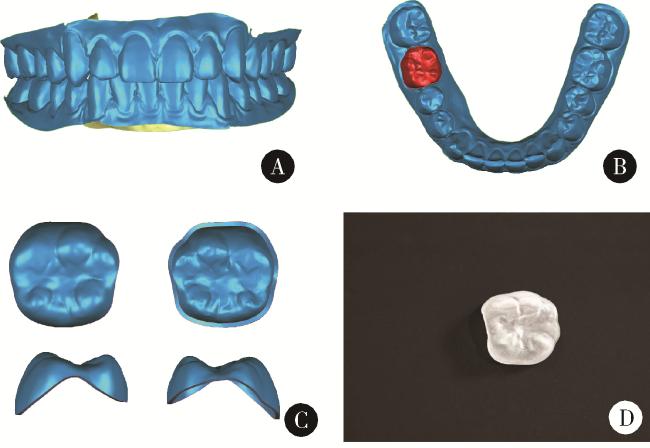
图1 标准化咬合干扰贴片设计制作流程Figure 1 Design and fabrication process of the standardized occlusal interference patch A, three-dimensional morphological data of the maxillary and mandibular dentition; B, tissue surface morphology of the occlusal interference patch; C, views of the occlusal surface, tissue surface, mesial surface, and distal surface of the three-dimensional digital model of the occlusal interference patch; D, additively manufactured resin occlusal interference patch. |
1.4 口颌面肌肉的sEMG信号采集
1.4.1 定位颞肌前束、咬肌、二腹肌前腹
1.4.2 咀嚼肌活动sEMG信号的采集
1.5 sEMG信号的处理与指标体系构建
1.5.1 sEMG信号的预处理
1.5.2 口颌面肌肉多维度sEMG指标体系构建
表1 本研究构建的口颌面肌肉sEMG指标体系Table 1 sEMG parameter system for orofacial muscles established in this study |
| Category | Indicator name | Data source | Formula |
| Common sEMG indicators for muscle function assessment in oral medicine | Percentage overlapping coeffificient,POC | Normalized RMS data | |
| Modified asymme- try index,mAI | Normalized RMS data | ||
| Activity index,Ac | Normalized RMS data | ||
| Torque coeffifi- cient,TC | Normalized RMS data | ||
| Time-frequency domain sEMG indicators | Average rectified value, ARV | Filtered data | |
| Median frequency, MF | Filtered data | ||
| Mean power fre- quency, MPF | Filtered data | ||
| Novel sEMG indicators | Coefficient of variation, CV | Normalized RMS data | |
| Muscle synergy in- dex, MSI | Normalized RMS data | Calculation of the Pearson correlation matrix from six-channel RMS data, extraction of the fifteen off-diagonal elements from its upper triangular part, and computation of the arithmetic mean of their absolute values. |
MM represents the masseter muscle, TA represents the temporal muscle, DA represents the digastric muscle; NIS represents the non-interference side, IS represents the interference side; the subscript j denotes the j-th channel, the subscript i denotes the i-th data point; xi represents the EMG amplitude at the i-th sampling point, and n represents the total number of sampling points; fmedian represents the median frequency, P(f) represents the power spectral density of the surface electromyography (sEMG) signal, fmax represents the maximum frequency. |
1.6 统计学分析
2 结果
2.1 口颌面肌肉sEMG指标体系构建及咬合干扰前后的显著性检验
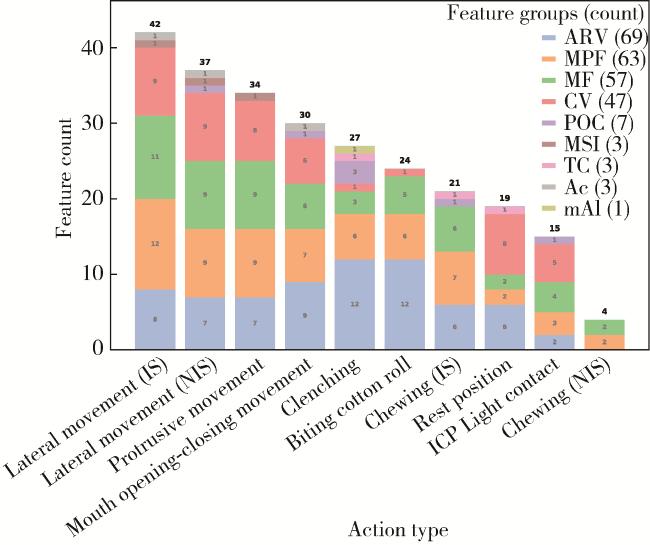
图2 各下颌动作中干扰前后差异有统计学意义的sEMG指标数量分布图Figure 2 Distribution of the number of surface electromyography (sEMG) parameters showing statistically significant differences before and after interference across mandibular movements IS, interference side; NIS, non-interference side; ICP, intercuspal position. The full names of all sEMG features have been provided in Table 1. |
2.2 基于主成分分析的sEMG特征变量提取
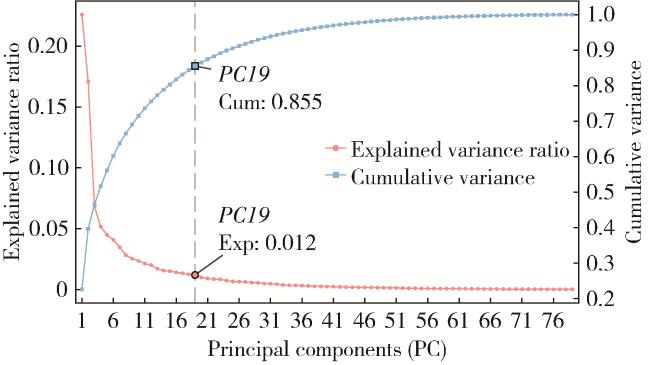
图3 口颌面肌群sEMG指标主成分分析碎石图及累积方差贡献率分布图Figure 3 Scree plot and cumulative variance contribution rate of principal component analysis for orofacial muscle surface electromyography (sEMG) parameters Cum, cumulative variance; Exp, explained variance ratio. |
表2 主成分代表性指标载荷及特征归纳Table 2 Representative factor loadings and characteristic interpretation of principal components |
| Variable | Primary feature | High-loading indicators | Loading |
| PC1 | Muscle fatigue level | MF_IS (mouth opening-closing movement) | 0.70 |
| MF_mean (mouth opening-closing movement) | 0.67 | ||
| MF_IS-DA (IS chewing) | 0.66 | ||
| MF_DA (IS lateral movement) | 0.65 | ||
| PC2 | Functional movement amplitude | ARV_NIS-TA (mouth opening-closing movement) | 0.78 |
| ARV_IS-MM (IS lateral movement) | 0.77 | ||
| ARV_NIS-MM (NIS lateral movement) | 0.77 | ||
| ARV_NIS-TA (protrusive movement) | 0.74 |
PC, principal component; MF, median frequency; ARV, average rectified value; MM represents the masseter muscle, TA represents the temporal muscle, DA represents the digastric muscle; NIS represents the non-interference side, IS represents the interference side. |
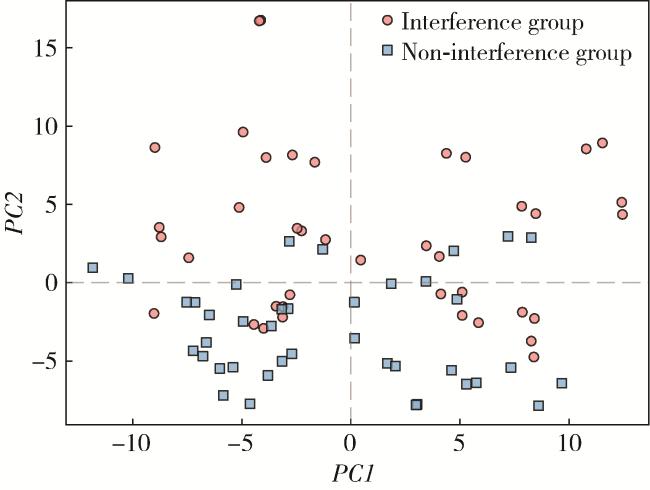
2.3 基于主成分的咬合干扰Logistic回归模型构建与性能评价
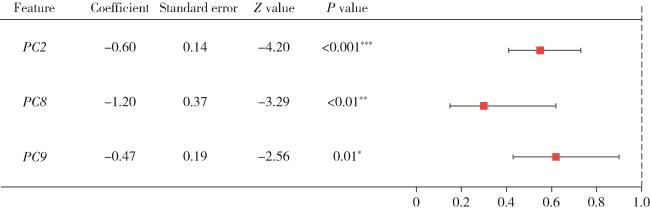
表3 纳入Logistic回归模型的主成分特征及代表性变量Table 3 Characteristics of principal components (PC) included in the Logistic regression model and their representative variables |
| Principal component | Primary feature | High-loading indicators | Loading |
| PC2 | Functional movement amplitude | ARV_NIS-TA (mouth opening-closing movement) | 0.78 |
| ARV_IS-MM (IS lateral movement) | 0.77 | ||
| ARV_NIS-MM (NIS lateral movement) | 0.77 | ||
| ARV_NIS-TA (protrusive movement) | 0.74 | ||
| PC8 | Static activity stability | MF_NIS-DA (rest position) | 0.58 |
| ARV_NIS-DA (clenching) | 0.48 | ||
| CV_IS (rest position) | 0.41 | ||
| PC9 | Fine-motor control | CV_MM (ICP light contact) | 0.68 |
| CV_IS-MM (ICP light contact) | 0.59 | ||
| MF_IS-DA (rest position) | 0.49 |
MM, masseter muscle; TA, temporal muscle; DA, digastric muscle; NIS, non-interference side, IS, interference side; ICP, intercuspal position. |