论著

铁死亡相关长链非编码核糖核酸预测放射治疗后非小细胞肺癌患者的临床结局

  • 许秋实 1, * ,
  • 刘彤 2, * ,
  • 王俊杰 , 3, *
展开
  • 1. 北京大学医学部医学技术研究院, 北京 100191
  • 2. 北京大学第三医院医学创新研究院基础医学研究中心, 北京 100191
  • 3. 北京大学第三医院放射肿瘤科, 北京 100191

* These authors contributed equally to this work

收稿日期: 2022-05-28

  网络出版日期: 2025-06-13

基金资助

北京市自然科学基金(7202228)

国家自然科学基金(82073335)

国家自然科学基金(82073057)

北京大学临床医学+X(PKU2020LCXQ024)

版权

版权所有,未经授权,不得转载。

Ferroptosis-related long non-coding RNA to predict the clinical outcome of non-small cell lung cancer after radiotherapy

  • Qiushi XU 1 ,
  • Tong LIU 2 ,
  • Junjie WANG , 3, *
Expand
  • 1. Institute of Medical Technology, Peking University Health Science Center, Beijing 100191, China
  • 2. Center of Basic Medical Research, Institute of Medical Innovation and Research, Peking University Third Hospital, Beijing 100191, China
  • 3. Department of Radiation Oncology, Peking University Third Hospital, Beijing 100191, China
WANG Junjie, e-mail,

Received date: 2022-05-28

  Online published: 2025-06-13

Supported by

the Beijing Natural Science Foundation(7202228)

National Natural Science Foundation of China(82073335)

National Natural Science Foundation of China(82073057)

Clinical Medicine plus X Project of Peking University(PKU2020LCXQ024)

Copyright

All rights reserved. Unauthorized reproduction is prohibited.

摘要

目的: 构建基于铁死亡的相关长链非编码核糖核酸(long non-coding RNA, lncRNA)模型,预测放射治疗(放疗)后非小细胞肺癌患者的预后。方法: 从癌症基因组图谱数据库(the cancer genome atlas,TCGA)下载标准化原发瘤和正常组织转录组数据,以及相应的临床信息数据,进行单变量和多变量Cox回归模型分析,构建与铁死亡相关的lncRNA高、低风险组预测模型,使用数据包预测患者的生存率和无进展生存期,验证模型在高、低风险组中的差异。结果: 铁死亡相关的差异性表达基因主要富集于铁死亡、谷胱甘肽代谢、脂质和动脉粥样硬化信号通路及氧化应激、活性氧的代谢过程;用14个与铁死亡相关的lncRNA构建一个预后模型,数据分析表明铁死亡相关的lncRNA可以独立预测放疗后非小细胞肺癌患者的预后;以年龄、性别、分期作为临床病理学变量,可预测出放疗后非小细胞肺癌高风险组预后较差。结论: 风险模型能够独立预测放疗后非小细胞肺癌患者的预后,可为铁死亡相关lncRNA在放疗后非小细胞肺癌中预后预测提供依据,并为非小细胞肺癌患者放疗联合铁死亡治疗提供临床治疗指导。

本文引用格式

许秋实 , 刘彤 , 王俊杰 . 铁死亡相关长链非编码核糖核酸预测放射治疗后非小细胞肺癌患者的临床结局[J]. 北京大学学报(医学版), 2025 , 57(3) : 569 -577 . DOI: 10.19723/j.issn.1671-167X.2025.03.022

Abstract

Objective: To construct a long non-coding RNA (lncRNA) model based on ferroptosis and predict the prognosis of non-small cell lung cancer (NSCLC) patients after radiotherapy, to develop a comprehensive framework that integrates genomic data with clinical outcomes, and to identify lncRNA associated with ferroptosis and evaluate their predictive power for patient survival and progression-free survival following radiotherapy. Methods: This study commenced by acquiring standardized transcriptome data from primary tumors and normal tissues, along with corresponding clinical information, from the cancer genome atlas (TCGA) database. This dataset provided a robust foundation for identifying differentially expressed genes (DEGs) related to ferroptosis. These analyses helped pinpoint specific pathways and biological processes involved in ferroptosis, such as glutathione metabolism, lipid signaling, oxidative stress, and reactive oxygen species (ROS) metabolism. Subsequently, univariate and multivariate Cox regression analyses were conducted to construct a predictive model based on lncRNA associated with ferroptosis. The goal was to differentiate between the high-risk and low-risk groups of NSCLC patients who had undergone radiotherapy. By incorporating these lncRNA into the model, we aimed to provide a more accurate prediction of patient outcomes. The performance of the model was validated by comparing the survival rates and progression-free survival between the high-risk and low-risk groups. Additionally, differences in gene expression patterns and pathway activities between these two groups were examined to further validate the model's effectiveness. Results: Our analysis revealed that the differentially expressed genes related to ferroptosis were significantly enriched in several key pathways, including ferroptosis itself, glutathione metabolism, lipid signaling, and processes involving oxidative stress and ROS metabolism. Based on these findings, we constructed a prognostic model using 14 lncRNA that showed strong associations with ferroptosis. Further data analysis demonstrated that these lncRNA could independently predict the prognosis of NSCLC patients after radiotherapy. Specifically, age, stage, and gender were used as clinical pathological variables, and the results indicated that the high-risk group of NSCLC patients had a poorer prognosis following radiotherapy. This finding underscores the potential of the model to serve as a valuable tool for predicting prognosis for NSCLC patients undergoing radiotherapy. Conclusion: The risk model developed in this study can independently predict the prognosis of NSCLC patients after radiotherapy. This model provides a solid basis for understanding the role of ferroptosis-related lncRNA in the prognosis of NSCLC patients following radiotherapy. Furthermore, it offers clinical guidance for combining radiotherapy with ferroptosis-targeted treatments, potentially improving therapeutic outcomes for NSCLC patients. The integration of genomic and clinical data in this study highlights the importance of personalized medicine approaches in oncology, paving the way for more precise and effective treatment strategies.

肺癌为世界第二大恶性肿瘤,在中国发病率和死亡率高居首位,为重大的公共卫生问题[1-3]。肺癌现有多种治疗方式,目前放射治疗(放疗)是唯一普适的治疗方式[4]。虽然放疗可更加精准地靶向肿瘤,但辐射抗性的产生却使得这种一线治疗方法也有极大的局限性[5]。放疗可诱导DNA损伤,使活性氧增加[6-7],有效利用放疗机制可为放疗增敏提供契机。
2012年有研究提出一种新型细胞死亡形式——铁死亡[8],铁死亡为程序性细胞死亡的一种[9],关键机制为调节氧化损伤和抗氧化损伤之间的平衡[10-11],放疗诱导的活性氧增加可诱导铁死亡发生。研究表明,肺癌治疗中放疗与铁死亡紧密相关[12-13],在肺癌中缺乏肿瘤抑制KEAP1因子,可导致NRF2因子和SLC7A11因子上调,部分抑制放疗诱导的铁死亡,从而导致放射抗性。
长链非编码核糖核酸(long non-coding RNA, lncRNA) 是长度超过200个核苷酸的非编码核糖核酸[14],在转录、剪接、翻译、蛋白质定位等生物学过程中发挥着重要作用[15-16],与肺癌的发生和进展有关,其中PANDAR在过表达时抑制非小细胞肺癌的体外和体内增殖[17],ANRIL、HNF1A-AS1、PVT1在非小细胞肺癌的迁移和侵袭中起重要作用[18-20]。本研究中,我们构建了与铁死亡相关lncRNA的预测模型,用以预测放疗后非小细胞肺癌的预后,并为放疗联合铁死亡临床治疗提供新的生物标志物。

1 资料与方法

1.1 转录组数据集

从癌症基因组图谱(The Cancer Genome Atlas,TCGA,https://cancergenome.nih.gov)下载175例标准化原发瘤转录组数据和18例正常组织转录组数据,以及它们相应的临床信息数据。纳入标准:(1)器官类型为支气管和肺;(2)疾病类型为鳞癌与腺癌;(3)样品类型为原发肿瘤与实体正常组织;(4)治疗类型为放疗;(5)数据类型为基因表达量;(6)实验方案为转录组分析。排除标准:数据信息不完整。
数据的预处理如下:选取每百万片段中来自于每千碱基转录本的片段数(fragments per kilobase of transcript per million mapped reads,FPKM)数据;将转录组数据标识符(identification,ID)转化为基因符号;当多个集成IDs对应同一个基因符号时,取中间值作为基因符号的表达谱;对表达谱数据进行log2变换。从铁死亡调控因子与疾病关联数据库(http://www.zhounan.org/ferrdb)下载259个铁相关基因。

1.2 差异表达的铁死亡相关基因的功能富集分析

使用假阳性发现率(false discovery rate,FDR) < 0.05和对数比值变化|logFC| ≥1作为获得铁死亡相关差异表达基因的筛选标准。

1.3 铁死亡相关lncRNA预测模型的构建

对放疗后非小细胞肺癌表达数据处理如下:表达数据有多行时对该数据取均值,基因在所有样品里表达值均为0,则删除该基因。将铁死亡相关基因与放疗后基因表达取交集,提取交集基因表达量。使用“limma”包来计算铁死亡相关基因和lncRNA之间的相关性。使用相关系数=0.4和P<0.001作为筛选标准,获得铁死亡相关lncRNA。进一步使用|logFC| ≥1,FDR < 0.05获得正常组织与肿瘤组织的差异性lncRNA。差异性lncRNA使用单变量Cox回归模型分析获得与非小细胞肺癌患者预后相关的lncRNA,接下来对所选基因进行多变量Cox回归模型分析,然后采用逐步回归法进一步减少基因数量,计算各基因的风险系数,最后利用所选基因构建预后模型,分析预测模型的计算公式为:风险评分=x1*coef1 + x2*coef2 + … +xn*coefn,公式中coef代表系数值,x代表选定的铁死亡相关lncRNA的表达值,该公式用于计算每个放疗后非小细胞肺癌患者的风险评分,以风险评分中位值作为划分标准,分为高、低风险两组。

1.4 统计学分析

统计分析使用的R软件为4.1.3版本。当P < 0.05时,认为差异具有统计学意义。对于来自TCGA的mRNA测序数据,将|logFC| ≥ 1且FDR < 0.05的基因视为具有显著差异表达。

2 结果

2.1 铁死亡相关基因的富集分析

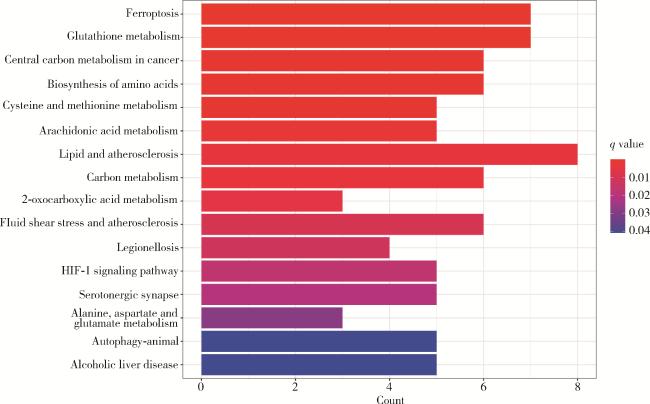
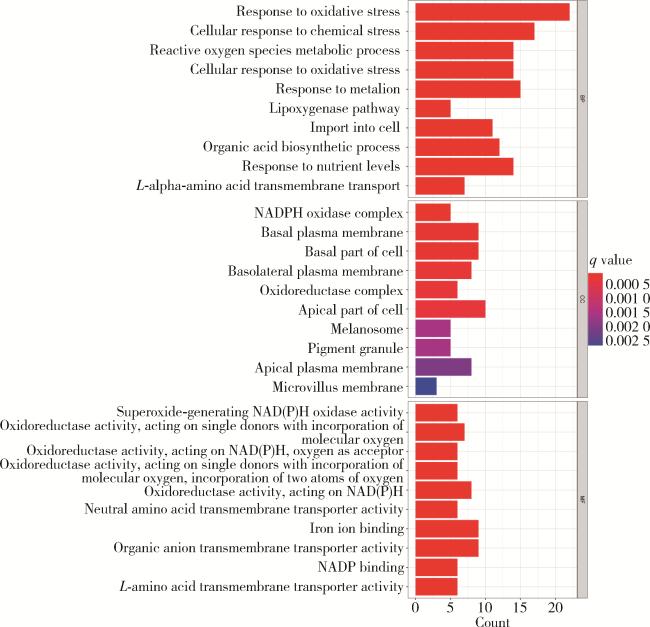
用生存分析、无进展生存期、受试者工作特征(receiver operating characteristic,ROC)曲线等来验证模型的预测效果,最后以不同亚组分类验证模型的准确性。京都基因与基因组百科全书数据库(Kyoto encyclopedia of genes and genomes,KEGG)中的通路分析表明,铁死亡相关的差异性表达基因主要富集于铁死亡、谷胱甘肽代谢、脂质和动脉粥样硬化等信号通路(图 1)。基因本体数据库(gene onto-logy,GO)代谢分析显示差异表达基因主要富集于氧化应激、活性氧的代谢(图 2)。
图1 KEGG数据库中铁死亡相关差异基因通路的富集分析

Figure 1 Enrichment analysis of pathways for ferroptosis-related differential genes in the KEGG database

HIF-1, hypoxia-inducible factor-1; KEGG, Kyoto encyclopedia of genes and genomes.

图2 GO数据库中铁死亡相关差异基因代谢的富集分析

Figure 2 Enrichment analysis of metabolic pathways for ferroptosis-related differential genes in the GO database

BP, biological process; CC, cellular component; MF, molecular function; NAD(P)H, nicotinamide adenine dinucleotide phosphate-reduced; NADP, nicotinamide adenine dinucleotide phosphate; GO, gene ontology.

2.2 铁死亡相关lncRNA筛选

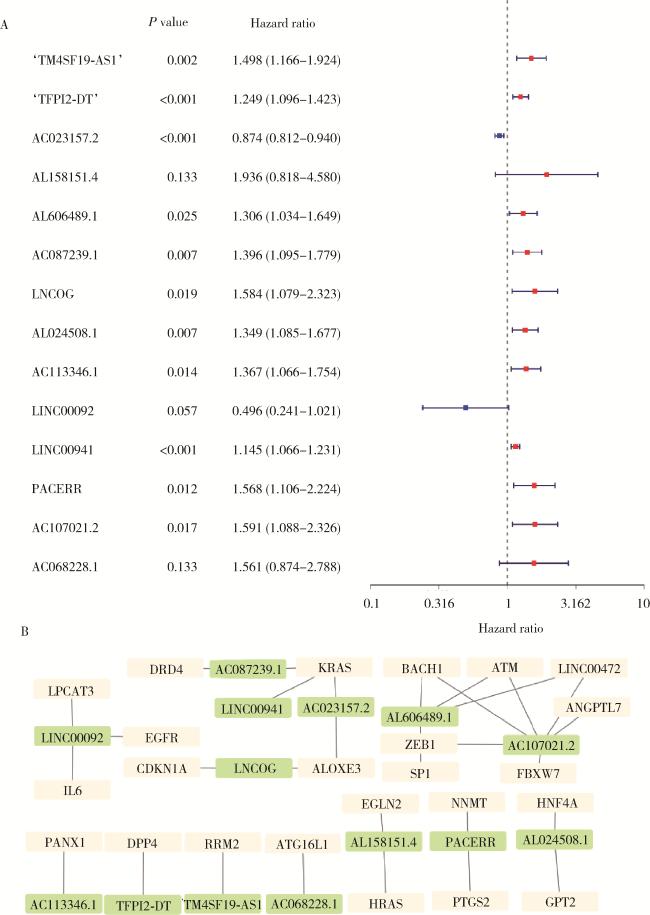
使用“limma”包来计算铁死亡相关基因和lncRNA之间的相关性,相关系数=0.4和P<0.001作为筛选标准,共获得2 781个铁死亡相关lncRNA。进一步使用|logFC| ≥1且FDR < 0.05获得正常组织与肿瘤组织有差异性的961个lncRNA。进一步用单变量Cox回归模型对差异lncRNA进行分析,将lncRNA表达量与生存时间、生存状态进行比较,得到34个与非小细胞肺癌患者预后相关的lncRNA。多变量Cox回归模型分析显示有14个与铁死亡相关的lncRNA,用这14个相关的lncRNA构建相关预测模型。14个铁死亡相关的lncRNA表达水平见图 3A,其中高风险lncRNA有12个(LINC00941、TFPI2-DT、AL606489.1、AL024508.1、AC113346.1、AC087239.1、TM4SF19-AS1、AC068228.1、PACERR、LNCOG、AC107021.2、AL158151.4),风险比(hazard ratio, HR)>1;保护性lncRNA有2个(LINC00092、AC023157.2),HR<1。进一步使用Cytoscape和ggalluvial R软件包形成14个lncRNA与铁死亡相关差异性mRNA的共表达网络关系图,有24对相关lncRNA-mRNA(图 3B)。
图3 14个与铁死亡相关的lncRNA表达水平和lncRNA-mRNA共表达网络

Figure 3 Expression levels of 14 lncRNA related to ferroptosis and the lncRNA-mRNA co-expression network

The green color indicates 14 predicted lncRNA;The yellow color indicates genes related to ferroptosis. lncRNA, long non-coding RNA.

2.3 预测模型与非小细胞肺癌患者预后的相关性

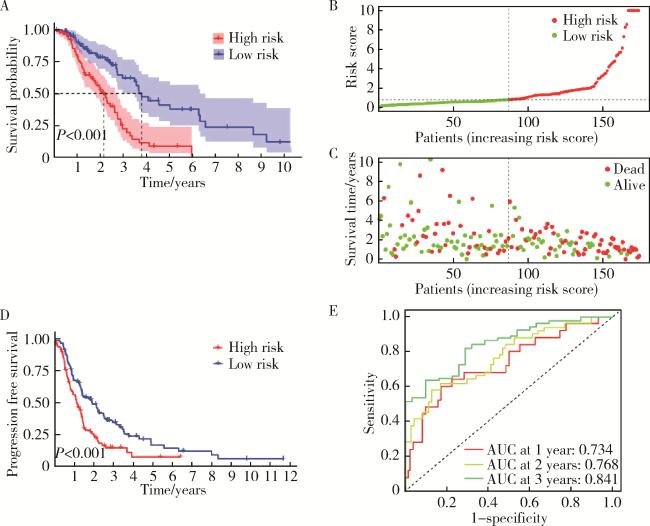
根据风险评分的中位值将患者分为高风险组和低风险组,为确定风险评分在预测放疗后非小细胞肺癌患者预后中的价值,采用生存分析模型分析高风险组和低风险组的总生存期时间。与低风险组相比,高风险组的总生存期时间明显缩短(图 4A)。高风险组和低风险组的风险评分如图 4B所示,随着风险评分的增加,患者死亡概率增加(图 4C)。从泛癌数据库(https://www.cbioportal.org)下载泛癌的临床数据文件,对患者的无进展生存期进行分析,结果表明低风险组的无进展生存期显著高于高风险组(图 4D)。1、2和3年生存期的ROC曲线下面积分别为0.734、0.768和0.841,表明预测性能良好(图 4E)。
图4 预测模型与非小细胞肺癌患者预后的相关性

Figure 4 Correlation between the predictive model and the prognosis of patients with non-small cell lung cancer

A, the overall survival time for the high-risk and low-risk groups; B, the horizontal axis represented patients arranged in increasing order of risk score, and the vertical axis represented the specific risk score values; C, the relationship between risk score and survival time; D, progression free survival in the high risk and low risk groups; E, the ROC curves for 1 year, 2 year, and 3 year survival. ROC, receiver operating characteristic curve; AUC, area under curve.

2.4 不同临床病理变量与预后的关系

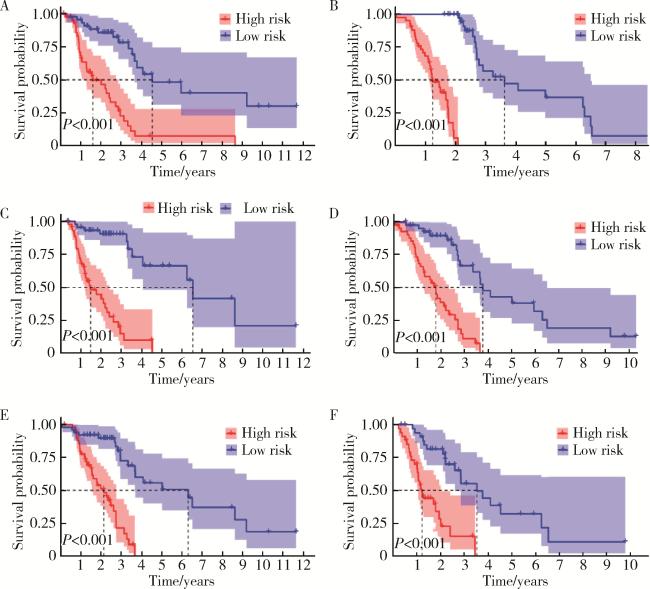
为避免自变量间的强共线性,我们进行了共线性诊断,结果表明预测模型的lncRNA、年龄、性别间无共线性关系。接下来对临床变量相关因素根据临床特征进行进一步的细化,将放疗后非小细胞肺癌患者按年龄、性别分组。对于每种不同的分类,高风险组患者的总生存期显著短于低风险组患者(图 5)。这些结果表明,细化的临床病理学变量可预测放疗后非小细胞肺癌患者的预后。
图5 不同临床变量对总生存期的预测

Figure 5 Prognostic impact of clinical variables on overall survival

A, age≤65 years; B, age>65 years; C, male; D, female; E, stage Ⅰ-Ⅱ;F,stage Ⅲ-Ⅳ.

2.5 预测模型的内部验证

为了验证基于整个TCGA数据库的预测模型的适用性,将175例非小细胞肺癌患者随机分为两组,分别为训练数据集和验证数据集。为了避免随机分配偏差影响后续建模的稳定性,将所有样本随机分组100次,不进行替换,训练数据集与验证数据集的比例为1 ∶ 1,两数据集患者的人口统计学特征见表 1
表1 训练数据集和验证数据集患者临床特征

Table 1 Clinical characteristics of patients in the training dataset and validation dataset

Items Total number of datasets (n=175) Training dataset (n=88) Validation dataset (n=87)
Age/years, n (%)
    ≤65 90 (51.43) 45 (51.14) 45 (51.72)
    >65 85 (48.57) 43 (48.86) 42 (48.28)
Gender, n (%)
    Male 84 (48.00) 43 (48.86) 41 (47.13)
    Female 91 (52.00) 45 (51.14) 46 (52.87)
Stage, n (%)
    Ⅰ+Ⅱ 103 (58.86) 49 (55.68) 54 (62.07)
    Ⅲ+Ⅳ 69 (39.43) 37 (42.05) 22 (25.29)
    Unknown 3 (1.71) 2 (2.27) 1 (1.15)
T, n (%)
    T1+T2 133 (76.00) 69 (78.41) 64 (73.56)
    T3+T4 40 (22.86) 18 (20.45) 22 (25.29)
    TX+unknown 2 (1.14) 1 (1.14) 1 (1.15)
M, n (%)
    M0 122 (69.71) 61 (69.32) 61 (70.11)
    M1 10 (5.71) 3 (3.41) 7 (8.05)
    MX+unknown 42 (24.00) 24 (27.27) 19 (21.84)
N, n (%)
    N0 82 (46.86) 40 (45.45) 42 (48.28)
    N1+N2 86 (49.14) 44 (5.00) 42 (48.28)
    N3 3 (1.71) 2 (2.27) 1 (1.15)
    NX+unknown 4 (2.29) 2 (2.27) 2 (2.30)

T, tumor; N, node; M, metastasis.

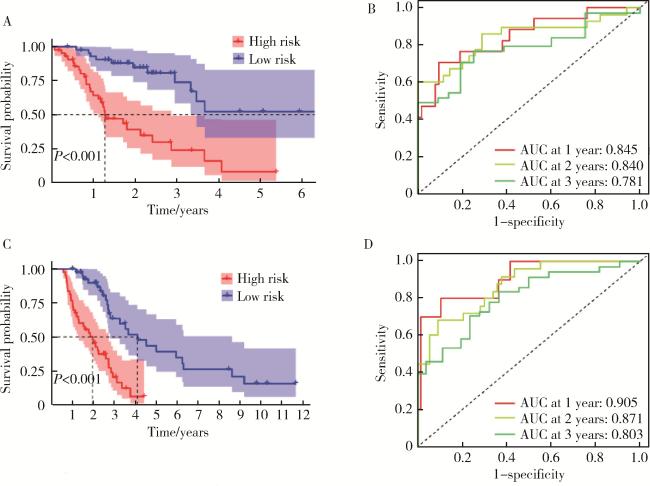
与整个数据集中观察到的结果一致,在训练数据集和验证数据集中,高风险组患者的总生存期低于低风险组(图 6)。两个训练集的ROC曲线显示出良好的预测性能,在训练数据集中,1、2和3年曲线下面积分别为0.845、0.840和0.781,在验证数据集中,1、2和3年曲线下面积分别为0.905、0.871和0.803。
图6 训练数据集与验证数据集的验证结果

Figure 6 Validation results of the training dataset and validation dataset

A, B, training dataset; C, D, validation dataset. AUC, area under curve.

3 讨论

放疗可诱导强效的铁死亡发生,铁死亡在癌症治疗中的作用已被广泛报道[21-23]。有研究通过构建铁死亡相关的lncRNA模型来预测放疗患者的预后[24]。然而,尚未有报道放疗后非小细胞肺癌与铁死亡相关lncRNA之间的关系,本研究构建了一个由14个与铁死亡相关的lncRNA组成的预后模型,为临床治疗提供指导。
有研究表明放疗可通过诱导脂质过氧化、ACSL4基因表达以及消耗谷胱甘肽等经典铁死亡途径来诱导癌细胞死亡[13, 25]。除此之外,铁死亡能在放疗中发挥作用还与免疫治疗密切相关,免疫系统激活为放疗介导抗癌的另一组成部分,但联合免疫疗法在临床治疗中因为个体差异等因素缺乏普适性,因此,迫切需要生物标志物来确定适合放疗与铁死亡联合治疗的特定人群。本研究中,在经过放疗的人群中筛选了铁死亡相关风险lncRNA作为潜在的生物标志物,可针对个体差异性进行治疗,有望为放疗联合治疗铁死亡提供新思路。
我们对放疗与铁死亡相关lncRNA进行深入研究的主要原因为肺癌死亡率高居首位,早期发现和有效的联合疗法有助于肺癌的治疗,因此,需要找出用于早期诊断肺癌的生物标志物,lncRNA可作为癌症诊断与预后的潜在生物标志物以及治疗靶点。在作为癌症诊断的生物标志物方面,有研究表明外周血MALAT-1的上调可以反映非小细胞肺癌的存在,特异性可高达96%[26]。但随之而来的问题为检测外周血中一种lncRNA的含量,可能因为RNA酶的降解作用而出现血液中含量较低,进而产生结果不准确的情况,因此,为了提高lncRNA检测的敏感性并提高其诊断性能,可选用几种lncRNA联合诊断的方式[27-28]。目前,出现了一系列检测lncRNA的新技术,为更好地检测人体中的lncRNA提供了更好的方法[29]。在癌症预后方面,研究表明一些lncRNA可区分转移性与非转移性癌症,以及良、恶性肿瘤,因此,lncRNA的水平可能有助于评估疾病的进展,且lncRNA中的P21已被描述为肿瘤抑制因子[18],而MALAT-1、HOTAIR、H19、PVT1、GIHCG和ANRIL已被证实为致癌lncRNA[26, 30-34],因此,lncRNA可以作为治疗靶点。lncRNA不仅在肺癌中发挥重要作用[35],也在肺癌相关铁死亡中发挥重要作用[36-37]。已有研究证实,肺腺癌中铁死亡和铁代谢相关的lncRNA可以有效地预测患者总生存期[38],因此,在经过放疗的非小细胞肺癌患者中, 鉴定与铁死亡相关的lncRNA对联合治疗、预后分析、减低辐射抗性等方面具有重要意义。
然而,本研究仍有一些局限性,首先,TCGA数据库中经过放疗后的样本量及亚组样本量相对不足;其次,本研究只是按照鳞癌、腺癌以及随机分组的方式进行转录组数据验证,仍然需要进行临床验证,以测试预测模型的适用性;最后,非小细胞肺癌中铁死亡相关lncRNA处于早期阶段,未来需要实验进一步验证。

利益冲突  所有作者均声明不存在利益冲突。

作者贡献声明  许秋实:设计研究方案,收集、分析、整理数据,撰写论文;刘彤:设计研究方案,收集、分析、整理数据;王俊杰:提出研究思路,总体把关和审定论文。

1
Siegel RL , Miller KD , Jemal A . Cancer statistics[J]. CA Cancer J Clin, 2020, 70 (1): 7- 30.

DOI

2
Nooreldeen R , Bach H . Current and future development in lung cancer diagnosis[J]. Int J Mol Sci, 2021, 22 (16): 8661.

DOI

3
Wu F , Wang L , Zhou C . Lung cancer in China: Current and prospect[J]. Curr Opin Oncol, 2021, 33 (1): 40- 46.

DOI

4
Vinod SK , Hau E . Radiotherapy treatment for lung cancer: Current status and future directions[J]. Respirology, 2020, 25 (Suppl 2): 61- 71.

5
Citrin DE . Recent developments in radiotherapy[J]. N Engl J Med, 2017, 377 (11): 1065- 1075.

DOI

6
Baidoo KE , Yong K , Brechbiel MW . Molecular pathways: Targeted α-particle radiation therapy[J]. Clin Cancer Res, 2013, 19 (3): 530- 537.

DOI

7
Azzam EI , Jay-Gerin JP , Pain D . Ionizing radiation-induced metabolic oxidative stress and prolonged cell injury[J]. Cancer Lett, 2012, 327 (1/2): 48- 60.

8
Dixon SJ , Lemberg KM , Lamprecht MR , et al. Ferroptosis: An iron-dependent form of nonapoptotic cell death[J]. Cell, 2012, 149 (5): 1060- 1072.

DOI

9
Tang D , Kang R , Berghe TV , et al. The molecular machinery of regulated cell death[J]. Cell Res, 2019, 29 (5): 347- 364.

DOI

10
Kuang F , Liu J , Tang D , et al. Oxidative damage and antioxidant defense in ferroptosis[J]. Front Cell Dev Biol, 2020, 8, 586578.

DOI

11
Yang WS , Stockwell BR . Ferroptosis: Death by lipid peroxidation[J]. Trends Cell Biol, 2016, 26 (3): 165- 176.

DOI

12
Lang X , Green MD , Wang W , et al. Radiotherapy and immunotherapy promote tumoral lipid oxidation and ferroptosis via synergistic repression of SLC7A11[J]. Cancer Discov, 2019, 9 (12): 1673- 1685.

DOI

13
Lei G , Zhang Y , Koppula P , et al. The role of ferroptosis in ionizing radiation-induced cell death and tumor suppression[J]. Cell Res, 2020, 30 (2): 146- 162.

DOI

14
Spizzo R , Almeida MI , Colombatti A , et al. Long non-coding RNAs and cancer: A new frontier of translational research?[J]. Oncogene, 2012, 31 (43): 4577- 4587.

DOI

15
Li CH , Chen Y . Targeting long non-coding RNAs in cancers: Progress and prospects[J]. Int J Biochem Cell Biol, 2013, 45 (8): 1895- 1910.

DOI

16
Zhou M , Guo M , He D , et al. A potential signature of eight long non-coding RNAs predicts survival in patients with non-small cell lung cancer[J]. J Transl Med, 2015, 13, 231.

DOI

17
Han L , Zhang EB , Yin DD , et al. Low expression of long nonco-ding RNA PANDAR predicts a poor prognosis of non-small cell lung cancer and affects cell apoptosis by regulating Bcl-2[J]. Cell Death Dis, 2015, 6 (2): e1665.

DOI

18
Nie FQ , Sun M , Yang JS , et al. Long noncoding RNA ANRIL promotes non-small cell lung cancer cell proliferation and inhibits apoptosis by silencing KLF2 and P21 expression[J]. Mol Cancer Ther, 2015, 14 (1): 268- 277.

DOI

19
Yang X , Song JH , Cheng Y , et al. Long non-coding RNA HNF1A-AS1 regulates proliferation and migration in oesophageal adenocarcinoma cells[J]. Gut, 2014, 63 (6): 881- 890.

DOI

20
Yang YR , Zang SZ , Zhong CL , et al. Increased expression of the lncRNA PVT1 promotes tumorigenesis in non-small cell lung can-cer[J]. Int J Clin Exp Pathol, 2014, 7 (10): 6929- 6935.

21
Chen Q , Ma X , Xie L , et al. Iron-based nanoparticles for MR imaging-guided ferroptosis in combination with photodynamic therapy to enhance cancer treatment[J]. Nanoscale, 2021, 13 (9): 4855- 4870.

DOI

22
Ghoochani A , Hsu EC , Aslan M , et al. Ferroptosis inducers are a novel therapeutic approach for advanced prostate cancer[J]. Cancer Res, 2021, 81 (6): 1583- 1594.

DOI

23
Li H , Li L , Xue C , et al. A novel ferroptosis-related gene signature predicts overall survival of breast cancer patients[J]. Biology (Basel), 2021, 10 (2): 151.

24
Zheng J , Zhou Z , Qiu Y , et al. A prognostic ferroptosis-related lncRNA signature associated with immune landscape and radio-therapy response in glioma[J]. Front Cell Dev Biol, 2021, 9, 675555.

DOI

25
Ye LF , Chaudhary KR , Zandkarimi F , et al. Radiation-induced lipid peroxidation triggers ferroptosis and synergizes with ferroptosis inducers[J]. ACS Chem Biol, 2020, 15 (2): 469- 484.

DOI

26
Weber DG , Johnen G , Casjens S , et al. Evaluation of long noncoding RNA MALAT1 as a candidate blood-based biomarker for the diagnosis of non-small cell lung cancer[J]. BMC Res Notes, 2013, 6, 518.

DOI

27
Tantai J , Hu D , Yang Y , et al. Combined identification of long non-coding RNA XIST and HIF1A-AS1 in serum as an effective screening for non-small cell lung cancer[J]. Int J Clin Exp Pathol, 2015, 8 (7): 7887- 7895.

28
Tong YS , Wang XW , Zhou XL , et al. Identification of the long non-coding RNA POU3F3 in plasma as a novel biomarker for diagnosis of esophageal squamous cell carcinoma[J]. Mol Cancer, 2015, 14, 3.

29
Chen M , Wu D , Tu S , et al. A novel biosensor for the ultrasensitive detection of the lncRNA biomarker MALAT1 in non-small cell lung cancer[J]. Sci Rep, 2021, 11 (1): 3666.

DOI

30
Gupta RA , Shah N , Wang KC , et al. Long non-coding RNA HOTAIR reprograms chromatin state to promote cancer metastasis[J]. Nature, 2010, 464 (7291): 1071- 1076.

DOI

31
Matouk IJ , DeGroot N , Mezan S , et al. The H19 non-coding RNA is essential for human tumor growth[J]. PLoS One, 2007, 2 (9): e845.

DOI

32
Colombo T , Farina L , Macino G , et al. PVT1:A rising star among oncogenic long noncoding RNAs[J]. Biomed Res Int, 2015, 2015, 304208.

33
Zhu SY , Zou HC , Gao MM , et al. LncRNA GIHCG promoted the proliferation and migration of renal cell carcinoma through regulating miR-499a-5p/XIAP axis[J]. Transl Oncol, 2022, 20, 101356.

DOI

34
Yap KL , Li S , Muñoz-Cabello AM , et al. Molecular interplay of the noncoding RNA ANRIL and methylated histone H3 lysine 27 by polycomb CBX7 in transcriptional silencing of INK4a[J]. Mol Cell, 2010, 38 (5): 662- 674.

DOI

35
Hua Q , Jin M , Mi B , et al. LINC01123, a c-Myc-activated long non-coding RNA, promotes proliferation and aerobic glycolysis of non-small cell lung cancer through miR-199a-5p/c-Myc axis[J]. J Hematol Oncol, 2019, 12 (1): 91.

DOI

36
Sun J , Zhang Z , Bao S , et al. Identification of tumor immune infiltration-associated lncRNA for improving prognosis and immunotherapy response of patients with non-small cell lung cancer[J]. J Immunother Cancer, 2020, 8 (1): e000110.

DOI

37
Wang M , Mao C , Ouyang L , et al. Long noncoding RNA LINC00336 inhibits ferroptosis in lung cancer by functioning as a competing endogenous RNA[J]. Cell Death Differ, 2019, 26 (11): 2329- 2343.

DOI

38
Yao J , Chen X , Liu X , et al. Characterization of a ferroptosis and iron-metabolism related lncRNA signature in lung adenocarcinoma[J]. Cancer Cell Int, 2021, 21 (1): 340.

DOI

文章导航

/