论著

2015—2021年宁波市6岁以下儿童热性惊厥的流行病学特征

  • 刘光旭 1 ,
  • 张良 2 ,
  • 赵厚宇 1 ,
  • 邓思危 1 ,
  • 杨君婷 1 ,
  • 李宁 2 ,
  • 马瑞 2 ,
  • 何艳 3 ,
  • 许国章 2 ,
  • 刘志科 , 1, *, * ,
  • 詹思延 , 1, *, *
展开
  • 1. 北京大学公共卫生学院流行病与卫生统计学系, 北京 100191
  • 2. 宁波市疾病预防控制中心, 浙江宁波 315010
  • 3. 宁波市妇女儿童医院, 浙江宁波 315012

* These authors contributed equally to this work

收稿日期: 2022-08-03

  网络出版日期: 2025-06-13

基金资助

国家自然科学基金(91846303)

中国中医药循证医学中心研究室主任专项(2020YJSZX-2)

版权

版权所有,未经授权,不得转载。

Epidemiological characteristics of febrile seizure among children under 6 years old in Ningbo City from 2015 to 2021

  • Guangxu LIU 1 ,
  • Liang ZHANG 2 ,
  • Houyu ZHAO 1 ,
  • Siwei DENG 1 ,
  • Junting YANG 1 ,
  • Ning LI 2 ,
  • Rui MA 2 ,
  • Yan HE 3 ,
  • Guozhang XU 2 ,
  • Zhike LIU , 1, * ,
  • Siyan ZHAN , 1, *
Expand
  • 1. Department of Epidemiology and Biostatistics, Peking University School of Public Health, Beijing 100191, China
  • 2. Ningbo Municipal Center for Disease Control and Prevention, Ningbo 315010, Zhejiang, China
  • 3. Ningbo Women & Children's Hospital, Ningbo 315012, Zhejiang, China
LIU Zhike, e-mail,
ZHAN Siyan, e-mail,

Received date: 2022-08-03

  Online published: 2025-06-13

Supported by

the National Natural Science Foundation of China(91846303)

the Special Project for Director, China Center for Evidence Based Traditional Chinese Medicine(2020YJSZX-2)

Copyright

All rights reserved. Unauthorized reproduction is prohibited.

摘要

目的: 探讨浙江省宁波市2015—2021年6岁以下儿童热性惊厥(febrile seizure,FS)发病的流行病学特征,分析新型冠状病毒感染对FS发病趋势的影响。方法: 基于宁波区域卫生信息平台,利用预防接种登记信息建立动态队列,通过电子病历的中文诊断术语“热性惊厥”“发热惊厥”“发热 & 惊厥”等,以及国际疾病分类第10版(International Classification of Diseases 10th revision, ICD-10)编码(R56.0)识别FS病例,在观察期间内FS发作并首次就诊定义为新发病例,发作间隔大于7 d为复发病例。采用Poisson分布估算发病密度的95%置信区间(confidence interval,CI)。结果: 2015年1月至2021年6月,累计纳入宁波市6岁以下儿童130.3万人,男性占52.87%,总随访人时为3 765 767.35人年,中位随访时间为2.83 (1.55~4.00)年。研究期间共有12 776例FS新发病例,男性多于女性,总发病密度为4.34 (95%CI: 4.27~4.40)/1 000人年,复发率为21.63%。男性、出生于宁波、非流动儿童FS的发病密度较高。相比于乡村和城乡结合部,城区FS的发病密度更高,且各区县间发病密度不同。儿童18~23月龄为发病密度高峰[8.42 (95%CI: 8.11~8.74)/1 000人年];2015—2019年,发病密度逐年升高(Ptrend < 0.001),最高为5.62 (95%CI: 5.43~5.81)/1 000人年,2020—2021年FS发病密度显著下降;冬季FS发病密度较高。结论: 2015—2019年宁波市6岁以下儿童FS的发病密度整体呈升高趋势,新型冠状病毒感染期间应更加注重高风险人群和高发地区FS的健康宣教与识别处置,减少其带来的疾病负担。

本文引用格式

刘光旭 , 张良 , 赵厚宇 , 邓思危 , 杨君婷 , 李宁 , 马瑞 , 何艳 , 许国章 , 刘志科 , 詹思延 . 2015—2021年宁波市6岁以下儿童热性惊厥的流行病学特征[J]. 北京大学学报(医学版), 2025 , 57(3) : 584 -591 . DOI: 10.19723/j.issn.1671-167X.2025.03.024

Abstract

Objective: To describe the epidemiological characteristics and changes of febrile seizure (FS) among children under 6 years old in Ningbo City, Zhejiang Province from 2015 to 2021. Methods: Based on the Ningbo Regional Health Information Platform, a dynamic cohort was established using vaccination registration information, and the cases of FS were identified by the diagnostic results of Chinese terms or International Classification of Diseases 10th revision (ICD-10) R56.0 code in the electronic medical records. The first visit of FS during the observation period was defined as a new case, and a recurrence case was defined as the case with a visit interval of more than 7 days. The 95% confidence interval (CI) of FS incidence density was calculated by the Poisson distribution. Results: From January 2015 to June 2020, there were 1.3 million children under 6 years old in Ningbo, with male accounting for 52.87%. The median follow-up time was 2.83 (1.55-4.00) years. During the follow-up period, 12 776 new onset cases had FS, with more males than females, with an overall incidence density of 4.34 (95%CI 4.27-4.40)/1 000 person-years and a recurrence rate of 21.63%. There was a higher incidence density in children who were male, born in Ningbo and of non-mobility. The incidence density of FS was higher in urban areas than in rural and rural-urban fringe areas, and the incidence density was different among districts and counties. The peak density was found in children aged 18-23 months [8.42 (95%CI 8.11-8.74)/1 000 person-years]. From 2015 to 2019, the incidence density increased with calendar year (Ptrend < 0.001), and the highest was 5.62 (95%CI 5.43-5.81) /1 000 person-years. The incidence density of FS decreased significantly during the period between 2020 and 2021. The incidence density was higher in winter. Conclusion: From 2015 to 2019, the overall incidence density of FS in children under 6 years old in Ningbo City presented an increasing trend. More attention should be paid to the health education, the improvement of the health maintenance model, the enhancement of the cognition of FS, the identification and treatment of FS among high-risk population and regions so as to prevent its recurrence and reduce the disease burden during the corona virus disease 2019 (COVID-19) epide-mic.

热性惊厥(febrile seizures, FS)是指发热(腋温≥38.0 ℃或肛温≥38.5 ℃)过程中出现的惊厥发作,没有中枢神经系统感染证据及导致惊厥的其他原因,既往也没有无热惊厥史[1],多见于6月龄至5岁、处于脑神经发育敏感时期和动作发展关键阶段的儿童。FS的全球患病率约为2%~14%[2],大多数FS呈良性过程,发作短暂,预后较好,但其复发率较高,具有一定年龄依赖性[3]。儿童若反复FS发作,可能会损害智力、学习记忆和发育行为[4]
FS发病率的流行病学调查在国外开展较早,欧美国家FS的累计发病率为2%~5%,日本为6%~9%,印度和关岛为14%[5]。我国研究显示FS发病率为0.35%~4.37%[6-8],但由于研究对象、调查方法、率的估算方法等的差异,各地区FS的发病率差别较大,缺乏较为准确的、代表性好的、以人群为基础的流行病学研究。近期意大利一项基于儿童专科医院的住院数据研究显示,新型冠状病毒流行的防控期间,FS住院率比同期增加了3倍[9],因此,针对我国新型冠状病毒感染对FS发病的影响也值得探究。另外,FS是疫苗预防接种后不良反应的重点关注疾病,FS的患病率调查对及时发现其与疫苗接种的关联具有重要意义,也是评价疫苗安全性的重要内容。
鉴于上述原因,本研究基于宁波区域健康信息平台,采用动态队列设计,分析2015—2021年宁波市6岁以下儿童FS的三间分布,及时更新儿童FS发病的流行病学特征,了解该地区FS的发病率及变化趋势,识别FS发生的高危人群,并探讨新型冠状病毒感染对FS的影响,为地区疾病防控政策与措施的制定提供数据支撑。

1 资料与方法

1.1 数据来源

研究数据来源于宁波区域健康信息平台(以下简称平台),该平台于2015年全面运行使用,覆盖了全市10个区县800多万常住居民,包含居民从出生到死亡的健康相关数据[10]。本研究所用数据主要包括平台中的预防接种信息数据及电子医疗记录数据,预防接种信息数据是基于宁波市免疫规划管理信息系统,可获得出生于宁波的所有儿童的基本信息;电子医疗记录数据来源于市、区/县两级系统的综合医院、专科医院、妇幼保健院、社区卫生服务中心的医疗服务数据,用于识别FS儿童;两个数据源在平台进行统一集成、校验与存储,并进行交换与共享,可通过个体唯一标识实现数据源的互联互通。本研究所用的分析数据均经过脱敏处理,不包含任何可识别的个体信息,本研究已通过宁波市疾病预防控制中心生物医学研究伦理审查委员会的审核批准(202002)。

1.2 研究对象来源及纳入排除标准

根据国家免疫规划接种政策,出生婴幼儿均需要免疫接种(即宁波本地出生者30 d内就近接种疫苗并建卡登记),因此本研究对象来自预防接种信息系统登记注册的儿童,可基本覆盖宁波市辖区内全部目标儿童。研究观察时间为2015年1月1日至2021年6月30日,研究对象为观察期间平台注册登记的0~71月龄的儿童。
纳入标准:(1)2009—2020年出生,且在宁波市免疫规划信息系统登记的儿童;(2)至少接种1剂任意疫苗;(3)注册登记时间不少于180 d。
排除标准:(1)免疫规划信息的登记时间缺失;(2)本地首次接种任意疫苗时间早于登记时间;(3)用于数据链接的变量信息缺失或无法识别;(4)观察期内随访时间少于180 d。

1.3 研究设计

考虑FS易复发的特点,本研究采用动态队列设计。根据出生属地不同,对每个个体进入队列的时间进行如下定义:(1)宁波市本地出生的儿童, 其进入队列的时间为2015年1月1日或系统中注册登记日期两者中的较晚者;(2)宁波市以外出生的儿童,其进入队列的时间为系统中记录的本地首次接种任意疫苗的日期或2015年1月1日两者中的较晚者。队列结束时间为本地最后一次疫苗接种日期、迁出宁波日期、死亡日期或2021年6月30日四者中的较早者。

1.4 资料整理

利用免疫规划信息系统提取以下变量:个体唯一识别码(隐匿化)、性别、出生日期、登记日期、迁出日期、居住地址(国标编码)等。
通过电子医疗记录提取以下变量:个体唯一识别码(隐匿化)、主要诊断、次要诊断、诊断编码[国际疾病分类第10版(International Classification of Diseases 10th revision, ICD-10)]等。FS通过电子医疗记录中疾病的ICD-10编码“R56.0”或中文诊断名称“热性惊厥”“高热惊厥”“发热 & 惊厥”等进行模糊匹配,识别病例。新发病例定义为观察期内个体首次出现FS,诊断日期即为发病日期;复发病例定义为发病日期间隔至少7 d后再次出现FS发作的个体。

1.5 统计学分析

使用结构化查询语言(structured query language,SQL)对平台数据进行清洗整理与链接,采用SAS 9.4软件进行统计分析。计量资料服从正态分布者采用$\bar x \pm s$表示,服从偏态分布者采用M(P25P75)表示,计数资料采用频数(构成比或百分比)表示。组间比较采用Wilcoxon秩和检验或χ2检验,发病密度为观察期内发病人次与随访人年的比值,其95%置信区间(confidence interval,CI)采用Poisson分布估算。双侧检验P < 0.05为差异有统计学意义。

2 结果

2.1 研究人群的基本特征

2015年1月至2021年6月宁波市6岁以下儿童累计纳入1 302 937人,其中男性688 855人,占52.87%,随访中位时间为2.83(1.55~4.00)年,研究期间发生FS者12 776人,占总人数的0.98%(表 1)。
表1 2015—2021年宁波市6岁以下儿童一般人口学特征

Table 1 Basic demographic characteristics of children under 6 years old in Ningbo City from 2015 to 2021

Characteristics variables Total (n=1 302 937) Non-FS children (n=1 290 161) FS children (n=12 776) U/χ2 a P
Follow-up/years, M (P25, P75) 2.83 (1.55, 4.00) 2.81 (1.55, 4.00) 3.97 (3.03, 4.84) 77.0b < 0.000 1
Gender, n (%) 414.7 < 0.000 1
    Female 614 075 (47.13) 609 179 (47.22) 4 878 (38.21)
    Male 688 855 (52.87) 680 957 (52.78) 7 898 (61.79)
Birth year, n (%) 3 721.3 < 0.000 1
    2009 52 503 (4.03) 52 474 (4.07) 29 (0.23)
    2010 97 372 (7.48) 97 180 (7.53) 192 (1.50)
    2011 114 688 (8.80) 114 165 (8.85) 523 (4.09)
    2012 127 890 (9.82) 126 776 (9.83) 1 114 (8.72)
    2013 123 135 (9.45) 121 577 (9.42) 1 558 (12.19)
    2014 139 110 (10.67) 136 920 (10.61) 2 190 (17.14)
    2015 124 730 (9.57) 122 794 (9.52) 1 936 (15.15)
    2016 135 426 (10.39) 133 393 (10.34) 2 033 (15.91)
    2017 124 524 (9.56) 122 843 (9.52) 1 681 (13.16)
    2018 103 732 (7.96) 102 772 (7.97) 960 (7.51)
    2019 93 662 (7.19) 93 178 (7.22) 484 (3.79)
    2020 66 165 (5.08) 66 089 (5.12) 76 (0.59)
City of birth, n (%) 756.6 < 0.000 1
    Ningbo outside 428 490 (32.88) 425 742 (33.00) 2 748 (21.51)
    Ningbo 873 107 (67.01) 863 094 (66.90) 10 013 (78.37)
    Missing 1 340 (0.10) 1 325 (0.10) 15 (0.12)
Mobility population, n (%) 167.9 < 0.000 1
    No 972 391 (74.63) 962 222 (74.58) 10 169 (79.59)
    Yes 330 546 (25.37) 327 939 (25.42) 2 607 (20.41)
Location, n (%) 95.0 < 0.000 1
    Urban 763 701 (58.61) 755 716 (58.58) 7 985 (62.5)
    Urban-rural fringe 309 936 (23.79) 307 319 (23.82) 2 617 (20.48)
    Rural 227 820 (17.49) 225 661 (17.49) 2 159 (16.90)
    Missing 1 480 (0.11) 1 465 (0.11) 15 (0.12)
District, n (%) 903.4 < 0.000 1
    Yuyao 171 664 (13.17) 170 314 (13.2) 1 350 (10.57)
    Beilun 128 216 (9.84) 126 985 (9.84) 1 231 (9.64)
    Fenghua 66 982 (5.14) 65 952 (5.11) 1 030 (8.06)
    Ninghai 98 411 (7.55) 97 627 (7.57) 784 (6.14)
    Cixi 251 111 (19.27) 249 186 (19.31) 1 925 (15.07)
    Jiangbei 69 471 (5.33) 68 738 (5.33) 733 (5.74)
    Haishu 90 916 (6.98) 89 920 (6.97) 996 (7.8)
    Xiangshan 70 338 (5.40) 69 900 (5.42) 438 (3.43)
    Yinzhou 271 894 (20.87) 268 861 (20.84) 3 033 (23.74)
    Zhenhai 77 081 (5.92) 75 858 (5.88) 1 223 (9.57)
    Missing 6 853 (0.53) 6 820 (0.53) 33 (0.26)

a, The value is the testing statistics for the comparison of characteristic variables between the non-FS group and the FS group. b, The value is the U statistics of Wilcoxon rank-sum test, and the others are χ2 values. FS, febrile seizure.

2.2 FS患儿的基本特征

表 1显示,FS患儿中男性7 898人,占61.8%,出生地为宁波市的患儿共10 013人,占78.4%。FS复发患儿共2 764人,复发率为21.63%。与未发生FS者相比,发生FS儿童中的男性比例更高,随访时间更长;出生地为宁波、居住地为城区、非流动儿童中发生FS的比例较高;发生FS占比排前三位的出生年份为2014年、2016年和2015年,各区县发生FS占比排前三位的分别为鄞州、慈溪、余姚(表 1)。

2.3 FS的发病密度

观察期间,FS发作共16 326人次,总随访人时为3 765 767.35人年,发病密度为4.34(95%CI:4.27~4.40)/1 000人年。男性发病密度高于女性(4.75/1 000人年vs. 3.24/1 000人年),出生地为宁波的儿童发病密度高于非宁波地区,非流动儿童的发病密度高于流动儿童(表 2)。
表2 2015—2021年宁波市6岁以下儿童FS发病密度的人群分布特征

Table 2 Population characteristics of the FS incidence density among children under 6 years old in Ningbo City from 2015 to 2021

Variable Number of FS episodes, n (%)a Follow-up(/person-years) Incidence density (95%CI)(/1 000 person-years)
Total 16 326 (100.00) 3 765 767.35 4.34 (4.27-4.40)
Gender
    Female 6 134 (37.57) 1 776 810.55 3.24 (3.13-3.35)
    Male 10 192 (62.43) 1 988 941.25 4.75 (4.67-4.84)
Birth city
    Ningbo outside 3 361 (21.59) 1 038 704.37 3.24 (3.13-3.35)
    Ningbo 12 944 (79.28) 2 722 824.45 4.75 (4.67-4.84)
Mobility population
    No 13 072 (80.06) 2 796 648.95 4.67 (4.59-4.76)
    Yes 3 254 (19.94) 969 118.40 3.36 (3.24-3.48)

a, The washout period of 7 days was used to identify the FS episode. FS, febrile seizure; CI, confidence interval.

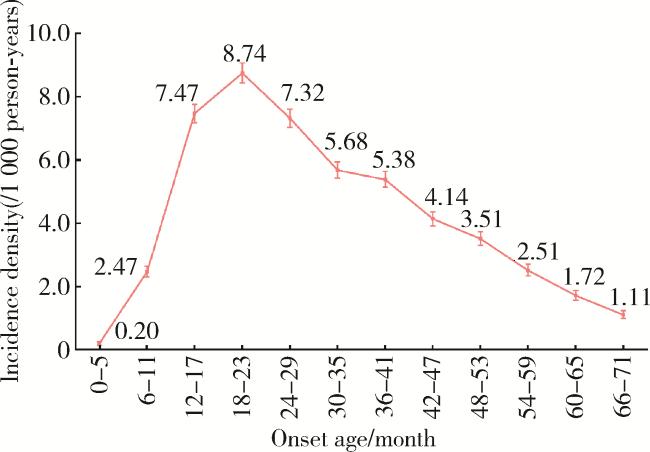
图 1显示,随儿童年龄增长,发病密度呈现先升高后降低的趋势,其中,18~23月龄儿童的发病密度最高[8.73 (95%CI:8.43~9.06)/1 000人年],0~5月龄儿童的发病密度最低[1.98 (95%CI:1.52~2.57)/1 000人年]。
图1 2015—2021年宁波市6岁以下儿童FS发病密度的年龄分布特征

Figure 1 Age distribution characteristics of FS incidence density among children under 6 years old in Ningbo City from 2015 to 2021

FS, febrile seizure.

2.4 FS发病的地区分布

表 3显示,宁波城区FS的发病密度为4.64 (95%CI:4.55~4.73)/1 000人年,高于乡村的4.16 (95%CI:4.01~4.32)/1 000人年,以及城乡结合部的3.69 (95%CI:3.57~3.81)/1 000人年。
表3 2015—2021年宁波市6岁以下儿童FS发病密度的地区分布特征

Table 3 Regional distribution characteristics of the FS incidence density among children under 6 years old in Ningbo City from 2015 to 2021

Location Number of FS episodes, n (%) Follow-up(/person-years) Incidence density (95%CI)(/1 000 person-years)
Urban 10 329 (63.33) 2 224 472.86 4.64 (4.55-4.73)
Urban-rural fringe 3 289 (20.16) 891 344.26 3.69 (3.57-3.82)
Rural 2 692 (16.51) 646 612.06 4.16 (4.01-4.32)

FS, febrile seizure; CI, confidence interval.

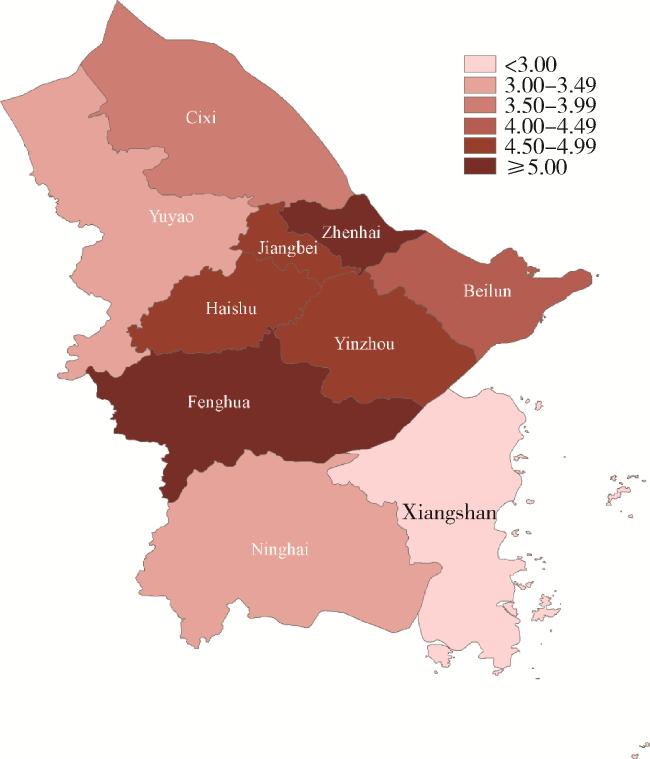
辖区内10个区县中,FS的发病密度不同,其中较高的为镇海[7.41 (95%CI:7.07~7.78)/1 000人年]和奉化[7.13 (95%CI:6.76~7.52)/1 000人年],较低的为慈溪[3.54 (95%CI:3.40~3.68)/1 000人年]、余姚[3.38 (95%CI:3.22~3.55)/1 000人年]、宁海[3.34 (95%CI:3.13~3.55)/1 000人年],最低的为象山[2.52 (95%CI:2.31~2.74)/1 000人年],见图 2
图2 2015—2021年宁波市6岁以下儿童FS发病密度的地区分布示意图(/1 000人年)

Figure 2 Diagram of regional distribution of the incidence density of FS among children under 6 years old in Ningbo City from 2015 to 2021 (/1 000 person-years)

This figure was drawn by ArcGIS software version 10.6. FS, febrile seizure.

2.5 FS发病的时间分布

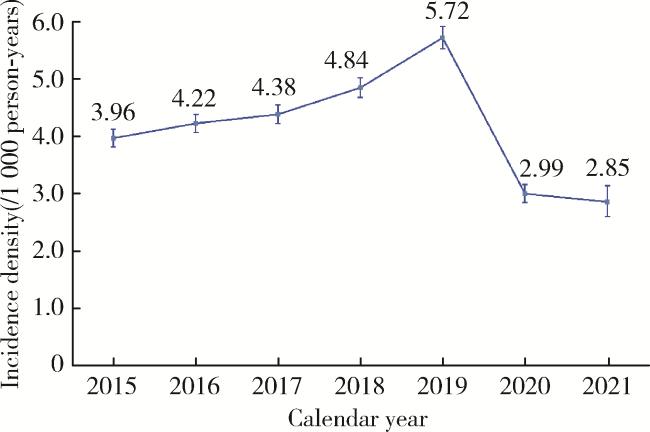
图 3显示,FS的发病密度在不同年间存在差异,2015—2019年逐年增加(Ptrend< 0.001),最高为5.72 (95%CI: 5.52~5.91)/1 000人年,2020— 2021年发病密度明显降低,最低为2.85 (95%CI: 2.60~3.13)/1 000人年。
图3 2015—2021年宁波市6岁以下儿童FS发病密度的时间分布

Figure 3 Temporal distribution of incidence density of FS among children under 6 years old in Ningbo City from 2015 to 2021

FS, febrile seizure.

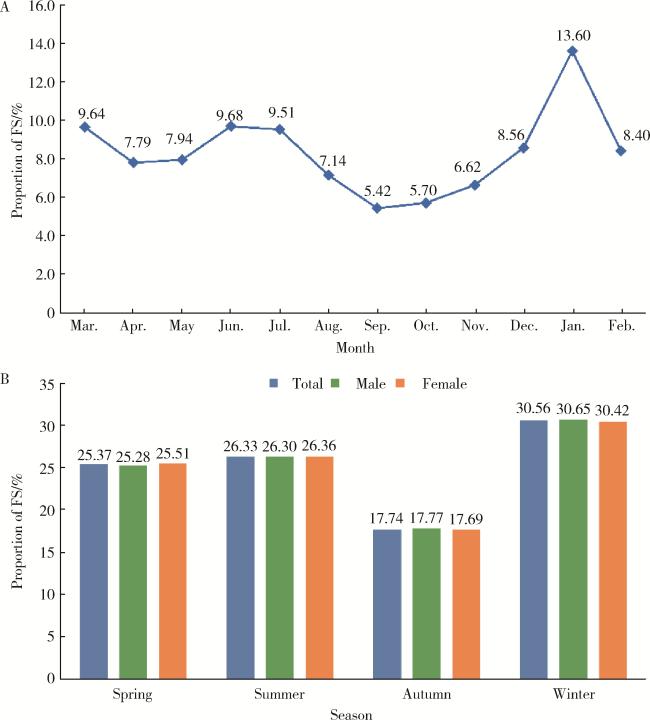
对于患有FS的儿童,1月份发生FS的比例最高,占13.60%,9月份最低,占5.42%;从季节分布上看,冬季发生FS的比例最高,占所有FS病例的30.56%,见图 4
图4 2015—2020年宁波市6岁以下儿童FS发病的时间分布

Figure 4 Time distribution of FS incidence among children under 6 years old in Ningbo City from 2015 to 2020

The data of 2021 were excluded due to the incompleteness. A, distributed by month; B, distributed by season. FS, febrile seizure.

3 讨论

本研究中,2015—2021年宁波市6岁以下儿童FS新发病例共12 776人,男性7 898人(61.82%),总体发病密度为4.34/1 000人年,其中,男性、本地出生、非流动儿童的发病密度较高,FS复发率为21.63%。城区FS的发病密度较高,宁波的区县中,镇海(7.17/1 000人年)和奉化(7.13/1 000人年)FS的发病密度较高,慈溪(3.54/1 000人年)、余姚(3.38/1 000人年)、宁海(3.34/1 000人年)较低,象山最低(2.51/1 000人年)。随着儿童年龄增长,FS发病密度呈现先升高后降低的趋势,18~23月龄的儿童发病密度达到峰值(8.42/1 000人年);2015—2019年发病密度呈逐年增加趋势,最高为5.62/1 000人年;FS好发于冬季;2020—2021年FS的发病密度明显降低。
总体来看,宁波市6岁以下儿童FS发病密度为4.34/1 000人年,与2006年中国香港基于医院就诊儿童的随访结果相近(6岁以下儿童年发病率为3.5‰)[7],与国外多个队列研究结果也类似[11-12]。英国一项利用临床实践研究数据库(Clinical Practice Research Datalink,CPRD)建立的队列研究报道,2月龄至5岁儿童的FS发病密度为6.68/1 000人年[12]。丹麦利用电子健康记录的回顾性研究显示,12~47月龄儿童的FS发病密度为4.9/1 000人年[12]。美国的一项前瞻性随访调查研究表明,0~59月龄儿童的FS发病密度为4.6/1 000人年。荷兰的一项回顾性调查结果显示,2~59月龄的儿童FS发病密度为5.5/1 000人年。本研究结果低于国内两项抽样调查结果[7, 9]及国外多个国家估算的累计发病率[3-5, 13],这主要是由于不同研究间纳入人群的年龄范围、数据来源、调查方法、随访时长、发病指标计算等方面的差异,估计FS发病率的时候可能存在差别。另外,我们发现FS发病高峰为18~23月龄,男性发病密度高于女性,与既往研究结论一致[7-8, 12-13]。本地出生及非流动儿童的发病密度较高,考虑可能的原因是这部分人群发生迁移的可能性小,就诊记录更为完整,且家长对疾病的重视程度更高,更便于就医。FS是一种良性病程且自限性的疾病,但具有较高的复发风险[14]。本研究结果发现FS的复发率为21.63%,与中国香港的研究结果(20.5%)相似[7],但低于国外多个队列研究结果(30%~40%)[15-17],主要原因可能与人群遗传易感性的差异[18]以及中国人群部分相关易感基因缺失相关[19-22]
宁波市城乡之间FS的发病具有一定差异,考虑可能是由于各地区之间经济发展水平不同、医疗资源分配不均[23]、健康意识的差异影响了患儿父母寻求医疗服务的行为,一定程度上影响了FS的诊断率。另外,不同区县FS发病存在差异可能与区县之间医疗机构诊断能力不同有关。
FS随年龄增长呈现先升高后降低趋势,发病高峰为18~23月龄,与国内外研究基本一致[5, 7]。已有研究表明,FS发作与呼吸道感染相关,而冬季是儿童呼吸道疾病高发期,可能解释了FS冬季高发的原因。2015—2019年FS发病密度呈逐年升高趋势,与李宁等[24]的研究结论一致,该研究利用2004—2013年期间的患儿临床资料,发现患儿的年病例数呈现上升趋势。本研究中,2020—2021年FS发病显著降低,考虑主要与新型冠状病毒感染期间防控政策及生活卫生行为改变相关。首先,新型冠状病毒感染防控初期,宁波市制定并实施了一系列防控措施,包括延迟复工复学、卡口筛查、医学隔离、社区封控等,以减少人群不必要的流动,而由于大部分FS发作持续时间较短,病程良性,且预后较好,这些防控措施加上疾病本身的特点可能导致了患儿延缓或者避免就医,从而减少了FS诊断率。其次,病毒感染,尤其呼吸道病毒感染,是诱发FS的主要外源性因素,新型冠状病毒感染防控期间,保持社交距离,公共场所必须佩戴口罩等个人防护措施,减少了多种呼吸道病毒的感染机会[25-26],降低了儿童发生高热的机会,进而可能减少FS的发生。Chiu等[27]的研究表明,中国香港人群中甲型流感病毒的感染对引发FS具有重要作用,2020年浙江省实施了老年人免费接种流感疫苗政策,减少了家庭流感的聚集性传播,降低了儿童FS的发生可能。另外,新型冠状病毒感染防控期间,交通出行减少,交通噪音减轻,环境污染物减少,儿童居家生活,避免处于人流密集的区域,这些因素均与诱发FS呈负相关[28]。尽管上述原因可能部分解释新型冠状病毒感染防控期间FS发病降低,但针对新型冠状病毒感染对FS发病的真实影响仍需开展专项研究加以验证。
本研究基于宁波区域健康医疗数据,利用免疫规划登记信息(全覆盖、强制性),建立0~6岁儿童动态队列,主要优势包括:(1)能够覆盖该地区全部儿童,与采用传统流行病学调查方法相比,人群分母更为准确;(2)采用电子病历的诊断结果确定结局,能够准确识别FS新发病例;课题组的前期工作中,对利用疾病诊断名称或ICD-10编码提取的500例FS患儿的随机样本,采用病历回顾的方式进行了病例验证,计算诊断阳性预测值为90.6%,提示该平台对FS的诊断准确性较好。尽管如此,本研究中仍存在近10%的结局错分可能,另外,因研究对象仅局限于宁波地区,结果外推仍需谨慎。
综上所述,2015—2019年宁波市6岁以下儿童FS发病整体呈上升趋势,2020—2021年FS发病显著降低,可能与新型冠状病毒感染防控政策导致的就医行为改变相关。在常态化防控时期,针对高危人群及高发地区,更需加大针对FS疾病的健康宣传,改进健康维护模式,增强对FS的认知,提高父母对FS的识别和处置能力,预防其复发,减轻家长对疾病的焦虑和担忧,减少其所带来的疾病负担。

利益冲突  所有作者均声明不存在利益冲突。

作者贡献声明  刘志科:提出研究思路;张良、李宁:收集数据;刘光旭、邓思危、杨君婷、何艳、马瑞:整理数据;刘志科、刘光旭、赵厚宇:分析数据;刘光旭:撰写论文;詹思延、许国章、刘志科:总体把关论文。

1
Subcommittee on Febrile Seizures , American Academy of Pedia-trics . Neurodiagnostic evaluation of the child with a simple febrile seizure[J]. Pediatrics, 2011, 127 (2): 389- 394.

DOI

2
Sadleir LG , Scheffer IE . Febrile seizures[J]. BMJ, 2007, 334 (7588): 307- 311.

DOI

3
Tosun A , Koturoglu G , Serdaroglu G , et al. Ratios of nine risk factors in children with recurrent febrile seizures[J]. Pediatr Neurol, 2010, 43 (3): 177- 182.

DOI

4
Elmas B , Erel Ö , Ersavas D , et al. Thiol/disulfide homeostasis as a novel indicator of oxidative stress in children with simple febrile seizures[J]. Neurol Sci, 2017, 38 (11): 1969- 1975.

DOI

5
Leung AK , Hon KL , Leung TN . Febrile seizures: An overview[J]. Drugs Context, 2018, 7 (4): 2125- 2136.

6
Zhao F , Emoto SE , Lavine L , et al. Risk factors for febrile seizures in the People ' s Republic of China: A case control study[J]. Epilepsia, 1991, 32 (4): 510- 514.

DOI

7
Chung B , Wat LC , Wong V . Febrile seizures in southern Chinese children: Incidence and recurrence[J]. Pediatr Neurol, 2006, 34 (2): 121- 126.

DOI

8
徐晶, 王瑞琪, 许莉莉. 上海市发热儿童病例热性惊厥发生状况及影响因素分析[J]. 华南预防医学, 2021, 47 (10): 1250- 1253.

9
Smarrazzo A , Mariani R , Valentini F , et al. Three-fold increase in admissions for paediatric febrile convulsions during COVID-19 pandemic could indicate alternative virus symptoms[J]. Acta Paediatrica, 2021, 110 (3): 939- 940.

DOI

10
Liu Z , Zhang L , Yang Y , et al. Active surveillance of adverse events following human papillomavirus vaccination: Feasibility pilot study based on the Regional Health Care Information Platform in the City of Ningbo, China[J]. J Med Internet Res, 2020, 22 (6): e17446.

DOI

11
Sammon CJ , Charlton RA , Snowball J , et al. The incidence of childhood and adolescent seizures in the UK from 1999 to 2011:A retrospective cohort study using the Clinical Practice Research Datalink[J]. Vaccine, 2015, 33 (51): 7364- 7369.

DOI

12
Vestergaard M , Obel C , Henriksen TB , et al. The Danish Natio-nal Hospital Register is a valuable study base for epidemiologic research in febrile seizures[J]. J Clin Epidemiol, 2006, 59 (1): 61- 66.

DOI

13
Shang J , Yamashita T , Fukui Y , et al. Prevalence, incidence, and recurrence of febrile seizures in Korean children based on national registry data[J]. J Clin Neurol, 2018, 14 (1): 43- 47.

DOI

14
中华医学会儿科学分会神经学组. 热性惊厥诊断治疗与管理专家共识(2016)[J]. 中华儿科杂志, 2016, 54 (10): 723- 727.

15
Scotoni AE , Manreza MLG , Guerreiro MM . Recurrence after a first unprovoked cryptogenic/idiopathic seizure in children: A prospective study from Sao Paulo, Brazil[J]. Epilepsia, 2004, 45 (2): 166- 170.

DOI

16
Pavlidou E , Tzitiridou M , Kontopoulos E , et al. Which factors determine febrile seizure recurrence? A prospective study[J]. Brain Dev, 2008, 30 (1): 7- 13.

DOI

17
Kumar N , Midha T , Rao YK . Risk factors of recurrence of febrile seizures in children in a tertiary care hospital in Kanpur: A one year follow up study[J]. Ann Indian Acad Neurol, 2019, 22 (1): 31- 36.

DOI

18
Kjeldsen MJ , Kyvik KO , Friis ML , et al. Genetic and environmental factors in febrile seizures: A Danish population-based twin study[J]. Epilepsy Res, 2002, 51 (2): 167- 177.

19
Tsai FJ , Hsieh YY , Chang CC , et al. Polymorphisms for interleukin 1 beta exon 5 and interleukin 1 receptor antagonist in Tai-wanese children with febrile convulsions[J]. Arch Pediatr Adolesc Med, 2002, 156 (6): 545- 548.

DOI

20
Tsai FJ , Chou IC , Hsieh YY , et al. Interleukin-4 intron 3 polymorphism is not related to susceptibility to febrile seizures[J]. Pediatr Neurol, 2002, 27 (4): 271- 274.

DOI

21
Chou IC , Tsai FJ , Huang CC , et al. The voltage-gated potassium channel KCNQ2 in Taiwanese children with febrile convulsions[J]. Neuroreport, 2002, 13 (15): 1971- 1973.

DOI

22
Chou IC , Peng CT , Tsai FJ , et al. The lack of association between febrile convulsions and polymorphisms in SCN1A[J]. Epilepsy Res, 2003, 54 (1): 53- 57.

DOI

23
宁波市统计局. 宁波统计年鉴[EB/OL]. (2021-01-31)[2021-12-03]. http://tjj.ningbo.gov.cn/col/col1229042824/index.html.

24
李宁, 陈言钊, 周克英. 儿童热性惊厥临床特征及其变化趋势[J]. 中国当代儿科杂志, 2015, 17 (2): 176- 179.

25
Jenkins C , Sunjaya A . Social distancing as a strategy to prevent respiratory virus infections[J]. Respirology, 2021, 26 (2): 143- 144.

DOI

26
Liang M , Gao L , Cheng C , et al. Efficacy of face mask in preventing respiratory virus transmission: A systematic review and meta-analysis[J]. Travel Med Infect Dis, 2020, 36, 101751.

DOI

27
Chiu SS , Tse CYC , Lau YL , et al. Influenza A infection is an important cause of febrile seizures[J]. Pediatrics, 2001, 108 (4): E63.

DOI

28
Hjortebjerg D , Andersen AMN , Ketzel M , et al. Exposure to traffic noise and air pollution and risk for febrile seizure: A cohort study[J]. Scand J Work Environ Health, 2018, 44 (5): 539- 546.

DOI

文章导航

/