论著

较大的肱骨大结节角和峰盂角与肩袖撕裂的相关性

  • 蒋华 1 ,
  • 颜宇 2 ,
  • 李盼盼 1 ,
  • 陈康 1 ,
  • 马红兵 1 ,
  • 曾勇 1 ,
  • 唐新 2 ,
  • 崔国庆 , 3, *
展开
  • 1. 成都市第二人民医院/成都医学院附属医院骨科, 成都 610017
  • 2. 四川大学华西医院骨科, 成都 610041
  • 3. 北京大学第三医院运动医学科, 北京 100191
CUI Guoqing, e-mail,

收稿日期: 2024-09-29

  网络出版日期: 2025-08-02

基金资助

成都市卫生健康委员会科研项目(2020090)

四川省中医药管理局科研专项(2024MS179)

版权

版权所有,未经授权,不得转载。

Association of increased greater tubercle angle and critical shoulder angle with rotator cuff tears

  • Hua JIANG 1 ,
  • Yu YAN 2 ,
  • Panpan LI 1 ,
  • Kang CHEN 1 ,
  • Hongbing MA 1 ,
  • Yong ZENG 1 ,
  • Xin TANG 2 ,
  • Guoqing CUI , 3, *
Expand
  • 1. Department of Orthopedics, Chengdu Second People ' s Hospital, Affiliated Hospital of Chengdu Medical College, Chengdu 610017, China
  • 2. Department of Orthopedics, West China Hospital, Sichuan University, Chengdu 610041, China
  • 3. Department of Sports Medicine, Peking University Third Hospital, Beijing 100191, China

Received date: 2024-09-29

  Online published: 2025-08-02

Supported by

the Project of Chengdu Health and Health Commission(2020090)

the Special Fund of Sichuan Provincial Administration of Traditional Chinese Medicine(2024MS179)

Copyright

All rights reserved. Unauthorized reproduction is prohibited.

摘要

目的: 肱骨大结节角(greater tuberosity angle,GTA)和峰盂角(critical shoulder angle,CSA)通常作为影像学标记用于描述肱骨大结节和肩峰的形态,本研究分析肩袖撕裂患者GTA和CSA的变化趋势和风险阈值,并探讨肩袖撕裂的保护因素和危险因素。方法: 从2019年5月至2020年12月共回顾性纳入130例患者,根据南加州骨科研究所(Southern California Orthopaedic Institute,SCOI)的分类法,将患者分为4组:A组,正常对照组;B组,部分肩袖撕裂(关节侧)组;C组,部分肩袖撕裂(滑囊侧)组;D组,全层肩袖撕裂组。在单盲条件下,由同一组医生分别在手臂中立位的肩胛骨正位X线片上测量GTA和CSA,分析其对肩袖撕裂的诊断价值,同时对可能影响肩袖撕裂的因素进行相关性分析。结果: 根据受试者工作特征(receiver operating characteristic,ROC)曲线下面积(area under curve,AUC),在95%置信区间(confidence interval,CI)内,肩袖撕裂组(B、C、D组)的GTA和CSA分别为0.736和0.673,肩袖撕裂患者的GTA和CSA临界值(cut-off value)分别为70.5°和39.5°。与对照组相比,各肩袖撕裂组在身高、年龄、体重指数(body mass index,BMI)等方面差异均有统计学意义(P < 0.05),全层肩袖撕裂组(D组)患者的年龄更大(P < 0.05,临界值为56.5岁),比A、B组身高更低(P < 0.05,临界值为1.58 m)。散点图和回归分析显示,GTA与CSA之间不存在线性相关。与对照组相比,肩袖撕裂组在性别、优势肩和吸烟等方面差异无统计学意义(P>0.05)。结论: 较大的GTA(>70.5°)和CSA(>39.5°)可能对诊断肩袖撕裂具有较高的预测价值,相较而言,GTA的诊断价值更高;年龄>56.5岁、身高 < 1.58 m的患者更易发生全层肩袖撕裂;性别、优势肩、吸烟既不是危险因素,也不是保护因素。

本文引用格式

蒋华 , 颜宇 , 李盼盼 , 陈康 , 马红兵 , 曾勇 , 唐新 , 崔国庆 . 较大的肱骨大结节角和峰盂角与肩袖撕裂的相关性[J]. 北京大学学报(医学版), 2025 , 57(4) : 740 -747 . DOI: 10.19723/j.issn.1671-167X.2025.04.018

Abstract

Objective: The greater tuberosity angle (GTA) and critical shoulder angle (CSA) are commonly referred to as radiographic markers which were used to described morphology of the greater tuberosity and acromion respectively. At present, most international studies focus on the correlation between the above two parameters and rotator cuff tears (RCTs), and their diagnostic value and risk assessment. This study attempts to find out the trend of GTA and CSA changes and risk threshold of RCTs, as well as the protective factors and risk factors. Methods: In this study, 130 individuals from May 2019 to December 2020 were recruited. According to Southern California Orthopedic Institute (SCOI) classification, the individuals were divided into four groups retrospectively: Group A, negative control group; Group B, partial tears (articular side); Group C, partial tears (bursal side); Group D, full-thickness tears. GTA and CSA were measured respectively on true anteroposterior position X-ray of shoulder with arm in neutral rotation and performed by the same trained technician team in single-blind. The correlations between RCTs and relevant factors were analyzed. Results: According to the area under the receiver operating characteristic curve (AUC), GTA and CSA of RCTs (Groups B, C and D) were 0.736 and 0.673 with 95% confidence interval (CI), the cut-off value of GTA and CSA of RCTs were 70.5° and 39.5° respectively. Comparing with the control group, RCTs groups had significant statistical differences in age and body mass index (BMI) (P < 0.05), especially the full-thickness RCTs (Group D), which was older than Groups A, B and C (P < 0.05, cut-off value: 56.5 years old) and shorter than Groups A and B (P < 0.05, cut-off value: 1.58 m). Analyzed from scatter plot and regression analysis, there was no linear correlation between GTA and CSA. There were no significant differences in gender, dominant shoulders and smoking between the RCTs groups and the control group (P>0.05). Conclusion: Larger GTA (>70.5°) and CSA (>39.5°) would be highly predictive in diagnosing RCTs without linear correlation, and GTA has a higher diagnostic value in contrast. Subacromial impingement and shoulder degeneration occurred before RCTs. Patients with age >56.5 years and height < 1.58 m were more likely to develop disease of full-thickness RCTs and no statistic differences in weight and BMI. Gender, dominant shoulder and smoking were neither risk factors nor protective factors.

肩袖撕裂(rotator cuff tears, RCTs)是常见的肩部病变,国际常用的南加州骨科研究所(Southern California Orthopedic Institute, SCOI)分型,将RCTs分为关节侧部分撕裂、滑囊侧部分撕裂和全层撕裂型,因其临床症状与冻结肩急性期相似,故确诊RCTs还需要影像学检查和准确的体格检查来相互印证。目前,国际上针对RCTs的体格检查方法较多,但影像学检查却十分有限,临床上缺乏能快速对RCTs作出初筛和判断的影像学指标。相较于MRI预约、检查时间较长,甚至在基层医院缺乏MRI设备等缺点,X线片更容易获得和测量,可在较短时间内对RCTs做出初步、快速诊断,提高工作效率,提高确诊率,即使在缺乏MRI设备的基层单位,亦能辅助临床医师明确诊断和制定诊疗计划。
1972年,Neer[1]首次报道了慢性肩峰撞击综合征,并提到了肩峰成形术。撞击通常是由至少两个骨性结构的反复接触引起,肩峰撞击一般是由肩峰形态和/或肱骨近端形态的改变引起的,尤其是肱骨大结节的形态[2-5]。为了量化形态学变化并进行统计分析,本研究使用肱骨大结节角(greater tuberosity angle,GTA)和峰盂角(critical shoulder angle,CSA)[6-8]来描述肱骨大结节和肩峰的形态。
Cunningham等[3]的研究显示,肱骨大结节形态与RCTs有关,证明GTA是可靠的放射学标记。Moor等[9]引入了一个新的放射学参数,即CSA,该研究发现84%的CSA>35°的患者属于RCTs组,显示与正常肩关节相比,原发性肩骨关节炎可能会伴有更大的CSA和退变性RCTs。
为了便于辅助临床医师快速诊断RCTs和早期干预,本研究拟从测量X线片的GTA和CSA入手,观察肩峰和肱骨大结节的形态学变化,尝试分析GTA、CSA与RCTs之间的关系,阐释肩峰撞击的发病顺序与RCTs的相关性,进而明确GTA、CSA及RCTs的危险因素阈值,同时分析GTA与CSA之间是否存在相关性。

1 资料与方法

1.1 一般资料

本研究遵循诊断试验准确性研究报告标准(Standards for Reporting of Diagnostic Accuracy,STARD)[10]并获得成都市第二人民医院医学伦理委员会的审查许可(2020108)。
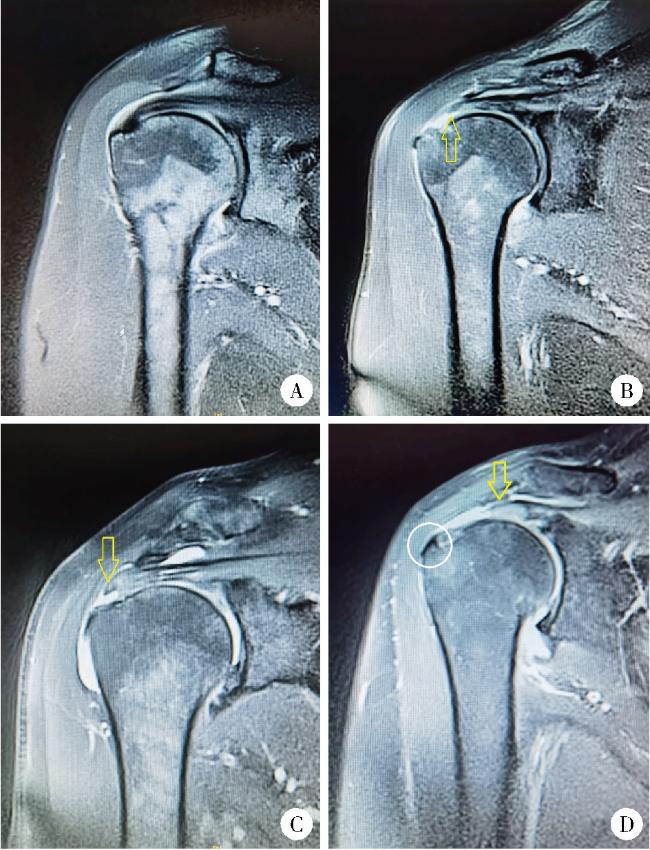
回顾性分析2019年5月至2020年12月期间入院的患者,根据病史、临床检查和MRI检查选择肩痛但肩袖正常的患者作为阴性对照组(A组),患病组是在相同条件下、相同类型的术前MRI检查中被证实为非外伤性的RCTs(B、C、D组)。主要依据冈上肌撕裂类型分为:B组,部分RCTs(关节侧)组;C组,部分RCTs(滑囊侧)组;D组,全层RCTs组;见图 1
图1 各组肩袖撕裂患者的MRI影像

Figure 1 MRI images of patients with rotator cuff tears in each group

A, negative control group; B, partial RCTs (articular side) group; C, partial RCTs (bursal side) group; D, full-thickness RCTs group. The arrow indicates the site of RCTs, the circle marks the osteophytes of greater tuberosity of humerus. RCTs, rotator cuff tears.

排除标准为曾经接受同侧肩胛骨手术史、孤立性肩胛下肌撕裂、神经肌肉性疾病、肱骨头坏死、肩骨关节炎、先天性肱骨近端畸形或重度骨质疏松。

1.2 影像学测量及其他分析指标

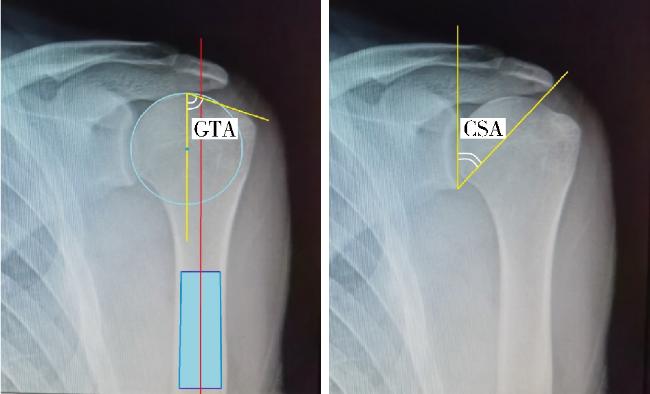
由同一组医生拍摄肩胛骨正位(又称盂肱关节前后位)X线片,手臂处于中立位,测量前逐一检查患者体位,摄片不满意时会补拍。分别由外科医师和放射科医师在单盲下测量患者的GTA和CSA数据,采用Cunningham等[3]报道的方法使用肩胛骨正位X线片测量GTA,GTA由两条交叉线组成,第一条线穿过肱骨头中心,与肱骨骨干平行,第二条线将肱骨头上缘与大结节最上外侧边缘相连(图 2);采用文献[9, 11-12]报道的方法使用肩胛骨正位X线片测量CSA,CSA由两条相交线组成,一条从肩胛盂上缘画到下缘,另一条从肩胛盂下缘画到肩峰外侧(图 2)。
图2 GTA和CSA在肩胛骨正位X线片上的测量方法

Figure 2 Measurement methods of GTA and CSA on apraxis of scapula

Greater tuberosity angle (GTA) is made by two crossing lines. The first line passes through the center of humeral head and parallels to the humerus diaphysis, and the second one connects the upper border of the humeral head to the most superolateral edge of the greater tuberosity. Critical shoulder angle (CSA) consists of the angle with two crossing lines. One of which was drawn from the glenoid superior to inferior border, the other was drawn from the glenoid inferior border to lateral aspect of the acromion.

观察者在不同时间分别进行两次角度测量,包括肩关节专业的外科医师和关节亚专业的影像医师在内,观察者对X线片的患者分组信息和彼此的测量结果均不知情。测量CSA和GTA的观察者内部和观察者之间的信度都得到了很好的验证。
本研究还分析了RCTs与性别、年龄、体重、身高、主肩、吸烟史、医疗记录中获得的体重指数(body mass index,BMI)等因素的相关性。

1.3 统计学分析

采用SPSS 26.0软件进行统计分析。使用组内相关系数(intraclass correlation coefficient,ICC)评估观察者内信度和观察者间信度[13-16]。根据kappa系数对信度进行分类:0~0.20为“轻微一致”,0.21~0.40为“大致一致”,0.41~0.60为“适度一致”,0.61~0.80为“实质一致”,0.81~1.00为“几乎完全一致”。各组间CSA和GTA采用单因素方差分析、最小显著性差异法(least significant diffe-rence,LSD)和SNK(Student-Newman-Keuls)检验。基线患者特征的比较采用卡方检验、Pearson(性别、优势肩、吸烟史)和独立student-t检验(年龄、体重、身高、BMI)。评估RCTs组(性别、优势肩、吸烟史)的优势比(odd ratio, OR)和95%置信区间(confidence interval,CI)。使用线性回归评估RCTs组CSA和GTA的相关性,并确定CSA和GTA在RCTs的最佳临界值(cut-off value)。P<0.05为差异有统计学意义。

2 结果

2.1 可靠性测试

根据RCTs的类型,分别由外科医师和放射科医师测量各组的CSA和GTA,观察者对患者分组和彼此的测量结果均不知情,观察者间信度和观察者内信度几乎完全一致(ICC>0.81,表 1)。
表1 放射学测量的可靠性检测

Table 1 Reliability of radiological measurements

Measurements ICC-1 ICC-2 ICC-3
CSA 0.988 0.988 0.897
GTA 0.977 0.990 0.921

CSA, critical shoulder angle; GTA, greater tuberosity angle; ICC, intraclass correlation coefficient; ICC-1, surgeon intra-observer variation test; ICC-2, radiologist intra-observer variation test; ICC-3, surgeon vs. radiologist inter-observer variation test.

2.2 RCTs患者特征的分析

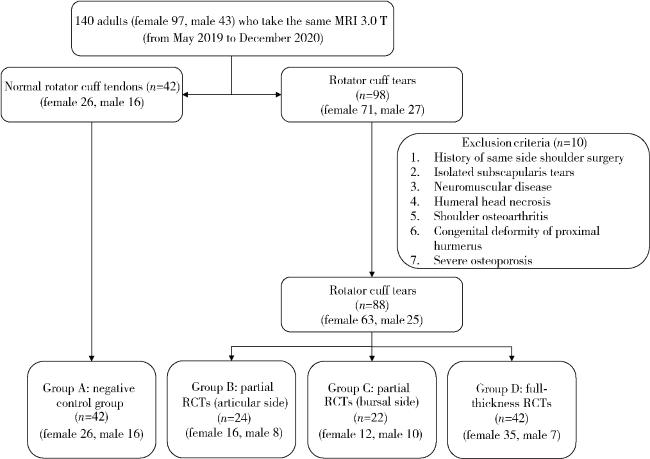
基于患者纳入和排除标准,排除了因术前是外院影像资料(未保留原始资料)及未能按时复查等因素造成的数据缺失的10名患者,本研究共纳入了130例患者,其中对照组42例,RCTs组88例,女性患者89例,男性患者41例,受试者入组流程见图 3
图3 受试者入组流程图

Figure 3 Enrollment flow chart

Patients were screened and grouped according to inclusion and exclusion criteria (according to the exclusion criteria, 10 patients with RCTs were not included in this study and statistical analysis due to factors such as preoperative imaging data missing (not recorded) and non-timely review. RCTs, rotator cuff tears.

各组人口学数据资料见表 2,在体重、性别、优势肩、吸烟等方面差异均无统计学意义(P>0.05)。D组身高[临界值1.58 m,敏感度0.524,(1-特异度)0.091,约登指数(Youden index) 0.433]显著小于A、B组(P<0.05),A、B、C组间差异无统计学意义(P>0.05)。D组年龄[临界值56.5岁,敏感度0.810,(1-特异度)0.205,约登指数0.605]明显大于A、B、C组(P<0.05),A组年龄明显小于B、C、D组(P<0.05),B、C组间年龄差异无统计学意义(P> 0.05)。A组BMI明显小于B、C、D组(P<0.05),B、C、D组间BMI差异无统计学意义(P>0.05)。
表2 各组人口学数据资料

Table 2 Demographic data in each group

Items Group A Group B Group C Group D P value
Age/years, ${\bar x}$±s 27.76±7.30 54.00±14.89 51.27±8.41 64.24±10.01 <0.001
Weight/kg, ${\bar x}$±s 58.90±6.51 63.83±9.06 63.27±6.13 61.43±10.06 0.075
Height/m, ${\bar x}$±s 1.64±0.50 1.65±0.78 1.62±0.68 1.59±0.07 0.001
BMI/(kg/m2), ${\bar x}$±s 21.82±1.73 23.24±1.91 24.04±1.54 24.10±2.93 <0.001
Gender (male/female), n 16/26 8/16 10/12 7/35 0.067
Shoulder (left/right), n 16/26 8/16 12/10 18/24 0.487
Smoking (yes/no), n 6/36 2/22 2/20 2/40 0.511

Group A, negative control group; Group B, partial RCTs (articular side); Group C, partial RCTs (bursal side); Group D, full-thickness RCTs. RCTs, rotator cuff tears; BMI, body mass index.

2.3 CSA和GTA的临界值分析

各组CSA和GTA的测量值见表 3
表3 各组CSA和GTA的测量值

Table 3 Measured values of CSA and GTA in each group

Items Group A Group B Group C Group D
CSA, ${\bar x}$±s 35.33±4.69 38.56±4.83 40.23±5.72 39.18±7.18
GTA, ${\bar x}$±s 68.36±3.06 70.54±3.08 71.09±5.31 72.62±5.37

The notes for Group A-D as in Table 2. GTA, greater tuberosity angle; CSA, critical shoulder angle.

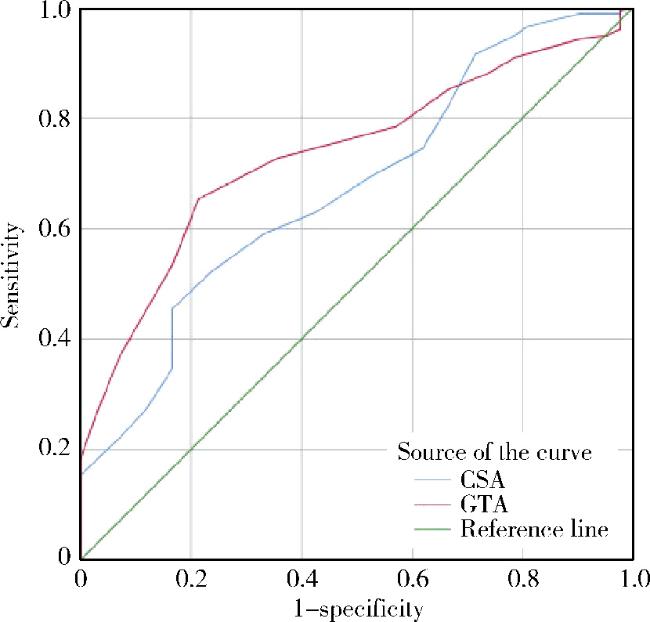
A组平均CSA为35.33°±4.69°,B组为38.56°± 4.83°,C组为40.23°±5.72°,D组为39.18°±7.18°;B、C、D组的CSA值均显著高于A组(P<0.05,表 4),B、C、D组间差异无统计学意义(P>0.05,表 4)。CSA的曲线下面积(area under curve, AUC)为0.673(95%CI: 0.612~0.735),CSA的临界值为39.5°,敏感度0.455,特异度0.833,约登指数0.288 (图 4),表明当CSA值>39.5°时,RCTs的可能性极大。
表4 CSA的组间多重比较(P value)

Table 4 Multiple comparisons of CSA between groups (P value)

Items Group A Group B Group C Group D
Group A - 0.028* 0.001** 0.002**
Group B 0.028* - 0.323 0.673
Group C 0.001** 0.323 - 0.485
Group D 0.002** 0.673 0.485 -

*, P<0.05; **, P<0.01. The notes for Group A-D as in Table 2. CSA, critical shoulder angle.

图4 ROC曲线下肩袖撕裂患者CSA和GTA的临界值分析

Figure 4 Analysis of critical values for CSA and GTA in RCTs patients under ROC curve

ROC, receiver operating characteristic; GTA, greater tuberosity angle; CSA, critical shoulder angle; RCTs, rotator cuff tears.

A组平均GTA为68.36°±3.06°,B组为70.54°± 3.08°,C组为71.09°±5.31°,D组为72.62°±5.37°;与CSA相似,B、C、D组的GTA值也显著高于A组(P<0.05,表 5),B、C、D组间差异无统计学意义(P>0.05,表 5)。GTA的AUC为0.736 (95%CI: 0.684~0.788),比CSA的AUC大,具有更高的诊断价值。GTA的临界值为70.5°,敏感度0.653,特异度0.786,约登指数0.439 (图 4),表明当GTA值>70.5°时,诊断RCTs的可能性极大,具有较高的诊断价值。
表5 GTA的组间多重比较(P value)

Table 5 Multiple comparisons of GTA between groups (P value)

Items Group A Group B Group C Group D
Group A - 0.045* 0.015* <0.001**
Group B 0.045 - 0.660 0.057
Group C 0.015* 0.660 - 0.172
Group D <0.001** 0.057 0.172 -

*, P<0.05; **, P<0.01. The notes for Group A-D as in Table 2. GTA, greater tuberosity angle.

2.4 CSA和GTA的相关性分析

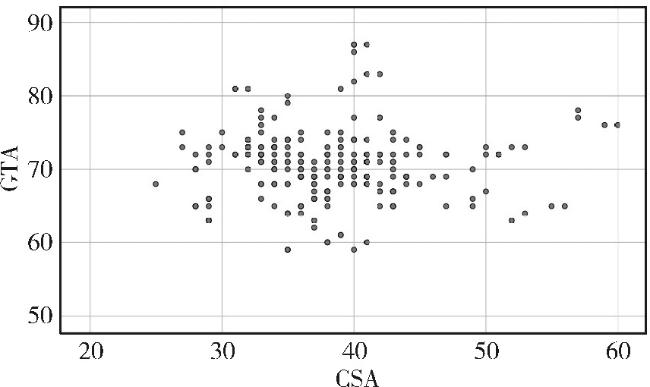
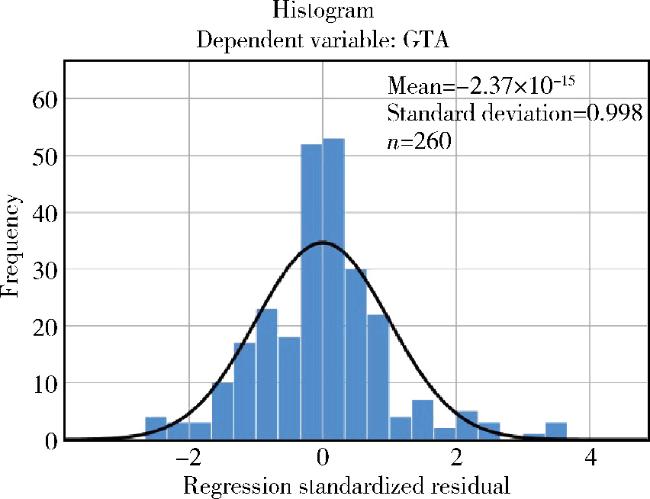
由散点图(图 5)和回归分析(图 6)可见,CSA与GTA之间不存在线性相关,回归标准化残差(因变量:GTA)服从标准正态分布(95%CI: -2, 2)。
图5 GTA和CSA的散点图

Figure 5 Scatter diagram of GTA and CSA

GTA, greater tuberosity angle; CSA, critical shoulder angle.

图6 回归标准化残差(因变量:GTA)遵循标准正态分布(95%CI: -2, 2)

Figure 6 Regression standardized residual (dependent variable: GTA) follows a standard normal distribution (95%CI: -2, 2)

GTA, greater tuberosity angle.

2.5 RCTs的危险因素和保护因素

计算RCTs各组的OR (95%CI),尽管性别的OR为1.231(95%CI:0.430~3.527),但Pearson卡方检验的P值(双侧)为0.699,这意味着性别既不是RCTs的危险因素,也不是其保护因素(表 6)。在优势肩和吸烟这两个因素上也是如此,总之,根据OR值的计算,性别、优势肩和吸烟在RCTs中既不是危险因素,也不是保护因素。
表6 RCTs各组的优势比

Table 6 Odd ratios of RCTs groups

Items Group B Group C Group D
OR (95%CI) P value OR (95%CI) P value OR (95%CI) P value
Gender (male/female) 1.231 (0.430-3.527) 0.699 0.738 (0.260-2.100) 0.569 3.077 (1.106-8.558) 0.050
Shoulder (left/right) 1.231 (0.430-3.527) 0.699 0.513 (0.180-1.458) 0.208 0.821 (0.343-1.963) 0.657
Smoke (yes/no) 1.833 (0.340-9.895) 0.476 1.667 (0.307-9.042) 0.551 3.333 (0.632-17.574) 0.137

The notes for Group B-D as in Table 2. RCTs, rotator cuff tears.

3 讨论

3.1 肩峰撞击与RCTs的关系

继1972年Neer[1]报道了慢性肩峰撞击综合征以及肩峰成形术之后,1982年,Bigliani等[2]开始用肩峰成形术治疗年龄小于40岁的肩峰撞击症患者,并根据其解剖形态提出了Bigliani肩峰分型[2, 17-19],在国际上得到了广泛应用。该研究报道,肩峰成形术的优良率为81%,能有效缓解肩部疼痛,恢复功能。肩峰撞击在解剖学上需要肩峰和肱骨近端两个骨性结构,尤其是肱骨大结节,经常伴有疼痛弧(外展60°~120°之间的疼痛)[20-21]。据Ellman[22]所报道,反复的肩峰撞击必然会引起RCTs,对于Ⅱ期晚期和选定的Ⅲ期撞击综合征患者,关节镜下的肩峰下减压术是开放式肩峰成形术的替代方案,该治疗将使绝大多数患者立即实现全范围的主动运动和实质性的疼痛缓解,从而降低RCTs的发生或进一步加重成为全层撕裂的概率。Gartsman等[23]的研究也证实了关节镜下肩峰下减压术的可行性及保护肩袖的临床价值。因此,肩峰成形术已被证实是一种有效的肩峰下减压方法,并有助于防止持续的撞击,促进撕裂肩袖的愈合[24-30]

3.2 GTA和CSA的价值和意义

近年研究发现,较大的GTA和CSA与全层RCTs的发生呈正相关[11-12]。GTA被推荐作为指导治疗孤立性大结节骨折或大结节畸形愈合的有用指标[31-32]。最近的研究发现,喙突撞击与小结节和二头肌沟的形态有关[33-35]。Moor等[9]的研究显示,RCTs组中84%的患者CSA大于35°(范围:29.5°~43.5°),且随着CSA的增加产生更高的剪切力。CSA改变了肩关节的生物力学,可能导致肩袖更易撕裂[36]。Pandey等[37]的研究显示,全层RCTs组的CSA临界值为39.3°,意味着较大的CSA与全层RCTs相关,而与部分RCTs无关,且全层RCTs组的患者体重更重,OR为4.9 (95%CI: 2.16~11.43, P<0.001)。Shinagawa等[38]的研究表明,更大的CSA (33.9°±4.1°)显著增加RCTs的风险,CSA每增大1°,OR增加1.8,CSA增大可能是RCTs的独立危险因素。Cunningham等[3]的研究共纳入了71例患者,研究结果显示GTA值为70°以上时,检测出RCTs的概率增加93倍(P<0.001),患者的平均GTA值为72.5°(范围:67.6°~79.2°),该研究认为GTA是一种可靠的影像学指标,70°以上对检测RCTs病变具有很高的预测性。
本研究在影像学测量具有高可靠性的前提下,分析GTA和CSA在RCTs诊断中的临床价值,探讨GTA与CSA之间是否存在相关性以及RCTs的高危因素(如年龄、性别、体重、身高、BMI、优势肩、吸烟等)。本研究结果显示,GTA和CSA是预测全层RCTs的可靠影像学指标,其中GTA>70.5°和CSA> 39.5°为高预测值,且GTA比CSA具有更高的诊断价值。通过散点图和回归方程分析,GTA与CSA之间不存在线性相关。
与阴性对照组比较,RCTs组的年龄和BMI差异均有统计学意义(P<0.05),全层RCTs组患者的年龄比其他三组更大(P<0.05,临界值为56.5岁),身高比A、B组更低(P<0.05,临界值为1.58 m)。上述结果显示,年龄>56.5岁、身高<1.58 m可作为更易罹患全层RCTs的辅助参考因素。
本研究还发现,RCTs组的GTA和CSA与对照组相比差异均有统计学意义(P<0.05)。GTA和CSA的增加可能是由于肩峰撞击或肩关节退行性变引起的肩峰和肱骨大结节的形态学改变造成的,由此可以推断,肩峰撞击和肩关节退行性变是发生在RCTs之前的。
此外,性别、体重、优势肩、吸烟在各组RCTs中差异均无统计学意义(P>0.05),说明这些因素既不是危险因素,也不是保护因素。

3.3 本研究的局限性

本研究也存在一些局限性。
首先,GTA和CSA的临界值因为人种、患病群体的劳动性质及地理位置分布等因素,在以往各国文献报道中存在细微差别,本研究亦同样存在上述客观因素导致的分析局限性,但GTA和CSA值的表达趋势和范围是一致的,可以作为参考且可靠性高。其次,根据本文的结果数据,GTA和CSA与部分RCTs类型之间没有相关性,其原因可能是部分RCTs尚未改变肩关节的解剖形态,但由于本研究的样本量有限,以及患病群体分布的局限性,因此后续可能需要联合多中心进行分析。第三,即使根据医师的要求,患者肩膀被放置在X线片的标准位置,但肱骨近端轻微旋转和肩关节倾斜也是不可避免的,由于患者体位和X线投影角度的微小变化,会给测量带来误差,但以往有研究显示,GTA和CSA在轴向旋转-20°~+40°和矢状旋转-10°~+20°的范围内可以保持不变[39-41]。第四,肩部正位X线片测量的GTA和CSA是基于二维平面,没有考虑肩峰撞击时肩峰相对于肱骨近端的实际位置,当实际发生肩峰撞击时,肱骨近端与肩峰在一定的运动范围内(外展、旋转、前屈和前伸)是接触的。第五,根据本研究结果推断,肩峰撞击和肩关节退行性变是发生在RCTs之前的,但RCTs的发生、发展及病理生理变化仍需进一步研究。第六,虽然MRI表现正常,但本研究随机选择的对照组可能存在少许偏倚。
综上所述,较大的GTA(>70.5°)和CSA(>39.5°)对RCTs的诊断具有较高的预测价值,其中GTA的诊断价值更高;CSA与GTA之间无线性相关;肩峰撞击和肩关节退行性改变发生在RCTs之前;年龄>56.5岁、身高<1.58 m的患者更容易罹患全层RCTs,而体重和BMI在组间的差异无统计学意义;性别、优势肩、吸烟既不是危险因素,也不是保护因素。

利益冲突  所有作者均声明不存在利益冲突。

作者贡献声明  蒋华、颜宇:设计研究方案,撰写论文;李盼盼、陈康、马红兵、曾勇:收集、分析、整理数据;唐新、崔国庆:审定论文。

1
Neer CS . Anterior acromioplasty for the chronic impingement syndrome in the shoulder: A preliminary report[J]. J Bone Joint Surg Am, 1972, 54 (1): 41- 50.

2
Bigliani LU , D' Alessandro DF , Duralde XA , et al. Anterior acromioplasty for subacromial impingement in patients younger than 40 years of age[J]. Clin Orthop Relat Res, 1989 (246): 111- 116.

3
Cunningham G , Nicodeme-Paulin E , Smith MM , et al. The greater tuberosity angle: A new predictor for rotator cuff tear[J]. J Shoulder Elbow Surg, 2018, 27 (8): 1415- 1421.

4
Kocadal O , Tasdelen N , Yuksel K , et al. Volumetric evaluation of the subacromial space in shoulder impingement syndrome[J]. Orthop Traumatol Surg Res, 2022, 108 (2): 103- 110.

5
Bufe K , Müller KH , Retzlaff C , et al. Interobserver reliability of shoulder radiographic findings and correlation to MRI: A preliminary case series[J]. Arch Orthop Trauma Surg, 2024, 144 (8): 3313- 3322.

6
Bi AS , Morgan AM , O' Brien M , et al. Partial-thickness rotator cuff tears: Current concepts[J]. JBJS Rev, 2024, 12 (8): e24.00063.

7
王琦, 王会祥, 吴晓明. 峰盂角的定义及临床研究进展[J]. 中华骨科杂志, 2020, 40 (1): 55- 59.

8
陈俊, 楼珏翔, 申屠国建, 等. 肩关节峰盂角对肩袖撕裂修补术后再撕裂的影响[J]. 中国运动医学杂志, 2022, 41 (6): 423- 429.

DOI

9
Moor BK , Bouaicha S , Rothenfluh DA , et al. Is there an association between the individual anatomy of the scapula and the deve-lopment of rotator cuff tears or osteoarthritis of the glenohumeral joint? A radiological study of the critical shoulder angle[J]. Bone Joint J, 2013, 95-B (7): 935- 941.

10
Bossuyt PM , Reitsma JB , Bruns DE , et al. STARD 2015:An updated list of essential items for reporting diagnostic accuracy studies[J]. BMJ, 2015, 351, h5527.

11
Seo J , Heo K , Kwon S , et al. Critical shoulder angle and greater tuberosity angle according to the partial thickness rotator cuff tear patterns[J]. Orthop Traumatol Surg Res, 2019, 105 (8): 1543- 1548.

12
Yoo JS , Heo K , Yang JH , et al. Greater tuberosity angle and critical shoulder angle according to the delamination patterns of rotator cuff tear[J]. J Orthop, 2019, 16 (5): 354- 358.

13
Schaaf JV , Weidinger L , Molleman L , et al. Test-retest reliability of reinforcement learning parameters[J]. Behav Res Methods, 2024, 56 (5): 4582- 4599.

14
Job TDW , Cross MR , Cronin JB . Comparison of shoulder rotation strength and test-retest reliability in 3 test positions with swimmers[J]. J Sport Rehabil, 2024, 11 (6): 1- 7.

15
Sutton P , Lund Ohlsson M , Röijezon U . Reduced shoulder proprioception due to fatigue after repeated handball throws and evaluation of test-retest reliability of a clinical shoulder joint position test[J]. Shoulder Elbow, 2024, 16 (1): 100- 109.

16
Othman R , Bajaber AM , Alhabshi AM , et al. Test-retest reliability of pain sensitivity measures in individuals with shoulder pain[J]. J Pain Res, 2024, 25 (17): 1917- 1927.

17
Bigliani LU , Levine WN . Subacromial impingement syndrome[J]. J Bone Joint Surg Am, 1997, 79 (12): 1854- 1868.

18
Akgün D , Gebauer H , Paksoy A , et al. Differences in osseous shoulder morphology, scapulothoracic orientation, and muscle volume in patients with constitutional static posterior shoulder instability (type C1) compared with healthy controls[J]. Am J Sports Med, 2024, 52 (5): 1299- 1307.

19
Dong W , Du K , Shi B , et al. Distribution and analysis of subacromial spurs and the relationship with acromial classification and angle in healthy individuals[J]. PLoS One, 2024, 19 (3): e0301066.

20
Abu El Kasem ST , Alaa FAA , Abd El-Raoof NA , et al. Efficacy of Mulligan thoracic sustained natural apophyseal glides on sub-acromial pain in patients with sub-acromial impingement syndrome: A single-blinded randomized controlled trial[J]. J Man Manip Ther, 2024, 32 (6): 584- 593.

21
Saengpetch N , Bamrungchaowkasem J , Chitrapazt N , et al. Predicting bursal-side supraspinatus tendon tears with the acromioclavicular angle[J]. Asia Pac J Sports Med Arthrosc Rehabil Technol, 2024, 27 (39): 15- 21.

22
Ellman H . Arthroscopic treatment of impingement of the shoulder[J]. Instr Course Lect, 1989, 38, 177- 185.

23
Gartsman GM , Blair ME , Jr. Noble PC , et al. Arthroscopic subacromial decompression: An anatomical study[J]. Am J Sports Med, 1988, 16 (1): 48- 50.

24
Lowry V , Lavigne P , Zidarov D , et al. A systematic review of clinical practice guidelines on the diagnosis and management of various shoulder disorders[J]. Arch Phys Med Rehabil, 2024, 105 (2): 411- 426.

25
Yang S , Pang L , Zhang C , et al. Lower reoperation rate and superior patient-reported outcome following arthroscopic rotator cuff repair with concomitant acromioplasty: An updated systematic review of randomized controlled trials[J]. Arthroscopy, 2025, 41 (5): 1618- 1634.

26
Zhao J , Huang H , Zeng L , et al. Acromioplasty combined with arthroscopic rotator cuff repair can reduce the risk of reoperation: A systematic review and meta-analysis[J]. Postgrad Med, 2024, 136 (6): 666- 677.

27
Maguire JA , Dhillon J , Scillia AJ , et al. Rotator cuff repair with or without acromioplasty: A systematic review of randomized controlled trials with outcomes based on acromial type[J]. Am J Sports Med, 2024, 52 (13): 3404- 3411.

28
Gatto L , Fernando A , Patel M , et al. Subacromial contact after acromioplasty in the rotator cuff deficient shoulder[J]. J Orthop Res, 2024, 42 (3): 588- 597.

29
Heydar AM , Kiyak G . Effect of arthroscopic acromioplasty on the isometric abduction strength[J]. Cureus, 2024, 16 (4): e59426.

30
Sayampanathan AA , Tan AHC . Editorial commentary: Long-term, clinical outcome of arthroscopic rotator cuff repair may be improved with concomitant acromioplasty in patients with a type Ⅲ acromion[J]. Arthroscopy, 2025, 41 (5): 1635- 1636.

31
Gutierrez-Naranjo JM , Salazar LM , Kanawade VA , et al. The greater tuberosity version angle: A novel method of acquiring humeral alignment during intramedullary nailing[J]. Bone Jt Open, 2024, 5 (10): 929- 936.

32
Castanheira A , Amaro P , Alonso R , et al. Influence of reestabli-shing greater tuberosity angle on patient outcomes following greater tuberosity fractures[J]. Eur J Orthop Surg Traumatol, 2024, 35 (1): 22- 26.

33
Klosterman EL , Tagliero AJ , Lenters TR , et al. The subcoracoid distance is correlated with pain and internal rotation after reverse shoulder arthroplasty[J]. JSES Int, 2024, 8 (3): 528- 534.

34
Açan AE , Hapa O , Gursan O , et al. The effect of arthroscopic coracoplasty on subscapularis strength in cases of subcoracoid impingement in the absence of subscapularis tear[J]. Medicine (Baltimore), 2024, 103 (3): e36947.

35
Gamiel A , Elkhawaga H , Badr M , et al. Multimodal physical therapy management of subcoracoid impingement: A case report with one-year follow-up and ultrasound measurement of coracohumeral distance[J]. Cureus, 2024, 16 (11): e73398.

36
Villatte G , van der Kruk E , Bhuta AI , et al. A biomechanical confirmation of the relationship between critical shoulder angle (CSA) and articular joint loading[J]. J Shoulder Elbow Surg, 2020, 29 (10): 1967- 1973.

37
Pandey V , Vijayan D , Tapashetti S , et al. Does scapular morphology affect the integrity of the rotator cuff?[J]. J Shoulder Elbow Surg, 2016, 25 (3): 413- 421.

38
Shinagawa K , Hatta T , Yamamoto N , et al. Critical shoulder angle in an East Asian population: Correlation to the incidence of rotator cuff tear and glenohumeral osteoarthritis[J]. J Shoulder Elbow Surg, 2018, 27 (9): 1602- 1606.

39
Moor BK , Wieser K , Slankamenac K , et al. Relationship of individual scapular anatomy and degenerative rotator cuff tears[J]. J Shoulder Elbow Surg, 2014, 23 (4): 536- 541.

40
Oladimeji AE , Amoo-Achampong K , Ode GE . Impact of critical shoulder angle in shoulder pathology: A current concepts review[J]. JSES Int, 2023, 8 (2): 287- 292.

41
Cerciello S , Mocini F , Proietti L , et al. Critical shoulder angle in patients with cuff tears[J]. Sports Med Arthrosc Rev, 2024, 32 (1): 38- 45.

文章导航

/