
输尿管狭窄是一种常见的泌尿系统疾病,常由炎症、外伤、医源性损伤、盆腔肿瘤放疗、先天性因素等多种原因引起[1-4],严重时可导致肾功能受损甚至肾功能丧失。对于长段输尿管狭窄,腹腔镜或机器人输尿管狭窄重建是常用的治疗方式,总的治疗原则是恢复输尿管的解剖连续性与功能,预防尿漏并保护患侧肾功能。输尿管狭窄的位置和长度是决定手术策略的关键因素[5-6],CT尿路造影(computed tomography urography,CTU)、逆行肾盂造影和其他影像重建方法常被用于狭窄段的定位[7],然而传统的定位方式在处理复杂输尿管狭窄时存在显著局限性,尤其是在瘢痕化组织背景下,难以实现对输尿管狭窄段的精准定位。本研究应用双镜联合(腹腔镜/机器人辅助腹腔镜联合输尿管软镜)技术,免分腿侧卧输尿管软镜裸镜探查技术,通过腹腔镜和输尿管软镜的协同操作,实现了对输尿管狭窄段的术中精确定位和全面观察,提高了手术成功率和患者预后,现报道如下。
1 资料与方法
1.1 一般资料
回顾2023年1月至2024年11月在北京大学人民医院由同一术者完成的127例输尿管重建手术,其中21例复杂输尿管狭窄患者应用双镜联合定位的方式进行了手术,这组复杂输尿管狭窄患者的狭窄长度超过2 cm,为多处狭窄,系因医源性手术或放疗引起的狭窄。本研究收集21例复杂输尿管狭窄患者的临床资料,患者术前均行泌尿系增强CT检查以及利尿肾动态显像检查,证实存在输尿管狭窄及上尿路梗阻(表 1)。本研究通过北京大学人民医院医学伦理委员会的审查批准(批件号:2025PHB243-001)。
表1 复杂输尿管狭窄患者的临床资料Table 1 Clinical data of patients with complex ureteral strictures |
| Variables | Data (n=21) |
| Gender (male/female), n | 10/11 |
| Age/years, ${\bar x}$±s | 44.1±13.3 |
| Causes of stenosis, n | |
| Calculus | 15 |
| Injury | 1 |
| Radiotherapy | 1 |
| Congenital factors | 4 |
| Location of stenosis, n | |
| Left/right side | 9/12 |
| Upper/middle/lower segment | 4/12/5 |
| Length of stenosis/cm, ${\bar x}$±s | 4.81±4.33 |
| Reconstruction methods, n | |
| Pyeloplasty | 4 |
| Ureteroneocystostomy | 2 |
| Bladder flap ureteroplasty | 4 |
| Lingual mucosal graft ureteroplasty | 6 |
| Appendix graft ureteroplasty | 2 |
| Ureteroureterostomy | 1 |
| Ileal segment replacement of ureter | 1 |
| Renal pelvis flap + ureteroneocystostomy | 1 |
| Surgical approaches, n | |
| Laparoscopy | 17 |
| da Vinci robot-assisted laparoscopy | 4 |
1.2 手术方法
患者气管插管,全身麻醉,术前评估为中上段的长段狭窄患者,选择经鼻插管取舌黏膜补片。中上段狭窄患者取斜仰卧位,背部与水平面呈60°(图 1),女性患者大腿之间夹铺巾单帮助暴露尿道外口。由脐外侧腹直肌旁置入12 mm穿刺器(trocar)作为腹腔镜观察孔,在腹直肌外缘与肋缘下1 cm处交点、髂嵴与脐连线外三分之一处放置10 mm穿刺器或8 mm穿刺器,作为腹腔镜操作孔或机器人1臂及2臂孔,采用机器人手术的患者额外于下腹放置3臂孔穿刺器及正中线脐下辅助孔穿刺器。沿结肠旁韧带纵行打开,沿Told’ s间隙打开侧腹膜,游离并暴露输尿管。手术助手用7.5F(1F≈0.33 mm)一次性输尿管软镜裸镜在超滑导丝引导下进入患侧输尿管内,自下而上探查输尿管,直至输尿管狭窄段远端。调暗腹腔镜光源,由腹腔镜监视器中可以看到输尿管管腔内的软镜光源,操作软镜挤过狭窄段,探查狭窄段上方,定位狭窄段近端,标记狭窄部位,纵向劈开狭窄段,操作软镜再次探查,判断裁剪位置跨过狭窄段。对于腔内闭锁型狭窄,操作软镜定位狭窄段远端,切开输尿管狭窄段全长,直至狭窄段上方见尿液流出,跨过狭窄段探查狭窄段近端,确保管腔通畅没有多处狭窄存在。镜下以软镜能顺利通过管腔、管壁黏膜光滑平整没有明显息肉、管壁颜色为淡粉色来判断保留部分输尿管的通畅性及血运情况。根据狭窄长度及输尿管吻合处的张力选用合适的重建方式,用5-0单桥线及4-0倒刺线进行输尿管吻合(图 2)。经软镜留置导丝,逆行留置输尿管支架,撤镜留置尿管。
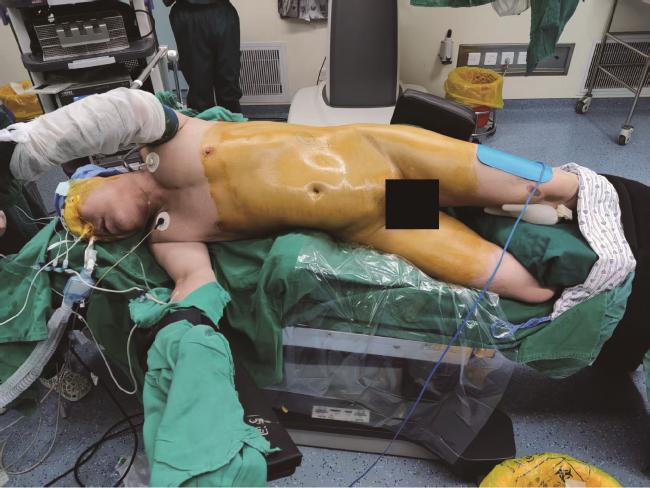
图1 体位:斜仰卧位,背部与水平面呈60°Figure 1 An inclined supine position with the back inclined at a 60° angle relative to the horizontal plane |
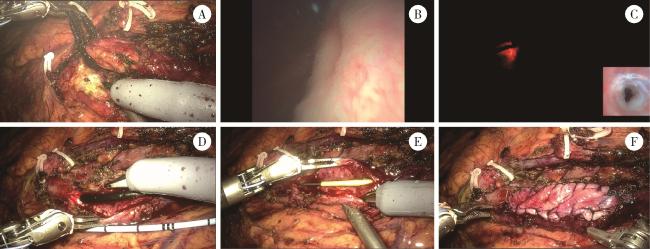
图2 输尿管软镜联合机器人辅助腹腔镜定位中段狭窄Figure 2 Robot-assisted laparoscopic ureteroplasty with flexible ureteroscopic guidance for mid-ureteral stricture localization A, dissection of the ureter; B, flexible ureteroscopy exploration of the ureter in lateral position (bare scope technique); C, deactivation of robotic laparoscopic light source for stricture localization; D, resection of strictured segment with patency confirmation via flexible scope; E, retrograde ureteral stent placement; F, lingual mucosa graft ureteroplasty. |
术前评估为中下段狭窄的患者取仰卧截石位,脐上置入12 mm穿刺器作为观察孔,平脐左右侧方置入10 mm穿刺器或8 mm穿刺器作为腹腔镜操作孔或机器人1臂及2臂孔,下腹髂嵴内侧放置5 mm辅助孔,采用机器人手术的患者于右侧腋中线与脐下1 cm交点处放置8 mm穿刺器作为3臂通道。松解粘连的肠管,在髂血管水平打开腹膜,于腹膜后游离输尿管,手术助手用输尿管软镜探查患侧输尿管,跨过狭窄段探查全程输尿管,后退至狭窄段上方,调暗腹腔镜光源,于腹腔镜内通过光源判断狭窄位置,于狭窄段上方离断输尿管,再根据狭窄位置及膀胱游离度选择输尿管膀胱再植或膀胱瓣代输尿管,用4-0倒刺线吻合输尿管和膀胱,逆行留置输尿管支架,留置尿管及引流管。
1.3 术后处理及随访
术后给予静脉输液支持、镇痛及抗生素预防感染等综合治疗措施,密切监测生命体征变化。导尿管保留时间设定为14 d,患侧输尿管支架管保留时间为8周。拔除输尿管支架后2周进行评估,包括排尿后的泌尿系统超声扫描及肾功能检查,此后每3个月进行周期性影像学跟踪随访。临床疗效以拔除支架管后2周的影像学积水程度和症状缓解情况评价,积水程度通过超声下测量肾盂前后径进行量化对比,分为:(1)治愈:积水较术前明显减轻,随访期间积水未加重,症状消失;(2)好转:积水较前减轻或未加重,症状减轻;(3)失败:积水加重,症状未改善。总有效率=(治愈人数+好转人数)/总人数× 100%。
1.4 统计学分析
采用SPSS 27.0统计软件进行分析,计量资料以均数±标准差表示,术前术后计量资料采用配对t检验,以P < 0.05为差异有统计学意义。
2 结果
所有患者均采用双镜联合技术进行输尿管狭窄段的定位及重建。本研究共纳入患者21例,其中男性10例,女性11例,年龄17~63岁,平均(44.1±13.3)岁。结石相关狭窄15例,妇科术后输尿管损伤1例,放疗后输尿管狭窄1例,先天性因素4例。狭窄部位为上段4例,中段12例,下段5例。平均狭窄长度为(4.81±4.33) cm。采用腹腔镜手术者17例,采用达芬奇机器人(da Vinci Robot)辅助腹腔镜手术者4例。有11例患者术前通过影像资料判断的狭窄位置与术中软镜定位的位置存在不同(52.4%),其中2例为上下两处狭窄,分别行肾盂瓣代输尿管+输尿管膀胱再植,下段输尿管球囊扩张+输尿管成形;8例术中判断的狭窄段长于术前影像判断,分别行舌黏膜补片输尿管成形和膀胱瓣代输尿管术;1例术中判断的狭窄段短于术前影像判断,行输尿管端端吻合,免于行舌黏膜补片输尿管成形。术后,有1例患者发生漏尿,退出引流管后漏尿症状消失;1例患者输尿管支架取出后因肾结石下移至输尿管梗阻,行输尿管镜碎石,镜检输尿管腔通畅,取石治疗后未再次出现积水加重。患者术后随访2~21个月[平均(10.76±6.81)个月],所有患者积水均无加重,症状消失,总有效率为100%。
3 讨论
复杂输尿管狭窄通常由医源性因素引起,随着输尿管镜钬激光碎石术在泌尿系结石治疗中的广泛应用,结石继发性输尿管狭窄逐渐成为输尿管狭窄最常见的原因[8],其发病机制与术中器械操作引发的组织损伤密切相关。临床研究表明,钬激光碎石术(Ho: YAG)及输尿管镜操作过程中产生的热效应和机械应力可对输尿管黏膜及肌层造成双重损伤,进而激活局部炎症反应通路[9]。这种持续性刺激可导致转化生长因子-β(transforming growth factor-β,TGF-β)、角质细胞生长因子(keratinocyte growth factor, KGF)和表皮生长因子(epidermal growth factor, EGF)等促纤维化因子异常分泌,最终引起胶原过度沉积和瘢痕组织病理性增生[10]。
随着放疗技术的发展,放疗后输尿管狭窄的患者也呈现增加的趋势,尤其常见于宫颈癌、前列腺癌、结直肠癌等盆腔肿瘤的放疗患者。放疗后输尿管狭窄的发生率为0.3%~13.5%,5年累积发生率为1.5%~4.4%,最高风险集中在放疗的前5年,之后每年仍有约0.15%的发生率。在宫颈癌患者中,图像引导的三维近距离后装放疗后,输尿管狭窄的3年和5年累积风险分别为1.9%和2.7%[11-12]。放疗引起的慢性炎症反应导致输尿管壁胶原沉积和纤维化,微血管内皮细胞受损导致局部缺血,进一步加重纤维化进程,最终形成管腔狭窄[13-15]。同时,输尿管管壁的纤维化也会导致输尿管蠕动功能受损,进而影响尿液引流,引发肾积水[16]。
治疗输尿管狭窄的主要方法包括腔内技术、腹腔镜和机器人辅助的输尿管重建手术。腔内技术主要包括输尿管支架置入、球囊扩张和内切开术等。尽管这些方法操作简便,但其长期效果有限,对于1.5 cm以上的狭窄失败率较高[17],常需要反复治疗,且不能从根本上解决狭窄问题。相比之下,腹腔镜或机器人辅助手术在输尿管狭窄的切除和重建中表现出了较低的复发率和良好的远期疗效[18],因此在治疗中占据了重要地位。准确识别和精确切除狭窄段是确保手术成功的关键,也是目前这一手术的挑战所在。术前CTU、磁共振尿路造影(magnetic resonance urography,MRU)和逆行肾盂造影是常用的狭窄部位定位方式,但是术中仅凭影像很难精确定位狭窄段,尤其是当狭窄区域伴有致密的纤维瘢痕时,管腔外很难判断腔内情况,定位变得尤为困难。本研究结果显示,有52.4%的病例通过术前影像判断的狭窄位置和长度与术中的定位存在出入,这部分患者有可能因为遗漏狭窄部位导致治疗失败,或是裁剪过多正常输尿管导致被迫采取复杂的重建方式。
有研究通过术中向输尿管内注射吲哚菁绿(indocyanine green,ICG)染料,结合近红外荧光成像,可快速、准确地识别狭窄段边界。狭窄区域因血流减少或纤维化导致ICG荧光信号减弱,与正常组织形成对比,在复杂狭窄或粘连病例中可提高定位精度[19]。但这种方法存在一定局限性,需要留置肾造瘘管或输尿管导管,通过导管注射ICG染料,且对于反复手术或放疗后广泛缺血的情况难以清晰显影。腹腔镜与输尿管镜双镜联合技术,是术中通过内镜直接观察狭窄并标记位置,是最为准确的定位方式,尤其适用于长段或多发狭窄的定位[20]。双镜联合技术对患者体位有一定要求,当狭窄部位位于输尿管与髂血管交叉处上方时,患者采用侧卧截石位,而当狭窄部位位于输尿管与髂血管交叉处下方时,则采用仰卧截石位。侧卧截石位对患者的髋部压力较高,抬高的下肢在术中会对术者的操作或机械臂的运动造成影响,因此,本研究对患者体位进行了优化,采用了传统的斜仰卧位,应用免分腿侧卧位输尿管软镜裸镜探查技术进行软镜镜检,可以实现输尿管全程的探查,在直视下到达狭窄部位,腹腔镜下通过光源的引导使得狭窄段的切除更加精确,避免了主观判断的盲目性。利用输尿管软镜的柔性特质,可以在吻合后对输尿管管腔进行即刻探查、测漏,最大限度地避免了因缝合不当引起的狭窄。输尿管中段狭窄在进行端端吻合或是自体补片输尿管成形时,在放置双J管过程中,一端可以通过导丝引导放置,另一端由于缺乏引导,递送双J管时难度会大大增加,容易对输尿管壁造成二次损伤,此时通过软镜留置导丝,逆行留置双J管可以降低输尿管支架留置的难度,也避免了递送双J管时对管壁进行过多的钳夹动作。
本研究中,所有复杂输尿管狭窄的患者均在双镜联合技术的辅助下顺利完成,有2例患者因输尿管狭窄段几近闭锁,由软镜定位狭窄段远端后劈开狭窄段,再进行近端输尿管探查,其余患者均顺利通过狭窄段,裁剪前定位狭窄段远、近端,无术中中转开放。1例患者因多次手术粘连严重,在游离过程中出现髂血管损伤,经修复后无远期并发症。患者术后随访2~21个月[平均(10.76±6.81) 个月]。所有术前有症状的患者,术后腰部疼痛症状均消失,拔除双J管后肾积水均较术前减少,在复查中积水稳定没有增加,影像学检查未再发现狭窄。
本研究结果表明,双镜联合技术在治疗复杂输尿管狭窄方面是安全、可行且有效的,能够帮助医生快速、精确地定位狭窄段,有效识别多段狭窄,避免遗漏,在彻底切除病变的同时,最大限度地保留正常输尿管,避免了因裁剪过多而被迫改变重建策略,或是裁剪不到位而造成的治疗失败,在自体补片重建的病例中最大限度地减少了自体补片的取材,实现了无张力吻合,从而提高了手术成功率。



