论著

上颌骨前部和整体顺时针旋转改善骨性Ⅲ类牙颌面畸形患者鼻旁凹陷的对比

  • 宋凤岐 ,
  • 徐心雨 ,
  • 刘筱菁 ,
  • 李自力 , *
展开
  • 北京大学口腔医学院·口腔医院口腔颌面外科,国家口腔医学中心,国家口腔疾病临床医学研究中心,口腔生物材料和数字诊疗装备国家工程研究中心,北京 100081

收稿日期: 2022-10-09

  网络出版日期: 2024-04-03

基金资助

国家自然科学基金(82171012)

首都卫生发展科研专项(CFH2022-2-4104)

版权

版权所有,未经授权,不得转载。

Comparation of anterior maxilla and whole maxilla clockwise rotation to improve paranasal aesthetic defects of skeletal Class Ⅲ maxillofacial deformity

  • Fengqi SONG ,
  • Xinyu XU ,
  • Xiaojing LIU ,
  • Zili LI , *
Expand
  • Department of Oral and Maxillofacial Surgery, Peking University School and Hospital of Stomatology & National Center of Stomatology & National Clinical Research Center for Oral Diseases & National Engineering Research Center of Oral Biomaterials and Digital Medical Devices, Beijing 100081, China
LI Zili, e-mail,

Received date: 2022-10-09

  Online published: 2024-04-03

Supported by

the National Natural Science Foundation of China(82171012)

Capital' s Funds for Health Improvement and Research(CFH2022-2-4104)

Copyright

All rights reserved. Unauthorized reproduction is prohibited.

摘要

目的: 比较上颌骨前部顺时针旋转与整体顺时针旋转两种手术方式改善骨性Ⅲ类牙颌面畸形患者鼻旁凹陷的美学效果,为临床手术方式的选择提供参考依据。方法: 设计非随机临床对照试验,纳入骨性Ⅲ类牙颌面畸形患者21例(试验组11例,对照组10例),试验组采用上颌Le Fort Ⅰ型分块截骨术配合上颌前部顺时针旋转,对照组采用上颌整体顺时针旋转。分别采集术前(T0期)、术后2周(T1期)、术后6个月(T2期)的大视野锥形束CT(cone beam computered tomography, CBCT)和三维面相,进行三维软硬组织测量,测量指标包括颊凸点(cheek mass, CK)和鼻翼基点(subalare, SA)的矢状向位移量、鼻唇角、咬合平面角、上前牙唇倾角等。采用独立样本t检验对比不同时间节点测量指标的组间差异。结果: T0期两组三维头影测量指标的差异无统计学意义,术中试验组上颌平均前徙距离为(-0.71±1.67) mm,明显小于对照组(2.26±1.68) mm,t=-4.052,P<0.05;试验组咬合平面顺时针旋转角度1.46°±2.38°,明显小于对照组4.31°±1.83°,t=-3.047,P<0.05。T0到T2期试验组CK点和SA点的矢状向前移距离分别为(4.96±1.18) mm和(5.19±1.17) mm,对照组分别为(2.01±1.50) mm和(2.69±1.45) mm,组间差异具有统计学意义(P<0.05)。T2期试验组的上前牙唇倾角度为112.15°±5.40°,显著小于对照组122.38°±8.83°(t=-3.237,P<0.05);鼻唇角为106.54°±12.82°,显著大于对照组93.90°±12.46°(t=2.288,P<0.05)。结论: 相较于上颌整体顺时针旋转,上颌Le Fort Ⅰ型分块截骨术后顺时针旋转上颌前部,可以在不改变上颌切牙矢状向位置和咬合平面角的前提下,增大鼻旁区软硬组织的前徙距离,纠正上前牙唇倾及鼻唇角过锐,更好地改善骨性Ⅲ类牙颌面畸形患者的鼻旁美学缺陷。

本文引用格式

宋凤岐 , 徐心雨 , 刘筱菁 , 李自力 . 上颌骨前部和整体顺时针旋转改善骨性Ⅲ类牙颌面畸形患者鼻旁凹陷的对比[J]. 北京大学学报(医学版), 2025 , 57(5) : 980 -988 . DOI: 10.19723/j.issn.1671-167X.2025.05.025

Abstract

Objective: To compare the aesthetic effects of anterior maxilla clockwise rotation combined with segmental Le Fort Ⅰ osteotomy and whole maxilla clockwise rotation on improving paranasal concavity in patients with Class Ⅲ maxillofacial deformity. Methods: A non-randomized controlled trial was designed, and 21 patients diagnosed with skeletal Class Ⅲ maxillofacial deformity were included. In the study, 11 patients in the test group were treated by segmental Le Fort Ⅰ osteotomy combined with anterior maxilla clockwise rotation, and 10 patients in the control group were treated by whole maxilla clockwise rotation. The CBCT and 3D photography of preoperative (T0), 2 weeks postoperative (T1), and 6 months postoperative (T2) were collected respectively, and the three-dimensional cephalometry was carried out. The differences of specific parameters between the two groups were compared by independent sample t-test, including saggital displacement of the cheek mass point (CK) and subalare point (SA), nasolabial angle, occlusal plane angle and labial inclination angle of the upper incisor. Results: There were no significant differences of the parameters on T0 between the two groups. The average sagittal displacement of the upper incisors of the test group was (-0.71±1.67) mm and smaller than that of control group [(2.26±1.68) mm], t=-4.052, P < 0.05. The average angle of the occlusal plane clockwise rotation of the test group was 1.46°±2.38° and smaller than that of the control group (4.31°±1.83°), t=-3.047, P < 0.05. The angle of anterior maxilla clockwise rotation was 11.73°±2.81° during the surgery. The average saggital displacement of the paranasal soft tissue landmarks of the test group from T0 to T2 was larger than that of the control group [CK point, (4.96±1.18) mm vs. (2.01± 1.50) mm, P < 0.05;SA point, (5.19±1.17) mm vs. (2.69±1.45) mm, P < 0.05]. The labial inclination angle of the upper incisor of the test group was 112.15°±5.40° in T2 and significantly smaller than that of the control group (122.38°±8.83°), t=-3.237, P < 0.05. The nasolabial angle of the test group was 106.54°±12.82° in T2 and significantly larger than that of the control group (93.90°±12.46°), t=2.288, P < 0.05. Conclusion: Compared with whole maxilla clockwise rotation, anterior maxilla clockwise rotation combined with segmental Le Fort Ⅰ osteotomy can increase the saggital displacement of the paranasal soft tissue, correct labial inclination of the upper incisors and the acute naso-labial angle and better improve the paranasal aesthetic defects in patients with Class Ⅲ maxillofacial deformity with less changing on the saggital orientation of the upper incisors and the occlusal plane angle.

骨性Ⅲ类牙颌面畸形是指上颌发育不足和/或下颌发育过度导致的咬合及面型异常[1]。上颌发育不足会导致鼻旁区软组织凹陷、鼻唇角过锐,使得患者面部呈现增龄样改变,并且给人缺乏活力及亲和力的社交印象[2-3],所以改善鼻旁区凹陷已成为现代骨性Ⅲ类牙颌面畸形患者的常见治疗诉求之一。
正颌手术可以通过整体前徙上颌骨改善上颌发育不足,从而改善骨性Ⅲ类牙颌面畸形患者的鼻旁凹陷问题,但这类患者往往存在上前牙代偿性唇倾[4],上前牙切端的位置会限制上颌骨的前徙距离。传统的正畸正颌联合治疗通过术前正畸回收上前牙,为上颌整体前移创造空间。然而对于上颌前部牙槽基骨唇倾或上前牙唇侧骨板菲薄的患者,术前正畸回收上前牙的效果并不确定且容易造成骨开窗等牙周问题[4-5]。在上颌整体前徙受限时,上下颌骨复合体(maxillomandibular complex, MMC)的整体顺时针旋转可以在相同的上前牙前徙距离下增加鼻旁区的前徙幅度[6],但是该方法受咬合平面角及下颌平面角的限制,不适用于咬合平面本来较陡或者高角型的患者[7-8]。鼻旁区植骨和假体植入可以作为补偿解决方案[9],但改善幅度有限,且后者可引发异物感,远期有排异风险,部分患者难以接受。
20世纪80年代有研究者提出在上颌Le Fort Ⅰ型截骨术的基础上将上颌骨前部或后部截开,用于矫治复杂的牙颌面畸形,如上下颌牙弓宽度不调、上颌前突、前牙开牙合畸形等[10]。20世纪90年代,Chen等[11]提出对于上前牙严重唇倾的骨性Ⅲ类畸形患者,可在术中拔除两颗前磨牙,通过Le Fort Ⅰ型分块截骨术离断上颌前部及后部,并顺时针旋转上颌前部,手术纠正上前牙唇倾问题。上颌前部顺时针旋转在纠正上前牙唇倾的同时,缩小了梨状孔周围与牙槽突之间的骨梯度差,理论上能够改善鼻旁软组织凹陷问题,但目前还缺乏相关临床研究。
本研究通过前瞻性非随机临床对照试验对比“上颌前部顺时针旋转”与“上颌整体顺时针旋转”两种手术方式纠正骨性Ⅲ类牙颌面畸形患者鼻旁凹陷的临床效果,为临床诊疗中选择手术方式提供循证依据。

1 资料与方法

1.1 研究对象

本研究共纳入2021年9月至2022年4月在北京大学口腔医院口腔颌面外科接受正颌手术治疗的患者21例,其中女性17例,男性4例。纳入标准:(1)临床表现为骨性Ⅲ类牙颌面畸形,诊断包括上颌后缩畸形;(2)面中1/3表现为鼻旁区凹陷且患者有改善诉求;(3)上颌前牙牙槽基骨唇倾;(4)年龄18~35周岁。排除标准:(1)唇腭裂继发上颌发育不全;(2)有颌面部手术史或外伤史;(3)综合征类疾病导致上颌发育不全。21例患者中在术前正畸过程中已拔除两颗上颌前磨牙且拔牙间隙已关闭的患者进入对照组,术前正畸过程中未拔除上颌前磨牙或拔牙后保留间隙>4 mm的进入试验组,最终试验组纳入11例患者,对照组纳入10例患者。本研究已通过北京大学口腔医院生物医学伦理委员会批准(批准号:PKUSSIRB-202166105),并在中国临床试验注册中心注册(注册号:ChiCTR2200057346),每位受试者均在完全理解研究设计后签署知情同意书。

1.2 治疗方法

1.2.1 数据获取及处理

数据获取包括患者基本信息、头颅定位正侧位片、大视野锥形束CT (cone beam computered tomography, CBCT)、口内扫描、二维照片及三维面相。CBCT拍摄范围为颅顶至颏下缘(16 cm×16 cm),保存为DICOM格式。拍摄三维面相时通过水平激光仪记录患者自然头位[12]。将CBCT、三维面相及牙列扫描结果导入手术设计软件IVSP Image Trial(版本1.0.24.36),通过表面配准获得数字化头颅模型。

1.2.2 试验组的手术设计及术中实现

在数字化头颅模型上进行虚拟Le Fort Ⅰ型截骨,拔除双侧第一前磨牙,将上颌前部及后部分开,上颌前部骨块顺时针旋转,必要时在上颌中切牙之间做垂直截骨线,以消除两侧尖牙与第二前磨牙之间的台阶。咬合拼对完成后,上颌各骨块和下颌远心骨段的相对位置关系不再发生改变。根据头影测量参考数值和患者脸型的实际情况,将上下颌骨作为整体相对于颅骨进行移动,确定最终手术方案,在IVSP Image Trial软件中测量鼻旁前徙的距离。根据手术方案采用计算机辅助设计/加工技术(computer aided design and computer aided manufacture, CAD/CAM)制作中间、终末颌板,用于手术引导。术中按照手术设计进行截骨,上颌骨按照中间颌板就位后,测量鼻旁区的实际前徙距离,比较与设计距离是否一致,并根据该距离进行钛板塑形。在梨状孔边缘及双侧颧牙槽嵴处使用L型钛板进行坚固内固定。下颌经双侧升支矢状劈开截骨术后,下颌远心骨段根据终末咬合导板就位,在双侧下颌骨体部实施坚固内固定。术后2周拆除终末咬合导板,对佩戴固定矫治器的患者,上颌更换连续弓丝,同时在双侧上颌尖牙及第二前磨牙之间做细钢丝“8字”结扎;对佩戴隐形矫治器的患者,上颌戴入保持器,该保持器根据术前设计的上颌牙列3D打印模型采用1.0 mm膜片压模制作。

1.2.3 对照组的手术设计及术中实现

Le Fort Ⅰ型截骨线设计同试验组,上颌不分块,手术时不拔牙,根据咬合关系完成牙列拼对后,基于头影测量及面形特点设计MMC整体前徙和/或顺时针旋转,获得最终手术设计方案,利用CAD/CAM技术打印中间及终末咬合导板。术中Le Fort Ⅰ型截骨高度同试验组,上颌骨根据中间咬合导板定位后在梨状孔边缘及双侧颧牙槽嵴处使用L型钛板进行坚固内固定。下颌经双侧升支矢状劈开截骨术后,下颌骨远心骨段根据终末咬合导板就位,在双侧下颌骨体部实施坚固内固定。

1.3 术后随访

术后2周及术后6个月常规复诊,拍摄头颅定位正侧位片、大视野CBCT、二维照片和三维面相。

1.4 评价方法

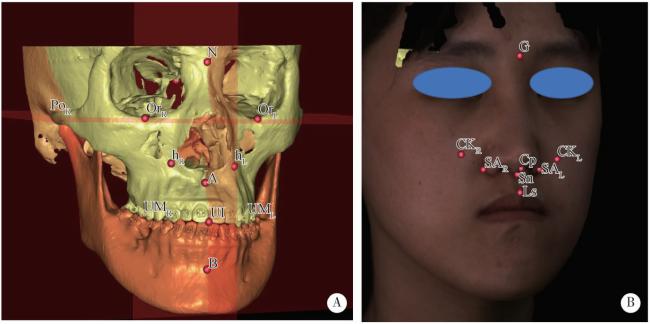
记录术前时间点为T0期,术后2周为T1期, 术后6个月为T2期,采用三维头影测量评价鼻旁区的软硬组织变化,测量工具为IVSP Image Trial软件。三维头影测量解剖标志点的选取方法如图 1所示,标志点及参考平面的释义如表 1所示。测量指标包括角度指标和距离指标,其中评价术前术后鼻旁硬组织凹陷程度的主要指标为蝶鞍点(sella, S)、鼻根点(nasion,N)和鼻翼基底映射点(point h,h)所成的夹角(angle of S, N and h,SNh),评价软组织凹陷程度的主要指标为颊凸点(cheek mass, CK)和鼻翼基底点(subalare, SA)到面平面(facial plane,FP)的距离,评价节点为T0期和T2期。
图1 三维头影测量标志点示意图

Figure 1 Diagram of main landmarks in three-dimensional cephalometry

A, landmarks of hard tissue; B, landmarks of soft tissue. The full names and explanations of all landmarks were listed in Table 1.

表1 三维头影测量中解剖标志点及参考平面的定义

Table 1 Definition of the three-dimensional anatomical landmarks and reference planes

Parameters Abbreviation Definition
Bone and dental landmarks
    Sella S The center of the hypophyseal fossa
    Nasion N The midpoint of the frontonasal suture
    Orbitale OrL, OrR The most inferior point of each infraorbital rim
    Porion PoL, PoR The most superior point of each external acoustic meatus
    Subspinale A The point of maximum concavity in the midline of the dento-alveolar process of the maxilla
    Upper incisor UI The most mesial point of the tip of the crown of the right upper central incisor
    Upper incisor apex UIa The apex of the right upper central incisor
    Upper molar UML, UMR The mesial buccal cusp of the first upper molar
    Supramental B The point of maximum concavity in the midline of the dento-alveolar process of the mandible
    Point h hL, hR Point on the left/right maxilla directly below the soft tissue alar base on axial view
Soft tissue landmarks
    Glabella G The most anterior midpoint on the fronto-orbital soft tissue contour
    Subalare SAL, SAR Labial insertion of each alar base
    Cheek mass CKL, CKR The most anterior point on the mid-pupillary plane (MPP) under infraorbital area and ahead of cornea perpendicular plane (CPP)
    Subnasale Sn The midpoint of the angle at the columella base where the lower border of the nasal septum and the surface of the upper lip meet
    Labiale superius Ls Midpoint of the upper vermillion border
    Columella peak Cp Most superior point of the columella
    Cornea CL, CR The most anterior point of the cornea
Reference planes
    Frankfort horizontal plane FHP The plane passes bilateral Orbitale and the midpoint between bilateral porion
    Midsagittal plane MSP The plane perpendicular to the FHP plane and passing through sella and nasion
    Facial plane FP The plane perpendicular to the FHP and MSP planes and passing through glabella
    Occlusal plane OP The plane passes the midpoint between UI and the midpoint between UML and UMR
    Mid-pupillary plane MPP The plane perpendicular to the FHP and FP planes and passing through cornea
    Cornea perpendicular plane CPP The plane perpendicular to the FHP and MSP planes and passing through cornea
T0期到T1期的硬组织测量指标的变化量代表手术干预量,包括上前牙切端(upper incisor, UI)矢状向前徙距离(saggital displacement of UI to FP, ΔUI-FP)、MMC旋转角度(clockwise rotation angle of MMC, ΔOP-SN)、上颌前部顺时针旋转角度(clockwise rotation angle of anterior maxilla, ACWR),其中试验组术中上颌前部顺时针旋转的角度由以下公式计算得出:
$A C W R_{(\mathrm{T} 1-\mathrm{T0})}=\left|\Delta U I-S N_{(\mathrm{T} 1-\mathrm{T0})}\right|-\Delta O P-S N_{(\mathrm{T} 1-\mathrm{T0})}$, 其中,ΔUI-SN(T1-T0)是指T0期到T1期上前牙唇倾角度(labial inclination angle of the upper incisor, UI-SN)的变化值。

1.5 统计学分析

采用SPSS 27.0进行统计学分析,两组术前、术后的三维头影测量值采用Shapiro-Wilk检验分析正态性,符合正态分布的测量数据采用独立样本t检验比较组间差异,不符合正态分布的数据采用Mann-Whitney检验比较组间差异。三维头影测量正常值参考既往文献中中国美貌人群的头影测量数据[13-14],采用单样本t检验比较测量值与正常值的差异,P<0.05为差异有统计学意义。
三维定点的可重复性试验由两名试验者完成,随机抽取10例样本,在1周之内对同一样本进行两次测量,分别计算组内及组间一致性。

2 结果

2.1 基本信息及术前三维头影测量结果对比

试验组11例,对照组10例,由表 2可见,两组的性别占比及平均年龄差异无统计学意义。T0期试验组和对照组在上颌骨位置、咬合平面角、上前牙唇倾角度以及上前牙到面平面的距离差异均无统计学意义(P>0.05)。术前两组的鼻旁区硬组织测量指标SNhR, SNhL和软组织测量指标CKR、CKL、SAR、SAL到FP的距离的差异均无统计学意义(P>0.05)。
表2 试验组和对照组的基线特征和T0期三维头影测量值

Table 2 General characteristic and preoperative 3D cephalometric values of test group and control group

Parameters Test group(n=11) Control group(n=10) t P value
Female 9 (81.8) 8 (80.0) -0.101 0.921
Age/years 24.91±6.20 24.00±5.06 0.366 0.719
SNA/(°) 82.47±2.28 81.26±2.89 1.067 0.299
SNB/(°) 85.90±2.46 86.45±2.74 -0.489 0.631
OP-SN/(°) 8.68±5.17 8.33±3.19 0.182 0.857
UI-SN/(°) 122.59±7.56 123.32±7.11 0.229 0.821
SNhR/(°) 72.07±2.91 71.50±4.30 0.364 0.720
SNhL/(°) 71.66±2.68 70.92±4.41 0.468 0.645
CKR-FP/mm -2.22±2.68 -3.04±3.44 0.614 0.546
CKL-FP /mm -3.01±3.26 -3.79±2.93 0.580 0.569
SAR-FP /mm -3.23±3.15 -4.51±3.20 0.921 0.369
SAL-FP /mm -4.16±3.01 -4.87±3.38 0.512 0.615
NL angle/(°) 87.61±14.62 84.63±12.97 0.491 0.629
UI-FP/mm 0.37±4.06 -1.42±3.96 1.020 0.320

The genetic ratio is presented as n (%) and other parameters are present as $\bar x \pm s$. Compared between groups by Student-t test, α=0.05, P<0.05 is considered statistically significant. SNA, the angle formed by point S, N and A; SNB, the angle formed by point S, N and B; SN, the skull base line connecting sella and nasion; OP-SN, angle of the occlusal plane and SN line; UI-SN, angle of the axis of the right upper incisor and SN line; SNhR, angle formed by point S, N and hR; SNhL, angle formed by point S, N and hL; CKR-FP, CKL-FP, SAR-FP, SAL-FP and UI-FP means the sagittal distance between CKR, CKL, SAR, SAL, UI and the facial plane, negative values means the points are behind the facial plane and positive values means the points are in front of the facial plane; NL angle, nasolabial angle compromised of Ls, Sn and Cp.

三维定点可重复性试验的组内一致性和组间一致性系数均>0.95,认为定点重复性较好。

2.2 手术干预对比

试验组的上前牙切端平均前徙距离为(-0.71± 1.67) mm,明显小于对照组(2.26±1.68) mm(t=-4.052,P<0.05);试验组的咬合平面顺时针旋转角度为1.46°±2.38°,明显小于对照4.31°±1.83°(t=-3.047,P<0.05);试验组通过上颌分块实现的前部骨块顺时针旋转角度为11.73°±2.81°。

2.3 鼻旁区软硬组织变化对比

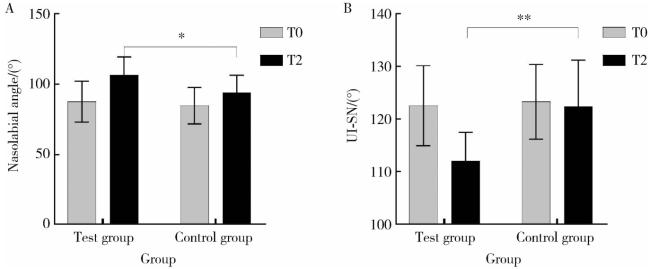
T2期试验组和对照组的三维头影测量值如表 3所示。试验组SNhR和SNhL分别为78.48°±2.77°和78.44°±2.55°,对照组SNhR为76.16°±3.83°,SNhL为75.97°±4.18°,组间差异无统计学意义(P>0.05),但鼻旁软组织标志点CK和SA相对于FP的位置组间差异有统计学意义(P < 0.05)。试验组上前牙唇倾角112.15°±5.40°,明显小于对照122.38°±8.83°(P < 0.05);试验组鼻唇角为106.54°±12.82°,显著大于对照组93.90°±12.46°(P < 0.05)。T0期及T2期两组上前牙唇倾角及鼻唇角的变化如图 2所示。
表3 T2期试验组和对照组的三维头影测量值对比

Table 3 3D cephalometric values at T2 of test group and control group

Parameters Test group (n=11) Control group (n=10) t P value
SNA/(°) 84.29±2.66 84.02±2.78 0.225 0.824
SNB/(°) 82.69±1.85 82.84±2.73 -0.142 0.889
OP-SN/(°) 10.26±4.64 11.62±3.92 -0.723 0.479
UI-SN/(°) 112.15±5.40 122.38±8.83 -3.237 0.004**
SNhR/(°) 78.48±2.77 76.16±3.83 1.600 0.126
SNhL/(°) 78.44±2.55 75.97±4.18 1.657 0.114
CKR-FP/mm 2.78±2.92 -1.21±3.31 2.932 0.009**
CKL-FP /mm 2.33±3.20 -1.60±3.25 2.793 0.012*
SAR-FP/mm 2.03±3.17 -1.32±2.95 2.507 0.021
SAL-FP/mm 2.23±3.73 -1.71±2.91 2.682 0.015*
NL angle/(°) 106.54±12.82 93.90±12.46 2.288 0.034*
UI-FP/mm 0.84±4.87 1.79±3.89 -0.494 0.627

All results are in normal distribution and presented as $\bar x \pm s$. Student-t test, * P<0.05,* * P<0.01. The definition of the parameters were listed under Table 2.

图2 T0期到T2期两组鼻唇角和上前牙唇倾角度的变化

Figure 2 Nasolabial angle and UI-SN of T0 and T2 in test group and control group

A, variations of nasolabial angle from T0 to T2 of test group and control group; B, variations of UI-SN from T0 to T2 of test group and control group. Student-t test, * P<0.05,* * P<0.01. UI-SN, angle of the axis of the right upper incisor and SN line.

T0期到T2期试验组和对照组的三维头影测量变化值对比如表 4所示,T0期到T2期试验组CK点和SA点的平均前移距离分别为(4.96±1.18) mm和(5.19±1.17) mm,对照组分别为(2.01±1.50) mm和(2.69±1.45) mm,试验组显著大于对照组(P < 0.05)。图 3展示了试验组和对照组鼻旁软组织标志点矢状向位移的差异。
表4 T0期到T2期试验组和对照组的三维头影测量变化值对比

Table 4 Variation of 3D cephalometric values from T0 to T2 of test group and control group

Parameters Test group (n=11) Control group (n=10) t P value
SNA/(°) 1.82±1.59 2.76±1.87 -1.245 0.228
SNB/(°) -3.21±1.04 -3.62±2.44 0.495 0.629
OP-SN/(°) 1.58±2.91 3.29±1.81 -1.597 0.127
UI-SN/(°) -10.43±4.28 -0.94±4.89 -4.746 <0.001**
SNhR/(°) 6.4±1.88 4.67±1.91 2.098 0.049*
SNhL/(°) 6.79±1.48 5.05±2.23 2.122 0.047*
CKR-FP/mm 4.78±1.22 1.83±1.55 4.886 <0.001**
CKL-FP /mm 5.15±1.74 2.19±1.63 4.005 <0.001**
SAR-FP /mm 5.24±1.71 3.18±1.67 2.782 0.012*
SAL-FP /mm 6.1±1.94 3.17±1.99 3.421 0.003**
NL angle/(°) 12.01±8.17 9.27±13.28 0.576 0.571
UI-FP/mm -0.03±1.95 3.05±2.44 -3.210 0.005**

All results are in normal distribution and presented as $\bar x \pm s$. Student-t test, * P<0.05,* * P<0.01. The definition of the parameters were listed under Table 2.

图3 T0期到T2期鼻旁区软组织标志点的矢状向位移

Figure 3 Saggital displacement of paranasal soft tissue landmarks from T0 to T2

Student-t test, * P<0.05,* * P<0.01, * * * P<0.001. The definition of the parameters were listed under Table 2.

2.4 病例展示

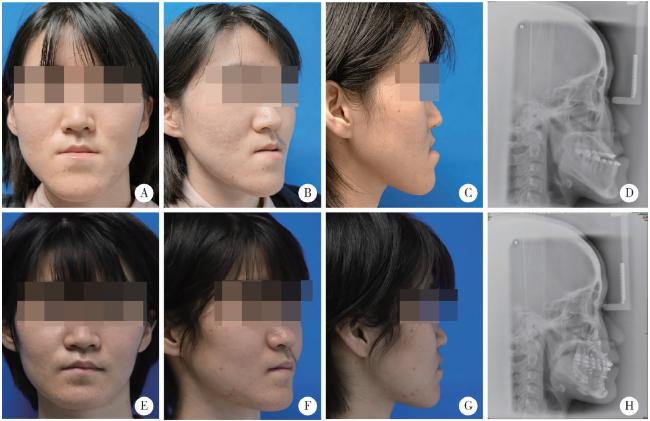
图 4图 5分别为试验组和对照组的典型病例在术前及术后6个月的二维照片和头颅侧位片,两者均为21岁女性患者,治疗诉求包括纠正骨性Ⅲ类牙颌面畸形和改善鼻旁区凹陷问题。两者术前均为高角型侧貌,上前牙牙槽基骨唇倾,鼻旁区明显凹陷。试验组患者采用上颌Le Fort Ⅰ型分块截骨术配合前部骨块顺时针旋转方案,对照组患者采用MMC顺时针旋转方案。
图4 试验组患者术前(T0)和术后6个月(T2)对比

Figure 4 Photographs and X-ray of a patient in test group before (T0) and 6 months after surgery (T2)

A-D, frontal photograph, 45° right side photograph, right lateral photograph and cephalometric lateral radiographs of T0; E-H, frontal photograph, 45° right side photograph, right lateral photograph and cephalometric lateral radiographs of T2.

图5 对照组患者术前(T0)和术后6个月(T2)对比

Figure 5 Photographs and X-ray of a patient in control group before (T0) and 6 months after surgery (T2)

A-D, frontal photograph, 45° right side photograph, right lateral photograph and cephalometric lateral radiographs of T0; E-H, frontal photograph, 45° right side photograph, right lateral photograph and cephalometric lateral radiographs of T2.

3 讨论

鼻旁区的丰满度是影响面部视觉年龄的重要因素之一,影响鼻旁区丰满度的因素有很多,一项研究纳入了900例接受面部注射填充的患者,发现皮肤、肌肉、脂肪和上颌骨的丰满度均可以影响鼻唇沟深度,其中上颌骨发育不足造成的鼻旁区凹陷通过单纯的透明质酸注射或脂肪移植难以完全改善[15]。正颌手术可以通过改变颌骨形态直接提升鼻旁区软组织的丰满度,近年来,鼻旁美学已经成为正颌手术效果的重要评价指标之一。
鼻旁区软组织丰满度的主要客观评价方法是三维头影测量,既往研究表明,基于CBCT的三维头影测量重复性较好,能够更加全面地反映面部软硬组织的结构特点[13]。Ho等[14]的研究提出将CK点作为代表鼻旁区软组织凸度的主要标志点,CK点是瞳孔正交平面上鼻旁区软组织的最凸点。在Lai等[16]的研究中,上颌前徙和咬合平面的顺时针旋转均能使CK点前移。Han等[17]的研究分析了上颌不同的测量指标与临床评价鼻旁凹陷程度的相关性,结果表明在上颌后缩的患者中,SNh与鼻旁凹陷程度显著相关,其中h点是SA点在上颌骨前面的水平映射点,因此,本研究将SNh、CK点和SA点作为术前术后鼻旁凹陷程度的主要评价指标。
本研究结果显示,试验组上前牙切端的前徙距离和咬合平面的旋转角度均显著小于对照组,但鼻旁区的软组织前移量显著大于对照组,这是由于Le Fort Ⅰ型分块截骨术离断上颌前部及后部,并顺时针旋转上颌前部,改变了上前牙牙槽基骨的唇倾形态,在同样的上前牙切端前徙幅度下,能够更大程度获得鼻旁区的前徙距离,对整体上颌骨的前后向位置、咬合平面角度和下颌平面角影响较小,这一手术更适用于临床上上前牙突出而鼻旁凹陷的患者。图 4图 5展示的病例均为此类患者,上前牙切端位置限制了上颌的整体前移,甚至需要少量后退以获得理想的上唇位置,鼻旁凹陷问题需要通过MMC顺时针旋转或上颌前部顺时针旋转解决,但MMC的整体旋转受限于咬合平面角和下颌平面角。二位患者术前均为高角型侧貌,因此对照组相较于试验组鼻旁凹陷的改善幅度受限。
本研究中,对照组和试验组术后6个月咬合平面角的差异无统计学意义,对照组虽然有更大的MMC顺时针旋转角度,但术后咬合平面角仍在正常值(8°±4°)[7]范围内,这是因为MMC的整体顺时针旋转除了受到咬合平面角和下颌平面角的限制外,还受下颌后退幅度的限制。MMC顺时针旋转可以增加下颌后退的距离,对于以下颌前突为主的骨性Ⅲ类牙颌面畸形是有益的,能够获得更符合亚洲审美的面型[18],但对于下颌突度基本正常,以鼻旁凹陷为主诉的患者,顺时针旋转幅度过大会造成下颌后缩,影响术后侧貌的协调性,且下颌后退距离过大,可能造成颏下区软组织松弛,甚至引起气道狭窄[19]。本研究中两组术前及术后6个月的SNB差异均无统计学意义,说明试验组在获得更大的上颌前部顺时针旋转角度的同时,并没有增加下颌后退距离,兼顾了美观与功能。这一结果提示对于临床中鼻旁区凹陷明显而下颌骨并不显著前突的骨性Ⅲ类畸形患者,单纯上颌前部顺时针旋转比整体MMC旋转能够更好地平衡上下颌骨前后方向位置与鼻旁区突度的关系。
骨性Ⅲ类牙颌面畸形患者的上前牙往往会代偿性唇倾,术前正畸可以通过减数双侧第一前磨牙创造空间回收上前牙,但对于上颌牙槽基骨唇倾或上前牙唇侧骨壁菲薄的患者,术前纠正上前牙唇倾的效果并不确定,容易造成骨开窗和/或骨开裂,有时即使拔除两颗前磨牙,也难以获得理想的去代偿效果[20]。本研究中对照组和试验组术前上前牙的唇倾角度差异无统计学意义,术后6个月试验组上前牙的唇倾角度显著小于对照组,说明上颌前部顺时针旋转能够更大程度地纠正上前牙唇倾,降低术前正畸难度,获得更确定的上前牙唇倾纠正效果,这一结果与Ko等[21]报道的研究结论一致。
此外,上颌后缩且上前牙唇倾的患者鼻唇角往往较锐利,纠正上颌牙槽突唇倾,降低牙槽突与梨状孔周围的骨梯度差,能够增大鼻唇角,获得更理想的侧貌。Sawh-Martinez等[22]的研究表明,MMC的顺时针旋转可以使鼻唇角增大。本研究中术前两组的鼻唇角差异无统计学意义,术后6个月较术前均有显著增加,试验组的增加幅度大于对照组。术后6个月试验组的鼻唇角显著大于对照组,但两组均在正常值(99°±8°)[14]范围内,说明两组的手术设计均达到了基本要求,而上颌分块后前部骨块顺时针旋转可以更大幅度地改善鼻唇角过锐的美学问题。
目前仍缺少针对美貌人群鼻旁区软硬组织测量值的大宗数据研究,因此,本研究的手术方案设计缺乏标准参照,鼻旁区前徙距离的设计依赖于医生经验和患者的审美偏好。另外,关于鼻旁区软硬组织变化的对应关系也没有可靠的循证医学证据,鼻旁区术后形态的预测较为困难,未来仍需要进一步的研究探索鼻旁美学的软硬组织关系。
相较于上颌整体顺时针旋转,上颌Le Fort Ⅰ型分块截骨术后顺时针旋转上颌前部,可以在不改变上颌切牙矢状向位置和咬合平面角的前提下,增大鼻旁区软硬组织的前徙距离,纠正上前牙唇倾及鼻唇角过锐,更好地改善骨性Ⅲ类牙颌面畸形患者的鼻旁美学缺陷。

利益冲突  所有作者均声明不存在利益冲突。

作者贡献声明  宋凤岐:设计研究方案,收集、分析、整理数据,撰写论文;徐心雨:收集、整理数据;刘筱菁、李自力:提出研究思路,实施手术,总体把关和审定论文。

1
Naini FB , Gill DS . Orthognathic surgery: Principles, planning and practice[M]. New York: John Wiley & Sons, 2017: 85- 86.

2
Catherine Z , Scolozzi P . Modified Le Fort Ⅰ step osteotomy for improvement of paranasal flatness in maxillary deficiency: Technical note and series of 24 cases[J]. J Stomatol Oral Maxillofac Surg, 2019, 120 (6): 559- 565.

DOI

3
Lee TY , Chung HY , Dhong ES , et al. Paranasal augmentation using multi-folded expanded polytetrafluorethylene (ePTFE) in the East Asian nose[J]. Aesthet Surg J, 2019, 39 (12): 1319- 1328.

DOI

4
Park HM , Lee YK , Choi JY , et al. Maxillary incisor inclination of skeletal Class Ⅲ patients treated with extraction of the upper first premolars and two-jaw surgery: Conventional orthognathic surgery vs. surgery-first approach[J]. Angle Orthod, 2014, 84 (4): 720- 729.

DOI

5
Kim DK , Baek SH . Change in maxillary incisor inclination during surgical-orthodontic treatment of skeletal Class Ⅲ malocclusion: Comparison of extraction and nonextraction of the maxillary first premolars[J]. Am J Orthod Dentofacial Orthop, 2013, 143 (3): 324- 335.

DOI

6
Choi JW , Lee JY , Oh TS , et al. Frontal soft tissue analysis using a 3 dimensional camera following two-jaw rotational orthognathic surgery in skeletal Class Ⅲ patients[J]. J Craniomaxillofac Surg, 2014, 42 (3): 220- 226.

DOI

7
Chemello PD , Wolford LM , Buschang PH . Occlusal plane alteration in orthognathic surgery. Part Ⅱ: Long-term stability of results[J]. Am J Orthod Dentofacial Orthop, 1994, 106 (4): 434- 440.

DOI

8
Wolford LM , Chemello PD , Hilliard F . Occlusal plane alteration in orthognathic surgery. Part Ⅰ: Effects on function and esthetics[J]. Am J Orthod Dentofacial Orthop, 1994, 106 (3): 304- 316.

DOI

9
林广贤, 宋震, 范飞. 鼻基底填充术矫正鼻翼基底凹陷的临床应用进展[J]. 中国美容整形外科杂志, 2022, 33 (5): 312- 314.

10
王兴. 正颌外科手术学[M]. 济南: 山东科学技术出版社, 1999: 199- 201.

11
Chen YR , Yeow VK . Multiple-segment osteotomy in maxillofacial surgery[J]. Plast Reconstr Surg, 1999, 104 (2): 381- 388.

DOI

12
Liu XJ , Li QQ , Pang YJ , et al. Modified method of recording and reproducing natural head position with a multicamera system and a laser level[J]. Am J Orthod Dentofacial Orthop, 2015, 147 (6): 781- 787.

DOI

13
Wong R , Chau A , Hägg U . 3D CBCT McNamara' s cephalometric analysis in an adult southern Chinese population[J]. Int J Oral Maxillofac Surg, 2011, 40 (9): 920- 925.

DOI

14
Ho CT , Denadai R , Lai HC , et al. Computer-aided planning in orthognathic surgery: A comparative study with the establishment of burstone analysis-derived 3D norms[J]. J Clin Med, 2019, 8 (12): 2106.

DOI

15
Zhang L , Tang MY , Jin R , et al. Classification of nasolabial folds in Asians and the corresponding surgical approaches: By Shanghai 9th People' s Hospital[J]. J Plast Reconstr Aesthet Surg, 2015, 68 (7): 914- 919.

DOI

16
Lai HC , Denadai R , Ho CT , et al. Effect of Le Fort Ⅰ maxillary advancement and clockwise rotation on the anteromedial cheek soft tissue change in patients with skeletal Class Ⅲ pattern and midface deficiency: A 3D imaging-based prediction study[J]. J Clin Med, 2020, 9 (1): 262.

DOI

17
Han MD , Momin MR , Munaretto AM , et al. Three-dimensional cephalometric analysis of the maxilla: Analysis of new landmarks[J]. Am J Orthod Dentofacial Orthop, 2019, 156 (3): 337- 344.

DOI

18
Lee TS , Park S . Clockwise rotation of the occlusal plane for aesthetic purposes by double jaw surgery without orthodontic treatment[J]. Plast Reconstr Surg, 2019, 144 (6): 1010e- 1013e.

DOI

19
Jeong S , Sung J , Kim S , et al. Upper airway morphologic changes after mandibular setback surgery in skeletal Class Ⅲ malocclusion patients measured using cone beam computed tomography super-imposition[J]. Int J Oral Maxillofac Surg, 2018, 47 (11): 1405- 1410.

DOI

20
Hernández-Alfaro F , Guijarro-Martínez R . On a definition of the appropriate timing for surgical intervention in orthognathic surgery[J]. Int J Oral Maxillofac Surg, 2014, 43 (7): 846- 855.

DOI

21
Ko EW , Hsu SS , Hsieh HY , et al. Comparison of progressive cephalometric changes and postsurgical stability of skeletal Class Ⅲ correction with and without presurgical orthodontic treatment[J]. J Oral Maxillofac Surg, 2011, 69 (5): 1469- 1477.

DOI

22
Sawh-Martinez R , Lin AM , DeSesa CR , et al. Clockwise and counterclockwise Le Fort Ⅰ movements influence nasolabial mor-phology differently[J]. Plast Reconstr Surg, 2018, 142 (6): 1572- 1581.

DOI

文章导航

/