
江苏省作为人口大省及医疗卫生信息化建设的先行区,其区域健康信息平台积累了详实的居民健康数据。本研究旨在利用该平台2018—2023年的数据,系统描述江苏省0~3岁常住儿童肠套叠的发病特征和趋势,以弥补既往基于哨点数据研究的局限性,为制定更具针对性的疾病防控策略、优化儿童医疗资源配置提供基于本省实际情况的科学依据。
1 资料与方法
1.1 数据来源
本研究的数据来源于江苏省区域健康信息平台[9],该平台整合了全省各级医疗机构的居民健康档案、电子病历(门/急诊、住院)、免疫规划接种记录及死亡登记等多源数据,实现了居民全年龄组人群的健康信息覆盖。所有数据在从平台提取前均进行了严格的匿名化和去隐私化处理。
1.2 研究设计
本研究采用基于人群的回顾性队列设计。数据提取窗口期为2018年1月1日至2023年12月31日,研究队列由在此期间出生且满足以下条件的儿童构成:(1)户籍及常住地址为江苏省;(2)通过关联免疫规划数据库,确认其在本地接种过卡介苗或首剂乙肝疫苗。由于本研究采用精确人时法计算发病密度,须确保分母人群为在本地区具有稳定医疗接触史的活跃人口。卡介苗与首剂乙肝疫苗属国家免疫规划强制要求且在新生儿期接种,以此作为本地常住活跃人口的操作性定义,可剔除出生后即迁出本省或长期不在本省居住的挂靠户籍儿童,从而保证随访人年计算的准确性。
排除个人识别信息缺失或无效的个体。每个儿童的个体观察期始于出生日期,止于以下最早发生事件:(1)满3周岁;(2)首次确诊肠套叠;(3)死亡;(4)从平台记录中迁出;(5)窗口期结束(2023年12月31日)。
1.3 研究变量提取与疾病定义
从平台提取的变量包括:匿名个人标识符、性别、出生日期、户籍地址(用于划分城乡)、死亡及迁出日期。在病例识别方面,本研究数据源于医疗机构客观产生的电子病历客观就诊信息,而非患者自报。考虑到婴幼儿肠套叠属于临床急症,大多数患儿必须在医院接受超声下空气灌肠复位,严重者需要手术治疗,此类医疗干预通常会在区域健康信息系统的门/急诊及住院病案首页中留下明确记录。
本研究中,肠套叠病例的识别与确认采用两步法:首先,利用疾病和有关健康问题的国际统计分类(第10版)(International Statistical Classification of Diseases and Related Health Problems, 10 revision,ICD-10)代码(K56.1)及中文关键词“肠套叠”筛查门/急诊和住院诊断记录;随后,对初步筛查出的病例采用人工审阅其手术记录(灌肠复位)或影像学报告(超声诊断)进行最终验证。仅纳入经手术或影像学证实的病例。结局事件定义为个体观察期内首次经上述方式确认的肠套叠诊断。该识别算法的准确性已在过往的研究中得到严格验证[10]。
1.4 统计学分析
研究数据提取与整合在Hue Impala平台通过SQL语句完成,所有统计分析均使用R软件(版本4.4.1)进行。
描述性分析:连续型变量(如随访时间、发病月龄)因呈偏态分布,采用中位数(median, M)和四分位距(interquartile range, IQR)描述;分类变量(如性别、城乡)采用频数和构成比(%)描述。采用χ2检验比较病例组与总队列的人口学特征差异。
发病密度计算:采用精确人时法计算分母,即所有研究对象的随访时间累加之和。发病密度定义为单位人时内的新发病例数(/10万人年),计算公式为:发病密度=(新发肠套叠病例数/总随访人年数)×100 000,其95%置信区间(confidence interval, CI)基于泊松(Poisson)分布近似法估算。
模型分析:构建泊松回归模型以分析影响因素和时间趋势。模型以病例数为因变量,以人年数的自然对数作为偏移量。具体应用包括:(1)亚组比较:计算不同性别、城乡间的发病率比(incidence rate ratio, IRR)及其95%CI;(2)趋势检验:将月龄作为连续变量纳入模型,检验发病密度的线性趋势;(3)季节性分析:将月份作为分类变量,通过似然比检验比较包含月份效应的模型与零模型,以评估季节性差异的统计学意义。
所有检验均为双侧检验,以P<0.05为差异有统计学意义。
2 结果
2.1 一般人口学特征
本研究基于江苏省区域健康信息平台,构建了一个2018—2023年的动态出生队列,最终纳入2 252 691名0~3岁常住儿童。在观察期内,该队列于0~3岁年龄段累计贡献了5 316 389.55人年的有效人时。队列的中位随访时间为3.00年(IQR:1.77~3.00年)。研究队列的基线特征见表 1。男童比例(52.13%)略高于于女童(47.87%)。地区分布显示,城市儿童(83.78%)远多于农村儿童(16.22%)。儿童的出生年份分布显示,2019年出生的儿童最多(19.27%),其后年份的队列人数呈下降趋势。
表1 研究队列的基线人口学特征Table 1 Baseline demographic characteristics of the study cohort |
| Characteristic | Total cohort (n=2 252 691) | Cases (n=2 650) | χ2 value | P value |
| Gender, n (%) | 71.99 | <0.001 | ||
| Male | 1 174 324 (52.13) | 1 600 (60.38) | ||
| Female | 1 078 367 (47.87) | 1 050 (39.62) | ||
| Residence, n (%) | 7.87 | 0.005 | ||
| Urban | 1 887 426 (83.78) | 2 274 (85.81) | ||
| Rural | 365 265 (16.22) | 376 (14.19) | ||
| Birth year, n (%) | ||||
| 2018 | 409 210 (18.17) | 332 (12.53) | ||
| 2019 | 434 083 (19.27) | 573 (21.62) | ||
| 2020 | 410 813 (18.24) | 690 (26.04) | ||
| 2021 | 358 774 (15.93) | 672 (25.36) | ||
| 2022 | 344 582 (15.30) | 327 (12.34) | ||
| 2023 | 295 229 (13.10) | 56 (2.11) |
Cases indicates the incident cases of intussusception. P values for birth year were not calculated because the differences in composition are influenced by varying follow-up durations (person-years) across different years, rendering a direct Chi-square test inappropriate. |
2.2 肠套叠的发病密度
在研究期间,共识别出2 650例符合纳入标准的0~3岁新发肠套叠病例,江苏省0~3岁儿童肠套叠的总体发病密度为49.8 (95%CI: 47.9~51.7)/ 10万人年。
性别与城乡分布:肠套叠的发病密度在不同亚组中存在差异,具体如表 2所示。男童的发病密度(57.8/10万人年)高于女童(41.2/10万人年),其风险是女童的1.40倍(IRR=1.40, 95%CI: 1.30~1.52)。城市儿童(50.7/10万人年)与农村儿童(45.3/10万人年)发病密度的差异处于统计学显著性临界水平(IRR=1.12, 95%CI: 1.00~1.25)。
表2 肠套叠发病密度的性别与城乡分布特征Table 2 Distribution of incidence density of intussusception by population characteristics |
| Characteristic | Cases | Person-years | Incidence density(/100 000 person-years) | IRR (95%CI) | P value |
| Total | 2 650 | 5 316 389.55 | 49.8 (47.9-51.7) | ||
| Gender | 1.40 (1.30-1.52) | <0.001 | |||
| Male | 1 600 | 2 770 401.07 | 57.8 (54.9-60.6) | ||
| Female | 1 050 | 2 545 988.47 | 41.2 (38.7-43.7) | ||
| Residence | 1.12 (1.00-1.25) | 0.046 | |||
| Urban | 2 274 | 4 487 101.09 | 50.7 (48.6-52.8) | ||
| Rural | 376 | 829 288.46 | 45.3 (40.8-49.9) |
Cases indicates the incident cases of intussusception. IRR, incidence rate ratio; CI, confidence interval. |
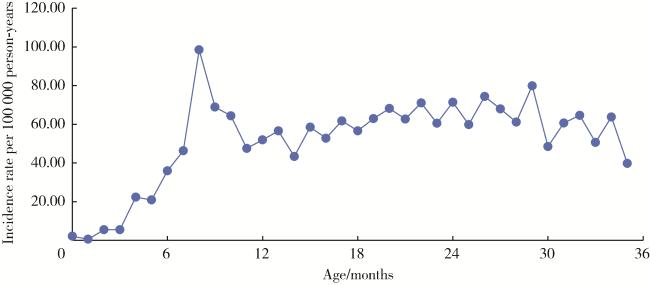
月龄分布:肠套叠的发病密度随月龄变化呈现单峰模式(图 1)。泊松回归分析提示,月龄是影响发病风险的相关因素(P<0.001),在模型拟合的线性趋势中,月龄与发病密度呈正相关,月龄每增加1个月,肠套叠的发病风险平均增加约2.9%。具体分布上,发病密度在出生后4个月起上升,在8月龄时达到峰值(98.5/10万人年),此后发病密度有波动,至3岁前降至较低水平。
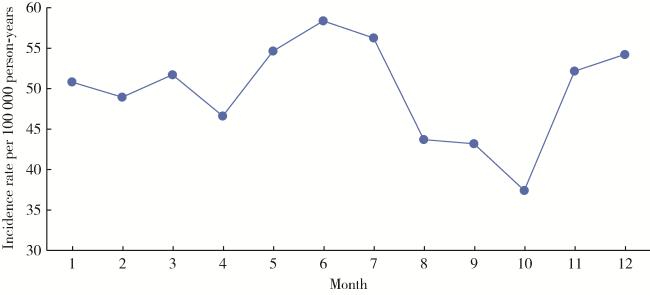
季节分布:从月份来看,肠套叠的发病密度存在季节性波动(P<0.001,图 2),呈现夏季、冬季双峰模式,6月份的发病密度达到年度高峰,为58.4/10万人年,其次是7月份(56.3/10万人年);冬季的高峰出现在12月份,发病密度为54.2/10万人年。
3 讨论
本研究基于覆盖江苏全省的大规模人群队列,系统描述了2018—2023年间江苏省0~3岁儿童肠套叠的发病特征,研究结果揭示了几个关键的流行病学特征,包括上升的年度报告发病趋势、高危人群以及发病年龄高峰。
本研究测算的总体发病密度为49.8/10万人年,处于国内外报道的中等水平。从发病率来看,国内部分地区(如湖南郴州112.9/10万[11]、济南86.5/ 10万[12]、苏州57.3/10万[13])以及一些亚洲国家(如越南296/10万[14]、日本180/10万~190/10万[15])所报道的发病率较高,而一些欧洲国家(如法国东部29.8/10万~44/10万[16]、德国60.4/10万[17]、荷兰21/10万~23/10万[18])报道的发病率与本研究接近。一项来自北美、亚洲、欧洲、大洋洲、非洲、东地中海地区以及中南美洲的82项研究综述显示,儿童肠套叠的世界平均发病率为74(9~328)/10万[19];另一项对轮状病毒疫苗接种前5岁以下儿童肠套叠发病率的综述研究显示,1岁以下儿童肠套叠住院病例的年发病率中位数从非洲的34(13~56)/10万到西太平洋地区的90(9~380)/10万不等[3],这种差异可能源于人种、地理环境和诊疗实践等因素[20-21]。值得注意的是,除真实流行病学差异外,多数比较研究是基于哨点监测数据,其结果易受医疗可及性与转诊模式的影响,难以反映人群全貌。本研究利用省级全人群数据,旨在克服此类偏倚,从而为评估该地区的疾病负担提供了更具代表性的基准。
本研究描绘了肠套叠的高危人群特征。男童的发病风险高于女童,这一现象与全球绝大多数研究结果一致,多国多中心回顾性和前瞻性研究均通过多变量分析证实,男性是肠套叠的独立危险因素,比值比(odds ratio, OR)为1.16~1.41,其背后的生物学机制可能与性别相关的解剖结构或激素水平差异有关,尚待进一步阐明[22-24]。本研究对象为0~3岁儿童,与成人在机能上有差别,成人肠套叠较为少见,多伴有器质性病变[25]。本研究发现,发病月龄高峰集中在8月龄至3岁,这与传统教科书和以往许多文献报道的肠套叠通常见于4~7个月龄婴儿有所差异[19],这一差异可能与研究人群特征、喂养方式变迁或病原体流行谱变化有关,值得进一步探究。城乡分布方面,本研究显示城市儿童的发病密度(50.7/10万人年)略高于农村儿童(45.3/10万人年),虽然泊松回归分析提示两者差异有统计学意义(P=0.046),但考虑到两者的CI存在重叠,且IRR为1.12,提示这种差异在公共卫生层面的意义可能有限。另外,本研究队列的城乡构成(城市人口83.78%)略高于统计年鉴公布的城镇人口比例(75.04%)[26],提示本研究结果可能更能反映城市化程度较高地区的发病情况。
需要说明的是,本研究未重点分析发病密度的年度变化趋势,主要归因于研究设计特征及数据平台建设初期的不完善[27]。2018年作为研究起点,纳入人群主要由当年出生的婴儿构成,导致研究初期队列的年龄结构偏向低月龄组。考虑到本组肠套叠的发病高峰集中在8月龄至3岁,研究早期的队列成员尚未充分进入高发风险窗口期。随着研究年份推移,早期出生儿童逐渐成长至1~3岁,队列年龄结构趋于完整,客观上会造成发病密度随年份自然增加,从而难以区分发病密度随时间变化的原因。此外,2018—2019年区域健康信息平台尚处于建设完善阶段,对比江苏省统计年鉴中的新生儿出生数据,队列初期覆盖率相对较低(约52%),医疗机构数据上报的规范性及诊断编码的准确性处于爬坡期,导致早期病例的捕获能力不足[28-29],到2020年后,队列覆盖率稳定在71.5%~77.5%[30]。因此,年度间数据的横向比较存在系统误差,不宜作为反映疾病流行规律的主要依据。从季节性来看,发病月份分布显示出夏季(6~7月)和冬季(12月)的双峰模式,这与肠套叠的病毒感染病因学说相符,即发病高峰可能与轮状病毒(冬季高发)和腺病毒、肠道病毒(夏秋季高发)的季节性流行相叠加有关[31]。
本研究最显著的优势在于基于大规模、全人群的真实世界数据。覆盖全省的队列最大限度地减少了选择偏倚,使得研究结果具有良好的代表性;长达6年的观察期和精确到天的随访人年计算,为准确评估疾病负担和捕捉长期趋势提供了可能;数据来源于真实世界的临床诊疗过程,避免了依赖患者回忆所带来的偏倚。
本研究也存在一些局限性,首先,作为基于区域健康信息平台的被动监测数据,本研究不可避免地存在患者漏报的情况,一方面,部分症状轻微、自行缓解的患儿,其诊疗信息无法被系统捕获;另一方面,居住在省际交界区域的患儿可能存在跨省就医现象,导致这部分发病数据流失,这些未报告的患者可能导致本研究测算的总体发病密度略低于真实的疾病发生水平;其次,本研究病例识别依赖临床医院的原始录入质量,电子病历中可能存在因医生书写不规范导致的漏诊,未来的研究可考虑在医院样本子集中开展抽样验证,以评估并校准纳入病例的准确性。
综上所述,本研究基于全省大数据明确了江苏省0~3岁儿童肠套叠的流行病学特征,总体发病密度处于中等水平,男童、8月龄至3岁的婴幼儿是本地区肠套叠发生的核心高危人群,夏季和冬季为高发季节。本研究结果为江苏省的儿科医疗资源配置和公共卫生策略制定提供了数据支持,也凸显了利用区域健康信息平台进行疾病监测的潜力与挑战。



