论著

中国育龄女性围孕期冷热暴露与先天性心脏病发病风险的关联

  • 徐慧颖 1 ,
  • 何兴侯 1 ,
  • 黄薇 , 1, * ,
  • 张彬 1 ,
  • 李梦瑶 1 ,
  • 刘家辉 1 ,
  • 方言 1 ,
  • 赵二璐 1 ,
  • 魏相睿 1 ,
  • 马旭 2 ,
  • 杨英 , 2, *
展开
  • 1. 北京大学公共卫生学院劳动卫生与环境卫生学系,北京 100191
  • 2. 国家卫生健康委科学技术研究所,北京 100081

收稿日期: 2026-01-22

  网络出版日期: 2026-04-24

基金资助

国家自然科学基金(82273589)

国家重点研发计划(2016YFC1000307)

北京市自然科学基金(7222246)

版权

版权所有,未经授权,不得转载。

Association between periconception maternal cold and heat exposure and the risk of congenital heart disease in offspring in China

  • Huiying XU 1 ,
  • Xinghou HE 1 ,
  • Wei HUANG , 1, * ,
  • Bin ZHANG 1 ,
  • Mengyao LI 1 ,
  • Jiahui LIU 1 ,
  • Yan FANG 1 ,
  • Erlu ZHAO 1 ,
  • Xiangrui WEI 1 ,
  • Xu MA 2 ,
  • Ying YANG , 2, *
Expand
  • 1. Department of Occupational and Environmental Health, Peking University School of Public Health, Beijing 100191, China
  • 2. Institute of Science and Technology, National Health Commission, Beijing 100081, China
HUANG Wei, e-mail,
YANG Ying, e-mail,

Received date: 2026-01-22

  Online published: 2026-04-24

Supported by

the National Natural Science Foundation of China(82273589)

National Key Research and Development Program of China(2016YFC1000307)

Beijing Natural Science Foundation(7222246)

Copyright

All rights reserved. Unauthorized reproduction is prohibited.

摘要

目的: 系统评估母亲在孕前3个月及孕早期冷热暴露对子代先天性心脏病发病风险的影响,并识别潜在的暴露敏感窗口及影响因素。方法: 研究对象为2014年1月1日至2020年4月21日纳入国家免费孕前优生健康检查项目队列中20~49岁有完整妊娠结局追踪的女性。气象数据来源于欧洲中期天气预报中心第五代再分析数据集,根据研究对象居住地匹配孕期温度。为反映区域热适应性,冷热暴露采用相对阈值法定义:依据气候带对研究人群进行分层,计算每位个体在特定暴露时间窗内的平均温度;热暴露定义为该温度高于其所在气候带所有个体温度分布的第90百分位数;冷暴露则定义为低于第10百分位数。采用Cox比例风险模型分析孕前3个月及孕早期冷热暴露与先天性心脏病发病风险的关联,校正母亲年龄、体重指数(body mass index, BMI)、教育水平、地理区域、受孕季节、相对湿度等混杂因素后计算风险比(hazard ratio, HR)及其95%置信区间(confidence interval, CI)。通过分层分析探讨年龄、体重指数、胎儿性别因素对冷热暴露与先天性心脏病发病风险关联的影响。结果: 共纳入6 322 635例20~49岁有完整妊娠结局追踪的女性,其子代共确诊先天性心脏病1 478例。分析显示,在孕前3个月,热暴露与子代先天性心脏病发病风险升高显著相关(HR=1.49,95%CI:1.23~1.80);而孕早期热暴露与子代先天性心脏病发病风险无显著关联。孕前3个月及孕早期的冷暴露均未发现与先天性心脏病发病风险存在显著关联(孕前3个月:HR=0.93,95%CI:0.77~1.14;孕早期:HR=0.95,95%CI:0.79~1.16)。分层分析显示,孕前3个月热暴露导致先天性心脏病发病风险在30岁及以上孕产妇(HR=2.18,95%CI:1.54~3.10)和男性胎儿(HR=1.73,95%CI:1.31~2.29)中更高;孕早期热暴露导致先天性心脏病发病风险在BMI≥24 kg/m2的孕产妇中显著升高(HR=1.86,95%CI:1.21~2.87)。结论: 孕前3个月热暴露可增加子代先天性心脏病的发病风险,该风险在30岁及以上孕产妇和男性胎儿中更高。此外,孕早期热暴露导致先天性心脏病发病风险在BMI≥24 kg/m2的孕产妇中显著升高。未发现冷暴露与先天性心脏病发病风险存在显著关联。

本文引用格式

徐慧颖 , 何兴侯 , 黄薇 , 张彬 , 李梦瑶 , 刘家辉 , 方言 , 赵二璐 , 魏相睿 , 马旭 , 杨英 . 中国育龄女性围孕期冷热暴露与先天性心脏病发病风险的关联[J]. 北京大学学报(医学版), 2026 , 58(3) : 503 -512 . DOI: 10.19723/j.issn.1671-167X.2026.03.009

Abstract

Objective: To investigate the associations between maternal exposure to cold and heat exposure during the three months before pregnancy and early pregnancy and the risk of congenital heart disease (CHD) in offspring, and to identify critical exposure windows and modifying factors. Methods: This nationwide cohort study included women aged 20-49 years with complete pregnancy outcome follow-up from the National Free Pre-pregnancy Check-ups Project (NFPCP) database between January 1, 2014 and April 21, 2020. Meteorological data from the European Centre for Medium-Range Weather Forecasts Reanalysis v5 (ERA5) dataset were linked to residential addresses. Cold and heat exposure were defined based on relative thresholds stratified by climate zone: heat and cold were defined as temperatures above the 90th percentile or below the 10th percentile, respectively, of the location-specific temperature distribution during each exposure window. Cox proportional hazards models were used to analyze the associations between cold and heat exposure during the three months before pregnancy and early pregnancy and the risk of CHD, and to calculate hazard ratios (HR) and 95% confidence intervals (CI) after adjusting for maternal age, body mass index (BMI), education level, geographical region, conception season, and relative humidity. Stratified analyses were performed to examine the effects of age, BMI, and fetal sex on the associations between cold and heat exposure and the risk of CHD. Results: A total of 6 322 635 women aged 20-49 years with complete pregnancy outcome follow-up were included, and 1 478 cases of CHD were diagnosed among their offspring. The analysis showed that heat exposure during the three months before pregnancy was significantly associated with an increased risk of CHD in offspring (HR=1.49, 95%CI: 1.23-1.80); while no significant association was found for heat exposure during early pregnancy. No significant association was observed for cold exposure during the three months before pregnancy and early pregnancy (three months before pregnancy: HR=0.93, 95%CI: 0.77-1.14; early pregnancy: HR=0.95, 95%CI: 0.79-1.16). Stratified analyses showed that the risk of CHD associated with heat exposure during the three months before pregnancy was increased in women aged ≥30 years (HR=2.18, 95%CI: 1.54-3.10) and in male fetuses (HR=1.73, 95%CI: 1.31-2.29); the risk of CHD associated with heat exposure during early pregnancy was significantly increased in women with BMI ≥24 kg/m2 (HR=1.86, 95%CI: 1.21-2.87). Conclusion: Heat exposure during the three months before pregnancy might increase the risk of congenital heart disease in offspring, and this risk was elevated in both women aged ≥30 years and male fetuses. Furthermore, heat exposure during early pregnancy significantly increased the risk of congenital heart disease in offspring among women with BMI ≥24 kg/m2. No significant association was observed between cold exposure and the risk of congenital heart disease.

在全球气候变暖背景下,冷热暴露日益频发,已成为威胁人群健康的重大公共卫生问题[1]。政府间气候变化专门委员会(Intergovernmental Panel on Climate Change,IPCC)第六次评估报告(Sixth Assessment Report, AR6)指出,全球变暖正系统性地加剧冷热暴露的发生频率与强度[2]。中国作为气候敏感区域,面临更为严峻的挑战,近百年气温升幅高于全球平均水平[3]。冷热暴露通过突破人体生理调节阈值,直接增加心血管、呼吸系统疾病等发病与死亡风险,其中老年人、孕妇等脆弱人群受影响尤为显著[4-7]
先天性心脏病(congenital heart disease, CHD)通常被定义为胚胎时期心血管发育过程中因遗传或环境因素干扰导致的血管结构、形态及代谢异常形成障碍或发育异常引起的一类心血管畸形,占所有出生缺陷的三分之一,也是导致婴幼儿死亡和长期健康损害的主要原因[8-9],其病因复杂,环境因素的作用日益受到关注。研究表明,冷热暴露可能通过诱发母体氧化应激、炎症反应、胎盘血流减少等途径,干扰胎儿心脏发育[6, 10-11]。然而,目前关于冷热暴露与CHD关联的研究仍有限且结论不一致,多数集中于热暴露,对低温影响的探讨不足,且多采用宽泛的暴露时间窗口,未能识别胚胎心脏发育过程中的关键敏感期[12-15]。因此,本研究旨在系统评估孕前3个月及孕早期(定义为从末次月经第一日起至妊娠第12周末)冷热暴露对CHD发病风险的影响,并识别易感暴露窗口,从而为制定针对性的早期预防策略提供科学依据。

1 资料与方法

1.1 研究对象与设计

本项目研究对象来源于国家免费孕前优生健康检查项目信息化网络工作平台。国家免费孕前优生健康检查项目是2010年启动的一项全国性的孕前保健服务,覆盖中国31个省份,旨在为符合生育政策并计划在未来6个月内怀孕的城乡育龄夫妇提供免费的孕前健康检查、咨询和妊娠结局跟踪,从而预防出生缺陷和不良妊娠结局发生,提高出生人口素质。本研究已获得国家卫生健康委员会机构研究审查委员会批准(批准号:IRB-201001)。所有研究对象均知晓研究内容并签署知情同意书。本研究遵循《加强流行病学观察性研究报告规范》进行报告。

1.2 数据收集

对参与该项目的6 389 566例研究对象进行标准问卷调查、体格检查以及临床实验室检查等。由经过统一培训的当地计划生育服务机构或妇幼保健机构医务工作人员对半年内有怀孕计划的参加检查的育龄妇女进行面对面访问,填写调查问卷。问卷内容包括:年龄、体重、民族、文化程度、家庭住址、吸烟、饮酒情况、孕育史、用药史等育龄期女性基本情况。由当地定点计划生育服务机构或妇幼保健院的医务工作人员对参加检查的妇女进行身高、体重等体格检查,结果上传国家免费孕前优生健康检查项目信息化网络工作平台。由经过统一培训的调查员进行电话随访,3个月1次,直至孕妇分娩。妊娠结局包括分娩日期、孕周、胎儿数目、胎儿性别和分娩方式等。
相关定义:体重指数(body mass index, BMI)的计算方法为体重(kg)/身高(m)2。根据我国卫生行业标准,体重指数<18.5 kg/m2被定义为体重过低,18.5 kg/m2≤体重指数<24.0 kg/m2被定义为体重正常,24.0 kg/m2≤体重指数<28.0 kg/m2被定义为超重,体质指数≥28 kg/m2被定义为肥胖。

1.3 纳入排除标准

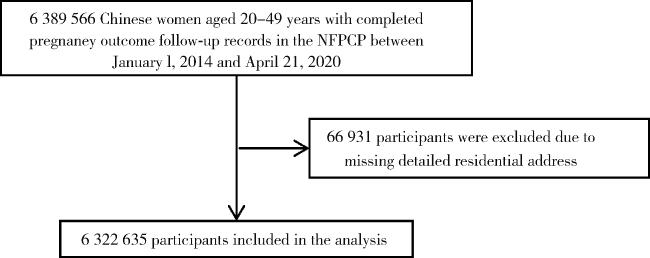
纳入标准:(1)2014年1月1日至2020年4月21日参加国家免费孕前优生健康检查项目的20~49岁计划怀孕女性;(2)2020年完成妊娠结局随访。排除标准:缺失详细居住地址。研究人群选择流程如图 1所示。
图1 研究对象筛选流程图

Figure 1 Flowchart of participant selection

NFPCP, National Free Pre-pregnancy Check-ups project.

1.4 气象数据

采用欧洲中期天气预报中心发布的第五代全球气候再分析数据集(European Centre for Medium-Range Weather Forecasts Reanalysis v5, ERA5, https://cds.climate.copernicus.eu/)。该数据集以0.25°×0.25°的高时空分辨率,整合了全球大气、海洋、陆地及冰雪系统,提供温度、湿度、风速、降水等气象要素,其全球覆盖性与长期连续性(1950年至今)支持冷热暴露的时空异质性分析,减少暴露错分偏倚。本研究提取2014年1月1日至2020年4月21日期间的小时温度、小时露点温度等气象数据,通过计算将其转化为日均温度、最高温度、最低温度、日均露点温度、日均相对湿度。根据研究对象家庭地址(精确至乡镇级)对应经纬度坐标,匹配至最近ERA5网格点,获取每位研究对象的逐日气象暴露数据。计算孕前3个月、孕早期两个妊娠时间窗的平均温度。相对湿度数值根据实际温度与露点温度使用以下公式计算:
$\begin{gathered}V P=0.611 \times e^{\left(\frac{L}{R_v} \times\left(\frac{1}{273.15}-\frac{1}{T_d}\right)\right)}, \\V P_s=0.611 \times e^{\left(\frac{L}{R_v} \times\left(\frac{1}{273.15}-\frac{1}{T_a}\right)\right)}, \\R H=\frac{V P}{V P_s} \times 100 \%, \end{gathered}$
其中,式中VP表示露点温度(Td)处的实际水汽压,VPs为实际温度(Ta)对应的平衡水汽压;L=2.501× 10⁶ J/kg,为273.15热力学温度下的汽化焓;Rv=461.52 J/(kg·K),是水蒸气的气体常数; RH是相对温度。

1.5 冷热暴露定义

由于本研究覆盖全国,为反映区域热适应性,我们根据每个暴露时间窗口内研究对象所在温度带的温度分布,将冷热暴露分为3类:热暴露组、冷暴露组和对照组。为每个温度带和每个妊娠时间窗创建了个体平均温度分布,在主要分析中,热暴露定义为温度高于第90百分位数,冷暴露定义为温度低于第10百分位数,对照组定义为温度介于第10与第90百分位数之间。为检验结果的稳健性,同时采用第85/95百分位数(热暴露)和第5/15百分位数(冷暴露)作为阈值进行敏感性分析。

1.6 统计学分析

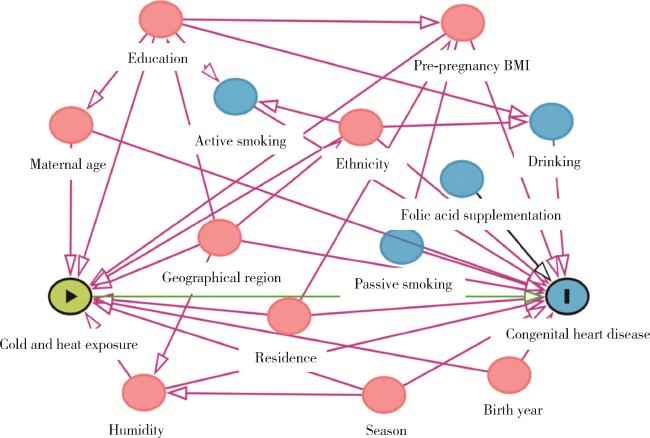
采用Cox回归定量分析冷热暴露与CHD发病风险的关联。通过绘制有向无环图确定模型的混杂因素,包括母亲年龄、孕前体重指数、教育水平、民族、地理区域、受孕季节、出生年份以及相对湿度,见图 2。在基础模型中采用自然样条平滑拟合湿度的影响,基于赤池信息量(Akaike’s information criterion, AIC)最小原则,对相对湿度采用自然立方样条进行拟合,自由度设定范围为3至10,最终确定相对湿度的自由度为4,如下所示:
$\begin{gathered}h(\mathrm{GA}, \mathrm{CHD})= \\h_0(\mathrm{GA}) \exp \left(\beta_{\mathrm{temp}_t} X_{\mathrm{temp}_t}+\beta_{d t} X_i+\beta_1 C\right), \end{gathered}$
图2 选择潜在混杂因素的有向无环图

Figure 2 Directed acyclic graph for the selection of potential confounders

BMI, body mass index.

其中,风险函数h(GA, CHD) 表示个体在特定胎龄(gestational age, GA)时发生CHD的瞬时风险率;h0(GA)为基线风险函数;βtempt为平均温度的回归系数;Xtempt为连续性变量,表示个体在时间窗口t内的平均温度;βdt为随时间变化的混杂因素的回归系数;Xi为孕期随时间变化的因素(如相对湿度等);C为孕期固定混杂因素(如母亲年龄、民族、教育水平、地理区域等);β1是固定混杂因素的回归系数。
用下列公式计算冷热暴露发生时疾病发生的风险比(hazard ratio,HR),以及对应的95%置信区间(confidence interval,CI),
$\begin{gathered}H R=\exp \left(\beta_{\text {temp}_t}\right), \\95 \% C I=\exp \left(\beta_{\text{temp}_t} \pm 1.96 S E\right), \end{gathered}$
其中,HR表示冷热暴露相对于非暴露的CHD发病的HRSE为回归系数的标准误,βtempt为平均温度的回归系数。
为探索其他因素对冷热暴露与CHD发病风险的影响,进一步采用分层分析,分别按照年龄(<30岁vs. ≥30岁)、体重指数(以BMI≥18.5~<24 kg/m2为参照,分别比较低体重<18.5 kg/m2和超重/肥胖≥24 kg/m2)和胎儿性别(男vs.女)进行分层,评估孕前3个月和孕早期冷热暴露与CHD的效应差异。采用Z检验比较各分层亚组间的效应估计值,公式如下:
$\left(\widehat{\beta_1}-\widehat{\beta_2}\right) \pm 1.96 \times \sqrt{S \widehat{E}_1^2+S \widehat{E}_2^2}, $
其中,β1β2是两个层的效应估计值,SE1SE2是各自的标准误。

2 结果

2.1 研究对象基本特征

共纳入6 322 635例育龄期妇女,其中热暴露组632 260例(10%),冷暴露组632 264例(10%),对照组5 058 111例(80%)。本研究共确诊CHD 1 478例,总新生儿数为6 350 058例(含多胎妊娠),发病率为0.023%。
孕前及孕早期温度暴露水平分组的人群特征如表 1所示。热暴露组与冷暴露组的基线特征呈现不同分布模式。与对照组相比,热暴露组具有以下特征:年龄在26~30岁之间、经产妇、拥有大学及以上教育水平、居住在城市、从事非农职业、在夏季受孕、居住在华中地区,而冷暴露组具有以下特征:年龄在25岁以下、少数民族、拥有初中及以下教育水平、居住在西北地区农村、职业为农民、规律服用叶酸、在冬季受孕、接受自然分娩。此外,热暴露组中被动吸烟和饮酒的比例均高于对照组。
表1 按孕前3个月及孕早期冷热暴露状态分组的研究对象基本特征

Table 1 Baseline characteristics of study participants stratified by cold/heat exposure status during the three months before pregnancy and the first trimester

Characteristic Total (n=6 322 635) Heat exposure group (n=632 260) Cold exposure group (n=632 264) Reference group (n=5 058 111) P value
Maternal age <0.001/<0.001
  ≤25 years 2 954 301 (46.73) 277 919 (43.96) 311 376 (49.25) 2 365 006 (46.76)
  26-30 years 2 340 674 (37.02) 245 876 (38.89) 223 325 (35.32) 1 871 473 (37.00)
  31-35 years 753 035 (11.91) 80 159 (12.68) 71 573 (11.32) 601 303 (11.89)
  36-40 years 237 627 (3.76) 24 609 (3.89) 22 264 (3.52) 190 754 (3.77)
  >40 years 36 998 (0.59) 3 697 (0.58) 3 726 (0.59) 29 575 (0.58)
Parity <0.001/<0.001
  0 3 187 438 (50.41) 310 842 (49.16) 321 770 (50.89) 2 554 826 (50.51)
  ≥1 2 710 740 (42.87) 278 429 (44.04) 273 172 (43.21) 2 159 139 (42.69)
  Missing 424 457 (6.71) 42 989 (6.80) 37 322 (5.90) 344 146 (6.80)
Ethnicity <0.001/<0.001
  Han Chinese 5 786 746 (91.52) 591 045 (93.48) 557 828 (88.23) 4 637 873 (91.69)
  Ethnic minority 368 979 (5.84) 21 064 (3.33) 60 055 (9.50) 287 860 (5.69)
  Missing 166 910 (2.64) 20 151 (3.19) 14 381 (2.27) 132 378 (2.62)
Pre-pregnancy BMI, kg/m2 <0.001/<0.001
  <18.5 836 772 (13.23) 86 856 (13.74) 78 230 (12.37) 671 686 (13.28)
  ≥18.5-<24 4 406 391 (69.69) 436 429 (69.03) 447 815 (70.83) 3 522 147 (69.63)
  ≥24-<28 835 383 (13.21) 83 607 (13.22) 82 809 (13.10) 668 967 (13.23)
  ≥28 206 453 (3.27) 20 878 (3.30) 20 345 (3.22) 165 230 (3.27)
  Missing 37 636 (0.60) 4 490 (0.71) 3 065 (0.48) 30 081 (0.59)
Education <0.001/<0.001
  Junior high school or below 3 381 720 (53.49) 311 218 (49.22) 381 363 (60.32) 2 689 139 (53.16)
  Senior high school 1 352 056 (21.38) 140 163 (22.17) 119 920 (18.97) 1 091 973 (21.59)
  College or above 1 262 756 (19.97) 138 245 (21.87) 108 629 (17.18) 1 015 882 (20.08)
  Missing 326 103 (5.16) 42 634 (6.74) 22 352 (3.54) 261 117 (5.16)
Residence <0.001/<0.001
  Rural 5 653 361 (89.41) 555 060 (87.79) 580 233 (91.77) 4 518 068 (89.32)
  Urban 667 753 (10.56) 76 839 (12.15) 51 989 (8.22) 538 925 (10.65)
  Missing 1 521 (0.02) 361 (0.06) 42 (0.01) 1 118 (0.02)
Occupation <0.001/<0.001
  Farmer 3 945 602 (62.40) 371 929 (58.83) 435 849 (68.93) 3 137 824 (62.04)
  Worker 726 121 (11.48) 73 792 (11.67) 64 321 (10.17) 588 008 (11.63)
  Other 1 273 756 (20.15) 139 527 (22.07) 104 656 (16.55) 1 029 573 (20.35)
  Missing 377 156 (5.97) 47 012 (7.44) 27 438 (4.34) 302 706 (5.98)
Smoking <0.001/<0.001
  No 6 266 975 (99.12) 625 940 (99.00) 627 715 (99.28) 5 013 320 (99.11)
  Yes 12 613 (0.20) 1 169 (0.18) 1 220 (0.19) 10 224 (0.20)
  Missing 43 047 (0.68) 5 151 (0.81) 3 329 (0.53) 34 567 (0.68)
Passive smoking <0.001/<0.001
  No 5 639 696 (89.20) 558 973 (88.41) 573 912 (90.77) 4 506 811 (89.10)
  Yes 639 714 (10.12) 68 164 (10.78) 55 031 (8.70) 516 519 (10.21)
  Missing 43 225 (0.68) 5 123 (0.81) 3 321 (0.53) 34 781 (0.69)
Drinking <0.001/<0.001
  No 6 111 037 (96.65) 608 280 (96.21) 616 308 (97.48) 4 886 449 (96.61)
  Yes 162 586 (2.57) 18 247 (2.89) 12 034 (1.90) 132 305 (2.62)
  Missing 49 012 (0.78) 5 733 (0.91) 3 922 (0.62) 39 357 (0.78)
Folic acid supplementation <0.001/<0.001
  No 1 132 478 (17.91) 114 881 (18.17) 97 806 (15.47) 919 791 (18.18)
  Regular 4 868 152 (77.00) 487 320 (77.08) 501 073 (79.25) 3 879 759 (76.70)
  Irregular 219 736 (3.48) 20 366 (3.22) 21 481 (3.40) 177 889 (3.52)
  Missing 102 269 (1.62) 9 693 (1.53) 11 904 (1.88) 80 672 (1.59)
Season of conception <0.001/<0.001
  Spring 1 834 270 (29.01) 25 875 (4.09) 60 516 (9.57) 1 747 879 (34.56)
  Summer 1 537 980 (24.32) 574 307 (90.83) 3 518 (0.56) 960 155 (18.98)
  Autumn 1 311 823 (20.75) 27 260 (4.31) 38 083 (6.02) 1 246 480 (24.64)
  Winter 1 638 562 (25.92) 4 818 (0.76) 530 147 (83.85) 1 103 597 (21.82)
Year of birth <0.001/<0.001
  2014 355 234 (5.62) 2 602 (0.41) 112 108 (17.73) 240 524 (4.76)
  2015 1 386 551 (21.93) 126 373 (19.99) 108 391 (17.14) 1 151 787 (22.77)
  2016 1 430 994 (22.63) 105 069 (16.62) 139 850 (22.12) 1 186 075 (23.45)
  2017 1 514 811 (23.96) 184 651 (29.20) 111 367 (17.61) 1 218 793 (24.10)
  2018 1 010 052 (15.98) 126 048 (19.94) 99 094 (15.67) 784 910 (15.52)
  2019 571 710 (9.04) 84 100 (13.30) 60 911 (9.63) 426 699 (8.44)
  2020 53 283 (0.84) 3 417 (0.54) 543 (0.09) 49 323 (0.98)
Neonate’s gender <0.001/<0.001
  Male 3 271 381 (51.74) 327 550 (51.81) 326 282 (51.61) 2 617 549 (51.75)
  Female 3 023 385 (47.82) 302 247 (47.80) 302 746 (47.88) 2 418 392 (47.81)
  Missing 27 869 (0.44) 2 463 (0.39) 3 236 (0.51) 22 170 (0.44)
Mode of delivery <0.001/<0.001
  Vaginal delivery 4 517 758 (71.45) 455 719 (72.08) 450 798 (71.30) 3 611 241 (71.40)
  Cesarean section 1 787 130 (28.27) 174 968 (27.67) 179 490 (28.39) 1 432 672 (28.32)
  Missing 17 747 (0.28) 1 573 (0.25) 1 976 (0.31) 14 198 (0.28)
Geographic region <0.001/<0.001
  Northern 380 976 (6.03) 29 319 (4.64) 73 873 (11.68) 277 784 (5.49)
  Northeast 73 447 (1.16) 6 514 (1.03) 8 741 (1.38) 58 192 (1.15)
  Eastern 1 563 946 (24.74) 137 595 (21.76) 186 272 (29.46) 1 240 079 (24.52)
  Central 2 335 185 (36.93) 295 028 (46.66) 133 708 (21.15) 1 906 449 (37.69)
  Southern 1 002 141 (15.85) 119 162 (18.85) 68 741 (10.87) 814 238 (16.10)
  Southwest 501 732 (7.94) 20 424 (3.23) 41 613 (6.58) 439 695 (8.69)
  Northwest 465 208 (7.36) 24 218 (3.83) 119 316 (18.87) 321 674 (6.36)
Climate zone 0.999/>0.999
  Tropic humid 1 056 022 (16.70) 105 603 (16.70) 105 603 (16.70) 844 816 (16.70)
  Subtropical humid 2 793 125 (44.18) 279 313 (44.18) 279 313 (44.18) 2 234 499 (44.18)
  Qinghai-Xizang Plateau 51 951 (0.82) 5 195 (0.82) 5 195 (0.82) 41 561 (0.82)
  Warmtemperate humid and subhumid 2 147 904 (33.97) 214 785 (33.97) 214 791 (33.97) 1 718 328 (33.97)
  Temperate humid and subhumid 129 444 (2.05) 12 945 (2.05) 12 945 (2.05) 103 554 (2.05)
  Temperate grassland 75 508 (1.19) 7 551 (1.19) 7 549 (1.19) 60 408 (1.19)
  Temperate and warmtemperate desert 68 681 (1.09) 6 868 (1.09) 6 868 (1.09) 54 945 (1.09)

All data are presented as n (%). Groups are based on mean temperature from the three months before pregnancy through early pregnancy: Heat exposure (≥90th percentile), cold exposure (≤10th percentile), and reference (between thresholds). BMI, body mass index. All P values are calculated using two-sided Chi-square tests. For each characteristic, the two P values represent comparisons of heat exposure vs. reference (first) and cold exposure vs. reference (second).

2.2 气象因素分布特征

表 2描述了研究期间研究对象孕前3个月和孕早期所在气候带的环境温度均值、第5百分位数、第10百分位数、第15百分位数、第85百分位数、第90百分位数、第95百分位数。温度在华中华南湿润亚热带地区、华北湿润半湿润地区、西北荒漠地区、东北湿润半湿润地区、内蒙古草原地区、华南湿润热带地区、青藏高原的平均水平分别为16.51 ℃、14.31 ℃、6.09 ℃、8.62 ℃、8.73 ℃、21.82 ℃、3.34 ℃。
表2 不同气候带中研究对象孕前3个月与孕早期环境温度暴露分布

Table 2 Distribution of ambient temperature exposure during the three months before pregnancy and the first trimester across climate zones

Climate zone Mean/℃ P5/℃ P10/℃ P15/℃ P85/℃ P90/℃ P95/℃
Subtropical humid 16.51 8.55 9.49 10.31 23.15 23.78 24.48
Warmtemperate humid and subhumid 14.31 4.10 5.78 6.88 22.55 23.29 23.93
Temperate and warmtemperate desert 6.09 -7.73 -6.11 -4.75 16.64 17.46 18.43
Temperate humid and subhumid 8.62 -3.41 -1.56 -0.31 18.03 19.32 21.56
Temperate grassland 8.73 -3.67 -1.57 0.15 18.22 19.19 20.20
Tropic humid 21.82 16.05 17.11 17.76 26.10 26.56 27.05
Qinghai-Xizang Plateau 3.34 -6.83 -4.89 -3.60 10.83 11.91 13.12

P5 and P10 represent the 5th and 10th percentiles, respectively.

表 3描述了研究期间研究对象孕前3个月和孕早期所在气候带的相对湿度均值、最小值、第25百分位数、中位数、第75百分位数、最大值。相对湿度在华中华南湿润亚热带地区、华北湿润半湿润地区、西北荒漠地区、东北湿润半湿润地区、内蒙草原地区、华南湿润热带地区、青藏高原的平均水平分别为75.90%、62.25%、61.92%、45.35%、45.43%、79.77%、57.54%。
表3 不同气候带中研究对象孕前3个月与孕早期环境相对湿度暴露分布

Table 3 Distribution of ambient relative humidity exposure during the three months before pregnancy and the first trimester across climate zones

Climate zone Mean/% Minimum/% P25/% Median/% P75/% Maximum/%
Subtropical humid 75.90 37.21 72.85 76.51 79.44 92.22
Warm-temperate humid and sub-humid 62.25 32.49 57.78 63.15 67.54 83.02
Temperate and warm-temperate desert 61.92 31.21 56.46 62.94 68.21 82.37
Temperate humid and sub-humid 45.35 17.06 37.68 44.41 53.00 78.69
Temperate grassland 45.43 27.54 39.19 44.55 50.79 74.52
Tropic humid 79.77 44.98 76.90 80.37 83.21 92.83
Qinghai-Xizang Plateau 57.54 22.63 49.76 57.17 64.59 91.02

P25 and P75 represent the 25th and 75th percentiles, respectively.

2.3 冷热暴露与CHD发病风险的关联

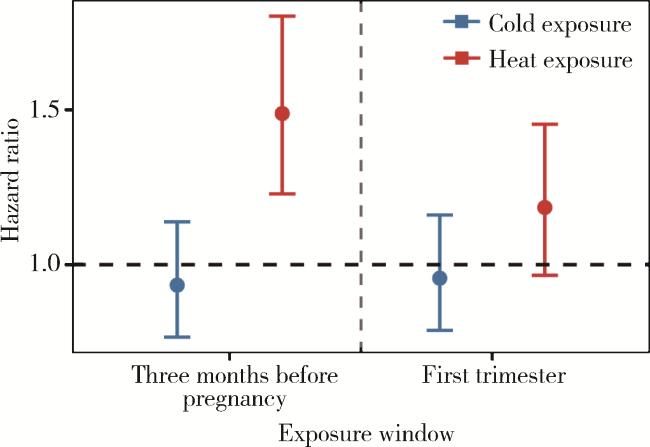
冷热暴露与CHD发病风险的关联分析显示,孕前3个月的热暴露与CHD发病风险升高显著相关(HR=1.49,95%CI:1.23~1.80),未发现冷暴露与CHD发病风险存在显著关联(HR=0.93,95%CI:0.77~1.14)。在孕早期,热暴露(HR=1.18,95%CI:0.97~1.45)和冷暴露(HR=0.95,95%CI:0.79~1.16)均未发现与CHD发病风险存在显著关联,结果见图 3
图3 母亲孕前3个月及孕早期冷热暴露与先天性心脏病发病风险的关联

Figure 3 Association of maternal cold/heat exposure during the three months before pregnancy and the first trimester with the risk of congenital heart disease in offspring

2.4 分层分析

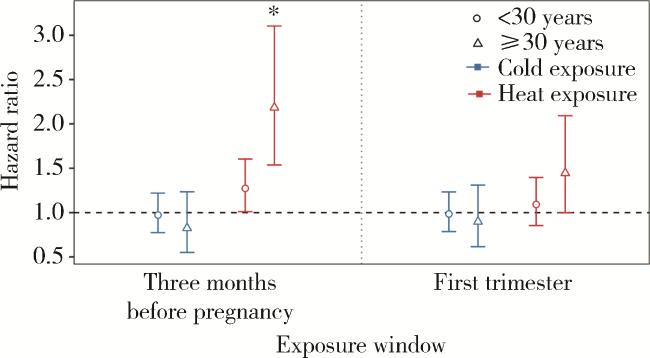
分层分析结果显示,与30岁以下孕产妇相比,30岁及以上孕产妇在孕前3个月热暴露可显著增加CHD的发病风险(HR=1.27,95%CI:1.01~1.60;HR=2.18,95%CI:1.54~3.10),组间差异有统计学意义。在孕早期,30岁及以上孕产妇热暴露与CHD发病风险存在显著关联(HR=1.45,95%CI:1.00~2.09),而30岁以下孕产妇未发现与CHD发病风险存在显著关联(HR=1.09,95%CI:0.85~1.40)。冷暴露在各年龄组均未发现与CHD发病风险存在显著关联,结果见图 4
图4 按母亲年龄分层的冷热暴露与先天性心脏病发病风险的关联

Figure 4 Association of cold/heat exposure with the risk of congenital heart disease stratified by maternal age

* P < 0.05, vs. heat exposure during the three months before pregnancy in the group aged < 30 years.

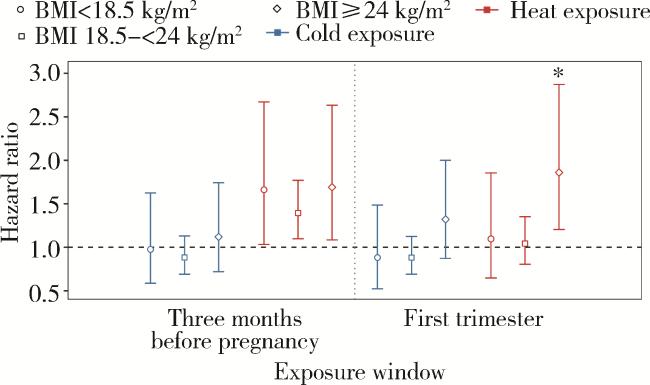
孕前3个月热暴露与CHD发病风险在正常体重组(18.5 kg/m2≤BMI<24.0 kg/m2)、低体重组(BMI<18.5 kg/m2)、超重/肥胖组(BMI≥24.0 kg/m2)中存在显著关联(HR=1.39, 95%CI: 1.10~1.77;HR=1.66, 95%CI: 1.03~2.67;HR=1.69, 95%CI: 1.09~2.63)。在孕早期,热暴露仅在超重/肥胖组中与CHD发病风险存在显著关联(HR=1.86, 95%CI: 1.21~2.87),且与体重正常组(HR=1.04, 95%CI: 0.80~1.35)相比,组间差异有统计学意义(P<0.05)。冷暴露在各BMI组均未发现与CHD发病风险存在显著关联,结果见图 5
图5 按母亲孕前体重指数分层的冷热暴露与先天性心脏病发病风险的关联

Figure 5 Association of cold/heat exposure with the risk of congenital heart disease stratified by maternal pre-pregnancy body mass index

* P < 0.05, vs. heat exposure during the first trimester in the group with BMI ≥18.5- < 24 kg/m2. BMI, body mass index.

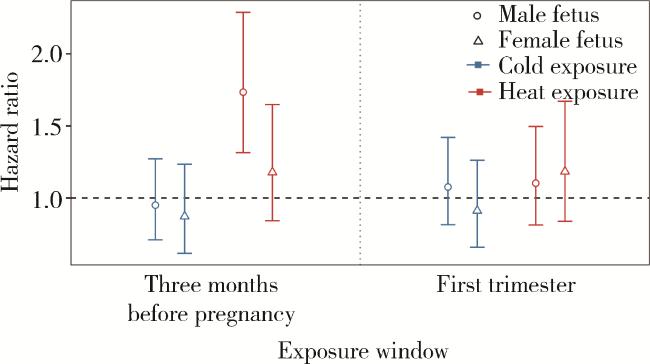
在男性胎儿组中,孕前3个月热暴露与CHD发病风险显著相关(HR=1.73,95%CI:1.31~2.29),而在孕早期热暴露与CHD发病风险未发现显著关联(HR=1.10,95%CI:0.81~1.50);在女性胎儿组中,孕前3个月和孕早期冷热暴露与CHD发病风险均未发现显著关联(P>0.05),结果见图 6
图6 按胎儿性别分层下冷热暴露与先天性心脏病发病风险的关联

Figure 6 Association of cold/heat exposure with the risk of congenital heart disease stratified by fetal sex

2.5 敏感性分析

为检验主要发现的稳健性,采用不同的相对阈值(第85百分位数及第95百分位数作为热暴露阈值,相应的第15百分位数及第5百分位数作为冷暴露阈值)重新定义冷热暴露。敏感性分析结果与主要分析一致:孕前3个月热暴露与CHD发病风险存在显著关联,孕早期热暴露及各时期冷暴露与CHD发病风险均未发现正向显著关联,见表 4
表4 基于不同相对阈值的母亲孕前3个月及孕早期冷热暴露与先天性心脏病发病风险的关联分析

Table 4 Association of maternal cold/heat exposure during the three months before pregnancy and early pregnancy with the risk of congenital heart disease risk using different relative thresholds

Exposure window Exposure threshold Exposure type HR (95%CI) P value
Three months before pregnancy P5 Cold exposure 0.91 (0.70-1.20) 0.513
Three months before pregnancy P15 Cold exposure 0.85 (0.72-1.02) 0.076
Three months before pregnancy P85 Heat exposure 1.29 (1.08-1.55) 0.006
Three months before pregnancy P95 Heat exposure 1.31 (1.03-1.69) 0.031
First trimester P5 Cold exposure 0.75 (0.56-0.99) 0.041
First trimester P15 Cold exposure 0.90 (0.75-1.07) 0.222
First trimester P85 Heat exposure 1.15 (0.96-1.38) 0.131
First trimester P95 Heat exposure 1.01 (0.76-1.34) 0.931

HR, hazard ratio; CI, confidence interval. P15 and P5 indicate cold exposure (temperature<15th or 5th percentile); P85 and P95 indicate heat exposure (temperature>85th or 95th percentile).

3 讨论

本研究基于一项覆盖全国的前瞻性队列,系统探讨了母亲孕前3个月及孕早期冷热暴露与子代CHD发病风险的关联。研究发现,孕前3个月热暴露可增加子代CHD的发病风险,其中30岁及以上孕产妇更为敏感;此外,孕早期热暴露可增加BMI≥24 kg/m2的孕产妇子代CHD发病风险。
本研究发现热暴露是子代CHD发病风险的潜在影响因素,与既往研究[10, 15]结论相一致。目前研究多聚焦于孕早期(尤其是心脏形态发生关键期,即孕3~8周)。多项研究报道孕早期热暴露与CHD某些亚型发生风险升高相关,例如,一项中国广东省人群研究发现,怀孕早期(第2~8周)环境热暴露与子代先天性心脏缺陷风险之间存在显著关联[15];一项涵盖加拿大704 209例妊娠早期胎儿的回顾性队列研究发现,妊娠2~8周时暴露于≥30 ℃的温度持续15 d,胎儿患房间隔缺损的风险显著增加(患病率比=1.37,95%CI:1.10~1.70)[10]。这些研究均将敏感窗口锁定于胚胎器官形成的经典时期,而本研究识别出“孕前3个月”这一早于传统形态发生期的关键暴露窗口。本研究主分析模型未发现孕早期热暴露与CHD风险存在显著关联,但分层分析提示在某些亚组中存在显著关联。既往报告阳性关联的研究多采用绝对阈值(如≥30 ℃)或特定热事件[10, 15],而本研究采用基于个体所在气候带的“相对百分位数阈值”,更能反映当地人群的热适应性,这可能导致暴露分类与研究间存在差异。另外,从生物学机制来看,孕早期是胚胎细胞高速增殖与分化的时期,对外界干扰极为敏感。然而,热暴露对配子(卵母细胞)质量、表观遗传编程或早期母胎免疫微环境的不利影响,其效应可能在孕前即已启动,并在器官形成期得以显现[16]。因此,孕早期暴露的直接影响,可能在一定程度上被孕前暴露的长期效应所掩盖。
热暴露干扰心脏发育的具体机制尚未完全阐明,但综合现有动物实验及部分人体研究,其潜在通路可归纳如下:首先,热暴露可诱发母体热应激反应,导致氧化应激损伤、炎症反应激活及代谢功能紊乱,进而影响胎盘血流灌注与营养输送功能[6];其次,热暴露可能通过引发热休克反应,调控热休克蛋白的表达模式,干扰正常蛋白质的转录与翻译,加速细胞凋亡,从而破坏胎儿器官发育所需的微环境稳态[11, 17];此外,动物实验表明,热暴露还可能诱发母体及胎儿缺氧,进而影响心脏祖细胞的增殖与分化,干扰心脏发育[18]。这些机制共同构成温度影响出生结局的生物学基础,为解释孕前及孕早期热暴露与CHD的关联提供了重要的生物学依据。
此外,本研究中未观察到冷暴露与CHD风险存在显著关联。一项全国性多中心研究发现,在胚胎心脏发育的关键期(孕3~8周)冷暴露,与特定的复杂CHD亚型(如法洛四联症、肺动脉狭窄等)风险升高显著相关,且人群归因分数可达2以上,提示冷暴露的影响可能具有强烈的亚型特异性[19]。因此,本研究将CHD作为整体结局进行分析,未能观察到其与特定亚型的显著关联。
在分层分析中,本研究年龄分层显示,30岁及以上孕产妇的风险显著升高。这一结果提示,30岁及以上妊娠可能是热暴露导致胎儿CHD风险升高的影响因素。30岁及以上妊娠伴随的卵巢功能减退、线粒体功能障碍及氧化应激水平升高等生理改变,可能与外源性热应激产生叠加效应,从而放大其对生殖细胞的负面影响[20]。同样,本研究体重指数分层分析显示,孕产妇BMI≥24 kg/m2时,其子代发生CHD的风险更高。这与近期大规模人群研究结果一致,例如,芬兰一项基于超过62万新生儿的研究显示,母亲肥胖是子代发生复杂先天性心脏缺陷的独立危险因素(OR=2.70,95%CI:1.14~6.43)[21]。本研究中,孕前热暴露与子代CHD风险的关联在男性胎儿中更为显著。这一性别差异与既往流行病学观察相一致:多种CHD亚型在男性中的发病率均高于女性[22-23]。上述发现提示,热暴露的健康效应受孕产妇年龄、体重指数及胎儿性别的多重影响。因此,在制定相关气候健康适应策略时,应特别关注30岁及以上和BMI≥24 kg/m2的计划怀孕妇女等脆弱人群。
本研究的主要优势在于大规模队列、前瞻性设计、高分辨率气象数据匹配以及针对多个潜在混杂因素的严格校正。然而,仍存在若干局限性:(1)本研究采用的冷热暴露评估基于高分辨率网格气象数据,反映的是个体居住地周边的室外环境温度,未能获取个体实际活动模式、室内环境温度以及空调使用情况等信息。近年来,随着公共及家庭场所空调普及率的大幅提高,人群实际暴露水平可能显著低于室外气象数据所反映的水平,由此可能导致暴露错分,并可能在一定程度上低估冷热暴露的真实健康效应。(2)CHD病例在不同地区的诊断水平可能存在差异,且本研究数据来源于医院上报系统,该系统未提供CHD亚型分类及相应的国际疾病分类编码信息,因此,无法进行亚型特异性分析,可能掩盖了温度暴露与特定CHD亚型之间的关联。(3)由于CHD为罕见结局(总检出率约0.02%),为保留足够的统计效能,本研究未排除多胎妊娠。多胎妊娠仅记录了第一胎的性别,导致胎儿性别分层分析主要基于单胎妊娠。考虑到多胎比例极低,约占总人群的0.6%(36 854/6 322 635),故该局限性对整体结论的影响可能较小。
综上所述,本研究在全国性队列中发现,母亲孕前3个月热暴露可增加子代CHD的发病风险,该风险在30岁及以上孕产妇和男性胎儿中升高。此外,孕早期热暴露导致CHD发病风险在BMI≥24 kg/m2的孕产妇中显著升高。未发现冷暴露与CHD发病风险存在显著关联。

利益冲突  所有作者均声明不存在利益冲突。

作者贡献声明  徐慧颖:统计分析,撰写论文;何兴侯:研究设计,统计分析;张彬、李梦瑶、刘家辉、方言:整理数据;赵二璐、魏相睿:统计分析;黄薇、马旭、杨英:提出研究思路,研究设计,总体把关和审定论文。所有作者均参与论文修改,并对最终文稿进行审读和确认。

1
Climate change exacerbates almost two-thirds of pathogenic diseases affecting humans[J]. Nat Clim Chang, 2022, 12(9): 791-792.

2
Intergovernmental Panel on Climate Change. Climate change 2021: The physical science basis: Working group Ⅰ contribution to the IPCC sixth assessment report[R/OL]. (2021-08-09)[2025-12-06]. https://www.ipcc.ch/report/ar6/wg1.

3
丁一汇, 任国玉, 石广玉, 等. 气候变化国家评估报告(Ⅰ): 中国气候变化的历史和未来趋势[J]. 气候变化研究进展, 2006, 2 (1): 3- 8.

4
Fitzgerald EF , Pantea C , Lin S . Cold spells and the risk of hospitalization for asthma: New York, USA 1991-2006[J]. Lung, 2014, 192 (6): 947- 954.

DOI

5
Kenny GP , Yardley J , Brown C , et al. Heat stress in older individuals and patients with common chronic diseases[J]. CMAJ, 2010, 182 (10): 1053- 1060.

DOI

6
Lakhoo DP , Brink N , Radebe L , et al. A systematic review and meta-analysis of heat exposure impacts on maternal, fetal and neonatal health[J]. Nat Med, 2025, 31 (2): 684- 694.

DOI

7
Lee W , Choi HM , Lee JY , et al. Temporal changes in mortality impacts of heat wave and cold spell in Korea and Japan[J]. Environ Int, 2018, 116, 136- 146.

DOI

8
Kodo K , Uchida K , Yamagishi H . Genetic and cellular interaction during cardiovascular development implicated in congenital heart diseases[J]. Front Cardiovasc Med, 2021, 8, 653244.

DOI

9
Roth GA , Mensah GA , Johnson CO , et al. Global burden of cardiovascular diseases and risk factors, 1990-2019: Update from the GBD 2019 study[J]. J Am Coll Cardiol, 2020, 76 (25): 2982- 3021.

DOI

10
Auger N , Fraser WD , Sauve R , et al. Risk of congenital heart defects after ambient heat exposure early in pregnancy[J]. Environ Health Perspect, 2017, 125 (1): 8- 14.

DOI

11
欧向阳, 丁锦丽, 杨哲, 等. HSP70在早期胚胎发育中作用的研究进展[J]. 中华生殖与避孕杂志, 2024, 44 (11): 1196- 1199.

12
Agay-Shay K , Friger M , Linn S , et al. Ambient temperature and congenital heart defects[J]. Hum Reprod, 2013, 28 (8): 2289- 2297.

13
Judge CM , Chasan-Taber L , Gensburg L , et al. Physical exposures during pregnancy and congenital cardiovascular malformations[J]. Paediatr Perinat Epidemiol, 2004, 18 (5): 352- 360.

DOI

14
Tikkanen J , Heinonen OP . Maternal hyperthermia during pregnancy and cardiovascular malformations in the offspring[J]. Eur J Epidemiol, 1991, 7 (6): 628- 635.

15
Yu X , Miao H , Zeng Q , et al. Associations between ambient heat exposure early in pregnancy and risk of congenital heart defects: A large population-based study[J]. Environ Sci Pollut Res Int, 2022, 29 (5): 7627- 7638.

DOI

16
Ding G , Chen B , McCarrey JR , et al. The epigenetic mechanisms underlying gamete origin of adult-onset diseases[J]. Sci Bull, 2022, 67 (17): 1724- 1727.

DOI

17
Samuels L , Nakstad B , Roos N , et al. Physiological mechanisms of the impact of heat during pregnancy and the clinical implications: Review of the evidence from an expert group meeting[J]. Int J Biometeorol, 2022, 66 (8): 1505- 1513.

18
Meng X , Zhang P , Zhang L . Fetal hypoxia impacts on proliferation and differentiation of Sca-1+ cardiac progenitor cells and maturation of cardiomyocytes: A role of microRNA-210[J]. Genes (Basel), 2020, 11 (3): 328.

19
Guo J , Ruan Y , Wang Y , et al. Maternal exposure to extreme cold events and risk of congenital heart defects: A large multicenter study in China[J]. Environ Sci Technol, 2024, 58 (8): 3737- 3746.

20
Cimadomo D , Fabozzi G , Vaiarelli A , et al. Impact of maternal age on oocyte and embryo competence[J]. Front Endocrinol, 2018, 9, 327.

DOI

21
Turunen R , Pulakka A , Metsälä J , et al. Maternal diabetes and overweight and congenital heart defects in offspring[J]. JAMA Netw Open, 2024, 7 (1): e2350579.

22
Conlon FL , Arnold AP . Sex chromosome mechanisms in cardiac development and disease[J]. Nat Cardiovasc Res, 2023, 2 (4): 340- 350.

23
Pugnaloni F , Felici A , Corno AF , et al. Gender differences in congenital heart defects: A narrative review[J]. Transl Pediatr, 2023, 12 (9): 1753- 1764.

文章导航

/