论著

5年以上长期生存肾透明细胞癌伴静脉瘤栓患者的临床病理特征及预后因素

  • 杜志明 1, * ,
  • 张纬亮 1, * ,
  • 赵磊 1 ,
  • 邱敏 1 ,
  • 马潞林 1 ,
  • 颜野 1 ,
  • 贺慧颖 2 ,
  • 谢睿扬 , 1, * ,
  • 张树栋 , 1, *
展开
  • 1. 北京大学第三医院泌尿外科,北京 100191
  • 2. 北京大学第三医院病理科,北京 100191

*These authors contributed equally to this work

收稿日期: 2026-02-25

  网络出版日期: 2026-06-05

基金资助

北京市自然科学基金(7254443)

国家自然科学基金(82504235)

版权

版权所有,未经授权,不得转载。

Clinicopathological features and prognostic factors associated with long-term survival (≥5 years) in patients with clear cell renal cell carcinoma and venous tumor thrombus

  • Zhiming DU 1 ,
  • Weiliang ZHANG 1 ,
  • Lei ZHAO 1 ,
  • Min QIU 1 ,
  • Lulin MA 1 ,
  • Ye YAN 1 ,
  • Huiying HE 2 ,
  • Ruiyang XIE , 1, * ,
  • Shudong ZHANG , 1, *
Expand
  • 1. Department of Urology, Peking University Third Hospital, Beijing 100191, China
  • 2. Department of Pathology, Peking University Third Hospital, Beijing 100191, China
XIE Ruiyang, e-mail,
ZHANG Shudong, e-mail,

Received date: 2026-02-25

  Online published: 2026-06-05

Supported by

Beijing Municipal Natural Science Foundation(7254443)

National Natural Science Foundation of China(82504235)

Copyright

All rights reserved. Unauthorized reproduction is prohibited.

摘要

目的: 分析接受手术治疗的肾透明细胞癌(clear cell renal cell carcinoma,ccRCC)伴静脉瘤栓(venous tumor thrombus,VTT)长期生存患者的临床病理特征,并探究除肿瘤生物学特征外的潜在影响因素,特别关注个体炎症及营养指标。方法: 回顾性分析2014—2019年于北京大学第三医院接受根治性肾切除术联合瘤栓取出术的ccRCC伴VTT患者,将患者分为长期生存组(总生存期≥60个月)和非长期生存组(总生存期 < 60个月),比较两组患者的临床特征(年龄、性别、体重指数、Mayo分级)、病理特征(T分期、M分期、组织学分级、肉瘤样变、肾周脂肪侵犯)、围术期指标(手术方式、手术时间、术中失血量、并发症)及实验室指标(血小板计数、白蛋白水平、中性粒细胞计数等)的差异。年龄、体重指数、血小板计数、白蛋白水平的最佳截断值采用X-tile软件基于最小P值原则确定。在长期生存组内进一步采用Kaplan-Meier生存分析及Log-rank检验,评估上述指标与远期生存的相关性。结果: 397例ccRCC伴VTT患者中有13.9%实现了长期生存。长期生存组(n=55)和非长期生存组(n=342)在基线血小板计数(P=0.040)、病理T分期(P=0.001)、组织学分级(P=0.006)、手术方式(P < 0.001),以及是否接受系统治疗(P=0.028)和治疗时机(P=0.003)、治疗方案(P < 0.001)方面差异均有统计学意义。在T分期方面,长期生存组中pT3a期肿瘤的比例显著高于非长期生存组(63.6% vs. 42.4%),而pT4期肿瘤的比例显著低于非长期生存组(10.9% vs. 33.0%)。长期生存组中低级别肿瘤(G1/G2)的比例也更高(50.9% vs. 31.9%)。在手术方式方面,长期生存组以腹腔镜手术为主(35/55,63.6%),而非长期生存组的手术方式分布更为均衡,包括开放手术102例(29.8%)、腹腔镜手术123例(36.0%)和机器人手术117例(34.2%)。在系统治疗方面,长期生存组有26例(47.3%)患者接受了系统治疗,且全部为术后辅助治疗(100.0%),而非长期生存组有215例(62.9%)患者接受了系统治疗,其中160例(74.4%)接受了术后辅助治疗,55例(25.6%)为术前新辅助治疗;长期生存组以靶向单药治疗为主(25/26,96.2%),而非长期生存组中靶向治疗联合免疫治疗的比例更高(64/215,29.8%)。长期生存组的中位随访时间为81.7个月,对该组的进一步亚组分析表明,年龄 < 70岁(P=0.038)、体重指数≥18.5 kg/m2 (P=0.032)、血小板计数159×109/L~273×109/L(P=0.003)及白蛋白>41.4 g/L(P=0.028)与更好的远期生存显著相关,而瘤栓Mayo分级与远期生存无显著相关性(P=0.250)。结论: ccRCC伴VTT患者中存在一定比例长期生存者。除肿瘤病理分期和分级外,个体炎症及营养状态可能是影响其长期生存的相关因素,探索与长期生存相关的预后因素有助于进一步优化高危患者风险分层及治疗策略。

本文引用格式

杜志明 , 张纬亮 , 赵磊 , 邱敏 , 马潞林 , 颜野 , 贺慧颖 , 谢睿扬 , 张树栋 . 5年以上长期生存肾透明细胞癌伴静脉瘤栓患者的临床病理特征及预后因素[J]. 北京大学学报(医学版), 2026 , 58(4) : 692 -699 . DOI: 10.19723/j.issn.1671-167X.2026.04.003

Abstract

Objective: To characterize the clinicopathological features of long-term survivors among patients with clear cell renal cell carcinoma (ccRCC) and venous tumor thrombus (VTT) who underwent surgical treatment, and to explore potential prognostic factors beyond tumor-related variables, with particular emphasis on host-related inflammatory and nutritional indicators. Methods: The patients with ccRCC and VTT who underwent radical nephrectomy combined with tumor thrombectomy at Peking University Third Hospital between 2014 and 2019 were retrospectively analyzed. The patients were stratified into a long-term survival group (overall survival ≥60 months) and a non-long-term survival group (overall survival < 60 months). The following parameters were compared between the two groups: clinical characteristics (age, sex, body mass index, Mayo classification), pathological features (T stage, M stage, histological grade, sarcomatoid change, perirenal fat invasion), perioperative parameters (surgical approach, operative time, intraoperative blood loss, complications), and laboratory parameters (platelet count, albumin, neutrophil count, etc.). Optimal cutoff values for continuous variables, such as age, body mass index (BMI), platelet count and serum albumin level, were determined using X-tile software based on the minimum P-value principle. Subsequently, Kaplan-Meier survival analysis with Log-rank test was performed within the long-term survival cohort to evaluate the association of the above-mentioned factors with long-term survival. Results: Long-term survival was achieved in 13.9% of 397 patients with ccRCC and VTT. Significant differences were observed between the long-term survival group (n=55) and the non-long-term survival group (n=342) in baseline platelet count (P=0.040), pathological T stage (P=0.001), histological grade (P=0.006), surgical approach (P < 0.001), as well as receipt of systemic therapy (P=0.028), treatment timing (P=0.003), and treatment regimen (P < 0.001). Regarding T stage, the long-term survival group had a significantly higher proportion of pT3a tumors (63.6% vs. 42.4%) and a significantly lower proportion of pT4 tumors (10.9% vs. 33.0%) compared with the non-long-term survival group. The long-term survival group also had a higher proportion of low-grade tumors (G1/G2: 50.9% vs. 31.9%). Regarding surgical approach, laparoscopic surgery predominated in the long-term survival group (35/55, 63.6%), whereas the non-long-term survival group had a more balanced distribution, including open surgery (102/342, 29.8%), laparoscopic surgery (123/342, 36.0%), and robotic surgery (117/342, 34.2%). Regarding systemic therapy, in the long-term survival group, 26 patients (47.3%) received systemic therapy, all of whom (100.0%) received adjuvant therapy. In the non-long-term survival group, 215 patients (62.9%) received systemic therapy, of whom 160 (74.4%) received adjuvant therapy and 55 (25.6%) received neoadjuvant therapy. Regarding treatment regimen, the long-term survival group was predominantly treated with targeted monotherapy (25/26, 96.2%), whereas the non-long-term survival group had a higher proportion of targeted therapy plus immunotherapy combination (64/215, 29.8%). The median follow-up time for the long-term survival group was 81.7 months. Further subgroup analysis of this group showed that age < 70 years (P=0.038), BMI≥18.5 kg/m2 (P=0.032), platelet count 159×109/L-273×109/L (P=0.003), and albumin level >41.4 g/L (P=0.028) were significantly associated with better long-term survival, whereas Mayo classification of tumor thrombus showed no significant association with long-term survival (P=0.250). Conclusion: A subset of patients with ccRCC and VTT can achieve long-term survival. Beyond pathological tumor stage and grade, patient-related inflammatory and nutritional status may be associated with long-term survival. Exploring prognostic factors related to long-term survival may help further optimize risk stratification and treatment strategies for high-risk patients.

肾细胞癌(renal cell carcinoma,RCC)是原发于肾脏的恶性肿瘤,其中70%~80%为肾透明细胞癌[1](clear cell renal cell carcinoma,ccRCC)。因早期症状隐匿且缺少生物学标志物,有4%~10%的RC C患者在初诊时已伴有静脉瘤栓(venous tumor thrombus,VTT)[2]。Mayo分级是VTT预后生存的分层因素,也是手术策略制定的依据,Blute等[3]发现VTT长度与5年总生存期(overall survival,OS)呈负相关,且可能与围术期风险相关。另外,因VTT与静脉血流的直接作用,可能是血管栓塞的潜在来源[4],从而增加围术期死亡率。目前,ccRCC伴VTT的标准治疗策略是根治性肾切除联合VTT取出术,但即使接受了根治性手术,患者总体预后仍然不良。既往研究报道伴下腔静脉VTT的RCC患者术后5年肿瘤特异性生存率仅为40%~65%,远低于无瘤栓患者[2],但也有部分ccRCC伴VTT患者能实现术后5年以上长期生存,针对该部分患者,目前尚缺乏相关预后因素的研究。
围术期炎症反应标志物及全身营养状态与多种恶性肿瘤的生存预后相关[5-6],关于这些指标在ccRCC伴VTT的长期生存患者中的分布特征及预后价值少有报道。基于此,本研究通过回顾性分析接受手术治疗的ccRCC伴VTT患者的临床资料,旨在比较长期生存(OS≥60个月)与非长期生存(OS < 60个月)患者的临床和病理特征差异,并进一步在长期生存组内探讨影响远期生存的潜在预后因素,重点关注除肿瘤分期和分级外的患者相关因素(如炎症及营养指标),以期进一步完善ccRCC伴VTT患者的风险分层,为临床医生识别潜在长期获益人群及制定个体化随访和治疗策略提供循证依据。

1 资料与方法

1.1 研究对象与病例筛选

回顾性纳入2014—2019年于北京大学第三医院泌尿外科接受根治性肾切除联合VTT取出术的ccRCC伴VTT的患者。纳入标准:(1)术前影像学检查(增强CT/MRI)或术中发现伴有VTT(累及肾静脉或下腔静脉);(2)术后病理确诊为ccRCC;(3)临床病理资料及随访资料完整。根据OS将纳入患者分为长期生存组(OS≥60个月)和非长期生存组(OS < 60个月)。
本研究已经通过北京大学第三医院医学科学研究伦理委员会审批(审批号:S20250365),因本研究为回顾性研究,故豁免患者知情同意。

1.2 资料收集

通过电子病历系统收集以下资料:(1)患者的基线特征:年龄、性别、体重指数(body mass index,BMI);(2)术前4周内的实验室检测结果:血小板计数、血红蛋白、中性粒细胞绝对值、白蛋白、血肌酐;(3)手术方式:开放手术、腹腔镜手术、机器人辅助腹腔镜手术;(4)瘤栓Mayo分级:根据影像学及术中所见分为0级(VTT位于肾静脉内)、Ⅰ级(VTT位于下腔静脉,瘤栓顶端距肾静脉开口≤2 cm)、Ⅱ级(VTT位于肝下下腔静脉)、Ⅲ级(VTT位于肝内下腔静脉)、Ⅳ级(VTT位于心房内);(5)手术指标:手术时间、术中估计失血量、Clavien-Dindo并发症分级;(6)系统治疗情况:既往是否接受过系统治疗(靶向治疗、免疫治疗)及系统治疗的时机和方案。

1.3 病理资料

由一名从事泌尿病理专业的病理科医师审阅切片,并记录以下指标:(1)肿瘤特征:肿瘤最大径、肿瘤侧别(左/右);(2)病理分期:按照美国癌症联合委员会(American Joint Committee on Cancer,AJCC)第8版TNM分期系统进行分期;(3)组织学分级:采用世界卫生组织(World Health Organization,WHO)/国际泌尿病理学会(International Society of Urological Pathology,ISUP)核分级系统(G1~G4);(4)其他病理特征:是否合并肉瘤样变、肾周脂肪侵犯。

1.4 随访

采用门诊复查结合电话随访的方式进行随访。随访起始时间为手术日期,随访截止日期为2025年9月30日。随访频率为:术后前2年每3个月1次,术后2~5年每6个月1次,5年后每年1次。随访内容主要包括体格检查、实验室检查、胸部CT、腹部增强CT/MRI等。OS为从手术日期至因任何原因死亡日期或最后1次随访日期之间的时间间隔。

1.5 亚组分析相关因素及分组依据

为进一步探讨影响ccRCC伴VTT患者长期生存的潜在因素,本研究对长期生存组患者进一步行Kaplan-Meier亚组生存分析。分组指标包括:年龄、性别、BMI、手术方式、肿瘤侧别、是否接受系统治疗、辅助靶向治疗(M0)、T分期、M分期、组织学分级、Mayo分级、肉瘤样变、肾周脂肪侵犯、围术期并发症、血小板计数、白蛋白水平。采用X-tile 3.6.1软件并基于最小P值原则确定最佳截断值[7]:年龄为70岁,BMI为18.5 kg/m2,基线白蛋白为41.4 g/L,基线血小板计数的两个截断值分别为159×109/L和273×109/L,据此将患者分为低、正常和高血小板亚组。其余指标按临床常规标准分组。

1.6 统计学分析方法

使用SPSS 23.0和GraphPad Prism 8.0.2软件进行统计分析。分类变量采用例数(%)描述,组间比较采用卡方检验;本研究中的连续变量均不符合正态分布,用中位数(P25P75) 描述,组间比较采用Mann-Whitney U检验。生存分析使用Kaplan-Meier法与Log-rank检验。P < 0.05为差异有统计学意义。

2 结果

2.1 ccRCC伴VTT患者的临床及病理资料

2014年1月至2019年12月于我院接受根治性肾切除术联合VTT取出术的ccRCC伴VTT的患者共467例,根据纳入标准,最终397例患者纳入本研究,包括长期生存组55例(13.85%)和非长期生存组342例(86.15%),两组患者的临床及病理特征见表 1表 2
表1 长期和非长期生存ccRCC伴VTT患者临床特征比较

Table 1 Comparison of clinical characteristics between the long-term and the non-long-term survival ccRCC patients with VTT

Items OS≥60 months (n=55) OS < 60 months (n=342) P value
Age/years, M (P25, P75) 59 (54, 65) 61 (55, 68) 0.290
Sex, n(%) 0.400
  Male 43 (78.2) 249 (72.8)
  Female 12 (21.8) 93 (27.2)
BMI/(kg/m2), M (P25, P75) 23 (21, 27) 24 (22, 27) 0.230
Surgical approach, n(%) < 0.001
  Open surgery 20 (36.4) 102 (29.8)
  Laparoscopic surgery 35 (63.6) 123 (36.0)
  Robotic surgery 0 (0) 117 (34.2)
Systemic therapy, n(%) 0.028
  Yes 26 (47.3) 215 (62.9)
  No 29 (52.7) 127 (37.1)
M stage at diagnosis, n(%) 0.060
  M0 45 (81.8) 238 (69.6)
  M1 10 (18.2) 104 (30.4)
Mayo classification, n(%) 0.370
  0 15 (27.3) 90 (26.3)
  Ⅰ 15 (27.3) 51 (14.9)
  Ⅱ 17 (30.8) 152 (44.4)
  Ⅲ 4 (7.3) 24 (7.0)
  Ⅳ 4 (7.3) 25 (7.3)
Intraoperative blood loss/mL, M (P25, P75) 400 (120, 1 300) 500 (200, 1 200) 0.660
Operative time/min, M (P25, P75) 251 (187, 363) 266 (195, 366) 0.800
Perioperative complications, n(%) 0.180
  Yes 13 (23.6) 110 (32.2)
  No 42 (76.4) 232 (67.8)
Clavien-Dindo grade of complications, n(%) 0.890
  0 42 (76.4) 232 (67.8)
  Ⅰ 3 (5.5) 22 (6.4)
  Ⅱ 9 (16.4) 74 (21.6)
  Ⅲ 0 (0) 4 (1.2)
  Ⅳ 1 (1.8) 8 (2.3)
  Ⅴ 0 (0) 2 (0.6)
Laboratory parameters, M (P25, P75)
  Preoperative serum creatinine/(μmol/L) 76 (88, 110) 91 (76, 107) 0.820
  Serum creatinine at 1 week postoperatively/(μmol/L) 86 (106, 117) 100 (83, 121) 0.760
  Baseline hemoglobin/(g/L) 115 (127, 142) 124 (106, 140) 0.150
  Baseline platelet count/(×109/L) 172 (203, 259) 240 (186, 309) 0.040
  Baseline neutrophil count/(×109/L) 4.4 (3.3, 5.2) 4.5 (3.4, 5.5) 0.430
  Baseline albumin/(g/L) 40 (35, 43) 40 (36, 43) 0.680

ccRCC, clear cell renal cell carcinoma; VTT, venous tumor thrombus; OS, overall survival; BMI, body mass index.

表2 长期和非长期生存ccRCC伴VTT患者的病理特征比较

Table 2 Comparison of pathological characteristics between the long-term and the non-long-term survival ccRCC patients with VTT

Items OS≥60 months (n=55) OS < 60 months (n=342) P value
Side, n(%) 0.440
  Left 17 (30.9) 124 (36.3)
  Right 38 (69.1) 218 (63.7)
pT stage, n(%) 0.001
  pT3a 35 (63.6) 145 (42.4)
  pT3b 11 (20.0) 44 (12.9)
  pT3c 3 (5.5) 40 (11.7)
  pT4 6 (10.9) 113 (33.0)
pN stage, n(%) 0.070
  pN0 55 (100.0) 323 (94.4)
  pN1 0 (0) 19 (5.6)
Histopathological grade, n(%) 0.006
  G1/G2 28 (50.9) 109 (31.9)
  G3/G4 27 (49.1) 233 (68.1)
Median tumor diameter/cm, M (P25, P75) 8.3 (6.4, 10.0) 8.4 (6.3, 10.3) 0.810
Sarcomatoid change, n(%) 0.810
  Yes 8 (14.5) 54 (15.8)
  No 47 (85.5) 288 (84.2)
Perinephric fat invasion, n(%) 0.190
  Yes 12 (21.8) 104 (30.4)
  No 43 (78.2) 238 (69.6)

ccRCC, clear cell renal cell carcinoma; VTT, venous tumor thrombus; OS, overall survival.

长期和非长期生存组间术前各项实验室检查指标中仅血小板计数差异有统计学意义(P=0.040)。手术方式方面,长期生存组腹腔镜手术占比最高(35例,63.6%),其次为开放手术(20例,36.4%),无机器人手术病例;而非长期生存组腹腔镜手术123例(36.0%)、开放手术102例(29.8%)、机器人手术117例(34.2%),两组间差异有统计学意义(P < 0.001)。
长期和非长期生存组患者接受系统治疗的比例差异有统计学意义(47.3% vs. 62.9%,P=0.028,表 3)。在治疗时机选择方面,长期生存组中接受系统治疗的26例患者全部为术后辅助治疗,而非长期生存组中有74.4%(160/215)的患者接受了术后辅助治疗,25.6% (55/215)的患者接受了术前新辅助治疗,两组间差异有统计学意义(P=0.003)。在治疗方案方面,长期生存组以单药靶向治疗为主(96.2%),仅1例(3.8%)患者接受了靶向治疗联合免疫治疗;非长期生存组有150例(69.8%)接受单药靶向治疗,1例(0.4%)接受单药免疫治疗,64例(29.8%)接受靶向治疗联合免疫治疗,两组间差异有统计学意义(P < 0.001)。
表3 接受系统治疗的长期和非长期生存ccRCC伴VTT患者治疗时机及方案比较

Table 3 Comparison of treatment timing and regimen between the long-term and the non-long-term survival ccRCC patients with VTT receiving systemic therapy

Items Receiving systemic therapy (n=241) P value
OS≥60 months (n=26) OS < 60 months (n=215)
Treatment timing, n(%) 0.003
  Adjuvant systemic therapy 26 (100.0) 160 (74.4)
  Neoadjuvant systemic therapy 0 (0) 55 (25.6)
Treatment regimen, n(%) < 0.001
  Targeted therapy (TKI monotherapy) 25 (96.2) 150 (69.8)
  Immunotherapy (PD-1/PD-L1 monotherapy) 0 (0) 1 (0.4)
  Targeted therapy plus immunotherapy combination 1 (3.8) 64 (29.8)

ccRCC, clear cell renal cell carcinoma; VTT, venous tumor thrombus; OS, overall survival; TKI, tyrosine kinase inhibitor; PD-1, programmed cell death protein-1; PD-L1, programmed cell death-ligand 1.

在pT分期方面,长期生存组中pT3a、pT3b、pT3c和pT4期患者分别有35例(63.6%)、11例(20.0%)、3例(5.5%)和6例(10.9%),而非长期生存组中相应分期分别为145例(42.4%)、44例(12.9%)、40例(11.7%)和113例(33.0%),两组间差异有统计学意义(P=0.001)。在组织学分级方面,长期生存组低级别肿瘤(G1/2)占比显著高于非长期生存组,两组间差异有统计学意义(50.9% vs. 31.9%,P=0.006)。

2.2 ccRCC伴VTT长期生存患者的临床病理特征及预后因素

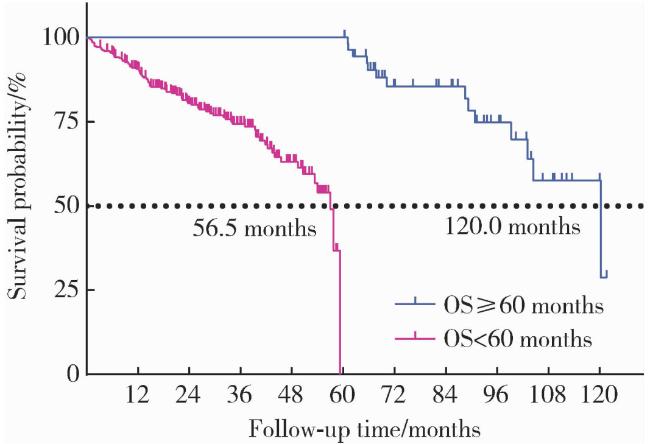
长期生存组的中位随访时间为81.7个月(61.0~ 121.6个月)。Kaplan-Meier生存曲线分析表明,长期生存组的总生存率显著高于非长期生存组(图 1)。
图1 长期和非长期生存ccRCC伴VTT患者的总生存期

Figure 1 Overall survival of long-term and non-long-term

ccRCC, clear cell renal cell carcinoma; VTT, venous tumor thrombus; OS, overall survival.

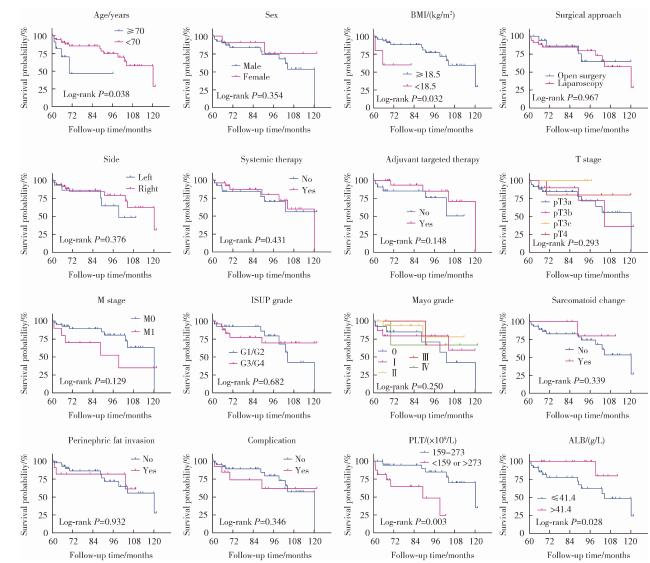
为探讨影响长期生存患者远期预后的潜在因素,本研究进一步将长期生存组患者分为若干亚组进行Kaplan-Meier生存分析(图 2)。结果表明,年龄 < 70岁、BMI≥18.5 kg/m2、白蛋白水平>41.4 g/L和血小板计数159×109/L~273×109/L均与更好的预后显著相关(Log-rank检验,P=0.038,P=0.032,P=0.028,P=0.003),而性别、手术方式、侧别、系统治疗、靶向辅助治疗、T分期、M分期、组织学分级、瘤栓Mayo分级、肉瘤样变、肾周脂肪侵犯、围术期并发症与远期生存的关系均未见明显统计学相关性(均P>0.05),其中,瘤栓Mayo分级的Log-rank检验P值为0.250。
图2 ccRCC伴VTT长期生存组(≥60个月)患者的总生存期及相关危险因素

Figure 2 Overall survival and related risk factors in long-term survival ccRCC patients with VTT (≥60 months)

ccRCC, clear cell renal cell carcinoma; VTT, venous tumor thrombus; BMI, body mass index; ISUP, International Society of Urological Pathology; PLT, platelet; ALB, albumin.

3 讨论

本研究通过对397例接受手术治疗的ccRCC伴VTT患者的病历资料进行回顾分析,发现55例患者实现了5年以上长期生存。长期生存患者的肿瘤生物学特征表现为较低的肿瘤分期(pT3a为主)和较好的组织学分化(G1/G2比例更高),且接受系统治疗的比例更高。另外,对长期生存组进一步的亚组分析表明,肿瘤患者相关因素,包括年龄、BMI、基线血小板计数、白蛋白水平,均与远期生存显著相关,而瘤栓的Mayo分级与远期生存未见明显相关性。
ccRCC伴VTT通常被视为局部进展期疾病,远期生存不佳。既往文献报道RCC伴VTT的5年总生存率约为22%~47%[2, 8]。长期生存组患者肿瘤多表现为相对惰性的生物学行为,pT3a期占比高达64%,而pT4期仅为11%,G1/G2占比为51%,显著高于非长期生存组。这一结果与既往研究一致,即肿瘤的生物学特征是影响肿瘤预后的基础[9-10];即便伴发VTT,若肿瘤分化较好,患者仍有获得长期生存的可能。
在手术方式方面,本研究显示长期生存组患者接受腹腔镜手术比例更高(63.6% vs. 36.0%),而机器人手术仅出现在非长期生存组,我们认为这一分布特征更可能反映了两组患者在接受手术治疗时间上的差异,并不能说明上述两种手术方式的优劣,因为机器人手术用于瘤栓领域较腹腔镜技术更晚,且通常用于瘤栓分级更高、解剖更加复杂、手术难度更大的病例[11],因此,关于接受机器人手术患者的生存情况仍需长期随访进行验证。在系统治疗方面,本研究发现非长期生存组的系统治疗率高于长期生存组(62.9% vs. 47.3%),且靶向治疗联合免疫治疗的比例更高(29.8% vs. 3.8%),这一结果可能与治疗选择偏倚相关,即临床医生倾向于为肿瘤负荷更大、分期更晚、复发风险更高的患者进行更为积极的系统治疗。另外,长期生存组中接受系统治疗的26例患者均为术后辅助治疗,这与当前循证医学证据一致——S-TRAC研究和KEYNOTE-564研究分别证实,舒尼替尼和帕博利珠单抗辅助治疗可显著改善高危ccRCC患者的无病生存期[12-13],且帕博利珠单抗可改善患者OS[14]。然而,本研究两组患者在治疗时机分布上的差异也可能受到入组时间和临床决策模式的影响,不能简单归因于辅助治疗优于新辅助治疗。在治疗方案选择方面,长期生存组以靶向单药治疗为主(96.2%),而靶向治疗联合免疫治疗的比例极低(3.8%),这一分布特征的差异也与本研究收集病例的时间有关,本研究回顾的是2014—2019年行手术治疗的患者,此期间靶向治疗仍是转移性肾癌的一线治疗方案。因此,靶向治疗联合免疫治疗在非长期生存组中的高比例(29.8%)可能反映了该组患者更晚的入组时间和更差的预后特征,而不能单一归因为免疫治疗本身导致预后不良。
血小板作为反映全身炎症反应的重要指标,其与肿瘤预后的关系已被学者们广泛研究。活化的血小板可通过释放转化生长因子-β、血小板源性生长因子等促进肿瘤血管生成及免疫逃逸,进而促进肿瘤进展[15]。Attawettayanon等[16]的研究表明,血小板是RCC术后的预后标志物,且较高的血小板/淋巴细胞比值与较好的OS显著相关。本研究发现过高或过低的血小板水平均与不良预后显著相关,过高的血小板水平可促进高凝状态及炎症反应,而过低的血小板水平则可能提示围术期出血与营养不良[17]。目前的研究多关注血小板计数增高对RCC预后的影响,Takahara等[18]对252例转移性RCC患者的研究发现,高血小板计数是国际转移性肾细胞癌数据库联盟(the International Metastatic Renal Cell Carcinoma Database Consortium,IMDC)中危组OS的独立预测因素(P=0.048);但低血小板计数与RCC预后的关系少有报道,还有待进一步研究。白蛋白是反映全身营养状态的指标,低白蛋白血症不仅与营养储备不足相关,且与全身炎症反应相关[19-20]。本研究中,高白蛋白亚组患者的远期生存时间显著优于低白蛋白组患者,说明良好的营养储备有助于抑制炎症反应,从而保障远期预后[21]。此外,BMI≥18.5 kg/m2与更好的远期生存相关,在部分肿瘤患者中,较高的BMI患者预后优于较低的患者[22],可能的解释是较高的BMI提供了较好的能量储备,使患者能够更好地耐受手术及术后治疗。但需要注意的是,过高的BMI也会增加心脑血管并发症的风险,因此,对于围术期能量补充仍需谨慎。
尽管本研究中Mayo分级在长期生存组中并未显示出远期生存获益,但我们认为这一阴性结果有着重要的临床意义。Mayo分级反映了瘤栓在腔静脉内的纵向高度,与手术难度及围术期风险密切相关。对于成功接受手术治疗且存活超过5年的患者而言,瘤栓的初始高度可能并不是影响其远期生存的主要因素,相比之下,肿瘤的生物学特性和患者的全身状态在这一阶段发挥着更加重要的作用[23-24]。对于临床医生而言,在长期随访管理中应更加关注患者的全身状态,而非仅仅关注初始的解剖学指标。
本研究存在以下局限性:第一,作为回顾性单中心研究,不可避免存在选择偏倚和信息偏倚,本中心收治患者多为局部晚期病例,术后管理及系统治疗方案遵循本中心诊疗规范,与其他中心可能存在差异,故结论外推需谨慎。第二,长期生存组样本量有限(n=55),可能影响部分因素统计效能的检出,尤其是Mayo分级等阴性结果需谨慎解读,由于可能存在假阴性,不能因此阴性结果而否定Mayo分级用于预后判断的价值,尚需在更大样本量的多中心研究中进一步验证。第三,由于接受系统治疗的患者数量有限,且治疗方式存在异质性,本研究未对术后系统治疗的具体方案进行亚组分析,无法评估不同治疗方案的优劣,有待在前瞻性研究中进一步探讨。第四,年龄、BMI、血小板和白蛋白的截断值基于本研究数据确定,但受限于样本量,确定的截断值可能存在过拟合风险,因此,该截断值需进一步在大样本临床研究中验证其普适性。
综上所述,ccRCC伴VTT患者术后辅以相关治疗仍有可能实现5年以上长期生存。除肿瘤特征外,个体炎症及营养状态可能是影响其长期生存的相关因素。整合肿瘤因素及患者因素有助于未来进一步细化风险分层及个体化治疗管理。

利益冲突  所有作者均声明不存在利益冲突。

作者贡献声明  张树栋、谢睿扬:提出研究思路;赵磊,邱敏,颜野:设计研究方案;张玮亮:收集、分析、整理数据;杜志明:撰写论文;张树栋,马潞林、谢睿扬、贺慧颖:总体把关和审定论文。所有作者均参与论文修改,并对最终文稿进行审读和确认。

1
Tumkur Sitaram R , Landström M , Roos G , et al. Significance of PI3K signalling pathway in clear cell renal cell carcinoma in relation to VHL and HIF status[J]. J Clin Pathol, 2021, 74 (4): 216- 222.

DOI

2
Martínez-Salamanca JI , Huang WC , Millán I , et al. Prognostic impact of the 2009 UICC/AJCC TNM staging system for renal cell carcinoma with venous extension[J]. Eur Urol, 2011, 59 (1): 120- 127.

DOI

3
Blute ML , Leibovich BC , Lohse CM , et al. The Mayo Clinic experience with surgical management, complications and outcome for patients with renal cell carcinoma and venous tumour thrombus[J]. BJU Int, 2004, 94 (1): 33- 41.

DOI

4
Barashi NS , Friedman D , Shiang A , et al. Growth kinetics of venous tumor thrombus in patients with renal cell carcinoma[J]. Urol Oncol, 2024, 42 (2): 31.e17- 31.e23.

DOI

5
Hu B , Yang XR , Xu Y , et al. Systemic immune-inflammation index predicts prognosis of patients after curative resection for hepatocellular carcinoma[J]. Clin Cancer Res, 2014, 20 (23): 6212- 6222.

DOI

6
Gupta D , LIS CG . Pretreatment serum albumin as a predictor of cancer survival: A systematic review of the epidemiological literature[J]. Nutr J, 2010, 9 (1): 69.

DOI

7
Qu N , Shi RL , Luo TX , et al. Prognostic significance and optimal cutoff of age in medullary thyroid cancer[J]. Oncotarget, 2016, 7 (13): 15937- 15947.

DOI

8
Hirono M , Kobayashi M , Tsushima T , et al. Impacts of clinicopathologic and operative factors on short-term and long-term survi-val in renal cell carcinoma with venous tumor thrombus extension: A multi-institutional retrospective study in Japan[J]. BMC Cancer, 2013, 13 (1): 447.

DOI

9
Chang TW , Cheng WM , Fan YH , et al. Predictive factors for disease recurrence in patients with locally advanced renal cell carcinoma treated with curative surgery[J]. J Chin Med Assoc, 2021, 84 (4): 405- 409.

DOI

10
Baboudjian M , Gondran-Tellier B , Khene Z , et al. Predictive factors of recurrence after surgery in patients with non-metastatic renal cell carcinoma with venous tumor thrombus (UroCCR-56 Study)[J]. World J Urol, 2023, 41 (2): 295- 302.

11
Masic S , Smaldone MC . Robotic renal surgery for renal cell carcinoma with inferior vena cava thrombus[J]. Transl Androl Urol, 2021, 10 (5): 2195- 2198.

DOI

12
Motzer RJ , Ravaud A , Patard JJ , et al. Adjuvant sunitinib for high-risk renal cell carcinoma after nephrectomy: Subgroup analyses and updated overall survival results[J]. Eur Urol, 2018, 73 (1): 62- 68.

DOI

13
Bedke J , Abu Ghanem Y , Albiges L , et al. Updated European association of urology guidelines on the use of adjuvant immune checkpoint inhibitors and subsequent therapy for renal cell carcinoma[J]. Eur Urol, 2025, 87 (4): 491- 496.

DOI

14
Choueiri TK , Tomczak P , Park SH , et al. Adjuvant pembroli-zumab after nephrectomy in renal-cell carcinoma[J]. N Engl J Med, 2021, 385 (8): 683- 694.

DOI

15
Gan J , Zhang X , Guo J . The role of platelets in tumor immune evasion and metastasis: Mechanisms and therapeutic implications[J]. Cancer Cell Int, 2025, 25 (1): 258.

DOI

16
Attawettayanon W , Choorit T , Chalieopanyarwong V , et al. Significance of preoperative hematologic scoring in predicting death among patients with non-metastatic renal cell carcinoma undergoing nephrectomy[J]. Asian J Surg, 2021, 44 (7): 952- 956.

DOI

17
Xu J , Chen P , Cao S , et al. Prognostic value of systemic immune-inflammation index in patients with metastatic renal cell carcinoma treated with systemic therapy: A meta-analysis[J]. Front Oncol, 2024, 14, 1404753.

DOI

18
Takahara K , Ando R , Kanao K , et al. Prognostic stratification of the IMDC intermediate risk group after treatment with first-line molecular-targeted therapy for metastatic renal cell carcinoma[J]. Anticancer Res, 2020, 40 (8): 4395- 4400.

DOI

19
Li S , Zhang W , Yang Z , et al. Systemic inflammation score as a novel prognostic indicator for patients undergoing video-assisted thoracoscopic surgery lobectomy for non-small-cell lung cancer[J]. J Invest Surg, 2021, 34 (4): 428- 440.

DOI

20
Zhang B , Ren W , Yang T , et al. Nomograms based on SIRI for predicting postoperative survival outcomes in patients with non-metastatic clear cell renal cell carcinoma[J]. BMC Surg, 2025, 25 (1): 593.

DOI

21
Tamagawa H , Aoyama T , Numata M , et al. Prognostic significance of the preoperative C-reactive protein-to-albumin ratio in patients with colorectal cancer[J]. J Cancer Res Ther, 2021, 17 (4): 1075- 1080.

DOI

22
Tsutsumi T , Komura K , Hashimoto T , et al. Distinct effect of body mass index by sex as a prognostic factor in localized renal cell carcinoma treated with nephrectomy~data from a multi-institutional study in Japan~[J]. BMC Cancer, 2021, 21 (1): 201.

DOI

23
Onal B , Simsekoglu MF , Gultekin MH , et al. Clinical outcomes of radical surgery in patients with renal carcinoma and associated venous thrombosis: Single-centre experience in a tertiary care institution[J]. Int J Clin Pract, 2021, 75 (4): e13811.

24
Chen Z , Yang F , Ge L , et al. Outcomes of renal cell carcinoma with associated venous tumor thrombus: Experience from a large cohort and short time span in a single center[J]. BMC Cancer, 2021, 21 (1): 766.

DOI

文章导航

/