论著

原发灶手术对比放射治疗在寡转移前列腺癌中的疗效:倾向评分匹配研究

  • 苏丹丹 1, * ,
  • 李百顺 1, 2, * ,
  • 肖若陶 1 ,
  • 张帆 , 1, * ,
  • 张树栋 , 1, *
展开
  • 1. 北京大学第三医院泌尿外科, 北京 100191
  • 2. 西双版纳傣族自治州人民医院, 云南西双版纳傣族自治州 666100

* These authors contributed equally to this work

收稿日期: 2026-03-02

  网络出版日期: 2026-05-25

基金资助

国家自然科学基金(82072828)

北京大学第三医院临床重点项目

版权

版权所有,未经授权,不得转载。

Comparison of clinical outcomes between radical prostatectomy and permanent prostate brachytherapy in patients with oligometastatic prostate cancer: A propensity score-matched study

  • Dandan SU 1 ,
  • Baishun LI 1, 2 ,
  • Ruotao XIAO 1 ,
  • Fan ZHANG , 1, * ,
  • Shudong ZHANG , 1, *
Expand
  • 1. Department of Urology, Peking University Third Hospital, Beijing 100191, China
  • 2. People's Hospital of Xishuangbanna Dai Autonomous Prefecture, Xishuangbanna Dai Autonomous Prefecture 666100, Yunnan, China
ZHANG Fan, e-mail,
ZHANG Shudong, e-mail,

Received date: 2026-03-02

  Online published: 2026-05-25

Supported by

the National Natural Science Foundation of China(82072828)

the Key Clinical Projects of Peking University Third Hospital

Copyright

All rights reserved. Unauthorized reproduction is prohibited.

摘要

目的: 比较根治性前列腺切除术(radical prostatectomy,RP)与永久性前列腺近距离放疗(permanent prostate brachytherapy,PPB)在接受规律雄激素剥夺治疗(androgen deprivation therapy,ADT)的寡转移前列腺癌(oligometastatic prostate cancer,omPCa)患者中延缓进展至去势抵抗性前列腺癌(castration-resistant prostate cancer,CRPC)时间的差异。方法: 连续选择2011年4月至2019年8月于北京大学第三医院诊治的88例omPCa患者(转移灶≤ 5个)的病例资料进行回顾性分析,分为RP组(62例)和PPB组(26例),所有患者术后均接受规律ADT治疗。采用倾向性评分匹配法(propensity score matching,PSM)对年龄、前列腺特异性抗原(prostate-specific antigen,PSA)水平、肿瘤T分期、肿瘤N分期等变量进行1 ∶ 1匹配,均衡基线差异。主要终点为发生CRPC。采用Kaplan-Meier法和Log-rank检验比较生存差异,Cox比例风险模型分析独立危险因素。结果: PSM前两组患者在年龄、PSA及肿瘤N分期上差异有统计学意义(P均 < 0.05),PSM后成功匹配36例患者(每组18例),基线特征达到良好均衡(所有协变量SMD < 0.1)。全组中位随访时间30.5个月,共观察到15例患者发生CRPC(PPB组8例,RP组7例)。匹配前后结果一致,RP组无CRPC生存期均显著长于PPB组(匹配前HR=3.38,95%CI:1.10~10.40,P=0.033;匹配后HR=4.60,95%CI:1.14~18.49,P=0.032);PPB组中位无CRPC生存期为80.0个月,RP组尚未达到。多因素Cox回归分析显示,调整T、N分期后,治疗方式是影响CR PC转化的独立预后因素(PPB vs. RP, HR=8.56,95%CI:1.51~48.64,P=0.015)。临床T分期T3期及以上亦是独立危险因素(HR=10.29,95% CI:1.75~60.57,P=0.010)。结论: 在接受ADT的omPCa患者中,RP较PPB更能显著延缓CRPC转化,且治疗方式是发生CRPC的独立预后因素,提示选择局部治疗方式时需考量其对疾病远期进程的影响,以便为个体化治疗提供循证依据。

本文引用格式

苏丹丹 , 李百顺 , 肖若陶 , 张帆 , 张树栋 . 原发灶手术对比放射治疗在寡转移前列腺癌中的疗效:倾向评分匹配研究[J]. 北京大学学报(医学版), 2026 , 58(4) : 787 -793 . DOI: 10.19723/j.issn.1671-167X.2026.04.015

Abstract

Objective: To compare radical prostatectomy (RP) versus permanent prostate brachytherapy (PPB) as primary local treatment modalities in delaying disease progression to castration-resistant prostate cancer (CRPC) among patients with oligometastatic prostate cancer (omPCa) receiving standard androgen deprivation therapy (ADT), and to provide clinical evidence for individualized treatment strategies. Methods: We performed a retrospective cohort analysis of 88 patients diagnosed with omPCa (defined as ≤5 metastatic lesions) at a single tertiary center between April 2011 and August 2019. All the patients, after receiving either RP (n=62) or PPB (n=26), were placed on a regimen of continuous ADT. To address significant baseline disparities-notably in patient age, presenting prostate-specific antigen (PSA) levels, and nodal disease burden: A 1 ∶ 1 propensity score matching (PSM) protocol was implemented. Matching variables included age at diagnosis, baseline PSA, clinical T stage (≤T2c vs. ≥ T3), and nodal status (N0 vs. N1). The primary study endpoint was the time interval from ADT initiation to CRPC development, as defined by the prostate cancer working group 3 (PCWG3) criteria. Survival outcomes were compared using Kaplan-Meier curves and the Log-rank test. Independent risk factors for progression were identified through both univariate and multivariate Cox proportional hazards regression analyses. Results: Prior to PSM, the RP and PPB groups exhibited significant differences in key prognostic factors: the PPB group was older (mean 73.2 vs. 68.1 years, P=0.002), had a higher median PSA (31.2 vs. 9.8 μg/L, P=0.002), and had a greater incidence of lymph node involvement (42.3% vs. 12.9%, P=0.006). Following PSM, a balanced cohort of 36 patients (18 in each group) was achieved. Over a median follow-up of 30.5 months (range: 3.2 to 113.4 months), 15 patients (17.0%) developed CRPC, with 8 events occurring in the PPB group and 7 in the RP group. Survival analysis demonstrated a consistent, statistically significant advantage for RP. In the pre-matched cohort, the RP group showed a significantly delayed progression to CRPC (Log-rank P=0.033, HR=3.38, 95%CI: 1.10-10.40), with a median CRPC-free survival of 80.0 months for PPB and not reached for RP. In the matched cohort, the survival advantage of RP was more pronounced (Log-rank P=0.032, HR=4.60, 95%CI: 1.14-18.49), with a median CRPC-free survival of 80.0 months for PPB and not reached for RP. Multivariate Cox regression, adjusting for T and N stages, confirmed treatment modality as a powerful independent predictor. Patients treated with PPB faced an 8.56-fold higher risk of progression compared with those treated with RP (HR=8.56, 95%CI: 1.51-48.64, P=0.015). Advanced primary tumor stage (≥T3) was also identified as a significant independent risk factor (HR=10.29, 95%CI: 1.75-60.57, P=0.010). Conclusion: For patients with omPCa receiving ADT, the choice of local therapeutic intervention significantly impacts the time to CRPC. Radical prostatectomy is associated with a markedly longer delay in disease progression to the castration-resistant state compared with permanent prostate brachytherapy, with the treatment modality itself serving as a strong independent prognostic factor. These findings underscore the importance of considering the type of local therapy in the multimodal management of omPCa and provide a rationale for individualized treatment planning. Prospective, randomized trials are necessary to validate these observations and further define optimal therapeutic paradigms.

前列腺癌(prostate cancer,PCa)是男性高发的恶性肿瘤[1],其中寡转移性前列腺癌(oligometastatic prostate cancer, omPCa)是介于局限性和广泛转移之间的中间或过渡状态,以转移灶数量有限(通常≤ 5个)和特定部位为特征,相较于广泛转移,此阶段可能仍存在潜在的根治机会[2]。针对寡转移灶的定向治疗(metastasis-directed therapy, MDT)联合短期雄激素剥夺治疗(androgen deprivation therapy,ADT)已被证实可延长omPCa患者无进展生存期,并在部分患者中实现长期疾病控制[3]。在此背景下,对原发灶实施积极局部治疗联合系统治疗正成为优化omPCa管理的重要方向[4]。根治性前列腺切除术(radical prostatectomy, RP)通过手术切除原发肿瘤,其技术可行性在严格筛选的omPCa患者中已获初步验证[4-5];永久性前列腺近距离放疗(permanent prostate brachytherapy, PPB)作为微创手段,在局限性高危前列腺癌中显示出良好的肿瘤控制效果。两种方式可能通过不同生物学机制影响系统治疗的持久性。然而,现有证据多集中于转移灶的控制或单一局部治疗模式[6],尚缺乏这两种原发灶局部治疗策略在规律雄激素剥夺治疗背景下对疾病进展影响的直接比较。去势抵抗性前列腺癌(castration-resistant prostate cancer, CRPC)的出现是疾病进展的关键节点,与患者预后显著相关[7],延缓其发生成为优化治疗策略的重要目标。尽管前列腺特异性膜抗原正电子发射断层扫描(prostate- specific membrane antigen positron emission tomography/ computed tomography,PSMA PET/CT)等新型影像技术提升了寡转移分层能力[8],但目前关于局部治疗方式选择对CRPC转化时间的影响仍缺乏高级别循证依据[9]。本研究旨在比较初治寡转移前列腺癌患者在接受规律雄激素剥夺治疗的基础上,接受RP或PPB后延缓进展至去势抵抗性前列腺癌的时间差异,以期为omPCa患者个体化综合治疗策略的选择提供临床依据。

1 资料与方法

1.1 临床资料

连续选择2011年4月至2019年8月北京大学第三医院泌尿外科诊治的88例寡转移性前列腺癌(转移灶数目≤5处)患者的病例资料进行回顾性分析。纳入标准:(1)年龄18~85岁;(2)经前列腺穿刺活检或术后病理确诊为前列腺癌;(3)全身骨扫描或PET-CT提示存在≤5个骨转移灶,且无其他部位转移;(4)针对原发灶接受过根治性前列腺切除术或前列腺癌放射性粒子植入术;(5)规律内分泌治疗。排除标准:(1)存在骨转移灶以外的其他部位的转移灶;(2)合并其他恶性肿瘤;(3)治疗期间接受过除ADT以外的其他全身性治疗(如化学治疗、免疫治疗等);(4)缺少完整的临床病理资料。
根据初始局部治疗方式,将患者分为RP组(62例)和PPB组(26例)。患者的影像学分期方式包括全身骨扫描+盆腔CT、18F-NaF PET/CT,其中PPB组和RP组的PET/CT检查率分别为23.1%(6/26)和21.0%(13/62)。需注意的是,PSMA PET/CT在北京大学第三医院于2017年后才开始应用,本研究中未常规使用。不同影像学方法对转移灶检出率的差异是潜在偏倚来源。RP组病理数据来源于术后标本,PPB组病理数据来源于诊断时经直肠/经会阴穿刺活检标本。本研究开始前已经北京大学第三医院医学科学研究伦理委员会审查批准(M2022002),所有研究程序均符合《赫尔辛基宣言》的要求。

1.2 患者治疗及随访

将患者依据初始局部治疗方式分为根治性前列腺切除术组(RP组,62例)与永久性前列腺近距离放疗组(PPB组,26例)。RP组患者均接受腹腔镜根治性前列腺切除术,手术时间为(205±50) min,预估出血量为(125±98) mL,无术中输血患者;盆腔淋巴结清扫比例为75.8%,其中标准清扫占67.7%,扩大清扫占8.1%。PPB组患者接受永久性前列腺近距离放疗,使用放射性粒子(如125I),处方剂量及植入技术遵循标准化流程。
所有患者在局部治疗后4周内接受ADT治疗,ADT方案为药物去势(使用促性腺激素释放激素激动剂,包括亮丙瑞林、戈舍瑞林或曲普瑞林)联合抗雄治疗(口服比卡鲁胺)。主要观察终点为患者进展为去势抵抗性前列腺癌,其定义参照前列腺癌临床试验工作组(Prostate Cancer Clinical Trials Working Group)的第三版共识标准,即在血清睾酮 < 50 ng/dL的去势状态下,前列腺特异性抗原(prostate specific antigen,PSA)水平较最低值升高≥ 25%且绝对增幅≥ 2 μg/L,并经连续两次测量确认。所有患者均被随访至疾病进展、死亡或研究截止日期。为保证能观察到足够的终点事件,本研究要求存活且未发生CRPC的患者最低随访时间为12个月。全组中位随访时间为30.5个月(3.2~113.4个月)。

1.3 倾向性评分匹配

本研究采用倾向性评分匹配法均衡组间基线差异,使用R软件MatchIt包,以治疗分组为结果变量,年龄、PSA、T分期分组、N分期分组为协变量,通过逻辑回归模型计算倾向评分。随后,采用不放回的最近邻匹配法进行1 ∶ 1匹配,卡钳值设定为0.25。匹配后采用标准化均差评估平衡性,所有协变量SMD < 0.1,表明匹配后组间可比性好,可进行后续疗效比较分析。

1.4 统计学分析

本研究使用R软件(版本4.5.2)和GraphPad Prism(版本9.5.0)进行统计分析与绘图。符合正态分布的计量资料以${\bar x}$ ±s表示,组间比较采用t检验;非正态分布的计量资料或等级资料以M(P25P75)表示,采用Wilcoxon秩和检验。计数资料以n(%)表示,组间比较采用卡方检验或Fisher精确检验。生存分析数据采用Kaplan-Meier法,并用Log-rank(Mantel-Cox)及Breslow(Generalized Wilcoxon)法比较组间生存差异。采用单因素及多因素Cox回归分析两组患者CRPC进展的危险因素。双侧检验,P < 0.05认为差异有统计学意义。

2 结果

2.1 倾向性评分匹配结果

在倾向性评分匹配前,共纳入88例寡转移前列腺癌患者,其中PPB组26例(29.5%),RP组62例(70.5%);经1 ∶ 1匹配后,最终纳入36例患者,RP组与PPB组各18例,两组患者的基线特征得到显著改善并趋于均衡。所有协变量在匹配后的标准化均数差绝对值均 < 0.1,实现了统计学上的良好平衡,表明匹配成功地构建了可比性显著优于原始队列的研究分组(图 1)。
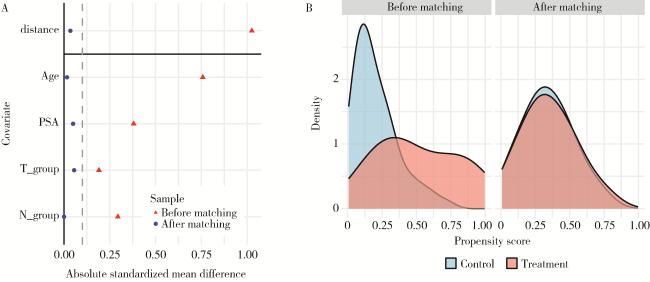
图1 倾向性评分匹配质量诊断图

Figure 1 Propensity score matching quality diagnostic plot

A, love plot (for covariate balance); B, propensity score distribution; PSA, prostate specific antigen.

匹配前,两组患者在诊断年龄、PSA水平及淋巴结转移状态(N分期)等关键基线特征上差异有统计学意义(P均 < 0.05)。所有基线特征,包括Gleason评分、T分期、美国国立综合癌症网络(National Comprehensive Cancer Network,NCCN)危险度分层[20],以及转移灶情况等,均达到良好平衡(P均>0.05),表明匹配后队列具有可比性,适于后续疗效分析(表 1)。
表1 匹配前后基线特征

Table 1 Baseline characteristics before and after matching

Characteristic Before matching After matching
PPB (n=26) RP (n=62) P PPB (n=18) RP (n=18) P
Age at PCa diagnosis, ±s 73.19±6.75 68.08±6.53 0.002* 71.94±7.12 71.28±4.42 0.684
PSA at PCa diagnosis/(μg/L), M(P25, P75) 31.2 (7.3, 61.5) 9.8 (6.6, 23.0) 0.002* 28.1 (8.0, 37.9) 14.0 (7.9, 24.1) 0.192
Gleason score, n (%) 0.725 0.477
  ≤ 7 9 (34.6) 31 (50.0) 7 (38.9) 9 (50.0)
  8-10 8 (30.8) 31 (50.0) 6 (33.3) 9 (50.0)
  Unknown 9 (34.6) 0 5 (27.8) 0
Clinical T stage, n (%) 0.061 >0.999
  ≤ 2c 23 (88.5) 43 (69.4) 15 (83.3) 16 (88.9)
  > 2c 3 (11.5) 19 (30.6) 3 (16.7) 2 (11.1)
N stage, n (%) 0.006* >0.999
  N0 15 (57.7) 54 (87.1) 14 (77.8) 15 (83.3)
  N1 11 (42.3) 8 (12.9) 4 (22.2) 3 (16.7)
NCCN risk stratification, n (%) 0.543 >0.999
  Low-risk 0 1 (1.6) >0.999
  Medium-risk 17 (65.4) 30 (48.4) 5 (27.8) 5 (27.8)
  High-risk 2 (7.7) 9 (14.5) 2 (11.1) 2 (11.1)
  Extremely high-risk 7 (26.9) 22 (35.5) 11 (61.1) 11 (61.1)
Sites of metastases, n (%) >0.999 >0.999
  ≤ 3 24 (92.3) 57 (91.9) 17 (94.4) 16 (88.9)
  > 3 2 (7.7) 5 (8.1) 1 (5.6) 2 (11.1)
Sites of metastases, n (%)
  Spine 8 (30.8) 25 (40.3) 6 (33.3) 8 (44.4)
  Rib 8 (30.8) 23 (37.1) 6 (33.3) 7 (38.9)
  Pelvis 15 (57.7) 21 (33.9) 9 (50.0) 5 (27.8)
  Shoulder 0 5 (8.1) 0 1 (5.6)
  Limb 2 (7.7) 3 (4.8) 1 (5.6) 0
  Skull 3 (11.5) 1 (1.6) 2 (11.1) 1 (5.6)

PPB, permanent prostate brachytherapy; RP, radical prostatectomy; PCa, prostate cancer; PSA, prostate specific antigen; National Comprehensive Cancer Network (NCCN) risk stratification: according to NCCN Prostate Cancer Guidelines, V.3.2024.

2.2 生存分析

所有患者中位随访时间为30.5个月(3.2~113.4个月),截至末次随访日期,共观察到15例患者进展为去势抵抗性前列腺癌。
在倾向性评分匹配前,相比于PPB组,RP组已显示出延缓CRPC进展的优势(HR=3.38, 95% CI: 1.10~10.40, P=0.033, 图 2),PPB组中位无CRPC生存期为80.0个月(基于Kaplan-Meier估计值),RP组尚未达到。为控制基线差异,经1 ∶ 1匹配获得均衡队列后,RP组的生存优势依然显著(匹配后HR=4.60, 95%CI: 1.14~18.49, P=0.032),PPB组中位无CRPC生存期为80.0个月,RP组尚未达到。RP组3年无CRPC生存率为92.8%(95%CI:85.2%~100%),显著高于PPB组的76.5%(95%CI:58.2%~100%)。
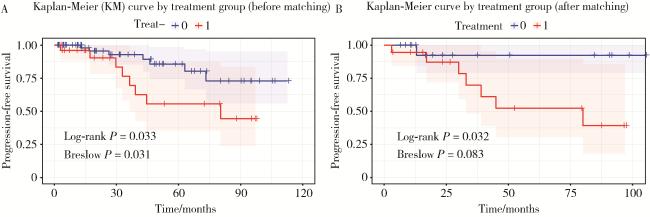
图2 匹配前后的KM生存曲线

Figure 2 KM survival curves before and after matching

A, KM curve before matching; B, survival curve after matching.

为校正其他潜在混杂因素并识别独立预后因子,进一步进行了Cox多因素回归分析(图 3)。
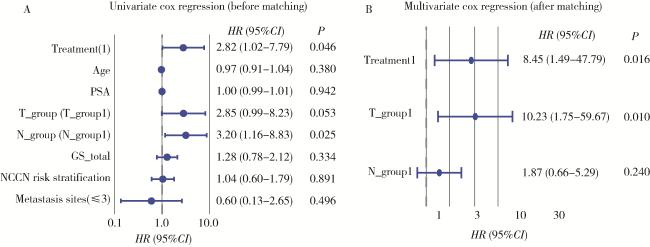
图3 Cox回归分析森林图

Figure 3 Forest plots of Cox regression analysis

A, forest plot of univariate Cox regression analysis; B, forest plot of multivariate Cox regression analysis. PSA, prostate-specific antigen; NCCN, National Comprehensive Cancer Network.

单因素Cox回归分析显示,治疗方式和N分期是影响CRPC进展的预后因素。PPB组的进展风险是RP组的2.83倍(HR=2.83,95%CI: 1.02~7.82,P=0.045);淋巴结转移患者进展的风险是无转移者的3.19倍(HR=3.19,95%CI: 1.16~8.82,P=0.025)。T分期接近统计学显著性水平(HR=2.83,95%CI: 0.98~8.19,P=0.054),提示可能存在一定关联趋势,而其余变量均未显示显著关联。
在匹配后队列中,进一步将单因素分析中 P < 0.10的变量(治疗方式、T分期、N分期)纳入多因素Cox回归分析,模型具有统计学显著性(似然比检验:χ2=14.96, P=0.002)。在校正其他协变量后,治疗方式和T分期是独立预后因素。PPB组的进展风险是RP组的8.56倍(HR=8.56, 95% CI: 1.51~48.64, P=0.015);T3期及以上患者的进展风险是T1~2期患者的10.29倍(HR=10.29, 95% CI: 1.75~60.57, P=0.010)。N分期未显示独立预测价值(P=0.242)。模型的C指数为0.767,提示模型具有较好的预测区分能力。
为评估缺失数据对结果的影响进行了敏感性分析,剔除PPB组中9例Gleason评分缺失的患者,采用相同的协变量(年龄、PSA、T分期、N分期)对剩余17例PPB患者与基于相同协变量(年龄、PSA、T分期、N分期)计算的倾向性评分最相近的17例RP患者进行1 ∶ 1倾向性评分匹配。Kaplan-Meier生存分析仍显示,RP组在延缓CRPC进展方面具有显著优势(HR=2.76,95%CI:1.02~11.06,P=0.048)。

3 讨论

本研究在倾向性评分匹配前后的omPCa队列中,直接比较了两种原发灶局部治疗方式(PPB和RP)联合ADT治疗对延缓疾病进展至CRPC时间的影响, 结果显示,匹配前后均显示RP显著延缓CRPC进展(匹配后HR=4.60),多因素Cox回归分析证实治疗方式是独立预后因素(HR=8.56), 这一结果为omPCa患者个体化局部治疗策略的选择提供了重要临床证据。
本研究提示RP在延缓CRPC进展方面可能优于近距离放疗,近期研究也支持这一结论。Cheng等[10]研究发现手术联合ADT可延长无CRPC生存期,另一项基于PSMA PET/CT的研究报道术后2年无CRPC生存率达85.8%[11],以上优势可能源于不同的生物学机制。手术通过完全移除原发肿瘤,最大限度地清除潜在的耐药克隆来源[12-13],这些克隆是驱动CRPC发展的核心。同时,原发灶的切除可能改变了系统平衡,减少了循环肿瘤细胞的持续释放,从而降低了远处播种和新转移灶建立的风险[14]。相比之下,放射治疗虽能有效杀灭细胞,但保留了前列腺的基质和结构。残留或耐辐射的细胞在ADT压力下,可能通过重塑肿瘤微环境(如诱导M2型巨噬细胞极化)[15],为肿瘤存活和再生长创造了有利的局部生态环境[16-17]。手术则可能更彻底地破坏这一潜在的“避难所”[14],这些机制差异或许部分解释了两者在长期疾病控制效果上的不同。
本研究的多因素分析显示,临床T分期(≥ T3期)是预测CRPC转化的独立危险因素(HR=10.29, 95%CI: 1.75~60.57, P=0.010),这与局部晚期肿瘤侵袭性更强、微转移风险更高的临床认知相符[18]。值得注意的是,本研究中N1状态未在多因素分析中显示出独立的预后价值,可能与T分期存在共线性或事件数较少有关。然而,其在单因素分析中的显著性差异提示淋巴结转移在疾病进展中仍可能扮演重要角色,这与既往研究结论一致[19],未来需要扩大样本量进一步验证。
本研究得出RP较PPB更能延缓CRPC转化的结论,但本结论与部分既往研究不完全一致(如NCCN指南指出,在高危局限性前列腺癌中,不同局部治疗方式在无转移生存差异方面可能并无统计学意义[20])。造成结论差异的潜在原因可能包括:第一,研究人群的差异,本研究聚焦于经影像学确认的寡转移患者(转移灶≤ 5处),而多数对比研究集中于局限性病变,在已存在微转移的背景下,原发灶局部治疗的生物学效应可能发生改变[11];第二,放疗技术差异,本研究中PPB为低剂量率单模态治疗,而部分对比研究采用高剂量率近距离放疗单用或联合外照射放疗,技术差异可能影响局部疗效及后续系统进展风险[21];第三,系统治疗策略存在异质性,本研究中ADT中位持续时间为18个月且为持续模式,而其他研究中ADT时长与联合方案各异,在寡转移激素敏感前列腺癌中,转移灶定向治疗联合ADT较单用ADT可改善临床无进展生存,提示系统治疗背景会显著影响局部干预的相对贡献[22];第四,终点指标定义不同,本研究采用无CRPC生存期,而既往研究多采用生化复发或无转移生存[23]。因此,本研究结论应谨慎外推至非寡转移人群或联合放疗方案的患者,需通过前瞻性随机对照试验进行进一步验证,并应加强个体化治疗策略的探索。
本研究绝大多数患者(91.9%)的转移灶数目小于等于3个,且高度集中于中轴骨,其中骨盆、脊柱、肋骨转移最为常见(分别占40.9%、37.5%和35.2%),符合寡转移前列腺癌的经典特征[10]。基于此背景,本研究通过倾向性评分匹配,校正了年龄、PSA、T分期、N分期等关键混杂因素,使得对两种治疗方式的比较更具科学性和可信度。经倾向性评分匹配后,两组基线特征均衡良好(所有协变量SMD < 0.1),增强了结果的可比性。重要的是,匹配前后的生存分析均显示一致的显著差异,进一步证实了局部治疗方式对疾病进展的真实影响,而非基线偏移所致。
本研究存在一定局限性,第一,本研究为单中心回顾性设计,虽然已采用PSM控制已知混杂因素,但仍无法排除选择偏好、体能状态等潜在偏倚;第二,影像方法不一致,早期多采用骨扫描可能低估转移负荷,导致分组不纯,结论向PSMA PET/CT分期人群外推需谨慎[8];第三,样本量有限(匹配后每组仅18例),这可能限制了统计效力,并且难以开展亚组分析,部分风险估计置信区间较宽;第四,中位随访30.5个月,短于PPB组中位无CRPC生存期估计值(80.0个月),无法评估长期生存,极早期CRPC事件可能与基线已存在的去势抵抗未被识别有关;第五,PPB组Gleason评分缺失比例高(34.6%),且两组病理来源不同(术后vs. 穿刺),影响匹配精确性,虽然敏感性分析支持主要结论,仍可能存在选择偏倚。
综上所述,本研究比较了寡转移前列腺癌患者在ADT基础上,联合RP或PPB局部治疗对疾病进展的影响,发现RP能更显著地延缓患者进展至CRPC,且这一差异在匹配前后的生存分析中保持一致。多因素分析证实,治疗方式是影响CRPC转化的独立预后因素,提示局部治疗方式的选择可能影响长期疾病进程。

利益冲突   所有作者均声明不存在利益冲突。

作者贡献声明   苏丹丹、李百顺:设计研究方案,撰写论文;肖若陶:修改论文;张帆、张树栋:设计研究方案,总体把关和审定论文。所有作者均参与论文修改,并对最终文稿进行审读和确认。

1
Siegel RL , Kratzer TB , Giaquinto AN , et al. Cancer statistics, 2025[J]. CA Cancer J Clin, 2025, 75 (1): 10- 45.

2
Vanden Berg RNW , Zilli T , Achard V , et al. The diagnosis and treatment of castrate-sensitive oligometastatic prostate cancer: A review[J]. Prostate Cancer Prostatic Dis, 2023, 26 (4): 702- 711.

DOI

3
Vaugier L , Morvan C , Pasquier D , et al. Long-term outcomes and patterns of relapse following high-dose elective salvage radiotherapy and hormone therapy in oligorecurrent pelvic nodes in prostate cancer: OLIGOPELVIS (GETUG-P07)[J]. Eur Urol, 2025, 87 (1): 73- 76.

DOI

4
Dai B , Zhang S , Wan FN , et al. Combination of androgen deprivation therapy with radical local therapy versus androgen deprivation therapy alone for newly diagnosed oligometastatic prostate cancer: A phase Ⅱ randomized controlled trial[J]. Eur Urol Oncol, 2022, 5 (5): 519- 525.

DOI

5
Giesen A , De Preter N , Fazekas T , et al. Direct treatment of all visible tumour in synchronous oligometastatic prostate cancer: Total eradication of tumour or the full monty treatment[J]. Eur Urol Oncol, 2025, 8 (4): 1203- 1207.

DOI

6
Hagan CT , Bloomquist C , Kim I , et al. Continuous liquid interface production of 3D printed drug-loaded spacers to improve prostate cancer brachytherapy treatment[J]. Acta Biomater, 2022, 148, 163- 170.

DOI

7
Wan L , Liu Y , Liu R , et al. GAD1 contributes to the progression and drug resistance in castration resistant prostate cancer[J]. Cancer Cell Int, 2023, 23 (1): 255.

DOI

8
Weber M , Fendler WP , Ravi Kumar AS , et al. Prostate-specific membrane antigen positron emission tomography-detected disease extent and overall survival of patients with high-risk nonmetastatic castration-resistant prostate cancer: An international multicenter retrospective study[J]. Eur Urol, 2024, 85 (6): 511- 516.

DOI

9
Le Guevelou J , Cuccia F , Flippot R , et al. The current landscape of stereotactic body radiation therapy for metastatic castration-resistant prostate cancer[J]. Prostate Cancer Prostatic Dis, 2025, 28 (3): 546- 556.

DOI

10
Cheng B , Li B , Fu J , et al. Evaluating the effectiveness of cytoreductive surgery in oligometastatic prostate cancer: Insights from quantitative analysis and retrospective cohort studies[J]. Int J Surg, 2025, 111 (1): 122- 134.

DOI

11
Rajwa P , Robesti D , Chaloupka M , et al. Outcomes of cytoreductive radical prostatectomy for oligometastatic prostate cancer on prostate-specific membrane antigen positron emission tomography: Results of a multicenter European study[J]. Eur Urol Oncol, 2024, 7 (4): 721- 734.

DOI

12
Rhinehart DP , Lai J , Sanin DE , et al. Intratumoral heterogeneity drives acquired therapy resistance in a patient with metastatic prostate cancer[J]. NPJ Precis Onc, 2024, 8, 275.

DOI

13
Cheng Q , Butler W , Zhou Y , et al. Pre-existing castration-resistant prostate cancer-like cells in primary prostate cancer promote resistance to hormonal therapy[J]. Eur Urol, 2022, 81 (5): 446- 455.

DOI

14
Sharifi MN , Sperger JM , Taylor AK , et al. High-purity CTC RNA sequencing identifies prostate cancer lineage phenotypes prognostic for clinical outcomes[J]. Cancer Discov, 2025, 15 (5): 969- 987.

DOI

15
Kane N , Romero T , Diaz-Perez S , et al. Significant changes in macrophage and CD8 T cell densities in primary prostate tumors 2 weeks after SBRT[J]. Prostate Cancer Prostatic Dis, 2023, 26 (1): 207- 209.

DOI

16
Piffkó A , Pitroda SP , Liang HL , et al. Amphiregulin as a mediator of radiation-induced systemic effects in metastatic cancer: Balancing local control with distant progression[J]. Clin Cancer Res, 2025, 31 (23): 4899- 4902.

DOI

17
Chin JL , Lavi A , Metcalfe MJ , et al. Long-term outcomes of whole gland salvage cryotherapy for locally recurrent prostate cancer following radiation therapy: A combined analysis of two centers[J]. J Urol, 2021, 206 (3): 646- 654.

DOI

18
Zhang Y , Ming A , Wang J , et al. PROTACs targeting androgen receptor signaling: Potential therapeutic agents for castration-resistant prostate cancer[J]. Pharmacol Res, 2024, 205, 107234.

DOI

19
Marra G , Valerio M , Heidegger I , et al. Management of patients with node-positive prostate cancer at radical prostatectomy and pelvic lymph node dissection: A systematic review[J]. Eur Urol Oncol, 2020, 3 (5): 565- 581.

DOI

20
Schaeffer EM , Srinivas S , Adra N , et al. NCCN Guidelines: Insights: Prostate Cancer, Version 3.2024[J]. J Natl Compr Canc Netw, 2024, 22 (3): 140- 150.

DOI

21
De B , Pasalic D , Barocas DA , et al. Patient-reported outcomes after external beam radiotherapy with low dose rate brachytherapy boost vs radical prostatectomy for localized prostate cancer: Five-year results from a prospective comparative effectiveness study[J]. J Urol, 2022, 208 (6): 1226- 1239.

DOI

22
Marvaso G , Corrao G , Zaffaroni M , et al. ADT with SBRT versus SBRT alone for hormone-sensitive oligorecurrent prostate cancer (RADIOSA): A randomised, open-label, phase 2 clinical trial[J]. Lancet Oncol, 2025, 26 (3): 300- 311.

DOI

23
Niazi T , Saad F , Tisseverasinghe S , et al. Metastases-directed therapy in addition to standard systemic therapy in oligometastatic castration-resistant prostate cancer in Canada (GROUQ-PCS 9): A multicentre, open-label, randomised, phase 2 trial[J]. Lancet Oncol, 2025, 26 (9): 1158- 1167.

DOI

文章导航

/