Journal of Peking University (Health Sciences) ›› 2025, Vol. 57 ›› Issue (5): 996-1001. doi: 10.19723/j.issn.1671-167X.2025.05.027

Previous Articles     Next Articles

Impact of palliative care on medication use and medical utilization in patients with advanced cancer

Dingyi CHEN1, Haoxin DU1, Yichen ZHANG1, Yanfei WANG2, Wei LIU2, Yuanyuan JIAO2, Luwen SHI1,3, Xiaodong GUAN1,3, Xinpu LU2,*()   

  1. 1. Department of Pharmacy Administration and Clinical Pharmacy, Peking University School of Pharmaceutical sciences, Beijing 100191, China
    2. Key Laboratory of Carcinogenesis and Translational Research(Ministry of Education/Beijing), Peking University Cancer Hospital & Institute, Beijing 100142, China
    3. International Research Center for Medicinal Administration, Peking University, Beijing 100191, China
  • Received:2023-02-20 Online:2025-10-18 Published:2025-09-05
  • Contact: Xinpu LU

RICH HTML


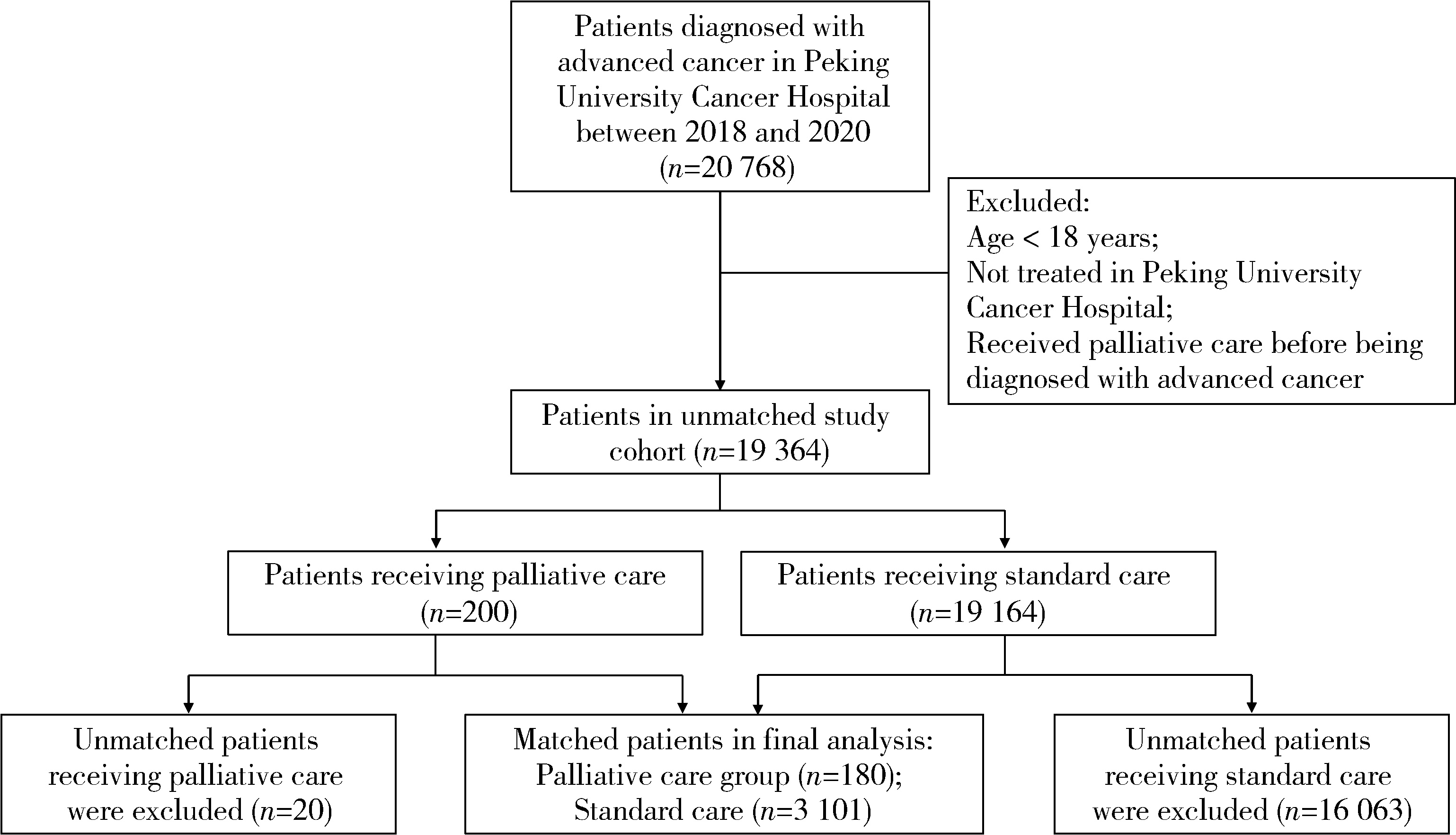
Abstract: Objective: To evaluate the effect of palliative care on drug use, medical service utilization and medical expenditure of patients with advanced cancer. Methods: A cohort of patients including pal-liative care and standard care was constructed using the medical records of the patients in Peking University Cancer Hospital from 2018 to 2020, and coarsened exact matching was used to match the two groups of patients. The average monthly opioid consumption, hospitalization rate, intensive care unit (ICU) rate and operation rate, and the average monthly total cost were selected to evaluate drug use, medical service utilization and medical expenditure. Chi-square test and Wilcoxon signed rank test were used to compare the differences between the two groups before and after exposure and the change in the palliative care group. The net impact of palliative care on the patients was calculated using the difference-in-differences analysis. Results: In this study, 180 patients in the palliative care group and 3 101 patients in the stan-dard care group were finally included in the matching, and the matching effect of the two groups was good (L1 < 0.1). Before and after exposure, the average monthly opioid consumption in the palliative care group was significantly higher than that in the standard care group (Before exposure: 0.3 DDD/person-month vs. 0.1 DDD/person-month, P < 0.01; After exposure: 0.7 DDD/person-month vs. 0.1 DDD/person-month, P < 0.01; DDD refers to defined daily dose), palliative care significantly increased the average monthly opioid consumption in the patients (0.3 DDD/person-month, P < 0.01). The hospitalization rate (48.9% vs. 74.3%, P < 0.01) and operation rate (3.9% vs. 8.8%, P < 0.01) of the patients in palliative care group were significantly lower than those in standard care group, and the ICU rate became similar between the two groups (1.1% vs. 1.6%, P=0.634). Palliative care significantly reduced the patients ' hospitalization rate (-25.6%, P < 0.01), ICU rate (-4.9%, P < 0.01) and operation rate (-14.5%, P < 0.01). Before and after exposure, the average monthly total costs of pal-liative care group were slightly higher than those of standard care group (Before exposure: 20 092.3 yuan vs. 19 132.8 yuan, P=0.725; After exposure: 9 719.8 yuan vs. 8 818.8 yuan, P=0.165). Palliative care increased the average monthly total cost by 2 208.8 yuan, but it was not statistically significant (P=0.316). Conclusion: Palliative care can increase the opioid consumption in advanced cancer patients, reduce the rates of hospitalization, ICU and surgery, but has no significant effect on medical expenditure.

Key words: Palliative care, Neoplasm, Opium, Drug utilization, Medical service utilization, Medical expenditure

CLC Number: 

  • R730.5

Figure 1

Flow chart of patient inclusion, exclusion, assignment and matching"

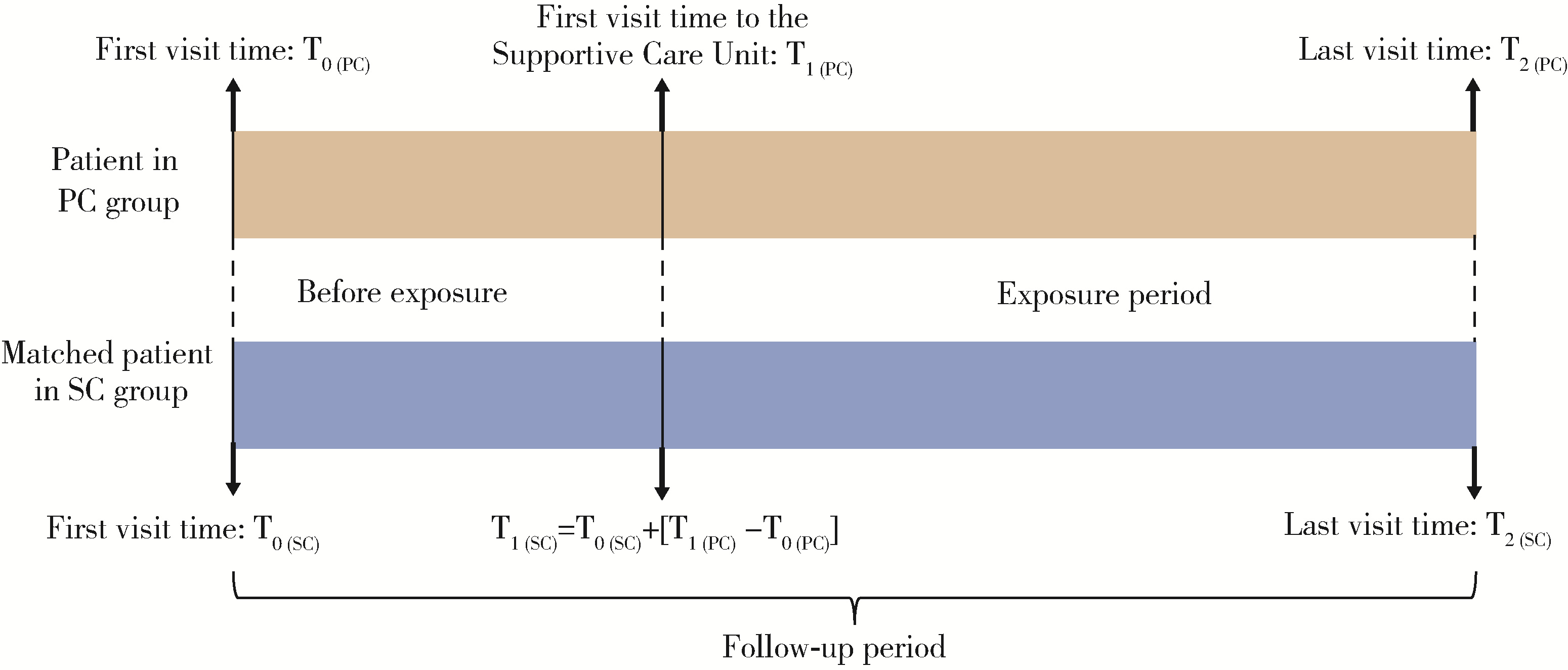
Figure 2

Each time point and period in the study PC, palliative care; SC, standard care."

Table 1

Characteristics of patients in the palliative care group and the standard care group"

Items Palliative care group (n=180) Standard care group (n=3 101) L1
Sex <0.01
    Female 55 (30.6) 1 198 (38.6)
    Male 125 (69.4) 1 903 (61.4)
Age/years 0.013
    18-44 8 (4.4) 54 (1.7)
    45-64 75 (41.8) 1 308 (42.2)
    ≥65 97 (53.9) 1 739 (56.1)
Location of medical insurance 0.046
    Local 42 (23.3) 578 (18.6)
    Non-local 138 (76.7) 2 523 (81.4)
Year of diagnosis 0.072
    2011-2015 13 (7.2) 30 (1.0)
    2016-2020 167 (92.8) 3 071 (99.0)
Cancer site 0.044
    Digestive system 80 (44.4) 984 (31.7)
    Respiratory system 19 (10.6) 242 (7.8)
    Genital system 1 (0.6) 3 (0.1)
    Hematologic system 1 (0.6) 259 (8.4)
    Breast 5 (2.8) 13 (0.4)
    Head and neck 6 (3.3) 7 (0.2)
    Other sites 6 (3.3) 9 (0.3)
    Not specified 62 (34.4) 1 584 (51.1)

Table 2

Comparison of each outcome in the two groups before and after exposure"

Outcomes Before exposure After exposure
Palliative care group Standard care group P Palliative care group Standard care group P
Drug use
  Average monthly opioid consumption/DDD per person-month 0.3 0.1 <0.01 0.7* 0.1 <0.01
Medical service utilization
  Hospital rate/% 100.0 99.8 0.555 48.9* 74.3 <0.01
  ICU rate/% 6.7 2.3 <0.01 1.1* 1.6 0.634
  Operation rate/% 25.6 15.1 <0.01 3.9* 8.8 <0.01
Medical expenditure
  Average monthly total cost/yuan 20 092.3 19 132.8 0.725 9 719.8 8 818.8 0.165

Table 3

The net effect value of palliative care on each outcome"

Outcomes Net effect value |t| P
Drug use
    Average monthly opioid consumption/DDD per person-month 0.3 4.48 <0.01
Medical service utilization
    Hospital rate/% -25.6 4.53 <0.01
    ICU rate/% -4.9 3.17 <0.01
    Operation rate/% -14.5 4.02 <0.01
Medical expenditure
    Average monthly total cost/yuan 2 208.8 1.00 0.316
1
WHO. Detail of Palliative Care[EB/OL]. (2020-08-05)[2022-05-01]. https://www.who.int/news-room/fact-sheets/detail/palliative-care.
2
刘佩, 蒲嘉泽, 黄雯. 晚期恶性肿瘤患者采用姑息治疗的临床效果[J]. 临床合理用药杂志, 2021, 14 (8): 169- 170.
3
赵杰. 安宁疗护和姑息治疗对直肠癌晚期患者临终期生活质量的影响[J]. 中国肛肠病杂志, 2022, 42 (3): 62- 63.
4
郭敏, 孟华, 张庆波. 姑息治疗老年恶性肿瘤患者的临床效果观察[J]. 中国社区医师, 2021, 37 (10): 15- 16.
5
Greer JA , Applebaum AJ , Jacobsen JC , et al. Understanding and addressing the role of coping in palliative care for patients with advanced cancer[J]. J Clin Oncol, 2020, 38 (9): 915-925, 198.

doi: 10.1200/JCO.19.00013
6
王茜, 林天华, 张仑. 晚期癌症患者的姑息护理研究进展分析[J]. 实用临床护理学电子杂志, 2018, 3 (15): 193- 198.
7
Triplett DP , LeBrett WG , Bryant AK , et al. Effect of palliative care on aggressiveness of end-of-life care among patients with advanced cancer[J]. J Oncol Pract, 2017, 13 (9): e760- e769.

doi: 10.1200/JOP.2017.020883
8
Smith CB , Phillips T , Smith TJ . Using the new ASCO clinical practice guideline for palliative care concurrent with oncology care using the TEAM approach[J]. Am Soc Clin Oncol Educ Book, 2017, 37, 714- 723.

doi: 10.1200/EDBK_175474
9
宁晓红. 中国缓和医疗的发展和思考[J]. 中国医学科学院学报, 2019, 41 (5): 723- 725.
10
张丽艳, 沈美玲. 积极养老视角下我国安宁疗护政策研究——基于2012-2019年政策文本分析[J]. 科学与管理, 2021, 41 (2): 49- 54.
11
Xu M , Zhou W , Yang L , et al. Effect of palliative care on the anxiety, depression and sleep quality in primary caregivers of elderly patients with terminal cancer[J]. Am J Transl Res, 2021, 13 (4): 3738- 3744.
12
Siddiqui ST , Xiao E , Patel S , et al. Impact of palliative care on interhospital transfers to the Intensive Care Unit[J]. J Crit Care Med (Targu Mures), 2022, 8 (2): 100- 106.

doi: 10.2478/jccm-2022-0009
13
Pelcovits A , Olszewski AJ , Decker D , et al. Impact of early pal-liative care on end-of-life outcomes in hematologic malignancies[J]. J Palliat Med, 2022, 25 (4): 556- 561.
14
Pottash M , McCamey D , Groninger H , et al. Palliative care consultation and effect on length of stay in a tertiary-level neurological intensive care unit[J]. Palliat Med Rep, 2020, 1 (1): 161- 165.

doi: 10.1089/pmr.2020.0051
15
Iacus SM , King G , Porro G . Causal inference without balance checking: Coarsened exact matching[J]. Polit Anal, 2012, 20 (1): 1- 24.

doi: 10.1093/pan/mpr013
16
Vallard A , Morisson S , Tinquaut F , et al. Drug management in end-of-life hospitalized palliative care cancer patients: The RHESO cohort study[J]. Oncology, 2019, 97 (4): 217- 227.

doi: 10.1159/000500783
17
Fredheim OM , Skurtveit S , Handal M , et al. A complete national cohort study of prescriptions of analgesics and benzodiazepines to cancer survivors in Norway 10 years after diagnosis[J]. Pain, 2019, 160 (4): 852- 859.

doi: 10.1097/j.pain.0000000000001459
18
Gade G , Venohr I , Conner D , et al. Impact of an inpatient palliative care team: A randomized control trial[J]. J Palliat Med, 2008, 11 (2): 180- 190.

doi: 10.1089/jpm.2007.0055
19
Dimick JB , Ryan AM . Methods for evaluating changes in health care policy: The difference-in-differences approach[J]. JAMA, 2014, 312 (22): 2401- 2402.

doi: 10.1001/jama.2014.16153
20
van den Beuken-van Everdingen MH , Hochstenbach LM , Joosten EA , et al. Update on prevalence of pain in patients with cancer: Systematic review and meta-analysis[J]. J Pain Symptom Manage, 2016, 51 (6): 1070- 1090.

doi: 10.1016/j.jpainsymman.2015.12.340
21
王薇. 北京市癌痛治疗现状调查分析及草乌甲素治疗轻中度癌痛的临床研究[D]. 北京: 中国中医科学院, 2019.
22
海峡两岸医药卫生交流协会全科医学分会. 姑息治疗与安宁疗护基本用药指南[J]. 中国全科医学, 2021, 24 (14): 1717- 1734.
23
NCCN. NCCN clinical practice guidelines in oncology: Palliative care[M/OL]. (2020-02-27)[2022-03-04]. https://www.nccn.org/professionals/physician_gls/pdf/palliative_enhanced.pdf.
24
Samuel D , Nevadunsky NS , Miller DT , et al. Opioid prescription by gynecologic oncologists: An analysis of Medicare part D claims[J]. Curr Probl Cancer, 2021, 45 (2): 100655.

doi: 10.1016/j.currproblcancer.2020.100655
25
Quinn KL , Shurrab M , Gitau K , et al. Association of receipt of palliative care interventions with health care use, quality of life, and symptom burden among adults with chronic noncancer illness: A systematic review and meta-analysis[J]. JAMA, 2020, 324 (14): 1439- 1450.

doi: 10.1001/jama.2020.14205
26
Mack JW , Cronin A , Keating NL , et al. Associations between end-of-life discussion characteristics and care received near death: A prospective cohort study[J]. J Clin Oncol, 2012, 30 (35): 4387- 4395.

doi: 10.1200/JCO.2012.43.6055
27
Obermeyer Z , Makar M , Abujaber S , et al. Association between the Medicare hospice benefit and health care utilization and costs for patients with poor-prognosis cancer[J]. JAMA, 2014, 312 (18): 1888- 1896.

doi: 10.1001/jama.2014.14950
28
Higginson IJ , Bausewein C , Reilly CC , et al. An integrated pal-liative and respiratory care service for patients with advanced disease and refractory breathlessness: A randomised controlled trial[J]. Lancet Respir Med, 2014, 2 (12): 979- 987.

doi: 10.1016/S2213-2600(14)70226-7
29
Haukland EC , von Plessen C , Nieder C , et al. Adverse events in deceased hospitalised cancer patients as a measure of quality and safety in end-of-life cancer care[J]. BMC Palliat Care, 2020, 19 (1): 76.

doi: 10.1186/s12904-020-00579-0
30
杨晓燕. ICU危重患者机械通气后常见并发症护理[J]. 医药论坛杂志, 2009, 30 (10): 127- 128.
31
荆明远. 腹腔镜胃癌手术常见并发症及其防治对策[J]. 中国卫生标准管理, 2014, 5 (20): 120- 121.
32
舒芳芳, 包磊, 朱蓓, 等. 成人择期手术患者术前焦虑现状、恐惧焦点及影响因素的横断面调查研究[J]. 实用临床医药杂志, 2022, 26 (6): 72-76, 108.
33
Maley JH , Worsham CM , Landon BE , et al. Association between palliative care and end-of-life resource use for older adults hospitalized with septic shock[J]. Ann Am Thorac Soc, 2020, 17 (8): 974- 979.

doi: 10.1513/AnnalsATS.202001-038OC
[1] Xiaoyong YANG, Fan ZHANG, Lulin MA, Cheng LIU. Clinical characteristics and influencing factors of extraglandular invasion of prostatic ductal adenocarcinoma [J]. Journal of Peking University (Health Sciences), 2025, 57(5): 956-960.
[2] Jiaxin NING, Haoran WANG, Shuhang LUO, Jibo JING, Jianye WANG, Huimin HOU, Ming LIU. Multi-omics analysis of the relationship between oxidative stress-related gene and prostate cancer [J]. Journal of Peking University (Health Sciences), 2025, 57(4): 633-643.
[3] Zeyuan WANG, Shuanbao YU, Haoke ZHENG, Jin TAO, Yafeng FAN, Xuepei ZHANG. A preoperative prediction model for pelvic lymph node metastasis in prostate cancer: Integrating clinical characteristics and multiparametric MRI [J]. Journal of Peking University (Health Sciences), 2025, 57(4): 684-691.
[4] Shuai LIU, Zhuo LIU, Yunhe GUAN, Guoliang WANG, Xiaojun TIAN, Hongxian ZHANG, Lei LIU, Lulin MA, Shudong ZHANG. Robot-assisted laparoscopic inferior vena cava segmental resection for renal tumor with tumor thrombus invading the vascular wall [J]. Journal of Peking University (Health Sciences), 2025, 57(4): 796-802.
[5] Dan HAN, Yangjin CIREN, Qiuhong LI, Jun LI. Changes of intestinal microflora in patients with colorectal benign and malignant tumors in high altitude area and comparison with the normal population in low altitude area [J]. Journal of Peking University (Health Sciences), 2025, 57(3): 578-583.
[6] Yanlei WANG, Min DUAN, Jianzhong XIAO, Wenhui ZHAO. Abnormal elevation of growth hormone in patients with pituitary adenoma combined with cirrhosis: A case report [J]. Journal of Peking University (Health Sciences), 2025, 57(2): 400-402.
[7] Guangyan YU, Xin PENG, Min GAO, Peng YE, Na GE, Mengqi JIA, Bingyu LI, Zunan TANG, Leihao HU, Wenbo ZHANG. Research progress in diagnosis and treatment of salivary gland tumors [J]. Journal of Peking University (Health Sciences), 2025, 57(1): 1-6.
[8] Zhicun LI, Tianyu WU, Lei LIANG, Yu FAN, Yisen MENG, Qian ZHANG. Risk factors analysis and nomogram model construction of postoperative pathological upgrade of prostate cancer patients with single core positive biopsy [J]. Journal of Peking University (Health Sciences), 2024, 56(5): 896-901.
[9] Yuxuan TIAN,Mingjian RUAN,Yi LIU,Derun LI,Jingyun WU,Qi SHEN,Yu FAN,Jie JIN. Predictive effect of the dual-parametric MRI modified maximum diameter of the lesions with PI-RADS 4 and 5 on the clinically significant prostate cancer [J]. Journal of Peking University (Health Sciences), 2024, 56(4): 567-574.
[10] Kaifeng YAO,Mingjian RUAN,Derun LI,Yuxuan TIAN,Yuke CHEN,Yu FAN,Yi LIU. Diagnostic efficacy of targeted biopsy combined with regional systematic biopsy in prostate cancer in patients with PI-RADS 4-5 [J]. Journal of Peking University (Health Sciences), 2024, 56(4): 575-581.
[11] Junyong OU,Kunming NI,Lulin MA,Guoliang WANG,Ye YAN,Bin YANG,Gengwu LI,Haodong SONG,Min LU,Jianfei YE,Shudong ZHANG. Prognostic factors of patients with muscle invasive bladder cancer with intermediate-to-high risk prostate cancer [J]. Journal of Peking University (Health Sciences), 2024, 56(4): 582-588.
[12] Le YU,Shaohui DENG,Fan ZHANG,Ye YAN,Jianfei YE,Shudong ZHANG. Clinicopathological characteristics and prognosis of multilocular cystic renal neoplasm of low malignant potential [J]. Journal of Peking University (Health Sciences), 2024, 56(4): 661-666.
[13] Zi-xuan XUE,Shi-ying TANG,Min QIU,Cheng LIU,Xiao-jun TIAN,Min LU,Jing-han DONG,Lu-lin MA,Shu-dong ZHANG. Clinicopathologic features and prognosis of young renal tumors with tumor thrombus [J]. Journal of Peking University (Health Sciences), 2023, 55(5): 802-811.
[14] Yi LIU,Chang-wei YUAN,Jing-yun WU,Qi SHEN,Jiang-xi XIAO,Zheng ZHAO,Xiao-ying WANG,Xue-song LI,Zhi-song HE,Li-qun ZHOU. Diagnostic efficacy of prostate cancer using targeted biopsy with 6-core systematic biopsy for patients with PI-RADS 5 [J]. Journal of Peking University (Health Sciences), 2023, 55(5): 812-817.
[15] Hai MAO,Fan ZHANG,Zhan-yi ZHANG,Ye YAN,Yi-chang HAO,Yi HUANG,Lu-lin MA,Hong-ling CHU,Shu-dong ZHANG. Predictive model of early urinary continence recovery based on prostate gland MRI parameters after laparoscopic radical prostatectomy [J]. Journal of Peking University (Health Sciences), 2023, 55(5): 818-824.
Viewed
Full text


Abstract

Cited

  Shared   
  Discussed   
No Suggested Reading articles found!