Journal of Peking University (Health Sciences) ›› 2026, Vol. 58 ›› Issue (1): 68-73. doi: 10.19723/j.issn.1671-167X.2026.01.009

Previous Articles     Next Articles

Value of direct immunofluorescence in the diagnosis of oral mucosal pemphigus vulgaris: A retrospective study based on multi-index combined analysis

Yanting CHI1, Hongjie JIANG1,2, Yan CHEN1, Zhixiu XU1,*(), Binbin LI1,*()   

  1. 1. Department of Oral Pathology, Peking University School and Hospital of Stomatology & National Center for Stomatology & National Clinical Research Center for Oral Diseases & National Engineering Research Center of Oral Biomaterials and Digital Medical Devices & Beijing Key Laboratory of Digital Stomatology, Beijing 100081, China
    2. The Affiliated Stomatological Hospital of Chongqing Medical University & Chongqing Key Laboratory of Oral Diseases & Municipal Key Laboratory of Oral Biomedical Engineering of Higher Education & Chongqing Municipal Health Commission Key Laboratory of Oral Biomedical Engineering, Chongqing 401147, China
  • Received:2025-09-19 Online:2026-02-18 Published:2026-01-06
  • Contact: Zhixiu XU, Binbin LI

RICH HTML


Abstract:

Objective: To clarify the diagnostic efficacy of various diagnostic methods through multi-index combined analysis, and to explore the core diagnostic value of direct immunofluorescence (DIF) in oral mucosal pemphigus vulgaris (PV). Methods: A total of 53 patients with confirmed oral mucosal PV were included, retrospectively. Their data of DIF, histopathology, serum enzyme-linked immunosorbent assay (ELISA) and clinical diagnosis were systematically analyzed, and diagnostic efficacy of each method was evaluated using indicators, such as sensitivity, specificity, and area under curve (AUC) of the receiver operating characteristic (ROC) curve. Results: The results showed that among the 53 patients, middle-aged and elderly females were predominant, the buccal mucosa was the most common involved site, and most patients had a history of blistering. The positive rate of DIF was 96.23%, mainly manifested as a reticular fluorescent deposition between epithelial spinous cells, demonstrating the highest diagnostic value with a sensitivity of 96.23%, specificity of 100.00%, and AUC of 0.981. Histopathology ranked second, with a sensitivity of 94.34%, a specificity of 100.00%, and an AUC value of 0.972. The ELISA test had a sensitivity of 82.61%, a specificity of 82.35%, and an AUC value of 0.825. Although the sensitivity of clinical diagnosis was acceptable, its specificity was relatively low. Additionally, DIF exhibited complementarity with histopathology, ELISA, and clinical diagnosis, and combined testing could improve diagnostic accuracy. Conclusion: DIF is the "gold standard" for the diagnosis of oral mucosal PV. A comprehensive diagnostic workflow of "clinical manifestation-DIF-histopathology-ELISA" is proposed. This integrated diagnostic system not only significantly improves the accuracy of oral mucosal PV diagnosis but also aligns with the core principles of precision medicine, providing a basis for indivi-dualized treatment.

Key words: Mouth mucosa, Pemphigus, Fluorescent antibody technique, direct, Diagnosis

CLC Number: 

  • R781.5

Figure 1

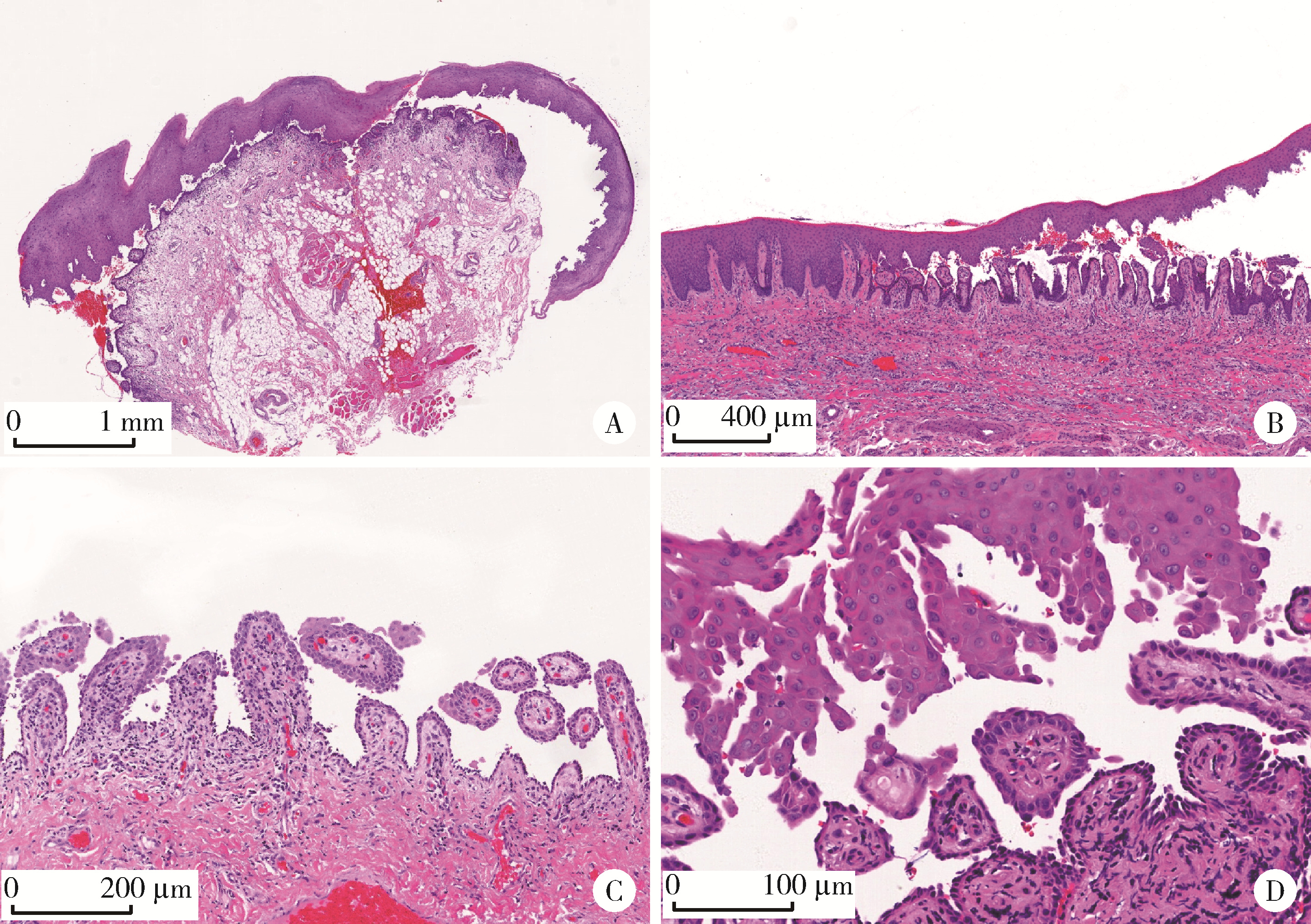
Histopathological features of oral mucosal pemphigus vulgaris (HE staining) A, intraepithelial blister formation (×20); B, acantholysis (×40); C, blister roof detachment, with epithelial basal cells attached to the surface of connective tissue papillae showing a villous appearance (×100); D, acantholysis with scattered Tzanck cells: swollen round cells with hyperchromatic nuclei, often surrounded by a perinuclear cytoplasmic halo (×200). HE, hematoxylin-eosin."

Figure 2

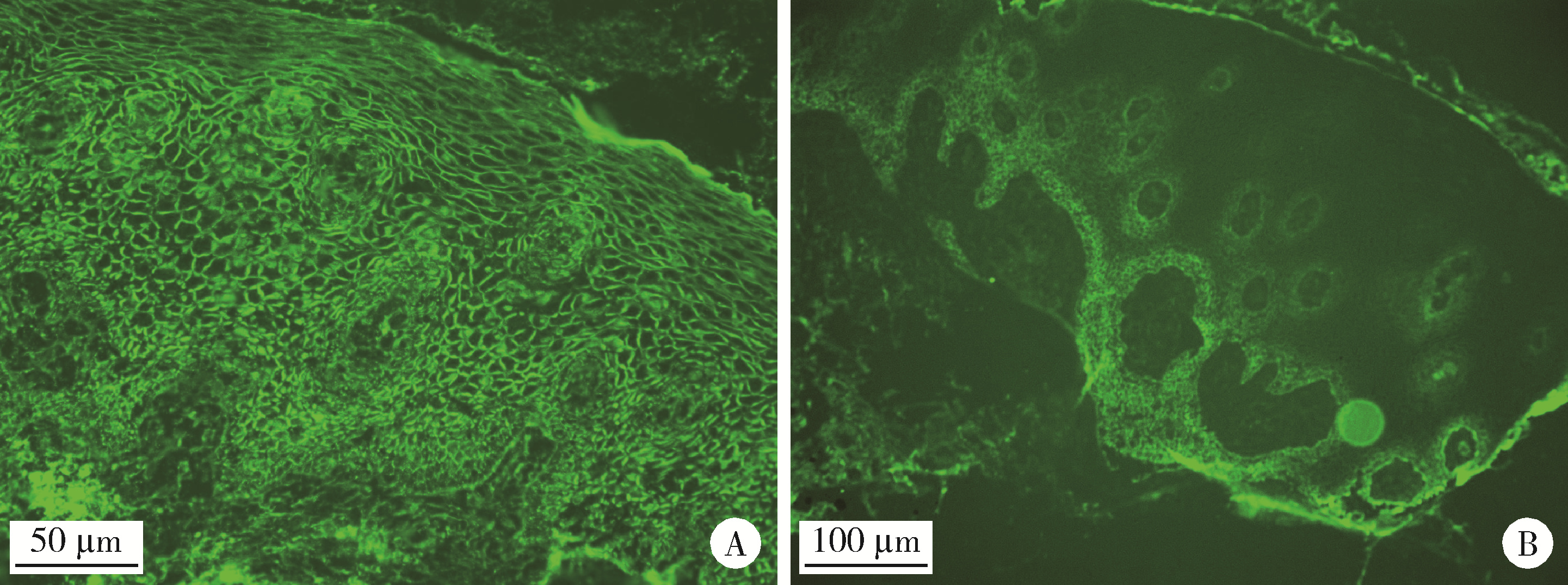
Direct immunofluorescence of oral mucosal pemphigus vulgaris A, a reticular pattern of IgG deposition is observed in the intercellular spaces of the epithelial stratum spinosum (excitation wavelength 488 nm, emission wavelength 520-530 nm, ×400); B, a reticular pattern of C3 deposition is observed in the intercellular spaces of the epithelial stratum spinosum (excitation wavelength 488 nm, emission wavelength 520-530 nm, ×200)."

Table 1

Diagnosis and treatment status of 2 patients with negative direct immunofluorescence results"

Patient Diagnosis Treatment
Clinical manifestation Histopathology Antibody level by ELISA/(U/mL) Treated with pemphigus protocol Used glucocorticoids Treatment outcome
No.1 Typical Atypical Anti-Dsg3: 93.70 (>20) Anti-Dsg1: 0 (< 20) Yes Yes Marked
No.2 Typical Atypical Anti-Dsg3: 58.44 (>20) Anti-Dsg1: 11.33 (< 20) Yes No Mild

Table 2

Diagnostic performance of various direct immunofluorescence antibody indicators"

Detection indicator Sensitivity Specificity Positive predictive value Negative predictive value Missed diagnosis rate False positive rate
IgG 92.45% 55.00% 84.48% 73.33% 7.55% 45.00%
C3 52.83% 60.00% 77.78% 32.43% 47.17% 40.00%
Fibrinogen 20.75% 75.00% 68.75% 26.32% 79.25% 25.00%
IgA 5.66% 85.00% 50.00% 25.37% 94.34% 15.00%
IgM 1.89% 95.00% 50.00% 26.76% 98.11% 5.00%
DIF 96.23% 100.00% 100.00% 90.91% 3.77% 0.00%

Figure 3

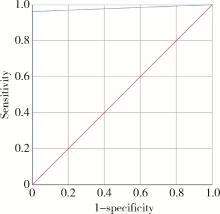
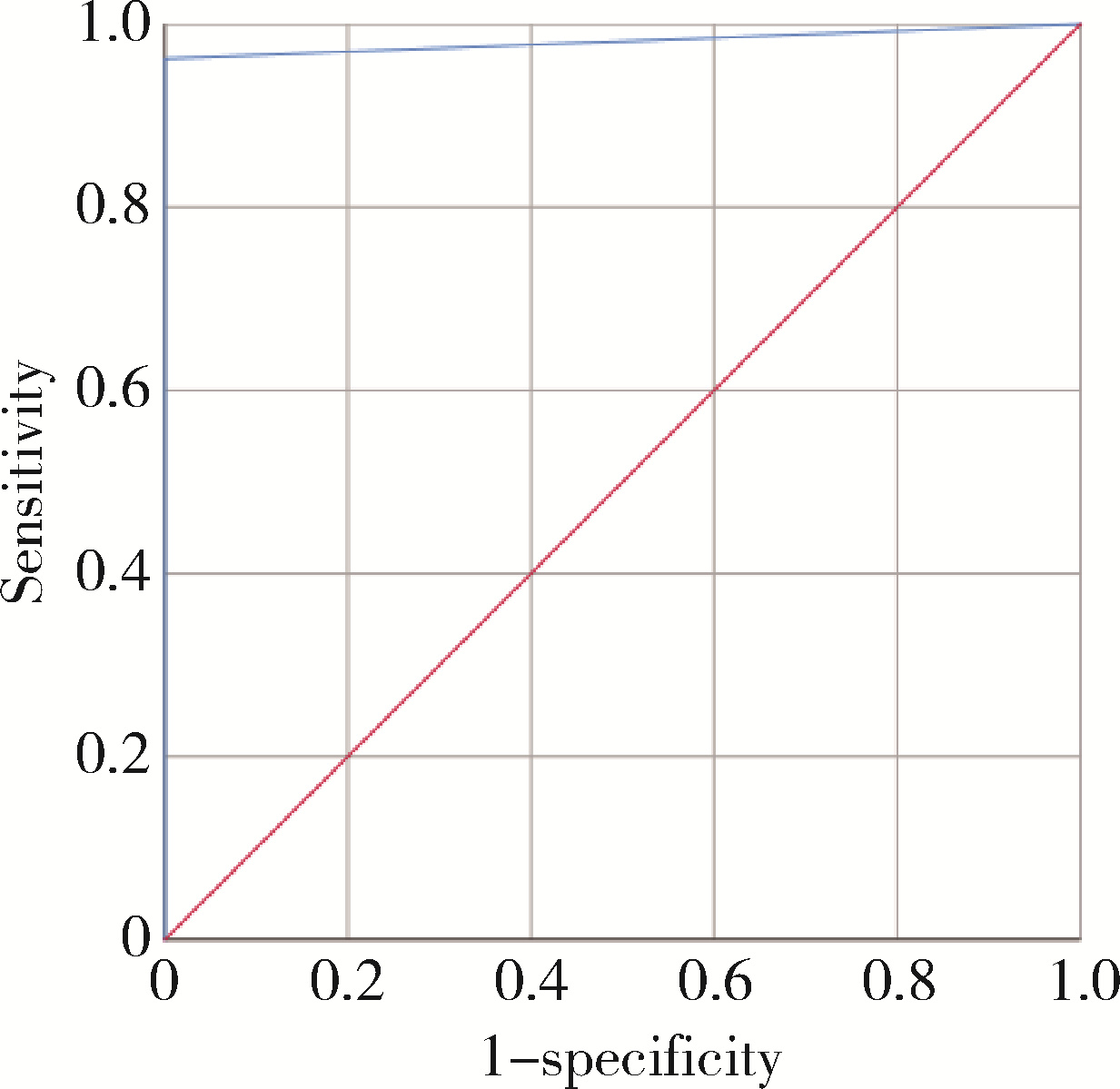
Receiver operating characteristic curve of direct immunofluorescence for the diagnosis of oral mucosal pemphigus vulgaris"

Table 3

Comparison of diagnostic performance of different detection methods in oral mucosal pemphigus vulgaris"

Detection method Sensitivity Specificity AUC
DIF 96.23% 100.00% 0.981
Histopathology 94.34% 100.00% 0.972
ELISA 82.61% 82.35% 0.825
Clinical diagnosis 86.79% 15.00% 0.509
1
Porro AM , Seque CA , Ferreira MCC , et al. Pemphigus vulgaris[J]. An Bras Dermatol, 2019, 94 (3): 264- 278.
2
Kridin K . Pemphigus group: Overview, epidemiology, mortality, and comorbidities[J]. Immunol Res, 2018, 66 (2): 255- 270.

doi: 10.1007/s12026-018-8986-7
3
Jamora MJJ , Jiao D , Bystryn JC . Antibodies to desmoglein 1 and 3, and the clinical phenotype of pemphigus vulgaris[J]. J Am Acad Dermatol, 2003, 48 (6): 976- 977.

doi: 10.1067/mjd.2003.438
4
Joly P , Horvath B , Patsatsi Α , et al. Updated S2K guidelines on the management of pemphigus vulgaris and foliaceus initiated by the European academy of dermatology and venereology (EADV)[J]. J Eur Acad Dermatol Venereol, 2020, 34 (9): 1900- 1913.

doi: 10.1111/jdv.16752
5
Witte M , Zillikens D , Schmidt E . Diagnosis of autoimmune blistering diseases[J]. Front Med (Lausanne), 2018, 5, 296.
6
Arockiam S , Raj B , Prabha N , et al. Diagnostic utility of immunofluorescence in oral lesions: A systematic review[J]. J Oral Maxillofac Res, 2024, 15 (3): e2.
7
Nili A , Salehi Farid A , Asgari M , et al. Current status and prospects for the diagnosis of pemphigus vulgaris[J]. Expert Rev Clin Immunol, 2021, 17 (8): 819- 834.
8
中国医疗保健国际交流促进会皮肤科分会. 寻常型天疱疮诊断和治疗专家建议(2020)[J]. 中华皮肤科杂志, 2020, 53 (1): 1- 7.
9
Mahmood MN . Direct immunofluorescence of skin and oral mucosa: Guidelines for selecting the optimum biopsy site[J]. Dermatopathology (Basel), 2024, 11 (1): 52- 61.

doi: 10.3390/dermatopathology11010006
10
Amagai M , Tanikawa A , Shimizu T , et al. Japanese guidelines for the management of pemphigus[J]. J Dermatol, 2014, 41 (6): 471- 486.

doi: 10.1111/1346-8138.12486
11
Mutasim DF , Adams BB . Immunofluorescence in dermatology[J]. J Am Acad Dermatol, 2001, 45 (6): 803- 824.

doi: 10.1067/mjd.2001.117518
12
Dridi SM , Lutz CM , Gaultier F , et al. Oral biopsy in mucous membrane pemphigoid and pemphigus vulgaris with gingival expression: The optimal site. A systematic review and meta-analysis[J]. BMC Oral Health, 2024, 24 (1): 1093.

doi: 10.1186/s12903-024-04853-y
13
Minz RW , Chhabra S , Singh S , et al. Direct immunofluorescence of skin biopsy: Perspective of an immunopathologist[J]. Indian J Dermatol Venereol Leprol, 2010, 76 (2): 150- 157.

doi: 10.4103/0378-6323.60561
14
Dainichi T , Chow Z , Kabashima K . IgG4, complement, and the mechanisms of blister formation in pemphigus and bullous pemphigoid[J]. J Dermatol Sci, 2017, 88 (3): 265- 270.

doi: 10.1016/j.jdermsci.2017.07.012
15
Xu Y , He X , Jie W , et al. The application of direct immunofluorescence in the pathological diagnosis of oral mucosal diseases: Series of 116 cases[J]. Pathol Res Pract, 2025, 270, 155989.

doi: 10.1016/j.prp.2025.155989
16
Arbache ST , Nogueira TG , Delgado L , et al. Immunofluorescence testing in the diagnosis of autoimmune blistering diseases: Overview of 10-year experience[J]. An Bras Dermatol, 2014, 89 (6): 885- 889.

doi: 10.1590/abd1806-4841.20143221
17
Buonavoglia A , Leone P , Dammacco R , et al. Pemphigus and mucous membrane pemphigoid: An update from diagnosis to therapy[J]. Autoimmun Rev, 2019, 18 (4): 349- 358.

doi: 10.1016/j.autrev.2019.02.005
18
Feng X , Zheng H , Wang M , et al. Autoimmune bullous diseases: Pathogenesis and clinical management[J]. Mol Biomed, 2025, 6 (1): 30.

doi: 10.1186/s43556-025-00272-9
19
Genovese G , Maronese CA , Casazza G , et al. Clinical and serological predictors of relapse in pemphigus: A study of 143 patients[J]. Clin Exp Dermatol, 2022, 47 (1): 98- 106.

doi: 10.1111/ced.14854
20
Harman KE , Seed PT , Gratian MJ , et al. The severity of cutaneous and oral pemphigus is related to desmoglein 1 and 3 antibody levels[J]. Br J Dermatol, 2001, 144 (4): 775- 780.

doi: 10.1046/j.1365-2133.2001.04132.x
21
Golinski ML , Lemieux A , Maho-Vaillant M , et al. The diversity of serum anti-DSG3 IgG subclasses has a major impact on pemphigus activity and is predictive of relapses after treatment with rituximab[J]. Front Immunol, 2022, 13, 849790.

doi: 10.3389/fimmu.2022.849790
[1] Ye ZHAO, Xiaoli DIAO, Yan XIONG. Application of cell transfer technology in pathological diagnosis of micro-volume cell fluid [J]. Journal of Peking University (Health Sciences), 2026, 58(1): 208-213.
[2] Yue WANG, Yuhong LIANG. Florid cemento-osseous dysplasia: A case report [J]. Journal of Peking University (Health Sciences), 2026, 58(1): 220-224.
[3] Jingyan GU, Xinyi LI, Jinxia ZHAO, Rong MU. Diabetic Charcot neuroarthropathy initially misdiagnosed as rheumatoid arthritis and gout: A case report [J]. Journal of Peking University (Health Sciences), 2025, 57(6): 1193-1197.
[4] Xiaodi XIAO, Youchen XIA, Jianying LIU, Peng FU. Left sided sternocleidomastoid interosseous intravascular papillary endothelial hyperplasia: A case report [J]. Journal of Peking University (Health Sciences), 2025, 57(5): 1002-1004.
[5] Xiangyu SUN, Chao YUAN, Xinzhu ZHOU, Jing DIAO, Shuguo ZHENG. Application of salivary micro-ecosystem in early prevention and control of oral and systemic diseases [J]. Journal of Peking University (Health Sciences), 2025, 57(5): 859-863.
[6] Zhao CHEN, Yongkang QIU, Lei KANG. Classical Sweet syndrome with multiple organ lesions by 18F-FDG PET/CT: A case report [J]. Journal of Peking University (Health Sciences), 2025, 57(2): 403-407.
[7] Guangyan YU, Xin PENG, Min GAO, Peng YE, Na GE, Mengqi JIA, Bingyu LI, Zunan TANG, Leihao HU, Wenbo ZHANG. Research progress in diagnosis and treatment of salivary gland tumors [J]. Journal of Peking University (Health Sciences), 2025, 57(1): 1-6.
[8] Yuanyuan FANG, Fan XU, Jie LEI, Hao ZHANG, Wenyu ZHANG, Yu SUN, Hongxin WU, Kaiyuan FU, Weiyu MAO. Development and validation of a clinical automatic diagnosis system based on diagnostic criteria for temporomandibular disorders [J]. Journal of Peking University (Health Sciences), 2025, 57(1): 192-201.
[9] Juan WANG, Lixin QIU, Huajie YU. Influence of emergence profile designs on the peri-implant tissue in the mandibular molar: A randomized controlled trial [J]. Journal of Peking University (Health Sciences), 2025, 57(1): 65-72.
[10] Jialu CHE, Zichen LIU, Kun LI, Chen ZHANG, Nanying CHE. Clinical value of automated EasyNAT system for the diagnosis of tuberculosis in paraffin-embedded tissues [J]. Journal of Peking University (Health Sciences), 2024, 56(6): 1047-1051.
[11] Xinxin CHEN, Zhe TANG, Yanchun QIAO, Wensheng RONG. Caries experience and its correlation with caries activity of 4-year-old children in Miyun District of Beijing [J]. Journal of Peking University (Health Sciences), 2024, 56(5): 833-838.
[12] Hua ZHONG, Yuan LI, Liling XU, Mingxin BAI, Yin SU. Application of 18F-FDG PET/CT in rheumatic diseases [J]. Journal of Peking University (Health Sciences), 2024, 56(5): 853-859.
[13] Zhengfang LI,Cainan LUO,Lijun WU,Xue WU,Xinyan MENG,Xiaomei CHEN,Yamei SHI,Yan ZHONG. Application value of anti-carbamylated protein antibody in the diagnosis of rheumatoid arthritis [J]. Journal of Peking University (Health Sciences), 2024, 56(4): 729-734.
[14] Hai-hong YAO,Fan YANG,Su-mei TANG,Xia ZHANG,Jing HE,Yuan JIA. Clinical characteristics and diagnostic indicators of macrophage activation syndrome in patients with systemic lupus erythematosus and adult-onset Still's disease [J]. Journal of Peking University (Health Sciences), 2023, 55(6): 966-974.
[15] Yan XIONG,Xin LI,Li LIANG,Dong LI,Li-min YAN,Xue-ying LI,Ji-ting DI,Ting LI. Evaluation of accuracy of pathological diagnosis based on thyroid core needle biopsy [J]. Journal of Peking University (Health Sciences), 2023, 55(2): 234-242.
Viewed
Full text


Abstract

Cited

  Shared   
  Discussed   
No Suggested Reading articles found!