Journal of Peking University (Health Sciences) ›› 2025, Vol. 57 ›› Issue (5): 941-946. doi: 10.19723/j.issn.1671-167X.2025.05.019

Previous Articles     Next Articles

Establishment and validation of a risk prediction model for scoliosis after Nuss procedure in children and young adults with pectus excavatum

Bowen LI, Qiang ZHANG*(), Yixin SUN   

  1. Department of Thoracic Surgery, Beijing Jishuitan Hospital Affiliated to Capital Medical University, National Center for Orthopedics, Beijing 100035, China
  • Received:2024-06-16 Online:2025-10-18 Published:2025-09-04
  • Contact: Qiang ZHANG

RICH HTML


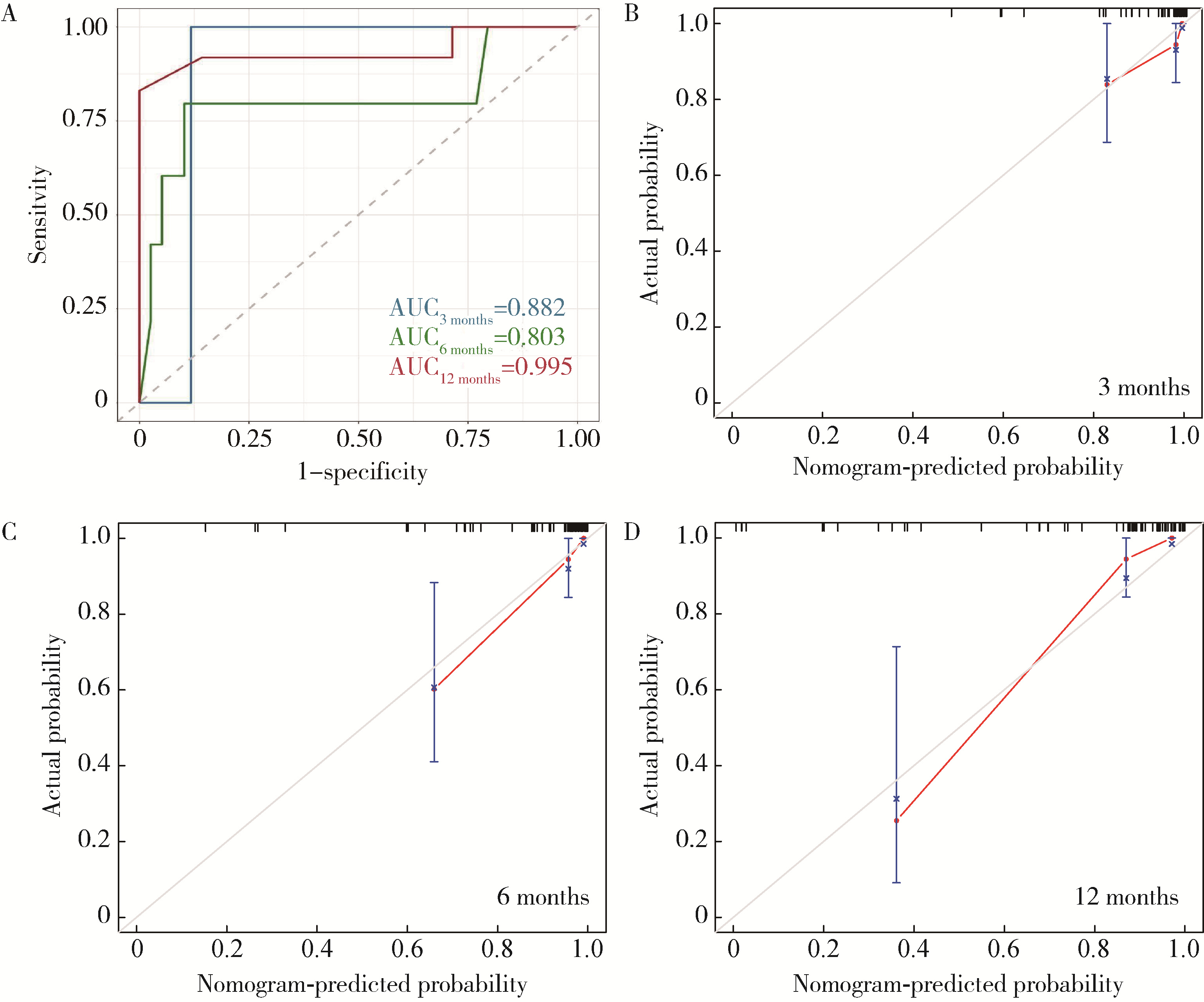
Abstract: Objective: To identify the risk factors associated with the development of post-Nuss procedure scoliosis in pectus excavatum patients and to establish a relevant predictive model. Methods: A retro-spective review was conducted on pectus excavatum patients who underwent Nuss procedure in Department of Thoracic Surgery at Beijing Jishuitan Hospital between January 2018 and February 2023. We gathered the patient demographic information (including age, sex, height, weight, and body mass index) and diagnostic imaging results (echocardiogram, chest CT scan, full-spine radiography, and PA/lateral chest X-rays), and measurements of Haller index, asymmetry index, sternal torsion angle (STA) index, and Cobb angle changes. The risk of post-Nuss procedure scoliosis was assessed. Cox regression analysis was performed to identify independent risk factors for scoliosis development in the pectus excavatum patients. Based on the results of the Cox regression analysis, a risk prediction model was established, and its specific predictive performance was assessed through internal cross-validation. Results: A total of 59 pectus excavatum patients who underwent Nuss procedure were included after applying inclusion and exclusion criteria. The median follow-up duration was 6.84 months, and the follow-up results showed significant improvements in Haller index, STA index, and asymmetry index postoperatively. Twelve patients developed scoliosis 3 months after Nuss procedure, while 47 patients did not, the incidence of scoliosis was 20.3%. Cox regression analysis identified preoperative pulmonary artery hypertension and preoperative asymmetry index as independent risk factors for post-Nuss procedure scoliosis. A predictive model was constructed based on single-factor Cox regression analysis results, incorporating age, height, weight, body mass index, preoperative pulmonary artery hypertension, preoperative Haller index, STA index, asymmetry index, and Cobb angle. The receiver operating characteristic (ROC) curve was plotted, and the area under the curve (AUC) for the overall predictive model was calculated to be 0.995. A calibration curve demonstrated good alignment between predicted values and actual values. Conclusion: Nuss procedure achieved favorable clinical outcomes. However, postoperative scoliosis emerged as a significant complication with a high incidence rate. Pulmonary artery hypertension and asymmetry index were independent predictors of post-Nuss procedure scoliosis. The predictive model developed in this study demonstrated robust performance in estimating the risk of postoperative scoliosis.

Key words: Pectus excavatum, Nuss surgery, Scoliosis, Risk factors, Nomograms

CLC Number: 

  • R655

Table 1

Baseline characteristics of pectus excavatum patients before Nuss procedure (n=59)"

Characteristics Values
Age/years, ${\bar x}$±s 16.0±3.99
Gender, n(%)
  Male 52 (88.1)
  Female 7 (11.9)
Height/cm, ${\bar x}$±s 134±8.71
Weight/kg, ${\bar x}$±s 38.3±8.15
Body mass index/(kg/m2), ${\bar x}$±s 20.0±2.36
Mitral valve prolapse, n(%) 3 (5.08)
Mitral regurgitation, n(%) 6 (10.2)
Tricuspid regurgitation, n(%) 1 (1.69)
Pulmonary artery hypertension, n(%) 4 (6.78)

Table 2

Radiographic parameter changes before and 3 months after Nuss procedure in pectus excavatum patients"

Radiographic parameters Before Nuss 3 months after Nuss P
Haller index, median (P25, P75) 3.20 (0.47, 5.35) 1.32 (0.18, 2.53) < 0.000 1
Sternal torsion angle index, median (P25, P75) 16.0 (5.75, 29.8) 11.8 (1.78, 21.6) < 0.000 1
Asymmetry index, median (P25, P75) 0.59 (0.33, 0.89) 0.32 (0.12, 0.48) < 0.000 1
Cobb angel, ${\bar x}$±s 7.16±2.45 8.86±3.20 0.001 6

Table 3

Univariate Cox regression analysis of factors associated with scoliosis in pectus excavatum patients after the Nuss procedure"

Variable HR (95%CI) β SE P
Age 1.19 (1.05-1.36) 0.18 0.07 0.010
Gender 0.00 (0.00-Infinity) -18.20 6 900.00 1.000
Height 1.07 (1.01-1.14) 0.07 0.03 0.040
Weight 1.10 (1.02-1.19) 0.10 0.04 0.020
BMI 0.67 (0.49-0.90) -0.40 0.15 0.010
Mitral valve prolapse 4.75 (0.54-41.64) 1.56 1.11 0.160
Mitral regurgitation 1.54 (0.34-7.04) 0.43 0.78 0.580
Pulmonary artery hypertension 17.08 (4.66-62.62) 2.84 0.66 < 0.001
Haller index 0.25 (0.14-0.43) -1.40 0.29 < 0.001
STA index 0.68 (0.58-0.80) -0.39 0.08 < 0.001
Asymmetry index 0.00 (0.00-0.00) -19.70 4.30 < 0.001
Cobb angle 0.41 (0.28-0.61) -0.89 0.20 < 0.001

Table 4

Multivariate Cox regression analysis of factors associated with scoliosis in pectus excavatum patients after the Nuss procedure"

Variable HR (95%CI) β SE P
Age 1.19 (0.96-1.48) 0.176 0.110 0.111
Height 1.09 (0.94-1.25) 0.083 0.073 0.259
Weight 1.04 (0.87-1.25) 0.040 0.092 0.664
BMI 1.13 (0.61-2.08) 0.119 0.313 0.704
Pulmonary artery hypertension 20.80 (1.37-314.00) 3.030 1.390 0.029
Haller index 39.9 (0.19-8 380) 3.690 2.730 0.177
STA index 0.47 (0.06-3.55) -0.749 1.030 0.466
Asymmetry index 1.8×10-54 (3.6×10-96-9.1×10⁻¹³) -124.000 49.000 0.011
Cobb angle 54.4 (0.31-9 650) 4.000 2.640 0.131

Figure 1

Establishment of a risk prediction model for scoliosis in pectus excavatum patients after the Nuss procedure A, B, forest plots showing the results of the multivariate Cox regression analysis, indicating that AI and PAH are key risk factors influencing postoperative scoliosis in patients; C, nomogram displaying the prediction model. BMI, body mass index; PAH, pulmonary arterial hypertension; STA, sternal torsion angle; AI, asymmetry index; Pr, prediction."

Figure 2

Validation of the risk prediction model for scoliosis in pectus excavatum patients after the Nuss procedure A, time-dependent receiver operating characteristic (ROC) curve at 3, 6, and 12 months evaluating the predictive performance of the overall prediction model on patient prognosis; B-D, calibration curves at 3, 6, and 12 months assessing the consistency between predicted and actual values respectively. AUC, area under the curve."

1
Scalise PN , Demehri FR . The management of pectus excavatum in pediatric patients: A narrative review[J]. Transl Pediatr, 2023, 12 (2): 208- 220.

doi: 10.21037/tp-22-361
2
Yoo G , Jeon HH , Rha EY , et al. The changes of distance between nipples following correction of women pectus excavatum[J]. Sci Rep, 2023, 12 (1): 20265.

doi: 10.1038/s41598-022-24768-4
3
Wang W , Long W , Liu Y , et al. Reoperation 10 years after Nuss procedure failed: Wung procedure combined with Wenlin procedure[J]. J Surg Case Rep, 2022, 2022 (12): rjac545.

doi: 10.1093/jscr/rjac545
4
Janssen N , Daemen JHT , Ashour O , et al. Nuss bar removal without straightening is a safe technique: A single center experience[J]. J Thorac Dis, 2022, 14 (9): 3335- 3342.

doi: 10.21037/jtd-22-725
5
Li H , Wang F , Ji G , et al. Modified Nuss procedure for the treatment of pectus excavatum: Experience of 259 patients[J]. Asian J Surg, 2023, 46 (2): 692- 697.

doi: 10.1016/j.asjsur.2022.06.080
6
Kuru P , Cakiroglu A , Er A , et al. Pectus excavatum and pectus carinatum: Associated conditions, family history, and postoperative patient satisfaction[J]. Korean J Thorac Cardiovasc Surg, 2016, 49 (1): 29- 34.

doi: 10.5090/kjtcs.2016.49.1.29
7
Araújo ME , Penha AD , Westphal FL , et al. Nuss procedure for pectus excavatum repair: Critical appraisal of the evidence[J]. Rev Col Bras Cir, 2014, 41 (6): 400- 405.

doi: 10.1590/0100-69912014006004
8
İşcanM, KılıçB, TurnaA, 等. The effect of minimally invasive pectus excavatum repair on thoracic scoliosis[J]. Eur J Cardiothorac Surg, 2020, ezaa328.
9
尚华, 张大, 杨林, 等. 漏斗胸Nuss矫形术对胸廓的影响及相关因素分析[J]. 中华小儿外科杂志, 2020, 41 (1): 42- 46.
10
梁林, 叶金铎, 王志芹, 等. Nuss手术矫正漏斗胸过程的数值模拟[J]. 生物医学工程与临床, 2011, 15 (4): 316- 321.
11
曹隽. 脊柱侧弯在漏斗胸矫正术中的形态改变及力学分析[D]. 北京: 首都医科大学, 2017.
12
Okuyama H , Tsukada R , Tazuke Y , et al. Thoracoscopic costal cartilage excision combined with the nuss procedure for patients with asymmetrical pectus excavatum[J]. J Laparoendosc Adv Surg Tech A, 2021, 31 (1): 95- 99.

doi: 10.1089/lap.2020.0312
13
Floccari LV , Sucato DJ , Ramo BA . Scoliosis progression after the nuss procedure for pectus excavatum: A case report[J]. Spine Deform, 2019, 7 (6): 1003- 1009.

doi: 10.1016/j.jspd.2019.01.009
14
Heydweiller AC , König TT , Yavuz ST , et al. Complications following metal bar removal after Nuss repair are rare in a duocentric retrospective evaluation[J]. Pediatr Surg Int, 2022, 38 (12): 1919- 1924.

doi: 10.1007/s00383-022-05250-8
15
Khairallah S , Chow OS , Mick SL . Combined minimally invasive repair of pectus excavatum and robotically assisted mitral valve repair: A case report and considerations[J]. J Card Surg, 2022, 37 (12): 5571- 5574.

doi: 10.1111/jocs.17070
16
Yi JH . Rastelli conduit change with the Nuss procedure for relieving compression of extracardiac conduit[J]. Eur J Cardiothorac Surg, 2022, 62 (5): ezac490.

doi: 10.1093/ejcts/ezac490
17
Park HJ , Park CB , Jeong JY . Bilateral tension pneumothoraxes in buffalo chest several months after Nuss procedure for pectus excavatum[J]. J Cardiothorac Surg, 2022, 17 (1): 314.

doi: 10.1186/s13019-022-02055-7
18
Chen HYM , Cheng WYR , Chan H , et al. Associated risk factors for patients undergoing a unique or double Nuss bar placement for pectus excavatum[J]. Asian Cardiovasc Thorac Ann, 2023, 31 (3): 221- 228.

doi: 10.1177/02184923221142165
19
Martin G , Canuet M , Rahli M , et al. Severe pre-capillary pulmonary hypertension associated with kyphoscoliosis: Description of 4 cases[J]. Respir Med Res, 2023, 84, 101034.
20
Li Q , Zeng F , Chen T , et al. Management of severe scoliosis with pulmonary arterial hypertension: A single-center retrospective case series study[J]. Geriatr Orthop Surg Rehabil, 2022, 13, 21514593221080279.

doi: 10.1177/21514593221080279
21
Sarwahi V , Borlack RE , Dworkin A , et al. Adolescent idiopathic scoliosis patients are at increased risk for pulmonary hypertension which reverses after scoliosis surgery[J]. Spine J, 2014, 14 (11): S153- S154.
22
Yang G , Deng X , Yang Y , et al. Simultaneous operative repair of pectus excavatum and concurrent congenital heart defects[J]. Interact Cardiovasc Thorac Surg, 2019, 28 (5): 783- 788.

doi: 10.1093/icvts/ivy294
23
曹隽, 张学军, 曾骐, 等. Nuss手术治疗漏斗胸患儿合并特发性脊柱侧弯的临床研究[J]. 临床小儿外科杂志, 2019, 18 (1): 13- 17.
24
Lotfi N , Chauhan GS , Gardner A , et al. The relationship between measures of spinal deformity and measures of thoracic trunk rotation[J]. J Spine Surg, 2020, 6 (3): 555- 561.

doi: 10.21037/jss-20-562
25
Li H , Jin X , Fan S , et al. Behavioural disorders in children with pectus excavatum in China: A retrospective cohort study with propensity score matching and risk prediction model[J]. Eur J Cardiothorac Surg, 2019, 56 (3): 596- 603.

doi: 10.1093/ejcts/ezz038
26
王丹, 沈明月. 胸腔镜下小儿漏斗胸矫形术后并发症风险预测模型的构建和验证[J]. 中国妇幼保健, 2022, 37 (1): 84- 86.
[1] Xiaoyong YANG, Fan ZHANG, Lulin MA, Cheng LIU. Clinical characteristics and influencing factors of extraglandular invasion of prostatic ductal adenocarcinoma [J]. Journal of Peking University (Health Sciences), 2025, 57(5): 956-960.
[2] Wei LIU, Wen GUO, Zhe GUO, Chunyan LI, Yunlong LI, Siqi LIU, Liang ZHANG, Hui SONG. Risk factors associated with non-radiographic bone erosion in patients with gout [J]. Journal of Peking University (Health Sciences), 2025, 57(4): 735-739.
[3] Mengxi LU, Qiuping LIU, Tianjing ZHOU, Xiaofei LIU, Yexiang SUN, Peng SHEN, Hongbo LIN, Xun TANG, Pei GAO. Association of triglyceride-glucose index and cardiovascular disease in a community-based Chinese cohort [J]. Journal of Peking University (Health Sciences), 2025, 57(3): 430-435.
[4] Huaqiu GUO, Zhe WANG, Xue YANG, Jie BAI. Clinical features and risk factors of patients with oral bleeding in dental emergency [J]. Journal of Peking University (Health Sciences), 2025, 57(1): 142-147.
[5] Minting DENG, Nan WANG, Bin XIA, Yuming ZHAO, Junxia ZHU. Factors associated with spontaneous re-eruption of traumatically intruded permanent anterior teeth in children and adolescents [J]. Journal of Peking University (Health Sciences), 2025, 57(1): 148-153.
[6] Yukai LI, Hongyan WANG, Liang LUO, Yun LI, Chun LI. Clinical significance of antiphospholipid antibodies in Behcet disease with thrombosis [J]. Journal of Peking University (Health Sciences), 2024, 56(6): 1036-1040.
[7] Yang TIAN, Yongzheng HAN, Jiao LI, Mingya WANG, Yinyin QU, Jingchao FANG, Hui JIN, Min LI, Jun WANG, Mao XU, Shenglin WANG, Xiangyang GUO. Incidence and risk factors of postoperative epidural hematoma following anterior cervical spine surgery [J]. Journal of Peking University (Health Sciences), 2024, 56(6): 1058-1064.
[8] Mingrui WANG, Jinhui LAI, Jiaxiang JI, Xinwei TANG, Haopu HU, Qi WANG, Kexin XU, Tao XU, Hao HU. Risk factors for decreased quality of life in patients with kidney stones predicted by the Chinese version of Wisconsin stone quality of life questionnaire [J]. Journal of Peking University (Health Sciences), 2024, 56(6): 1069-1074.
[9] Yuanmei LIU, Yicheng FU, Jingxin HAO, Fuchun ZHANG, Huilin LIU. Construction and validation of a nomogram for predicting in-hospital postoperative heart failure in elderly patients with hip fracture [J]. Journal of Peking University (Health Sciences), 2024, 56(5): 874-883.
[10] Zhicun LI, Tianyu WU, Lei LIANG, Yu FAN, Yisen MENG, Qian ZHANG. Risk factors analysis and nomogram model construction of postoperative pathological upgrade of prostate cancer patients with single core positive biopsy [J]. Journal of Peking University (Health Sciences), 2024, 56(5): 896-901.
[11] Ye YAN,Xiaolong LI,Haizhui XIA,Xuehua ZHU,Yuting ZHANG,Fan ZHANG,Ke LIU,Cheng LIU,Lulin MA. Analysis of risk factors for long-term overactive bladder after radical prostatectomy [J]. Journal of Peking University (Health Sciences), 2024, 56(4): 589-593.
[12] Zezhen ZHOU,Shaohui DENG,Ye YAN,Fan ZHANG,Yichang HAO,Liyuan GE,Hongxian ZHANG,Guoliang WANG,Shudong ZHANG. Predicting the 3-year tumor-specific survival in patients with T3a non-metastatic renal cell carcinoma [J]. Journal of Peking University (Health Sciences), 2024, 56(4): 673-679.
[13] Yan CHEN,Kuangmeng LI,Kai HONG,Shudong ZHANG,Jianxing CHENG,Zhongjie ZHENG,Wenhao TANG,Lianming ZHAO,Haitao ZHANG,Hui JIANG,Haocheng LIN. Retrospective study on the impact of penile corpus cavernosum injection test on penile vascular function [J]. Journal of Peking University (Health Sciences), 2024, 56(4): 680-686.
[14] Bo PANG,Tongjun GUO,Xi CHEN,Huaqi GUO,Jiazhang SHI,Juan CHEN,Xinmei WANG,Yaoyan LI,Anqi SHAN,Hengyi YU,Jing HUANG,Naijun TANG,Yan WANG,Xinbiao GUO,Guoxing LI,Shaowei WU. Personal nitrogen oxides exposure levels and related influencing factors in adults over 35 years old in Tianjin and Shanghai [J]. Journal of Peking University (Health Sciences), 2024, 56(4): 700-707.
[15] Jing HE,Zhongze FANG,Ying YANG,Jing LIU,Wenyao MA,Yong HUO,Wei GAO,Yangfeng WU,Gaoqiang XIE. Relationship between lipid metabolism molecules in plasma and carotid atheroscle-rotic plaques, traditional cardiovascular risk factors, and dietary factors [J]. Journal of Peking University (Health Sciences), 2024, 56(4): 722-728.
Viewed
Full text


Abstract

Cited

  Shared   
  Discussed   
No Suggested Reading articles found!