Journal of Peking University (Health Sciences) ›› 2025, Vol. 57 ›› Issue (2): 403-407. doi: 10.19723/j.issn.1671-167X.2025.02.030
Previous Articles Next Articles
Classical Sweet syndrome with multiple organ lesions by 18F-FDG PET/CT: A case report
Zhao CHEN, Yongkang QIU, Lei KANG△( )
)
- Department of Nuclear Medicine, Peking University First Hospital, Beijing 100034, China
CLC Number:
- R814.42
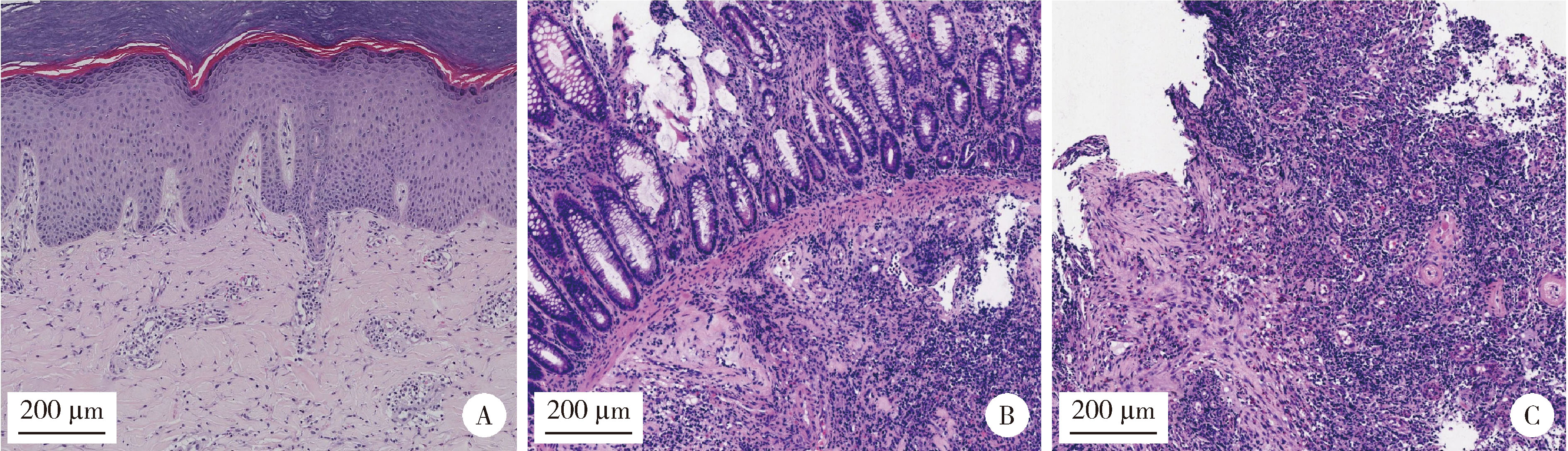
| 1 |
Raza S , Shahzad RS , Patel AA , et al. Insight into Sweet's syndrome and associated-malignancy: A review of the current literature[J]. Int J Oncol, 2013, 42 (5): 1516- 1522.
doi: 10.3892/ijo.2013.1874 |
| 2 | Ytting H , Vind I , Bang D , et al. Sweet's syndrome: An extra-intestinal manifestation in inflammatory bowel disease[J]. Digestion, 2005, 72 (2/3): 195- 200. |
| 3 |
Von D . Sweet's syndrome (acute febrile neutrophilic dermatosis)[J]. J Am Acad Dermatol, 1994, 31 (4): 535- 536.
doi: 10.1016/S0190-9622(94)70215-2 |
| 4 | Cohen PR . Sweet's syndrome: A comprehensive review of an acute febrile neutrophilic dermatosis[J]. Orphanet J Rare Dis, 2007, 34 (1): 1750- 1772. |
| 5 |
Neoh CY , Tan A , Ng SK . Sweet's syndrome: A spectrum of unusual clinical presentations and associations[J]. Br J Dermatol, 2007, 156 (3): 480- 485.
doi: 10.1111/j.1365-2133.2006.07677.x |
| 6 |
Hou TY , Chang DM , Gao HW , et al. Sweet's syndrome as an initial presentation in systemic lupus erythematosus: A case report and review of the literature[J]. Lupus, 2005, 14 (5): 399- 402.
doi: 10.1191/0961203305lu2083cr |
| 7 |
Schadt CR , Callen JP . Management of neutrophilic dermatoses[J]. Dermatol Ther, 2012, 25 (2): 158- 172.
doi: 10.1111/j.1529-8019.2012.01488.x |
| 8 |
Aydemir H , Oztoprak N , Celebi G , et al. Pulmonary and central nervous system involvement in Sweet's syndrome: A very rare case report[J]. Intern Med, 2008, 47 (16): 1481- 1484.
doi: 10.2169/internalmedicine.47.1115 |
| 9 | Ravaglia C , Poletti G , Gurioli C , et al. Sweet's syndrome asso-ciated with myelogenous leukemia and pulmonary involvement[J]. Monaldi Arch Chest Dis, 2011, 75 (2): 149- 150. |
| 10 |
Marie I , Boyer A , Heron F , et al. Focal aseptic osteitis under-lying neutrophilic dermatosis[J]. Br J Dermatol, 1998, 139 (4): 744- 745.
doi: 10.1046/j.1365-2133.1998.02482.x |
| 11 |
Li B , Ma Z , Xu X , et al. Multi-organ involvement of Sweet's syndrome: A case report and literature review[J]. Intern Med, 2015, 54 (3): 339- 343.
doi: 10.2169/internalmedicine.54.2755 |
| 12 |
Evans AV , Sabroe RA , Setterfield J , et al. Erythema elevatum diutinum/Sweet's syndrome overlap with gastrointestinal and oral involvement[J]. Br J Dermatol, 1999, 141 (4): 766- 767.
doi: 10.1046/j.1365-2133.1999.03140.x |
| 13 |
Notani K , Kobayashi S , Kondoh K , et al. A case of Sweet's syndrome (acute febrile neutrophilic dermatosis) with palatal ulceration[J]. Oral Surg Oral Med Oral Pathol Oral Radiol Endod, 2000, 89 (4): 477- 479.
doi: 10.1016/S1079-2104(00)70128-4 |
| 14 |
Rosen MJ , Dhawan A , Saeed SA . Inflammatory bowel disease in children and adolescents[J]. Jama Pediatr, 2015, 169 (11): 1053- 1060.
doi: 10.1001/jamapediatrics.2015.1982 |
| 15 | Beckers C , Ribbens C , Andre B , et al. Assessment of disease activity in rheumatoid arthritis with 18F-FDG PET[J]. J Nucl Med, 2004, 45 (6): 956- 964. |
| 16 |
Gontier E , Fourme E , Wartski M , et al. High and typical 18F-FDG bowel uptake in patients treated with metformin[J]. Eur J Nucl Med Mol Imaging, 2008, 35 (1): 95- 99.
doi: 10.1007/s00259-007-0563-6 |
| 17 | Nielsen I , Donati D , Strumia R , et al. Sweet's syndrome and malignancy: Report of the first case associated with adenocarcinoma of the lung[J]. Lung Cancer, 1993, 10 (1/2): 95- 99. |
| 18 |
Cohen PR , Kurzrock R . Sweet's syndrome and malignancy[J]. Am J Med, 1987, 82 (6): 1220- 1226.
doi: 10.1016/0002-9343(87)90229-4 |
| 19 | Liu D , Seiter K , Mathews T , et al. Sweet's syndrome with CML cell infiltration of the skin in a patient with chronic-phase CML while taking imatinib mesylate[J]. Leuk Res, 2004, 28 (Suppl 1): S61- S63. |
| 20 |
White JM , Mufti GJ , Salisbury JR , et al. Cutaneous manifestations of granulocyte colony-stimulating factor[J]. Clin Exp Dermatol, 2006, 31 (2): 206- 207.
doi: 10.1111/j.1365-2230.2005.01996.x |
| 21 |
Titulaer MJ , Soffietti R , Dalmau J , et al. Screening for tumours in paraneoplastic syndromes: Report of an EFNS task force[J]. Eur J Neurol, 2011, 18 (1): 19- e3.
doi: 10.1111/j.1468-1331.2010.03220.x |
| [1] | Doudou MA, Xiaocai MA, Tianjing CHANG, Lifang WANG, Yan DING, Lianjie SHI. Bone marrow infiltration of large B-cell lymphoma with clinical manifestations similar to systemic lupus erythematosus: A case report [J]. Journal of Peking University (Health Sciences), 2026, 58(3): 666-669. |
| [2] | Ye ZHAO, Xiaoli DIAO, Yan XIONG. Application of cell transfer technology in pathological diagnosis of micro-volume cell fluid [J]. Journal of Peking University (Health Sciences), 2026, 58(1): 208-213. |
| [3] | Yue WANG, Yuhong LIANG. Florid cemento-osseous dysplasia: A case report [J]. Journal of Peking University (Health Sciences), 2026, 58(1): 220-224. |
| [4] | Yanting CHI, Hongjie JIANG, Yan CHEN, Zhixiu XU, Binbin LI. Value of direct immunofluorescence in the diagnosis of oral mucosal pemphigus vulgaris: A retrospective study based on multi-index combined analysis [J]. Journal of Peking University (Health Sciences), 2026, 58(1): 68-73. |
| [5] | Jingyan GU, Xinyi LI, Jinxia ZHAO, Rong MU. Diabetic Charcot neuroarthropathy initially misdiagnosed as rheumatoid arthritis and gout: A case report [J]. Journal of Peking University (Health Sciences), 2025, 57(6): 1193-1197. |
| [6] | Xiaodi XIAO, Youchen XIA, Jianying LIU, Peng FU. Left sided sternocleidomastoid interosseous intravascular papillary endothelial hyperplasia: A case report [J]. Journal of Peking University (Health Sciences), 2025, 57(5): 1002-1004. |
| [7] | Xiangyu SUN, Chao YUAN, Xinzhu ZHOU, Jing DIAO, Shuguo ZHENG. Application of salivary micro-ecosystem in early prevention and control of oral and systemic diseases [J]. Journal of Peking University (Health Sciences), 2025, 57(5): 859-863. |
| [8] | Guangyan YU, Xin PENG, Min GAO, Peng YE, Na GE, Mengqi JIA, Bingyu LI, Zunan TANG, Leihao HU, Wenbo ZHANG. Research progress in diagnosis and treatment of salivary gland tumors [J]. Journal of Peking University (Health Sciences), 2025, 57(1): 1-6. |
| [9] | Yuanyuan FANG, Fan XU, Jie LEI, Hao ZHANG, Wenyu ZHANG, Yu SUN, Hongxin WU, Kaiyuan FU, Weiyu MAO. Development and validation of a clinical automatic diagnosis system based on diagnostic criteria for temporomandibular disorders [J]. Journal of Peking University (Health Sciences), 2025, 57(1): 192-201. |
| [10] | Jialu CHE, Zichen LIU, Kun LI, Chen ZHANG, Nanying CHE. Clinical value of automated EasyNAT system for the diagnosis of tuberculosis in paraffin-embedded tissues [J]. Journal of Peking University (Health Sciences), 2024, 56(6): 1047-1051. |
| [11] | Xinxin CHEN, Zhe TANG, Yanchun QIAO, Wensheng RONG. Caries experience and its correlation with caries activity of 4-year-old children in Miyun District of Beijing [J]. Journal of Peking University (Health Sciences), 2024, 56(5): 833-838. |
| [12] | Hua ZHONG, Yuan LI, Liling XU, Mingxin BAI, Yin SU. Application of 18F-FDG PET/CT in rheumatic diseases [J]. Journal of Peking University (Health Sciences), 2024, 56(5): 853-859. |
| [13] | Zhengfang LI,Cainan LUO,Lijun WU,Xue WU,Xinyan MENG,Xiaomei CHEN,Yamei SHI,Yan ZHONG. Application value of anti-carbamylated protein antibody in the diagnosis of rheumatoid arthritis [J]. Journal of Peking University (Health Sciences), 2024, 56(4): 729-734. |
| [14] | Hai-hong YAO,Fan YANG,Su-mei TANG,Xia ZHANG,Jing HE,Yuan JIA. Clinical characteristics and diagnostic indicators of macrophage activation syndrome in patients with systemic lupus erythematosus and adult-onset Still's disease [J]. Journal of Peking University (Health Sciences), 2023, 55(6): 966-974. |
| [15] | Yan XIONG,Xin LI,Li LIANG,Dong LI,Li-min YAN,Xue-ying LI,Ji-ting DI,Ting LI. Evaluation of accuracy of pathological diagnosis based on thyroid core needle biopsy [J]. Journal of Peking University (Health Sciences), 2023, 55(2): 234-242. |
|
||