Journal of Peking University (Health Sciences) ›› 2025, Vol. 57 ›› Issue (4): 666-669. doi: 10.19723/j.issn.1671-167X.2025.04.006

Previous Articles     Next Articles

Experience summary of robot-assisted laparoscopic transplant nephrectomy

Qiming ZHANG1, Zebo CHEN2, Yu TIAN1, Dameng PAN1, Lei LIU1, Hongxian ZHANG1, Lei ZHAO1, Shudong ZHANG1, Lulin MA1,*(), Xiaofei HOU1,*()   

  1. 1. Department of Urology, Peking University Third Hospital, Beijing 100191, China
    2. Department of Urology, Yichang Central People's Hospital, Yichang 443000, Hubei, China
  • Received:2025-03-03 Online:2025-08-18 Published:2025-08-02
  • Contact: Lulin MA, Xiaofei HOU

RICH HTML


Abstract:

Objective: To review and summarize the experience of robot-assisted laparoscopic transplant nephrectomy, share the surgical steps and technical key points, and provide a reference for clinical practice. Methods: A retrospective analysis was conducted on the perioperative data of 5 patients who underwent robot-assisted laparoscopic donor nephrectomy at Peking University Third Hospital from August 2023 to December 2024. The surgical steps and key points were summarized. The continuous variables were described by medians(ranges). Results: A total of 5 patients were included in the analysis, of whom 2 were male and 3 were female. The median age of the patients was 37 (31-68) years. The median time from kidney transplantation to donor nephrectomy was 10 (3-22) years. The indications for donor nephrectomy included recurrent hematuria, abdominal pain, malignant tumor of the transplanted kidney, and recurrent infection with hydronephrosis of the transplanted kidney. The excised transplanted kidneys from all the 5 patients had a single renal artery and a single renal vein. The median operation time was 212 (145-351) min, the median blood loss was 300 (20-500) mL, and the median post-operative hospital stay was 7 (4-25) days. Only 1 patient experienced intraoperative complications, who experienced an external iliac artery injury during the operation and underwent suture repair. No patient died during the perioperative period. Postoperative pathological results showed that 3 patients had end-stage non-functional kidneys, 1 patient had BK virus-associated urothelial carcinoma, and 1 patient had chronic pyelonephritis with renal parenchymal atrophy. Conclusion: Robot-assisted laparoscopic transplant nephrectomy as a new surgical approach is feasible and safe. Compared with traditional open transplant nephrectomy, its advantage lies in the ability to directly observe and prioritize the management of the renal pedicle of the transplanted kidney, while completely freeing and removing the transplanted kidney outside the renal capsule. With the continuous accumulation of experience, this surgical technique is expected to become a powerful alternative to traditional open transplant nephrectomy.

Key words: Kidney transplantation, Transplants, Nephrectomy, Robotic surgical procedures

CLC Number: 

  • R692

Figure 1

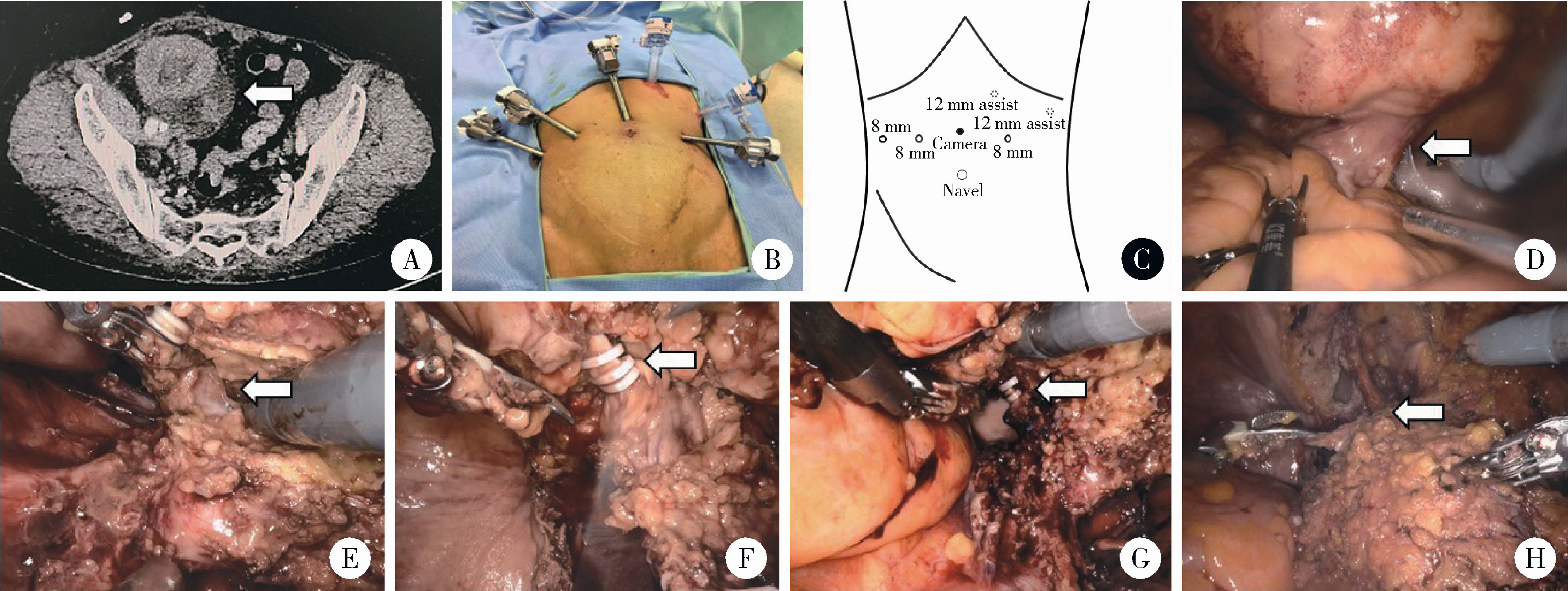
Preoperative imaging, trocar placement, and key surgical steps of robot-assisted laparoscopic transplant nephrectomy (right side as an example) A, preoperative imaging with the arrow indicating the transplanted kidney in right pelvic; B, C, example of trocar placement; D, the transplanted kidney was suspended in the extraperitoneal space, with the arrow indicating the anastomosis site between the renal pedicle and the iliac vessels; E, the arrow showed that the transplanted renal artery sheath was significantly thickened; F, the arrow showed that the transplanted renal artery was dissected and occluded with Hemolock clips, the blue vascular suture was visible at the anastomotic site; G, the arrow showed that the transplanted renal vein was dissected and occluded with Hemolock clips; H, the arrow showed that the ureter of transplanted kidney was dissected and occluded with Hemolock clips."

Table 1

Basic information of patients undergoing robot-assisted laparoscopic transplant nephrectomy"

Characteristics Case 1 Case 2 Case 3 Case 4 Case 5
Gender Male Female Female Female Male
Age/years 33 68 60 31 37
Body mass index/(kg/m2) 17.83 24.24 20.73 14.57 21.05
Duration since kidney transplant/years 3 18 22 10 6
Number of transplanted kidneys 1 1 1 1 Double kidney transplant, removal of the left transplanted kidney
Indications for transplant nephrectomy Recurrent hematuria and fever Recurrent hematuria Recurrent hematuria and abdominal pain Mass of transplant kidney Hydronephrosis with recurrent pyelonephritis
Operative time/min 351 220 212 150 145
Blood loss/mL 300 500 150 300 20
Postoperative stay of hospital/d 7 6 8 25 4
Perioperative complications Injury of the external iliac artery None None Cardiac failure and infection None
Conversion to open surgery No No No Yes No
Perioperative motality No No No No No
Pathological results End-stage nonfunctioning kidney End-stage nonfunctioning kidney End-stage nonfunctioning kidney BK virus-associated urothelial carcinoma Chronic pyelonephritis with renal parenchymal atrophy
1
de Castro Rodrigues Ferreira F, Cristelli MP, Paula MI, et al. Infectious complications as the leading cause of death after kidney transplantation: Analysis of more than 10 000 transplants from a single center[J]. J Nephrol, 30(4): 301- 606.
2
Gómez-Dos-Santos V, Lorca-Álvaro J, Hevia-Palacios V, et al. The failing kidney transplant allograft. Transplant nephrectomy: Current state-of-the-art[J]. Curr Urol Rep, 2020, 21(1): 4.
3
张启鸣, 侯小飞. 微创技术在肾移植中的应用[J]. 器官移植, 2022, 13(1): 38- 43.
4
Abdul-Muhsin HM, McAdams SB, Syal A, et al. Robot assisted renal allograft nephrectomy: Initial case series and description of technique[J]. Urology, 2020, 146, 118- 124.
5
McCabe M, Osinski T, Kashyap R, et al. Robotic assisted transplant nephrectomy: Case series and training model for improving adoption[J]. JSLS, 2023, 27(1): e2022.00079.
[1] Zonghan LI, Yangyue HUANG, Ning LI, Minglei LI, Hongcheng SONG, Weiping ZHANG, Chao LIU. Preliminary application of domestic single-port serpentine arm robotic surgical system in children's pyeloplasty [J]. Journal of Peking University (Health Sciences), 2025, 57(4): 662-665.
[2] Zezhen ZHOU, Liyuan GE, Fan ZHANG, Shaohui DENG, Ye YAN, Hongxian ZHANG, Guoliang WANG, Lei LIU, Yi HUANG, Shudong ZHANG. A retrospective matching study of partial nephrectomy and radical nephrectomy for pathological T3a stage renal cell carcinoma [J]. Journal of Peking University (Health Sciences), 2025, 57(4): 704-710.
[3] Shihao LIU, Liqing XU, Xinfei LI, Kunlin YANG, Zhaoying LI, Zibo ZHANG, Xiang WANG, Wei-xiao FU, Zhihua LI, Xuesong LI. Evaluation of the feasibility and safety of a Chinese developed modular surgical robotic system for robot-assisted pyeloplasty [J]. Journal of Peking University (Health Sciences), 2025, 57(4): 779-783.
[4] Huanrui WANG, Shicong LAI, Haopu HU, Zehua DING, Tao XU, Hao HU. Efficacy analysis of laparoscopy combined with flexible ureteroscope in the treatment of complex ureteral stricture [J]. Journal of Peking University (Health Sciences), 2025, 57(4): 784-788.
[5] Shuai LIU, Zhuo LIU, Yunhe GUAN, Guoliang WANG, Xiaojun TIAN, Hongxian ZHANG, Lei LIU, Lulin MA, Shudong ZHANG. Robot-assisted laparoscopic inferior vena cava segmental resection for renal tumor with tumor thrombus invading the vascular wall [J]. Journal of Peking University (Health Sciences), 2025, 57(4): 796-802.
[6] Zhao ZHAO, Weiyu ZHANG, Wenbo YANG, Yongjie ZHANG, Xiaopeng ZHANG, Huiying ZHAO, Gang ZHOU, Qiang WANG. Kidney transplantation in low-age, low-weight children: A report of two cases [J]. Journal of Peking University (Health Sciences), 2025, 57(4): 803-807.
[7] Handong DING, Qin WANG, Guiyi LIAO, Zongyao HAO. Diagnosis and treatment of gastrointestinal bleeding after kidney transplantation [J]. Journal of Peking University (Health Sciences), 2024, 56(5): 902-907.
[8] Kewei CHEN,Zhuo LIU,Shaohui DENG,Fan ZHANG,Jianfei YE,Guoliang WANG,Shudong ZHANG. Clinical diagnosis and treatment of renal angiomyolipoma with inferior vena cava tumor thrombus [J]. Journal of Peking University (Health Sciences), 2024, 56(4): 617-623.
[9] Jie YANG,Jieli FENG,Shudong ZHANG,Lulin MA,Qing ZHENG. Clinical effects of transesophageal echocardiography in different surgical methods for nephrectomy combined with Mayo Ⅲ-Ⅳ vena tumor thrombectomy [J]. Journal of Peking University (Health Sciences), 2024, 56(4): 631-635.
[10] Yicen YING,Yicong DU,Zhihua LI,Yiming ZHANG,Xinfei LI,Bing WANG,Peng ZHANG,Hongjian ZHU,Liqun ZHOU,Kunlin YANG,Xuesong LI. Robot-assisted laparoscopic ureteroplasty with buccal mucosa graft for complex ureteral stricture [J]. Journal of Peking University (Health Sciences), 2024, 56(4): 640-645.
[11] Wenbo YANG,Lei YU,Weiyu ZHANG,Tao XU,Qiang WANG. Effect and safety of self-draining ureteral stent with thread in kidney transplant reci-pients [J]. Journal of Peking University (Health Sciences), 2024, 56(4): 656-660.
[12] Fan SHU,Yichang HAO,Zhanyi ZHANG,Shaohui DENG,Hongxian ZHANG,Lei LIU,Guoliang WANG,Xiaojun TIAN,Lei ZHAO,Lulin MA,Shudong ZHANG. Functional and oncologic outcomes of partial nephrectomy for cystic renal cell carcinoma: A single-center retrospective study [J]. Journal of Peking University (Health Sciences), 2024, 56(4): 667-672.
[13] Min QIU,You-long ZONG,Bin-shuai WANG,Bin YANG,Chu-xiao XU,Zheng-hui SUN,Min LU,Lei ZHAO,Jian LU,Cheng LIU,Xiao-jun TIAN,Lu-lin MA. Treatment outcome of laparoscopic partial nephrectomy in patients with renal tumors of moderate to high complexity [J]. Journal of Peking University (Health Sciences), 2023, 55(5): 833-837.
[14] Quan ZHANG,Hai-feng SONG,Bing-lei MA,Zhe-nan ZHANG,Chao-hui ZHOU,Ao-lin LI,Jun LIU,Lei LIANG,Shi-yu ZHU,Qian ZHANG. Pre-operative prognostic nutritional index as a predictive factor for prognosis in non-metastatic renal cell carcinoma treated with surgery [J]. Journal of Peking University (Health Sciences), 2023, 55(1): 149-155.
[15] Wei ZUO,Fei GAO,Chang-wei YUAN,Sheng-wei XIONG,Zhi-hua LI,Lei ZHANG,Kun-lin YANG,Xin-fei LI,Liang LIU,Lai WEI,Peng ZHANG,Bing WANG,Ya-ming GU,Hong-jian ZHU,Zheng ZHAO,Xue-song LI. Trends in upper urinary tract reconstruction surgery over a decade based on a multi-center database [J]. Journal of Peking University (Health Sciences), 2022, 54(4): 692-698.
Viewed
Full text


Abstract

Cited

  Shared   
  Discussed   
No Suggested Reading articles found!